
… Lincoln is yet to be got vividly between the covers of a book. The Nicolay-Hay work is quite impossible; it is not a biography, but simply a huge storehouse of biographical raw materials; whoever can read it can also read the official Records of the Rebellion. All the other standard lives of old Abe — for instance, those of Lamon, Herndon and Weil, Stoddard, Morse and Miss Tarbell — fail still worse; when they are not grossly preachy and disingenuous they are trivial. So far as I can make out, no genuinely scientific study of the man has ever been attempted. The amazing conflict of testimony about him remains a conflict; the most elemental facts are yet to be established; he grows vaguer and more fabulous as year follows year. One would think that, by this time, the question of his religious views (to take one example) ought to be settled, but apparently it is not, for no longer than a year ago there came a reverend author Dr. William E. Barton, with a whole volume upon the subject, and I was as much in the dark after reading it as I had been before I opened it. All previous biographers, it appeared by this author’s evidence, had either dodged the problem, or lied. The official doctrine, in this as in other departments, is obviously quite unsound. One hears in the Sunday-schools that Abe was an austere and pious fellow, constantly taking the name of God in whispers, just as one reads in the school history-books that he was a shining idealist, holding all his vast powers by the magic of an inner and ineffable virtue. Imagine a man getting on in American politics, interesting and enchanting the boobery, sawing off the horns of other politicians, elbowing his way through primaries and conventions, by the magic of virtue! As well talk of fetching the mob by hawking exact and arctic justice! Abe, in fact, must have been a fellow highly skilled at the great democratic art of gum-shoeing. I like to think of him as one who defeated such politicians as Stanton, Douglas and Sumner with their own weapons — deftly leading them into ambuscades, boldly pulling their noses, magnificently ham-stringing and horn-swoggling them — in brief, as a politician of extraordinary talents, who loved the game for its own sake, and had the measure of the crowd. His official portraits, both in prose and in daguerreotype, show him wearing the mien of a man about to be hanged; one never sees him smiling. Nevertheless, one hears that, until he emerged from Illinois, they always put the women, children and clergy to bed when he got a few gourds of corn aboard, and it is a matter of unescapable record that his career in the State Legislature was indistinguishable from that of a Tammany Nietzsche.
But, as I say, it is hopeless to look for the real man in the biographies of him: they are all full of distortion, chiefly pious and sentimental. The defect runs through the whole of American political biography, and even through the whole of American history.
H.L. Mencken, “Roosevelt: An Autopsy”, Prejudices, part 2, 1920.
October 3, 2013
QotD: Biographies of Abraham Lincoln
September 30, 2013
Re-evaluating Neville Chamberlain
BBC News Magazine on the reputation of British PM Neville Chamberlain:
…this derogatory reference reflects the continuing potency of a well-established conventional wisdom assiduously propagated by Chamberlain’s detractors after his fall from the premiership in May 1940. As Churchill is once supposed to have quipped, “Poor Neville will come badly out of history. I know, I will write that history”.
In his influential account The Gathering Storm, published in 1948, Churchill characterised Chamberlain as “an upright, competent, well meaning man” fatally handicapped by a deluded self-confidence which compounded an already debilitating lack of both vision and diplomatic experience. For many years, this seductive version of events remained unchallenged and unchallengeable.
[…]
The Munich agreement, which later came to symbolise the evils of appeasement, was signed 75 years ago, in the early hours of 30 September. At Munich, Britain and France acquiesced in the dismemberment of Czechoslovakia and the transfer of its Sudeten region to Germany in face of Hitler’s increasingly bellicose threats of military action. Chamberlain’s hopes that this humiliating sacrifice would satisfy Hitler’s last major territorial demand and thus avert another catastrophic war were dashed within four months.
After this monumental failure of policy Chamberlain’s name became an abusive synonym for vacillation, weakness, immoral great-power diplomacy and, above all, the craven appeasement of bullies — whatever the price in national honour. Despite his many achievements in domestic policy, therefore, ultimately Chamberlain’s reputation remains indelibly stained by Munich and the failure of his very personal brand of diplomacy.
As he confessed in the Commons at the outbreak of war, “Everything I have worked for, everything that I have hoped for, everything that I have believed in during my public life, has crashed into ruins.”
September 27, 2013
The day World War III didn’t happen
In The Register, Iain Thomson takes us back to the depth of the Cold War, when it nearly turned very hot indeed:
Computer problems are an annoyance for us all, but thirty years ago a fault in the Soviet Union’s ballistic missile early warning system very nearly caused nuclear war, if not for the actions of Lieutenant Colonel Stanislav Petrov of the Soviet Air Defense Forces.
[…]
in the early hours of the morning on the September 26, there was panic when the Soviet early warning system Oko, a monitoring system of geostationary satellites and ground stations designed to spot ballistic missile launches, reported that the US had fired off a missile against the Soviet Union. Then four more launches were reported by the system in quick succession.
“An alarm at the command and control post went off with red lights blinking on the terminal. It was a nasty shock,” Petrov told Moscow News in 2004. “Everyone jumped from their seats, looking at me. What could I do? There was an operations procedure that I had written myself. We did what we had to do. We checked the operation of all systems — on 30 levels, one after another. Reports kept coming in: All is correct.”
Petrov, then the officer in command of the Oko system at a bunker near Moscow, had the responsibility of informing the Soviet high command in the event of a US missile launch. Although he didn’t have launch control of the USSR’s huge nuclear arsenal, he was the first responder, and given the scant minutes available in the event of a surprise attack, his word would most likely have been accepted by the Soviet leadership.
But Petrov didn’t make the call. He knew that the Oko system, which had only gone live the year before, was buggy. He also later described how logically such a move made no sense. While a first strike by the US wasn’t out of the question, if the capitalists were to do so they’d launch everything they had, not a few missiles at a time, he reasoned.
September 26, 2013
Charles Mingus
In The Nation, Adam Shatz looks back at the turbulent and creative career of Jazz giant Charles Mingus:
Mingus rarely left his pieces alone when he took them on the road with his Jazz Workshop, as he began calling his bands in the mid-1950s. When the Workshop played “Fables of Faubus,” a dart of sarcasm aimed at Arkansas’s segregationist governor Orval Faubus, at the Concertgebouw in Amsterdam, the jaunty eight-minute tune swelled into a half-hour suite, punctuated by tart allusions to “When Johnny Comes Marching Home” and “God Bless America” and a bass clarinet solo of blistering intensity by Eric Dolphy. (The performance is one of five concerts included in The Jazz Workshop Concerts 1964–65, a seven-disc boxed set on Mosaic Records.) In the studio, Mingus was always splicing, dicing and overdubbing, enriching the texture of his music, increasing its density. He tinkered with titles, giving old pieces new and sometimes cryptic names: the tender portrait of a woman he loved, “Nouroog,” reappeared after their breakup as “I X Love”; “Better Get It in Your Soul,” a foot-stomping gospel tune that’s still played on jukeboxes, became “Better Get Hit in Yo’ Soul,” a message to junkies that they’d be better off with a boost from the Lord than one from the needle.
Mingus was always true to his ever-changing moods: he wanted to create music that, in his words, was “as varied as my feelings are, or the world is.” For sheer range of expression, his work has few equals in postwar American music: furious and tender, joyous and melancholy, grave and mischievous, ecstatic and introspective. It moves from the rapture of the church to the euphoria of the ballroom, from accusation to seduction, from a whisper to a growl, often by way of startling jump cuts and sudden changes in tempo. Vocal metaphors are irresistible when discussing Mingus. As Whitney Balliett remarked, music for him was “another way of talking.”
Though he wrote only a few songs with lyrics, his compositions — and his own bass playing, which revealed new dimensions of the instrument and helped liberate it from its traditional time-keeping role — were supremely vocal. He collaborated with poets in East Village coffeehouses and never hesitated to call out to his sidemen when the spirit caught him, as if he was leading a gospel choir. Each instrument in a Mingus tune evoked the voice, invariably in conversation with other voices; and each voice was an extension of his famously tempestuous personality. (“We don’t need a vocalist,” he told the trombonist Britt Woodman. “This band can have an argument with instruments.”) Philip Larkin was astonished by “how every Mingus band sounds like a great rabble of players, like some trick of Shakespearian production.” No matter how small the ensemble, he could create a sense of passionate, often combative dialogue: as one of his sidemen put it, Mingus “liked the sound of a struggle.” If his Workshop settled into a groove, he would suddenly change the time signature: he didn’t want anyone to get too comfortable. Struggle — against complacency, against the confinements of race and genre, against the record industry and the American government — inspired him; he depended on it to create. Though he dreamed of finding refuge on some “colorless island,” it wasn’t clear how he’d spend his time there. He needed something to fight against; his anger, in Geoff Dyer’s words, was “a form of energy, part of the fire sweeping through him.”
September 22, 2013
QotD: The personal alienation of Karl Marx
Almost any Jew can be stateless, but Marx was particularly so — born of alien parents in a frontier region between Germany and France, educated in the Rhineland and in Prussia, a student at Berlin but a graduate of Jena, exiled by the age of thirty-two. Nor was this domicile chosen from any love of England or of anything but safety. He knew next to nothing of the English when he died, preferring to live among German exiles, talking German, thinking in German, and for preference writing in German. He knew of the toiling masses only from blue books and parliamentary reports. We hear nothing of his travels among the Lancashire cotton mills and as little of his talks with the London poor. There is no record of his visiting the coal mines, the docks, or even a public house. He was essentially homeless, offering no loyalty and expecting no aid. And with his scorn went hatred. He despised and loathed his rivals, quarreled with this allies and condemned all sympathizers who deviated even by a little from the doctrine he held to be sacred. Karl Marx had no country.
C. Northcote Parkinson, “Internal Contradiction”, Left Luggage, 1967.
September 21, 2013
QotD: True liberalism
The function of Liberalism in the past was that of putting a limit to the powers of kings. The function of true Liberalism in the future will be that of putting a limit to the powers of Parliament.
Herbert Spencer, The Man Versus the State, 1884.
September 16, 2013
British battlefields and the belated preservation effort
In History Today, Julian Humphrys talks about the late start in preserving and interpreting the battlefields in Britain:
Few would disagree that battles have played a significant part in Britain’s history. The Norman Conquest after the Battle of Hastings in 1066 caused enormous social, political and cultural change; De Montfort’s victory at Lewes in 1264 led to the earliest forerunner of Parliament; Bruce’s victory at Bannockburn in 1314 helped secure Scotland’s independence from England while the battles of the mid-17th century helped change both the roles of Crown and Parliament and the relationship between the component parts of the United Kingdom. Furthermore the reputations of many great leaders were forged on the battlefield: Cromwell’s victories, for example, gave him both the opportunity and the desire to intervene on the national political stage. But why preserve the battlefields?
Part of the answer lies in the ground itself. Battlefields may contain important topographical and archaeological evidence, which can help us understand the events that took place on their soil. Walk the boggy ground at the foot of the steep slopes of Branxton Hill at Flodden and you’ll quickly understand how in 1513 advancing blocks of Scottish pikemen lost cohesion and momentum and floundered to bloody defeat at the hands of the Earl of Surrey’s English billmen (see James IV: Renaissance Monarch). By locating the fall of shot through metal detecting, archaeological projects at Edgehill (1642), Naseby (1645) and Culloden (1746) have helped us learn more about the dispositions of the armies and the course of the battles, while at Bosworth (1485) it has finally unearthed the actual location of the fighting itself.
[…]
It is sometimes said that Britain lags behind the US, Belgium and parts of France in the care, interpretation and promotion of its battlefields. Many more British schools visit the Western Front than they do the battlefields of the Wars of the Roses or the Civil Wars. There are a dozen First World War museums in and around Ypres alone, headed by the award-winning ‘In Flanders Fields’ museum in the town’s restored Cloth Hall. There are numerous bunkers and preserved or reconstructed sections of trench, over a hundred British and Commonwealth cemeteries, and countless walking tours, self-drive tours, coach tours, cycle tours, even balloon tours to choose from.
Many American Civil War battlefields are carefully tended, painstakingly interpreted and bristling with memorials. The field of Gettysburg (1863) is administered by the US National Park Service; with a staggering 1,300 monuments it has been described as one of the largest collections of outdoor sculpture in the world. But perhaps all this is to be expected, for while its civil war remains America’s most costly conflict and was fought at home, Britain has done much of its fighting abroad. Mention battlefields to a Briton and the chances are they will initially think of somewhere overseas, notably Ypres or the Somme. The Great War was in many ways our national Calvary — the first time that anything more than a relatively small British army took part in a major war, suffering mass casualties as a result. Furthermore much of it was fought just across the Channel within reach of the British visitor, most of whom will know of relatives who fought there.
September 13, 2013
The Catalonian separation movement
If you’re not already enthralled by watching Canada’s separatist movement in Quebec or the Scottish independence campaign, there’s a potentially even more disruptive separation brewing in Spain. Tyler Cowen thinks it’s not getting as much media exposure as it deserves:
Personally, I am still waiting to hear why Catalonian independence would not bring the fiscal death knell of current Spain, and thus also the collapse of current eurozone arrangements and perhaps also a eurozone-wide depression. Otherwise I would gladly entertain Catalonia as an independent nation, or perhaps after the crisis has passed a referendum can be held. When referenda are held during tough times, it is often too easy to get a “no” vote against anything connected with the status quo.
Is the view simply that “now is the time to strike” and “it is worth it”? Obviously, an independence movement will not wish to speak too loudly about transition costs, but I would wish for more transparency. Or is the view that Spain could fiscally survive the shock of losing about twenty percent of its economy, with all the uncertainties and transition costs along the way? That could be argued, but frankly I doubt it, OMT or not, furthermore other regions would claim more autonomy too. An alternative, more moralizing view is that the fiscal problems are “Spain’s fault in the first place” and need not be discussed too much by the pro-independence side, but I am more consequentialist and marginal product-oriented than that.
This piece, in Catalan, does cover the fiscal implications of debt assumption for an independent Catalonia. The site also links to this somewhat spare piece by Gary Becker, but I still want more of a discussion of the issues raised above.
Keep in mind that two clocks are ticking. The first is that education in Catalonia is becoming increasingly “hispanicized,” the second is that as economic conditions in Spain improve, or maybe just become seen as a new normal, getting a pro-secession vote in a referendum may become harder. It doesn’t quite seem like “do or die” right now, but overall time probably is not on the side of Catalonian independence.
For those that assume Catalonia has always been part of Spain, Edward Hugh discusses why September 11 has been an important date in Catalonian history for nearly 300 years:
Catalonia was a party in the War of Spanish Succession (1701-1714), where the old crowns of Castile and Aragon fought, alongside their European allies, over who should be crowned as king of Spain following the death of Charles II. Catalonia, which favoured archduke Charles as successor, lost a war which ended with Europe recognising Philip V as the new king of Spain. The long war ended with a prolonged siege of Barcelona, Catalonia’s capital, which was systematically bombarded by Spanish troops fighting for the Bourbon candidate, Philip V. After months of resistance Barcelona finally surrendered on September 11 1714. Modern Spain was born, but Catalonia was to pay a heavy price for its support for the Austrian candidate: Catalan language was forbidden and Catalan institutions abolished. Every year, on September 11, Catalans commemorate the day on which Barcelona fell, honouring those killed defending the country’s laws and institutions.
September 12, 2013
Stirring up opposition to the Charter of Quebec Values
In Maclean’s, Paul Wells gives a bit of sovereigntist history and brings us up to date on the proposed Charter of Quebec Values:
When Bernard Drainville, another minister in today’s post-cosmopolitain PQ government, released the text of his proposed Charter of Values — complete with handy wall charts showing the articles of clothing (Veil! Kippah!) that will heretofore be banished from public servants’ bodies while at work — he had the handy effect of smoking out two federal party leaders who have been equivocal until now. The Liberal, Justin Trudeau, has opposed the charter since the PQ started putting up trial balloons nearly a month ago. The New Democrat, Thomas Mulcair, has most of his seats in Quebec, and had resisted comment until now. So, mostly, had the Prime Minister, Stephen Harper, although he did tip his hand when asked about the PQ plan in Toronto: “Our job is making all groups who come to this country, whatever their background, whatever their race, whatever their ethnicity, whatever their religion, feel home in this country and be Canadians. That’s our job.”
On Tuesday the trial balloons became official government policy. The NDP and Conservatives came out unequivocally against the PQ. Speaking for the government, Jason Kenney suggested a possible federal court challenge.
This, too, happens to be one of the tactical tricks Jean-François Lisée cooked up during the long years before he entered electoral politics. In his 2000 book Sorti de secours, Lisée suggested the PQ cook up some scheme that would be rejected by the rest of the country, so Quebecers would feel insulted and want to secede.
Such a plan would depend for its success on a clear distinction between Quebec public opinion and the actions of national parties. So far it’s not going well for the PQ. Mulcair and Trudeau are Quebecers whose parties hold 66 of the province’s 75 seats. The Bloc Québécois did not hurry to embrace Marois’s scheme. Every Montreal mayoral candidate opposes it, as does the Quebec Federation of Women.
The inspiration for the PQ’s decision to retrench is purely electoralist. It is a reaction to 30 years of failed efforts to make the sovereignty movement every Quebecer’s fight. Forced generosity having failed the PQ, the party is falling back on cynicism and pettiness. It’s make-or-break for the entire sovereignty movement, and I’m pretty sure Marois, Lisée and Drainville just broke it.
September 10, 2013
China’s historical model for naval strategy
At The Diplomat, James Holmes explains the odd fact that China is a “good citizen” in their coalition work with other countries fighting piracy away from home, but bullies its neighbours in the waters closer to home:
The analogy is the doctrine of “no peace beyond the line” practiced in late Renaissance Europe. To recap: in a nifty bit of collective doublethink, European rulers struck up a compact whereby nations could remain at peace in Europe, avoiding the hardships of direct conflict, while assailing each other mercilessly beyond a mythical boundary separating Europe from the Americas. In practice this meant they raided each other’s shipping and outposts in the greater Caribbean Sea and its Atlantic approaches.
It feels as though an inverse dynamic is at work in the Indo-Pacific theater. Naval powers cooperate westward of the line traced by the Malay Peninsula, Strait of Malacca, and Indonesian archipelago. Suspicions pockmarked by occasional confrontation predominate east of the South China Sea rim, a physical — rather than imaginary — line dividing over there from home ground.
A non-Renaissance European, Clausewitz, helps explain why seafaring powers can police the Gulf of Aden in harmony while feuding over the law of the sea in the East China Sea and South China Sea. It’s because the mission is apolitical. Counterpiracy is the overriding priority for the nations that have dispatched vessels to the waters off Somalia. Few if any of them have cross-cutting interests or motives that might disrupt the enterprise. It’s easy to work together when the partners bring little baggage to the venture.
[…]
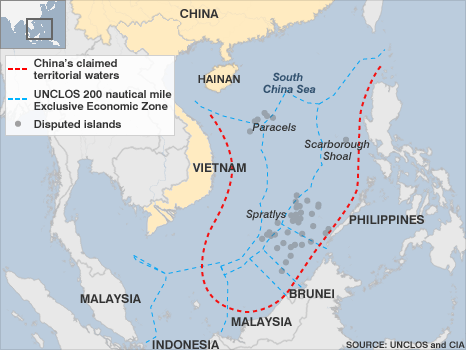
You see where I’m going with this. The expedition to the Gulf of Aden is an easy case. It proves a trivial result, namely that rivals can collaborate for mutual gain when they have the same interests in an endeavor. Now plant yourself in East Asia and survey the strategic terrain within the perimeter separating the Indian from the Pacific Ocean. China views the South China Sea, to name one contested expanse, not as a commons but as offshore territory. Indeed, Beijing asserts “indisputable sovereignty” there.
Such pretensions grate on Southeast Asian states, while the United States hopes to rally coalitions and partnerships to oversee the commons. But if Beijing is serious about the near seas’ constituting “blue national soil” — and our Chinese friends are nothing if not sincere — then outsiders policing these waters must look like invaders. How else would you regard foreign constables or armies roaming your soil — even for praiseworthy reasons — without so much as a by-your-leave?
QotD: Law-making
One might have expected that whether they observed the implication of these domestic failures, or whether they contemplated in every newspaper the indications of a social life too vast, too varied, too involved to be even vaguely pictured in thought, men would have entered on the business of law-making with the greatest hesitation. yet in this more than anything else do they show a confident readiness. Nowhere is there so astounding a contrast between the difficulty of the task and the unpreparedness of those who undertake it. Unquestionably among monstrous beliefs one of the most monstrous is that while for a simple handicraft, such as shoe-making, a long apprenticeship is needful, the sole thing which needs no apprenticeship is making a nation’s laws.
Herbert Spencer, The Man Versus the State, 1884.
September 8, 2013
QotD: What is Fascism?
Learned controversies, reverberating for years on end in American magazines, have not even been able to determine whether or not Fascism is a form of capitalism. But still, when we apply the term ‘Fascism’ to Germany or Japan or Mussolini’s Italy, we know broadly what we mean. It is in internal politics that this word has lost the last vestige of meaning. For if you examine the press you will find that there is almost no set of people — certainly no political party or organized body of any kind — which has not been denounced as Fascist during the past ten years. Here I am not speaking of the verbal use of the term ‘Fascist’. I am speaking of what I have seen in print. I have seen the words ‘Fascist in sympathy’, or ‘of Fascist tendency’, or just plain ‘Fascist’, applied in all seriousness to the following bodies of people:
Conservatives: All Conservatives, appeasers or anti-appeasers, are held to be subjectively pro-Fascist. British rule in India and the Colonies is held to be indistinguishable from Nazism. Organizations of what one might call a patriotic and traditional type are labelled crypto-Fascist or ‘Fascist-minded’. Examples are the Boy Scouts, the Metropolitan Police, M.I.5, the British Legion. Key phrase: ‘The public schools are breeding-grounds of Fascism’.
Socialists: Defenders of old-style capitalism (example, Sir Ernest Benn) maintain that Socialism and Fascism are the same thing. Some Catholic journalists maintain that Socialists have been the principal collaborators in the Nazi-occupied countries. The same accusation is made from a different angle by the Communist party during its ultra-Left phases. In the period 1930-35 the Daily Worker habitually referred to the Labour Party as the Labour Fascists. This is echoed by other Left extremists such as Anarchists. Some Indian Nationalists consider the British trade unions to be Fascist organizations.
Communists: A considerable school of thought (examples, Rauschning, Peter Drucker, James Burnham, F. A. Voigt) refuses to recognize a difference between the Nazi and Soviet régimes, and holds that all Fascists and Communists are aiming at approximately the same thing and are even to some extent the same people. Leaders in The Times (pre-war) have referred to the U.S.S.R. as a ‘Fascist country’. Again from a different angle this is echoed by Anarchists and Trotskyists.
Trotskyists: Communists charge the Trotskyists proper, i.e. Trotsky’s own organization, with being a crypto-Fascist organization in Nazi pay. This was widely believed on the Left during the Popular Front period. In their ultra-Right phases the Communists tend to apply the same accusation to all factions to the Left of themselves, e.g. Common Wealth or the I.L.P.
Catholics: Outside its own ranks, the Catholic Church is almost universally regarded as pro-Fascist, both objectively and subjectively;
War resisters: Pacifists and others who are anti-war are frequently accused not only of making things easier for the Axis, but of becoming tinged with pro-Fascist feeling.
Supporters of the war: War resisters usually base their case on the claim that British imperialism is worse than Nazism, and tend to apply the term ‘Fascist’ to anyone who wishes for a military victory. The supporters of the People’s Convention came near to claiming that willingness to resist a Nazi invasion was a sign of Fascist sympathies. The Home Guard was denounced as a Fascist organization as soon as it appeared. In addition, the whole of the Left tends to equate militarism with Fascism. Politically conscious private soldiers nearly always refer to their officers as ‘Fascist-minded’ or ‘natural Fascists’. Battle-schools, spit and polish, saluting of officers are all considered conducive to Fascism. Before the war, joining the Territorials was regarded as a sign of Fascist tendencies. Conscription and a professional army are both denounced as Fascist phenomena.
Nationalists: Nationalism is universally regarded as inherently Fascist, but this is held only to apply to such national movements as the speaker happens to disapprove of. Arab nationalism, Polish nationalism, Finnish nationalism, the Indian Congress Party, the Muslim League, Zionism, and the I.R.A. are all described as Fascist but not by the same people.
George Orwell, “What is Fascism?”, Tribune, 1944
September 7, 2013
QotD: Truth, rumour, and sketchy footnotes
In the Aeneid, Virgil wrote Fama, malum qua non aliud velocius alium, which tranlates as “Rumour, than whom no other evil thing is faster.” Fifteen centuries later, William Shakespeare expounded upon this at great length in Rumor’s prologue to Henry IV, part 2. Two centuries later, Jonathan Swift wrote “Falsehood flies, and the truth comes limping after it.” A century later C.H. Spurgeon said “Falsehood will fly from Maine to Georgia while truth is pulling her boots on,” but it would appear that he was quoting Fisher Ames, who said the same thing thirty years earlier.
Perhaps unhappy with having lifted the quote directly, in 1859 Spurgeon wrote “A lie will go ’round the world while the truth is pulling its boots on.” Eighty years or so after that, Winston Churchill slowed falsehood a bit, and then vastly improved the quote with a different article of clothing when he said “A lie gets halfway around the world before the truth has a chance to get its pants on.”
Within four hundred years, however, truth could not find the airlock. In a stroke of irony, the previous pedigree was lost, which means that not only did all copies of The Yale Book of Quotations go missing, but now falsehood spread throughout the galaxy while truth never left the house. Also, somebody deleted this footnote.
Howard Tayler, Schlock Mercenary, 2012-11-18
September 6, 2013
QotD: Risk-taking
This necessity for taking risks had previously been stressed by a passage in a letter written by James Wolfe when a colonel on the staff in 1757, a passage that has become justly famous:
Experience shows me that … pushing on smartly is the road to success; that nothing is to be reckoned an obstacle to your undertaking which is not found really so upon trial; that in war something must be allowed to chance and fortune, seeing it is in its nature hazardous and on option of difficulties; that the greatness of an object should come under consideration as opposed to the impediments that lie in the way; that the honour of one’s country is to have some weight; and that in particular circumstances and times the loss of a thousand men is rather an advantage to a nation than otherwise, seeing that gallant attempts raise its reputation and make it respected; whereas the contrary appearance sink the credit of a country, ruin the troops, and create infinite uneasiness and discontent at home.
General Robert E. Lee puts it in fewer words:
There is always hazard in military movements, but we must decide between the possible loss from inaction and the risk of action.
Napoleon laconically brings out the same basic idea:
Shuffling half-measures lose everything in war.
Lt. Colonel Alfred H. Burne, “The Strands of War”, The Art of War on Land, 1966.


