
Forgotten Weapons
Published 8 Aug 2022The Browning High Power story begins with a French 1921 request for a new military pistol. FN engineer Dieudonné Saive developed a double stack, single feed magazine and John Browning adapted a Browning 1903 pistol to use it, and this was sent to France for consideration. This pistol worked well enough, but the French trials board requested changes … and they would continue requesting changes and more trials for the next decade.
By 1931, FN felt that the current iteration of the pistol — while still not meeting all the French requirements — was good enough to stand on its own as a service pistol for the Belgian Army and other clients. They named it the “Grand Rendement” (High Efficiency) and began marketing it. The Belgian Army showed a definite interest, and bought 1,000 pistols for field trials, based on the prototype example we have in today’s video. These would become the Grande Puissance, aka the High Power.
For more details on this and other FN Browning pistols, I highly recommend Anthony Vanderlinden’s FN Browning Pistols, soon to be released in its third edition:
December 12, 2022
Before the High Power was the FN Grand Rendement
QotD: Oversensitivity is not constrained by the mere passage of time
This newspaper lost its editor-in-chief and guiding light to academia a few weeks ago, and we — you know, the talent! — are all still moping. Meanwhile, however, the job is open, and is being publicly advertised. The pay is pretty good, but if you are thinking of applying, you should really be conscious of what a top editor has to deal with these days. BBC News provided a good example on Wednesday, offering a brief account of a controversy at the Teesdale Mercury, a rural paper in princely, scenic County Durham. (The county called Durham in England, that is.)
It seems a reader of the Mercury ran across a brief news item about the suicide of a 16-year-old girl in its pages, and was horrified at the sensational, detailed nature of the report. The story described Dorothy Balchin as being “of a reserved and morbid disposition” and described the romantic disappointment — a beau’s emigration to Australia — that preceded her suicide. The newspaper noted that a photograph of her boyfriend was found immediately below her hanged body, and even printed the text of two notes she left. In other words, the news copy broke every rule that newspapers now normally observe in mentioning suicide.
But of course no one had thought of any of those rules in the year 1912.
Which is when the story had appeared in the Mercury.
Which didn’t stop some reader from complaining to the paper in the year 2019.
Colby Cosh, “Want a newspaper job? Dream of making films? Be careful what you wish for”, National Post, 2019-05-09.
December 11, 2022
An Amphibious Landing to take Rome? – 224 – December 10, 1943
World War Two
Published 10 Dec 2022There are plans afoot to hit the enemy from behind in Italy. Allied leaders are meeting again in Cairo to go over other plans, notably what to do about China and Burma. There is active fighting on two fronts in Italy too, though this week it doesn’t go particularly well for the Allies. Attacks in the USSR are unsuccessful for the Soviets, but do go well for the Germans, and there are Allied attacks by air in the Marshall Islands and over France.
(more…)
Winter of Discontent 2, non-electric boogaloo?
Matt Goodwin sets the stage for Britain’s potential re-run of the “Winter of Discontent”. By chance, I happened to be in England for a few weeks smack-dab in the middle of the worst of that winter, so although I was not following the news at the time, the physical and emotional state of the country struck me very deeply. There certainly are strong similarities between late 1970s Britain and post-pandemic Britain:
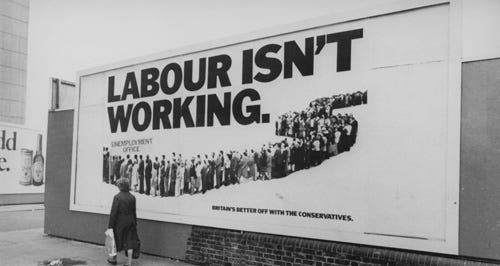
Conservative Party election poster, 1979.
Britain is entering a Winter of Discontent. If you are in the country and plan to take a train, a bus, a flight, a driving test, travel on the highway, send a letter, have a beer, go to school or university, need an ambulance to take you to hospital, need a nurse to look after you while you are in hospital or want to buy a coffin in case things do not go so well while you are in hospital then there is more than a good chance you will be caught up in a wave of strikes that are sweeping across the country.
More than one million working days are about to be lost due to strike action, the largest number since 1989. This is nowhere near the twelve million days that were lost in the original Winter of Discontent, in 1978-9, or the 126 million days lost during the general strike in 1926. But it is more than enough to cause yet another problem for Rishi Sunak and the faltering Conservative Party he is struggling to turn around.
As I pointed out in the Sunday Times last week, while Sunak has stabilised his party it remains deeply unpopular in the country. Even before this winter, voters blame the Tories far more than global events for Britain’s deteriorating economy. One legacy of Partygate and the disastrous experiment with Trussonomics is that Sunak has inherited a party that is now seen by much of the electorate as untrustworthy, serving its own interests, in the hands of a narrow elite and out of touch. Today, not even one in ten voters think the Conservatives “care about ordinary people”.
What options does Sunak have? While he and his team will be tempted to recycle the Thatcher playbook from the original Winter of Discontent, blaming the unions for the strikes and trying to appeal to national unity, this time things are more complicated. For a start, large numbers of voters actually support the strikes, which reduces Sunak’s room for manoeuvre. Second, this time it is the Conservatives not Labour who are in power, and are being blamed just as much as the unions for the unfolding chaos. Every train that is missed, every flight that is cancelled, every hospital patient that is not looked after will entrench the party’s negative image. And, third, as I said during an after dinner talk to clients of a major law firm this week, irrespective of what happens in the weeks ahead research on the impact of major strikes tells a consistent story: they hurt incumbent governments, lowering their support at the next election.
In fact, this might explain why the Rishi recovery already appears to be running out of steam. As I pointed out on Twitter this week, since taking over Sunak has certainly managed to increase his party’s average share of the vote from 23 to 27 per cent while Labour’s average lead in the polls has dropped from thirty to twenty points. And when voters are asked who would make the “best prime minister”, Sunak is much closer to Starmer, trailing him by only 5-points, than Liz Truss ever was, who trailed him by 29-points. But the Conservatives remain a long, long way behind. Just how far behind was underlined by a by-election in Chester this week which saw the party’s vote crash by sixteen points. The last time this happened at a by-election in a Labour-held seat was in the 1990s, shortly before the Blair asteroid almost rendered the Tories extinct.
At a deeper level, however, this winter also looks set to entrench a much deeper mood among the British people which will also undermine the government. The strikes, the chaos, the mounting sense of crisis are all feeding a palpable feeling among voters that nothing really works in Britain anymore, that contrary to the populist mantra of the last decade nobody is in control.
How to Make A Christmas Cake – The Victorian Way
English Heritage
Published 30 Nov 2017Christmas is approaching so Mrs Crocombe is making a cake for Lord and Lady Braybrooke at Audley End House.
This traditional plum cake is based on a recipe by Charles Francatelli, who was Queen Victoria’s chief cook from 1840 to 1841.
(more…)
December 10, 2022
United States Empire – The Spanish-American War
The Great War
Published 9 Dec 2022The Spanish-American War (fought in Cuba and the Philippines) kickstarted US global ambitions and expanded their influence far beyond the borders of the United States. At the same time the war marked the endpoint of the decline of Spain as a global power.
(more…)
The “Dark” Ages were fine, actually — History Hijinks
Overly Sarcastic Productions
Published 5 Aug 2022Curb your Crusading – the artwork, literature, and scholarship are far more interesting.
SOURCES & Further Reading: China: A History by John Keay, Byzantium & Sicily & Venice by John Julius Norwich, Great Courses Lecture series Foundations of Western Civilization by Thomas F. X. Noble lectures 27 through 38: “The Emergence of the Catholic Church”, “Christian Culture in Late Antiquity”, “Muhammad and Islam”, “The Birth of Byzantium”, “Barbarian Kingdoms in the West”, “The World of Charlemagne”, “The Carolingian Renaissance”, “The Expansion of Europe”, “The Chivalrous Society”, “Medieval Political Traditions I”, “Medieval Political Traditions II”, and “Scholastic Culture”.
(more…)
QotD: The Western Roman Empire – “decline and fall” or “change and continuity”?
With that out of the way, the old view, that of Edward Gibbon (1737-1794) and indeed largely the view of the sources themselves, was that the disintegration of the western half of the Roman polity was an unmitigated catastrophe, a view that held largely unchallenged into the last century; Gibbon’s great work, The History of the Decline and Fall of the Roman Empire (1789) gives this school its name, “decline and fall“. While I am going at points to gesture to Gibbon’s thinking, we’re not going to debate him; he is the “old man” of our title. Gibbon himself largely exists only in historiographical footnotes and intellectual histories; he is not at this point seriously defended nor seriously attacked but discussed as the venerable, but now out of date, origin point for all of this bickering.
The real break with that view came with the work of Peter Brown, initially in his The World of Late Antiquity (1971) and more or less canonically in The Rise of Western Christendom (1st ed. 1996; 2nd ed. 2003, 3rd ed. 2013). The normal way to refer to the Peter Brown school of thought is “change and continuity” (in contrast to the traditional “decline and fall”), though I rather like James O’Donnell’s description of it as the Reformation in late antique studies.
Among medievalists this reformed view, which focuses on continuity of culture and institutions from late antiquity to the early Middle Ages, remains essentially the orthodoxy, to the point that, for instance, the very recent (and quite excellent) The Bright Ages: A New History of Medieval Europe (2021) can present this vision as an uncomplicated fact, describing the “so-called Fall of Rome” and noting that “there was never a moment in the next thousand years in which at least one European or Mediterranean ruler didn’t claim political legitimacy through a credible connection to the empire of the Romans” and that “the idea that Rome ‘fell’ on the other hand, relies upon a conception of homogeneity – of historical stasis … things changed. But things always change” (3-4, 12-3). As we’ll see, I don’t entirely disagree with those statements, but they are absolute to a degree that suggests there is no real challenge to the position. There have been a few cracks in this orthodoxy among medievalists, particularly the work of Robin Flemming (a revision, not a clear break, to be sure), to which we’ll return, but the cracks have been relatively few.
While some ancient historians also bought into this view, purchase there has always been uneven and seems, to me at least, now to be waning further. Instead, a process of what James O’Donnell describes as a “counter-reformation” (which he stoutly resists with his own The Ruin of the Roman Empire; O’Donnell is a declared reformer) is well underway, a response to the “change and continuity” narrative which seeks to update and defend the notion that there really was a fall of Rome and that it really was quite bad actually. This is not, I should note, an effort to revive Gibbon per se; it does not typically accept his understanding of the cause of this decline (and often characterizes exactly what is declining differently). Nevertheless, this position too is sometimes termed the “decline and fall” school. My own sense of the field is that while nearly all ancient historians will feel the need to concede at least some validity to the reformed “change and continuity” vision, that the counter-reformation school is the majority view among ancient historians at this point (in a way that is particularly evident in overview treatments like textbooks or the Cambridge Ancient History (second edition)). We’ll meet many of the core works of this revised “decline and fall” school as we go.
As O’Donnell noted in a 2005 review for the BMCR, the reformed school tends to be strongest in the study of the imperial east rather than the west (something that will make a lot of sense in a moment), and in religious and cultural history; the counter-reformation school is stronger in the west than the east and in military and political history, though as we’ll see, to that list must at this point now be added archaeology along with demographic and economic history, at which point the weight of fields tends to get more than a little lopsided.
Those are our two knights – the “change and continuity” knight and the “decline and fall” knight (and our old man Gibbon, long out of his dueling days). To this we must add the nitwit: a popular vision, held by functionally no modern scholars, which represents the Middle Ages in their entirety as a retreat from a position of progress during the Roman period which was only regained during the “Renaissance” (generally represented as a distinct period from the Middle Ages) which then proceeded into the upward trajectory of the early modern period. Intellectually, this vision traces back to what Renaissance thinkers thought about themselves and their own disdain for “medieval” scholastic thinking (that is, to be clear, the thinking of their older teachers), a late Medieval version of “this ain’t your daddy’s rock and roll!”
But almost every intellectual movement represents itself as a radical break with the past (including, amusingly, many of the scholastics! Let me tell you about Peter Abelard sometime); as historians we do not generally accept such claims uncritically at face value. For a long time, well into the 19th century, the Renaissance’s cultural cachet in Europe (and the cachet of the classical period where it drew its inspiration) shielded that Renaissance claim from critique; that patina now having worn thin, most scholars now reject it, positioning the Renaissance as a continuation (with variations on the theme) of the Middle Ages, a smooth transition rather than a hard break. At the same time, knowledge of developments within the Middle Ages have made the image of one unbroken “Dark Age” untenable and made clear that the “upswing” of the early modern period was already well underway in the later Middle Ages and in turn had its roots stretching even deeper into the period. It is also worth noting here, that the term “Dark Age” has to do with the survival of evidence, not living conditions: the age was not dark because it was grim, it was dark because we cannot see it as clearly.
The popular version of this idea continues, however, to have a lot of sway in the popular conception of the Middle Ages, encouraged by popular culture that mistakes the excesses of the early modern period for “medieval” superstition and exaggerates the poverty of the medieval period (itself essentialized to its worst elements despite being approximately a millennia long), all summed up in this graph:
We are mostly going to just dunk relentlessly on this graph and yet we will not cover even half of the necessary dunking this graph demands. We may begin by noting that in its last century, the Roman Empire was Christian, a point apparently missed here.
While that sort of vision is not seriously debated by scholars, it needs to be addressed here too, in part because I suspect a lot of the energy behind the “change and continuity” position is in fact to counter some of the worst excesses of this thesis, which for simplicity, we’ll just refer to as “The Dung Ages” argument, but also because assessing how bad the fall of the Roman Empire in the West was demands that we consider how long-lasting any negative ramifications were.
Bret Devereaux, “Collections: Rome: Decline and Fall? Part I: Words”, A Collection of Unmitigated Pedantry, 2022-01-14.

December 9, 2022
V-1: Hitler’s Deluded Revenge Plan – War Against Humanity 090
World War Two
Published 8 Dec 2022Japanese planes bomb Calcutta when it is still being crushed by the weight of the Bengali famine. Adolf Hitler and Albert Speer are obsessively trying to increase war production so Germany can begin launching its vengeance weapon against Britain. The wars of resistance continue across the Balkans with continued brutality and a new resistance force emerges in Italy.
(more…)
Caesar versus Cato
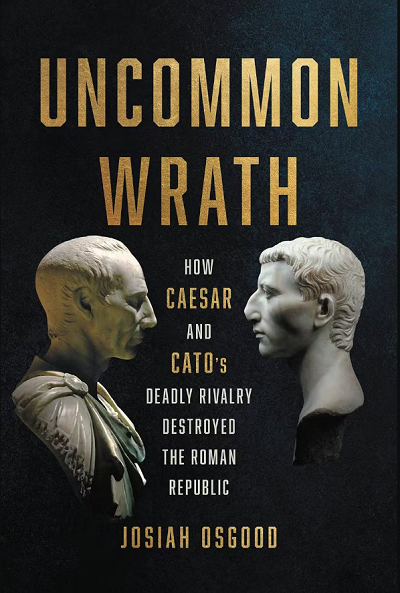
In The Critic, Daisy Dunn reviews Uncommon Wrath: How Caesar and Cato destroyed the Roman Republic by Josiah Osgood:
If there was one thing the Romans did well — aside from sanitation, irrigation and concrete — it was polemic. Cicero composed fourteen fiery Philippics against Mark Antony in the 40s BC, and Catullus jibed at Julius Caesar so profusely in his poems that he had to issue an apology. Less famous, but equally explosive, was Caesar’s own collection of vitriol. The Anticato survives today only in fragments, but according to an ancient satirist, it was originally so long that it took up two scrolls and almost outweighed the penis of Publius Clodius Pulcher, apparently among the best-endowed politicians in Rome.
Caesar wrote it shortly before he became dictator, with the intention of denigrating the memory of Marcus Porcius Cato, “Cato the Younger”. For years the two men had been locked in furious rivalry. Caesar blasted Cato as cold and miserly. Cato despaired at Caesar’s profligacy and tireless womanising. If Caesar was louche in his barely-belted toga and exotic unguents, Cato was positively austere — a prime hair-shirt candidate — with his bare feet, rustic diet, extreme exercise and strict sexual mores; it was most unusual for a Roman to make his wife the first woman he slept with.
Few would argue with Josiah Osgood, Professor of Classics at Georgetown, when he describes Caesar and Cato as opposites. Even Donald Trump and Joe Biden have more in common than they did. Caesar was the nephew of the wife of Gaius Marius, the populist enemy of Sulla, who as dictator had thousands of Italians proscribed and killed in his bid to restore the authority of the Senate. Cato could count Sulla as an old family friend. Caesar belonged to a well-established Roman family and claimed descent from Venus via her son Aeneas. Cato’s family was Sabine, and his most famous ancestor was a mere mortal in the shape of the plebeian writer and highly conservative statesman Cato the Elder.
The differences between Caesar’s and Cato’s personalities mattered because they reflected the differences in their visions for Rome. Osgood sums these up as “an empire wielding its power for the people” (Caesar) versus “a Senate protecting the people from the all-powerful empire builders” (Cato). It is little wonder they came to blows.
Osgood takes the tense relationship between Cato and Caesar as the central focus of his book. He argues that their feud has been overlooked as a contributing factor to the civil war that erupted in 49 BC and brought the Roman Republic crashing to the ground. Blame for this war has more usually been placed on the collapse of the First Triumvirate — an illegal alliance for power forged between Julius Caesar, Pompey the Great and Marcus Licinius Crassus in 60 BC — and the breakdown in relations between Caesar and Pompey in particular. But all wars have long-term and short-term causes. For Osgood, the dispute between Caesar and Cato was significant in at least the medium term.
Rod Bayonet Springfield 1903 (w/ Royalties and Heat Treat)
Forgotten Weapons
Published 20 Nov 2016(Note: I misspoke regarding Roosevelt’s letter; he was President at the time and writing to the Secretary of War)
The US military adopted the Model 1903 Springfield rifle in 1903, replacing the short-lived Krag-Jorgenson rifle. However, the 1903 would undergo some pretty substantial changes in 1905 and 1906 before becoming the rifle we recognize today. The piece in today’s video is an original Springfield produced in 1904, before any of these changes took place.
The most notable difference is the use of the rod bayonet. When the 1903 was in development, the Ordnance Department opined that the bayonet was largely obsolete, and that it was unnecessary to encumber soldiers with a long blade hanging from the belt. Instead, the new rifle would have a retractable spike bayonet that could double as cleaning rod and would be stored in the rifle stock, unobtrusive to the soldier. This ended in 1905 with a critical letter from Theodore Roosevelt (who was Secretary of War at the time). As the rod bayonet was replaced with a traditional blade bayonet, the cartridge would also be improved to a new style spitzer projectile at higher velocity, and the rifles’ stocks, hand guards, and sights were redesigned.
In this video I also discuss two often misunderstood elements of the Springfield’s history: heat treating and patent royalties. Are low serial number 1903 Springfields safe to shoot, and why or why not? And did the US government actually pay royalties to Germany for copying Mauser elements in the 1903?
(more…)
December 8, 2022
Is the Luftwaffe Defeated in 1943? – WW2 Documentary Special
World War Two
Published 7 Dec 2022Outnumbered and outproduced, the once mighty Luftwaffe is battling to hold its own across three fronts. Every month brings new pain for the force. But the Luftwaffe still has a few tricks up its sleeves and can make the Allies bleed heavily. If only Hitler and the Nazi leadership weren’t sabotaging its chances …
(more…)
Byzantine Honey Fritters
Tasting History with Max Miller
Published 26 Jul 2022
(more…)
December 7, 2022
The Marie Antoinette Diet
Tasting History with Max Miller
Published 6 Dec 2022
(more…)
Pearl Harbor: Before and After December 7th
Geographics
Published 20 Sep 2022
(more…)


