
Quotulatiousness

October 31, 2011

British constitutional quirk: Prince Charles has a limited veto over some legislation

Filed under: Britain, Government, History, Law — Tags: , — Nicholas @ 09:17

There are times when I think the British system of government compares poorly to that of Terry Pratchett’s Ankh-Morpork. This charming little hangover from medieval times, for instance:

Ministers have been forced to seek permission from Prince Charles to pass at least a dozen government bills, according to a Guardian investigation into a secretive constitutional loophole that gives him the right to veto legislation that might affect his private interests.

Since 2005, ministers from six departments have sought the Prince of Wales’ consent to draft bills on everything from road safety to gambling and the London Olympics, in an arrangement described by constitutional lawyers as a royal “nuclear deterrent” over public policy. Unlike royal assent to bills, which is exercised by the Queen as a matter of constitutional law, the prince’s power applies when a new bill might affect his own interests, in particular the Duchy of Cornwall, a private £700m property empire that last year provided him with an £18m income.

Neither the government nor Clarence House will reveal what, if any, alterations to legislation Charles has requested, or exactly why he was asked to grant consent to such a wide range of laws.
October 30, 2011

“That will be the Age of Great Confusion”

Filed under: Britain, Cancon, Randomness, USA — Tags: — Nicholas @ 12:23

Let’s get this out of the way right up front: the American habit of date notation is wrong, wrong, wrong:

An American, a Brit, and a Canadian schedule a business meeting for 02/04/12.

It sounds like the beginning of a joke, but here is how it plays out: The American plans for February 4, 2012. The Brit circles April 2, 2012 in his calendar. And the Canadian? Depends on who you ask.

Written in myriad sequences between slashes or dashes, dates cause what one mathematician calls “maximum confusion.” They cause us to miss meetings and unwittingly eat sour yogurt. They are so prone to mix-ups, in fact, that the International Organization for Standardization (ISO) made a declaration on the subject in 1988.

[. . .]

‘ISO 8601: Data Elements and Interchange Formats’ espouses year/month/day, abiding by the so-called big endian format, which orders the date from the largest element to the smallest (YYYY/MM/DD). Mr. Kramp chose this format for his bill. The ISO directive, embraced by the UN in its international trade protocols and by the European Union (although not by the individual countries), runs 33 pages.

[. . .]

And Canada, as Canadians will attest, is one of the worst culprits. Even the Canadian Payments Association, which regulates personal and business cheques, says it accepts day/month/year, month/day/year, and year/month/day, although it requires cheque producers to print guidance letters to clarify the sequencing.

[. . .]

Some measure of reprieve is around the corner: The year 2013 marks the end of what American mathematician Jim Blowers calls the “Age of Maximum Confusion.”

“After the year 2012, the year can no longer be confused with the month,” he noted on his blog. “But it can be confused with the day. That will be the Age of Great Confusion. For example, 07/11/13 could be 2007 November 13 or 2013 November 7, but not 2007 13-ember the 11th.”

This will go on, he wrote, until 2031, when the day cannot be confused with the month, although the month can still be confused with the day.

It makes sense to use big endian notation (biggest-to-smallest) or even little endian (smallest-to-biggest) but it makes no sense at all to mix up the sequence!

Using Pompeii as another stick to beat Berlusconi

Filed under: Europe, Government, History, Italy, Media — Tags: , , , , — Nicholas @ 11:48

Mary Beard debunks the widely reported story of yet another wall collapse in the archaeological remains of Pompeii:

By chance I am on the site of Pompeii for the weekend. It is now swarming with more journalists than tourists, and all (it seems) with a determination to hype another collapse, another Pompeian disaster. That is to say, they are here with a determined misunderstanding of what has just happened — or with a drive to use any damage to the site as a stick with which to beat Berlusconi.

Actually, I am usually quite happy to beat Berlusconi, but the fact is that this latest melodrama only serves to make the job much more difficult for those in the archaeological services here, who are doing their level best to keep the place up and running. (This weekend curators and other staff have been fielding tv crews, not getting on with the real job.)

So far as I can tell, what happened is this. There was an absolute downpour last night, in the course of which some stones were dislodged from a relatively fragile (and not very well built) stretch of wall near the Nola gate. A custode entered this damage rather loosely in the incident book — and (we can only speculate how and why) that report got to the press, and it soon became a new “wall collapse”. The carabinieri arrived and everything in the area (including, let me confess, where I want to go) was shut off.

Media folks are not trained archaeologists, so it’s easy to understand how a garbled report could be misunderstood — and that’s setting aside the urge to use any tool as a weapon against the current Italian prime minister. This is why media reports become less and less dependable as they try to report on more specific or more technical information: they lack the expertise and usually don’t take the time to get external experts to help them. (My favourite examples of this are when naval vessels larger than a rowboat are described as “battleships” and tracked military vehicles are invariably “tanks”.)

H/T to Tyler Cowen for the link.

October 28, 2011

Royal succession rule change

Filed under: Australia, Britain, Cancon, History, Law — Tags: , — Nicholas @ 09:20

Dedicated republicans, feel free to skip this item. Thanks to an agreement among the heads of government meeting at the Commonwealth meeting in Australia, the line of succession to the throne will now treat women equally:

Sons and daughters of any future UK monarch will have equal right to the throne, after Commonwealth leaders agreed to change succession laws.

The leaders of the 16 Commonwealth countries where the Queen is head of state unanimously approved the changes at a summit in Perth, Australia.

It means a first-born daughter of the Duke and Duchess of Cambridge would take precedence over younger brothers.

The ban on the monarch being married to a Roman Catholic was also lifted.

Under the old succession laws, dating back more than 300 years, the heir to the throne is the first-born son of the monarch. Only when there are no sons, as in the case of the Queen’s father George VI, does the crown pass to the eldest daughter.

October 26, 2011

When all the party leaders agree, it’s almost certainly a bad idea

Filed under: Britain, Government, Media, Politics — Tags: , , , — Nicholas @ 08:43

Mick Hume on the consistent refusal of British politicians to allow the electorate any choice on EU involvement:

When all of Britain’s elitist, unrepresentative and interchangeable political leaders unite behind an issue in the name of ‘the national interest’, it is a sure sign that something is amiss. Exhibit A: the united front presented by Tory prime minister David Cameron, his Lib Dem deputy Nick Clegg and opposition Labour leader Ed Miliband against the demand for a referendum on Britain’s relationship with the European Union. When this unappealing triumvirate is being cheered on by many in the high-minded media, alarm bells should really be ringing.

The official line from the Lib-Con government and the Labour opposition this week, as party leaders sought to marshal their MPs to vote against the parliamentary motion calling for an EU referendum, was that to have a national debate about the UK’s membership of the EU just now would not be in the national interest; it would be ‘a distraction’ from coping with Europe’s desperate economic and financial problems. As Cameron put in on the day of the vote, ‘it’s the wrong time to have this debate’ because ‘we’re in the middle of dealing with a crisis in the Eurozone’. A referendum now would be ‘rash’.

Turn that front-bench consensus on its head. It is precisely because of the parlous state of the Euro economy, and the paucity of solutions being offered by our rulers, that now is exactly the right time to have a major public debate on the future of the UK and Europe. The real ‘distraction’ that the Euro-elites fear today is democracy.

October 25, 2011

Gangs not to blame for London’s August riots

Filed under: Britain, Government, Media — Tags: , , , , , , — Nicholas @ 09:15

Brendan O’Neill debunks the widespread story that the August riots were either gang-led or pre-planned by gangsters:

In the aftermath of the riots, police, politicians and penmen all arrived at the same conclusion: gangs have taken over parts of England. Organised cliques of mask-wearing, territory-protecting youth, who divide themselves into ‘elders’, ‘soldiers’ and ‘youngers’, are turning bits of London and other English cities into something akin to south-central LA. These gangs orchestrated the violence, we’re told, as a way of staking their claim over local patches of land and warning off the ‘Feds’ (police). It is now apparently time, says David Cameron, for a war against ‘gang culture’.

There’s only one problem with these claims: they are complete and utter bunkum. No doubt gangs exist in some parts of urban England, and no doubt some of them are criminal. But there is no ‘gang culture’ and gangs were not responsible for the recent rioting in London and elsewhere. ‘Gang culture’ is almost entirely the imaginary creation of a political elite which prefers to fantasise that urban implosion is a product of gang conspiracies, rather than face up to the harsh reality that the riots were triggered by the twin crises of community solidarity and state authority.

[. . .]

Perusing the press, it was hard to tell if you were reading genuine reports about English cities or drafts for a movie about the life and times of 50 Cent. ‘Inside the deadly world of gangs’, screamed newspaper headlines, inviting readers to peer at these violent groups where new recruits as young as nine are referred to as ‘Tinies’ or ‘Babies’, while teenage members are known as ‘Soldiers’ and the overlords have the title ‘General’. Apparently there are 171 such gangs in London alone. Journalists write about being ‘embedded’ with the police, as if they’re in Iraq rather than England, and observing an ‘inner-city underworld’. This underworld exploded into the overworld two weeks ago, we’re told, when these military-style gangs ‘orchestrated’ looting through social media or by ‘laying on minibuses to ferry yobs into and around towns’.

[. . .]

Often, the hotheaded claims about Britain being overrun with hundreds of gangs simply do not stand up to scrutiny. So the Metropolitan Police claims there are 171 gangs in London, while the Home Office says there are 356 gang members in London. As one study pointed out, this would mean ‘around two people per gang’

October 19, 2011

Four year sentence for . . . posting an idiotic suggestion to Facebook

Filed under: Britain, Law, Liberty — Tags: , , , , , — Nicholas @ 08:54

Patrick Hayes attempts to point out that the sentence imposed on Facebook idiot Jordan Blackshaw is both disproportional and a clear and present danger to free speech rights in Britain:

Did you know that all it took for people to trash their own neighbourhoods this summer, such was the ‘collective insanity’ then gripping the UK, was for someone to suggest they do so on Facebook? A few words saying something like ‘let’s have a riot’ and, hey presto, off people went to have a riot.

This didn’t happen, of course. But it is a view of last August’s riots that seems to provide the rationale behind the sentencing of 20-year-old Jordan Blackshaw. This was the man, lest we forget, who on 9 August set up a Facebook ‘event’ entitled ‘Smash Down in Northwich town’. This hardly inspiring suggestion involved would-be rioters meeting up for said ‘smash down’ outside a local McDonald’s.

In explaining why Blackshaw was to receive a four-year jail sentence for doing nothing more than publishing words online, the judge claimed that ‘this happened at a time when collective insanity gripped the nation’. Blackshaw’s conduct, he continued, ‘was quite disgraceful and the title of the message you posted on Facebook chills the blood’. Yesterday, Blackshaw’s appeal against the harsh sentencing, alongside that of another ‘Facebook rioter’, was rejected by the Crown Court.

So, how many people responded to Blackshaw’s online suggestion during this period of ‘collective insanity’? The answer is one: Blackshaw himself. (He was immediately arrested). In fact, only nine of his 147 Facebook friends even responded online. Yet the reason for this collective no-show, at least as far as the judge was concerned, was ‘the prompt and efficient actions of police’ who eventually took Blackshaw’s Facebook page offline.

October 18, 2011

Politicians should stop lecturing us about our “obesity epidemic”

Filed under: Britain, Government, Health, Media — Tags: , , , — Nicholas @ 09:32

Rob Lyons in the Yorkshire Post:

I would argue that the obesity panic is greatly exaggerated, that the “cure” for it doesn’t work, and that it usually gets promoted by politicians who have no better way to justify their existence.

For starters, obesity rates have stopped rising for adults, and are actually falling for children. The latest figures from the Health Survey for England, the best source of information we have, show that in 2009, 22.1 per cent of men were obese — compared to 24.1 per cent in 2008; for women, the new figure was 23.9 per cent, as against 24.9 per cent in 2008.

In 2004, 19.4 per cent of boys aged two to 15 were regarded as obese; in 2009, that figure was down to 16.1 per cent. The equivalent figures for girls were 18.5 per cent (2004) and 15.3 per cent (2009).

Even then, what the medical profession regards as obesity and what we commonly recognise as obesity are two different things. About one in four adults is classed as obese.

Now, think about your workmates and friends. Would you really regard a quarter of them as obese? I’ll bet few of them match up to the typical picture that accompanies every story about obesity: a morbidly obese person, whose clothes are straining to hold in their tummies. Such very overweight people only make up about two per cent of the population.

In truth, distinctions between normal weight, overweight and obesity are pretty arbitrary lines, based on something called body mass index (BMI) — that’s your weight in kilos divided the square of your height in metres. BMI is not a particularly good predictor of health, except at the extremes. Those who are mildly obese have much the same life expectancy and health outcomes as those who are normal weight. Being a little underweight is almost certainly worse for you than being mildly obese.

October 17, 2011

It was “a moment of mass credulity on the part of the nation’s media”

Filed under: Britain, Media, Technology — Tags: , , , , , , , — Nicholas @ 12:59

Cory Doctorow points out that no “adult content” filter is a replacement for parental guidance and supervision:

Last week’s announcement of a national scheme to “block adult content at the point of subscription” (as the BBC’s website had it) was a moment of mass credulity on the part of the nation’s media, and an example of how complex technical questions and hot-button save-the-children political pandering are a marriage made in hell when it comes to critical analysis in the press.

Under No 10’s proposal, the UK’s major ISPs — BT, Sky, TalkTalk and Virgin — will invite new subscribers to opt in or out of an “adult content filter.” But for all the splashy reporting on this that dominated the news cycle, no one seemed to be asking exactly what “adult content” is, and how the filters’ operators will be able to find and block it.

Adult content covers a lot of ground. While the media of the day kept mentioning pornography in this context, existing “adult” filters often block gambling sites and dating sites (both subjects that are generally considered “adult” but aren’t anything like pornography), while others block information about reproductive health and counselling services aimed at GBLT teens (gay, bisexual, lesbian and transgender).

[. . .]

The web is vast, and adult content is a term that is so broad as to be meaningless. Even if we could all agree on what adult content was, there simply aren’t enough bluenoses and pecksniffs to examine and correctly classify even a large fraction of the web, let alone all of it (despite the Radio 4 newsreader’s repeated assertion that the new filter would “block all adult content”.)

What that means is that parents who opt their families into the scheme are in for a nasty shock: first, when their kids (inevitably) discover the vast quantities of actual, no-fooling pornography that the filter misses; and second, when they themselves discover that their internet is now substantially broken, with equally vast swathes of legitimate material blocked.

October 15, 2011

Chile upgrades their amphibious capabilities

Filed under: Americas, France, Military, Pacific — Tags: , — Nicholas @ 11:21

A brief item from the invaluable Strategy Page talks about Chile’s most recent naval acquisition:

Chile is buying the French amphibious ship Foudre, which is being replaced by a more recent design. The 12,000 ton Foudre has been in service for 21 years and could, with some refurbishment, serve another two decades or more. The 168 meter (521 feet) long ship has a crew of 160 and carries up to 70 vehicles. The well deck contains eight landing craft and there is a hangar that carries up to four helicopters. There are accommodations for 450 troops (or double that for short voyages). The Foudre can also be used as a command ship, which spaces for 150 headquarters personnel and their equipment.

Chile will use the Foudre to replace an 8,700 ton, 40 year old, American Newport class LPD. This ship was retired earlier this year, as it was considered too expensive to refurbish it. France has also offered Chile the second ship of the Foudre class, which is scheduled to retire from French service in a few years. The price of the Foudre to Chile has not been revealed. It will be cheap, and will depend on how much refurbishment French firms will undertake. Foudre undertook several long-distance operations during its career.

October 13, 2011

BBC’s Top Gear GPS deal violates BBC’s own rules

Filed under: Britain, Bureaucracy, Humour, Media — Tags: , , , , — Nicholas @ 09:04

Due to editorial rules, a Top Gear-branded GPS using Jeremy Clarkson’s voice will be withdrawn:

The BBC’s commercial arm, BBC Worldwide, will now will now donate all proceeds from the sales to Children In Need to bypass rules that prevent the show’s presenters endorsing motoring products.

The Top Gear satnav features Clarkson giving instructions in typically sardonic style — amusing for Top Gear fans, no doubt, but it may begin to grate on the 100th journey.

“Keep left — if you’re not sure which side left is you really shouldn’t be on the road,” he tells drivers.

“After 700 yards, assuming this car can make it that far, you have reached your destination, with the aid of 32 satellites and me — well done.”

The corporation’s commercial arm, BBC Worldwide, said no more of the Top Gear satnavs, made by TomTom, would be produced.

A plan to allow existing TomTom owners to download Clarkson’s voice to update their models has now been dropped.

Given how many people have complained about the default voices provided with their GPS units, I can see why adding Jeremy Clarkson’s dulcet tones to the mix could hardly have made the situation any worse.

The war on photography continues: Glasgow shopping mall front

Filed under: Britain, Bureaucracy, Liberty — Tags: , , , , — Nicholas @ 09:03

Nick Thorne recounts the over-reaction of mall security (and the local police) to an alleged incident of photography at the Braehead Shopping Centre in Glasgow:

It took a high-profile internet campaign to get a shopping-centre chain to reconsider its irrational photography policy. After security guards at Glasgow’s Braehead Shopping Centre stopped Chris White from taking a picture of his own four-year-old daughter, White set up a Facebook page called ‘Boycott Braehead’. In just three days it was ‘liked’ by over 20,000 people. Capital Shopping Centres has now announced that 11 of its malls will from now on allow family and friends to take pictures of each other.

So, parents can now take snaps of their kids eating ice cream, like White did, without worrying about security guards telling them they’re committing an offence, as White was told, or being taken away for questioning by cops who threaten to use anti-terror powers to take snappers’ cameras away, like an officer warned White. That’s splendid.

White’s Facebook campaign went viral and Braehead Shopping Centre was forced to apologise for its overreaction. Common sense won the day. But why was the photography policy implemented in the first place? And why was an innocent, everyday occurrence interpreted as a potentially dodgy, abusive incident?

A statement from the shopping centre explained that staff had become suspicious ‘after they saw a male shopper taking photographs of a child sitting at their counter’. The security guard who went over to investigate said that he had at no point been informed that the girl was White’s daughter. The automatic assumption, it seems, was that a man taking a picture of a child must be some sleazy scumbag.

October 12, 2011

Britain decides not to follow German lead on nuclear power

Filed under: Britain, Environment, Technology — Tags: , — Nicholas @ 07:55

Unlike their European partners, Britain will continue to depend on nuclear power to provide a large part of their electricity needs:

Britain breathed a collective sigh of relief yesterday. The question on everyone’s lips had been answered. Following the Fukushima accident in Japan, was it safe to continue using nuclear power here in the UK? The answer from chief nuclear inspector Mike Weightman and his team, who had spent months undertaking research, was ‘yes’.

Of course, that finding didn’t actually come as a shock to anyone. And not just because the interim report, published earlier in the year, had already made it clear that the UK nuclear-power industry could learn few new lessons from the accident in Japan — but also because you didn’t need a PhD in nuclear-reactor design to recognise the Fukushima disaster was a unique situation that arose in an area of the world prone to earthquakes and tsunamis with a different, older model of nuclear-power station than that used in the UK. A similar event would be highly unlikely here, or anywhere in Europe, and existing safety regulations are extremely tight. Furthermore, despite the full force of nature being thrown at the outdated Fukushima plant — an earthquake measuring 9.0 on the Richter scale leading to tsunami waves up to 40.5 metres high — the disaster was largely contained and, to date, not a single individual has died from the radiation that leaked out.

[. . .]

Despite their best attempts to win over new recruits, the tiny handful of aging anti-nuclear protesters saw no swell in numbers, no matter how they tried to draw comparisons between the European situation and the disaster in Japan. Despite holding vigils and undertaking stunts, such as releasing balloons outside a nuclear-power plant symbolising how many days it had been since the disaster, hardly any of their planned ‘wave of protests’ were deemed newsworthy or interesting.

Actually, UK public opinion has shifted in favour of nuclear power. The results of a Populus poll published last month revealed that 41 per cent of the population believed the benefits outweigh the risks, a three per cent increase on the previous year; 54 per cent wanted more nuclear-power stations or at least the replacement of existing stations with new ones. There was, in fact, an eight per cent drop (to 28 per cent) in people opposing nuclear power, compared to 2010.

October 11, 2011

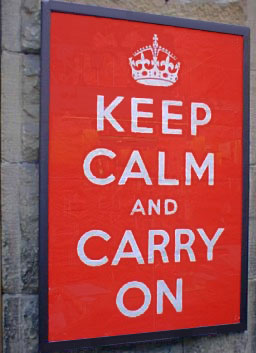
The famous British wartime poster that was never used

Filed under: Britain, History, Media, WW2 — Tags: , , — Nicholas @ 14:33

There’s a fascinating story posted at The Awl discussing the trademark battle over the famous “Keep Calm and Carry On” poster from the British Ministry of Information during World War 2. The most interesting part of the article, in my opinion, is that the poster was never used during the war:

The Keep Calm and Carry On poster was designed and produced by the British government in 1939 in advance of the war, but it was never displayed in a single English tube station or tobacconists or newsagents. Not one ordinary citizen ever saw it in the street before or during the war.



Of the 2.5 million posters originally printed, only a handful survived the war; all the rest were pulped. Exactly two copies are known to have made it into private hands. One of these is owned by Wartime Posters of Warrington, Cheshire. The other is Stuart Manley’s.

A very few more are held in government museums, such as the Imperial War Museum, whose website observes, “And remember the most important wartime tip of all: Keep Calm and Carry On.” Haha, not even! Hardly anyone had ever seen that thing before 2001!!

[. . .]

Early in 1939, it was clear that war was all but inevitable. The precursor organization to the Ministry of Information swung quietly into gear at that time, and began work on five million posters to plaster all over the place and improve citizen morale. Not everybody was on board with crafting public messaging before it was clear how things were going to shake out, but the dissenters were overruled and the project went forward.

But the war didn’t begin the way they expected. The period from late 1939 to early May of 1940 was known as the Phoney War because the Germans had invaded Poland with such a lot of Blitzkrieg that everyone in Britain and France expected pretty much the same thing for themselves. But that did not happen, and wags took to calling this period the Sitzkrieg and so on, and that went on until the Germans marched into France and the Low Countries. It took until autumn of 1940 for the London Blitz to begin.

Meanwhile, Sitzkrieg or no, the MoI was lumbering onward. The first two posters produced in 1939 were: “Your Courage, Your Cheerfulness, Your Resolution Will Bring Us Victory” and “Freedom is in Peril: Defend It With All Your Might.” Two and a half million of the third were printed. They read, “Keep Calm and Carry On,” and these last were held back in anticipation of the rain of bombs that was expected the moment war broke out. They were meant for a crisis that didn’t in the event occur. For that and a few other reasons, the British public never saw them.

October 9, 2011

Top Gear: Jeremy Clarkson’s tribute to the E-type Jaguar

Filed under: Britain, History, Technology — Tags: , , , — Nicholas @ 12:19

« Newer PostsOlder Posts »

Powered by WordPress