
Published on 30 Apr 2015
Completely underestimating the Ottoman army at the Dardanelles, the British commanders decide to let the ANZACs take the Gallipoli peninsular as a gateway to the Bosporus and Constantinople. After the landing in ANZAC Cove and on Z Beach one thing comes clear though: Mustafa Kemal and his troops will fight for every inch of this piece of rock.
May 1, 2015
The Sea Turns Red – Gallipoli Landings I THE GREAT WAR – Week 40
Comments Off on The Sea Turns Red – Gallipoli Landings I THE GREAT WAR – Week 40
April 29, 2015
How did Propaganda Change After the First Months of World War 1? I OUT OF THE TRENCHES
Published on 27 Apr 2015
Indy takes place in the chair of wisdom again to answer your questions. This week we deal with the outer ends of the Western Front, changes in propaganda and the logistics in the Carpathians.
Comments Off on How did Propaganda Change After the First Months of World War 1? I OUT OF THE TRENCHES
April 28, 2015
Professor: New UK railway signalling system is hackable … while he’s also selling anti-hacking gear
At The Register, John Leyden offers a bit of doubt that Professor David Stupples can really be said to be an impartial observer:
The rollout of a next generation train signalling system across the UK could leave the network at greater risk of hack attacks, a university professor has claimed.
Prof David Stupples warns that plans to replace the existing (aging) signalling system with the new European Rail Traffic Management System (ERTMS) could open up the network to potential attacks, particularly from disgruntled employees or other rogue insiders.
ERTMS will manage how fast trains travel, so a hack attack might potentially cause trains to move too quickly. UK tests of the European Rail Traffic Management System have already begun ahead of the expected rollout.
By the 2020s the system will be in full control of trains on mainline routes. Other countries have already successfully rolled out the system and there are no reports, at least, of any meaningful cyber-attack to date.
Nonetheless, Prof Stupples is concerned that hacks against the system could cause “major disruption” or even a “nasty accident”.
ERTMS is designed to make networks safer by safeguarding against driver mistakes, a significant factor historically in rail accidents. Yet these benefits are offset by the risk of hackers manipulating control systems, Prof Stupples, of City University London, warned.
Comments Off on Professor: New UK railway signalling system is hackable … while he’s also selling anti-hacking gear
April 27, 2015
Armenia and the Ottoman Empire
In The Walrus, Atom Egoyan discusses the fading memories of the Armenian genocide:
They are disappearing. When I arrived in Toronto in 1978 and first became involved with Armenian issues, there were many survivors still alive. Every year on April 24 — the day commemorating the Armenian genocide — we would head to Ottawa. There, survivors would present testimonials, and offer living proof of the systematic campaign of extermination carried out by Ottoman Turks a century ago.
These people would tell their haunting stories — stories that Canadians needed to hear. Unlike the Holocaust, the Armenian genocide has not been universally acknowledged. Turkey — the successor state to the Ottoman Empire — still refuses to admit the historical fact of the event. And with each passing year, there are fewer and fewer survivors left to disprove the deniers with eyewitness recollections.
In the immediate aftermath of World War I, there was hope for accountability. When the Young Turk government collapsed in 1918, many former senior party members fled to Germany, a wartime ally. But the incoming Turkish administration arrested hundreds of those officials who remained in the country — and their collaborators — on suspicion of having participated in the orchestration of the deportations and killings. The suspects were charged with a variety of offences, including murder, treason, and theft. In a series of trials that took place between 1919 and 1920, former Young Turk officials delivered startling confessions and revealed secret documents that outlined the tactics they employed in carrying out their genocidal program.
After the war, the victorious Allies originally had advocated tough punishments for the criminals, as well as an independent Armenian republic in northeastern Turkey. But Turkish nationalists, led by Mustafa Kemal, opposed this. Kemal, who in 1934 was granted the surname Atatürk (meaning “Father of the Turks”), believed the ongoing trials exemplified the desire of foreign powers to tear apart his country. He moved to shut them down and also sought to abrogate the 1920 Treaty of Sèvres, under which Turkey was to recognize Armenia as “a free and independent state.” He promised to help Western nations gain access to the region’s valuable oil fields in return for their support of his cause.
Comments Off on Armenia and the Ottoman Empire
April 26, 2015
Giovanni Guareschi
I first read the short stories of Giovanni Guareschi when I was about ten years old. Much of the political content flew right over my head, but I enjoyed the interplay of the two main characters, Don Camillo and Peppone, in their never-ending battles in the un-named tiny Italian village somewhere in the Po valley. From the beginning of this post, you can tell that Sarah Hoyt is also a fan:
Years ago on this blog I talked about “Technique of The Coup D’Etat” by Giovanni Guareschi and I typed the beginning in here. I shall copy that. (Assume typos are mine.)
At ten o’clock on Tuesday evening, the village square was swept with wind and rain, but a crowd had been gathered there for three or four hours to listen to the election news coming out of a radio loudspeaker. Suddenly the lights went out and everything was plunged into darkness. Someone went to the control box but came back saying there was nothing to be done. The trouble must be up the line or at the power plant, miles away. People hung around for half an hour or so, and then, as the rain began to come down even harder than before, they scattered to their homes, leaving the village silent and deserted. Peppone shut himself up in the People’s Palace, along with Lungo, Brusco, Straziami, and Gigio, the same leader of the “Red Wing” squad from Molinetto. They sat around uneasily by the light of a candle stump and cursed the power and light monopoly as an enemy of the people, until Smilzo burst in. He had gone to Rocca Verde on his motorcycle to see if anyone had news and now his eyes were popping out of his head and he was waving a sheet of paper.
“The Front has won!” he panted. “Fifty-two seats out of a hundred in the senate and fifty-one in the chamber. The other side is done for. We must get hold of our people and have a celebration. If there’s no light, we can set fire to a couple of haystacks nearby.
“Hurrah!” shouted Peppone. But Gigio grabbed hold of Smilzo’s jacket.
“Keep quiet and stay where you are!” he said grimly. It’s too early for anyone to be told. Let’s take care of our little list.”
“List? What list?” asked Peppone in astonishment.
“The list of reactionaries who are to be executed first thing. Let’s see now…”
Peppone stammered that he had made no such list, but the other only laughed.
“That doesn’t matter. I’ve a very complete one here all ready. Let’s look at it together, and once we’ve decided we can get to work.”
Gigio pulled a sheet of paper with some twenty names on it out of his pocket and laid it on the table.
“Looks to me as if al the reactionary pigs were here,” he said. “I put down the worst of them, and we can attend to the rest later.”
Peppone scanned the names and scratched his head.
“Well, what do you say?” Gigio asked him.
“Generally speaking, we agree,” said Peppone. “But what’s the hurry? We have plenty of time to do things in the proper style.”
Gigio brought his fist down on the table.
“We haven’t a minute to lose, that’s what I say,” he shouted harshly. “This is the time to put our hands on them, before they suspect us. If we wait until tomorrow, they may get wind of something and disappear.”
At this point Brusco came into the discussion.
“You must be crazy,” he said. “You can’t start out to kill people before you think it over.”
“I’m not crazy and you’re a very poor Communist, that’s what you are! These are all reactionary pigs; no one can dispute that, and if you don’t take advantage of this golden opportunity then you’re a traitor to the party!”
Brusco shook his head.
“Don’t you believe it! It’s jackasses that are traitors to the Party! And you’ll be a jackass if you make mistakes and slaughter innocent people.”
Gigio raised a threatening finger.
“It’s better to eliminate ten innocents than to spare one individual who may be dangerous to the cause. Dead men can do the party no harm. You’re a very poor Communist, as I’ve said before. In fact, you never were a good one. You’re as weak as a snowball in hell, I say. You’re just a bourgeois in disguise!”
Brusco grew pale, and Peppone intervened.
“That’s enough,” he said. “Comrade Gigio has the right idea and nobody can deny it. It’s part of the groundwork of Communist philosophy. Communism gives us the goal at which to aim and democratic discussion must be confined to the quickest and surest ways to attain it.”
Giggio nodded his head in satisfaction, while Peppone continued: “Once it’s been decided that these people are or may be dangerous to the cause and therefore we must eliminate them, the next thing is to work out the best method of elimination. Because if by our carelessness, we were to allow a a single reactionary to escape, then we should indeed be traitors to the Party. Is that clear?”
“Absolutely,” the others said in chorus. “You’re dead right.”
“There are six of us,” Peppone went on, “And twenty names on that list, among them the Filotti, who has a whole regiment in his house and a cache of arms in the cellar. If we were to attack these people one by one, at the first shot the rest would run away. We must call our forces together and divide them up into twenty squads, each one equipped to deal with a particular objective.”
“Very good,” said Gigio.
“Good, my foot!” shouted Peppone. “That’s not the half of it! We need a twenty first squad, equipped even better than the rest to hold off the police. And mobile squads to cover the roads and the river. If a fellow rushes into action in the way you proposed, without proper precautions, running the risk of botching it completely, then he’s not a good communist, he’s just a damn fool.”
It was Gigio’s turn to pale now, and he bit his lip in anger, while Peppone proceeded to give orders. Smilzo was to transmit word to the cell leaders in the outlying settlements and these were to call their men together. A green rocket would give the signal to meet in appointed places, where Falchetto, Brusco and Straziami would form the squads and assign the targets. A red rocket would bid them go into action. Smilzo went off on his motorcycle while Lungo, Brusco, Straziami and Gigio discussed the composition of the squads.
“You must do a faultless job,” Peppone told them. “I shall hold you personally responsible for its success. Meanwhile, I’ll see if the police are suspicious and find some way to put them off.
Don Camillo, later waiting in vain for the lights to go on and the radio to resume its mumble, decided to get ready for bed. Suddenly he heard a knock at the door and when he drew it open cautiously, he found Peppone before him.
“Get out of here in a hurry!” Peppone panted. “Pack a bag and go! Put on an ordinary suit of clothes, take your boat and row down the river.”
Don Camillo stared at him with curiosity.
“Comrade Mayor, have you been drinking?”
“Hurry,” said Peppone. “The people’s Front has won and the squads are getting ready. There’s a list of people to be executed and your name is the first one!”
Spoiler alert, though this is not one of the stories that you read for the denouement: by the end of the story, the entire cell except Gigio is crammed in Don Camillo’s closet, as each successive comrade shows up to try to save him and is shoved into the closet as the next one comes along.
Then it is revealed that they didn’t in fact win the election, but more importantly, the entire cell, which had lived in fear of the Stalinist *sshole who pulled book and fervor on them every time and made everyone of them live in terror of being denounced as insufficiently fervent, now knows who the enemy really is. That is, each individual now knows he is not an isolated individual surrounded by good party members who will turn on him, but one in a collection of decent individuals kinda sorta following an ideology but not so far it blunts their humanity and ONE isolated *sshole turning them against each other for the power.
At the end of the story, Peppone finds Gigio proudly waiting to send up the red rocket and kicks him all the way to main street.
Gigio’s power is gone, because he’s revealed to be ONE individual working for himself and only that, and a hateful, little one at that.
If you’d like to know more about Guareschi and his work, you could do worse than to read the entries at The Little Blog of Don Camillo, which unfortunately hasn’t been updated for a few years, but has lots of details both about the Little World and its author.
Comments Off on Giovanni Guareschi
QotD: Teaching French in school
Lest, in spite of all, the British schoolboy should obtain, even from the like of Ahn, some glimmering of French, the British educational method further handicaps him by bestowing upon him the assistance of, what is termed in the prospectus, “A native gentleman.” This native French gentleman, who, by-the-by, is generally a Belgian, is no doubt a most worthy person, and can, it is true, understand and speak his own language with tolerable fluency. There his qualifications cease. Invariably he is a man with a quite remarkable inability to teach anybody anything. Indeed, he would seem to be chosen not so much as an instructor as an amuser of youth. He is always a comic figure. No Frenchman of a dignified appearance would be engaged for any English school. If he possess by nature a few harmless peculiarities, calculated to cause merriment, so much the more is he esteemed by his employers. The class naturally regards him as an animated joke. The two to four hours a week that are deliberately wasted on this ancient farce, are looked forward to by the boys as a merry interlude in an otherwise monotonous existence. And then, when the proud parent takes his son and heir to Dieppe merely to discover that the lad does not know enough to call a cab, he abuses not the system, but its innocent victim.
I confine my remarks to French, because that is the only language we attempt to teach our youth. An English boy who could speak German would be looked down upon as unpatriotic. Why we waste time in teaching even French according to this method I have never been able to understand. A perfect unacquaintance with a language is respectable. But putting aside comic journalists and lady novelists, for whom it is a business necessity, this smattering of French which we are so proud to possess only serves to render us ridiculous.
Jerome K. Jerome, Three Men on the Bummel, 1914.
Comments Off on QotD: Teaching French in school
April 25, 2015
Finnish divers binge on 200-year-old wine and beer
Perhaps “binge” isn’t quite the right word to use…
Finnish divers recently discovered several crates of champagne and beer from a sunken ship that had been at the bottom of the Baltic Sea for nearly two centuries. The experts carefully identified, researched, and analyzed the alcohol…then they drank it.
The divers discovered the wreck just south of Aaland, a Finland-controlled archipelago of some 6,500 small islands in the Baltic Sea. Inside the sunken schooner, they found 168 bottles of champagne and an undisclosed amount of bottles of beer. The ship itself likely dates back to the second quarter of the 19th century, making its cargo almost certainly the oldest alcoholic drinks in existence. By comparison, the oldest wines in private hands are only thought to date back to the very end of the 1800s.
This entire story is a good reminder of a basic scientific truth — when in doubt, start drinking the 200-year-old booze. The divers first discovered the champagne was drinkable when changing pressures caused the cork to pop off one of the bottles, and a diver decided to take a swig. He expected to taste seawater that had seeped into the bottle over the last 200 years — which raises very legitimate questions about just why he decided to take a sip in the first place — but was shocked to discover the wine still tasted fine.
H/T to Never Yet Melted, for linking to a story from 2010.
Comments Off on Finnish divers binge on 200-year-old wine and beer
April 24, 2015
Gas On The Western Front – Baptism of Fire for Canada I THE GREAT WAR Week 39
Published on 23 Apr 2015
After experiments on the Eastern Front, the German Army is using poison gas for the first time on the Western Front. At the beginning of the 2nd Battle of Ypres, the wind blows in a favourable direction; the wide spread use of chlorine gas has a devastating effect on the French troops. Even the Germans are surprised by it. The incredible sacrifice of the Canadian troops make it possible to defend Hill 60 in the end.
Comments Off on Gas On The Western Front – Baptism of Fire for Canada I THE GREAT WAR Week 39
April 23, 2015
Kicking Neville Chamberlain while he’s dead
Poor old Neville … he’s become such a byword for failure that they’re even comparing Barack Obama to Chamberlain. This is hardly fair to either party:
One of the hardest things to do in history is to read history in context, shutting out our foreknowledge of what is going to happen — knowledge the players at the time did not have.
Apparently Neville Chamberlain is back in the public discourse, again raised from the dead as the boogeyman to scare us away from any insufficiently militaristic approach to international affairs.
There is no doubt that Neville Chamberlain sold out the Czechs at Munich, and the Munich agreement was shown to be a fraud on Hitler’s part when he invaded the rest of Czechoslovakia just months later. In retrospect, we can weep at the lost opportunity as we now know, but no one knew then, that Hitler’s generals planned a coup against him that was undermined by the Munich agreement.
But all that being said, let’s not forget the historic context. World War I was a cataclysm for England and Europe. It was probably the worst thing to happen to Europe since the black death. And many learned folks at the time felt that this disaster had been avoidable (and many historians today might agree). They felt that there had been too much rush to war, and too little diplomacy. If someone like Britain had been more aggressive in dragging all the parties to the bargaining table in 1914, perhaps a European-wide war could have been avoided or at least contained to the Balkans.
If you’ve read my Origins of WW1 posts, you’ll probably agree that Britain alone could not have averted the First World War, although they could have stayed out of the war (which would probably have guaranteed a German victory by 1916). Unlike the attitudes in 1914, few Europeans wanted any kind of war in the late 1930s, having learned too well what the casualties of modern war could be. The idea that Chamberlain and Édouard Daladier could somehow have deterred Hitler requires an amazing lack of awareness of the political realities in Britain and France at the time … and of the state of the respective armed forces of the two nations. Neither politician could have survived the reaction if they’d forced Hitler’s hand … which might well have served Hitler’s purposes just as well as the “scrap of paper” did in the end.
In a postscript, Warren also points out that FDR could just as easily take the place of Neville Chamberlain for his own “sell out” of Poland and the rest of what became the Warsaw Pact “allies”:
Years ago in my youth I used to excoriate FDR for caving into Stalin at Yalta, specifically in giving away most of Eastern Europe. I still wish he hadn’t given his moral authority and approval to the move, but even if we stood on the table and screamed at Stalin in opposition, what were we going to do? Was there any appetite for extending the war? Zero. That is what folks who oppose the dropping of the atomic bombs on Japan get wrong in suggesting there were alternatives. All those alternatives involved a longer war and more American deaths which no one wanted.
Comments Off on Kicking Neville Chamberlain while he’s dead
April 22, 2015
Denmark’s Bornholm Island draws Russian attention
At Strategy Page, Austin Bay talks about the unusual attention paid to a Danish island in the Baltic Sea by Russian military forces:
Denmark’s Bornholm Island apparently troubles Vladimir Putin’s 21st-century Kremlin war planners as much as it vexed their Cold War Soviet-era predecessors.
More on Bornholm’s specifics in a moment, but first let’s cover one more example of Putin Russia’s aggressive wrong doing. According to an open-source Danish security assessment, in mid-June 2014, three months after Putin’s Kremlin attacked and annexed Ukraine’s Crimean peninsula, Russian aircraft carrying live missiles bluffed an attack on Bornholm. Though the report doesn’t provide the exact date, the bomber “probe” occurred during the three-day period the island hosted a touchy-feely “peoples festival.” The festival’s 90,000 participants were unaware they were seeking peaceful solutions on a bulls-eye.
The Bornholm faux-attack reprised Soviet Cold War “tests” of Danish defenses and is but one of a score of serious Russian military probes since 2008 designed to rattle Northern Europe. These Kremlin air and naval probes, backed by harsh rhetoric, have led Denmark, Norway, Sweden and Finland to reassess their military defenses. “Nordic cooperation” with an emphasis on territorial defense was the first formulation. The Nordics, however, acknowledged ties to Baltic states (and NATO members) Estonia, Latvia and Lithuania. Since the Crimea invasion, Denmark and Norway (NATO members) want to reinvigorate NATO military capabilities. Continued Russian aggression in Ukraine has led a few habitually neutral Swedes to voice an interest in joining NATO.
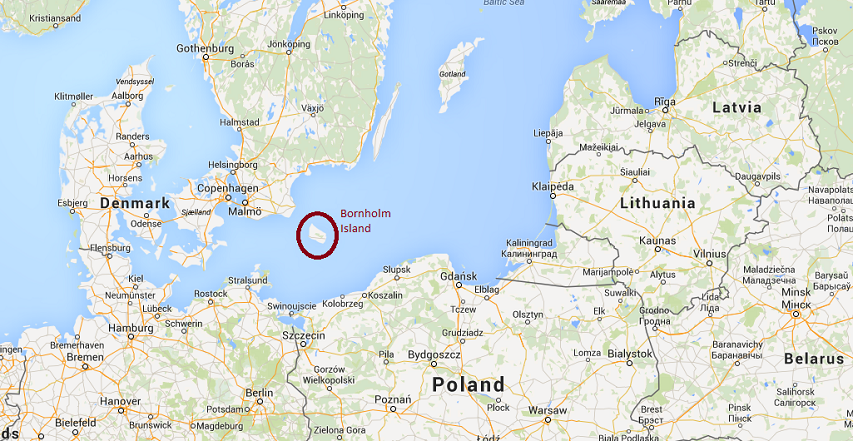
Bornholm Island (via Google Maps)
Back to Bornholm: the island’s location and geology irritated Soviet-era Kremlin strategists. Located in the Baltic Sea east of peninsular Denmark, north of Poland’s coast and to the rear of what was East Germany, Bornholm gave the Free World outpost north of and behind Warsaw Pact lines.
Soviet communications security officers despised the place. Bornholm’s electronic intercept systems, quite literally, bugged them.
As for geology, unlike Jutland’s flat peninsula, Bornholm is rock. In the 1970s, while serving a U.S. Army tour in West Germany, I heard a senior officer describe Bornholm as “sort of a Gibraltar.” His exaggeration had a point. Dig tunnels and Bornholm became a hard target for Soviet conventional weapons.
Comments Off on Denmark’s Bornholm Island draws Russian attention
“Victorian style poverty” in the UK
In a recent Forbes column, Tim Worstall pours scorn on the recent claim that some British children are living in “Victorian conditions”:
There’s a very large difference between arguing that we have Victorian style (for those unacquainted with British practise, this means late 19th century style) poverty in the UK and that we have Victorian style inequality in the UK. That second is at least arguably possible, although untrue, while the first is simply a flat out untruth. There is nothing even remotely akin to 19th century poverty in the UK today. Nor is there, of course, in any of the industrialised nations. The problem stems from people simply not understanding how poor the past was.
The claim is made this morning in The Guardian:
Many children are living in Victorian conditions – it’s an inequality timebomb
That second assertion could be true but is a matter for another day. That first is just wrong.
I was reminded of this by the teaching union NASUWT’s warning this week that there are children in this country living in “Victorian conditions”, turning to charity for regular meals and going without a winter coat.
“Going without a winter coat” might be something we’d like to remedy (and yes, I think we would like to do so) but it’s not a reminder of Victorian levels of poverty, it’s nothing like it at all. It’s necessary to actually understand what Victorian poverty was. Late 19th century Britain had some 25% of the population living at or below the subsistence level. This subsistence level is not a measure of inequality, nor of the lack of winter clothes. It is a measure of gaining enough calories each day in order to prolong life. This is the sort of subsistence level that Malthus and Ricardo were talking about. The sort of level of poverty that the World Bank currently uses as a measure of “absolute poverty”.
This absolute poverty is set at $1.25 per person per day. No, this is not the number that can be spent upon food per person per day. This is the amount that can be spent upon everything per person per day. This covers shelter, clothing, heating, cooking, food, education, pensions, health care, absolutely everything. This number is also inflation adjusted, so we are not talking about $1.25 a day when bread was one cent a gallon loaf. This number is also Purchasing Power Parity adjusted: so we are not talking about lentils costing two cents a tonne in India and £3 a kg in Tesco. We are adjusting for those price differences across geography and time.
Just to note, by these PPP and inflation adjusted numbers, being on the minimum wage in the UK puts you in the top 10% of all income earners in the current world. Being on nothing at all but benefits would put you into the top 20%.
Up to 25% of the population of Britain were that badly off in the late Victorian era: “Actual real starvation to death as a result of poverty was not unknown, even that late, as late as 1890.”
Comments Off on “Victorian style poverty” in the UK
April 19, 2015
QotD: Learning languages
… they have a way of teaching languages in Germany that is not our way, and the consequence is that when the German youth or maiden leaves the gymnasium or high school at fifteen, “it” (as in Germany one conveniently may say) can understand and speak the tongue it has been learning. In England we have a method that for obtaining the least possible result at the greatest possible expenditure of time and money is perhaps unequalled. An English boy who has been through a good middle-class school in England can talk to a Frenchman, slowly and with difficulty, about female gardeners and aunts; conversation which, to a man possessed perhaps of neither, is liable to pall. Possibly, if he be a bright exception, he may be able to tell the time, or make a few guarded observations concerning the weather. No doubt he could repeat a goodly number of irregular verbs by heart; only, as a matter of fact, few foreigners care to listen to their own irregular verbs, recited by young Englishmen. Likewise he might be able to remember a choice selection of grotesquely involved French idioms, such as no modern Frenchman has ever heard or understands when he does hear.
The explanation is that, in nine cases out of ten, he has learnt French from an Ahn’s First-Course. The history of this famous work is remarkable and instructive. The book was originally written for a joke, by a witty Frenchman who had resided for some years in England. He intended it as a satire upon the conversational powers of British society. From this point of view it was distinctly good. He submitted it to a London publishing firm. The manager was a shrewd man. He read the book through. Then he sent for the author.
“This book of yours,” said he to the author, “is very clever. I have laughed over it myself till the tears came.”
“I am delighted to hear you say so,” replied the pleased Frenchman. “I tried to be truthful without being unnecessarily offensive.”
“It is most amusing,” concurred the manager; “and yet published as a harmless joke, I feel it would fail.”
The author’s face fell.
“Its humour,” proceeded the manager, “would be denounced as forced and extravagant. It would amuse the thoughtful and intelligent, but from a business point of view that portion of the public are never worth considering. But I have an idea,” continued the manager. He glanced round the room to be sure they were alone, and leaning forward sunk his voice to a whisper. “My notion is to publish it as a serious work for the use of schools!”
The author stared, speechless.
“I know the English schoolman,” said the manager; “this book will appeal to him. It will exactly fit in with his method. Nothing sillier, nothing more useless for the purpose will he ever discover. He will smack his lips over the book, as a puppy licks up blacking.”
The author, sacrificing art to greed, consented. They altered the title and added a vocabulary, but left the book otherwise as it was.
Jerome K. Jerome, Three Men on the Bummel, 1914.
Comments Off on QotD: Learning languages
April 18, 2015
April 17, 2015
Hubris – A General’s Worst Enemy I THE GREAT WAR Week 38
Published on 16 Apr 2015
This week, generals on three different fronts show that they are not able to realise their mistakes. Basra falls to the British, the quick victory at the Dardanelles is getting more and more unlikely and the Russians are loosing their advantage in the Carpathians. But not the commanders have to pay the price for their mistakes, the soldiers have to.
Comments Off on Hubris – A General’s Worst Enemy I THE GREAT WAR Week 38
April 16, 2015
An alliance of monsters – Hitler and Stalin, 1939-1941
In The New York Review of Books, John Lukacs reviews a new book from Roger Moorhouse documenting the brief alliance between the Nazi and Soviet regimes:
In the vast literature about Stalin and Hitler during World War II, little is said about their being allies for twenty-two months. That is more than an odd chapter in the history of that war, and its meaning deserves more attention than it has received.
Two factors were involved in this neglect. One was that after Hitler chose to conquer Russia he did not succeed; Stalin emerged as one of the supreme victors of World War II. The other was the Western Powers’ relative lack of interest in Eastern Europe. Yet the war broke out in 1939 because of Eastern Europe, as a result of the British (and French) decision to oppose the German conquest of Poland. The political earthquake of the Nazi–Soviet Pact of August 23, 1939, nine days before the outbreak of war on September 1, did not deter Britain and France from declaring war on Germany upon its invasion of Poland. This is one of the few—very few—decisions in their favor at the time. That they were reluctant in the months that followed to wage war seriously against Germany is another story.
Three quarters of a century have now passed since 1939. A fair amount has been written about the Nazi–Soviet Pact since then, mostly by Eastern European writers and historians. The Devil’s Alliance is a good account by the British historian Roger Moorhouse of what the pact meant for Hitler and Stalin—and, worse, for its victims. Perhaps the book’s most valuable part deals with the immediate consequences of the pact in 1939. Before then, obviously and stridently, Nazism and communism were outright enemies. From the very beginning of his political rise Hitler described Judaism and communism as his principal enemies. Stalin, by that time, was less of an ideologue. Like Hitler, he was a nationalist; he had little interest in international communism.
Comments Off on An alliance of monsters – Hitler and Stalin, 1939-1941


