
The Great War
Published on 29 Sep 2018Support Othais on Patreon: https://www.patreon.com/CandRsenal
Indy and Othais talk about the different kinds of machine guns that were used during World War 1.
October 1, 2018
Machine Guns Of World War 1 I THE GREAT WAR Special feat. C&Rsenal
Comments Off on Machine Guns Of World War 1 I THE GREAT WAR Special feat. C&Rsenal
Britain’s Labour Party under Jeremy Corbyn has become a “force for antisemitism”
Hugh Fitzgerald on the British Labour Party’s slide into open anti-semitic actions under Jeremy Corbyn:

Jeremy Corbyn, Leader of the Labour Party speaking at a Rally in Hayfield, Peak District, UK on 25th July 2018 in support of Ruth George MP.
Photo by Sophie Brown via Wikimedia Commons.
In Great Britain, Jeremy Corbyn and his willing collaborators in the Labour Party continue their ferocious attacks on anyone in the party who still supports Israel. In the first week of September, a vote of no-confidence against Joan Ryan, the head of Labour Friends of Israel, passed 94-92 among local party members. Frank Field, another long-serving MP and prominent supporter of Israel, resigned as whip to protest the Labour Party becoming a “force for antisemitism” and for allowing a “culture of nastiness, bullying and intimidation” to develop; he was informed that as result he was no longer a member of the Party.
As is well known, Jeremy Corbyn intensely dislikes Israel. He refers to members of Hamas and Hezbollah, on the other hand, as “friends.” They feel the same about him. In a Twitter post, Hamas wrote: “We salute Jeremy Corbyn’s supportive positions to the Palestinians.”
When first accused of having honored dead terrorists at a graveside ceremony in Tunisia in October 2014, Corbyn denied that he had been anywhere near the graves of any terrorists, and he certainly had “no memory” of any wreath laying. Then some photographs surfaced. One of them shows Corbyn holding — with others — a large wreath. And the grave they are standing over turns out to have been that of one of those who planned the murder of the Israeli athletes at the Munich Olympics in 1972.
Another photo of Jeremy Corbyn shows him posing in the same graveyard next to a convicted terrorist, Fatima Bernawi, who was given a life sentence for trying to blow up a Israeli cinema in 1967. While the attempted terror attack did not come off, Bernawi boasted that it was successful because it “generated fear.” Bernawi was later freed in a prisoner swap, and was thus able to attend the same terrorist-honoring graveside ceremony as Jeremy Corbyn.
Asked to explain what he was doing next to a convicted terrorist, Mr Corbyn’s spokesman said: “Jeremy has a long and principled record of solidarity with the Palestinian people and engaging with actors in the conflict to support peace and justice in the Middle East.”
Comments Off on Britain’s Labour Party under Jeremy Corbyn has become a “force for antisemitism”
September 30, 2018
Poland is Crushed – WW2 – 005 29 September 1939
World War Two
Published on 29 Sep 2018Facing two enemies at once, Poland finds itself in a crushing vice after less than a month of war and the Polish forces must flee their own country to live to fight another day.
Join us on Patreon: https://www.patreon.com/TimeGhostHistory
Or join The TimeGhost Army directly at: https://timeghost.tvWritten and Hosted by: Indy Neidell
Produced and Directed by: Spartacus Olsson and Astrid Deinhard
Executive Producers: Bodo Rittenauer, Astrid Deinhard, Indy Neidell, Spartacus Olsson
Research by: Indy Neidell
Edited by: Spartacus Olsson
Trainee Editors: Sarvesh and Ben Ollerenshaw
Colorized Pictures by Spartacus OlssonArchive by Screenocean/Reuters http://www.screenocean.com
A TimeGhost chronological documentary produced by OnLion Entertainment GmbH
Comments Off on Poland is Crushed – WW2 – 005 29 September 1939
September 29, 2018
8mm M1915 Chauchat Fixing and Range Testing
Forgotten Weapons
Published on 9 Sep 2018http://www.patreon.com/ForgottenWeapons
Well, my 8mm French Chauchat finally cleared transfer, as did my application to reactivate it. This was a “dewat”, or “Deactivated War Trophy” – a machine gun put on the NFA registry but modified to be non-firing. This is not the same as legal destruction, as the receiver of the gun remained intact. The method of deactivation on such things can very significantly; in this case the chamber was plugged with weld, the bolt face welded up, and the barrel extension welded to the receiver. I did have an intact spare bolt and barrel assembly, however.
I removed the weld holding the barrel assembly in place, cleaned it up a bit, and dropped in my new parts.
Legal note: this was done after the receipt of an approved Form 5 from ATF, complete with tax stamp.
Today I took it out to the range for the first time, to see if any further work would be needed. And yeah, there was a bit of tweaking necessary. The feeding and extraction are solid, but the ejection requires some work. So, after swapping in a better extractor, I headed back to the range for another test run.
This time it ran great, with the exception of one bad magazine (3 of 4 being 100% reliable is better than I expected, given their age and construction). So now, I have a fully functioning Chauchat and three known-good magazines. Next up? Two-gun match! Stay tuned…
If you enjoy Forgotten Weapons, check out its sister channel, InRangeTV! http://www.youtube.com/InRangeTVShow
Comments Off on 8mm M1915 Chauchat Fixing and Range Testing
QotD: Alanbrooke and Churchill
This was indeed a typical Churchillian soirée. Like most of those around the table, [Major-General Sir John] Kennedy too kept a diary. His account is graphic and chagrined. He noted at the time that AB [Alanbrooke] did not intervene on his behalf, “although I knew I had said nothing with which he did not agree.” His coda is equally pointed. “Later, I realized the wisdom of the technique which Brooke acquired after many stormy passages with the Prime Minister. Brooke found it an invaluable rule never to tell Churchill more than was absolutely necessary. I remember him once scoring out nine-tenths of the draft of a minute to the Prime Minister, remarking as he did so, ‘The more you tell that man about the war, the more you hinder the winning of it.'”
Footnote to Field Marshal Lord Alanbrooke, War Diaries, 1939-1945, 1957.
Comments Off on QotD: Alanbrooke and Churchill
September 28, 2018
The Meuse-Argonne Offensive – Bulgarian Collapse I THE GREAT WAR Week 218
The Great War
Published on 27 Sep 2018This week, the biggest American military operation in history kicks off with 1.2 million American soldiers trying to take the Krimhilde Stellung. At the same time the Army of the Orient advances into Bulgaria and the Ottoman 7th and 8th armies collapse in Palestine.
Comments Off on The Meuse-Argonne Offensive – Bulgarian Collapse I THE GREAT WAR Week 218
Arthur C. Clarke – Beyond Human – Extra Sci Fi – #2
Extra Credits
Published on 25 Sep 2018Arthur C. Clarke’s novel Childhood’s End explores his self-described “crypto-Buddhist” philosophy and the question of: are higher powers inherently, morally good, or is that something we decide as humans?
Comments Off on Arthur C. Clarke – Beyond Human – Extra Sci Fi – #2
The Death of Socrates
Andrew Heaton
Published on 17 Feb 2017A 100% historically accurate, clinical portrayal of the Death of Socrates.
Comments Off on The Death of Socrates
September 27, 2018
France moves toward the Soviet system of psychological “treatment” for dissidents
You may not agree with much that prominent French nationalist politician Marine Le Pen stands for, but the recent court order that she must undergo a psychological evaluation as part of the investigation of a “hate crime” should worry everyone. Jacob Sullum writes:

Marine Le Pen speaking in Lille during the 2017 French presidential election
Photo by Jérémy-Günther-Heinz Jähnick via Wikimedia Commons
France ranked 12 notches above the United States in this year’s World Press Freedom Index, produced by Reporters Without Borders. But such ratings can be misleading, as illustrated by the prosecution of Marine Le Pen, head of the right-wing National Rally party (formerly the National Front), for posting images of ISIS atrocities on Twitter. Last week Le Pen revealed that she had been ordered to undergo a psychiatric examination as part of the investigation into her speech crime, which added another layer of Soviet-style thought control to the story.
It is inconceivable that an American politician, no matter how extreme his views, would be prosecuted for doing what Le Pen did, because a law like the one she is charged with violating would be clearly inconsistent with the First Amendment. That law, Article 227-24 of the French Criminal Code, makes it a crime, punishable by a fine of €75,000 (about $88,000) and up to three years in prison, to distribute “a message bearing a pornographic or violent character or a character seriously violating human dignity…where the message may be seen or perceived by a minor.” Le Pen allegedly ran afoul of that prohibition in 2015 by posting three pictures of men murdered by ISIS—one beheaded, one burned alive, and one run over by a tank—in response to a Twitter user who likened her party to the terrorist organization. “Daesh [the Arabic acronym for ISIS] is this!” she tweeted.
This case vividly illustrates why Article 227-24 would never pass constitutional muster in the United States. Le Pen’s tweet is indisputably political speech, sitting at the core of the expression protected by the First Amendment. The terms of Article 227-24 (especially the phrase “seriously violating human dignity”) are broad and vague, encouraging self-censorship and inviting politically motivated prosecution of people who irk the powers that be. Le Pen, who unsuccessfully ran against Emmanuel Macron in a presidential runoff last year, was stripped of her parliamentary immunity six months later, leaving her open to prosecution.
Comments Off on France moves toward the Soviet system of psychological “treatment” for dissidents
QotD: Gandhi’s views on Britain
… as almost always with historical films, even those more honest than Gandhi, the historical personage on which the movie is based is not only more complex but more interesting than the character shown on the screen. During his entire South African period, and for some time after, until he was about fifty, Gandhi was nothing more or less than an imperial loyalist, claiming for Indians the rights of Englishmen but unshakably loyal to the crown. He supported the empire ardently in no fewer than three wars: the Boer War, the “Kaffir War,” and, with the most extreme zeal, World War I. If Gandhi’s mind were of the modern European sort, this would seem to suggest that his later attitude toward Britain was the product of unrequited love: he had wanted to be an Englishman; Britain had rejected him and his people; very well then, they would have their own country. But this would imply a point of “agonizing reappraisal,” a moment when Gandhi’s most fundamental political beliefs were reexamined and, after the most bitter soul-searching, repudiated. But I have studied the literature and cannot find this moment of bitter soul-searching. Instead, listening to his “inner voice” (which in the case of divines of all countries often speaks in the tones of holy opportunism), Gandhi simply, tranquilly, without announcing any sharp break, set off in a new direction.
It should be understood that it is unlikely Gandhi ever truly conceived of “becoming” an Englishman, first, because he was a Hindu to the marrow of his bones, and also, perhaps, because his democratic instincts were really quite weak. He was a man of the most extreme, autocratic temperament, tyrannical, unyielding even regarding things he knew nothing about, totally intolerant of all opinions but his own. He was, furthermore, in the highest degree reactionary, permitting in India no change in the relationship between the feudal lord and his peasants or servants, the rich and the poor. In his The Life and Death of Mahatma Gandhi, the best and least hagiographic of the full-length studies, Robert Payne, although admiring Gandhi greatly, explains Gandhi’s “new direction” on his return to India from South Africa as follows:
He spoke in generalities, but he was searching for a single cause, a single hard-edged task to which he would devote the remaining years of his life. He wanted to repeat his triumph in South Africa on Indian soil. He dreamed of assembling a small army of dedicated men around him, issuing stern commands and leading them to some almost unobtainable goal.
Gandhi, in short, was a leader looking for a cause. He found it, of course, in home rule for India and, ultimately, in independence.
Richard Grenier, “The Gandhi Nobody Knows”, Commentary, 1983-03-01.
Comments Off on QotD: Gandhi’s views on Britain
September 26, 2018
The last British carriers before the Queen Elizabeth class
This is a long, long thread from @EngageStrategy, so I’m putting it below the fold for those who aren’t interested and don’t want to scroll down for hours…
It covers the near-death experience of British carriers in the 1960s (the cancellation of the last fleet carriers), the odd evolution of the “through deck command cruisers” (Invincible, Illustrious, and Ark Royal), the development of the Harrier, and the very near-run thing that was the carriers’ share of combat duty during the Falklands War.
Comments Off on The last British carriers before the Queen Elizabeth class
German Anti-Aircraft Gun System | Flak | US Air Force Training Film | 1944
The Best Film Archives
Published on 6 Oct 2015● Please SUPPORT my work on Patreon: https://bit.ly/2LT6opZ
✚ Watch my “Military Training Films” PLAYLIST: https://bit.ly/2G6XIrN
FLAK is German acronym of Fliegerabwehrkanone / Flugabwehrkanone (“aeroplane defence cannon”).
This US Air Force training film (1944) provides an in-depth look at the German anti-aircraft gun (Flak) system, and highlight the evasive maneuvers utilized by US pilots during their missions.
German Anti-Aircraft Gun System | Flak | US Air Force Training Film | 1944
TBFA_0019 (DM_0005)
NOTE: THE VIDEO REPRESENTS HISTORICAL EVENTS. SINCE IT WAS PRODUCED DECADES AGO, IT HAS HISTORICAL VALUES AND CAN BE CONSIDERED AS A VALUABLE HISTORICAL DOCUMENT. THE VIDEO HAS BEEN UPLOADED WITH EDUCATIONAL PURPOSES. ITS TOPIC IS REPRESENTED WITHIN HISTORICAL CONTEXT. THE VIDEO DOES NOT CONTAIN SENSITIVE SCENES AT ALL!
Comments Off on German Anti-Aircraft Gun System | Flak | US Air Force Training Film | 1944
September 25, 2018
Belgium Under German Occupation During WW1 I THE GREAT WAR On The Road
The Great War
Published on 24 Sep 2018Visit the Ijser museum: http://www.museumaandeijzer.be/ijzert…
Indy talks to Peter Verplancke about Belgium during World War 1, in particular the German occupation policies.
Comments Off on Belgium Under German Occupation During WW1 I THE GREAT WAR On The Road
Is the UK military situation really as dire as this new book portrays?
In the Daily Mail, there’s an excerpt from a new book on the British military by Michael Ashcroft and Isabel Oakeshott, White Flag? An Examination Of The UK’s Defence Capability:
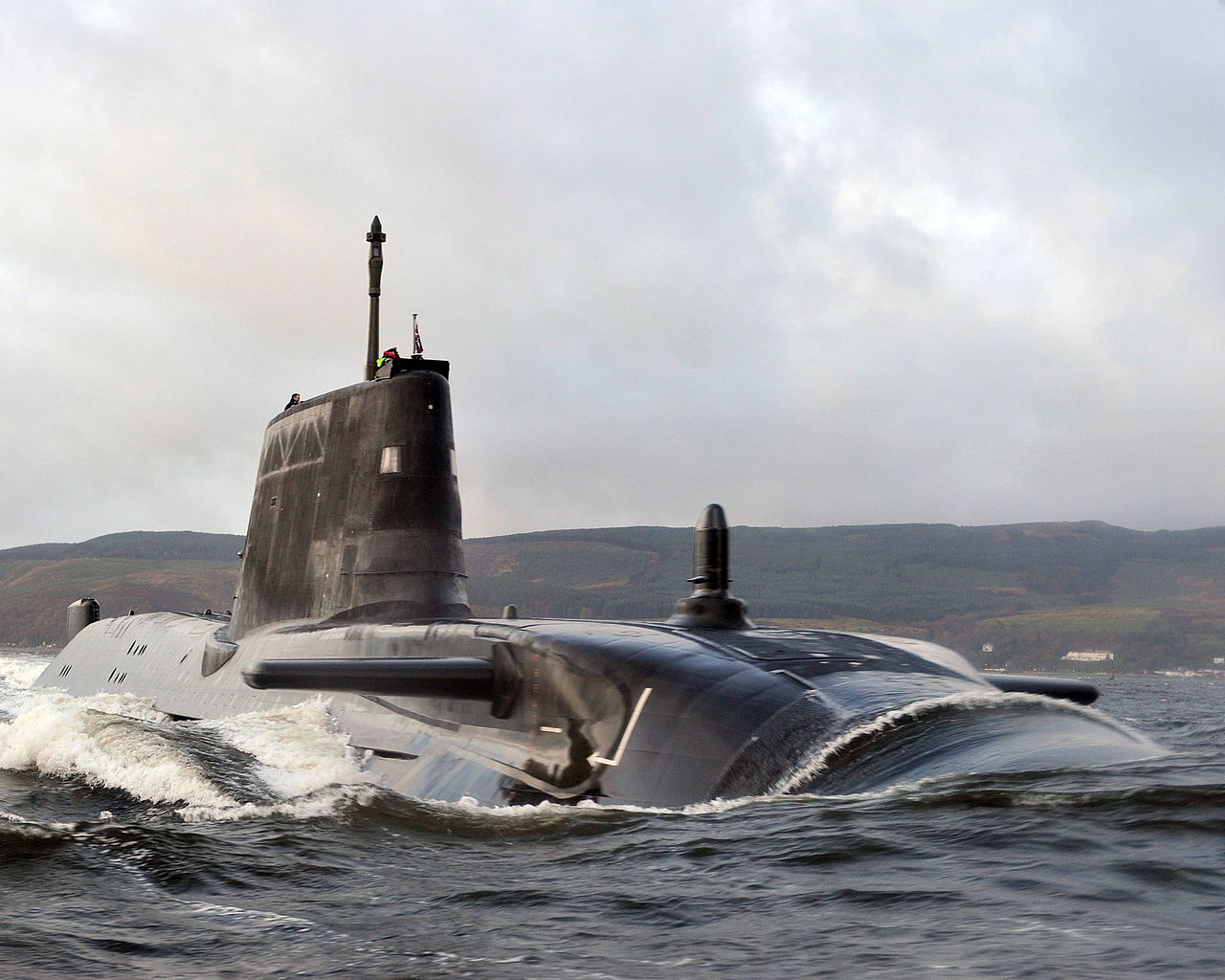
HMS Astute (S119), lead ship of her class, sails up the Clyde estuary into her home port of Faslane, Scotland.
MOD photo, via Wikimedia Commons.
Bluntly, at a time of international crisis, when the prime minister wanted to take a stand against the illegal use of chemical weapons, our Armed Forces did not have what was needed for a full-throttle response.
Naturally, ministers preferred voters to imagine that submarines were on their way to the action. The truth about our limited capability might have fuelled creeping fears that the UK has run up the white flag.
This was one of the many shocks we had during our wide-ranging investigation into the state of this country’s defence capabilities. Thanks to remorseless cuts imposed by successive governments, the Army, Navy and RAF all struggle to meet day-to-day commitments to protect this country and play their part in collective security through Nato and other defence alliances — let alone prepare for serious potential new threats.
The particular problem this time was probably down to maintenance issues.
Hulls need cleaning to stop them rusting, engines need overhauling and nuclear reactors need to be flushed.
When you don’t have very many ships, taking one or two out of circulation leaves quite a gap — in this case, one that could not be filled.
And the fact is that we don’t have enough ships any more. Or aircraft. Or tanks. Or military personnel. Not since Defence became a soft target for governments looking to cut spending.
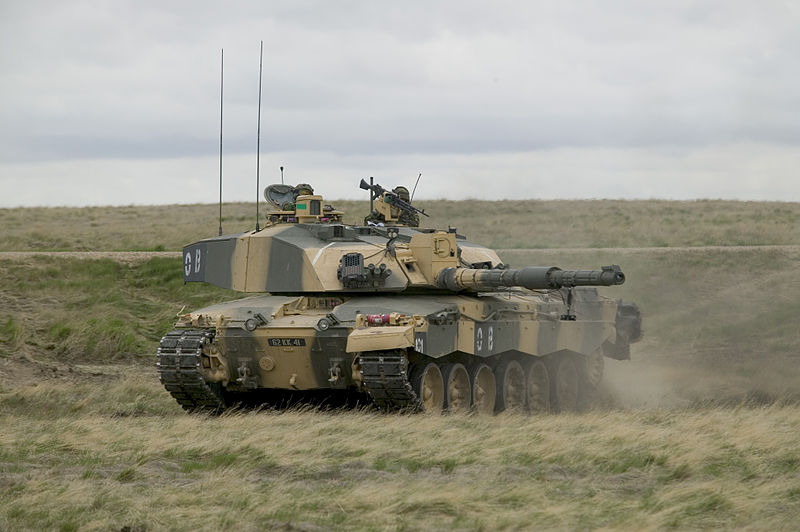
A British army Challenger 2 Main Battle Tank, of 1 Royal Regiment of Fusiliers (1RRF), is shown returning to base after completing a firing mission as part of Exercise MedMan.
1RRF Battle group were based at the British Army Training Unit Suffield (BATUS) in Canada.
MOD photo by Mike Weston via Wikimedia Commons.
What this means on the front line is illustrated by the small but fierce battalion of 800 UK troops stationed at a remote base in the Baltic state of Estonia as a crucial part of Nato’s defences against a Russian attack. They are on their guard at all times, scouring the bleak horizon for anything suspicious.
Inside a vast metal hangar is a fleet of Challenger tanks. The Army wanted to send 18 but the MoD cut this back to ten, of which only eight can be operational because two will always be in for repairs.
Asked if this would be enough if the Russians came over the border, the men we met there shrugged and laughed. They know full well that the Russians could throw as many as 22 tank battalions — that’s more than 650 tanks — at them.
A war-gaming exercise concluded that Nato forces would be ‘woefully inadequate’ in the event of an invasion: the Russians would be in Tallinn, the Estonian capital, within 60 hours.
No wonder the men themselves refer to their assignment as ‘Operation Tethered Goat’. Hopelessly outnumbered, they would be brushed aside, sacrificed to the predatory Putin, like the goat swallowed by the T. rex in Jurassic Park.
Amazons – fierce fighting tribe or just ancient Greek porn?
Lindybeige
Published on 21 Jun 2011You can believe in them if you want, but if you do, you should out of fairness to other mythological characters believe in giants, cyclopes, griffins, and gorgons.
Comments Off on Amazons – fierce fighting tribe or just ancient Greek porn?


