
Around a certain sort of leftist mention of the Laffer Curve just brings a derisive snort. The sadness of that reaction being that it’s just an obvious mathematical truth. Tax rates of 0 % and 100 % bring in no revenue. Somewhere in between maximises the moolah. Note what isn’t being said, that all tax cuts always pay for themselves, nor even that lower tax rates are necessarily a good thing. Only that there’s some optimal level with regard to revenue collection.
All the arguments about the optimal level of government are over in the Wagner Curve and such others.
The Laffer Curve is also made up of two components, the income and substitution. Some people will work just to make their nut. Observational studies have shown that many taxi drivers do. So, increase their tax rates and they’ll work more. The substitution effect is, well, what’s that net wage worth to me? What’s the value of not working? When going fishing is worth more than working then people will go fishing. The curve as a whole is the interplay of these two effects.
Each tax in each society has its own such curve. A transactions tax of 0.01% can reduce revenue collection, as the EU’s study of a financial transactions tax shows us. Taxes upon income of 20% are below that Laffer Curve peak.
But where, exactly, is that peak for taxes upon income? The best study we’ve got, Saez and Diamond, says between 54% and 80% dependent upon other structures in the tax system. The Tory part of the UK Treasury says around 40 to 45% for income tax, plus national insurance, so at the bottom end of that S&D range. Many lefties want to say it’s higher so we can tax “the rich” more.
Tim Worstall, “How Lovely To Spot The Laffer Curve In The Wild – Doctors’ Pensions Edition”, Continental Telegraph, 2018-09-05.
September 25, 2018
QotD: The Laffer Curve
September 24, 2018
Drafting – Poetry – Georg von Trapp I OUT OF THE TRENCHES
The Great War
Published on 22 Sep 2018Chair of Wisdom Time!
September 23, 2018
The Nimrod MRA4 – the world’s most expensive bad aircraft
Back in 2011, I posted an article about the retirement of the Hawker Siddeley Nimrod from the Royal Air Force inventory. I referred to the Nimrod as
… expensive to buy, eye-wateringly expensive to upgrade, but it must be cheap to operate, right? No:
[…] our new fleet of refurbished De Havilland Comet subhunters (sorry, “Nimrod MRA4s”) will cost at least £700m a year to operate. If we put the whole Nimrod force on the scrapheap for which they are so long overdue right now, by the year 2019 we will have saved […] £7bn
The Register certainly got in the right ballpark with this helpful graphic:

Earlier this month, the Nimrod saga was detailed at Naval Gazing, if only as a way to show that someone can have worse procurement experiences than the United States military. Despite being a military development of a passenger jet famous for crashes, the initial marks of the Nimrod were able to meet the RAF’s needs. The problems began when a requirement was generated for a British AWACS aircraft and the Nimrod was deemed to be the best candidate for conversion (“best” probably meaning “only British competitor”):
Things began to go wrong in the mid-70s, when the British decided to introduce an AWACS aircraft to support their air defense efforts. They had several options. The E-2 Hawkeye and E-3 Sentry were both about to enter service, and were rapidly proving themselves to have excellent radar systems during trials. The British could have had either aircraft, or bought their radar systems to integrate into an aircraft of their own. Or they could have only bought a few subcomponents, like the antenna or the radar transmitter itself, and built the rest domestically.
They decided to take none of these options. Instead, they would produce an entirely new radar system. Instead of an American-style radome, separate antennas would be installed in the nose and tail, and the system would sweep through one, and then the other. This was far more expensive and much riskier than buying from the Americans, but it did produce a lot more jobs in the British defense industry, which was apparently the government’s prime concern. In 1977, a contract was placed, making BAE and GEC-Marconi co-leads on the project to convert 11 surplus Nimrod MR1 airframes to the new configuration.
As might be expected based on that kind of decision-making, the resulting airplane had problems. The computer system chosen wasn’t powerful enough to integrate all of the data, particularly the area where the nose and tail radars overlapped. It was also horribly unreliable, with a mean time between failures of only two hours, in a system which took 2.5 hours to load the mission data from the tape. The Nimrod, considerably smaller than the American Sentry, was unable to carry more equipment to solve this problem. Different electronics racks were earthed to different points in the airframe, and the resulting potential differences caused false tracks to appear, overloading the computer even more. To make matters worse, most of the electronics units weren’t interchangeable for reasons that were never entirely clear. If one unit failed, several spares had to be tried before one that worked was found. The only system that functioned reliably was the IFF system, which could only track friendly aircraft and airliners. This was a major handicap in an aircraft intended to detect incoming Soviet bombers.
It probably isn’t a surprise to hear that the planes were delayed. A lot. And delaying military projects tends to drive the overall price higher. What was anticipated to be a £200-300 million project was over £1 billion before the government of the day came to their fiscal senses and pulled the plug (they ended up buying Boeing E-3 Sentry aircraft instead).
A few years later, the RAF ran a competition to replace the Nimrod MR2 maritime patrol aircraft. Lockheed, Dassault and Airbus entered the competition, but somehow, the RAF ended up selecting BAE’s bid which involved rebuilding 30-year-old Nimrod frames with new electronics and all the modern conveniences.
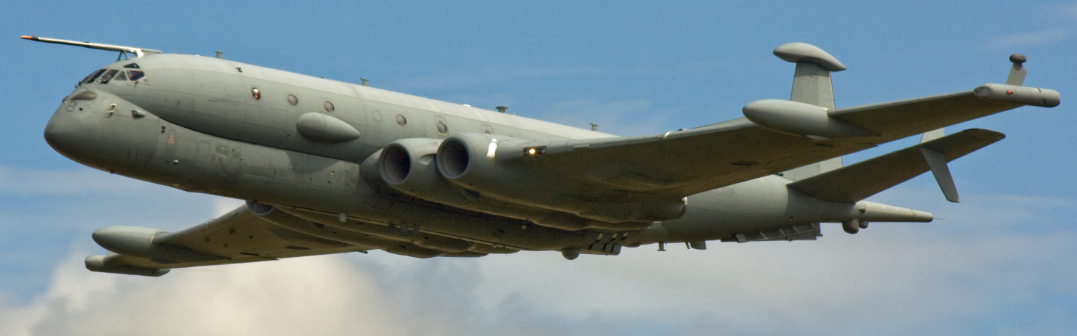
RAF Nimrod MRA4 on 18 July 2009.
Detail of original photo by Ronnie Macdonald, via Wikimedia Commons.
In 1996, a contract was issued for the new aircraft, designated Nimrod MRA4. 21 aircraft were to be produced at a cost of £2.8 billion, and they would be essentially new airplanes, with only the fuselage structure being retained. The antique Spey engines would be replaced with modern BR700s. These engines were significantly larger, and required much more air, forcing BAE to design a new, larger wing. The combined effect of these two changes was to double the Nimrod’s range and improve performance. Inside, the flight deck was replaced with one derived from the A340 airliner, and the mission systems were to be all-new.
A fuselage was sent to be reverse-engineered for the design of the new wing, and BAE designed and built it, then pulled in another aircraft to make the modification. And discovered that the wing didn’t fit. Apparently, the problem dated back to the initial construction of the aircraft. When positioning the frames, Hawker Siddeley had not done what all sensible manufacturers did, and measured from a common baseline. Instead, they had positioned each frame with a tolerance relative to the previous one, which meant that the position of the wings varied by as much as a foot across the fleet. Worse, the aircraft they had designed the wings for was one of the most extreme in wing position, so the new wings didn’t fit most of the other aircraft. This forced a redesign of the wings, further delaying the program.
Spoiler: they missed their delivery deadline. By nearly a decade. And the original plan to build 21 aircraft shrank to only 4 … but the budget continued to grow, from the original £2.8 billion to over £4.1 billion at cancellation. Each of the surviving airframes had literally cost more than £1 billion. That’s why Bean gave the Nimrod his “Naval Gazing Worst Procurement Ever” trophy, and I think it was very well-deserved.
The Russians are Coming! – WW2 004 September 22 1939
World War Two
Published on 22 Sep 2018When the USSR crushes the plans of the Allies for Poland and the Japanese plans in China in the same week, it is Germany that benefits.
Join us on Patreon: https://www.patreon.com/TimeGhostHistory
Or join The TimeGhost Army directly at: https://timeghost.tvBetween 2 Wars: https://www.youtube.com/playlist?list…
Written and Hosted by: Indy Neidell
Produced and Directed by: Spartacus Olsson and Astrid Deinhard
Executive Producers: Bodo Rittenauer, Astrid Deinhard, Indy Neidell, Spartacus Olsson
Research by: Indy Neidell
Edited by: Spartacus Olsson
Colorized Pictures by Olga Shirnina and Norman StewartOlga’s pictures: https://klimbim2014.wordpress.com
A TimeGhost chronological documentary produced by OnLion Entertainment GmbH
30 Years War | 3 Minute History
Jabzy
Published on 28 Oct 2015Thanks to Xios, Alan Haskayne, Lachlan Lindenmayer, William Crabb, Derpvic, Seth Reeves and all my other Patrons. If you want to help out – https://www.patreon.com/Jabzy?ty=h
September 22, 2018
Arthur C. Clarke – Master of Science Fiction – Extra Sci Fi – #1
Extra Credits
Published on 18 Sep 2018Arthur C. Clarke is well known for his work on 2001: A Space Odyssey, but even more importantly he ventured into writing novels instead of just magazine serializations. Works like The City and the Stars asked big philosophical questions in science fiction.
September 21, 2018
Allied Breakthroughs In Palestine And Macedonia I THE GREAT WAR Week 217
The Great War
Published on 20 Sep 2018In a turbulent week of the First World War, the Allies break through at the Macedonian Front during the Battle of Vadar and in Palestine during the Battle for Palestine. At the same time, the Ottoman defeats the last defenders of Baku.
Declassified: The Old RAF Base Bringing Hollywood To Upper Heyford | Forces TV
Forces TV
Published on 30 Aug 2018Upper Heyford was one of the largest US Air Force bases in Europe, housing bombers that carried NATO’s intermediate-range nuclear weapons… now it’s attracting Hollywood A-listers…
Read more: https://www.forces.net/news/declassif…
September 20, 2018
The Last Lee Enfield: the L42A1 Sniper
Forgotten Weapons
Published on 31 Aug 2018More info: https://www.forgottenweapons.com/the-…
http://www.patreon.com/ForgottenWeapons
When the British military adopted the FAL (L1A1 SLR) in 1960, they adopted the 7.62x51mm NATO cartridge along with it. While the Bren guns were converted to the new cartridge, efforts at converting the Lee Enfield into a precision rifle were not successful at the time. However, civilian target shooters and the British NRA would work on perfecting that conversion for use in competition, and would ultimately produce very accurate 7.62mm rifles built on Lee Enfield actions – accurate enough that the military took notice. Copying the competition rifles, the British military would adopt the L42A1 in 1970, an Enfield action converted to 7.62mm NATO with a shortened and free-floated stock and hand guard and a heavy profile barrel. A total of 1,080 L42A1 rifles would be converted from existing No4 MkI(T) sniper rifles, and they would serve in the front lines of the British military until 1992, when they were replaced by the Accuracy International L96A1.
If you enjoy Forgotten Weapons, check out its sister channel, InRangeTV! http://www.youtube.com/InRangeTVShow
September 19, 2018
Belgian Uniforms Of World War 1 I THE GREAT WAR Special
The Great War
Published on 17 Sep 2018Visit the IJser Museum: http://www.museumaandeijzer.be/ijzert…
Indy talks to Peter Verplancke from the Museum at the former Yser front about the Belgian uniforms and their evolution during the war.
The Byzantine Empire should really be called the “Medieval Roman Empire”
Sean Gabb makes the case for the least well-known part of the Roman world that outlasted the western empire by a thousand years:
Properly considered, the history of what I will from now call not the Byzantine Empire, but the Mediaeval Roman Empire, is perhaps the most astonishing instance of how courage and determination can keep civilisation alive in the face of the most forbidding and apparently overpowering challenges. In setting out my argument, I hope you will forgive me if I begin with an introduction covering much that many of your will know at least as well as I do, but that may not be so familiar to those reading the text or watching the speech on YouTube.
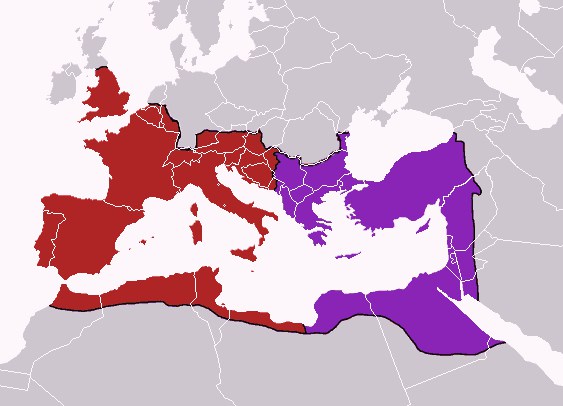
If you look at the first of the maps that I have put on your tables, you will see the Roman Empire as it was in the year 395 AD. This shows the Empire at something close it its greatest extent. The conquests that Trajan made to the north of the Danube and east of the Euphrates have been given up. But it includes the whole of the Mediterranean World and its various hinterlands – an area stretching from the North of England to Upper Egypt, from Casablanca to Trebizond. In that year, however, nearly a century of political experiments is formally ended with the division of the Empire into two administrative zones. There is the Western or the red Empire, ruled by an Emperor in Rome or Milan or Ravenna. There is the Eastern or the purple Empire, ruled by an Emperor in Constantinople.
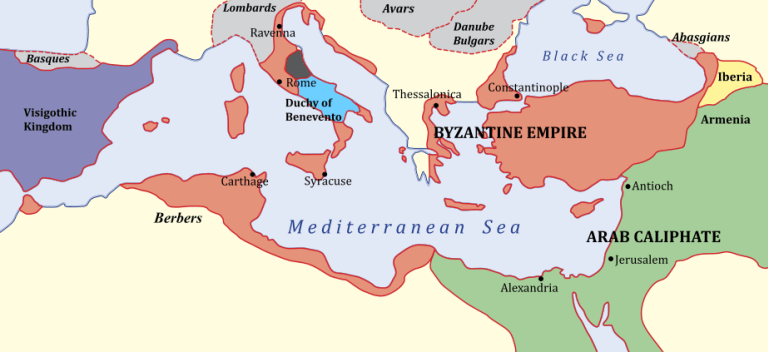
If you look at the second map, dated roughly 650 AD, you will see that the Western Empire has disappeared. Excepting North Africa and parts of Italy, now ruled from Constantinople, the whole of the Western Empire has disappeared – replaced by a set of barbarian kingdoms from which modern Europe takes its origin. The Eastern Empire itself has lost both Syria and Egypt to the Arabs.
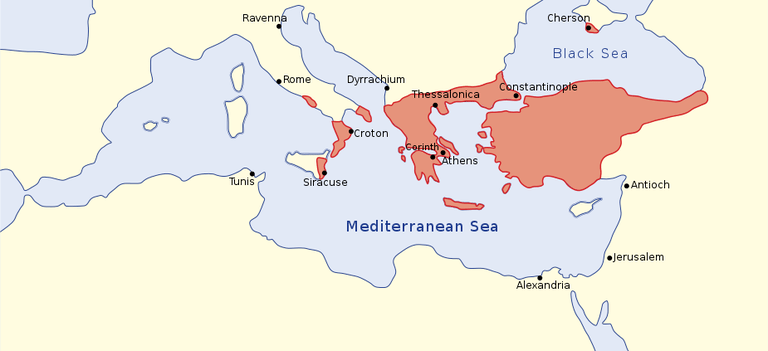
If you look at the third map, dated roughly 867 AD, you will see that the Empire has suffered the further loss of Cyprus and North Africa and most of Sicily. Nevertheless, what we have in that year should undeniably be called the Mediaeval Roman Empire. It has weathered the storm of the Early Middle Ages. It is the richest and most powerful state in the Mediterranean World. Indeed, during the next few centuries, it will expand. It has already reconquered Greece. It will conquer the Bulgarian Kingdom and re-establish its ancient frontier on the Danube. It will even retake Antioch and make Egypt for a while its economic and diplomatic client.
After 1071, the Empire falls on evil days. In that year, the Turks deprive it of its Anatolian heartland. But this loss is stabilised and in part reversed by a skilful handling of the Crusades. There is another disaster in 1204, when the Venetians take and plunder Constantinople. But this is not the end. The Empire is restored in large parts in 1261; and, even if as little more than a city-state based around Constantinople, it continues to the final Turkish conquest of 1453. Indeed, the formal extinction of the Empire comes nearly a decade after 1453, with the annexation of its last territories in Southern Greece.
There was a time when school textbooks in England dated the fall of the Roman Empire to 476 AD. Its continued survival for a thousand years after then had to be explained, where admitted, by taking a contemptuous view of what was called the Byzantine Empire. See, for example, W.E.H. Lecky:
Of that Byzantine empire, the universal verdict of history is that it constitutes, without a single exception, the most thoroughly base and despicable form that civilization has yet assumed. There has been no other enduring civilization so absolutely destitute of all forms and elements of greatness, and none to which the epithet “mean” may be so emphatically applied… The history of the empire is a monotonous story of the intrigues of priests, eunuchs, and women, of poisonings, of conspiracies, of uniform ingratitude.
Lecky is one of my favourite historians. But, if you look even at the mediaeval Greek and Italian historians of the Empire, you will see that this is a bizarre judgement. Undoubtedly, these historians tended to focus on intrigues in and about the Imperial Palace. But they also record much else. They record the story of a rich and powerful empire, directed with high military and diplomatic ability – an empire in which slavery and the death penalty have been almost abolished, where people lived, and knew that they lived, under a set of divinely-ordained laws that protected life, liberty and property to a degree unknown in any other mediaeval state.
QotD: The “generations” of jet fighters
American warplanes like the F-22 and F-35 are often called “5th generation” fighters. This leaves many wondering what the other generations were and what the next one will be. The generation reference is all because of jet fighters, and the first generation was developed during and right after World War II (German Me-262, British Meteor, U.S. F-80, and Russian MiG-15). These aircraft were, even by the standards of the time, difficult to fly and unreliable (especially the engines). The 2nd generation (1950s) included more reliable but still dangerous to operate aircraft like the F-104 and MiG-21. The 3rd generation (1960s) included F-4 and MiG-23. The 4th generation (1970s) included F-16 and MiG-29. Each generation has been about twice as expensive (on average, in constant dollars) as the previous one. But each generation is also about twice as safe to fly and cheaper to operate. Naturally, each generation is more than twice as effective as the previous one. Increasingly it looks like the 6th generation will come without pilots. That’s because producing fifth generation fighters has proved difficult as well as very expensive. So far only the United States has managed to get 5th gen fighters (F-22 and F-35) into service. The Russians are still trying as are the Chinese, even though one of their stealth fighter designs (J-20) is technically in service (even though production has been suspended after less than a dozen were produced).
The Russians have said they will keep working on their 5th generation Su-57, although some of the derivatives of their Su-27 are at least generation 4.5. One of the reasons the Soviet Union collapsed was the realization that they could not afford to develop 5th generation warplanes to stay competitive with America. The Russians had a lot of interesting stuff on the drawing board and in development but the bankruptcy of most of their military aviation industry during the 1990s left them scrambling to put it back together ever since. At the moment the Russians are thinking of making a run for the 6th generation warplanes, which will likely be unmanned and largely robotic. As of 2018 they don’t have much choice because their answer to the F-22, work on the Su-57 was canceled (“indefinitely paused”.)
“Murphy’s Law: The Impossible 5th Generation”, Strategy Page, 2018-08-20.
September 18, 2018
A case to keep Theresa May in power … at least until March, 2019
Sean Gabb offers about the only possible justification for the British Tories to keep Theresa May on as Prime Minister:
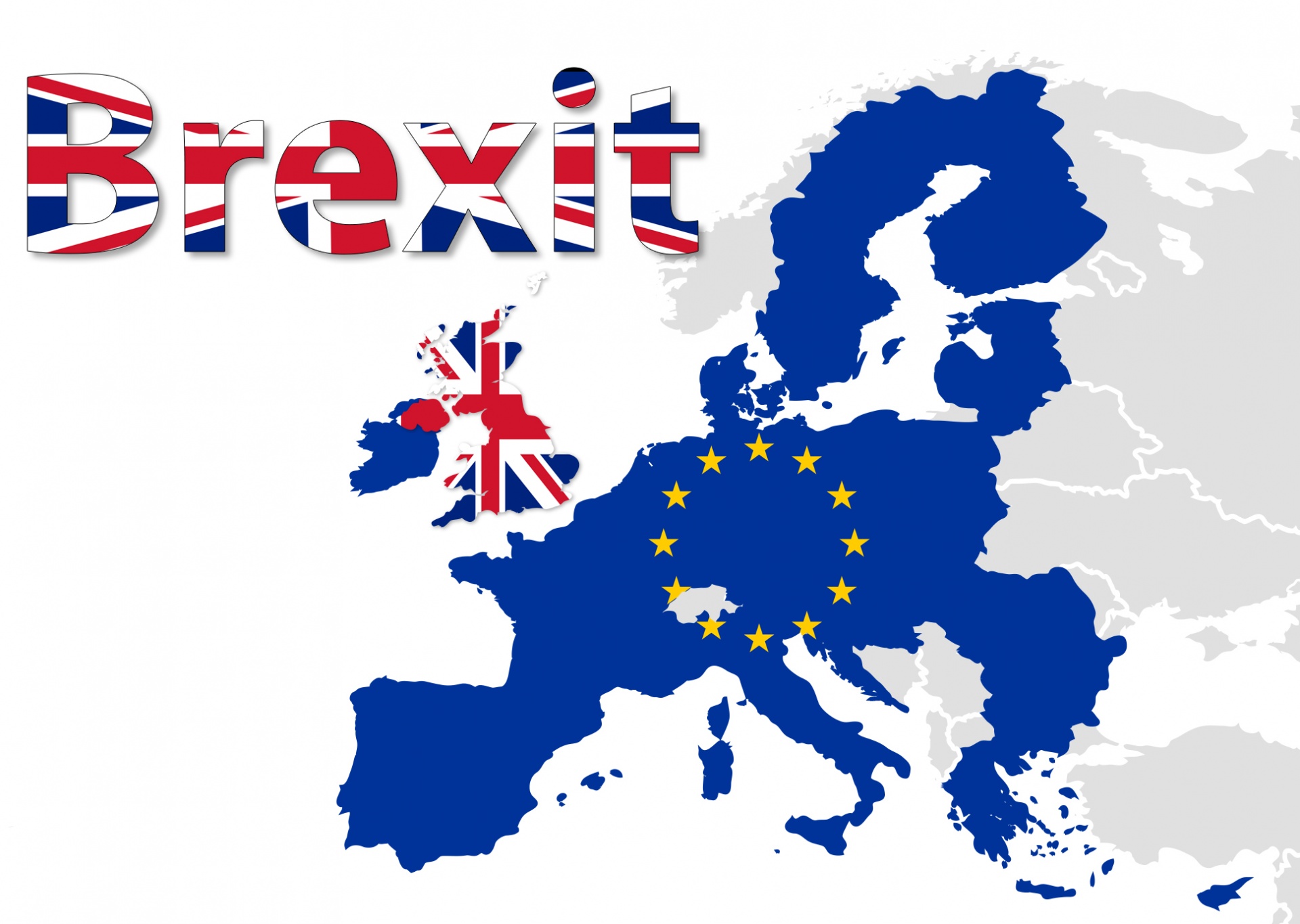
Let us imagine that there is a vote of no-confidence in Mrs May as Leader of the Conservative Party. Let us imagine what is not certain — that someone more committed to leaving then becomes the Prime Minister. We can suppose that Anna Soubry and Damian Green will resign the Conservative whip — they and perhaps several dozen others of their kind. They are held from doing this at the moment because the ghostly electoral mandate Mrs May has gives them no excuse for splitting. A new Prime Minister without any mandate would give them their excuse. This would leave the Government with no majority. But there is worse.
Between a third and half the Parliamentary Labour Party would like an excuse to peel away and form a new party. So far, they have not found this excuse. A Conservative split would be their excuse. I can imagine a “centrist” block of 150 Members in the House of Commons. Add the Scottish Nationalists and the Liberal Democrats — that would be enough to form a new coalition government. Whether this new government then called a second referendum or found some less honest method, there would be no departure of any kind from the European Union. And, thanks to the Fixed Term Parliaments Act, they would keep their seats until 2022. After that, they could look forward to a shower of corporate sinecures.
Bearing this in mind, I call on the Conservative leavers not to allow a vote of no-confidence in Mrs May. Instead, let them focus on making it impossible for the Government we have to offer new concessions to the European negotiators. I call on the relevant Jewish organisations to keep up their pressure on the Labour leadership — but not to try for any killing blow. They can have Mr Corbyn’s head on a plate after next March. In short, I pray for no change in any direction in British politics until after we have left the European Union. Then, we can have blood on the moon — the more, the better. Until then, let the May Government continue shuffling towards departure on whatever terms they can get or want to get.
September 17, 2018
“Nazis on Drugs” – Wehrmacht & Meth – Wunderwaffe?
Military History not Visualized
Published on 17 Aug 2018There some over-blown claims out there that the “Blitzkriege” were mainly achieved due to the use of Meth (Pervitin) and that historians had ignored this issue. Is it true or false? In this video we take a look at Pervitin, the Wehrmacht, the early German victories aka “Blitzkriege” and various aspects. Was Pervitin a Wunderwaffe? Was the Wehrmacht on Meth? How long was it used? And some aspects.
September 16, 2018
Poland on Her Own – WW2 September 15 1939
World War Two
Published on 15 Sep 2018When the Wehrmacht and the SS continue devastating Poland and her people in the first weeks of September, her last chance is her western allies.
Join us on Patreon: https://www.patreon.com/TimeGhostHistory
Or join The TimeGhost Army directly at: https://timeghost.tvWritten and Hosted by: Indy Neidell
Produced and Directed by: Spartacus Olsson and Astrid Deinhard
Executive Producers: Bodo Rittenauer, Astrid Deinhard, Indy Neidell, Spartacus Olsson
Research by: Indy Neidell
Edited by: Spartacus OlssonA TimeGhost chronological documentary produced by OnLion Entertainment GmbH


