
Historigraph
Published on 24 Nov 2018So it’s probably worth noting here that when Dreadnought made all other battleships irrelevant, it didn’t do so equally. For example, Japan had constructed two ‘semi-dreadnoughts’ a couple of years earlier, with more 10-inch guns than was standard at the time. The Americans too were moving towards building an ‘all-big-gun’ battleship, but they were much slower at getting them built than the British.
If you enjoyed this video and want to see more made, consider supporting my efforts on Patreon: https://www.patreon.com/historigraph
Sources:
Robert K. Massie, Dreadnought: Britain, Germany and the Coming of the Great War
Ben Wilson, Empire of the Deep: The Rise and Fall of the British Navy
December 14, 2018
Dreadnought: The Battleship that Changed Everything
Comments Off on Dreadnought: The Battleship that Changed Everything
QotD: Burgundy
If it’s red, French, costs too much, and tastes like the water that’s left in the vase after the flowers have died and rotted, it’s probably Burgundy.
Jay McInerney, Bacchus & Me: Adventures in the Wine Cellar, 2002.
Comments Off on QotD: Burgundy
December 13, 2018
QotD: The Cabinet
[T]here is a clear similarity between the Prime Minister’s cabinet and the wardrobe/closet from the Narnia Chronicles: neither has any back to it and people who spend an excessive amount of time in either find themselves in a fantasy land.
Eric Kirkland, 2005-03-24.
Comments Off on QotD: The Cabinet
December 12, 2018
WW1 World Leaders & Generals After The War I THE GREAT WAR Epilogue
The Great War
Published on 10 Dec 2018The First World War was a historic event that challenged established power structures, political and military leaders. It also catapulted new ideas, new leaders and new officers onto the world stage. In this video we briefly explore what happened to them after the Great War.
Comments Off on WW1 World Leaders & Generals After The War I THE GREAT WAR Epilogue
Why Socrates Hated Democracy
The School of Life
Published on 28 Nov 2016We’re used to thinking hugely well of democracy. But interestingly, one of the wisest people who ever lived, Socrates, had deep suspicions of it.
Comments Off on Why Socrates Hated Democracy
December 11, 2018
Viking Expansion – Lies – Extra History
Extra Credits
Published on 8 Dec 2018Writer Rob Rath talks about all the cool stories and facts we didn’t get to cover in the already expansive Viking Expansion series.
Join us on Patreon! http://bit.ly/EHPatreon
7:08 – Rob learns he has a linguistic tic about being able to correctly distinguish “ancestor” and “descendant”
17:10 – Olga of Kiev scared Matt to death… really though…
25:23 – Walpole Connection
28:05 – what’s next on Extra HistorySome other works to check out: The Sea Wolves: A History of the Vikings, by Lars Brownworth / The Vikings, by Else Roesdahl / Podcast: Norse by Northwest
Comments Off on Viking Expansion – Lies – Extra History
Criticizing the left, from the left
In Quillette, Matt Johnson discusses the phenomenon of devoted leftists being willing to criticize their own “side”, and includes a section on George Orwell’s willingness to critique leftists while still being a fully dedicated leftist himself:
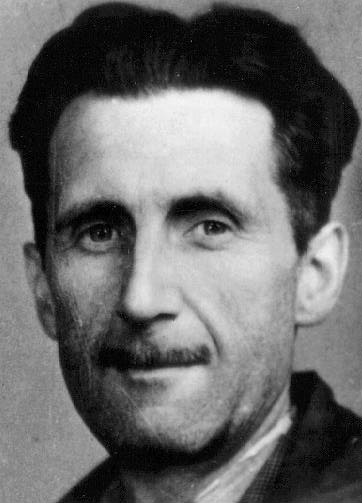
Orwell’s press card portrait, 1943
Bruckner’s remark about “Stalinist blackmail” calls to mind a writer whose commitment to both left-wing politics and anti-totalitarianism never wavered in the face of threats and coercion from the Left.
In the summer of 2003, the BBC aired George Orwell: A Life in Pictures. About halfway through the documentary, Orwell (played by Chris Langham) says, “Every line of serious work that I have written since 1936 has been written, directly or indirectly, against totalitarianism.” This is a line from one of Orwell’s best-known essays, published in 1946, “Why I Write.” But astute viewers may have noticed that something was missing from the reference — eight words that the producers decided to leave out.
Here’s the original sentence: “Every line of serious work that I have written since 1936 has been written, directly or indirectly, against totalitarianism and for democratic socialism, as I understand it.” After the sentence abruptly ends with the word “totalitarianism” in the documentary, Langham takes a long drag on his cigarette before jumping to a different passage of the essay. It was almost as if the producers wanted to accentuate the omission, taunting viewers with their own version of Orwell — one who didn’t have the courage to disclose his true beliefs.
There’s something simultaneously fitting and perverse about the manipulation of Orwell’s words more than half a century after his death (by the BBC, no less). Orwell’s anxiety about the falsification of history is one of the major themes of Nineteen Eighty-Four — as well as much of his other writing and later correspondence — and this is what the producers of the documentary were guilty of doing when they amputated one of his firmest ideological declarations and turned it into a much more palatable and anodyne comment on totalitarianism. No matter how badly some people want Orwell to be a polished and uncontroversial product for mass consumption, he was still the man who wrote these words as he speculated about the possibility of violent revolution in England: “I dare say the London gutters will have to run with blood. All right, let them, if it is necessary.”
Even when Orwell wasn’t in a mood that had him impatiently looking forward to the day “when the red militias are billeted in the Ritz,” he was always honest about his political beliefs. On November 13, 1945, Katharine Stewart-Murray, the Duchess of Atholl, wrote to Orwell asking if he would speak on behalf of an anti-communist organization called the League for European Freedom. This was a month after the publication of Animal Farm — a time when Orwell was worried that the book would be misinterpreted as a broadside against socialism instead of a narrower attack on Stalinism.
Given this context, it isn’t surprising that Orwell declined the duchess’s offer: “Certainly what is said on your platforms is more truthful than the lying propaganda to be found in most of the press, but I cannot associate myself with an essentially Conservative body which claims to defend democracy in Europe but has nothing to say about British imperialism.” Even though Orwell was a staunch anti-communist, his essential political convictions remained immovable: “I belong to the Left and must work inside it, much as I hate Russian totalitarianism and its poisonous influence in this country.”
Orwell was a socialist until the end of his life. For many people, this complicates his legacy and detracts from his pristine image as the twentieth century’s foremost foe of totalitarianism — an image that has been appropriated again and again over the past 70 years.
[…]
But as Orwell was at pains to demonstrate (especially after the publication of Animal Farm), he would have firmly rejected the Right’s attempts to appropriate his legacy. While Orwell is rightly celebrated for his refusal to accept the dogmas of the Left when he was under tremendous pressure to do so, his independence of mind is only one of the reasons why he remains so relevant today. His ability to maintain that independence without sacrificing his most fundamental principles may be even more important.
Comments Off on Criticizing the left, from the left
Why the Byzantine Empire Never Existed
KhAnubis
Published on 12 Aug 2018We frequently talk about the Eastern Roman Empire as if it were some separate empire from the Roman Empire, when in fact, in a lot of ways, the Roman and Byzantine Empires were really the same empire.
Comments Off on Why the Byzantine Empire Never Existed
December 10, 2018
One Million Subscriber Special! The French 75 – Guns, Drinks, and Shirts!
Forgotten Weapons
Published on 9 Dec 2018Holy cow, a million subscribers! When I started Forgotten Weapons, I never for a moment suspected it would end up this popular. Thank you to everyone who has subscribed! I think this required a celebratory cocktail … specifically, a French 75. So let’s talk about the French 75 the gun – the Canon de 75 modèle 1897 – as well as the cocktail named after it.
In celebration of the milestone, we have a two-day sale on some of the merchandise at the Forgotten Weapons store – which you should check out:
http://shop.bbtv.com/collections/forg…
I would also like to mention that you can now find lots of Forgotten Weapons content on Amazon Prime, where videos have been compiled into 1-2 hour themed series:
And last but certainly not least, a huge thanks to everyone who supports Forgotten Weapons on Patreon! Your support is what has made this possible, and what will keep it here for years to come.
http://www.patreon.com/ForgottenWeapons
Contact:
Forgotten Weapons
PO Box 87647
Tucson, AZ 85754
Comments Off on One Million Subscriber Special! The French 75 – Guns, Drinks, and Shirts!
Tank Chats #38 Churchill | The Tank Museum
The Tank Museum
Published on 3 Jun 2017Historian David Fletcher MBE, in the 38th Tank Chat discussing the well-loved Churchill tank. The Churchill in this video resides at The Tank Museum, Bovington and was the last Churchill VII of the production line.
The Churchill tank was rushed in to production during the early years of the Second World War. The Churchill tank was one of the most successful British tank designs of the Second World War. They saw service from the 1942 Dieppe raid, through to North Africa, Italy and Europe.
Support the work of The Tank Museum on Patreon: ► https://www.patreon.com/tankmuseum
Or donate http://tankmuseum.org/support-us/donateTwitter: ► https://twitter.com/TankMuseum
Tiger Tank Blog: ► http://blog.tiger-tank.com/
Tank 100 First World War Centenary Blog: ► http://tank100.com/ #tankmuseum #tanks
Comments Off on Tank Chats #38 Churchill | The Tank Museum
December 9, 2018
The Invasion of Finland – WW2 – 015 8 December 1939
World War Two
Published on 8 Dec 2018When the Red Army invades Finland they get a cold reception and a pretty nasty surprise. It looks like team Stalin might just be skating on some very thin ice.
WW2 day by day, every day is now live on our Instagram account @World_war_two_realtime https://www.instagram.com/world_war_t…
Between 2 Wars: https://www.youtube.com/playlist?list…
Join us on Patreon: https://www.patreon.com/TimeGhostHistory
Or join The TimeGhost Army directly at: https://timeghost.tvWritten and Hosted by: Indy Neidell
Produced and Directed by: Spartacus Olsson and Astrid Deinhard
Executive Producers: Bodo Rittenauer, Astrid Deinhard, Indy Neidell, Spartacus Olsson
Research by: Indy Neidell
Edited by: Iryna Dolka
Map animations by: Mikk Tali aka Eastory
Community Manager: Joram AppelColoring by Spartacus Olsson and Norman Stewart, Thumbnail character courtesy of Olga Sharina aka Klimbim
Eastory’s channel: https://www.youtube.com/channel/UCEly…
Norman’s pictures https://oldtimesincolor.blogspot.com/
Archive by Screenocean/Reuters https://www.screenocean.com
A TimeGhost chronological documentary produced by OnLion Entertainment GmbH
Comments Off on The Invasion of Finland – WW2 – 015 8 December 1939
MYSTERIOUS ‘Sea People’ And Their Unknown Origins
Beyond Science
Published on 28 Aug 2017Who were these mysterious sea people?
Comments Off on MYSTERIOUS ‘Sea People’ And Their Unknown Origins
December 8, 2018
The Iliad – what is it really about?
Lindybeige
Published on 4 Mar 2016The Iliad – Homer’s epic poem of Achilles and the Trojan War. It was the Bible of its day, but what is it really about? Spoilers!
Support me on Patreon: https://www.patreon.com/Lindybeige
Here I summarise the plot of the Iliad, which may surprise and disappoint those who thought that it was the story of the Trojan War, and then describe and illustrate one of its main themes: the glory and tragedy of war; and then go on to point out the crucial scene of the poem, in which Priam begs for the return of the body of his son, and argue that this is actually the scene that gives meaning to the piece.
Lindybeige: a channel of archaeology, ancient and medieval warfare, rants, swing dance, travelogues, evolution, and whatever else occurs to me to make.
▼ Follow me…
Twitter: https://twitter.com/Lindybeige I may have some drivel to contribute to the Twittersphere, plus you get notice of uploads.
website: www.LloydianAspects.co.uk
Comments Off on The Iliad – what is it really about?
QotD: The nationalist obsession
As nearly as possible, no nationalist ever thinks, talks, or writes about anything except the superiority of his own power unit. It is difficult if not impossible for any nationalist to conceal his allegiance. The smallest slur upon his own unit, or any implied praise of a rival organization, fills him with uneasiness which he can relieve only by making some sharp retort. If the chosen unit is an actual country, such as Ireland or India, he will generally claim superiority for it not only in military power and political virtue, but in art, literature, sport, structure of the language, the physical beauty of the inhabitants, and perhaps even in climate, scenery and cooking. He will show great sensitiveness about such things as the correct display of flags, relative size of headlines and the order in which different countries are named. Nomenclature plays a very important part in nationalist thought. Countries which have won their independence or gone through a nationalist revolution usually change their names, and any country or other unit round which strong feelings revolve is likely to have several names, each of them carrying a different implication. The two sides of the Spanish Civil War had between them nine or ten names expressing different degrees of love and hatred. Some of these names (e.g. ‘Patriots’ for Franco-supporters, or ‘Loyalists’ for Government-supporters) were frankly question-begging, and there was no single one of the which the two rival factions could have agreed to use. All nationalists consider it a duty to spread their own language to the detriment of rival languages, and among English-speakers this struggle reappears in subtler forms as a struggle between dialects. Anglophobe-Americans will refuse to use a slang phrase if they know it to be of British origin, and the conflict between Latinizers and Germanizers often has nationalists motives behind it. Scottish nationalists insist on the superiority of Lowland Scots, and socialists whose nationalism takes the form of class hatred tirade against the B.B.C. accent and even the often gives the impression of being tinged by belief in sympathetic magic — a belief which probably comes out in the widespread custom of burning political enemies in effigy, or using pictures of them as targets in shooting galleries.
George Orwell, “Notes on Nationalism”, Polemic, 1945-05.
Comments Off on QotD: The nationalist obsession
December 6, 2018
“Marx was right”
An interesting little bit of history and philosophy over at Rotten Chestnuts:
Marx was right: Society really is shaped by relations between the means of production.
The Middle Ages, for instance, organized itself around defense from marauding barbarian hordes. Fast, heavy cavalry were the apex of military technology at the time; the so-called “feudal” system were the cavalry’s support. The system was field tested in the later Roman empire — medieval titles like “duke” came from the ranks of the Roman posse comitatus — and perfected in the Dark Ages.
When the barbarians had been pacified sufficiently that Europeans had leisure time to think about this stuff, they took the feudal system — at that point a cumbersome relic — as their model for society. Hobbes, Locke, et al saw it as the origin of the Social Contract; Marx saw it as finely tuned oppression. But here’s the fun part:
Hobbes ends his Leviathan with the most absolute monarch that could ever be. He starts* with… wait for it… the equality of man. Marx, on the other hand, ends with the equality of man. He starts with a frank, indeed brutal, acknowledgment of man’s inequality. As much as I love Hobbes (and consider Leviathan the only political philosophy book worth reading), he’s wrong — fundamentally wrong — and Marx is right. Marx went wrong somewhere down the line; Hobbes jumped the track from page one.
Marx only went wrong when he started dabbling in metaphysics. Marxism isn’t the original underpants gnome philosophy, but it’s certainly the best — not least because Marx’s followers were so successful at hiding the deus ex machina that was supposed to bring Communism about. Marx didn’t just say “The Revolution will happen because that’s the way all the trend lines are pointing.” He said “the trend lines are pointing that way, and oh yeah, the animating Spirit of History demands that the Revolution shall happen.” This is so obviously sub-Hegelian junk that his followers dropped it as fast as they could, but to Marx himself it was the key to his philosophy. For all its formidable technobabble, Marxism is just another chiliastic mystery cult.
[…] Enlightenment-wise, Hobbes was the start, Marx the end of political philosophy, and both are flawed beyond redemption. Hobbes sure sounds like a viable alternative to Marx, because Hobbes’s reasoning seems sound, and based on an irrefutable premise: That in the State of Nature, life is nasty, poor, solitary, brutish, and short. But that’s not Hobbes’s premise — the fundamental equality of man in the State of Nature is. Life in the State of Nature is brutal because all men are equal.
* If you’ve read Leviathan, of course, you know he starts the book itself with a long discourse on contemporary physics. Hobbes was an innovator there, too — he’s the first person to put forth his humanistic ideas as the coldly logical deductions of physical science. It’d be fun to taunt the “I fucking love science” crowd with that, except they think Hobbes is a cuddly cartoon tiger and “Leviathan” one of the lesser houses at Hogwarts.
Comments Off on “Marx was right”


