A family-of-four who live on a council estate in Southampton were given a taste of a different life by swapping with a millionaire couple from Wiltshire for a week. The Leamon and the Fiddes families are participants in a new series of Channel 5’s Rich House, Poor House, which sees a family from the richest ten per cent of British society swap homes (and lives) with a family from the poorest ten per cent.
However, viewers took to Twitter to insist that Andy and Kim Leamon and their two children from Southampton who have £170 a week to spend on food, clothes and socialising after paying their mortgage and bills are certainly not struggling.
It’s not, by local standards, exactly great riches, to be sure. But that is £2,210 of disposable income per person per year. That’s on the fringes of the top 30% of all global incomes. 70% or so are poorer.
Note again, this is their disposable income, after housing, bills and taxes, the global income number is before all of that. Or, as we might also put it, this is unimaginable riches by global or historical standards.
Tim Worstall, “Well, yes, there’s a point here”, Tim Worstall, 2017-10-20.
October 21, 2019
October 20, 2019
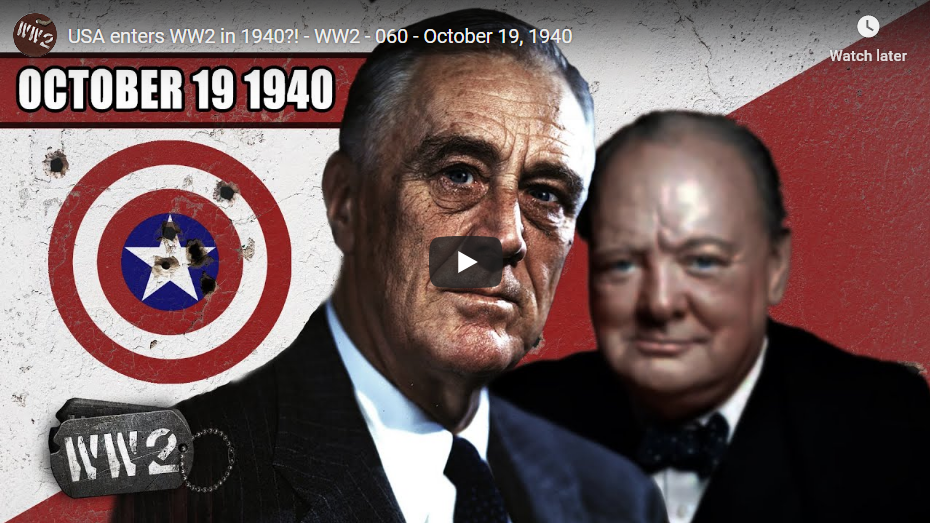
USA enters WW2 in 1940?! – WW2 – 060 – October 19, 1940
World War Two
Published 19 Oct 2019The World War seems to get bigger and bigger as Italy plans to invade Greece and the USA takes a stance.
Join us on Patreon: https://www.patreon.com/TimeGhostHistory
Or join The TimeGhost Army directly at: https://timeghost.tvFollow WW2 day by day on Instagram @World_war_two_realtime https://www.instagram.com/world_war_t…
Join our Discord Server: https://discord.gg/D6D2aYN.
Between 2 Wars: https://www.youtube.com/playlist?list…
Source list: http://bit.ly/WW2sourcesWritten and Hosted by: Indy Neidell
Produced and Directed by: Spartacus Olsson and Astrid Deinhard
Executive Producers: Bodo Rittenauer, Astrid Deinhard, Indy Neidell, Spartacus Olsson
Creative Producer: Joram Appel
Post-Production Director: Wieke Kapteijns
Research by: Indy Neidell
Edited by: Iryna Dulka
Map animations: EastoryColorisations by Norman Stewart and Julius Jääskeläinen https://www.facebook.com/JJcolorization/
Eastory’s channel: https://www.youtube.com/channel/UCEly…
Archive by Screenocean/Reuters https://www.screenocean.com.A TimeGhost chronological documentary produced by OnLion Entertainment GmbH.
Disruptive, theatrical “protests” are coming to the end of their usefulness
As I’ve said in comments on a few posts at other sites, the people who stage “protests” that block access to roads, railway stations, public buildings, and hospitals depend on the reactions of the people being mild, civilized, calm, and peaceful. But the more often these sorts of antics are performed, the thinner that veneer of civilization gets worn. At some point, and sooner than the organizers may realize, the veneer is gone and instead of peaceful commuters you’re disrupting, it’s a mob … and mobs don’t obey civilized rules like “thou shalt not kill”:
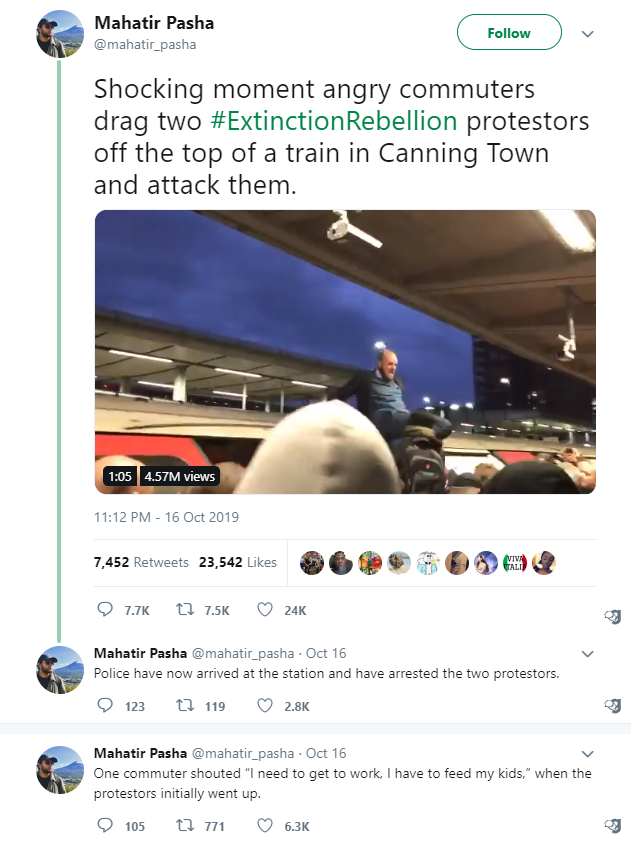
Those two were lucky that there was still some restraint being felt by the commuters. But it’s a clear warning sign that may not be attended to:
Extinction Rebellion, though it professes to be anti-Establishment, embodies the left-liberal values of the current Establishment hegemony.
That]s why rarely, if ever, will you hear anyone in government criticising Extinction Rebellion’s ideology, only its methods.
Then again, as one Conservative Brexiteer once told me, you can only fight a war on so many fronts. “Of course I know the whole climate change thing is bollocks,” he said – or words to that effect. “But I can only marshal my forces for one major battle at a time and that battle right now is Brexit.”
That’s how politicians have to think, it’s the nature of politics. Even the great Donald Trump has to play by these rules: look, for example, at how he has chickened out of having a red-team/blue-team scientific debate on global warming.
Happily, though, ordinary people are not constrained by such rules. There comes a point where they simply say to themselves:
“Sod this for a game of soldiers. I really don’t care whether what I’m about to do is wise or expedient or even legal, come to that. I’m just sick to the back teeth of what’s happening to my country. It’s wrong. It feels wrong. And if the system that is supposed to look after the interests of decent, law-abiding, productive citizens will no long protect the interests of decent, law-abiding, productive citizens then I guess I’ll have to take the law into my own hands.”
Which is exactly what happened at Canning Town Station in the East of London this week.
For months, on and off, Extinction Rebellion activists have been playing havoc with the lives of ordinary people who thought the law was supposed to protect them and their livelihoods from the kind of direct action that Extinction Rebellion and its apologists keep reassuring us is peaceful and in our best interests.
Grudging tolerance has gradually given way to a simmering sense of injustice: “How can it be”, ordinary folk have started to wonder, “that these privileged wanktards with their pointless degrees in Environmental Sciences and Advanced Poi are free to build pyramids at Oxford Circus and block Westminster Bridge when if I tried it I’d get myself chucked in jail?”
That simmering sense of injustice is now erupting into acts of rebellion — real rebellion, not Extinction Rebellion’s state-protected faux-rebellion — like the one in Canning Town Station.
Something very similar is happening with people’s feelings about Brexit: “How can it be right that we live in democracy which refuses to honour a popular vote? Surely honouring a popular vote is the most basic requirement. And if it doesn’t do that, then democracy has failed and we need to start looking at other ways of making our feelings known.”
Webley Model 1904
Forgotten Weapons
Published on 24 Feb 2015Sold for $109,250.
The Model 1904 was basically the first working automatic pistol made by Webley (there was a 1903 toolroom experiment, but it didn’t really work). Like all the Webley automatic that would follow, it was designed by William Whiting. The 1904 was the company’s first effort at making a semiautomatic sidearm for the British military, so it was chambered for the .455 cartridge (a special rimless version made by Kynoch, after early experiments using the .455 rimmed revolver ammunition caused lots of problems stacking in magazines). It is a rather huge handgun, and uses a short recoil mechanism with two separate locking blocks. This particular one is s/n 23 – very few were made before it was rejected in military trials and Webley redirected its efforts toward smaller commercial pistols.
http://www.forgottenweapons.com
Theme music by Dylan Benson – http://dbproductioncompany.webs.com

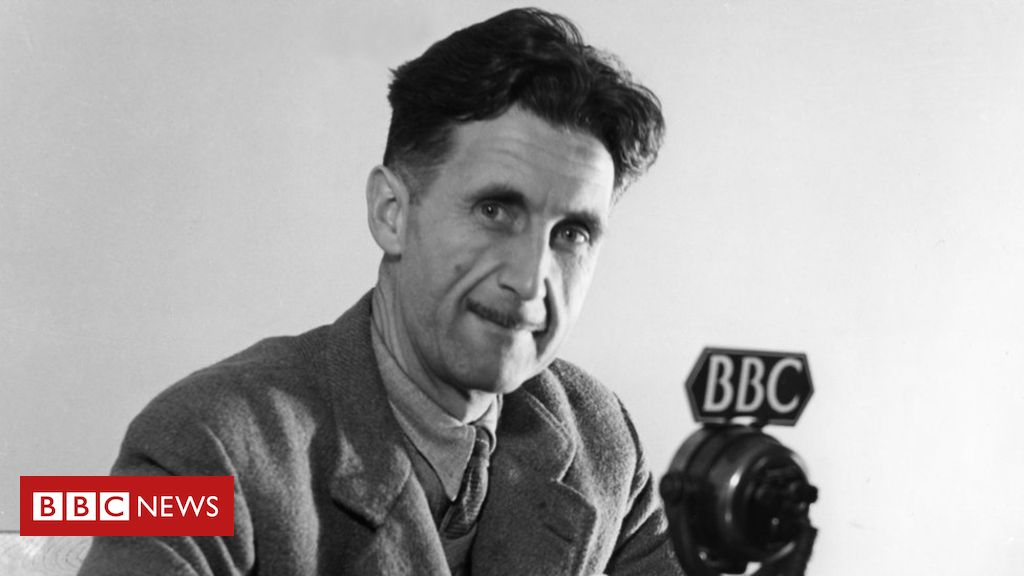
QotD: Why Orwell wrote Nineteen Eighty-Four
Many thanks for your letter. You ask whether totalitarianism, leader-worship etc. are really on the up-grade and instance the fact that they are not apparently growing in this country and the USA.I must say I believe, or fear, that taking the world as a whole these things are on the increase. Hitler, no doubt, will soon disappear, but only at the expense of strengthening (a) Stalin, (b) the Anglo-American millionaires and (c) all sorts of petty führers of the type of de Gaulle. All the national movements everywhere, even those that originate in resistance to German domination, seem to take non-democratic forms, to group themselves round some superhuman führer (Hitler, Stalin, Salazar, Franco, Gandhi, De Valera are all varying examples) and to adopt the theory that the end justifies the means. Everywhere the world movement seems to be in the direction of centralised economies which can be made to “work” in an economic sense but which are not democratically organised and which tend to establish a caste system. With this go the horrors of emotional nationalism and a tendency to disbelieve in the existence of objective truth because all the facts have to fit in with the words and prophecies of some infallible führer. Already history has in a sense ceased to exist, ie. there is no such thing as a history of our own times which could be universally accepted, and the exact sciences are endangered as soon as military necessity ceases to keep people up to the mark. Hitler can say that the Jews started the war, and if he survives that will become official history. He can’t say that two and two are five, because for the purposes of, say, ballistics they have to make four. But if the sort of world that I am afraid of arrives, a world of two or three great superstates which are unable to conquer one another, two and two could become five if the führer wished it. That, so far as I can see, is the direction in which we are actually moving, though, of course, the process is reversible.
As to the comparative immunity of Britain and the USA. Whatever the pacifists etc. may say, we have not gone totalitarian yet and this is a very hopeful symptom. I believe very deeply, as I explained in my book The Lion and the Unicorn, in the English people and in their capacity to centralise their economy without destroying freedom in doing so. But one must remember that Britain and the USA haven’t been really tried, they haven’t known defeat or severe suffering, and there are some bad symptoms to balance the good ones. To begin with there is the general indifference to the decay of democracy. Do you realise, for instance, that no one in England under 26 now has a vote and that so far as one can see the great mass of people of that age don’t give a damn for this? Secondly there is the fact that the intellectuals are more totalitarian in outlook than the common people. On the whole the English intelligentsia have opposed Hitler, but only at the price of accepting Stalin. Most of them are perfectly ready for dictatorial methods, secret police, systematic falsification of history etc. so long as they feel that it is on “our” side. Indeed the statement that we haven’t a Fascist movement in England largely means that the young, at this moment, look for their führer elsewhere. One can’t be sure that that won’t change, nor can one be sure that the common people won’t think ten years hence as the intellectuals do now. I hope they won’t, I even trust they won’t, but if so it will be at the cost of a struggle. If one simply proclaims that all is for the best and doesn’t point to the sinister symptoms, one is merely helping to bring totalitarianism nearer.
You also ask, if I think the world tendency is towards Fascism, why do I support the war. It is a choice of evils — I fancy nearly every war is that. I know enough of British imperialism not to like it, but I would support it against Nazism or Japanese imperialism, as the lesser evil. Similarly I would support the USSR against Germany because I think the USSR cannot altogether escape its past and retains enough of the original ideas of the Revolution to make it a more hopeful phenomenon than Nazi Germany. I think, and have thought ever since the war began, in 1936 or thereabouts, that our cause is the better, but we have to keep on making it the better, which involves constant criticism.
George Orwell, responding to a letter from Noel Willmett, 1944-05-18.
October 19, 2019
Churchill Was a Drunk… or Was He? – Doped WW2 Leaders Part 2
World War Two
Published 17 Oct 2019Winston Churchill was one of the most influential figures of World War Two. But as a heavy drinker he must have been under influence of constant drunkenness, right?
Watch Part 1 about Hermann Göring here: https://youtu.be/8H7arcUi7zQ
Join us on Patreon: https://www.patreon.com/TimeGhostHistory
Or join The TimeGhost Army directly at: https://timeghost.tvFollow WW2 day by day on Instagram @World_war_two_realtime https://www.instagram.com/world_war_t…
Join our Discord Server: https://discord.gg/D6D2aYN.
Between 2 Wars: https://www.youtube.com/playlist?list…
Source list: http://bit.ly/WW2sourcesHosted by: Indy Neidell
Written by: Francis van Berkel
Produced and Directed by: Spartacus Olsson and Astrid Deinhard
Executive Producers: Bodo Rittenauer, Astrid Deinhard, Indy Neidell, Spartacus Olsson
Creative Producer: Joram Appel
Post Production Director: Wieke Kapteijns
Research by: Francis van Berkel
Edited by: Michal Drzewiecki
Map animations: Eastory
Sound design: Marek KaminskiColorisations by Norman Stewart and Julius Jääskeläinen https://www.facebook.com/JJcolorization/
Eastory’s channel: https://www.youtube.com/channel/UCEly…
Archive by Screenocean/Reuters https://www.screenocean.com.Sources:
– IWM: A 11590
– Wine and whiskey icons by Made by Made, papers icon by Pauline, Breakfast icon by shashank singh, Champagne icons by Made by Made and Jenie Tomboc, Heart icon by Sophia Bai, alcohol icon by Flatart, beef icon by Igé Maulana, Beer by Valeriy, Cheese by Erin Agnoli, red wine by sasha willins, Brandy by NAS, all – the Noun Project
– Royalty free music of BensoundA TimeGhost chronological documentary produced by OnLion Entertainment GmbH.
From the comments:
World War Two
22 hours ago (edited)
We make an effort to approach history as unbiased as possible. The result is what we think is a balanced videos on Churchill’s alcohol (ab)use. For those of you who are new here, we are following World War Two Week by Week, in which we do pay a lot of attention to all those smaller but still significant events. If you would like to watch the series, make sure to subscribe and to click here to start watching from episode one: https://www.youtube.com/watch?v=3-A1gVm9T0A&list=PLsIk0qF0R1j4Y2QxGw33vYu3t70CAPV7XCheers,
The TimeGhost team.

Auberon Waugh’s wine book has been republished
It’s reviewed along with another book on Waugh by Henry Hitchings in the Times Literary Supplement:
“Looking back over my career to date, and at all the people I have insulted, I am mildly surprised that I am still allowed to exist”, wrote Auberon Waugh in 1980. For the remaining twenty-one years of his life he took pleasure in adding to his list of victims. Feminism and AIDS were bracketed together as “plagues”, ramblers were “semi-uniformed thugs”, the “lower classes” appeared “ugly, boring, humourless and desperately conceited”, and the female delegates at a Labour Party conference struck him as “either hunch-backed or hairy-legged or obviously lesbian”. It’s natural to associate such views with an age now pretty remote. But Waugh was born in the same year as John Cleese and Margaret Drabble; he was younger than Jilly Cooper and Vanessa Redgrave, John Prescott and David Dimbleby. Were he still alive, he would not yet be eighty.
[…]
A lot has changed since the period that Waugh on Wine covers. The British mass market is no longer in the grip of a “depraved” taste for semi-sweet wine. The drinkers he has in mind when he refers solecistically to “the hoi polloi” do not exhibit a “passion for filth” by favouring cheap Teutonic gut-rot. Pink champagne is easy to find, and Chianti is no longer the preserve of nurses hosting dinners in fifth-floor flatshares in Fulham. A large proportion of the most sought-after French wines now end up in Chinese cellars. The globalization of demand has stretched prices. When Waugh complains about the cost of 1982’s most rarefied clarets, he proposes as an alternative Château Léoville-Las Cases at £9 a bottle; anyone thinking of laying down its 2018 counterpart will have to find around twenty-five times that amount.
The durability of a few of Waugh’s claims is hard to assess. For instance, do the “semi-professional poules de luxe on the fringes of café society” continue to disappoint their admirers by failing to serve good vintage port? Yet much remains as it was. Dry white Bordeaux still doesn’t have a great following in Britain. Neither, more regrettably, do the best German wines. It is true that in America “only obvious alcoholics drink anything like as much as the ordinary English professional”. The British still go on holiday to France and return full of hyperbolic enthusiasm for some local plonk that they have been inspired to import in large quantities – only to find, once it arrives in Blighty, that it is no more potable than the contents of a fish tank. There is a certain prescience, too, in Waugh’s remark that the best wines are, increasingly, beyond English pockets “shrunk by the growing indolence, incompetence and indiscipline of our island race”.
Waugh writes entertainingly about the social life of the drinker: “A tremendous amount of unnecessary suffering goes on under the name of Liebfraumilch“. An enterprising young wine merchant is portrayed as someone who “in earlier times, might have spread terror among the fat galleons of the Spanish main”. He shies away from no quarrel: with greedy producers, covetous investors “who treat fine wine like rare postage stamps”, and wine merchants who spew out empurpled hype. Oddly, though, he clings to the belief that people choose wine in order to impress their friends, not to gratify their own palates, and he likes to pretend that perplexity exists where in fact there is none – “Aperitifs are not to be confused with aperients, which are laxatives designed to open the bowels”.
[…] Reflecting later on the effects of his “camped up” approach to writing about wine, he provided what could be taken as an epitaph for an entire stratum of maverick journalism: “I am not sure that it helps much, but it is more amusing to read”.

H/T again to Colby Cosh for the link.
October 18, 2019
Hong Kong
David Warren on how Hong Kong got to be Hong Kong:
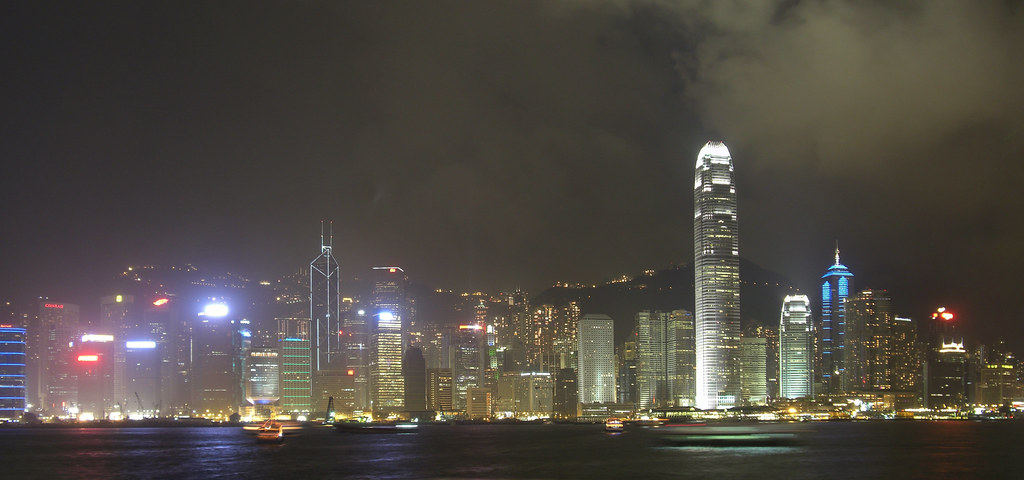
“Hong Kong night Panorama” by Andos_pics is licensed under CC BY-NC-SA 2.0


The motto of the resistance in Hong Kong is on my lips much lately, though often I am not applying it to Hong Kong. Nor am I not. I look at this “Oriental entrepôt” (as we used to say before political correctness), where once I lived for a couple of months, from a great and widening distance. The people there are quite another generation from that which I remember; of course they seem much younger. The idea of the inhabitants of Hong Kong nearly closing the city with demonstrations, week after week, was not formerly possible to imagine. But their enthusiasm for the personal freedom they once enjoyed (under the aegis of British imperialism and colonialism, descending from opium wars), hardly surprises me.
The British approach was finally, live and let live; but it had an administrative basis. From the 1950s, Hong Kong was an experiment. What would happen if they deregulated almost everything, and cut taxes to match? If they consciously de-politicized the colonial administration? If they shrank police functions to what was needed only to direct traffic, and defeat crime? The result was, as ever, unprecedented prosperity, but more: a people who forgot the habit even of kow-towing to men “dress’d in a little brief authority.”
People were transformed, from indifferent parts in a rusting machine, to free agents. (Unfortunately, in a broader view, prosperity also kills, as people use their freedom only for material gain, and a new jackboot state grows around the need to protect against the consequences.)
Hong Kong is a city now of seven million souls. It has, as it had, economic and social classes — plenty of them — yet the present “troubles” have nought to do with class. Opposition to the Communist government is as broad as it was in all ex-Soviet states, as we discovered when the Berlin Wall fell, and nearly discovered across China in the moment of Tiananmen. Rebellion, to start, is an urban phenomenon; it begins with a sudden collective sense that “we have the numbers.” The fear, upon which all tyrannical regimes depend, evaporates. What happens next is anyone’s guess, except, we can know the regime is doomed.
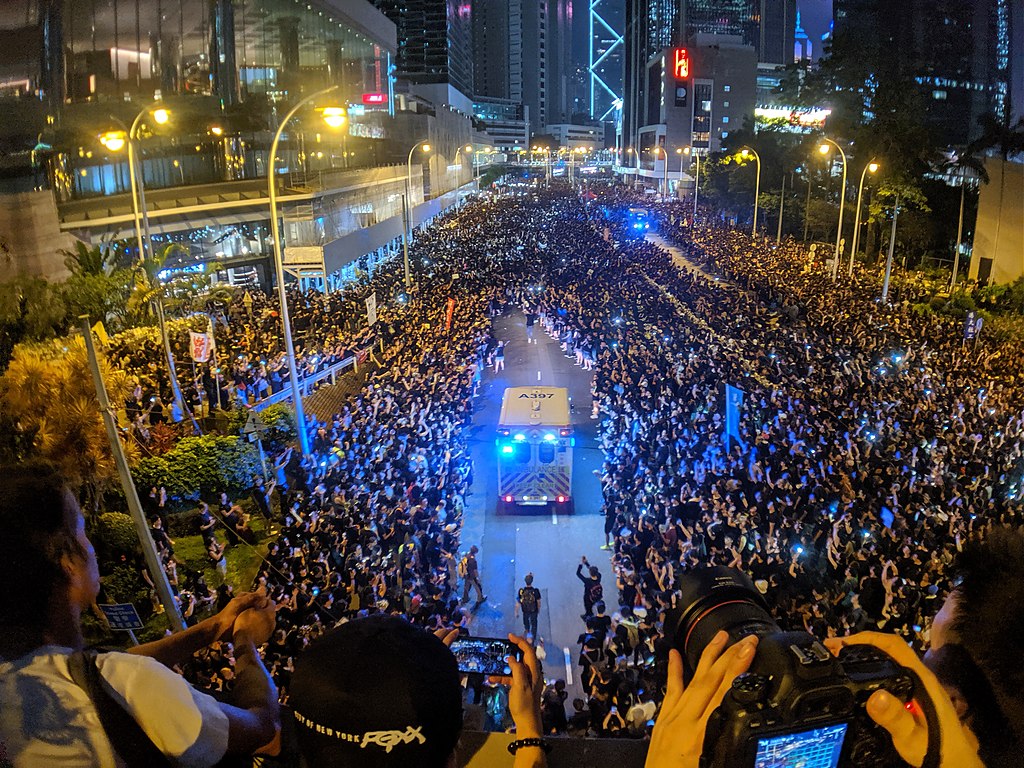
2019 Hong Kong anti-extradition law protest on 16 June, captured by Studio Incendo from Flickr.
Photo via Wikimedia Commons
7 Brutal Days for the Kriegsmarine – Battle for Norway
iChaseGaming
Published on 9 Sep 2019The first few days of Operation Weserübung, the invasion of Norway, cost the Kriegsmarine‘s surface fleet dearly. While the invasion and occupation was successful the German Navy would be hampered for the remainder of the war.
♥ Connect with me ♥
Discord: https://discord.gg/ichasegaming
Twitch: http://www.twitch.tv/ichasegaming
Twitter: https://twitter.com/iChaseGaming♦ Become my Patron at https://www.patreon.com/iChaseGaming ♦
To contact me via e-mail send it to chasegamingtv@gmail.com

QotD: England has become the Mother Hive
Now, something like this has happened in England. In the past few generations, the whole of national life has been taken over by the cultural Marxists. They run government and the administration, and the law, and education and the media, and business too. They have imposed on us a nasty hegemonic discourse. Cultural Marxism is ultimately to be traced to European thinkers like Antonio Gramsci and Louis Althusser and the Frankfurt School. But this has come to England in American clothing. It has prestige because it was taken up by the American universities.
In America, however, the progress of cultural Marxism has been resisted, or slowed, by a strong religious right and by a written constitution that it is taking a long time to subvert. Here, we have no religious right, nor an entrenched constitutional law. In the past, freedom and common sense were safeguarded by an hereditary land-owing aristocracy and gentry. These ran the country, and did much to determine its moral tone. During the twentieth century, they were marginalised and then eliminated from government. They remain as a class — still very rich — but the tacit deal since at least the 1940s has been that they will be left alone, so long as they keep out of politics. Government has been left to middle class lefties. The effect followed the cause only after several generations. But here it is.
It may be interesting for you, as foreigners, to learn an answer to the implied question in the title of this speech. But it is essential for the English to think about the question and its answers. You see, like both the Germans and the Russians, we have had a revolution. Unlike them, we have had no obviously revolutionary event. The Russians had the storming of the Winter Palace and the murder of their Royal Family. The Germans were utterly defeated in 1945. Their cities were bombed flat. Their country was occupied and divided. Every German knows either that German history came to an end in 1945, or at least that a new chapter in German history had begun.
We do not have that awareness, and it would be useful for us to understand, even so, that we are living in a state of revolution. England has become the Mother Hive.
Sean Gabb, “A Nation of Sheep: Understanding England and the English”, Libertarian Enterprise, 2017-09-23.
October 17, 2019
England in 1550 was a remarkably unpromising location for the later industrial revolution
Anton Howes, in his investigations on the Industrial Revolution looks back in time to see where or even if England deviated from the rest of Europe in ways that made the revolution possible, thinks he’s located the crucial time:
If a peaceful extraterrestrial visited the world in 1550, I often wonder where it would see as being the most likely site of the Industrial Revolution – an acceleration in the pace of innovation, resulting in sustained and continuous economic growth. So many theories about why it happened in Britain seem to have a sense of inevitability about them, but our extraterrestrial visitor would have found very few signs that it would soon occur there. There were many better candidates, on a multitude of metrics.
[…]
But England in 1550 was by global standards quite poor. Historical GDP per capita measures are notoriously difficult to obtain, even for some countries in the twentieth century let alone the sixteenth. The historical GDP per capita of England – by far the most studied region – is still hotly debated among economic historians. Nonetheless, according to the most recent collection of estimates – the Maddison project’s database of 2018 – in 1550 our extraterrestrial visitor would have been much more interested in Belgium. England at that stage lagged behind almost all of the areas for which we have estimates: Holland, Spain, Italy, Sweden, and France. In 1600, it was behind Portugal and India. Here are the figures in 2011 dollars; the colours are by row:
Such estimates should of course be taken with a hefty boulder of salt. (Note, also, that these particular figures, called “CGDPpc”, are something of an innovation by the team compiling the Maddison Project Database – they use multiple benchmarks to improve how we compare countries’ relative incomes in any particular year, which comes at the cost of not being able to compare their growth rates, for which there are separate figures. In other words, you should read the figures by row, not by column.) But it is worth noting that the more recent research on historical GDP per capita, finally filling in some details for regions other than England and Holland, often results in those other countries seeming richer in the sixteenth and seventeenth centuries. The more we know, the more the traces of an early English divergence seem to disappear.
Even without access to such statistics, however, our visitor would have noticed that in the mid-1550s England suffered severe food shortages. Indeed, the threat of famine would be present right up until the beginning of the eighteenth century: there was a major famine in the north of England in 1649, and even a famine in the 1690s that killed between five and fifteen percent of Scotland’s population. Britain would one day become perhaps the first famine-free region, but that did not occur until much later, when innovation had already begun to accelerate. It may even have been its result.
And England in 1550 was not just poor; it was also weak. If our visitor thought, as some historians do, that conquest and exploitation were essential for future growth, then it was Spain that had the major overseas empire, followed by Portugal. England in 1550 had no colonies in the New World, and its attempts to found them all failed until the seventeenth century, by which stage the Dutch and French had also begun to extend their own empires too. It was not until the eighteenth century that Britain began to exceed them.

American Eagle Lugers
Forgotten Weapons
Published on 1 Dec 2014
Dissent This
Sold for $14,950 (9mm fat barrel) and $9,775 (7.65mm test trials).Many people are aware of the .45 caliber Lugers made for US military field trials — but far fewer people realize that Lugers were both tested by the US military and sold commercially several years prior to the .45 tests.
In 1900, the US military put several hundred 7.65mm Luger pistols into field trials with both infantry and cavalry units. These pistols were marked with a large and elaborate American eagle crest, in an attempt by DWM to enhance the gun’s appeal to Americans. A similar tactic was used in production of Lugers for Swiss sale, with a large Swiss cross (and it worked well).
After complaints about the small caliber of the early 1900 Lugers, DWM developed the 9mm Parabellum cartridge, and attempted to sell them commercially in the US (and elsewhere). A small batch were also purchased for further military testing.
http://www.forgottenweapons.com
Theme music by Dylan Benson – http://dbproductioncompany.webs.com

October 15, 2019
The Tide Is Turning – Russian Civil War Fall 1919 I THE GREAT WAR 1919
The Great War
Published 14 Oct 2019Support 16 Days in Berlin: https://realtimehistory.net/indiegogo
The White Russian advance on Moscow comes to a crashing end as the Red Army manages to turn the tide of the Russian Civil War in Fall 1919.
» SUPPORT THE CHANNEL
Patreon: https://www.patreon.com/thegreatwar
Merchandise: https://shop.spreadshirt.de/thegreatwar/» SOURCES
Figes, Orlando. A People’s Tragedy. The Russian Revolution (London: The Bodley Head, 2017 [1996]).
Mawdsley, Evan. The Russian Civil War (New York: Pegasus Books, 2005).
Smele, Jonathan. The “Russian” Civil Wars 1916-1926 (London: Hurst, 2015).
Sumpf, Alexandre. “Russian Civil War,” in 1914-1918 online. International Encyclopedia of the First World War. https://encyclopedia.1914-1918-online.
Engelstein, Laura. Russia in Flames (Oxford University Press, 2017).»CREDITS
Presented by: Jesse Alexander
Written by: Jesse Alexander
Director: Toni Steller & Florian Wittig
Director of Photography: Toni Steller
Sound: Toni Steller
Editing: Toni Steller
Mixing, Mastering & Sound Design: http://above-zero.com
Maps: Daniel Kogosov (https://www.patreon.com/Zalezsky)
Research by: Jesse Alexander
Fact checking: Florian WittigChannel Design: Alexander Clark
Original Logo: David van StepholdA Mediakraft Networks Original Channel
Contains licensed material by getty images
All rights reserved – Real Time History GmbH 2019

October 14, 2019
Cavalry Combat & Tactics during the Napoleonic Era
Military History Visualized
Published 20 Jan 2018This video gives insights in cavalry combat and tactics during the era of Napoleon. This includes cavalry types, forms of combat, formations, organization, principles and many more.
Link to History Gaming Verified: https://www.youtube.com/channel/UCoeY…
»» SUPPORT MHV ««
» patreon – https://www.patreon.com/mhv
» paypal donation – https://www.paypal.com/cgi-bin/webscr…Military History Visualized provides a series of short narrative and visual presentations like documentaries based on academic literature or sometimes primary sources. Videos are intended as introduction to military history, but also contain a lot of details for history buffs. Since the aim is to keep the episodes short and comprehensive some details are often cut.
» SOURCES «
Rothenberg Gunther E.: The Art of Warfare in the Age of NapoleonNosworthy, Brent: Battle Tactics of Napoleon and his Enemies
Bruce, Robert B.; Dickie, Iain; Kiley, Kevin; Pavkovic, Michael F.; Schneid, Frederick C.: Fighting Techniques of the Napoleonic Age 1792 – 1815: Equipment, Combat Skills, and Tactics
Ortenburg, Georg: Waffen der Revolutionskriege 1792-1848
Planert, Ute: “Die Kriege der Französischen Revoluation und Napoleons. Beginn einer neuen Ära der europäischen Kriegsgeschichte oder Weiterwirken der Vergangenheit?” In: Beyrau, Dietrich; Hochgeschwender, Michael; Langewiesche, Dieter (Hrsg.): Formen des Krieges. Von der Antike bis zur Gegenwart, S. 149-162
Rogers, H.C.B.: Napoleon und seine Armee / Napoleon’s Army
Browing, Peter: The Changing Nature of Warfare. The Development of Land Warfare from 1792 to 1945
Citino, Robert M.: The German Way of War
Chandler, David: The Art of Warfare in the Age of Marlborough
Philip J. Haythornthwaite: Weapons & Equipment Of The Napoleonic Wars
Hughes, B. P.: Firepower – Weapon Effectiveness on the Battlefield, 1630-1850
Lind, William S.: “Maneuver”; in: Margiotta, Franklin (ed): Brassey’s Encyclopedia of Land Forces and Warfare, p. 661-667
AskHistorians: How does a commander screen his army?
https://www.reddit.com/r/AskHistorian…Russell, Jill R.: With rifle and bibliography: General Mattis on professional reading
http://www.strifeblog.org/2013/05/07/…» DISCLAIMER «
Amazon Associates Program: “Bernhard Kast is a participant in the Amazon Services LLC Associates Program, an affiliate advertising program designed to provide a means for sites to earn advertising fees by advertising and linking to amazon.com.”Bernhard Kast ist Teilnehmer des Partnerprogramms von Amazon Europe S.à.r.l. und Partner des Werbeprogramms, das zur Bereitstellung eines Mediums für Websites konzipiert wurde, mittels dessen durch die Platzierung von Werbeanzeigen und Links zu amazon.de Werbekostenerstattung verdient werden können.
» TOOL CHAIN «
PowerPoint 2016, Word, Excel, Tile Mill, QGIS, Processing 3, Adobe Illustrator, Adobe Premiere, Adobe Audition, Adobe Photoshop, Adobe After Effects, Adobe Animate.

Krupp 50mm Mountain Gun (Thai Model 1902)
Forgotten Weapons
Published on 27 Jul 2014http://www.forgottenweapons.com
Theme music by Dylan Benson – http://dbproductioncompany.webs.com
Taking a look at another artillery piece today, a 50mm mountain gun made for Siam (now Thailand) by the German Krupp company. It is a relatively simple (and thus relatively inexpensive at the time) design, with no recoil mechanism or adjustable traverse.