
My nastier, more vindictive side rather hopes that it will take so long to renovate the British Houses of Parliament, and the unmistakable clock tower of Big Ben, that MPs have to move out of the building for good, and are rehoused in a hideous modern shed in the suburbs. This may seem spiteful. It is spiteful. Even so, there is a good case for it.
It is a real issue. For many years the experts have known that the Palace of Westminster, which looks so good in the background of TV news reports, is close to falling down. It was not very well built in the first place. It was quite severely bombed by Herr Hitler in 1941, and rebuilt on the cheap in the lean years after the war. A very expensive attempt to restore it in the 1980s has not held off the ravages of the years. A subway line which runs beneath it is suspected of making things worse. And now they are having to silence the great bell of Big Ben to allow unavoidable repairs to be done. Experts would like to shut the whole building down for several years and send both Houses of Parliament somewhere else. The members themselves don’t want to go. Who knows where they might end up? Worse, seen against a more ordinary background, would they look as dull and undistinguished as they truly are?
Peter Hitchens, “An Empty Parliament”, First Things, 2017-10-03.
October 14, 2019
QotD: Parliament and the Palace of Westminster
October 13, 2019
It’s raining bombs, keep calm and carry on… – WW2 – 059 – October 12 1940
World War Two
Published 12 Oct 2019The Blitz continues while Chinese Communists are fighting Chinese Nationalist in China. But the mass bombing of civilian targets does not really do what it is supposed to.
Join us on Patreon: https://www.patreon.com/TimeGhostHistory
Or join The TimeGhost Army directly at: https://timeghost.tvFollow WW2 day by day on Instagram @World_war_two_realtime https://www.instagram.com/world_war_two_realtime/
Join our Discord Server: https://discord.gg/D6D2aYN.
Between 2 Wars: https://www.youtube.com/playlist?list…
Source list: http://bit.ly/WW2sourcesWritten and Hosted by: Indy Neidell
Produced and Directed by: Spartacus Olsson and Astrid Deinhard
Executive Producers: Bodo Rittenauer, Astrid Deinhard, Indy Neidell, Spartacus Olsson
Creative Producer: Joram Appel
Post-Production Director: Wieke Kapteijns
Research by: Indy Neidell
Edited by: Iryna Dulka
Map animations: Eastory
Sound design: Marek KaminskiColorisations by Norman Stewart and Julius Jääskeläinen https://www.facebook.com/JJcolorization/
Eastory’s channel: https://www.youtube.com/channel/UCEly…
Archive by Screenocean/Reuters https://www.screenocean.com.A TimeGhost chronological documentary produced by OnLion Entertainment GmbH.
From the comments:
World War Two
2 days ago
Indy mentioned our Instagram page, where we make a daily post about what happened in the war on that day. This might be something completely different from what’s covered in these videos, or might add some more details. You can follow it by searching @world_war_two_realtime or by clicking here: https://www.instagram.com/world_war_two_realtime/. See you there!
Cheers,
Joram
Tank Chats #52 Sherman Crab Flail | The Funnies | The Tank Museum
The Tank Museum
Published on 15 Jun 2018Tank Chats playlist https://www.youtube.com/playlist?list…
Another episode in the Tank Chats Funnies Specials, looking at the weird and wonderful vehicles of 79th Armoured Division led by Major General Percy Hobart.
The Flail tank was designed to clear mines and flails were operated in the 79th Armoured Division after D-Day.
Support the work of The Tank Museum on Patreon: ► https://www.patreon.com/tankmuseum
Or donate http://tankmuseum.org/support-us/donateVisit The Tank Museum SHOP: ►https://tankmuseumshop.org/
Press the little bell above to enable NOTIFICATIONS so you don’t miss the latest Tank Museum videos.
Twitter: ► https://twitter.com/TankMuseum
Tiger Tank Blog: ► http://blog.tiger-tank.com/
Tank 100 First World War Centenary Blog: ► http://tank100.com/ #tankmuseum #tanks #tankchats

QotD: The modern British army is custom-tailored to resist reform of any meaningful type
Talking to friends in the army, there is a real sense of anger and frustration among many mid-level officers. The veterans of [Operation] HERRICK feel that the army hasn’t learned lessons and remains bound by tradition and an inability to really learn. Candidly, many feel that the UK “lost” in Afghanistan and hasn’t yet accepted this fact. They feel the army is overly top heavy and rigid and unable to really adapt to 21st century warfare. Suggestions that much of the army exists as a structure to support rapid expansion in the future is met with a hollow snort of derision – we could never do a WW1-style rapid expansion again for the legacy reserve stocks of weapons and equipment have long since been disposed of as part of the move to RAB accounting in the early 2000s.
The operations that the army is likely to be involved in are either low level defence engagement, or as part of NATO reassurance in Eastern Europe. The chances of needing BAOR established again are slim – if we get to the stage where the UK is trading shots with the Russians, then things will be quickly escalating beyond the point where conventional weapons are of value. Home defence remains an issue, although the days of Exercise “Brave Defender” will never be repeated — the threat is completely different. There is simply no credible home threat that needs the army to deploy against invasion or insurrection. It is telling that there has been a move to get back into the Aid to the Civil Power role again, if only because having troops able to do flood relief helps generate positive headlines.
Whenever brave efforts are made to try and look again at how things can be done differently to free up funding (such as closing RHQs or making sense of the archaic HQ and regimental structure) leaks to the press ensure a media and Parliamentary furore that prevents real change being put into play. This stops the army from being able to genuinely restructure itself because the moment it tries to do so, some tired old headline such as “we don’t have an army anymore, only a militia” (an utter fallacy) appears and men of a certain generation with angry moustaches and blazers with badges and purchased medals write to their MPs. In a Parliament without a majority, it only takes a minor backbench rebellion to threaten chaos, meaning no minister will risk reform if it angers the backbenches.
The army today faces a structural and existential crisis. Too large to be properly funded, and politically barred from restructuring itself (although the recent 2017 manifesto pledge is merely to preserve the headline strength of the forces, not the individual services, so there is still hope). Denied a credible enemy that it can prepare to fight against, it has no clear rationale for why it needs to operate at a large scale when the political decision makers are increasingly set against boots on the ground for long term commitment.
Sir Humphrey, “How Do You Solve a Problem Like a Deployable Division?”, Thin Pinstriped Line, 2017-08-06.
October 12, 2019
Göring, the Stoned Nazi Nut – Doped WW2 Leaders Part 1
World War Two
Published 10 Oct 2019Hermann Göring was one of the most powerful leaders of the Third Reich. He was also a drug addict with some serious problems and a remarkable lifestyle.
Join us on Patreon: https://www.patreon.com/TimeGhostHistory
Or join The TimeGhost Army directly at: https://timeghost.tvFollow WW2 day by day on Instagram @World_war_two_realtime https://www.instagram.com/world_war_t…
Join our Discord Server: https://discord.gg/D6D2aYN.
Between 2 Wars: https://www.youtube.com/playlist?list…
Source list: http://bit.ly/WW2sourcesHosted by: Indy Neidell
Written by: Joram Appel
Produced and Directed by: Spartacus Olsson and Astrid Deinhard
Executive Producers: Bodo Rittenauer, Astrid Deinhard, Indy Neidell, Spartacus Olsson
Creative Producer: Joram Appel
Research by: Joram Appel
Edited by: Iryna Dulka
Map animations: EastoryColorisations by Norman Stewart and Julius Jääskeläinen https://www.facebook.com/JJcolorization/
Eastory’s channel: https://www.youtube.com/channel/UCEly…
Archive by Screenocean/Reuters https://www.screenocean.com.Sources:
Klimbim Colorizations – https://klimbim2014.wordpress.com/A TimeGhost chronological documentary produced by OnLion Entertainment GmbH.
From the comments:
World War Two
31 minutes ago (edited)
Though this episode is mostly about the lifestyle of Hermann Göring, we will certainly get back to his more serious impact on the Nazi party, Germany and World War Two. For those of you who are new here, we are following World War Two Week by Week, in which we do pay a lot of attention to all those smaller but still significant events. If you would like to watch the series, make sure to subscribe and to click here to start watching from episode one: https://www.youtube.com/watch?v=3-A1gVm9T0A&list=PLsIk0qF0R1j4Y2QxGw33vYu3t70CAPV7XCheers,
The TimeGhost team.

To the amazement of the chattering classes, Greta didn’t win the Nobel
Teen apocalypse prophet Greta Thunberg not only had her childhood stolen from her, now they’ve stolen her Nobel Prize:

Greta Thunberg at the EU Parliament, 16 April, 2019.
European Parliament photo via Wikimedia Commons.
It seems like Ethiopian Prime Minister Abiy Ahmed Ali stole even more of Greta Thunberg’s childhood by winning this year’s Nobel Peace Prize, beating the 16-year old Swedish Apocalyptic who seemed to have been the sentimental favourite of the international chattering classes (and the betting site Ladbrokes) for her figureheading of Climate Strikes and her recent appearance at the [United Nations] where she shouted at the adults for killing the planet. Ali was awarded the prize for ending the twenty-year conflict with the neighbouring Eritrea (once a part of Ethiopia) and the general moves to liberalise what has been a rather unappealing regime. In other words, Prime Minister Ali got his Peace Prize for actually bringing peace. Radical, eh?
Interestingly, Ali has not only done more for peace than Thunberg (it’s perhaps not a great claim to fame to have beaten a 16-year old girl, but hey, her cheerleaders in the media and elsewhere have turned her into a cross between a saint and a savant); he has also done far more for the environment. While Thunberg and millions of others wagged school and work and sat on their asses to save the Earth, Ali and millions of his compatriots got off theirs to do something quite spectacular recently:
Ethiopians planted more than 350,000,000 trees* in just 12 hours on Monday [29 July], the country’s minister of innovation and technology announced on Twitter. The mass-tree planting not only helps the environment, it sets a world record, the Associated Press reported.
Prime Minister Abiy Ahmed created the initiative to help restore Ethiopia’s landscape, which experts say is being eroded by deforestation and climate change, the AP reported.
The country’s goal was to plant 200 million trees in one day. But Getahun Mekuria, Ethiopia’s Minister of Innovation and Technology, later announced that 353,633,660 trees were planted.
Ethiopia has a larger goal of planting 4 billion trees between May and October 2019. So far, more than 2.6 billion trees have been planted in almost all parts of the country, the AP reported.
Planting trees is one of the most effective ways of removing CO2 from the atmosphere, which the trees (and all other plants) do through the process of photosynthesis as they grow. In fact, half the weight of a tree is carbon. Statistics vary between countries (and climates, soil conditions, etc), but a hectare of wood in the United States has some 118 tons of carbon, while in Europe the figure is 177 tons (density of trees can also, of course, vary widely but the plantation average is 1000-2500 per hectare). By the way, one tonne of carbon accounts for 3.67 tonnes of carbon dioxide, with oxygen being released back into the atmosphere.
October 11, 2019
Germany Never Elected Hitler | BETWEEN 2 WARS I 1933 Part 1 of 3
TimeGhost History
Published 10 Oct 2019Hitlers rise to power, also known as the Machtergreifung, was riddled with physical and mental manipulation, political games and an exploitation of the Democratic system. This episode follows the events leading up to the Nazi takeover of Germany.
Join us on Patreon: https://www.patreon.com/TimeGhostHistory
Hosted by: Indy Neidell
Written by: Spartacus Olsson
Directed by: Spartacus Olsson and Astrid Deinhard
Executive Producers: Bodo Rittenauer, Astrid Deinhard, Indy Neidell, Spartacus Olsson
Creative Producer: Joram Appel
Post-Production Director: Wieke Kapteijns
Research by: Spartacus Olsson
Edited by: Daniel Weiss
Sound design: Iryna Dulkaimage source:
Deutsche BundesarchivA TimeGhost chronological documentary produced by OnLion Entertainment GmbH.
From the comments:
Spartacus Olsson
18 minutes ago
Hi, for those of you that don’t know me yet, I’m the lead author of this series and the author of this episode. Now, as you will, or have just seen, this episode covers an event of earth-shattering magnitude in human history. An event that is often misunderstood and glossed over. The reason for that is not that there is anything controversial, or stupendously new with what we’re documenting here. The simple fact is that its just too detailed and too complicated to cover in general history studies, especially in secondary school. The level we get into here is usually only covered in specialized lectures at college or university level. Tons and tons of books have been written on the topic and yet, many misconceptions remain. It was my goal to dispel some of the many misunderstandings that abound about how Hitler finally seized power. One of the chief myths is that Hitler was elected. As the video shows, that is not what happened. So you might ask yourself; how come the vast majority of Germans finally rallied behind him? Because they did, there’s no question. But you see, that happens after he seizes power and it will be the topic of our next episode on Germany that covers the Nazi consolidation of power.It was also my goal to cast some more light on a topic that has been weaponized in political debate in recent years: the level of Socialism in the German National Socialist Worker’s Party. I hope that I have laid the latter one to rest, but I fear that the comment section will still be full of politically biased nonsense on this topic. It’s quite tiring for our community managers to answer that misrepresenting alt-right trope over and over again. And we won’t stop you from posting it, even if it’s nonsense. Instead we will try to patiently answer, but think fifteen times about posting ‘Nazis were Socialists, duh!’ or “Dude, Nazis are left-wing, duh!’ out of respect for us. What we will not tolerate is that you post links to any of the clown videos by non-historians that try to perpetuate that myth. We are a team of actual historians. We have no interest in ‘pinning’ Naziism on anyone. We also have no interest in ‘pinning’ Socialism on anyone. Nor should you, if you have any interest whatsoever in understanding history. Revolutionary Socialism, Communism, Fascism and Nazism have all brought down a lot of suffering on humanity – if we are supporters of freedom and democracy we need to learn from that. Throwing them all in one bucket and dumping it on our perceived political opponents is not learning, it’s obfuscation, confusion, and destruction of education. So respect humanity, respect history and don’t take part in that kind of nonsense.

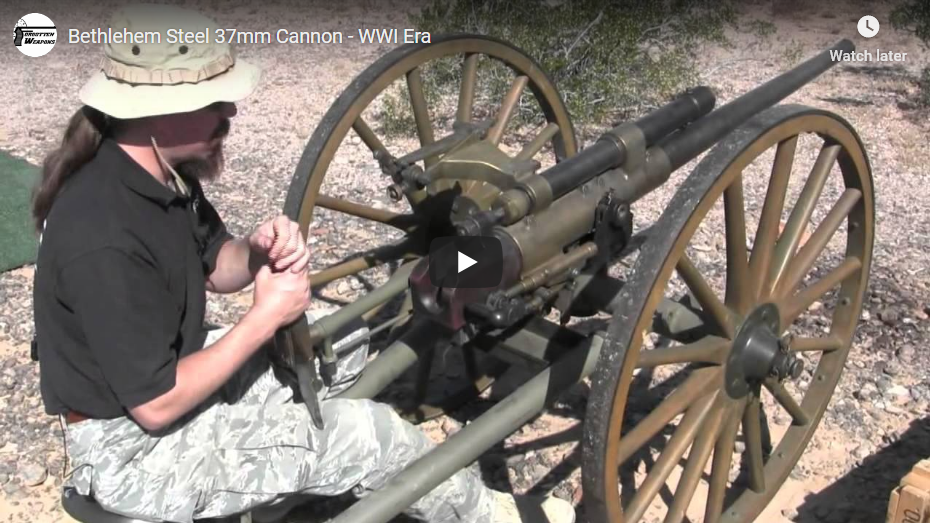
Bethlehem Steel 37mm Cannon – WWI Era
Forgotten Weapons
Published on 6 Jul 2014http://www.forgottenweapons.com
Theme music by Dylan Benson – http://dbproductioncompany.webs.com
The 37mm gun was found in many guises during World War One – that caliber was the smallest allowed to use exploding projectiles by the 1899 Hague accords. Every nation in the world, it seems, used 37mm guns of one type or another. Well, one particular version I had the chance to look at was built by Bethlehem Steel in Pennsylvania for the French Army. Chambered for the same 37x136mm Hotchkiss Heavy cartridge used in US naval service, 200 were purchased in 1916. Only 15 were actually shipped before the US Army seized the bulk of the order in 1917 – but they were never put into any sort of service by the US military. The French tested the guns for suitability as an infantry gun, anti-tank gun, anti-aircraft gun, and naval landing gun – and found it unsuitable for all roles. It was probably tested only as a backup in case the redesign of the Mle 1916 Tir Rapid ran into problems.
At any rate, the 15 guns sent to France were sent back at the end of the war, and the guns remained in US Army inventory until 1921, when they appear to have been distributed out the National Guard units.
I think this is a very cool gun for the present-day enthusiast. In addition to the historical links to WWI, it has the practical benefits of being relatively light and using ammunition relatively inexpensive to reload. And, of course, the free mount and shoulder rest and iron sights give it more the feel of a shoulder rifle than later light artillery that use precisely adjusted mounts. This one is just more fun to shoot! Alas, there are very few still in existence. Perhaps an opportunity for someone who wants to make a reproduction Big Boy’s Toy?
October 10, 2019
Suez Crisis Part 2 of 2
Epic History TV
Published on 28 Dec 2017In 1956, an international crisis over control of the Suez Canal put Britain and France into direct conflict with President Nasser of Egypt, a proud Arab nationalist determined to stand up to foreign powers meddling in Egyptian affairs.
Part 2 explores how Britain, France and Israel cooked up a secret plan to invade Egypt, overthrow Nasser and reassert their standing as global powers. But when the international community, and in particular the United States, condemned their actions, the aggressors were forced into a humiliating climbdown. The repercussions for the Middle East and global history were long-lasting and profound.
Archive film from AP Archive http://www.aparchive.com/
Music from Filmstro https://www.filmstro.com/
Get 20% off an annual license! Use our exclusive coupon code:EPICHISTORYTV_ANNHelp me make more videos by supporting Epic History TV on Patreon https://www.patreon.com/EpicHistoryTV
Further Reading on Suez Crisis (click affiliate links to buy on Amazon & support the channel):
Blood and Sand, Alex von Tunzelmann (Simon & Schuster, 2016) http://geni.us/QyoWs
Suez: Britain’s End of Empire in the Middle East, Keith Kyle (I.B.Tauris, 2011) http://geni.us/aqn6AH
The Suez Crisis 1956, Derek Varble (Osprey, 2003) http://geni.us/ANxBQEE
“Suez 1956”, Timothy Benson in History Today (Nov 2006)
“Suez: The Canal Before the Crisis”, Steve Morewood in History Today (Nov 2006)
“Nasser, Suez and Arab Nationalism”, Michael Scott-Baumann in History Today (Mar 2010)
“The First Suez Crisis”, Christopher Danziger in History Today (Sep 1982)
The Suez Crisis, by Laurie Milner, BBC website http://www.bbc.co.uk/history/british/…
“Andrew Bacevich reviews ‘Eisenhower 1956′”, London Review of Books (Vol.33 No.12)
“Avi Shlaim reviews ‘Israel’s Border Wars, 1949-56′”, London Review of Books (Vol.16 No.16)#EpicHistoryTV #SuezCrisis #ColdWarHistory

October 9, 2019
Theodore Dalrymple on Justin Trudeau and David Cameron
He doesn’t hate either of them, he just thinks they are either fools or knaves. As the Instapundit often says, it might be time to “embrace the healing power of ‘and'”:

No doubt it is the mark of bad character to rejoice, as I do, in the spectacle of a man being hoist with his own petard, and as the Canadian Prime Minster, Justin Trudeau, has recently been hoist. And while I am at it, I confess also that, though I know that there is no art to find a mind’s construction in the face, I cannot help also but judge people, at least to an extent, by their physiognomy. And the fact is that Mr Trudeau has a face as characterless as that of the former British Prime Minister, David Cameron. They are of the same ilk. You look at them and think “What nullities!” The main character discernible in their faces is lack of character.
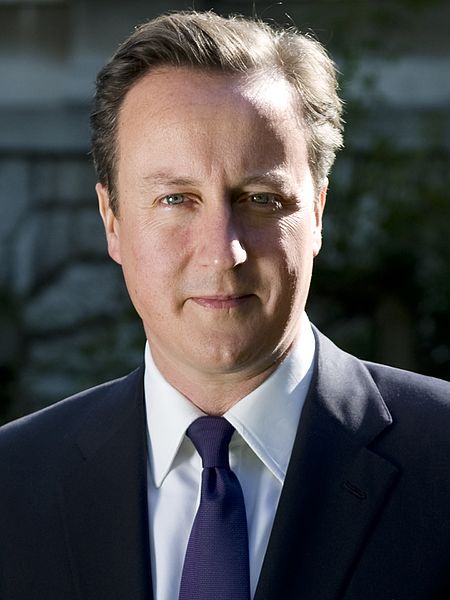
David Cameron’s official portrait from the 10 Downing Street website, 3 August 2010.
Open Government Licensed image via Wikimedia Commons.It is not their fault, perhaps; besides which I, or you, might be mistaken in our assessment of them and actually they have backbones (or what my teachers use to call moral fibre) of enormous strength. In any case, there are worse things to be, especially in the field of politics, than a nullity: an evil monster, for example, would be far worse, and no one could seriously claim that either of Messrs Trudeau and Cameron are, or were, evil monsters, however little they inspire admiration.
No one, then, could accuse me of partiality for Mr Trudeau, and the abjectness of his apology for his behaviour when he was a very young man did nothing to increase my liking for him. But it seems to me that sins as a young man were venial at worst, a callow disregard of the sensibilities of others which I common in youth. I very much doubt that he was a deep-dyed racist in any dangerous way, more a silly boy having a bit of fun.
There is a serious side to this imbroglio, of course. If the political leader of an important country can be overthrown or not re-elected on so relatively trivial a ground, while at the same town no one cares in the least about his shallow but dangerous moral posturing and obviously weak-minded pandering to the ayatollahs of an absurd and ill-founded political morality, then a new nadir of decadence and cowardice has been reached. It is a difficult question of moral philosophy as to whether it would be worse if Mr Trudeau actually believed his own political correctness or merely made use of it as a means to power. If the former, he is a fool; if the latter a knave. I leave it to others to decide which is better in a politician, or indeed in any other human being, foolishness or a knavery.
Political correctness is dangerous because when fools or knaves get into power, they may try to implement its dictates. And since many people are much more concerned to appear good than to do good, and since they are unlikely to suffer the consequences of their own actions (except when hoist on their own petard), the implementation may continue for a long time after the negative effects of its dictates have become clear. When implemented, those dictates create a clientele dependent upon their continuation, which turns any attempt to undo the harm into a nasty social conflict.
The Villa Council Presents: 1177 BC: The Year Civilization Collapsed
Getty Museum
14 Jun 2016Noted historian and archaeologist Eric Cline discusses the themes of his Pulitzer Prize-nominated book 1177 BC: The Year Civilization Collapsed and takes a closer look at why Mediterranean societies of the Late Bronze Age — with their complex cosmopolitan and globalized world-systems — came to a dramatic halt. He considers the similarities and parallels of our contemporary civilization, making the chain of interconnected events more than simply a study of ancient history.
Photo: Blink Films
May 22, 2016
The Getty Villa, Malibu, CaliforniaFind out what’s on now at the Getty:
http://www.getty.edu/360/
#gettytalks

Suez Crisis Part 1 of 2
Epic History TV
Published on 22 Dec 2017In 1956, an international crisis over control of the Suez Canal put Britain and France into direct conflict with President Nasser of Egypt, a proud Arab nationalist determined to stand up to foreign powers meddling in Egyptian affairs.
To understand the deep roots of the crisis we go right back to the creation of the canal in 1869, and the long history of British intervention in Egypt — all with the usual Epic History TV maps as well as loads of brilliant and rarely-seen archive film from the period.
Archive film from AP Archive http://www.aparchive.com/
Music from Filmstro https://www.filmstro.com/
Get 20% off an annual license! Use our exclusive coupon code:EPICHISTORYTV_ANNHelp me make more videos by supporting Epic History TV on Patreon https://www.patreon.com/EpicHistoryTV
Further Reading on Suez Crisis (click affiliate links to buy on Amazon & support the channel):
Blood and Sand, Alex von Tunzelmann (Simon & Schuster, 2016) http://geni.us/QyoWs
Suez: Britain’s End of Empire in the Middle East, Keith Kyle (I.B.Tauris, 2011) http://geni.us/aqn6AH
The Suez Crisis 1956, Derek Varble (Osprey, 2003) http://geni.us/ANxBQEE
“Suez 1956”, Timothy Benson in History Today (Nov 2006)
“Suez: The Canal Before the Crisis”, Steve Morewood in History Today (Nov 2006)
“Nasser, Suez and Arab Nationalism”, Michael Scott-Baumann in History Today (Mar 2010)
“The First Suez Crisis”, Christopher Danziger in History Today (Sep 1982)
The Suez Crisis, by Laurie Milner, BBC website http://www.bbc.co.uk/history/british/…
“Andrew Bacevich reviews ‘Eisenhower 1956′”, London Review of Books (Vol.33 No.12)
“Avi Shlaim reviews ‘Israel’s Border Wars, 1949-56′”, London Review of Books (Vol.16 No.16)#EpicHistoryTV #SuezCrisis #ColdWarHistory

October 8, 2019
Sarah Hoyt on the “rough music”
Sarah Hoyt borrows a notion from Terry Pratchett’s Discworld series to explain a real phenomenon in our world:
Pratchett’s “Witches” world was so similar to my own, from jumping over fires to get married (not legal in my day, but there was memory of it) to various local folk superstitions, that it was always a surprise when he pulled something I’d never heard of.
One of these is the “rough music.”
When someone has done just about enough that a small village can no longer put up with him, the men in the village get together and play a barbarous and terrible music as they nerve themselves up for the barbarous and terrible things they have to do.
In Europe — hell, all over the rest of the world — the rough music is playing. Just because no one is reporting on this, it doesn’t mean it’s not going on, and growing, and nerving itself up to … something.
“Gilets jaunes #12” by Christophe Becker is licensed under CC BY-NC-SA 2.0
The level at which the Gilets Jaunes have been under reported is extraordinary, except that it hasn’t stopped the uprising either.
(And now I think about it, how much do we see in main stream news about Hong Kong? And it hasn’t stopped the uprising either.)
[…]
So, let’s talk about the rough music. Sure, you can hear it. I can hear it too. The stomp and the drumming can be heard all over the world.
That which can’t go on, won’t.
But I implore you to stop and think: if the rough music plays, what comes after?
There might be no hope for Europe, but Europe’s … ah … how do we put this? Europe’s tenets, their stand before the world, an improvement as they were on everything before them, are not ours.
Even in Europe I suspect when this bursts — and there it will burst. The elites flaying and screaming is only making it worse — you’re going to see things that will make you wonder why on Earth good American boys died in WWII. Because we’re about to get National Socialism, the sequel. National because they’re getting tired of the international elites (and who isn’t) and socialism because the poor bastards have not experienced anything else their entire adult lives.
It will happen. It is necessary. The EU was probably one of the most bizarre ideas in the history of bad ideas. The way it’s run which essentially steals the franchise from ordinary people was just the old style “good families” coming back into power through a back door.
But what comes after will probably be horrific. If we’re all lucky it will also be briefish and like France after the revolution they’ll find their way to something slightly less insane. With or without Napoleon and Europe wide war? Ah … that’s where we need to talk.
First however, let me say that hearing the rough music from the rest of the world is starting to echo here. We see what’s going on there. And we hear strange and stupid stuff, like the “whistleblower of the day” and an impeachment without voting and of course, pancake-gate.
Faced with that kind of behavior you obviously think “It’s insane.” And “We have to stop it.”



Extinction Rebellion – “an upper-middle-class death cult”
Brendan O’Neill watched a death cult hold one of their ceremonies in public on the streets of London the other day:

This was, of course, Extinction Rebellion. Let us no longer beat around the bush about these people. This is an upper-middle-class death cult.
This is a millenarian movement that might speak of science, but which is driven by sheer irrationalism. By fear, moral exhaustion and misanthropy. This is the deflated, self-loathing bourgeoisie coming together to project their own psycho-social hang-ups on to society at large. They must be criticised and ridiculed out of existence.
Yesterday’s gathering, like so many other Extinction Rebellion gatherings, was middle-aged and middle-class. The commuters heading in and out of King’s Cross looked upon them with bemusement. “Oh, it’s those Extinction freaks”, I heard one young man say. It had the feel of Hampstead and the Home Counties descending on a busy London spot to proselytise the cult of eco-alarmism to the brainwashed, commuting plebs.
It was a gathering to mark Extinction Rebellion’s week of disruption. The group is asking people in London and other cities around the world to “take two weeks off work” and join the revolt against the “climate and ecological crisis”. You can tell who they’re trying to appeal to. Working-class people and the poor of New Delhi, Mumbai and Cape Town – some of the cities in which Extinction Rebellion will be causing disruption – of course cannot afford to take two weeks off work. But then, these protests aren’t for those people. In fact, they’re against those people.
Extinction Rebellion is a reactionary, regressive and elitist movement whose aim is to impose the most disturbing form of austerity imaginable on people across the world. One of the great ironies of “progressive” politics today is that people of a leftist persuasion will say it is borderline fascism if the Tory government closes down a library in Wolverhampton, but then they will cheer this eco-death cult when it demands a virtual halt to economic growth with not a single thought for the devastating, immiserating and outright lethal impact such a course of action would have on the working and struggling peoples of the world.
Extinction Rebellion says mankind is doomed if we do not cut carbon emissions to Net Zero by 2025. That’s six years’ time. Think about it: they want us to halt a vast array of human activity that produces carbon. All that Australian digging for coal; all those Chinese factories employing millions of people and producing billions of things used by people around the world; all those jobs in the UK in the fossil-fuel industries; all those coal-fired power stations; all that flying; all that driving … cut it all back, rein it in, stop it. And the people who rely on these things for their work and their food and their warmth? Screw them. They’re only humans. Horrible, destructive, stupid humans.
The Toronto chapter of the death cult shut down one of the major bridges across the Don Valley on Monday morning:
Just in time for rush hour on Monday morning, hundreds of climate change activists have barricaded themselves across a major four-lane bridge in the heart of Canada’s largest city.
Extinction Rebellion (XR) Toronto, the local arm of an environmental protest group with demonstrations taking place across the world today, shut down traffic on the Prince Edward Viaduct between Bloor Street and Danforth Avenue around 8 a.m. on Monday morning.
Members of the group formed blockages on both sides of the truss bridge with their bodies and props, including a larger-than-life set of letters reading “ACT NOW.”
Eco protest shuts down Bloor Viaduct this morning #ClimateChange #environment #Toronto #cdnpoli pic.twitter.com/zliNjj49kT
— Rupen Seoni (@RupenSeoni) October 7, 2019
Anton Howes on innovation
Anton Howes publishes a newsletter on the Age of Invention (I just signed up to start receiving it). Here’s an older article from the newsletter on innovation:

The Industrial Revolution was caused by an acceleration of innovation. But how was that acceleration caused? Most theories of the acceleration’s causes assume that innovation is in human nature, that it has always been around.
So, they might argue:
- Property rights became better enforced so budding innovators felt more secure to make themselves known.
- Patents appeared so innovators could reveal their secrets and still profit from them.
- Brits were particularly skilled or well-educated so innovators could more easily get their innovations implemented.
- British society started to accord dignity or honour to innovation so innovators felt motivated to have a go.
- Demand increased so innovators had a big enough market to begin selling their innovations.
And so on. All of these arguments assume the same thing — that innovation is a part of human nature, a choice that has always been recognised. Their implicit claim is that, other than in mid-eighteenth century Britain, save for a few short-lived cases, choosing innovation was simply just not worth it.
I disagree.
The more I study the lives of British innovators, the more convinced I am that innovation is not in human nature, but is instead received. People innovate because they are inspired to do so — it is an idea that is transmitted. And when people do not innovate, it is often simply because it never occurs to them to do so. Incentives matter too, of course. But a person needs to at least have the idea of innovation — an improving mentality — before they can choose to innovate, before they can even take the costs and benefits of innovation into account.
An illustration: at a conference I was at last month the attendees wore lanyards with name tags, which listed their names on one side. Over the course of the conference the tags would inevitably flip over, hiding the names. People would, when introducing themselves, periodically check each other’s tags, flipping them the right way around. But only one person — one single person, of attendees in the hundreds, had the ingenuity to write their name on the other side. To my shame, it wasn’t me.
Everyone at that conference had an incentive to do that innovation. Everyone was there to meet one another, so the innovation helped achieve that goal. And the cost of the innovation was negligible. It took a couple of seconds to whip out a pen and scribble a name. It simply did not occur to them to innovate. Innovation can be extraordinarily rare — despite the opportunities, despite the incentives.


