
… the Kaiser’s armies behaved abysmally on the battlefields of the Great War fighting foreigners. As soon as the Germany Army crossed the border into Belgium, the atrocities began. If the sensational stories of German soldiers eating Belgian babies can be discounted as Allied propaganda, the painstaking research of Alan Kramer and John Horne, in German Atrocities, 1914: A History of Denial (2001), demonstrates beyond reasonable doubt that Germany engaged in a systematic programme of civilian executions with the purpose of striking terror into the heart of the Belgian population. On 23 August, 1914, in the city of Dinant, the German army burned down a thousand buildings and executed some 674 civilians. The oldest among them was in his 90s; the youngest was barely a month old.
On and on the German outrages went: the sinking of the Lusitania, the execution of Nurse Cavell. Of course, the Allies were not saints, but the fashionable fallacy of moral equivalence — that all sides in the Great War were as bad as each other — founders on the rocks of Germany’s treatment of prisoners of war, who became slave labourers.
This was the main substance of the British agenda at Leipzig. Almost 165,000 British soldiers were taken prisoner on the Western Front between 1914-18; by the end of 1916, almost 80% were forced into labour for the Second Reich. Prisoners were literally worked to death in salt mines. And conditions in many camps were inhuman: in Wittenberg, two water taps served 17,000 Allied PoWs. When typhus struck the camp, the German staff abandoned it and left the prisoners to die. Some 13,000 Brits perished in the Kaiser’s camps — the vast majority because of brutality, disease, malnutrition or exhaustion. But 500 British soldiers were summarily shot or beaten to death at the Kaiser’s pleasure during their detention.
Of all the German PoWs held in Britain during the Great War, 3% died; of the British PoWs held in Germany, more than 10% perished. In 1918 it was statistically safer for a British soldier to fight in the trenches of the Western Front than be a prisoner in Germany. That year, 5.8% of British PoWs in Germany died, compared to 4% of British soldiers on the battlefield.
John Lewis Stempel, “Germany’s First World War Guilt”, UnHerd, 2021-05-25.
September 14, 2021
QotD: “In 1918 it was statistically safer for a British soldier to fight in the trenches of the Western Front than be a prisoner in Germany”
September 13, 2021
Early Rome, Part IV: Plutarch’s Life of Numa Pompilius
Thersites the Historian
Published 5 Sep 2021In this video, we look at how the philosopher Plutarch dealt with early Rome when he covered the life and times of Numa Pompilius, the most significant of Rome’s cultural heroes.
Patreon link: https://www.patreon.com/thersites
PayPal link: paypal.me/thersites
Discord: https://discord.gg/QCaXXFr
Brave Browser: https://brave.com/noa557
Twitter link: https://twitter.com/ThersitesAthens
Minds.com link: https://www.minds.com/ThersitestheHis…
Steemit/dtube link: https://steemit.com/@thersites/feed
BitChute: https://www.bitchute.com/channel/jbyg…

How Is Worcestershire Sauce Made? | How Do They Do It?
DCODE by Discovery
Published 25 Sep 2018Worcestershire Sauce was invented in 1835 when a posh army officer went to India to help run the British Empire. He fell in love, not with a woman, but with a fish sauce. DCODE how the iconic sauce is made in England today.
#DCODE, #HowDoTheyDoIt, #WorcestershireSauce

QotD: Those classic British children’s stories
In a boarding school near the Kentish coast, a ruffian sneaks along the corridor, hunting for the rare stamp that will make him rich. In a Home Counties village, a tousled-haired schoolboy lies awake, putting the finishing touches to his scheme that will win the war for the Allies. Many miles to the north, a boat pulls away from Wildcat Island, bound for fortune and glory. And far across the oceans, a group of schoolboys tremble in terror, as their South Sea captors prepare to sacrifice them to their idol …
Such is the world of the classic British children’s story: the world of Billy Bunter and his Greyfriars chums, William Brown and his fellow Outlaws, Titty, Roger and the rest of the Swallows and Amazons, Jennings, Molesworth and the Secret Seven. For more than half a century, such stories dominated the imagination of millions of readers. You can still buy second-hand editions of Richmal Crompton’s Guillermo el Detective, and wonder what on earth readers in General Franco’s Spain made of them.
When I was growing up, the books of Frank Richards, Arthur Ransome and Richmal Crompton were still everywhere, just about. Our local library groaned with stories in which middle-class British children spent their weekends in the barn across the fields and their weeknights sneaking out of the dormitory for some stolen tuck. Raised on the virtues of teamwork and courage, the boys grew up to become hunters, naval commanders and Spitfire pilots. I never found out what happened to the girls. For a boy in the early Eighties, to have been caught reading Mallory Towers would have been social suicide.
Dominic Sandbrook, “Children don’t need woke stories”, UnHerd, 2021-05-17.
September 12, 2021
Early Rome, Part III: Livy and the Roman Tradition of Early Rome
Thersites the Historian
Published 5 Sep 2021Here, I examine Livy’s Book I with an emphasis on the tradition that he worked in and his agenda for undertaking such a massive and ambitious project.
Patreon link: https://www.patreon.com/thersites
PayPal link: paypal.me/thersites
Discord: https://discord.gg/QCaXXFr
Brave Browser: https://brave.com/noa557
Twitter link: https://twitter.com/ThersitesAthens
Minds.com link: https://www.minds.com/ThersitestheHis…
Steemit/dtube link: https://steemit.com/@thersites/feed
BitChute: https://www.bitchute.com/channel/jbyg…

Hitler Finally Fed Up with his Army – WW2 – 159 – September 11, 1942
World War Two
Published 11 Sep 2021Adolf Hitler sacks Wilhelm List, Army Group Commander in the Caucasus. His replacement does not have military command experience. The fighting there is still successful this week, though, as is the advance through the suburbs of Stalingrad. The Japanese are advancing along the Kokoda Trail and on Guadalcanal, but the Axis attacks in North Africa have failed badly.
(more…)
Ocean travel without losing half the crew to scurvy
In the most recent Age of Invention newsletter, Anton Howes discusses the scurvy dogs of the Spanish Main, or any other ocean before Europeans discovered how to fight off scurvy:
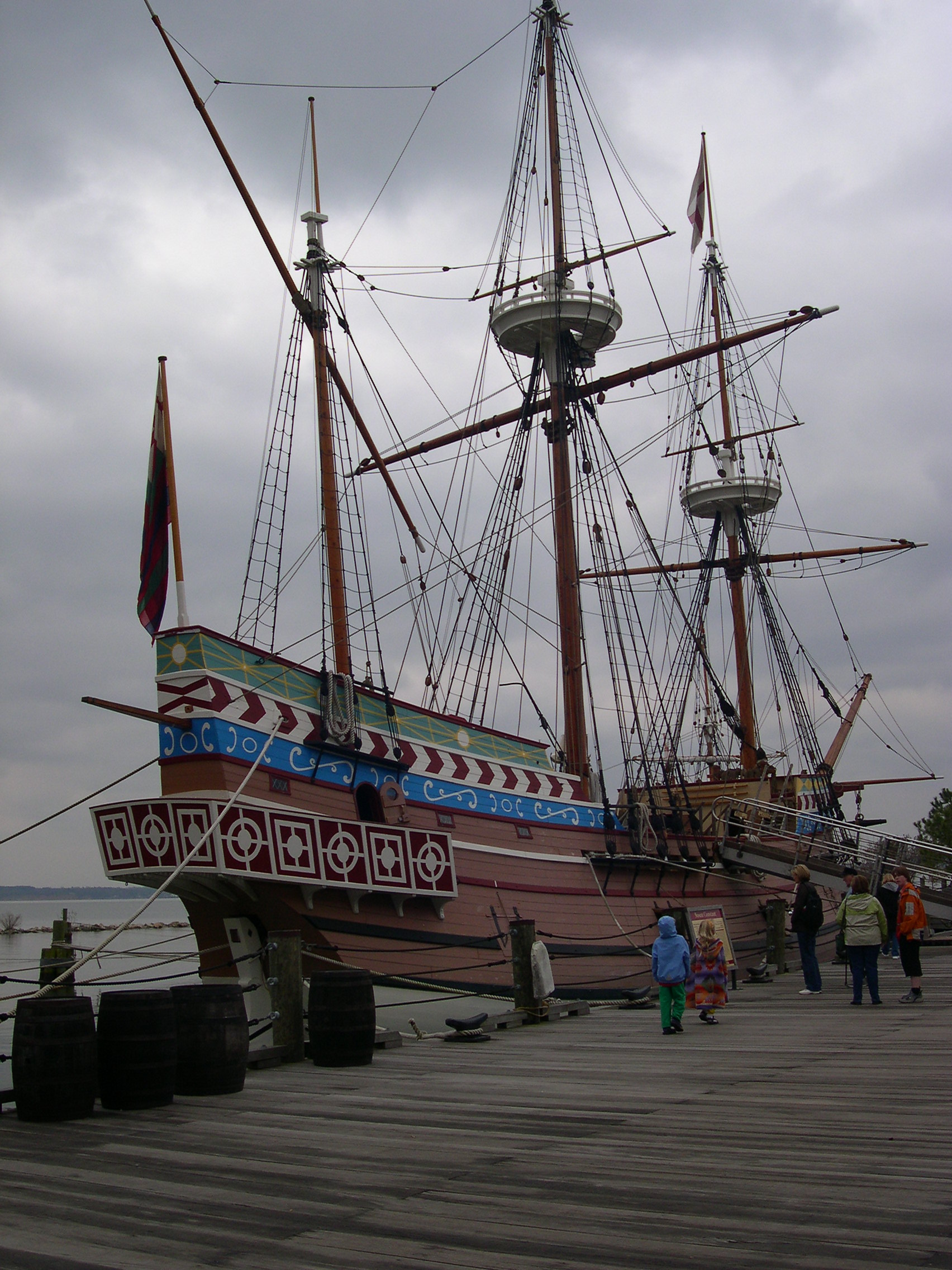
An English ship of the late 16th/early 17th century: this is a replica of the Susan Constant at the Jamestown Settlement in Virginia. The original ship was built sometime before 1607 and rented by the Virginia Company of London to transport the original settlers to Jamestown.
Photo by Nicholas Russon, March 2004.
For as long as humans have suffered severe food shortages, scurvy has been known. The first record of it appears to date to ancient Egypt, in 1550BC, and it was especially familiar to the inhabitants of northern climates, with fresh vegetation every winter becoming scarce. Our word for scurvy almost certainly comes from the old Norse skyrbjugr — the skyr being a sort of soured cow’s milk that was thought to have caused the disease by going bad. In mid-sixteenth-century sources, scurvy was often referred to as though it was endemic to the Netherlands — a flat land assailed by the North Sea each winter, that had suffered long sieges and devastation thanks to the Dutch Revolt, and where fishing and merchant shipping employed an especially large proportion of the workforce. The Dutch thus had a perfect storm of factors to make vitamin C deficiencies more common, even though they abounded in fresh-caught fish and imported Baltic grain.
And so, over the centuries, the people of the northern climes had discovered the cure. Or rather, cures. The Iroquois ate the bark, needles or sap of evergreen trees — most likely white cedar, or some other kind of spruce, fir, juniper or pine, all rich in vitamin C. Their remedy saved the lives of Jacques Cartier’s colonists based near modern-day Quebec City in the winter of 1536. It’s the reason white cedar is known as arborvitae, the tree of life. And the Saami of northern Scandinavia prized cabbages and other leafy greens, in the summertime filling up casks of reindeer milk with crowberries and cloudberries, to be ready for winter.
[…]
Still more remedies were discovered by accident, as European ships began to range farther and farther abroad. The very first Portuguese voyagers around the Cape of Good Hope almost immediately discovered the value of orange and lemons — especially effective sources of vitamin C, as their acidity helps to preserve it. The voyage of Vasco da Gama, having been the first to round the Cape and reach the eastern coast of Africa, was then stricken with scurvy. They were only inadvertently saved when they traded with some Arabian ships laden with oranges, before landing at Mombasa. There, the ruler sent them a sheep and some sugar-cane, the gift also happening to include some oranges and lemons. Although the Portuguese couldn’t stay there long — they learned of a conspiracy to capture their ship — one of the voyagers later reported in wonder how the climate there must have been especially healthful to have cured them all.
Fortunately, at least some of the crew suspected the citrus instead. On the return journey from India, after a fatally slow three-month crossing of the Indian Ocean, some of the newly scurvy-ridden sailors asked their captain to procure them some oranges at Malindi. At least a few of the crew must certainly have been saved by this request, though perhaps the excitement of their imminent deliverance induced a few fatal aneurysms: “our sick did not profit”, was the report, “for the climate affected them in such a way that many of them died here.” By the time the fleet limped home back to Lisbon in 1499, scurvy had still managed to claim the lives of over two thirds of the original crew.
Nonetheless, the status of oranges as a scurvy wonder-cure had entered sailors’ lore. When Pedro Alvares Cabral repeated da Gama’s feat of rounding the Cape of Good Hope in 1500, his crew purposefully treated their scurvy using oranges. And by the 1560s, if not earlier, the news of the cure had spread beyond the Portuguese. Sailors from the Low Countries, on the eve of the Dutch Revolt from Spain, were said to be staving off scurvy by eating oranges in large quantities, skins and all. (Orange peel is in fact especially rich in vitamin C, so they were onto something.) Their value was certainly appreciated by the Dutch explorer Jacob Corneliszoon van Neck by the time of his second expedition to the Indian Ocean in 1598. Not long after setting out, he purchased 10,000 oranges from a passing ship off the coast of Spain, rationing them out to all his crew. And on the return journey via St Helena they were dismayed when initially “we found no oranges, whereof we had most need, for those that were troubled with the scurvy disease.”
The account of van Neck’s journey was translated into English for the first voyage of the East India Company in 1601, which may be why its commander, James Lancaster, directed his crew to drink three spoonfuls of lemon juice every morning. Lancaster doesn’t appear to have paid any special attention to oranges and lemons ten years earlier, when he first attempted the voyage, although other English mariners like the privateer Sir Richard Hawkins had in the 1590s already been extolling their virtues. We don’t know many of the details of Lancaster’s lemon juice trial, but his flagship’s crew was not entirely saved. Contrary to common report, at least a third of them had died by the time they left their first landing at Table Bay, South Africa — a proportion similar those on the other ships of his fleet, though we don’t know how many actually died of scurvy or of other causes. But upon the expedition’s return, the experience placed lemon juice firmly on the list of known scurvy cures — “the most precious help that ever was discovered against the scurvy” as the East India Company’s surgeon-general put it.
Terry Pratchett: Discworld And Beyond
Biographics
Published 19 Mar 2021Dive into Discworld.

September 11, 2021
Sturmgewehr MP-44 Part I: Mechanics
Forgotten Weapons
Published 27 Sep 2016The MP-43 (which is mechanically identical to the MP-44 and StG-44; the differences are the subject for another video later) is a tilting bolt rifle with a long stroke gas piston. It was manufactured primarily from complex sheet steel stampings, as a way to minimize the amount of high-quality and thus difficult to acquire steels needed for its construction. The rifle is heavy by today’s standards, but remarkably ergonomic (except for the metal handguard, when heats up quickly). Its sights come right up to the eye when shouldering the rifle, and it disassembles quickly and easily.
It really is one of the best small arms developed during World War II.

September 10, 2021
Why France Did Not Surrender After Sedan – Empress Eugénie Flees The Country I Franco-Prussian War
realtimehistory
Published 9 Sep 2021Sign up for a free 1 month trial for Skillshare: https://skl.sh/realtimehistory08211
After the French defeat at Sedan, the German states expect peace negotiations. But instead the new French republic declares an early form of “total war” and continues the fight. Meanwhile Empress Eugénie flees the country for Britain.
» THANK YOU TO OUR CO-PRODUCERS
John Ozment
James Darcangelo
Jacob Carter Landt
Thomas Brendan» OUR PODCAST
https://realtimehistory.net/podcast – interviews with historians and background info for the show.» LITERATURE
Arand, Tobias: 1870/71. Der Deutsch-Französische Krieg erzählt in Einzelschicksalen. Hamburg 2018
Arand, Tobias/Bunnenberg, Christian (Hrsg.): Karl Klein. Die Fröschweiler Chronik. Hamburg 2021
Herre, Franz: Eugénie. Kaiserin der Franzosen. München 2000
Howard, Michael: The Franco-Prussian War. London 1961
Milza, Pierre: L’année terrible. La guerre franco-prussienne. Septembre 1870 – mars 1871. Paris 2009» SOURCES
Braun, Lily (Hrsg.): Kriegsbriefe aus den Jahren 1870/71 von Hans v. Kretschman. Berlin 1911
Hérisson, Maurice Graf d’: Journal d’un officier d’ordonannce. Juillet 1870 – Février 1871. Paris 1885
Goncourt, Edmond de: Journal des Goncourt. Memoire de la vie litteraire. 2.1. 1870-1871. Paris 1890
Russell, William Howard: Meine sieben Kriege. Die ersten Reportagen von den Schlachtfeldern des 19. Jahrhunderts. Frankfurt a. M. 2000» OUR STORE
Website: https://realtimehistory.net»CREDITS
Presented by: Jesse Alexander
Written by: Cathérine Pfauth, Prof. Dr. Tobias Arand, Jesse Alexander
Director: Toni Steller & Florian Wittig
Director of Photography: Toni Steller
Sound: Above Zero
Editing: Toni Steller
Motion Design: Philipp Appelt
Mixing, Mastering & Sound Design: http://above-zero.com
Maps: Battlefield Design
Research by: Cathérine Pfauth, Prof. Dr. Tobias Arand
Fact checking: Cathérine Pfauth, Prof. Dr. Tobias ArandChannel Design: Battlefield Design
Contains licensed material by getty images
All rights reserved – Real Time History GmbH 2021

The German Slave Economy – WW2 Special
World War Two
Published 9 Sep 2021To fuel the German war economy, the Nazis force millions of Prisoners of War, Concentration Camp inmates and civilians from all over Europe to work for in their factories and on their farms as slave laborers under harsh circumstances.
(more…)
The Channel Dash / Operation Cerberus — How to win through refuge in audacity
Drachinifel
Published 9 Jan 2019Today we look at the Channel Dash, also known as one of the few times Hitler was right, the British were asleep and the Germans succeeded in spite of thinking they were all doomed. An operation made up purely of rolling natural 1’s and 20’s.

September 9, 2021
Did Freudian Psychology Create Modern Art? | B2W: ZEITGEIST! I E.25 Harvest 1924
TimeGhost History
Published 8 Sep 2021The Surrealist Movement is born this season with unsurprising eccentric drama. Salvador Dali will one day be a part of it, but for now he is still in art school and has actually only just come out of prison. Also this season, a crime which sees police chasing America’s first ever “Public Enemy No. 1”
(more…)
When you mess around in a software testing environment … make sure it actually is a test
A British local government found out the hard way that they need to isolate their software testing from their live server:
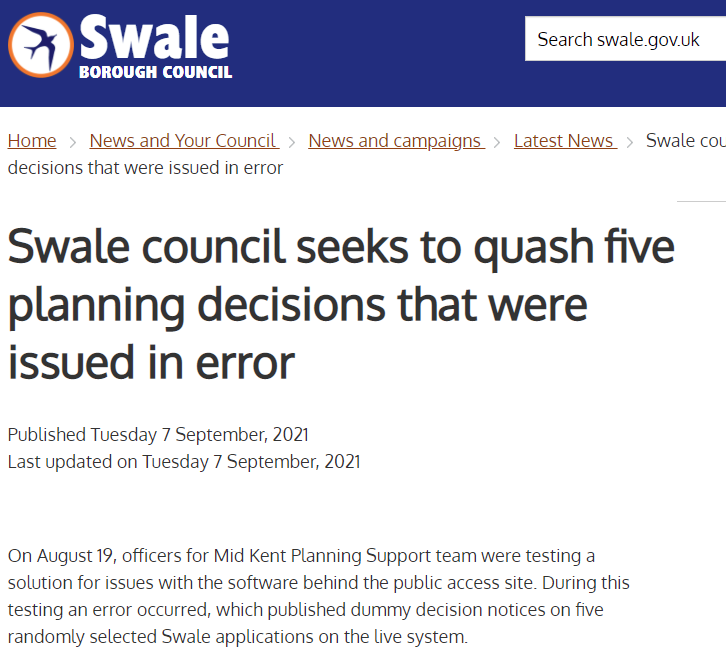
A borough council in the English county of Kent is fuming after a software test on the council’s website led to five nonsensical dummy planning application documents being mistakenly published as legally binding decisions.
According to a statement from Swale Borough Council, staff from the Mid Kent Planning Support Team had been testing the software when “a junior officer with no knowledge of any of the applications” accidentally pressed the button on five randomly selected Swale documents, causing them to go live on the Swale website.
After learning what had happened, the council moved to remove the erroneous decisions from public display, but according to the statement: “Legal advice has subsequently confirmed they are legally binding and must be overturned before the correct decisions are made.”
Publishing randomly generated planning decisions is obviously bad enough, but the problems got worse for Swale when it was discovered that the “junior officer” who made the mistake had also added their own comments to the notices in the manner of somebody “who believed they were working solely in a test environment and that the comments would never be published,” as the council diplomatically described it.
So it was that despite scores of supportive messages from residents, the splendidly named Happy Pants Ranch animal sanctuary had its retrospective application for a change of land use controversially refused, on the grounds that “Your proposal is whack. No mate, proper whack,” while an application to change the use of a building in Chaucer Road, Sittingbourne, from a butchers to a fast-food takeaway was similarly denied with the warning: “Just don’t. No.”
The blissfully unaware office junior continued their cheerful subversion of Kent’s planning bureaucracy by approving an application to change the use of a barn in the village of Tunstall, but only on condition of the numbers 1 to 20 in ascending order. They also approved the partial demolition of the Wheatsheaf pub in Sittingbourne and the construction of a number of new flats on the site, but only as long as the project is completed within three years and “Incy Wincy Spider.”
Finally, Mid Kent’s anonymous planning hero granted permission for the demolition of the Old House at Home pub in Sheerness, but in doing so paused to ponder the enormous responsibility which had unexpectedly been heaped upon them, commenting: “Why am I doing this? Am I the chosen one?”
For their part, Swale Borough Council’s elected representatives were less than impressed by the work of their colleagues at the Mid Kent Planning Support Team and wasted no time in resolutely throwing them under the bus.
“These errors will have to be rectified but this will cause totally unnecessary concern to applicants,” thundered Swale councillors Roger Truelove, Leader and Cabinet Member for Finance, and Mike Baldock, Deputy Leader and Cabinet Member for Planning in a shared statement. “This is not the first serious problem following the transfer of our planning administration to Mid Kent shared services. We will wait for the outcome of a proper investigation and then consider our appropriate response as a council.”
Tank Chats #123 | Oxford and Cambridge Carriers | The Tank Museum
The Tank Museum
Published 16 Apr 2021Tank Museum Historian David Fletcher presents a Tank Chat on the Carrier, Tracked, CT20, otherwise known as the Oxford Carrier. This unusual vehicle was an early post-Second World War British Armoured Personnel Carrier and Gun Tractor, which saw service in the Korean War. David also touches upon the Cambridge Carrier, built by Rolls-Royce as an updated and improved version of the Oxford, which never got out of the prototype stage.
(more…)


