The stagnation of the Empire in the between-war years affected everyone in England, but it had an especially direct effect upon two important sub-sections of the middle class. One was the military and imperialist middle class, generally nicknamed the Blimps, and the other the left-wing intelligentsia. These two seemingly hostile types, symbolic opposites – the halfpay colonel with his bull neck and diminutive brain, like a dinosaur, the highbrow with his domed forehead and stalk-like neck – are mentally linked together and constantly interact upon one another; in any case they are born to a considerable extent into the same families.
Thirty years ago the Blimp class was already losing its vitality. The middle-class families celebrated by Kipling, the prolific lowbrow families whose sons officered the army and navy and swarmed over all the waste places of the earth from the Yukon to the Irrawaddy, were dwindling before 1914. The thing that had killed them was the telegraph. In a narrowing world, more and more governed from Whitehall, there was every year less room for individual initiative. Men like Clive, Nelson, Nicholson, Gordon would find no place for themselves in the modern British Empire. By 1920 nearly every inch of the colonial empire was in the grip of Whitehall. Well-meaning, over-civilized men, in dark suits and black felt hats, with neatly rolled umbrellas crooked over the left forearm, were imposing their constipated view of life on Malaya and Nigeria, Mombasa and Mandalay. The one-time empire builders were reduced to the status of clerks, buried deeper and deeper under mounds of paper and red tape. In the early ‘twenties one could see, all over the Empire, the older officials, who had known more spacious days, writhing impotently under the changes that were happening. From that time onwards it has been next door to impossible to induce young men of spirit to take any part in imperial administration. And what was true of the official world was true also of the commercial. The great monopoly companies swallowed up hosts of petty traders. Instead of going out to trade adventurously in the Indies one went to an office stool in Bombay or Singapore. And life in Bombay or Singapore was actually duller and safer than life in London. Imperialist sentiment remained strong in the middle class, chiefly owing to family tradition, but the job of administering the Empire had ceased to appeal. Few able men went east of Suez if there was any way of avoiding it.
George Orwell, “The Lion And The Unicorn: Socialism and the English Genius”, 1941-02-19.
January 11, 2022
QotD: The decline of the “Blimp class” in the British empire
January 10, 2022
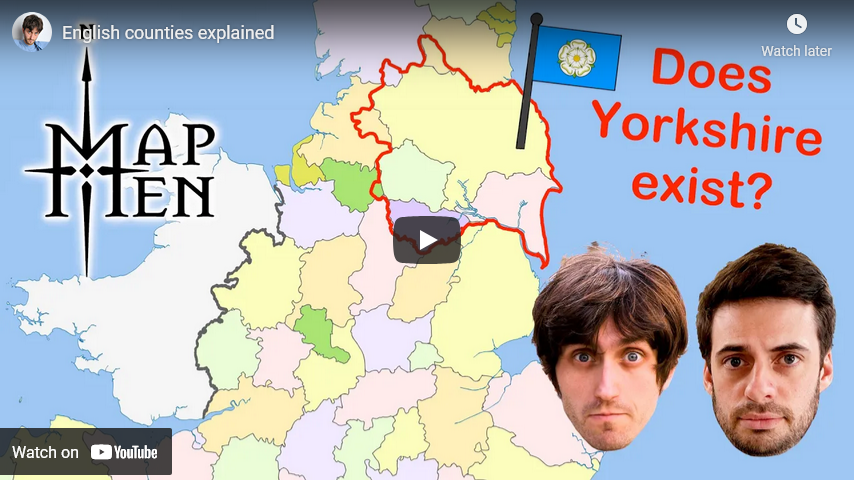
English counties explained
Jay Foreman
Published 13 Sep 2021BUY MAP MEN MUGS, T-SHIRTS, POSTERS ETC…
http://www.mapmenmerch.comSEE NEW EPISODES EARLY, AND BEHIND-THE-SCENES EXTRAS…
http://www.patreon.com/jayforemanWritten, presented and edited by
JAY FOREMAN https://www.twitter.com/jayforeman
MARK COOPER-JONES https://www.twitter.com/markcooperjonesAD, Camera, Props and Costumes
JADE NAGI https://www.twitter.com/jade_nagihttps://commons.wikimedia.org/wiki/Fi…
Maximilian Dörrbecker (Chumwa), CC BY-SA 3.0 https://creativecommons.org/licenses/…, via Wikimedia Commons
I wouldn’t say it explains why my home town seemed to move from county to county every few years since my family emigrated, but at least it provides a few clues about the changes.
January 9, 2022
A Soviet Offensive Along the Entire Front? – WW2 – 176 – January 8th, 1943
World War Two
Published 8 Jan 2022Things look grim for the Germans, surrounded at Velikie Luki and Stalingrad and with no real help of relief. The Soviets are, in fact, making plans for attacks all along the front, as are the Americans to push the Japanese off of Guadalcanal.
(more…)
A century of William Brown books
In The Critic, Alexander Larman celebrates the centenary of Richmal Compton’s William Brown books:

Growing up in suburban Bristol in the Eighties and Nineties, my reading matter was of a suitably timeless disposition, even if it seldom, if ever, included any Enid Blyton. Amidst the colonial and deeply un-PC likes of Biggles and Rider Haggard, my trio of preferred characters never really changed: Jennings, Billy Bunter and William Brown. Of the three, Jennings was probably my favourite, being closest to my own life as a prep school boy of a vaguely similar appearance and age, and also because the situations were the most recognisable. Bunter I found uproarious but also rather tasteless and absurd, for reasons that have now, alas, become much clearer. And then there was William Brown: would-be outlaw, committed dog owner and perpetual enemy of soap-and-water, to say nothing of his perpetual nemeses, Hubert Lane and Violet Elizabeth Bott.
I enjoyed the books as picaresque stories of bad behaviour without seeing much of myself in William, or indeed his friends. Their author Richmal Crompton’s evocation of invincible pre-war suburbia — not so very far from a benign version of the half-idylls, half-nightmares portrayed by Orwell in Coming Up For Air and Patrick Hamilton in Hangover Square — was certainly compelling, but I was too young to appreciate Crompton’s social satire, itself considerably more piquant than anything that could be found in Jennings and Bunter, let alone the stiff-upper-lip fantasias of English manhood peddled by WE Johns with Biggles, Gimlet and the rest. All of them now sound to me like nothing so much as industrial-strength cocktails. Drink a couple, and you too will want to revive the Empire.
Yet now, a century after the first appearance of Just William, I reassess Crompton’s universe afresh, and so I respond far more warmly to her characters and creations. William Brown himself is an entertaining if undeniably two-dimensional figure, at his most amusing when he is required to fit into the adult world temporarily, as in the story William’s Truthful Christmas, when he causes social outrage and misery by offering an honest opinion of the gifts that he has received. But it is the rich panoply of figures around William who give the stories their interest and colour, and which make them as entertaining for adults to read today as they ever might be for their children. If, of course, eleven-year olds can be distracted from their iPads and Netflix and nefarious online activities long enough to enjoy the William books.
Leaving aside the children for a moment, the adult supporting characters in the unnamed village provide endless humour and intrigue. There is William’s neurotic mother, desperately saying of her son that “he means well” even as he is involved in yet another humiliating scrape. His father, meanwhile, is a hard-drinking Conservative whose cynicism at the world sees him reward his errant son with extra pocket money for his more outrageous actions, as long as he is not bedbound with “his liver”. Not for nothing is this stalwart representative of middle England named John Brown.
Then there is William’s would-be romantic elder brother Robert, desperately professing each of his girlfriends “the most beautiful girl in the world” until his eye is taken by another. Mr and Mrs Bott are a pair of arriviste millionaires who have made their money via “Bott’s Digestive Sauce”, a substance that William contends, probably accurately, has been constructed from squashed beetles. Needless to say, they take up residence in the nouveau riche establishment Bott Hall, where their social status irks them. (“We ought to have some ancestors, Botty,” said Mrs Bott. “We’ve got ’em, dear,” said Mr Bott after a moment’s thought. “We must have. Come to think of it, we shouldn’t be here now if we’d not.”) Floating around the periphery is Robert’s friend, the splendidly named Jameson Jameson, of whom Crompton writes, with caustic humour, “[his] parents had perpetrated on him the supreme practical joke of giving him his surname for a Christian name, so that people who addressed him by his full name seemed always to be indulging in some witticism.”
The Korsac EM1 – a British/Polish Bullpup FG-42
Forgotten Weapons
Published 26 Jun 2017Armament Research Services (ARES) is a specialist technical intelligence consultancy, offering expertise and analysis to a range of government and non-government entities in the arms and munitions field. For detailed photos of the guns in this video, don’t miss the ARES companion blog post:
http://armamentresearch.com/british-k…
The Korsac EM-1 (not to be confused with the Thorpe EM-1, which is a completely different rifle) was a bullpup light machine gun based on captured examples of the German FG-42 paratroop rifle. It was developed between 1945 and 1947 by a team led by a Polish refugee designer named Korsac.
It was chambered for the 8mm Mauser cartridge, and used an 18 round magazine adapted from the ZB-26. The operating mechanism was closely copied from the FG-42, as were many elements of the rifle’s controls, including the capability for firing from an open bolt in fully automatic and from a closed bolt in semi-automatic. Unlike the FG-42, it used a short stroke tappet type gas piston, and had a detachable barrel. Ultimately only two examples were built, and only one of those (the one in this video) was completed to firing condition. It suffered from reliability problems in semi-automatic mode, and was quickly sidelined in favor of the other development projects ongoing by 1947. However, many lessons from its development would be put into the EM-2 rifle.
Cool Forgotten Weapons merchandise! http://shop.bbtv.com/collections/forg…
http://www.patreon.com/ForgottenWeapons
If you enjoy Forgotten Weapons, check out its sister channel, InRangeTV! http://www.youtube.com/InRangeTVShow

January 8, 2022
Antique Antics: The Pantheon
Overly Sarcastic Productions
Published 7 Jan 2022It’s a good dome, simple as that.
SOURCES & Further Reading: The Great Courses lectures: “The Most Celebrated Edifice – The Pantheon” from Understanding Greek and Roman Technology by Stephen Ressler, and “Roman Art and Architecture” from The Roman Empire: From Augustus to The Fall of Rome by Gregory Aldrete. “The Pantheon” by Chris Legare via ATouchOfRome https://www.atouchofrome.com/the_pant…. Additionally, I have a university degree in Classical Studies.
Our content is intended for teenage audiences and up.
PATREON: https://www.Patreon.com/OSP
PODCAST: https://overlysarcasticpodcast.transi…
DISCORD: https://discord.gg/osp
MERCH LINKS: http://rdbl.co/osp
OUR WEBSITE: https://www.OverlySarcasticProductions.com
Find us on Twitter https://www.Twitter.com/OSPYouTube
Find us on Reddit https://www.Reddit.com/r/OSP/

The Board of Green Cloth — the original “we investigated ourselves and found us innocent” organization
In the latest Age of Invention newsletter, Anton Howes explains how England managed to avoid the first attempt by King James I to impose absolute monarchy — that is, putting the Stuart notions of the “divine right of kings” in place of royal powers limited by the Parliamentary control of the royal income:
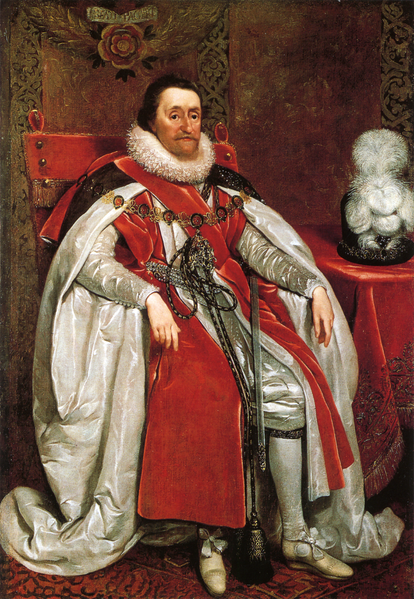
King James I (of England) and VI (of Scotland)
Portrait by Daniel Myrtens, 1621 from the National Portrait Gallery via Wikimedia Commons.
The year 1610 might by the most under-rated year in British history. It was the year in which England almost became a more permanent absolutist monarchy. Had things gone only a little differently, King James I might have obtained a substantial annual income — enough to pay off his debts within just a few years, to run a substantial surplus, and perhaps even to never have to summon a Parliament ever again. Over the course of a few decades, so long as they didn’t require too many extraordinary taxes to pay for one-off wars, the Stuart kings could have ruled without challenge, issuing proclamations that would have gradually taken on the force of laws.
[…]
As we saw in the last instalment of this series, James I’s finances were desperate. His predecessor had left him substantial war debts, and he was running a large deficit, so the chances of repaying them anytime soon were slim. So in 1604 he had summoned a Parliament with the aim of making a financial deal. Parliaments were typically called in order for the monarch to raise one-off, extraordinary taxes, usually in times of rebellion or war. Rather confusingly from today’s perspective, these taxes were known as “subsidies”, because they were a subsidy to the Crown. Yet James and his ministers wanted Parliament to instead establish peacetime taxes that would be both ongoing and ordinary — what came to be known as “support”. The deal was that he would give up some of his least popular feudal prerogative rights in return.
The House of Commons did not go for the deal in 1604, as we saw. They may have hated feudal obligations like purveyance or wardship — the requisitioning of goods for the court, and the Crown’s control of noble heirs whose fathers had died before they came of age — but they also saw some major risks in trying to make a deal with the king.
When it came to the matter of purveyance, for example, many members of Parliament wanted to stamp out the abuses rather than see the institution abolished. They thought it perfectly legal for the Crown to compulsorily purchase goods, and even to requisition the carts to carry them. What they complained of was that many purveyors were failing to give compensation immediately, and that corrupt purveyors were sometimes taking more than was required, pocketing the difference for themselves. Many MPs also argued that there was no legal basis for purveyors to determine their own prices for the provisions that they seized — a privilege that the Crown adamantly insisted upon.
James’s predecessor Queen Elizabeth I had granted a concession over patent disputes — “patents” at that time were a rather different and much wider legal notion than our more product-oriented modern patents: the monarch granted patents to assign lands and titles, appoint officials, create cities or guilds, or to allow monopoly privileges over an economic resource among other purposes. The concession was that patent disputes would be litigated in common-law courts rather than by royally appointed judges.
Yet by extending the jurisdiction of the common-law courts to monopolies, Elizabeth opened the floodgates of complaints against all prerogative courts — especially against the court of royal household officials responsible for commissioning the purveyors, known as the Board of Green Cloth.
To Hyde and his followers, this court was especially corrupt. Whereas the trying of monopoly patents had at least been done in the more general prerogative courts, anyone hauled before the Green Cloth for denying the purveyors was effectively being tried, judged, fined, and even imprisoned, by the very organisation that was accusing them. Even if purveyors really were acting illegally by naming their own prices, as opponents maintained, there would be no justice so long as the purveyors effectively judged themselves. For Hyde and his allies then, they wished to do to purveyance what they had done to monopolies — to subject them to the common law.
Battle of the River Plate 1939: Minute-by-Minute
Historigraph
Published 24 Jul 2018The Battle of the River Plate took place in December 1939, and featured the Royal Navy cruisers Exeter, Achilles and Ajax, against the German Panzerschiffe, Graf Spee.
–
If you’d like to support the creation of more videos like this, please consider supporting us at: https://www.patreon.com/historigraph
If you’d like to join the historigraph community, consider joining my discord server, which is shared with my strategy gaming channel: https://discord.gg/f8JZw93
Follow the channel on Twitter: https://twitter.com/historigraph
And on facebook: https://www.facebook.com/historigraph/
Sources:
Richard Petrow, The Bitter Years: The invasion and Occupation of Denmark and Norway April 1940-May 1945 (London: Hodder and Stoughton, 1974). — The first chapter of the book includes a brief description of the hunt for the Graf SpeeCorelli Barnett, Engage The Enemy More Closely: The Royal Navy in the Second World War (London: Penguin, 1991)
Commodore Harwood’s own account of the battle, made available here: http://naval-history.net/WW2LGGrafSpe…
Graf Spee‘s voyage described here: https://www.deutschland-class.dk/admi…
Video clips from World of Warships gameplay and the Battle of the River Plate film, 1958
Music:
“Crypto” Kevin MacLeod (incompetech.com)
Licensed under Creative Commons: By Attribution 3.0 License
https://creativecommons.org/licenses/by/3.0/“Division” Kevin MacLeod (incompetech.com)
Licensed under Creative Commons: By Attribution 3.0 License
https://creativecommons.org/licenses/by/3.0/“Crossing the Chasm” Kevin MacLeod (incompetech.com)
Licensed under Creative Commons: By Attribution 3.0 License
https://creativecommons.org/licenses/by/3.0/Sound Effects:
Gunshots and so on are recordings from World of Warships, where the gameplay footage of the ships hails from.

January 7, 2022
Desert War – Dysentery, Disease, and Dehydration – WW2 Special
World War Two
Published 6 Jan 2022North Africa. The Axis and Allies are fighting each other but even more, they’re fighting the desert itself. The men of the desert burn during the day and freeze at night. They do most of their fighting on a litre of water and a packet of army biscuits. What is life in such a hostile environment?
(more…)
French Ragtag Army’s Desperate Winter Battles 1871
Real Time History
Published 6 Jan 2022Support us on Patreon: https://patreon.com/realtimehistory
One of the last bastions of French resistance in the new year 1871 is Belfort. A ragtag army called “Army of the East” rushes to free the city near the Swiss border. Meanwhile the Germans prepare to announce their Empire in Versailles.
» THANK YOU TO OUR CO-PRODUCERS
John Ozment, James Darcangelo, Jacob Carter Landt, Thomas Brendan, Kurt Gillies, Scott Deederly, John Belland, Adam Smith, Taylor Allen, Rustem Sharipov, Christoph Wolf, Simen Røste, Marcus Bondura, Ramon Rijkhoek, Theodore Patrick Shannon, Philip Schoffman, Avi Woolf» OUR PODCAST
https://realtimehistory.net/podcast – interviews with historians and background info for the show.» LITERATURE
Arand, Tobias: 1870/71. Der Deutsch-Französische Krieg erzählt in Einzelschicksalen. Hamburg 2018Buk-Swienty, Tom: Schlachtbank Düppel. 18. April 1864. Die Geschichte einer Schlacht. Berlin 2011
» SOURCES
Klein, Karl: Fröschweiler Chronik. Arand, Tobias/Bunnenberg, Christian (Hrsg.). Hamburg 2021.Allorant, Salomé u.a. (Hrsg.): La République au défi de la guerre. Lettres et carnet de l’Année terrible (1870-1871). Amiens 2015
Fontane, Theodor: Der Krieg gegen Frankreich. Bd. 4. Berlin 1876
Goncourt, Edmond de: Journal des Goncourts. II.1. 1870-1871. Paris 1890
Meisner, Heinrich Otto (Hrsg.): Kaiser Friedrich III. Das Kriegstagebuch von 1870/71. Berlin, Leipzig 1926
N. N. (Hrsg.): Bismarcks Briefe an seine Gattin aus dem Kriege 1870/71. Stuttgart, Berlin 1903
Pflugk-Harttung, Julius: Krieg und Sieg 1870-71. Berlin 1896
Sheridan, Philip H.: Von Gravelotte nach Paris. Erinnerungen aus dem deutsch-französischem Kriege. Leipzig 1889
Zeitz, Karl: Kriegserinnerungen eines Feldzugsfreiwilligen aus den Jahren 1870 und 1871. Altenburg 1905
» OUR STORE
Website: https://realtimehistory.net»CREDITS
Presented by: Jesse Alexander
Written by: Cathérine Pfauth, Prof. Dr. Tobias Arand, Jesse Alexander
Director: Toni Steller & Florian Wittig
Director of Photography: Toni Steller
Sound: Above Zero
Editing: Toni Steller
Motion Design: Philipp Appelt
Mixing, Mastering & Sound Design: http://above-zero.com
Maps: Battlefield Design
Research by: Cathérine Pfauth, Prof. Dr. Tobias Arand
Fact checking: Cathérine Pfauth, Prof. Dr. Tobias ArandChannel Design: Battlefield Design
Contains licensed material by getty images
All rights reserved – Real Time History GmbH 2022
QotD: British intelligentsia and imperial decline
It should be noted that there is now no intelligentsia that is not in some sense “Left”. Perhaps the last right-wing intellectual was T.E. Lawrence. Since about 1930 everyone describable as an “intellectual” has lived in a state of chronic discontent with the existing order. Necessarily so, because society as it was constituted had no room for him. In an Empire that was simply stagnant, neither being developed nor falling to pieces, and in an England ruled by people whose chief asset was their stupidity, to be “clever” was to be suspect. If you had the kind of brain that could understand the poems of T.S. Eliot or the theories of Karl Marx, the higher-ups would see to it that you were kept out of any important job. The intellectuals could find a function for themselves only in the literary reviews and the left-wing political parties.
The mentality of the English left-wing intelligentsia can be studied in half a dozen weekly and monthly papers. The immediately striking thing about all these papers is their generally negative, querulous attitude, their complete lack at all times of any constructive suggestion. There is little in them except the irresponsible carping of people who have never been and never expect to be in a position of power. Another marked characteristic is the emotional shallowness of people who live in a world of ideas and have little contact with physical reality. Many intellectuals of the Left were flabbily pacifist up to 1935, shrieked for war against Germany in the years 1935-9, and then promptly cooled off when the war started. It is broadly though not precisely true that the people who were most “anti-Fascist” during the Spanish civil war are most defeatist now. And underlying this is the really important fact about so many of the English intelligentsia – their severance from the common culture of the country.
George Orwell, “The Lion And The Unicorn: Socialism and the English Genius”, 1941-02-19.
January 6, 2022
The war on “ultra-processed food”
Our self-imagined “elites” have a new crusade to prosecute — the crusade against “ultra-processed food”:
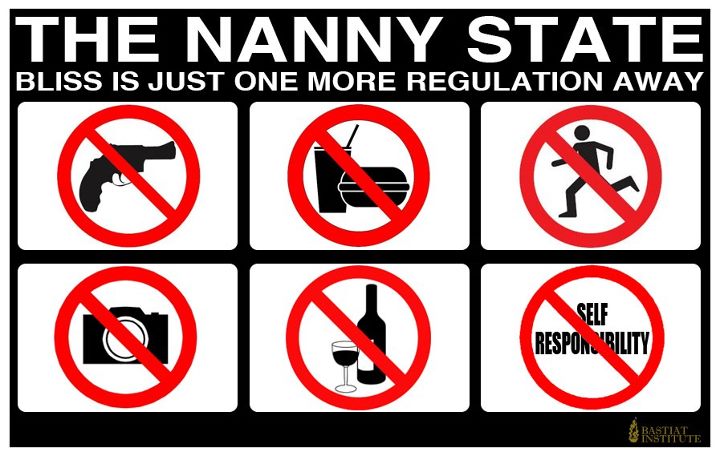
In “public health”, the name of the game is to interfere with people’s lives without having your own choices meddled with. This is straightforward with smoking since the philosopher kings of the nanny state don’t smoke. Alcohol is more tricky since most of them drink, but minimum pricing — which was introduced in Ireland yesterday — offers the perfect way to penalise ordinary people while leaving fine wine and craft beer unaffected.
The war on food poses the trickiest problem since its pretext — obesity — is the result of over-consumption and physical inactivity rather than the consumption of any specific type of food. “Junk food” is too narrow since most people interpret it to mean “fast food” from a handful of restaurant chains. And so, in the absence of an obvious dietary culprit, the “public health” lobby is shifting towards a crusade against “ultra-processed food”.
Most people don’t know what this means, but it sounds bad if you have an instinctive objection to industry and modernity. Perhaps it evokes thoughts of “chemicals” and “E numbers”. Certainly, it sounds like the opposite of the “natural”, “organic” and “home made” food so beloved of those who think they are superior to other people. It is, however, a classic “public health” bait and switch. Just as people didn’t realise that a ban on “junk food” advertising would result in adverts for cheese and butter being banned, people won’t realise what a war on ultra-processed food means for them until it is too late.
In a deranged op-ed in BMJ Global Health, some of Mike Bloomberg’s minions from Vital Strategies call for tobacco-style regulation of “ultra-processed food”, starting with warning labels.
Simply put, ultra-processed foods are foods that can’t be made in your home kitchen because they have been chemically or physically transformed using industrial processes. They are recognisable on the supermarket shelf as packaged foods that are ready-to-eat, contain more than five ingredients and have a long shelf-life. The industrial processing, as well as the cocktail of additives, flavours, emulsifiers and colours they contain to give flavour and texture, make the final product hyper-palatable or more appealing and potentially addictive, which in turn leads to poor dietary patterns.
With more than half the total calories consumed in high-income countries coming from ultra-processed foods and rapid increases in low- and middle-income countries, these products are exposing billions of people to a higher risk of type 2 diabetes, heart disease, stroke, depression and death.
Scary stuff, eh? Alas, they don’t give any examples of ultra-processed foods so let us instead turn to a recently published study about them …
Baked goods, including cakes, pastries, industrial breads, and soft drinks ranked among the top contributors to sales of UPFDs [ultra-processed food and drinks]
According to the the British Heart Foundation, ultra-processed foods include …
Ice cream, ham, sausages, crisps, mass-produced bread, breakfast cereals, biscuits, carbonated drinks, fruit-flavoured yogurts, instant soups, and some alcoholic drinks including whisky, gin, and rum.
I’m not sure how hard liquor made the cut, but I suppose if you’re going be a fun sponge you might as well go all the way.
Chinese Spymasters – The New Warlords? – WW2 – Spies & Ties 12
World War Two
Published 5 Jan 2022During World War Two, China was ripped up by many different warring parties, all of which were also playing spy games with crosses, double-crosses and triple-crosses.
(more…)
The 1874 Gras: France Enters the Brass Cartridge Era
Forgotten Weapons
Published 6 May 2019After the disaster of the Franco-Prussian War, it was clear to the French military that the rationale for using paper cartridge in the Chassepot was no longer valid — a future rifle would need to use brass cartridges. A competition to design a conversion of the Chassepot to use modern ammunition resulted in the 1874 adoption of the rifle designed by French Artillery Captain Basile Gras. This maintained the use of the bolt handle as a single locking lug, but introduced a separate bolt head and extractor. The new cartridge was the 11mm Gras; very similar to the Chassepot loading but at a slightly higher velocity.
The Gras would be produced from 1874 until 1884, with more than 4 million made in total. Most were full length infantry rifles, but two patterns of carbine and a musketoon were also included for cavalry, gendarmerie, and artillery troops. These rifles saw significant use in colonial conflicts, but the much-anticipated war of revenge against Germany would not happen while the Gras was the standard French rifle. Instead, it would see a supporting role in the First World War, both in the original 11mm caliber and also converted to 8mm Lebel.
http://www.patreon.com/ForgottenWeapons
Cool Forgotten Weapons merch! http://shop.bbtv.com/collections/forg…
Contact:
Forgotten Weapons
PO Box 87647
Tucson, AZ 85754

January 5, 2022
History Summarized: The Ottoman Empire
Overly Sarcastic Productions
Published 5 Oct 2018Leave it to the furniture boys to pioneer a Comfort-First attitude towards Imperialism.
Join Blue in investigating the history of the Ottoman empire, and find out why “The Sick Man of Europe” is more than their nickname implies.
Further reading: Osman’s Dream by Caroline Finkel
Famous Turkish Song — Gunduz Gece: https://www.youtube.com/watch?v=2UcbH…
PATREON: www.patreon.com/OSP
MERCH LINKS:
Shirts – https://overlysarcasticproducts.threa…
All the other stuff – http://www.cafepress.com/OverlySarcas…Find us on Twitter @OSPYouTube!