
Sabaton History
Published 2 Nov 2022When the Dreadnought made its appearance in the early 20th century, it was the mightiest ship the world had ever seen, making all other gunships obsolete, including the rest of its own navy. It also sparked a naval arms race around the world, as many nations built such behemoths. But what were they actually like?
(more…)
November 4, 2022
“Dreadnought” – The King of the High Seas! – Sabaton History 114 [Official]
Comments Off on “Dreadnought” – The King of the High Seas! – Sabaton History 114 [Official]
Tank Chats #157 | Ferret MKII & V | The Tank Museum
The Tank Museum
Published 1 Jul 2022Join David Fletcher for a new Tank Chat on the Ferret.
(more…)
Comments Off on Tank Chats #157 | Ferret MKII & V | The Tank Museum
November 2, 2022
QotD: Being “the world’s policeman”
The British spent most of the 19th and the first half of the 20th centuries as the world’s policeman, responsible for keeping the peace, and for maintaining a balance of power. They were usually pilloried by all about them for this role, particularly by up and coming powers who wanted a “place in the sun” — Germany and the United States being the stand-out examples (though there is a lot of whinging from old allies like Russia). For the last half of that period, the British voter was having serious second thoughts about the whole concept.
The United States took on the mantle of world’s policeman in the post-Second World War world. They have spent much of the last 60 years trying to keep the peace, and, interestingly, to maintain the balance of power. (Do not be fooled by the concept of the overwhelming superpower. Britain was a lot closer to being able to take on the rest of the world in the 19th century, when it really could defeat every other navy in the world combined; than the US is now, where it could perhaps face Iran, Russia and India simultaneously, as long as the European Union is friendly. Whoops, forgot China, the Balkans, Palestine, Syria, North Korea, Iraq, Afghanistan, Somalia and other little blips on the US horizon. Well let’s be honest, no one has ever been able to take on more than a few of the other powers simultaneously. NO one.)
For their troubles, they are usually pilloried by those all about them, particularly by up and coming powers who want their “place in the sun” – the Soviet Union and China being the stand-out examples. (Though there is a lot of whinging from old allies like France). For the last forty years (since Vietnam, and certainly since Gulf War One), there have been signs that the US voter is having serious second thoughts about the whole concept.
Britain was quite reluctant to take over later imperial dependencies, particularly leftover states of defeated Empires like Turkey, such as Iraq and Palestine: but also parts of Africa and Asia “of interest to no bugger”. They were never part of the British ideal of commercial empire, and were almost impossible to govern. They were abandoned as soon as possible.
The United States is currently experiencing the joys of taking over, or being responsible for unwanted bits of empire. Strangely the names Iraq and Palestine are occurring on that list, as well as Afghanistan and possibly other commitments to come. (The US has interfered in these areas far longer than Britain had before she was stuck with them). They cannot be considered part of a logical geopolitical empire (not even for oil conspiracy nuts), and will be abandoned as soon as possible.
The British voter responded to the world wars by wanting out of empire. Now. Some of the states thus “released” were well-developed societies with decent infrastructure and good literacy and rule of law concepts. India, Malta, Ceylon, Bermuda and Singapore spring to mind. Others were abandoned prematurely: without literacy, rule of law, good infrastructure, a developed civil service, practice of voting, or any of the other minor necessities for establishing a democratic state. See any list of African dictatorships.
The US voter is responding to current events by wanting out of the Middle East ASAP. They are intent on abandoning states to “democracy”, regardless of a lack of literacy, rule of law, good infrastructure, a developed civil service, practice of voting, or any of the other minor necessities for establishing a democratic state. Whoops.
Britain suffered from an immense artificial economic high after the Napoleonic war. This left the British economy extremely artificially inflated for eighty years, and still well above its realistic weight in the world for another fifty (and only really brought back to the field by the immense economic losses of two world wars). In the last twenty years Britain has held a more realistic place in the world economy for its population and industrial level (though still relatively inflated by an immense backlog of prestige and sometimes reluctant respect.).
The US suffered from an immense artificial economic high after WWII. This left the US economy artificially inflated for the rest of the century, and still well above its realistic weight in the world to the present. … Sometime in the next few decades, the US will probably return to a more realistic place in the world economy for its population and industrial level. (Minor variables like World War III may make this projection uncertain as to actual timing, but it will happen: simply because the US will not be able to largely sit out most of the next world wars and profiteer from everyone else’s ruin the way she could in the last two).
Nigel Davies, “The Empires of Britain and the United States – Toying with Historical Analogy”, rethinking history, 2009-01-10.
Comments Off on QotD: Being “the world’s policeman”
November 1, 2022
Ukraine unleashes the modern descendent of the “fireship” against Sevastopol
CDR Salamander on the Ukrainian attack on Russian shipping in Sevastopol harbour over the weekend:
The big navalist news over the weekend was unquestionably what appears to be a successful attack on the Russian Navy at Sevastopol by remotely piloted surface craft by the Ukrainians.
Some reports call them “drones” or other such descriptors, but really they appear to be an upscaled militarized remotely piloted surface vessel on a one way trip. There is a lot of expected hyperbole about the attack, and that is what I wanted to address today. I am concerned that the overhype by the ignorant, click hunting, or agenda driven people in the public space will cause us to miss the most important lesson here.
This attack was not historically significant in a larger sense, no more than the attack on the Moskva was. This is not a glimpse into the future of naval warfare. This was simply a continuation of sound naval tactics with a pedigree directly tracible thousands of years in to the past. Not to understand this is to dangerously not understand what happened.
First of all, let’s take a moment to state the obvious: the Russians should have been ready. They had about as clear of a warning as possible in September.
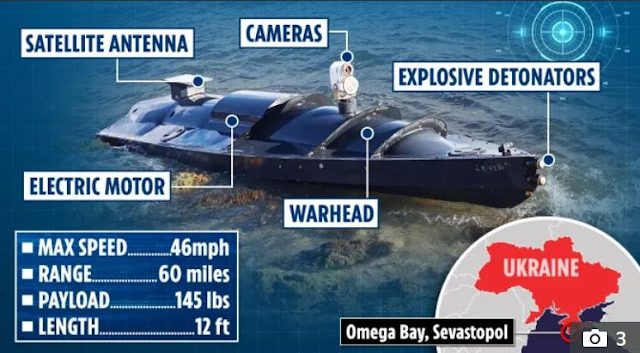
A MYSTERIOUS vessel widely believed to be a Ukrainian suicide drone has washed up near to a Russian naval base.
The vessel was found in Omega Bay, by the port of Sevastopol, which is home to Vladimir Putin’s Black Sea fleet.
We can safely assume — as the videos below seem to demonstrate — that the ones used in the attack are of the same design.
We will loop back to this point later, but just behold the simplicity of it via the article from The Sun linked above;
This is all COTS technology riding on either a canoe or ocean going kayak. If you have someone with an understanding of explosives and communications (the only part requiring military expertise +/-) and then any garden variety electrician, small engine pro, and fiberglass guy … you can run a production line of these on a shoestring budget at scale.
[…]
This is another demonstration that the military culture of Russia is broken. The human element in the Sevastopol was manifested in the complete lack of preparation for the attack in spite of the warnings so clearly provided in September.
As old as “fire ships” are to naval warfare are the defenses against them. They are as simple as the weapons you need to defend against them. Barriers at the water level and crew served weapons — preferable optically sighted — as a backup.
Part of the video above you can see both surface ship and helo gunfire taking out the threat from one boat, but other boats were able to approach surface ships underway and penetrate deep in to port.
Why?
What is one of the things we have repeatedly discussed here for the last 18-years? When war comes you never have enough of what? That’s right, anti-aircraft defenses and medium caliber guns including crew served weapons.
We build our ships around the most high-technology threats and equally exquisite defenses against them, but completely overlook the low-tech weapons that are just as deadly. We ignore mine warfare, and we also ignore threats as simple as a converted kayak. It isn’t sexy and the contracts awarded are small … but the threats are real.
Comments Off on Ukraine unleashes the modern descendent of the “fireship” against Sevastopol
Britain’s Final Assault – Falklands War
Historigraph
Published 29 Oct 2022In the closing days of May 1982, the British land campaign to recapture the Falkland Islands began, after an eight thousand mile voyage and weeks of battles at sea and in the air. With a beachhead established, British troops were now charged with rapidly defeating an Argentinian force that was more numerous and had spent weeks preparing defences. The Battle for the Falklands was about to begin.
(more…)
Comments Off on Britain’s Final Assault – Falklands War
QotD: Spartan strategy during the Persian wars
The hammer Sparta has, of course, is hoplite battle. Sparta seeks to solve almost all of its issues by applying a hoplite phalanx to the problem, regardless of if the problem can be solved by a hoplite phalanx. Spartan strategic thinking is thus marred by both a failure to consider military solutions that did not consist of traditional hoplite battles, as well as an inability to consider or execute non-military solutions at all.
We can see the former weakness in Spartan planning in the Persian Wars. Spartan planning is both direct and unrealistic: find a choke-point, fortify it and hold it indefinately with a hoplite army. Attempted at Thermopylae this plan fails; the Battle of Thermopylae is often represented in popular culture as an intentional delaying action, but it was nothing of the sort – Herodotus is clear that this was supposed to be the decisive land engagement (Hdt. 7.175; Cf. Diodorus 11.4.1-5). The Spartans then attempt to recreate this plan at the Isthmus of Corinth and have to be rescued from their strategic stupidity by the Athenians, who threaten to leave the alliance if the plan isn’t abandoned (Hdt. 8.49-62). A blockade at the Isthmus would be easy for the Persian army to bypass – assuming it didn’t simply defeat it with generally superior Persian siegecraft – and worse yet was a diplomatic disaster given that it meant essentially writing Athens off as a loss, when the Athenian navy provided the bulk of the ships protecting the Isthmus.
Bret Devereaux, “Collections: This. Isn’t. Sparta. Part VII: Spartan Ends”, A Collection of Unmitigated Pedantry, 2019-09-27.
Comments Off on QotD: Spartan strategy during the Persian wars
October 31, 2022
Executed for Telling a Joke – October 30, 1943 – WAH 084
World War Two
Published 30 Oct 2022From a conference in Moscow the United Nations Alliance issues a warning to Nazi Germany about their atrocities, while those atrocities continue unabated.
(more…)
Comments Off on Executed for Telling a Joke – October 30, 1943 – WAH 084
Halloween Special: The Wild Hunt
Overly Sarcastic Productions
Published 30 Oct 2020It’s a Halloween special AND a miscellaneous myth! Who could ask for more? Today let’s dive into a very spooktacular folkloric motif and get real in the spirit of the season!
(more…)
Comments Off on Halloween Special: The Wild Hunt
October 30, 2022
Andrew Sullivan on the rise of Rishi Sunak (or was it “Rashid Sanook”?)
In the free-to-cheapskates excerpt from his Weekly Dish newsletter, Andrew Sullivan contemplates the differences between how Barack Obama was seen as a historical figure to the US media and yet that same media can’t manage to see how Prime Minister Sunak is “the British Obama”:

Rishi Sunak shortly after becoming Chancellor of the Exchequer in 2020.
In his inimitable way, Joe Biden this week celebrated the rather remarkable fact the the new Conservative prime minister in Britain is the grandson of Indian immigrants:
As recently as today, we’ve gotten news that Rashid Sanook is now the prime minister. As my brother would say, “Go figure.” And the Conservative party! … Pretty astounding. A groundbreaking milestone. And it matters! It matters!
He got the name wrong, but he’s Joe Biden. He gets names wrong. But unlike many on the left, especially the woke left, and perhaps because he is old enough to remember the after-effects of colonialism, Biden could bring himself to see what a staggering moment it is. It really is. It has gotten a bit obscured in the incredible mess of recent Tory politics. But staring us in the face is a historic shift.
It’s an Obama moment, after a fashion.
[…]
No, Sunak didn’t run an inspirational campaign like Obama. He’s not an orator even close in skill, he hasn’t won an election in his own right, and he didn’t come out of the blue. But he’s even younger than Obama when he took office — just 42, five years younger than Obama when he became president, and, unlike Obama, a slip of a thing and only 5’7″. And, for understandable reasons, Sunak seems much less worried about the cultural and political aspects of breaking the race barrier than Obama was.
Sunak is, for example, an openly practicing and proud Hindu. He lit Diwali lights around 11 Downing Street and took his oath on the Bhagavad Gita. That’s not someone running from his heritage. And he is also a Brexiteer from conviction, and, unlike Truss, a fiscal conservative who’s a realist about what can and can’t be done in a period of extraordinary economic stress for Brits and massive post-Covid debt.
All of this suggests something too many liberals have forgotten. These countries of alleged “white supremacy” have less racism than almost anywhere else in the world. It is hard to imagine a non-white president of France or Germany or Italy — let alone China or Russia or anywhere in Central Europe. It is hard to think of another empire that was deliberately unwound by its architects, and who then, within two generations, installed the grandson of former colonial subjects to its most powerful office. And Obama, of course, was twice elected with more heartland white support than Hillary Clinton.
Sunak has, moreover, been selected by the Tory party — that bastion of alleged bigotry that has already had three female prime ministers in its history, and now also a non-white man, James Cleverly, as foreign secretary, and a woman of Indian ancestry, Suella Braverman, as home secretary. Three of the top four ministers of state in Sunak’s cabinet are non-white. The new chairman of the Conservative party is Nadhim Zahawi. I’m telling you this because the US MSM — who are usually obsessed with racial representation in every single mundane situation — suddenly aren’t that interested, when some of their woke priors are rattled.
This is true of the broader American left. A faction obsessed with racial “equity” cannot take a moment to observe a historical moment of extraordinary proportions. Some, like Trevor Noah, have even completely invented a racist “backlash” against Sunak that simply hasn’t happened, apart from one call on one radio call-in show. (I was on BBC Radio this morning talking to an interviewer who was simply baffled by the projection.)
Noah has the excuse of being a comedian. But the New York Times‘ coverage has been almost as ludicrously slanted as its usual coverage of post-Brexit Britain, and it quickly ran two op-eds by British leftists trashing Sunak. Every story that refers to his ethnicity always slams his class “privilege” — i.e. that his parents were middle-class children of immigrants. This morning, the paper ran another hit-piece on Sunak’s wealth. The only benefit of his Indian ancestry appears to be that he will help the Indian diaspora in Britain itself. The incredible arc of imperial history finally coming full circle? Barely a mention.
Comments Off on Andrew Sullivan on the rise of Rishi Sunak (or was it “Rashid Sanook”?)
Fresh German Armor in the USSR! – WW2 – 218 – October 29, 1943
World War Two
Published 29 Oct 2022Erich von Manstein finally gets the reserve armor he’s been begging Hitler for, so he can carry out his counteroffensive in Ukraine. The Soviets are still on the move themselves though. In Italy, though, the Allies are moving at a crawl since the Germans have mined and booby trapped everything. There’s also new action in the Solomons and a celebration in Japan.
(more…)
Comments Off on Fresh German Armor in the USSR! – WW2 – 218 – October 29, 1943
“The Economist is the most over-rated publication in the English language”
I started reading The Economist when I was in college, and became a subscriber for nearly 20 years. Over the last few years, the tone of the articles shifted away from classical liberal toward communitarian or even full-blown socialist cheerleading, so I sadly ended my subscription and haven’t picked up a copy in at least 15 years. According to Ken Whyte in the SHuSH newsletter, things haven’t improved since I stopped paying attention:
The Economist recently said that book publishing in today’s economy resembles book publishing during the Second World War when “paper imports collapsed” and “publishers printed only sure-fire hits”.
The Economist is the most over-rated publication in the English language, especially by itself. I give it marks for its broad range of interests, ability to cover a lot of ground in relatively tight articles, and occasionally solid reporting, but if you’re going to boast incessantly about how smart you are …
… you’d better back it up. The Economist seldom does. It tends to glib, obvious, and sloppy. Most of its articles are written by anonymous b-level freelancers whose best stuff goes to outlets that afford bylines. Their work is edited to a stultifying homogeneity by a haughty grad student with a Financial Times subscription. Or so it reads.
This piece — “Books are Physically Changing Because of Inflation” — is a case in point. Paper imports to the UK were reduced during WW2 but they did not collapse. The problem for the book trade was rationing. The government restricted publishers to 60 percent of their pre-war paper volumes (later falling to 35 percent) and itself used far more tonnage for propaganda than the book industry normally required. Manpower shortages were another factor limiting the production of new titles.
Nor is it true that publishers released “only sure-fire hits”. While much of their paper allotment went to keeping hot-selling books in stock, many bets were placed on new titles and most of them paid. It was wartime and leisure activities were limited. “British publishers found that they could sell virtually any title,” writes Zoe Thomson in The Journal of Publishing Culture.
The article isn’t all bad. It reports that British book publishers are paying 70% more for paper than they were a year ago: “Supplies are erratic as well as expensive: paper mills have taken to switching off on days when electricity is too pricey. The card used in hardback covers has at times been all but unobtainable.”
To cope with the price increases, publishers are printing smaller books on cheaper paper and jamming more words onto the page. Writers are being asked to write shorter and are being held to their word limits.
That reflects the current state of the industry. It’s hardly news, though. SHuSH readers are probably sick of hearing me on rising paper and printing costs, and I’ve just been following what others have written. The cost of printing has more or less doubled since before COVID. Many smaller publishers are already releasing fewer and slimmer titles. If we are headed into a recession, the trend will continue.

Comments Off on “The Economist is the most over-rated publication in the English language”
Jatimatic: Finland’s Least Successful PDW
Forgotten Weapons
Published 24 Jun 2022The Jatimatic was a stockless PDW designed by Jari Timari, who co-owned Tampereen Asepaja Oy, a firearms company in Tampere Finland. The firm was founded in the early 1920s, making .22 biathlon rifles, sporterizing military surplus, and other gunsmithing work. In the late 70s he got the idea for a compact 9mm PDW with some unique climb-reducing features, and in 1980 it was introduced as the Jatimatic (JAli TImari). Only about 400 were made, as it was not adopted or purchased in large quantities by anyone (although it was tested by many, including the Finnish Border Guards).
The Jatimatic was made without a stock, instead using a shooting sling for stabilization. It used standard Swedish K magazines, and has a distinctly off-angle appearance. This was done to counteract muzzle climb, as the line of the barrel points directly back into the shooter’s hand. It also has an interesting safety built into the folding front grip – if the grip is closed, the bolt is locked in place.
Production ended in the late 1980s after “permit irregularities” and a robbery of a bunch of Jatimatics from the company premises. The rights to the design were sold to a new company called Golden Gun in 1994, and they attempted to reintroduce it as the GG-95 with a few improvements, but it was a rather complete flop. Its best achievement was getting into several major movies, including Cobra and Red Dawn.
(more…)
Comments Off on Jatimatic: Finland’s Least Successful PDW
QotD: Thatcher’s legacy
Nevertheless, she won. In Britain in the Seventies, everything that could be nationalized had been nationalized, into a phalanx of lumpen government monopolies all flying the moth-eaten flag: British Steel, British Coal, British Airways, British Rail … The government owned every industry — or, if you prefer, “the British people” owned every industry. And, as a consequence, the unions owned the British people. The top income-tax rate was 83 per cent, and on investment income 98 per cent. No electorally viable politician now thinks the government should run airlines and car plants, and that workers should live their entire lives in government housing. But what seems obviously ridiculous to all in 2013 was the bipartisan consensus four decades ago, and it required extraordinary political will for one woman to drag her own party, then the nation, and subsequently much of the rest of the world back from the cliff edge.
Thatcherite denationalization was the first thing Eastern Europe did after throwing off its Communist shackles — although the fact that recovering Soviet client states found such a natural twelve-step program at Westminster testifies to how far gone Britain was. She was the most consequential woman on the world stage since Catherine the Great, and the United Kingdom’s most important peacetime prime minister. In 1979, Britain was not at war, but as much as in 1940 faced an existential threat.
Mark Steyn, “The Uncowardly Lioness”, SteynOnline.com, 2019-05-05.
Comments Off on QotD: Thatcher’s legacy
October 29, 2022
Witches, beware! It’s the Malleus Maleficarum!
It’s the season for ghosts, goblins, and — of course — witches, so Scott Alexander decided to review that famous book for witch-hunters, the Malleus Maleficarum:
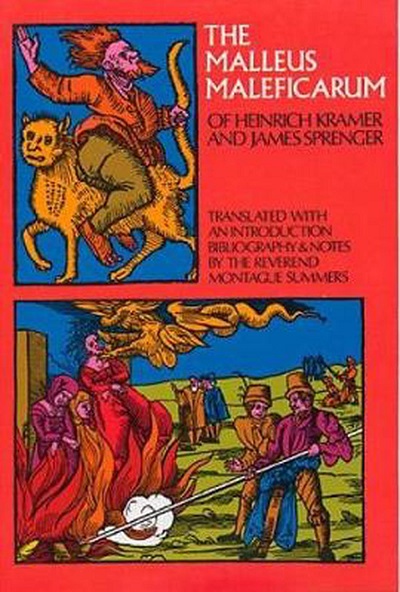
Did you know you can just buy the Malleus Maleficarum? You can go into a bookstore and say “I would like the legendary manual of witch-hunters everywhere, the one that’s a plot device in dozens of tired fantasy novels”. They will sell it to you and you can read it.
I recommend the Montague Summers translation. Not because it’s good (it isn’t), but because it’s by an slightly crazy 1920s deacon every bit as paranoid as his subject matter. He argues in his Translator’s Introduction that witches are real, and that a return to the wisdom of the Malleus is our only hope of standing against them:
Although it may not be generally recognized, upon a close investigation it seems plain that the witches were a vast political movement, an organized society which was anti-social and anarchical, a world-wide plot against civilization. Naturally, although the Masters were often individuals of high rank and deep learning, that rank and file of the society, that is to say, those who for the most part fell into the hands of justice, were recruited from the least educated classes, the ignorant and the poor. As one might suppose, many of the branches or covens in remoter districts knew nothing and perhaps could have understood nothing of the enormous system. Nevertheless, as small cogs in a very small [sic] wheel, it might be, they were carrying on the work and actively helping to spread the infection.
And is this “world-wide plot against civilization” in the room with us right now? In the most 1920s argument ever, Summers concludes that this conspiracy against civilization has survived to the modern day and rebranded as Bolshevism.
Paging Arthur Miller…You can just buy the Malleus Maleficarum. So, why haven’t you? Might the witches’ spiritual successors be desperate to delegitimize the only thing they’re truly afraid of — the vibrant, time-tested witch hunting expertise of the Catholic Church? Summers writes:
It is safe to say that the book is to-day scarcely known save by name. It has become a legend. Writer after writer, who had never turned the pages, felt himself at liberty to heap ridicule and abuse upon this venerable volume … He did not know very clearly what he meant, and the humbug trusted that nobody would stop to inquire. For the most part his confidence was respected; his word was taken.
We must approach this great work — admirable in spite of its trifling blemishes — with open minds and grave intent; if we duly consider the world of confusion, of Bolshevism, of anarchy and licentiousness all around to-day, it should be an easy task for us to picture the difficulties, the hideous dangers with which Henry Kramer and James Sprenger were called to combat and to cope … As for myself, I do not hesitate to record my judgement … the Malleus Maleficarum is one of the most pregnant and most interesting books I know in the library of its kind.
Big if true.
I myself read the Malleus in search of a different type of wisdom. We think of witch hunts as a byword for irrationality, joking about strategies like “if she floats, she’s a witch; if she drowns, we’ll exonerate the corpse”. But this sort of snide superiority to the past has led us wrong before. We used to make fun of phlogiston, of “dormitive potencies”, of geocentric theory. All these are indeed false, but more sober historians have explained why each made sense at the time, replacing our caricatures of absurd irrationality with a picture of smart people genuinely trying their best in epistemically treacherous situations. Were the witch-hunters as bad as everyone says? Or are they in line for a similar exoneration?
The Malleus is traditionally attributed to 15th century theologians/witch-hunters Henry Kramer and James Sprenger, but most modern scholars think Kramer wrote it alone, then added the more famous Sprenger as a co-author for a sales boost. The book has three parts. Part 1 is basically Summa Theologica, except all the questions are about witches. Part 2 is basically the DSM 5, except every condition is witchcraft. Part 3 is a manual for judges presiding over witch trials. We’ll go over each, then return to this question: why did a whole civilization spend three centuries killing thousands of people over a threat that didn’t exist?
Comments Off on Witches, beware! It’s the Malleus Maleficarum!
Your Thoughts on Our D-Day Coverage So Far – WW2 – Reading Comments
Updated with re-uploaded video, 3 Nov 2022. The original video was taken down within a few hours. This is the same video less one short rant that Indy reconsidered and has chosen to omit.
World War Two
Published 28 Oct 2022Indy and Sparty pick out some of the best, most interesting, and even controversial comments by you under our videos. Stay for the PJs.
(more…)
Comments Off on Your Thoughts on Our D-Day Coverage So Far – WW2 – Reading Comments


