
Tasting History with Max Miller
Published 9 May 2023
(more…)
May 10, 2023
Feasting at a Medieval Tournament
Comments Off on Feasting at a Medieval Tournament
May 9, 2023
The Republicans’ moment in the sun rain
I joked on Coronation Day that the only people not trying to have a good experience there were the British republicans, but they did get a bit more attention due to their proximity to the Royal Procession than they normally manage:
I mentioned before that it was a happy crowd, with high spirits. The crowd didn’t strike me as remarkable, which is to say, there wasn’t anything particularly notable about it. It was mixed. You’d find every age group and colour there, as well as a smattering of obvious tourists. Lots of people had little Union Jacks they would wave or tuck into the brims of hats or under backpack straps. Some wore full-sized flags as capes. A few young men, who’d obviously been drinking either since early that morning or perhaps the night before, were there in cheap royalty costumes — robes and plastic crowns. The way they were going, I had doubts they’d last much longer. One in particular seemed a bit wobbly on his feet.
One young woman with them had somehow attached a frisbee to her head, in delightfully mockery of the absurd hats women seem to love wearing to royal events. It made me laugh. So begins and ends The Line‘s coronation-related hat commentary.
One of a collection of photos from Kim du Toit’s post-coronation post showing many (perhaps most) of the Republican protestors along the parade route.
https://www.kimdutoit.com/2023/05/08/monday-funnies-post-coronation-edition/Quite near to the front of the viewing area, just off to the left of Nelson’s Column, was a group of a few dozen republican protesters. I have to remind my North American readers — I don’t mean U.S. Republicans, the of-late MAGA-infused husk of the once Grand Old Party. These are British republicans, an arguably even more baffling breed: these are the people that want Britain to be a republic. They too were a mixed group, but as I wandered over to join them, I did note something interesting. I had expected them to be younger and more ethnically diverse than the rest of the crowd. They weren’t. I don’t know if I’d go as far as saying that they were less diverse, but my sense was that, at least in terms of the age of the crowd of protesters, maybe they were a touch older than the rest? In any case, it would have been a near-run thing, but that was one of the only things that really jumped out at me about the protest. My assumption that they’d be younger, more diverse, more obviously progressive was wrong. If they’d dropped their yellow flags and banners and quit their chanting of “NOT MY KING!”, they’d have blended in with the rest.
It started to rain around this time. It’s England, of course it was raining. I’d come prepared with a rain jacket so wasn’t deterred, but the rain did have one admittedly lousy impact. Umbrellas. I’d been gradually able to work my way up quite close to the front of the crowd — I’d stuck close to the republicans and it seems that many people tried to give them a wide berth, and I’d been able to shuffle my way gradually forward. Nelson’s Column was to the right, behind me. To my right and front was Admiralty Arch. And off in the distance, but not too far, was Westminster Abbey itself. It was a pretty perfect place to view the procession.
But for the umbrellas. Once they opened up, all one could see was umbrellas.
And that’s how it stayed, to be honest. Troops began to march past in perfect ranks. Bands struck up patriotic songs. The crowd cheered and more than a few sang. One loud female voice — a surprisingly lovely one — struck up The Star Spangled Banner — which was either some kind of deliberate prank or just a very historically confused soul getting caught up in the moment. I heard the clopping of hooves and the crowd went absolutely wild, and suddenly, thousands of arms shot up into the air holding smartphones, every person present seeking a better angle for their videos. The arms and the umbrellas made it virtually impossible to see a damn thing. (See this video by a New York Times team: they must have been standing within 50 feet of where I was, a bit off to my left. You’ll see what I mean.)
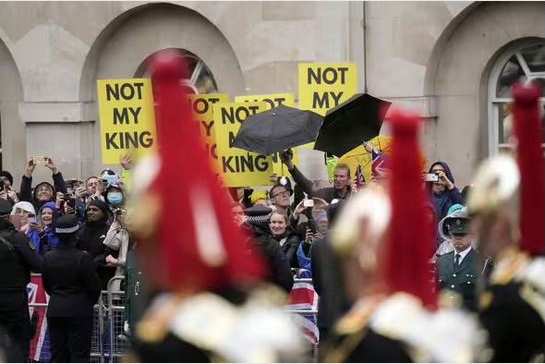
That was from Matt Gurney’s sleep-deprived view of the procession from The Line (that’s not editorializing on my part — he hadn’t slept on the plane from Toronto and got to London at 7am on Coronation Day). In what seemed like a useful break in the public celebrations, he snuck away to get some sustenance and be out of the rain for a bit. When he returned it was lowlight time for the Republicans:
After I’d polished off the pint, I headed back out, back to the square, and that’s where things got interesting. I figured I’d get back to my former spot near the chanting republicans, and did so, no problem. But I noticed there suddenly seemed to be an awful lot of cops around … all heading that way. As in: right toward me, and the chanting people I was standing near. Oops. I left, working my way around the crowd, heading back the way I came from my hotel, and found myself actually facing a rank of advancing cops. Oops again. One had a badge that said inspector, and I walked right up and told him I was a Canadian journalist just watching things. He grinned at me and said, “Alright, mate, come this way,” and had a security guard walk me through the police. I thus ended up missing what has proven to be a controversial event and perhaps the only unhappy moment I know of during the coronation, at least in my area: a bunch of the chanting republicans were arrested just moments after I got out of dodge, and then large metal screen barriers were thrown up, closing off the square due to, apparently, overcrowding. People could leave but no one new could enter.
My sense, as I walked away, was that there was no reason to arrest anyone. (And as I said, this is proving controversial.) I hadn’t seen anything getting out of hand. There had been some chanting and counter-chanting and even some heckling back and forth, but it had all seemed in good enough spirits. Even some of the boos sent at the republicans — two young men with flags had been hamming it up in the main crowd, apart from the main blob of republicans — had seemed in good humour. I don’t know what the police saw or knew. But I couldn’t tell you why they’d moved then and not before, or later. As for overcrowding, I don’t think so. The square really wasn’t all that full. It seemed less full at that moment than it had been when the procession had passed on the way to the abbey. But the barriers seemed to go up quickly, everywhere. Literally everywhere.
And though I was glad to have avoided getting caught up in the Cops vs. Chanting Republicans, I was now on the wrong side of the barriers.
In The Critic, Kittie Helmick recounts finding herself in the vicinity of the “NOT MY KING!” group:
“You seem to find this whole thing rather amusing,” snapped a short angry man with a Not My King sign, about half an hour into the Republic protest against the coronation of King Charles III. I must admit I did. Kettled into a small enclave just off Trafalgar Square, an angry swell of old school socialists, Twitter anarchists, Lib Dem mums, eccentric vicars, boomer hippies, blue haired students and Covid conspiracists had somehow found themselves part of the coronation spectacle. Before the bells of St Martin in the Fields, the full shouty brunt of British republicanism was aimed at a bewildered stream of Chinese tourists and young families out for a day in London.
The survival of the British monarchy is one of the great wonders of modern history. Spending the morning of the coronation with Republic, it began to seem less mysterious. Despite everything in recent years, the Monarchy is still liked more than most of our institutions and probably every one of our elected politicians. No one gathered there could really explain why. The arguments were articulated in between the shouty chanting: things about “modern Democracy” and a “family of Lizards”, none of which quite landed the blow as the day unfolded around us.
Somewhere beyond the crowds, towards Westminster Abbey, an ageing, eccentric dandyish farmer, who secretly wants to be King of Transylvania, was being anointed in holy oil and crowned by an Archbishop wearing hearing aids in a seven hundred year old chair vandalised by 18th century schoolboys. All the while this ceremony was being fawned over across the world by everyone from Kay Burley to one of the world’s most remote tribes. None of it made sense, and that is precisely the point.
Earlier that morning, the CEO of Republic Graham Smith, a man not even the protestors could name, achieved the greatest success of his kind since Cromwell, by being arrested at the hands of the jobsworth Met. For a brief moment, a shiver of excitement spread through the protest. Whilst the country was entranced by a fugue of sombre ritual and Zadok the Priest, Republic were experiencing their own desired reality unfold on the streets of London. Here was a police state enforcing the will of a “politically illiterate” nation brainwashed by bunting and tabloid journalism. The mask was finally off. The incoherent gaggle of shouty slogans and reddit thread arguments made sense. The fight was here and now.
Except that was all a fantasy too. As stupid as the arrests were, nothing could disguise the fact this was a fringe event for a movement that just can’t seem to take off — a Coronation curio to gawp at. “They’re a bunch of wronguns, aren’t they?” said one bored steward to me as we watched a man larping Les Miserables as he chanted Not My King at a trio of giggling Chinese students. The deeper I dug into the many arguments and protestations offered as an alternative to the “fairytale” of monarchy, the more the core transgressive energy of British republicanism revealed itself. It is itself strangely twee and fantastical. Rid us of the Royals, and everything will become better. Gone will be the “psychological baggage” of Britain’s past holding us back. Democracy will triumph. The crown jewels will be sold off and spent on food banks. The plebs will not worship hereditary blood, but NHS rainbows. Britain will become less racist, elitist and classist. The left might even win an election. We could have a poet president like Ireland, a Lineker or a Stormzy shaking hands with the American president.
Comments Off on The Republicans’ moment in the sun rain
QotD: Changing German Panzer tactics in 1943
Report of the Commanding General of the 17th Armored Division, 24 April, 1943
The following report, though obviously written in haste with little regard for elegance of expression, gives a good view of the changes in tank tactics which took place on the Eastern Front. This translation was made from a typed copy of the original and thus bears no signature. Nonetheless, there is good reason to believe that the author was the famous Fridolin von Senger und Etterlin, who commanded the 17th Armored Division at this time.
1. The tank tactics which led to the great successes of the years 1939, 1940, and 1941 must now be considered obsolete. Even if it were possible today to breakthrough an antitank front by means of the massive employment of concentrated waves of tanks, we would not be able to make use of these methods, which would once more lead to considerable losses, because of our [tank] production situation. These methods, often employed in rapid succession, would lead to such a quick reduction in tank strength that the character of an armored division would be fundamentally altered. This would lead to difficulties for the higher leadership.
The change in tank tactics is logical. The beginning successes of the weapon, the shock effect of which rested upon the technical achievement and overwhelming invincibility of the attacker, found at last its end in the development of appropriate defenses. From the point of view of production, the building of tanks could not keep pace with the building of antitank weapons. Apparently, a thousand antitank rifles, or dozens of antitank guns, can roll off the production lines for every tank.
The following are drawn from these insights.
2. The new tank tactics, which have already gained inevitable acceptance in the divisions, are outlined below.
The tank group no longer forms the nucleus of the armored division, about which other weapons are grouped as auxiliaries. The tank is a new arm acting in concert with and equal to the old arms. In cooperation with other weapons, it retains its power, even though its numbers are far below those called for by tables of organization.
Its meaning as a new arm is a function of the fact that it combines in itself a goodly portion of the two elements important to the attack: fire and maneuver. It derives these qualities from the fact that it is invulnerable, or less vulnerable, because of its armor.
Because the tank arm combines in itself firepower and mobility to a greater degree than other arms, it is the appropriate weapon for forming the main effort [Schwerpunkt].
The combat of the armored division is characterized by the fact that it is a mobile unit in all its parts and, as a result, the division commander is in a position, in the course of a battle, to chose and form a main effort [Schwerpunkt]. This principle excludes an irrevocable commitment of the tank group before an attack. Rigid employment within the framework of an already established battle plan is replaced by division commander himself holding [the tank group] in readiness and the flexibly employing it in the course of fighting against the required, or known to be appropriate, position.
The battle will begin with the infantry attack. The infantry attack provides the required foundation for the strength of the antitank front, for its length and depth. If the antitank front is known, then the tank attack can be ordered according to the classical principles for leading mobile units against the flanks or, if possible the rear, of an enemy defensive position. This attack should only be carried out exclusively by tanks when they can gain complete surprise. If surprise cannot be gained, then in this flank attack fire superiority must be fought for through the employment of artillery and, for the time being and to a certain extent the fire of the tanks themselves, until the enemy antitank front can be shaken or at least split up. If surprise can be gained, then a break-in against the flank of an antitank front can succeed without preparatory fire.
The attack against an enemy antitank front by means of a successful move against its flanks and rear cannot be carried out by tanks alone. It requires the support of artillery. In our experience, however, tank attacks carried out against the flanks and rear have outrun the artillery groups in direct support. Shifting fires by means of forward observers alone is not enough to ensure the shooting up of defensive fronts. What is needed here is thus the self-propelled batteries, which in the same manner as tanks themselves can quickly change their firing positions and thus attain the same mobility as the tank groups.
3. Now that these principles of the new tactics have been laid out, their use in practice will be explained.
a. The use of tanks as the first attack wave against a strongly fortified, deeply organized defensive position leads always to great losses and is thus false.
b. The use of tanks against deeply organized antitank positions is possible with the stipulation that it be commanded by an all-arms leader in close cooperation with other weapons after the formation of a main effort on the spot and that the further prosecution of the battle be steered by the same all-arms leader.
c. The employment of tanks leads to the greatest success when, sent into action and controlled by the all-arms leader, when they are used to strike the enemy in the flank, soon after the latter has begun an attack and before his antitank weapons have established firm antitank positions. Also in this last case, the attack must, with a view to direction and timing, be ordered by the all-arms leader on the spot. (With this last method the weak forces of the worn out 17th Armored Division annihilated one enemy division at Kuteinikowskaja on the 5th of January 1943 and another at Talowaja on the 27th of January, 1943.)
4. These new tactics are based upon the cooperation of the three main arms (infantry, tanks, and artillery) during the entire course of a battle. This cooperation can only be assured when the leader, that is to say, in all cases where the mass of the division is employed, the division commander himself, controls the cooperation of the arms on the spot throughout the entire battle. If, under the press of circumstance, as generally was the case during the battles between the Don and the Volga, widely separated battle groups [Kampfgruppen] of infantry, tanks and artillery had to be formed, it is essential that each of these battle groups be commanded by an all-arms leader, who is neither the commander of the tank element nor the infantry element of the battlegroup.
The all-arms leader’s means of command is the 10-watt radio built into a tank. With this equipment the leader is connected with the tank leaders as well as the leader of the infantry group, who, in case the proper radios are lacking, is provided with a tank. The all-arms commander is also in contact, by means of his armored personnel carrier, with battlegroups not forming part of the main effort and with his first general staff officer (Ia) working far to the rear.
The leader of the artillery group locates himself, according to the ordinary rules of command and control, with the all-arms leader. He is able, as was explained above, to give effective support only as the leader of an artillery group made up of self-propelled batteries. If he does not have access to some of these, there is always the danger the leader of the tank group would find his mobility limited by being bound to the less mobile towed artillery supporting him.
The place of the leader in combat is far forward, so that he can easily see the tank combat and, on the basis of these observations, can steer the course of the battle. He is sufficiently separated from the forward wave of tanks that he does not get involved in the tank-versus-tank and tank-versus-antitank battles, for this combat will focus his attention on the tanks fighting in the forward lines, to the point where tactical decisions which derive from the cooperation of all arms, can no longer be made.
The place of the leader can, however, rarely be chosen outside of the zone of enemy artillery fire. He can nevertheless remain mobile, thanks to the peculiar virtues of his means of command, namely voice radio. In the course of an attack in progress, he should be far enough forward to allow contact with the infantry group. Through it he can exert the leadership of a combined arms combat.
an armored personnel carrier used as a mobile command post in Russia in 1941From his location the leader should be in a position to himself assemble, according to the development of the situation and the requirements of the cooperation of arms, discrete tank groups.
Cooperation between discrete tank groups and infantry groups is possible if the all-arms leader remains in voice radio contact with the tank group in question. The attachment of tank groups to infantry groups is, as a matter of principle, always to be avoided. The infantry is not in a position to ensure the cooperation of infantry, heavy infantry weapons, and artillery as well as tanks because it is fully occupied with the conduct of the combat of other weapons. On this basis, the attachment of tanks to infantry divisions, which cannot be trained in the cooperation of the three arms, is, as a matter of principle, to be avoided.
The requirement to achieve success by the cooperation of all three arms does not exclude the concentration of all tanks in a single attack. This is still to be striven for. The concentration of tank power in the main effort [Schwerpunkt] will, however, not to striven for through systematic employment on the basis of an established plan, but rather in the course of the battle through the assembling of certain tank groups, in short, through the flexible combat leadership and formation of the main effort [Schwerpunkt] in the course of the battle through the all-arms leader himself.
This battle method, which aims at the close cooperation of the three main arms, cannot function without the formation of a special infantry group mounted in armored personnel carriers. Because it is essentially different, this group does not belong with the wheeled-vehicle mounted infantry of the division. They form, rather, an integrated part of the tank group. They can be attached to the later or will be employed according to the decision of the all-arms leader in accordance with the same principles that apply to the employment of tank waves.
The armored personnel carrier group of the infantry which is attached to the tank group corresponds closely to the self-propelled artillery. Both are special branches of their main arm, which work within the tank group itself and without which the cooperation of the tank group with the mass of the truck-mounted infantry and the towed artillery would not be possible.
5. The following deductions for the construction of tanks can be drawn from the aforementioned portrayal of the tactics and command techniques of the armored division. Because the race between tanks and anti-tank defenses can only be won by even heavier types and thus can not be guaranteed, the focus of effort [Schwerpunkt] in construction must be towards mobility and firepower.
The cooperation of arms can never be so close that artillery-infantry attacks alone can prepare an antitank front so that the tank attack can break through it in a rapid rollover. Instead, tanks must be an a position to use long-range fire to put anti-tank fronts out of action or at least so suppress them so as to make possible the further prosecution of the attack. They are only in a position to do this when they possess weapons of such a caliber that they can win superiority over immobile antitank weapons by means of fire and mobility.
According to this line of reasoning, great things can be expected from the creation of self-propelled artillery batteries. As unarmored fire units with greater range than tanks themselves they are in a position to attain that fire superiority which is necessary to gain the upper hand against the antitank defense.
During this winter’s fighting the best results were gained from assault gun battalions which, because of their great mobility and firepower, were employed and led in the same way as tanks. From the point of view of mobility, they outdid the tanks. Self- propelled guns were likewise successfully employed according to the same principles, to augment tank and assault gun groups, particularly by fire.
In contrast, the Tiger tanks, which were supposed to have fulfilled all three requirements, namely firepower, mobility, and heavy armor, were less successful, for their mobility was not sufficient for the elastic battle leadership outlined above. (In this experience it is important to take into account that the units sent fresh into battle were not at the height of their powers, especially where the use of radio was concerned. The impression of their lack of mobility, especially in rolling country with hard-frozen ground, however, would have been the same, even if the training of the personnel had been completed.)
These lessons of the more and more similar tactics of tanks, assault guns, and self-propelled artillery, which in more or less ad hoc arrangements establish the principle of fast-moving heavy firepower, causes one to wish that these weapons could be organized under a single leader with the goal of combining under him standardized training and well-schooled cooperation. This commander is the commander of the division’s tank group, that is to say, all more or less armored weapons mounted on tracked vehicles that are used for the fire battle. He must also have attached as an essential part an infantry group mounted in armored personnel carriers which should be made available according to a ratio of at least one infantry company for each three tank companies of whatever type.
The self-propelled artillery battalion should not be made an organic part of the tank group because of artillery training and the proposed design that will allow the guns to be dismounted. It should remain an organic part of the artillery regiment and be as- signed, on a case by case basis, to the commander of the tank group.
Unsigned report, probably authored by Fridolin von Senger und Etterlin, who commanded 17th Panzer Division at that time, via Bruce Gudmundsson’s Tactical Notebook, 2023-02-06.
Comments Off on QotD: Changing German Panzer tactics in 1943
May 8, 2023
Father Ted as Ireland’s answer to Fawlty Towers
Conor Fitzgerald on the tragically short run of the classic Irish comedy Father Ted:

Fondly remembered and occasionally quoted, Father Ted has its place in the broad canon of the British sitcom. But in Ireland, even 25 years since its finale, it has always been so much more. Its status is closer to Fawlty Towers in England or Cheers in the United States: the national sitcom, a piece of light entertainment that nevertheless Says Something Meaningful About Us.
Not only was Father Ted one of the few successful TV representations of Ireland, it was made during Ireland’s version of the Swinging Sixties, our flux decade of the Nineties. The accelerating collapse of the Church and the exposure of longstanding political corruption coincided with the dawn of the Celtic Tiger years, lending peripheral Ireland a sense of self-conscious modernity. It was a unique national turning point, where our 19th-century past seemed to co-exist with our 21st-century future. In reflecting this upheaval, Father Ted has become not just a social historical document, but a portent of where Ireland stands today.
It’s not the sort of thing that national epics are normally made of. The programme is about three Catholic Priests — Fathers Ted Crilly, Dougal McGuire, and Jack Hackett — on Craggy Island, a remote settlement off the west coast of Ireland. All three priests have been exiled to this purgatory by the terrifying Bishop Len Brennan (their misdemeanours are never referred to directly, but Ted often makes oblique reference to the fact that “the funds were only resting in my account”). Most episodes revolve around an absurdist version of Church life, Ted’s schemes to escape the island and their interactions with the island’s townsfolk.
Rarely for domestic Irish TV, it was a sitcom written by Irish people and it was set within a central Irish institution, the Catholic Church. And the dearth of representations of Irish people in entertainment meant it crystallised many Irish archetypes for the first time. Ireland itself hadn’t always been a welcoming place for satirists. Ted star Dermot Morgan knew this well — his major project before Ted had been a political comedy radio show named Scrap Saturday, which upset all the wrong people, and was eventually cancelled amid allegations of political interference.
Unlike Scrap Saturday, Ted never sought to be political or self-consciously “relevant”. But Craggy Island is a capsule of Irish life at this time of major social change — not least for gender relations and the Church. Take one married couple, John and Mary, who own the corner shop on Craggy Island. They contrive to show a winsome, loving front to the priest whenever they encounter him, but turn to violent bickering once his back is turned. At one point, Mary tries to drown John in a bucket of water; at another, Father Ted comes into the shop and finds John has locked Mary in a cupboard. When he leaves, they’re arguing over a shotgun.
This peck-and-scratch marriage is still funny, but in 2023 the laughter it provokes is nervous. It’s a product of an Irish society still processing the reality of divorce, only legalised by a referendum in Ireland in 1995, the same year Ted first aired. Though it was not uncommon at that time for people to separate, the divorce campaign had been ugly and emotional. One billboard for No bore the slogan “Hello divorce, goodbye daddy”. The referendum was passed by the tiny margin of 9,000 votes.
Divorce was only one step in the very gradual withering of religious power in Ireland — far more gradual than the rest of Europe. Remember that abortion was only legalised in Ireland five years ago. When Ted was broadcast, the Church was formally still one of the central pillars of Irish life, but its authority rang hollow. Priests often felt like administrators of a vanished country. And on remote Craggy, Ted, Dougal and Jack mirror this directly. All good sitcoms feature characters who are trapped, but Ted is doubly so: first on his island; and second in an institution people are coming to see as irrelevant. He is still an essential member of the community, more than just a ceremonial functionary for weddings and funerals. But it’s just not clear what the essential thing he does is anymore, beyond being a common reference point that deserves token respect.
Comments Off on Father Ted as Ireland’s answer to Fawlty Towers
May 7, 2023
Total Chaos on the Chinese Front! – WW2 – Week 245 – May 6, 1944
World War Two
Published 6 May 2023A command crisis in the Chinese Nationalist Army benefits the Japanese invaders, in Italy, Mark Clark spends his birthday planning new offensives, the Japanese are pushing for Imphal, and the Soviets for Sevastopol — another busy week of the war!
(more…)
Comments Off on Total Chaos on the Chinese Front! – WW2 – Week 245 – May 6, 1944
Tank Chats Reloaded | S-Tank | The Tank Museum
The Tank Museum
Published 27 Jan 2023In this episode of Tank Chats Reloaded, we are delighted to be joined by Stefan Karlsson, the director and curator of The Swedish Tank Museum. He shares his remarkable journey with the S-Tank, from his first experience driving it at the age of nine, to his later service in the Swedish Army. Stefan’s passion for the S-Tank is evident, and his story is sure to captivate and inspire.
(more…)
Comments Off on Tank Chats Reloaded | S-Tank | The Tank Museum
May 6, 2023
Face-palm-worthy Coronations of the past
I’m sure almost everyone — except the tiny number of Republicans in England — hopes for a smooth and spectacular Coronation for His Majesty King Charles III, there are plenty of examples of past Coronations that were anything but:
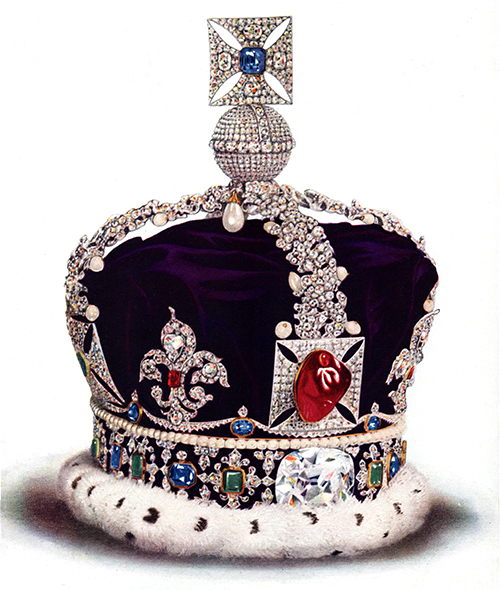
The Imperial State Crown, worn by the British monarch in the royal procession following the Coronation and at the opening of Parliament.
Wikimedia Commons.
Whereas so many traditions are 19th-century inventions, as any student of history knows, the coronation of Britain’s monarch is a rare example of a truly ancient custom, dating to the 10th century in its structure and with origins stretching back further, to the Romans and even Hebrews. As Tom Holland said on yesterday’s The Rest is History, it is like going to a zoo and seeing a woolly mammoth.
It is a sacred moment when the sovereign becomes God’s anointed, an almost unique state ceremony in a secular world. The custom originates with the late Roman emperors, associated with Constantine the Great and certainly established by the mid-fifth century in Constantinople. In the West, and following the fall of that half of the empire, barbarian leaders were eager to imitate imperial styles (a bit like today). Germanic and Celtic tribes had ceremonies for new leaders in which particular swords were displayed, a feature of later rites, but as they developed the practice of kingship, so their rituals began to imitate the Roman form.
[…]
Athelstan, the first king of England, had been crowned in 925 at Kingston, a spot where seven kings of England had been enthroned. Perhaps the most notorious was Edwig, a 16-year-old whose proto-rock star qualities were not appreciated at the time of his coronation in 955. Indeed he failed to turn up, and when Bishop Dunstan marched to the king’s nearby quarters to drag him along, he found the teenager in bed with a “strumpet” and the strumpet’s mother.
However, Edwig died four years later, and Dunstan was elevated to Canterbury, became a saint and, through chronicles recorded by churchmen, got his version of history.
This reign might seem impossibly distant and obscure, yet it was under Edwig’s brother Edgar that the current coronation format was established. Edgar was a powerful king, and the last of the Anglo-Saxon rulers to live a happily Viking-free existence. His coronation on 11 May 973 was an illustration of his strength, and also his aspirations. Held at Bath, most likely because of its association with Rome, it involved a bishop placing the crown on the king’s head, in the Carolingian style, and would become the template for the ceremony for his direct descendent Charles III.
But not all coronations would run so smoothly. After Edgar’s death his elder son Edward was killed in possibly nefarious circumstances, and his stepmother placed her son Ethelred on the throne. Ethelred’s reign was plagued by disaster, and it was later said in the chronicles — the medieval equivalent of “and then the whole bus clapped” Twitter tales — that Bishop Dunstan lambasted the boy-king for “the sin of your shameful mother and the sin of the men who shared in her wicked plot” and that it “shall not be blotted out except by the shedding of much blood of your miserable subjects”.
This would have been merely awkward, whereas many coronations ended in riot or bloodshed. The most notorious incident in English history occurred on Christmas Day 1066: Duke William got off to a bad start PR-wise when his nervous Norman guards mistook cheers for booing and began attacking the crowd, before setting fire to buildings.
[…]
Perhaps the most scandalous coronation took place at the newly completed St Paul’s Cathedral in February 1308. The young queen, Isabella, was the 12-year-old daughter of France’s King Philippe Le Bel, and had inherited her father’s good looks, with thick blonde hair and large blue, unblinking eyes. Her husband, Edward II, was a somewhat boneheaded man of 24 years whose idea of entertainment was watching court fools fall off tables.
It was a fairy tale coronation for the young girl, apart from a plaster wall collapsing, bringing down the high altar and killing a member of the audience, and the fact that her husband was gay and spent the afternoon fondling his lover Piers Gaveston, while ignoring her. Isabella’s two uncles, who had made the trip from France, were furious at the behaviour of their new English in-law, though perhaps not surprised.
[…]
One of the most disastrous coronations occurred during the Hundred Years’ War. Inspired by Joan of Arc, in 1429 the French had beaten the English at the Battle at Patay, after which their leader Charles VII entered Reims and was crowned at the spot where the kings of France had been enthroned for almost a thousand years. In response, on 26 December 1431 the English had their candidate, the 10-year-old Henry VI, crowned King of France at Notre-Dame in Paris, where one road was turned into a river of wine filled with mermaids, and Christmas plays were performed on an outdoor stage.
Unfortunately, the coronation was a complete mess. The entire service was in English, the weather was freezing, the event rushed, too packed, filled with pickpockets, and worst of all the English made such bad food that even the sick and destitute at the Hotel-Dieu complained they had never tasted anything so vile.
Comments Off on Face-palm-worthy Coronations of the past
Coronation Weekend
Jago Hazzard
Published 5 May 2023For us train nerds, “Coronation” means something very different.
Comments Off on Coronation Weekend
May 4, 2023
Fierce fighting on Gallipoli … before WW1
Bruce Gudmundsson outlines the operations of Ottoman Empire forces defending “Turkey in Europe” against Greek and Bulgarian invasion (in alliance with Serbia and Montenegro) in 1913:
In the English speaking world, the name Gallipoli invariably evokes memories of the great events of 1915 and 1916. A location of such strategic importance, however, rarely serves as the site of a single battles. Two years before the landings of the British, Indian, Australian, and New Zealand troops on the south-west portion of the the peninsula (and the concurrent French landings on the nearby mainland of Asia Minor near the ruins of the ancient city of Troy), Ottoman soldiers defended the Dardanelles against the forces of the Balkan League.
By the end of January of 1913, the combined efforts of Greece, Serbia, Montenegro, and Bulgaria had driven Ottoman forces from most of “Turkey in Europe”. Indeed, the only intact Ottoman formations on European soil were those trapped in the fortress of Adrianople, those holding the fortified line just west of Constantinople, and those that had recently arrived at Gallipoli.
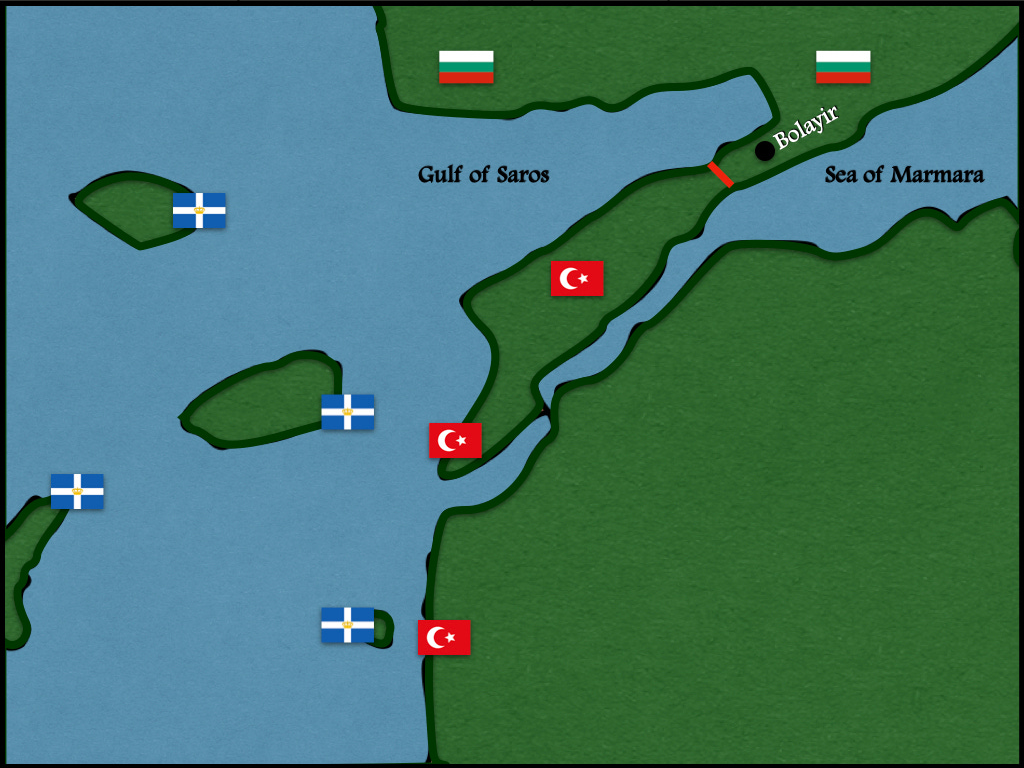
Soon after arriving, the Ottoman forces on Gallipoli began to build a belt of field fortifications across the narrowest part of the peninsula, a line some five kilometers (three miles) west of the the town of Bolayir. At the same time, they occupied outposts some twenty kilometers east of the line, at the place where the peninsula connected to the mainland.
The general situation in (and around) the Gallipoli Peninsula, 31 January 1913.
On 4 February 1913, the Bulgarians attacked. On the first day of this attack, they drove in the Ottoman outposts. On the second day, they broke through a hastily erected line of resistance, thereby convincing the Ottoman forces in front of them to evacuate Bolayir. However, rather than taking the town, or otherwise attempting to exploit their victory, they withdrew to positions some ten kilometers (six miles) east of the Ottoman earthworks.
While the Ottoman land forces returned to the earthworks along the neck of the Peninsula, ships of the Ottoman Navy operating in the Sea of Marmora located, and began to bombard, the Bulgarian forces near the coast. This caused the Bulgarians to move inland, where they took up, and improved, new positions on the rear slopes of nearby hills.
On 9 February, the Ottomans launched a double attack. While the main body of the Ottoman garrison of Gallipoli advanced overland, a smaller force, supported by the fire of Ottoman warships, landed on the far side of the Bulgarian position. Notwithstanding the advantages, both numerical and geometric, enjoyed by the Ottoman attackers, this pincer action failed to destroy the Bulgarian force. Indeed, in the course of two failed attacks, the Ottomans suffered some ten thousand casualties.
Though the Ottoman maneuver failed to dislodge the Bulgarians from their trenches, the two-sided attack convinced the Bulgarian commander to seek ground that was, at once, both easier to defend against terrestrial attack and less vulnerable to naval gunfire. He found this on the east bank of a river, thirteen kilometers (eight miles) northeast of Bolayir and ten kilometers (six miles) north of the place where the Ottoman landing had taken place.
Comments Off on Fierce fighting on Gallipoli … before WW1
British civil servants apparently need to have training on BDSM theory and practice
In Spiked, Malcolm Clark outlines the proposal to be discussed at a civil service union conference next month:

“Cologne BDSM 07” by CSD2006 is licensed under CC BY-SA 3.0 

 .
.
For years, the LGBT lobby has wreaked havoc across the UK’s civil service. It has helped to turn the machinery of government into a crèche for the kind of people who can’t remember what pronouns they’re using that day. But this may have just been a taster of what’s to come. Kink, it seems, is the new frontier in identity politics. Get ready to meet the “BDSM” lobby.
Next month, at its annual conference, the biggest civil-service union, PCS, will discuss a motion calling on Whitehall to set up a network for staff who are into bondage, domination and sado-masochism (BDSM). I suppose there’s one thing to be said for this daft idea. The more time these jobsworths spend slapping each other around, the less time they’ll have to humiliate and torment members of the taxpaying public.
There are a few obvious problems with this proposed BDSM staff network. For one, its advocates have called for workplace training courses about BDSM. No, I’m not making this up. The suggested courses would explain that “mutual informed consent … is needed before erotic activity is carried out”. This is a statement of the obvious to most of us. Who says entry standards for the civil service are slipping?
You may have assumed that the priority of our civil service should be carrying out the business of government, rather than BDSM advocacy. Perhaps it should be getting on top of the fact that only three per cent of hospital trusts in England hit cancer waiting-time targets in 2022? Or the fact that 360,000 people had to wait more than 10 weeks for their passport last year?
One strange thing about this demand for training courses for kink-meisters is that it flies in the face of other recent staff demands. Across Whitehall, as in private industry, advocacy groups have long insisted that Britain’s workplaces have developed a toxic culture that does not respect sexual boundaries. Reams of new guidelines have been drawn up in response. Many of these guidelines consider asking questions about someone’s sex life to be, in itself, a form of sexual harassment. Yet now we could soon have staff networks based solely around people’s private sex lives. And what would a meeting of sexual fetishists discuss if not their sex lives? The weather?
Even twenty years ago, it was a common witticism to refer to workplace meetings as “beatings”, but this is a long way past a casual joke (that yes, is probably risky to make in most modern workplaces, as someone is bound to find offence).
While looking for an appropriate image to accompany this post, I was quickly reminded why most search engines now offer varying levels of “safe” viewing.
Comments Off on British civil servants apparently need to have training on BDSM theory and practice
Why British train enthusiasts hate this man – Dr. Beeching’s Railway Axe
Train of Thought
Published 27 Jan 2023In today’s video, we take a look at one Doctor Richard Beeching, the man who ripped up a third of Britain’s railways with nothing but a pen and paper.
May 3, 2023
The History of the Hawaiian Luau
Tasting History with Max Miller
Published 2 May 2023
(more…)
Comments Off on The History of the Hawaiian Luau
Finland’s High Power Rig
Forgotten Weapons
Published 6 Jan 2023Finland used a variety of FN pistols prior to WW2, and had already evaluated the High Power when Russian invaded and the Winter War began. With an urgent need for more arms, Finland ordered a batch of High Power pistols, which FN was happy to include with the other arms orders already being delivered to Finland. In total, the Finns bought 2,400 of them, with 900 delivered in February 1940 and 1,500 in March 1940. All of them were bought as rigs with leather holsters riveted to flat board shoulder stocks (note that a Finnish pistol with a Finnish-contract original stock is exempted form the NFA in the US, and need not be registered as a short-barreled rifle).
This delivery schedule meant that only a few were available in time to be used in the Winter War, and they saw much greater use in the Continuation War. They were particularly appreciated by the Finnish Air Force as survival weapons. This is often misinterpreted to mean that they were exclusively used by the Air Force; in fact the quantity of Finnish aircraft was small enough that only a small fraction of the pistols were issued to pilots.
Finnish contract pistols have serial numbers falling between 11,000 and 15,000 (and not all guns in that range are Finnish). The stocks were marked in large numbers with the serial number of the gun, although matching rigs are quite scarce today. Some, but not all, were later marked “SA” by the Finnish Army. During the continuation War some of the holsters were separated from the stocks, and some of the pistols had new square front sights put on (a common Finnish preference, done to Lugers as well).
About 40% of the High Powers were lost or rendered unserviceable by the end of the Continuation War. The remainder were kept in service until the 1980s, when they were replaced by the Browning Double Action and slowly sold as surplus.
(more…)
Comments Off on Finland’s High Power Rig
May 2, 2023
Dad’s Army: What Was The Military Career of Lance Corporal Jones?
The History Chap
Published 25 Jan 2023Lance Corporal Jack Jones is one of the most loved characters in the classic British comedy Dad’s Army. Constantly referring to his exploits in the Sudan, the North West Frontier (India) and the First World War.
So I thought I would make a short video exploring his long (& fictitious) military career.
The local butcher, Jack Jones, is a member of Walmington-on-Sea Home Guard during World War Two. This fictitious Home Guard unit are the stars of the classic BBC comedy: Dad’s Army.
What I found amazing is that the BBC created a back story for the character of Lance Corporal Jones. researching the medal ribbons that Jones wears on his Home Guard uniform I have put together a timeline of his military career in the 1st battalion, Warwickshire Regiment.
The story starts when young Jack Jones joins the Royal Warwickshire’s in 1884 as a drummer boy. He is to spend 31 years serving in the British army where he participates in the Gordon Relief Expedition, the re-conquest of Sudan under General Kitchener, the Boer War, the North West Frontier of India, and the First World War.
Comments Off on Dad’s Army: What Was The Military Career of Lance Corporal Jones?
QotD: The musical importance of the city of Córdoba
Is it New York or London? Paris or Tokyo? Los Angeles or Shanghai? Nashville or Vienna? Berlin or Rio de Janeiro?
That depends on what you’re looking for. Do you value innovation or tradition? Do you want insider acclaim or crossover success? Is your aim to maximize creativity or promote diversity? Are you seeking timeless artistry or quick money attracting a large audience?
Ah, I want all of these things. So I only have one choice — but I’m sure my city isn’t even on your list.
My ideal music city is Córdoba, Spain.
But I’m not talking about today. I’m referring to Córdoba around the year 1000 AD.
I will make a case that medieval Córdoba had more influence on global music than any other city in history. That’s probably not something you expected. But even if you disagree — and I already can hear some New Yorkers grumbling in the background — I think you will discover that the “Córdoba miracle,” as I call it, is an amazing role model for us.
It’s a case study in how communities foster the arts — and in a way that benefits everybody, not just the artists.
[…] a thousand years before New Orleans spurred the rise of jazz, and instigated the Africanization of American music, a similar thing happened in Córdoba, Spain. You could even call that city the prototype for all the decisive musical trends of our modern times.
“This was the chapter in Europe’s culture when Jews, Christians, and Muslims lived side by side,” asserts Yale professor María Rosa Menocal, “and, despite their intractable differences and enduring hostilities, nourished a complex culture of tolerance.”
There’s even a word for this kind of cultural blossoming: Convivencia. It translates literally as “live together.” You don’t hear this term very often, but you should — because we need a dose of it now more than ever. And when scholars discuss and debate this notion of Convivencia, they focus their attention primarily on one city: Córdoba.
It represents the historical and cultural epicenter of living together as a norm and ideal.
Even today, we can see the mixture of cultures in Spain’s distinctive architecture, food, and music. These are both part of Europe, but also separate from it. It is our single best example of how the West can enter into fruitful cultural dialogue with the outsider — to the benefit of both.
Ted Gioia, “The Most Important City in the History of Music Isn’t What You Think It Is”, The Honest Broker, 2023-01-26.
Comments Off on QotD: The musical importance of the city of Córdoba


