
Before one can discuss the midday meal […] it is necessary to explain away the mysteries of “lunch”, “dinner” and “high tea”. The actual diet of the richer and poorer classes in Britain does not vary very greatly, but they use a different nomenclature and time their meals differently, because certain habits adopted from France during the past hundred years have not yet reached the great masses.
The richer classes have their midday meal at one-thirty in the afternoon and call it “luncheon”. At about half-past four in the afternoon they have a cup of tea and perhaps a piece of bread-and-butter or a slice of cake, which they call “afternoon tea” and they have their evening meal at half-past seven or eight, and call it “dinner”. The others, perhaps ninety percent of the population, have their midday meal somewhat earlier – usually about half-past twelve – and call it “dinner”. They have their main evening meal at about half-past six and call it “tea” and before going to bed they have a light snack – for instance cocoa and bread-and-jam – which they call “supper”. The distinction is regional as well as social. In the North of England, Scotland and Ireland many well-to-do people prefer to follow the working-class time scheme, partly because it fits in better with the working day, and partly, perhaps, from motives of conservation: for our ancestors of a century ago also had their meals at approximately these hours.
But though the name and the hour may differ, every British person’s idea of midday meal is approximately the same. We are not here concerned with the quasi-French meals that are served in hotels, but solely with British cookery, and therefore we can leave both soups and hors d’oeuvres out of account. Most British people are inclined to despise both, and do not care for them in the middle of the day. British soups are seldom good, and there is hardly a single one that is peculiar to the British Isles, while even the word “hors d’oeuvre” has no equivalent in the British language. The British midday meal consists essentially of meat, preferably roast meat, a heavy pudding, and cheese. And here one comes upon the central institution of British life, the “joint”: that is, a large piece of meat – round of beef or leg of pork or mutton – roasted whole with its potatoes round it, and preserving a flavour and a juiciness which meat cooked in smaller quantities never seems to attain.
Most characteristic of all is roast beef, and of all the cuts of beef, the sirloin is the best. It is always roasted lightly enough to be red in the middle: pork and mutton are roasted more thoroughly. Beef is carved in wafer-thin slices, mutton in thick slices. With beef there nearly always goes Yorkshire pudding, which is a sort of crisp pancake made of milk, flour and eggs and which is delicious when sodden with gravy. In some parts of the country suet pudding is eaten with roast beef instead of Yorkshire pudding. Sometimes instead of roasted fresh beef there is boiled salt beef, which is always eaten with suet dumplings and carrots or turnips.
[…]
In the second half of the midday meal we come upon one of the greatest glories of British cookery – its puddings. The number of these is so enormous that it would be impossible to give an exhaustive list, but, putting aside stewed fruits, British puddings can be classified under three main heads: suet puddings, pies and tarts, and milk puddings.
[…]
If the midday meal ends with cheese, that cheese will probably be foreign. Some of the cheeses native to Britain are very good, but they are not produced in large quantities and are mostly consumed locally. The best of them is Stilton, a cheese rather the same kind as Roquefort or Gorgonzola, but stronger-tasting and closer in the grain. Wensleydale, a similar but milder cheese, is also very good.
George Orwell, “British Cookery”, 1946. (Originally commissioned by the British Council, but refused by them and later published in abbreviated form.)
December 5, 2023
QotD: British meals – the midday meal
December 4, 2023
Jeeves and Wooster, in a nutshell …
Barcode
Published 11 Oct 2021A summary of the entire Jeeves & Wooster series in roughly 6 minutes.
P.G. Wodehouse’s Jeeves (played by Stephen Fry) and Bertie Wooster (Hugh Laurie) have been lauded as one of the greatest comic double acts of all time. Set in the late 1920s-1930s, Jeeves and Wooster (1990-1993) follows the hilarious misadventures of Bertram Wilberforce Wooster — a young, affable English gentleman of the idle rich — and Jeeves — Bertie’s omniscient and resourceful valet. Jeeves discreetly takes control of his “mentally negligible” employer’s life, while Bertie Wooster finds himself pushed and reeled into countless imbroglios, fiascoes, and romantic entanglements led by his hapless friends and imperious aunts. But each disaster is drawn to its own satisfactory conclusion through a concatenation of intriguing coincidences … or so they would seem. Until, that is, the silent force behind every “coincidence” is revealed to be none other than the brilliant and inimitable Jeeves.
(more…)
December 3, 2023
“I find myself despising the elites I joined in ways that shock me. I have come to despise the woke left, their indifference to crime, their reveling in reverse-racism, their deep hatred of Western civilization”
I’ve been reading Andrew Sullivan’s Substack since he started and it’s always been a pretty clear indicator that as soon as the name Trump is mentioned, the rest of the piece can be ignored because he’s been saying the same things for literally years now. This week’s article is a significant break with that tradition. It’s not that he suddenly likes Trump but that he seems to have gained more understanding about why other people support him:

As old-time Dishheads may recall, I was one of a handful of pundits who thought in early 2016 that Trump not only could, but probably would, win the election. I could feel his appeal in my lizard brain, and had long studied the fragility of liberal democracy in my frontal cortex. But the moment I knew his presidency was almost certain was when the Brexit result was announced in June, when everyone still assumed Hillary was a shoo-in. Something was stirring. And that’s why, after my annual trip back to Britain last week, I’m feeling the nausea again.
[…]
Add to that anger a lockdown far more intense than in the US and a period of crippling inflation, and you have a recipe that will likely lead to a Labour landslide next year. And in so many countries right now, for a variety of reasons, you see the same “blow it all up” mentality, turfing out incumbents mercilessly, often in favor of performative populists of various hues and flavors.
Look at the Netherlands: a progressive country that just saw Geert Wilders’ hard-right anti-immigration party go from 10 percent in 2021 to 23.5 percent of the vote, and become by far the biggest party in the Dutch House of Representatives, with center-right parties open to joining them. Or Argentina, where a weirdly coiffed, former rock-singer, Javier Milei — who had a near mental breakdown in a televised interview during the campaign, complaining about voices that weren’t there — wiped out the Peronist establishment in a landslide.
Orbán’s decisive re-election, Meloni’s electoral victory in Italy, and Sweden’s lurch to the right all suggest a sudden widening of the Overton window in much of Europe. In Germany, the AfD, the far-right movement, is now polling at 21 percent of the electorate, compared with 15 percent for Chancellor Scholz’s Social Democrats and 9 percent for the Greens. None of it is particularly coherent. Milei is Steve Forbes in a very bad toupee — about as far away from Boris’ Red Toryism or entitlement-friendly Trumpism as you can get. The only truly consistent thing is the ridiculous hair, and contempt for elites.
And the fear of the crazy right has gone. Milei and Wilders instantly moderated on some of their most outlandish positions, as soon as power was within reach. No, Milei won’t dollarize the Argentine economy, it turns out; and no, Wilders won’t ban mosques, as he tries to build a coalition government. Meloni has talked up immigration control, but in power, she hasn’t done much about it, and her support for Ukraine and the EU has been a big surprise. Poland’s hard-right party showed it could not stay in power forever this year, and in Spain, Vox lost ground. But in all this, a taboo has been broken — the same kind of taboo that the election of Donald Trump represented. The small-c conservatism of the Western electorate has expired.
That’s why I find the re-election of Joe Biden so hard to imagine. Biden is the incumbent of all incumbents. He became a senator in 1973! He has been vice president for eight years and president for four. He’s extremely old for the job he is doing, and everyone knows it. He has presided over inflation higher than at any time since the 1970s, and a huge new wave of legal and illegal immigration. We may now have a higher percentage of the population that is foreign-born than in the entire history of this country of immigration. Americans’ support for a border wall is the highest it’s been since 2016.
And Gallup’s latest polling on how the public feels about crime should terrify the Democrats. Coming back to DC this week after seven months away, I’m struck by how stark the decline has become. It says something when a city is experiencing a massive wave of carjackings, bars the cops from pursuing them, and just hands out free AirTags so you can track your stolen car yourself.
And the key, lame argument from Biden will be that Trump is too big a risk to take. He’s right. Broadly speaking, I agree with Bob Kagan on the crazed ambitions of this tyrant wannabe. But how has that argument worked out so far? Impeachments and indictments seem to have strengthened, not weakened him. And what we’re seeing all over the world is that voters are rushing toward the risky candidates, not away from them.
And Trump has already been in office for four years, and … democracy didn’t end, did it? Or at least, that’s what his supporters will say. They’ll remember the pre-Covid years as the good old days (and economically they wouldn’t be wrong), and also vent anger at an elite that seems to care more about pronouns and “equity” than protecting the border or controlling crime — the core functions of government. I’d be worried if Biden were ahead of Trump by five points in the battleground states. But he’s actually behind.
And though I will never vote for Trump, in my lizard brain, I kind of get the appeal. Inflation and mass immigration, alongside a bewildering and compulsory cultural revolution, are the kind of uncontrollable things that make people vent, especially if the president seems oblivious to these concerns — as Biden does. When Elon Musk f-bombed on Andrew Ross Sorkin and the advertisers who are boycotting X this week, the rational part of me shook my head. He’s bonkers and may see his company collapse from his whims and rages.
But at some deeper level, I also wanted to yell “Fuck yeah!” I find myself despising the elites I joined in ways that shock me. I have come to despise the woke left, their indifference to crime, their reveling in reverse-racism, their deep hatred of Western civilization. I hate how they’ve taken so much of the progress we made on gay integration and thrown it all away in transqueer solipsism. I loathe their piety and certainty and smugness. I found their instant condemnation of Israel, even as October 7 was taking place, shocking.
Was Hürtgen Forest Worth it? WW2 – Week 275 – December 2, 1944
World War Two
Published 2 Dec 2023The bulk of the fight for Hürtgen Forest is now over, and today we look at the results. We also look at Soviet plans for their January offensive. In the field this week, the Red Army is still fighting in Hungary, the Allies are still trying to reach the Roer River in the west, and in the Pacific Theater the kamikaze menace is wreaking havoc with Allied scheduling.
00:00 INTRO
01:06 Soviet Offensive Plans for 1945
03:12 Red Army attacks in Hungary
06:19 The Port of Antwerp is clear for use
07:23 The Battle of Hurtgen Forest is Over
12:20 Allied advances to the Roer
14:19 Tension builds in Greece
15:32 The aerial situation in the Philippines
21:36 CONCLUSION
(more…)
Doctor What-are-your-pronouns
I don’t watch Doctor Who although I have fond childhood memories of watching William Hartnell and Patrick Troughton’s respective “Doctors” and I caught one or two episodes of Jon Pertwee and Tom Baker in the role. That the show is still running on British TV is a wonder … but it got headlines for a recent installment that had the Doctor being told off for “assuming” an alien creature’s pronouns:
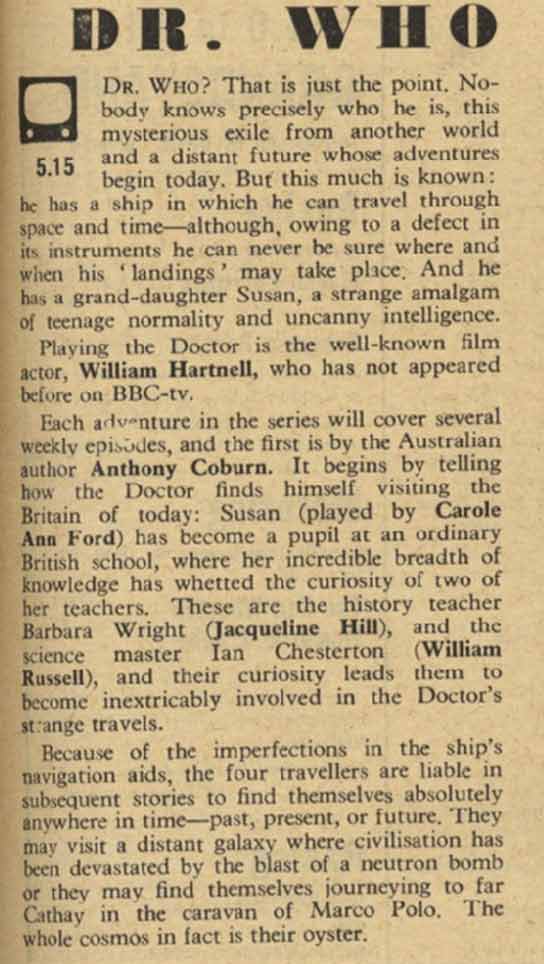
Remember when Doctor Who was fun? Watching it now is about as much fun as being publicly humiliated at work by some jumped-up nonbinary form-filler from HR who thinks he’s amazing because he’s painted one of his fingernails black.
A good example of this joylessness is a scene in the most recent special, “The Star Beast”, which has been treated by right-on broadsheet types as a moment of profound importance. Yet all that happened was a transwoman character – played by transwoman actor Yasmin Finney – lectured the Doctor about pronouns. In a moment of unforgivable Time Lord-cis privilege, the Doctor had assumed a diminutive alien called Beep the Meep used male pronouns. What was he thinking?
It is this sort of banal plot line that encapsulates the shrivelling ambition of science fiction. Once the genre dared to hold up a provocative mirror to contemporary society. From Mary Shelley’s Frankenstein to Octavia Butler’s Parable of the Sower, sci-fi challenged lazy assumptions. Now it revels in groupthink that feeds the collective self-righteousness of indolent teenagers and adults with teenage imaginations.
This matters, because at its best sci-fi can dazzle and even inspire us with the potential strangeness of the imagined future. A few years ago I made a series presented by William Shatner tracing the cultural and technological influence of Star Trek. In one episode, the inventor of the mobile phone, Martin Cooper, told director Julian Jones how he had been inspired by the example of Captain Kirk’s hand-held “communicator”. Will anyone invent something inspired by the new Doctor Who? A new set of guidelines for pronoun use, perhaps?
You can tell how out of touch Doctor Who has now become by the fact its enormously pompous showrunner, Russell T Davies, seemed to think that the new series would shock viewers with its “progressive” radicalism. The only shock was the alien pronoun scene’s patent stupidity.
I mean, why on Earth would the Doctor assume the gender of any alien? He has been encountering aliens with no fixed gender since the 1960s. The Doctor has effectively been asking aliens for their pronouns for nigh on 60 years.
Davies may think he’s blazing a trail with the new series of Doctor Who. But the truth is that gender-bending in science fiction is as old as the frozen hills of Gallifrey. In The War of the Worlds, published 125 years ago, HG Wells regaled us with Martian invaders who reproduced asexually. And hermaphrodites pepper sci-fi, from the work of Philip K Dick to that of Ursula K Le Guin.
December 2, 2023
Shane MacGowan, RIP
I’ve been a long-time fan of the Pogues, and Shane MacGowan was the original lead singer for their first several albums. His lifestyle and undependability brought about a break with the rest of the band who continued on without him. I rather lost track of him soon after his next band, the Popes, had one okay album that showed MacGowan hadn’t shaken his demons. I still post his duet with the late Kirsty MacColl every Christmas. In The Pillar, Ed Condon remembers MacGowan:
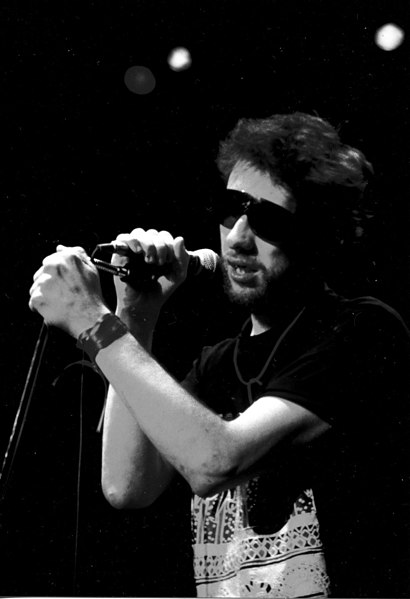
Shane MacGowan performing in Japan on an unknown date.
Photo by Masao Nakagami via Wikimedia Commons.
Yesterday Shane MacGowan, lead singer of the Pogues, died at age 65.
He was, in every sense, a living legend of Irish music — so much so that many people, sincerely, expressed shock that he was actually still alive. [NR: Literally the words out of my mouth when Elizabeth told me he’d died.]
Most people, at least in this country, know him best for his fiercely melancholic Christmas ballad “Fairytale of New York”, though the Pogues albums Rum, Sodomy & the Lash and If I Should Fall from Grace with God firmly fixed MacGowan as the living conduit of a musical tradition all too often dismissed as a postcard anachronism, created to appeal to tourists.
There was nothing contrived, though, about MacGowan, who was the living embodiment of the distinctly Irish contradiction of “fierce melancholy.” An incredibly gifted writer and poet, he wrote, performed — and lived — with a kind of burning urgency that seemed at once self-consuming and yet in him, rather than from him.
It would be easy to dismiss the riotous drinker and singer, whose punk-inflected incarnation of Irish ballardry seemed stoked with some terrible ferocity, as just an eloquently wounded product of a now nearly vanished Irish society. But what marked him out, to me, was that he was driven by something from within, not without.
Born on Christmas Day in 1957 to Irish parents in England, he spent his early life back in Ireland, living in a family cottage in rural Tipperary, where the children slept three to a bed, there was no running water, and the family cooked on an open fire.
According to his parents, music and storytelling were the focus of their family life in those days.
“It was basic and beautiful,” he said of his childhood. “It was the end of an era that I just happened to catch. And I’m glad I caught it, you know?”
[…]
“All I ever had were happy times,” is how MacGowan described his childhood in Ireland.
This deep understanding and love for his own history and where he came from, which John Paul II also wrote about in Memory and Identity, suffused MacGowan’s music.
But even as he became a kind of living totem in his home country it was clear he loathed the spotlight, writhed during interviews, and fought, often unsuccessfully, to balance his natural reticence with the convulsive need to make his music.
It drove him to at times terrible self-destruction, but the defiance and desperation of his singing seemed always directed back within himself. And it was a great comfort to read his family’s announcement that he’d died with the last rites imparted.
He was a man for whom the words of Jim Harrison, another great poet, seemed to be written:
Some people hear their own inner voices with great clearness and they live by what they hear. Such people become crazy, or they become legend.
Rest in peace, Shane.
NATO’s Ostfront
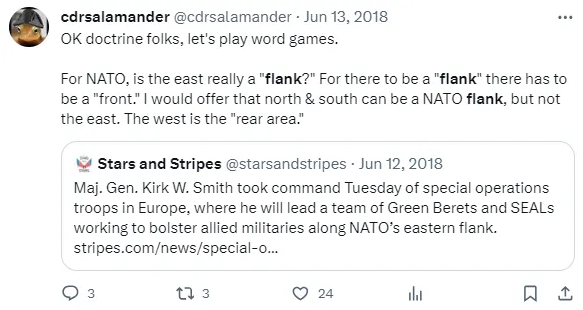
CDR Salamander doesn’t like the misunderstandings that cause commentators to identify NATO’s primary (but thankfully not militarily active) front as a “flank”:
For those who follow me on twitter/X, you are quite familiar with the meme I’ve been posting since long before the Russo-Ukrainian War, all the way back to at least 2018.
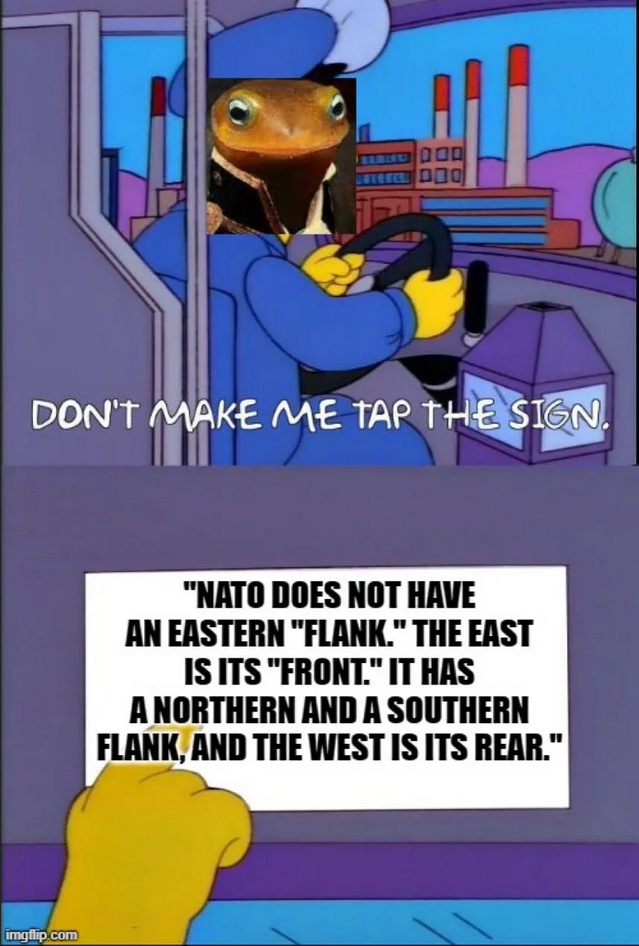
This misuse of the King’s English soon became a bur under my saddle as this error continued to be made. Seeing a trend, the following meme was generated by a friend;
This is not a new problem, and I know exactly where it comes from. In my years as a NATO Staff Officer, it did not take long to notice a twitch in the eye of many, not only Germans, to the mention of an “Eastern Front”. It seems silly, and in the 21st Century is it, but it is a reality.
I refused to play along. Yes, I understand how a very few highly emotional people can’t let go of their grandfather’s nightmares, but it is time for the adults in the room to just go around them. Anyway, this is the English language, and while there were French and Walloon Waffen SS units along with Hungarians, Romanians, Italians, and a few volunteer Spanish and others now on the NATO bench that fought on the Eastern Front in WWII, it doesn’t have the same impact with them as we don’t discuss such things in polite company.
Eastern Front, Front de l’Est, or Ostfront, we should all have moved along. History — and proper military terminology — have been around for centuries. In any event, it doesn’t bother the Russians one way or the other and you are fooling yourself if you think it does.
The use of “Eastern Flank” instead of “Front” where referring to real military threat to NATO, the Russian Federation, is just childish.
Original FG42: A Detailed Comparison of the 1st and 2nd Patterns
Forgotten Weapons
Published 16 Aug 2023Today we are looking at examples of the first (Type E) and second pattern (Type G) FG42, comparing their construction and disassembling both to get a close look at the internal differences. Despite sharing the basic mechanism, these two models share zero parts in common, not even the bayonets or magazines. We will also discuss the developmental path of the FG-42, and why the majority of production was the 2nd pattern but the vast majority of combat use was the 1st pattern …
(more…)
QotD: Western media and Putin’s war
Regarding [Vladimir Putin’s] Magical Mystery War, I’m going with the stoyak that the casualty counts peddled by the [western media] is part of a very very old playbook which various Western observers have peddled since 1905-that of Russian stupidity and indifference to casualties. Russia loses a war? They’re stupid gopniks who flung their soldiers into meat grinders until they rebelled (1905 or 1917). Russia wins a war? They’re stupid gopniks who flung their soldiers into meat grinders until they won (1945, 2023). Note that you can effortlessly pivot your propaganda when it becomes obvious in hindsight the outcome of the war. This becomes very important when [Putin] negotiates his 18th century kabiniettskreig ending to the war, since nobody in the West, especially AINO, understands how a cabinet war is fought, much less ends. They will claim that they foiled Putin’s plan for conquering all Ukraine (which he never has wanted) by killing hundreds of thousands of poor, oppressed, stupid, vodka-fueled gopniks used as cannon fodder who simply overwhelmed the valiant forces of good by sheer numbers. Not by superior strategy or tactics, or weapons, but the good ol’ Russian sledgehammer. Just like Hitler’s excuse in 1945, when Ivan was knock knock knockin’ on his bunker door. His generals who survived carried that piece of gospel West when the US Army started studying how to fight the Reds and asked the Germans how they did it. Their answer was happily embraced by the next generation of Very Clever Boys in the 1960s and carried forward to today’s Fistagon — Wunderwaffen.
Pickle Rick, commenting on “Friday Mailbag”, Founding Questions, 2023-12-01.
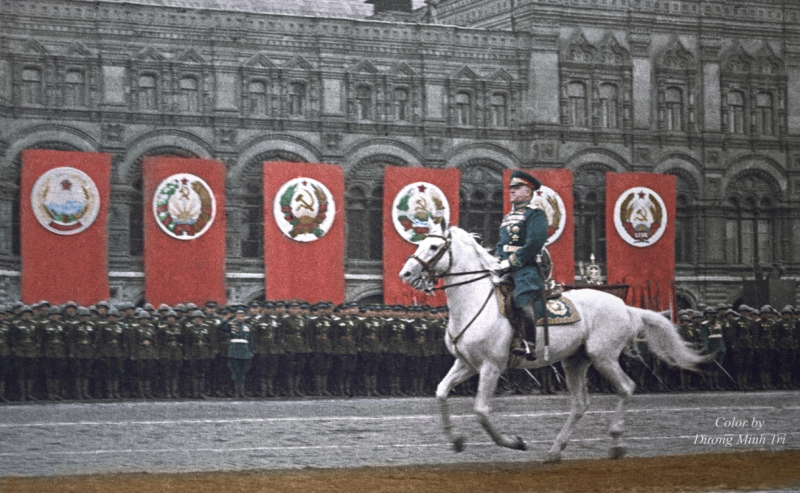
Rick agreed to me posting this quote as long as I included this colourized photo of Marshal of the Soviet Union Georgy Zhukov (“because it’s gangsta as FUCK”)
December 1, 2023
Gregorian – “Stairway To Heaven”
gregorianmusiccom
Published 20 Jun 2015We proudly present the new fan-video “Stairway to Heaven” performed and made by members of the Gregorian-music.com fan club.
(more…)
November 30, 2023
Why Wilders’ PPV appealed to Dutch voters and why the establishment is utterly horrified
In The Free Press, Ayaan Hirsi Ali and Evelyn Markus explain why Geert Wilders’ Party for Freedom took so many seats in the Dutch elections:
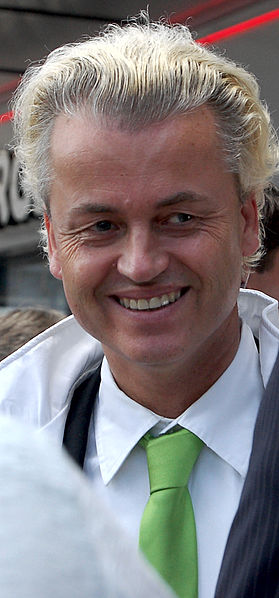
Geert Wilders, leader of the Dutch Party for Freedom (PVV).
Photo by Wouter Engler via Wikimedia Commons.
It was in 2004, the same year that Theo van Gogh was brutally murdered, that Geert Wilders saw his opening.
Though Wilders had been in Dutch politics for a long time, that year Wilders left the VVD — the center-right party where he served alongside Ayaan — and branched out on his own with a new party, the Party for Freedom. The key issue that led to his break was that Wilders refused to countenance the possibility of EU membership for Turkey (which the VVD was willing to accept as long as certain conditions were met).
Almost immediately, Wilders became the most controversial man in Dutch politics. He urged the banning of the Quran and a halt to the construction of new mosques. He railed against what he described as the “Islamization of the Netherlands”. When he asked a crowd in 2014 whether they wanted “more or fewer” Moroccans, the crowd chanted “fewer”, and Wilders replied that this was something that would be arranged. Prosecutors argued this constituted an illegal collective insult, and the Dutch High Court ultimately ruled that Wilders was guilty, but without sentencing him to a penalty.
It was easy to be scandalized by Wilders. The press and the political class certainly were. Some publicly supported Wilders’ prosecution in the “fewer Moroccans” case.
We disagreed — and still do — with Wilders’ calls for blanket bans on additional asylum seekers, with the notion of banning the Quran (let alone any book), and with his consistent failure to draw a distinction between Islam and Islamism.
But we understand how and why his message resonated with the public.
While elites over the past two decades have told the public to ignore their lying eyes, Wilders continued to emphasize the hot-button subjects that resonated with the public: the struggling economy, the importance of borders, the risks of devolving too much power to Brussels, the threat of Islamism, and the challenge of mass migration.
While elites told the public that opposing migration was xenophobic, ordinary people noticed structural changes in their country and felt they — the public — had not been adequately consulted. In the 1960s, 60,000 Muslims lived in the Netherlands; today there are around 1.2 million, thanks to massive chain migration, asylum, and a high birth rate. (Fewer than 50,000 Jews remain in the country.)
While political elites told the public to be tolerant of Islam, in keeping with a long-standing tradition of religious tolerance, ordinary people saw that Islamists were increasingly well-entrenched in the country, a point even made by Dutch intelligence officials. Although Wilders’ rhetoric can be uninhibited and extreme, he articulates a general and perfectly legitimate feeling among voters who know that Islamism is a threat to their way of life and want to oppose it. (Wilders has been the subject of sustained Islamist threats and has had to live his life within a tight security bubble because of them.)
While elites told the public that giving more power to the EU was an unqualified good, ordinary people took a more nuanced view. When we left the Netherlands in the early 2000s, the Dutch were solidly pro-EU. Today, although most Dutch voters do not wish to leave the EU, there are growing concerns that, especially when it comes to migration and borders, too much authority has been ceded to supranational institutions.
Over the years, we have heard more and more friends express private sympathy with Geert Wilders. And it should be noted that during the most recent campaign, he toned down some of his more extreme rhetoric. Previously, his party called for a “Ministry of Re-migration and De-Islamization”. That is no longer the case. Similarly, the phrase “Islam is not a religion, but a totalitarian ideology”, which was previously part of the election manifesto, was scrapped. This time around, Wilders emphasized his commitment to working within the Dutch coalition system, which he conceded would require him to make compromises in order to be able to govern.
The recent aggressive and occasionally violent pro-Palestinian demonstrations in the Dutch streets — as elsewhere — may have been the final blow that led to last week’s landslide. It’s worth noting that Wilders’ voters do not fit a crude stereotype — he won the most votes of any party among voters between the ages of 18 and 35.
Men and Morale: Canadian Army Training in the Second World War
WW2TV
Published 1 Feb 2023Men and Morale: Canadian Army Training in the Second World War
Part of Canadian Week on WW2TV With Megan HamiltonThe Canadian Army of the Second World War spent more time preparing and training their citizen soldiers then they did in sustained action. This chiefly took place across Canada and in the United Kingdom. Adequate training functioned as a cradle for collective action, morale, empowerment, self-confidence, and, ultimately, success in battle. Yet, due to a number of factors, a sufficient standard of training was not always achieved by all.
There were limits to the Canadian Army’s ability to control the morale of its men as it created a vast organization from scratch. Training camp experiences varied, influenced by factors such as food, weather, comfort, group cohesion, leadership, skill level, discipline, social activities, and interactions with local civilians. In fact, it required a constant negotiation between camp leadership and the rank and file. Drawing from her research on both the Canadian and wider Commonwealth armies, Megan’s presentation will explain why soldiers’ morale in training was a difficult, yet vital, balancing act.
Originally from Vernon, British Columbia, Megan Hamilton is a social and military historian of the 20th century. She has an Honours Bachelor of Arts degree from Wilfrid Laurier University and a Master of Arts degree from the University of Waterloo. Her federally-funded master’s research focused on the Canadian experience of the Second World War, specifically the Vernon Military Camp. Megan’s work has been published by a number of platforms and in 2022 she won the Tri-University History Program’s top essay prize for master’s students.
She is currently located in London, England, where she has begun a fully-funded PhD at King’s College London and the Imperial War Museum, supervised by Dr. Jonathan Fennell. Her dissertation is a study of Second World War army training across the Commonwealth.
(more…)
QotD: “Information velocity” in the English Civil War
Some of the battles of the Wars of the Roses were bigger than some of the Civil War’s battles – an estimated 50,000 men fought at Towton, in 1461 – but the Civil War was inconceivably harder and nastier than the Wars of the Roses, because the Civil War was an ideological war. The Wars of the Roses could’ve ended, at least theoretically, at any time – get the king and five dukes in a room, hammer out a compromise, and simply order everyone in each lord’s affinity to lay down his weapons. The Civil War could only end when everyone, in every army, was persuaded to lay down his arms.
Thus the winners had to negotiate with the people, directly. The Putney Debates didn’t involve everyone in the realm, but they were representative, truly representative, of everyone who mattered. Though no one explicitly made an appeal to competence alone, it was – and is, and must be – fundamental to representative government. Guys like Gerrard Winstanley had some interesting ideas, but they were fundamentally impractical, and Winstanley was not popularly viewed as a competent leader. Oliver Cromwell, on the other hand, was competence personified – the Protectorate became Cromwell’s military dictatorship largely because the People, as literally represented by the New Model Army, wanted it so … and, thanks to much faster information velocity, could make their wishes known.
Severian, “Inertia and Incompetence”, Founding Questions, 2020-12-25.
November 29, 2023
Alfred the Great
Ed West‘s new book is about the only English king to be known as “the Great”:
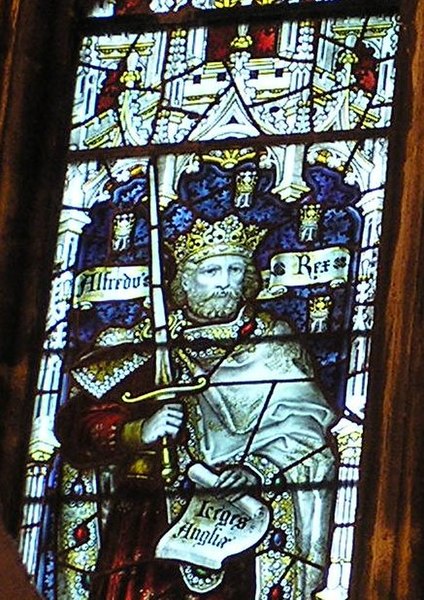
There are no portraits of King Alfred from his time period, so representations like this 1905 stained glass window in Bristol Cathedral are all we have to visually represent him.
Photo by Charles Eamer Kempe via Wikimedia Commons.
History was once the story of heroes, and there is no greater figure in England’s history than the man who saved, and helped create, the nation itself. As I’ve written before, Alfred the Great is more than just a historical figure to me. I have an almost Victorian reverence for his memory.
Alfred is the subject of my short book Saxons versus Vikings, which was published in the US in 2017 as the first part of a young adult history of medieval England. The UK edition is published today, available on Amazon or through the publishers. (use the code SV20 on the publisher’s site, valid until 30 November, which gives 20% off). It’s very much a beginner’s introduction, aimed at conveying the message that history is just one long black comedy.
The book charts the story of Alfred and his equally impressive grandson Athelstan, who went on to unify England in 927. In the centuries that followed Athelstan may have been considered the greater king, something we can sort of guess at by the fact that Ethelred the Unready named his first son Athelstan, and only his eighth Alfred, and royal naming patterns tend to reflect the prestige of previous monarchs.
Yet while Athelstan’s star faded in the medieval period, Alfred’s rose, and so by the fifteenth century the feeble-minded Henry VI was trying to have him made a saint. This didn’t happen, but Alfred is today the only English king to be styled “the Great”, and it was a word attached to him from quite an early stage. Even in the twelfth century the gossipy chronicler Matthew Paris is using the epithet, and says it’s in common use.
However, much of what is recorded of him only became known in Tudor times, partly by accident. Henry VIII’s break from Rome was to have a huge influence on our understanding of history, chiefly because so many of England’s records were stored in monasteries.
Before the development of universities, these had been the main intellectual centres in Christendom, indeed from where universities would grow. Now, along with relics, huge amounts of them would be lost, destroyed, sold … or preserved.
It was lucky that Matthew Parker, the sixteenth-century Archbishop of Canterbury with a keen interest in history, had a particularly keen interest in Alfred. It was Parker who published Asser’s Life of Alfred in 1574, having found the manuscript after the dissolution of the monasteries, a book that found itself in the Ashburnham collection amassed by Sir Robert Cotton in the late sixteenth and early seventeenth centuries.
Sadly, the original Life was burned in a famous fire at Ashburnham House in Westminster on October 23, 1731. Boys from nearby Westminster School had gone into the blaze alongside the owner and his son to rescue manuscripts, but much was lost, among them the only surviving manuscript of the Life of Alfred, as well as that of Beowulf. In fact the majority of recorded Anglo-Saxon history had gone up in smoke in minutes.
A copy of Beowulf had also been made, although the poem only became widely known in the nineteenth century after being translated into modern English. The fire also destroyed the oldest copy of the Burghal Hidage, a unique document listing towns of Saxon England and provisions for defence made during the reign of Alfred’s son Edward the Elder. An eighth-century illuminated gospel book from Northumbria was also lost.
So it is lucky that Parker had had The Life of Alfred printed, even if he had made alterations in his copy that to historians are infuriating because they cannot be sure if they are authentic. He probably added the story about the cakes, for instance, although this had come from a different Anglo-Saxon source.
We also know that Archbishop Parker was a bit confused, or possibly just lying; he claimed Alfred had founded his old university, Oxford, which was clearly untrue, and he was probably trying to make his alma mater sound grander than Cambridge. Oxford graduates down the years have been known to do this on one or two occasions.
Yugoslav M57: Tito’s Tokarev
Forgotten Weapons
Published 7 Aug 2023Yugoslavia purchased both 1895 Nagant revolvers and TT33 Tokarev from the Soviet Union after World War Two, but this was only a holdover until domestic pistol production could begin. While Yugoslavia was formally communist, Tito was not a puppet of Moscow, and Yugoslavia did their own development to reverse-engineer the Tokarev pistol. In the process, they made a number of improvements to the design, resulting in the M57. Serial production began in 1963 and lasted until 1982, with about 270,000 made in total. It was the standard sidearm for the Yugoslav People’s Army and Yugoslav police forces until 1988.
The changes made from the standard Soviet pattern Tokarev include:
– Longer grip and 9-round magazine capacity
– Captive recoil spring
– Improved front sight
– Stronger firing pin with improved retention system
– Magazine disconnect safety
(more…)


