
Top Gear
Published 26 Nov 2010Jeremy takes the extreme sport of Reliant Robin rolling to the streets of Barnsley, aided by a string of celebrities who just happen to be on hand to help keep the fabled three-wheeler upright.
(more…)
December 12, 2023
Rolling a Reliant Robin | Top Gear | BBC
Comments Off on Rolling a Reliant Robin | Top Gear | BBC
QotD: “Natural hierarchies” don’t work in distributed systems
This, I think, is a function of something like the Dunbar Number. There IS a “natural hierarchy”, but it only works in person – that is, in a group where everyone interacts face to face. Any given group of humans will naturally sort itself, and again, yeah yeah, I’m not a biologist, but I’ve been to a few bars in my time. If you doubt it, just head down to your local dive and pilot a barstool for a few hours, you’ll see enough basic primate behavior to give Jane Goodall a stiffie.
Politics, being a distributed system, doesn’t work like that. Neither does the corporate world, which is why both invariably end up dominated by sociopathic, sexually deviant shitweasels. Whereas the social interaction in a bar, in a pickup basketball game, in a church group, whatever, naturally bends towards a baboon troop, “social” interaction in a distributed power structure bends towards whoever has the time, energy, and sheer Wille zur Macht, as our friend above would put it, to dominate it.
Example: Even at the height of his power, when he really could have liquidated everyone in the room with a wave of his hand, Joe Stalin didn’t win arguments with his nomenklatura by threatening to have them all shot. Rather, he outworked them. Even when he exercised the most raw power any one human being is capable of wielding, Stalin’s work ethic was legendary – he spent a minimum of fifteen hours a day at his desk, every day, 365 days a year. He simply ground down all lesser men with the sheer force of his leather ass and cast-iron bladder … and compared to Stalin, when it came to paperwork, all men were lesser men.
That’s a cast of mind, reinforced by the habits of a lifetime. Stalin was also a dominant personality by the end, of course, but he certainly didn’t start that way – he was cringingly servile to Lenin, for instance, and even once to Trotsky, which is probably the main reason Trotsky had to die when you come right down to it.
Hitler was the same way, in his own special, bizarre way. While no one would ever accuse Hitler of an overactive work ethic when it comes to government – those who study these things still can’t get their heads around it, the fact that for long, critical periods the Third Reich basically didn’t have a government – but he could wear you down with the best of them when it came to party speeches, organizing, propaganda. No one worked harder at that stuff than Corporal Hitler … and no one knuckled under to authority faster, which is why he remained Corporal Hitler despite four years on the Western Front.
Combine them, and you get the Big Man On Campus thoroughly dominated by the deviant sociopathic shitweasels. The BMOC dominates every personal interaction; therefore, he thinks it’s the rules which get him where he is. Society is set up, he thinks, to produce people such as himself. And since that society is also set up such that the deviant sociopathic shitweasels (we should probably acronymize that; hereafter, DSS) do the boring shit like student government, when the DSS pass some bizarre law the BMOC just rolls with it …
Severian, “Bio-Marxism Grab Bag”, Founding Questions, 2021-01-21.
Comments Off on QotD: “Natural hierarchies” don’t work in distributed systems
December 11, 2023
Roman glossary
As I continue to post QotD entries drawn from Bret Devereaux’s fascinating historical blog A Collection of Unmitigated Pedantry (with Dr. Devereaux’s kind permission, I hasten to add), the number of names and specialized terms from the Roman Republic and Empire also expands. As some of these terms pop up in my shorter excerpts without immediate context, I think that a glossary for Rome is called for (similar to the Spartan glossary, as there’s a lot more Roman content coming up, it being Dr. Devereaux’s area of academic specialization) to help explain the terms that I think may need expansion in these excerpts from his longer posts. As usual, most of the information is drawn directly from ACOUP (often from more than one original post) and where I’ve felt the need to interpolate any additional information it will be enclosed in square brackets. Errors and misinterpretations of his original work are purely mine.
Comments Off on Roman glossary
This man built his office inside a lift
Tom Scott
Published 28 Aug 2023The Baťa Skyscraper, in Zlín, Czechia, is a landmark of architecture. And the office of Jan Antonín Baťa … is an elevator.
Thanks to the museum staff for fact-checking and translation!
(more…)
Comments Off on This man built his office inside a lift
QotD: The Palace of Westminster
I worked for some years in this odd place. It is by law a Royal Palace, so nobody was ever officially allowed to die on the premises, in case the death had to be inquired into by some fearsome, forgotten tribunal, perhaps a branch of Star Chamber. Those who appeared to have deceased were deemed to be still alive and hurried to a nearby hospital where life could be pronounced extinct and an ordinary inquest held. We were also exempt from the alcohol laws that used in those days to keep most bars shut for a lot of the time, and if the drinks were not free they were certainly amazingly cheap.
In my years of wandering its corridors and lobbies, of hanging about for late-night votes and dozing in committee rooms, I came to loathe British politics and to mistrust the special regiment of journalists (far too close to their sources) who write about it. I had hoped for a kingdom of the mind and found a squalid pantry in which greasy, unprincipled deals were made by people who were no better than they ought to be.
But I came to love the building. Once you had got past the police sentinels, who knew who everyone was, you could go everywhere, even the thrilling ministerial corridor behind the Speaker’s chair, from which Prime Ministers emerged to face what was then the genuine ordeal of Parliamentary questions, twice a week. There was a rifle range beneath the House of Lords, set up during World War I to make sure honorable members of both Houses would be able to shoot Germans accurately if they ever met any. There was a room where they did nothing but prepare vast quantities of cut flowers, and which perfumed the flagstone corridor in which it lay. There was a convivial staff bar (known to few) where the beer was the best in the building and politicians in trouble would hide from their colleagues. The Lords had a whole half of the Palace, with lovely murals illustrating noble moments of our history, and the Chief Whip’s cosy, panelled office where reporters would be summoned once a week for dangerous gossip and perilously large glasses of whisky or very dry sherry, generously refilled. And high up in the roof, looking down over the murky Thames, was the room where the government briefed us, in meetings whose existence we were sworn never to reveal. Now they are pretty much public, so the real briefings must happen somewhere else, I suppose.
Peter Hitchens, “An Empty Parliament”, First Things, 2017-10-03.
Comments Off on QotD: The Palace of Westminster
December 10, 2023
Can the Americans Stop the Kamikazes? – WW2 – Week 276 – December 9, 1944
World War Two
Published 9 Dec 2023This is a very busy week of the war. In the west, the Americans manage to reach the Roer River in force, but haven’t taken any of its dams; in Italy, the Allies liberate Ravenna; the Soviet advance in Hungary continues, and the Soviets even set up a new Hungarian government; martial law is declared in Greece; the Japanese make a corridor to Indochina; the fighting on Leyte continues, and the kamikaze menace becomes ever more worrisome.
00:00 INTRO
01:10 British intelligence failure
01:55 Allies reach the Roer River
05:35 Problems with Devers’ 6th Army Group
07:41 Allies liberate Ravenna
08:50 Soviet advances in Hungary
12:10 Soviets set up a new Hungarian government
13:47 A deadly demonstration and martial law in Greece
18:33 Japanese establish a corridor to Indochina
19:59 Leyte and kamikaze attacks
23:45 CONCLUSION
(more…)
Comments Off on Can the Americans Stop the Kamikazes? – WW2 – Week 276 – December 9, 1944
The history of the steam engine … but interactive
In the latest Age of Invention newsletter, Anton Howes is pleased to announce the release of a new ongoing project to illustrate the steam engine in an interactive format:
I’m excited to announce something I’ve been quietly working on for a few months now behind the scenes. Some of you may be familiar with the explorable interactive articles of Bartosz Ciechanowski. They are so clearly written and so cleverly explorable, that they give an intuitive grasp of how many very complicated technologies work. My favourite is his article on mechanical watches. Be warned: if you’ve not seen these before, you’re about to lose a good few hours.
But his article on watches — which came out just as I was doing some research on the development of watches, and which proved an invaluable reference work — got me thinking about how great it would be to have something similar not just for how current technologies function, but to show how they changed over time. Wouldn’t it be great, I dreamed, to have a similarly intuitive way to explore and appreciate the process of improvement. And to correct lots of misapprehensions about the development of various technologies along the way.
As it turned out, my fellow inventions history fanatic Jason Crawford, who runs the non-profit The Roots of Progress, had been thinking along the same lines. (Drumroll starts softly.) So with the help of the Matt Brown we’ve been able to realise what is hopefully just the first small step of our vision. (Drumroll intensifies.) Based on my recent work re-writing the standard pre-history of the steam engine (drumroll crescendoes), allow me to present:
(Cue trumpets!)
The interactive, animated, **Origins of the Steam Engine**
Alongside contemporary illustrations of the many devices, you can play around with the animated models, dragging them to see them from different angles. It introduces what are so far the only interactive and animated models yet made of a great many devices — from Philo of Byzantium’s 3rd Century BC experiments, to Salomon de Caus’s 1610s solar-activated and self-replenishing fountains and musical instruments, and the 1606 steam engine of the Spanish engineer Jerónimo de Ayanz y Beaumont:
It also contains the first depictions of the 1630s and 40s devices of Kaspar Kalthoff and William Petty. These are the experiments I discovered about a year ago, which I hope will now be given a place in the canon of the history of the steam engine. (You can read my discussion of the evidence I’d stumbled across about them here.)

Comments Off on The history of the steam engine … but interactive
Engines of War: How Wars Were Won and Lost on the Railways
WW2TV
Published 15 Jun 2023Engines of War: How Wars Were Won and Lost on the Railways With Christian Wolmar
Before the nineteenth century, armies had to rely on slow and unreliable methods of transportation to move soldiers and equipment during times of conflict. But with the birth of the railroad in the early 1830s, the way wars were fought would change forever. In this show renowned expert Christian Wolmar tells the story of that transformation with a focus on railways in WWII and especially the Normandy campaign.
Christian Wolmar is a British journalist, author, railway historian and Labour Party politician. He is known for his commentary on transport, especially as a pundit on Britain’s railway industry, and was named Transport Journalist of the Year in the National Transport Awards in 2007.
(more…)
Comments Off on Engines of War: How Wars Were Won and Lost on the Railways
QotD: Roman citizenship
The most common way to become a Roman citizen was by birth, though the Roman law on this question is more complex and centers on the Roman legal concept of conubium – the right to marry and produce legally recognized heirs under Roman law. Conubium wasn’t a right held by an individual, but a status between two individuals (though Roman citizens could always marry other Roman citizens). In the event that a marriage was lawfully contracted, the children followed the legal status of their father; if no lawfully contracted marriage existed, the child followed the status of their mother (with some quirks; Ulpian, Reg. 5.2; Gaius, Inst. 1.56-7 – on the quirks and applicability in the Republic and conubium in general, see S.T. Roselaar, “The Concept of Conubium in the Roman Republic” in New Frontiers: Law and Society in the Roman World, ed. P.J. du Plessis (2013)).
Consequently the children of a Roman citizen male in a legal marriage would be Roman citizens and the children of a Roman citizen female out of wedlock would (in most cases; again, there are some quirks) be Roman citizens. Since the most common way for the parentage of a child to be certain is for the child to be born in a legal marriage and the vast majority of legal marriages are going to involve a citizen male husband, the practical result of that system is something very close to, but not quite exactly the same as, a “one parent” rule (in contrast to Athens’ two-parent rule). Notably, the bastard children of Roman women inherited their mother’s citizenship (though in some cases, it would be necessarily, legally, to conceal the status of the father for this to happen, see Roselaar, op. cit., and also B. Rawson, “Spruii and the Roman View of Illegitimacy” in Antichthon 23 (1989)), where in Athens, such a child would have been born a nothos and thus a metic – resident non-citizen foreigner.
The Romans might extend the right of conubium with Roman citizens to friendly non-citizen populations; Roselaar (op. cit.) argues this wasn’t a blanket right, but rather made on a community-by-community basis, but on a fairly large scale – e.g. extended to all of the Campanians in 188 B.C. Importantly, Roman colonial settlements in Italy seem to pretty much have always had this right, making it possible for those families to marry back into the citizen body, even in cases where setting up their own community had caused them to lose all or part of their Roman citizenship (in exchange for citizenship in the new community).
The other long-standing way to become a Roman citizen was to be enslaved by one and then freed. An enslaved person held by a Roman citizen who was then freed (or manumitted) became a libertus (or liberta), by custom immediately the client of their former owner (this would be made into law during the empire) and by law a Roman citizen, although their status as a freed person barred them from public office. Since they were Roman citizens (albeit with some legal disability), their children – assuming a validly contracted marriage – would be full free-born Roman citizens, with no legal disability. And, since freedmen and freedwomen were citizens, they also could contract valid marriages with other Roman citizens, including freeborn ones […]. While most enslaved people in the Roman world had little to no hope of ever being manumitted (enslaved workers, for instance, on large estates far from their owners), Roman economic and social customs functionally required a significant number of freed persons and so a meaningful number of new Roman citizens were always being minted in the background this way. Rome’s apparent liberality with admission into citizenship seems to have been a real curiosity to the Greek world.
These processes thus churned in the background, minting new Romans on the edges of the populus Romanus who subsequently became full members of the Roman community and thus shared fully in the Roman legal identity.
Bret Devereaux, “Collections: The Queen’s Latin or Who Were the Romans, Part II: Citizens and Allies”, A Collection of Unmitigated Pedantry, 2021-06-25.
Comments Off on QotD: Roman citizenship
December 9, 2023
All those (officially unexplained) “excess” mortalities
Mark Steyn discusses European and Antipodean statistical reports that echo what Maxime Bernier was talking about the other day on the as-yet officially unexplained huge rise in “excess mortality” since the Wuhan Coronavirus pandemic:

We are now three years into the administration of the Covid vaccines, and we have many startling statistical anomalies, including the most basic one of all: a huge mound of extra corpses. Per the EU’s official statistics agency:
Among the eighteen EU Member States that recorded excess deaths, the highest rates were in Cyprus (13.9%), Finland (13.4%), the Netherlands (12.7%) and Ireland (12.5%).
Those percentages are sufficiently high that in the Netherlands, formerly one of the healthiest nations on earth, they’re reducing life expectancy. The ongoing excess deaths are at odds with the normal post-pandemic pattern, such as the Spanish Flu a century ago. The intro to this new scientific paper sets out what’s meant to be happening:
Our approach takes into account age and gender, but also under-mortality that you would expect after a period of excess mortality.
“Under-mortality” occurs because, if the Spanish Flu killed you prematurely in 1920, you weren’t around to die when you otherwise would have done in 1924. Hence, excess mortality is followed by under-mortality. So:
If this under-mortality does not seem to be happening, it is actually hidden excess mortality.
That’s an important point. What Eurostat identifies as an excess mortality rate in Ireland of 12.5 per cent is, as a practical matter, actually higher – because it should be measured against not the pre-Covid baseline but the under-mortality one would have expected four years on. So persistent excess mortality is deeply weird, and, unlike those killed by the virus (where the median age of death by Covid is above most developed nations’ life expectancy), the extra deaths, as we have discussed on The Mark Steyn Show, are skewed towards the young and middle-aged:
We note that excess mortality in the Netherlands remains consistently high during 2020-2022 and has shifted from high to low age and towards men.
In other words, it’s not a general trend of excess deaths, but something more particular. Which, in a normal environment, would suggest something particular is causing it. Aside from excess deaths in “low age”, we also have excess deaths at no age – the babies who aren’t being born. The western world’s jabbed and re-jabbed citizenry has seen a catastrophic slump in newborns. Scandinavia:
The whole region reported sharp declines in fertility rates in 2022. Finland had the lowest fertility rate of all Nordic countries, 1.32 children. This is also the lowest Finnish rate since 1776 when monitoring of fertility rates first started.
Incidentally, that Finnish rate – of 1.3 children per woman – is what demographers call “lowest-low fertility”, from which no society has ever recovered.
Fortunately for officialdom, there was enough Covid circulating in Finland, Ireland, the Netherlands, etc that the ever higher mountain of corpses can be shrugged off as most likely “Long Covid” or maybe, if necessary, “Extra-Long Covid”. In the Antipodes, they can’t get away with that. Australia and New Zealand enacted some of the most draconian public-health measures on the planet, and in effect quarantined their entire nations. As a result, pre-Omicron they had all but negligible accounts of Covid. But they obediently submitted themselves to the mass vaccination regime. And, whaddaya know, they too have extraordinary rates of excess death.
Clare Craig, a favourite guest of The Mark Steyn Show, has published a detailed analysis of the post-vaccination years Down Under. It makes for sober reading.
In 2021, for example, they had officially 1,224 deaths from Covid.
But also in 2021 – the first full year of the vaccines – they had 876 excess deaths from ischaemic heart disease alone. Plus another 583 excess deaths from other cardiac diseases.
Death by ischaemic heart disease had been in decline in Australia in the pre-vaccine years, but, having shot up in 2021, it went up even further in 2022. (Same trend with strokes.) So, having shut down the country for those 1,224 Covid deaths, you would think the public health bureaucracy might show a smidgeonette of interest in those 1,359 excess cardiac deaths.
But apparently not.
Now, across the Tasman Sea, we have a Kiwi whistleblower, Barry Young, who has released an avalanche of data with some quite disturbing takeaways that I referenced on Wednesday’s Clubland Q&A. I was careful to qualify my remarks with a lot of “ifs”, but our friend Norman Fenton, Professor of Risk Information Management at Queen Mary University, has taken a look and The Conservative Woman has published his findings. I see that on the Internet the kneejerk reaction was that Mr Young had simply leaked a lot of vaccination stuff from the old folks’ homes where the Covid centenarians would have died anyway. So it’s a biased sample.
In reality, it does not appear to be a “sample” at all:
[Steve Kirsch] says that there are widespread misunderstandings about the data and it is not biased. For a start he says that the dataset is the complete set of ‘pay-per-dose’ vaccination records and therefore there is no biased sampling at all. He says:
“The people within the group is representative of the total population. There are 2.2 million people in the group, and there are 4 million records. Each of those records is a Vaccination Record.”
2.2 million is over forty per cent of the population of New Zealand. That’s some “sample”. Nevertheless, Professor Fenton is being scrupulously cautious:
Even accounting for inevitable “survivor bias” (the more jabs a person gets, the quicker they are likely to die after their last jab) there was some evidence of increased risk the more doses a person gets. Moreover, given Steve’s comments about the datatset being the complete set of “pay-per-dose” vaccination records, this conclusion seems robust even if there were a biased proportion of vaccinee deaths in the dataset. Also (as per my above quote in Steve’s presentation) I felt that the data provided further support for the hypothesis that the vaccine was increasing the mortality rate in the older population (something which we had already concluded based on the most recent ONS data).
It’s interesting that such questions never come up at Britain’s official “Covid inquiry” which is increasingly risible in its palpable determination to find that the only mistake that was made was not to lock down harder and faster.
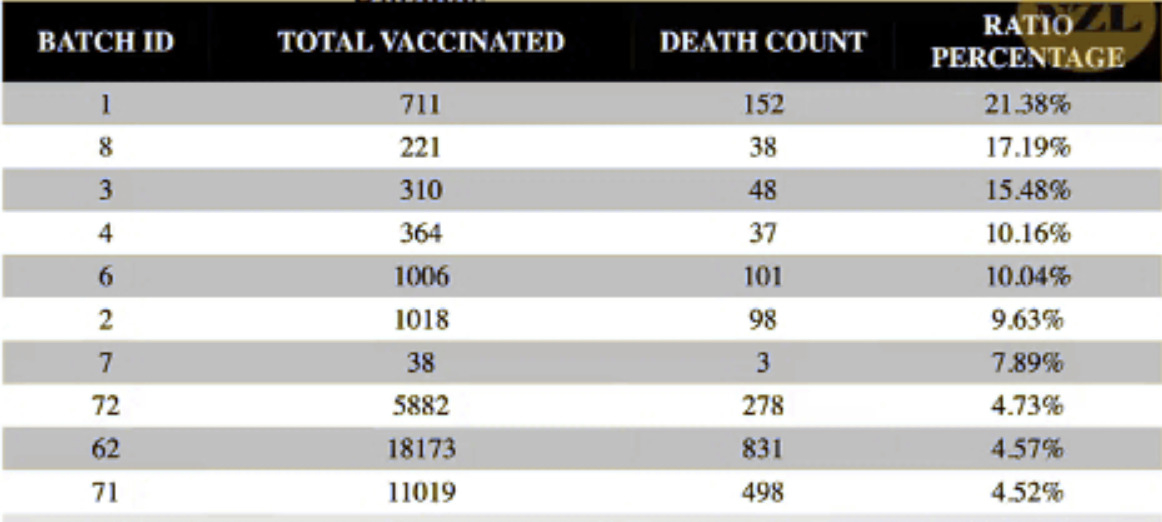
The other takeaway mentioned by Professor Fenton is the fatality rate of individual batches. Take a look at this handy graph:
I suppose it would be possible to argue that all 711 jabs of Batch #1 were administered to residents of the Shady Acres Retirement Home for Centenarians with Stage Four Ebola. But it’s difficult to make the same case with Batch #62 which went into the arms of 18,173 New Zealanders and killed 831 of them. Which, all by itself, is two hundred times the country’s official death toll from the vaccines. Which is to say, according to His Majesty’s Government in Wellington, precisely four Kiwis are dead of the vax.
Comments Off on All those (officially unexplained) “excess” mortalities
Romanian ZB-30 LMG: Improving the Already-Excellent ZB-26
Forgotten Weapons
Published 30 Aug 2023Brno’s ZB-26 was one of the best light machine guns of the 1920s, and it was widely adopted by countries that did not have domestic arms design and production capacity (and it would eventually become the British Bren gun as well). It was designed for the 8mm Mauser cartridge, and had a simple fixed gas system that ran very well — until countries began following the German lead in moving to standard use of s.S. (schweres Spitzgeschoß; heavy ball) ammunition. This put undue strain on the ZB-26 mechanism, and so an improvement was made to include an adjustable gas system that could be set to accommodate a variety of loadings. This experimental model was the ZB-27, and it was tested by Romania in the late 1920s.
Romania liked the design, and adopted it in 1930, purchasing guns from Brno and also buying a license to produce them at the Cugir factory complex in Romania. Today we are taking a look at two examples of Romanian ZB-30s, one Czech-made and one Romanian-made. They both incorporate a number of improvements over the ZB-26 (improved barrel latch security, rear monopod socket, bipod locking lever, etc) but also have a few minor differences from each other.
Thanks to the Southern Iceland Shooting Association for helping me film these and other cool guns in Iceland!
(more…)
Comments Off on Romanian ZB-30 LMG: Improving the Already-Excellent ZB-26
December 8, 2023
“An error of this magnitude makes one wonder how robust such calculations are”
Christopher Snowden notes the proliferation of media and public advocacy groups warning us about “junk food”:

On Monday, the front page of The Times led with a speech from Henry Dimbleby and a cost-of-obesity estimate from the Tony Blair Institute for Global Change — the perfect start to the week for any Times reader. According to Sir Tony’s think tank, “the effect on national productivity from excess weight is nine times bigger than previously thought”. An error of this magnitude makes one wonder how robust such calculations are (the previous estimate only came out last year), but Mr Dimbleby saw it as further proof that food should be treated like smoking.
The NHS “will suck all the money out of the other public services” while “at the same time, economic growth and tax revenue will stagnate. We will end up both a sick and impoverished nation,” Dimbleby will warn.
Would it be unfair to point out that the USA has much higher rates of obesity than the UK and also has much higher GDP growth?
As I pointed out on what I shall continue to call Twitter, the estimates as bunkum. They come from Frontier Economics and were first commissioned by the makers of Wegovy, presumably to make their effective but expensive weight loss drug look like a relative bargain.
Their previous estimate of the cost of obesity to “society” was £58bn. This year’s estimate is £98bn, most of which (£57bn) comes from lost quality-adjusted life years. As I tire of pointing out, these are internal costs to the individual which, by definition, are not costs to wider society. I can’t stress enough how absurd it is to include lost productivity due to early death as a cost to the economy. You might as well calculate the lost productivity of people who have never been born and claim that contraception costs the economy billions of pounds.
Since the previous estimate, the costs have been bulked up by including the costs of being overweight, but there is no indication in the wafer-thin webpage of what these are. Being merely overweight doesn’t have many serious health implications. The healthcare costs have doubled, but as in the previous report, the new estimate does not look at how much more healthcare would be consumed if there was no obesity. No savings are included. What we need is the net cost.
The “report” that The Times turned into a front page news story is no more than a glorified blog post. It contains no detail, no methodology and none of the assumptions upon which it is based can be checked. It comes with an eight page slideshow from Frontier Economics which is described as a “full analysis” but which doesn’t contain any useful figures either.
Estimates like this are bound to mislead the casual reader into thinking that they are paying higher taxes because of obesity. There is no other reason to publish them, as they have no academic merit. They are designed to be misunderstood.
Sure enough, the very next day The Times was explicitly claiming that the putative £98 billion — now rounded up to £100 billion — was a direct cost to government …
The findings come after an analysis found this week that Britain’s weight problem is costing the state almost £100 billion a year.
December 7, 2023
Carl Gustaf: Recoilless Rifle | Anti-Tank Chats
The Tank Museum
Published 25 Aug 2023From The Falklands to Ukraine; the Carl Gustaf recoilless rifle was introduced in 1948 and is still used by armies around the world today.
(more…)
Comments Off on Carl Gustaf: Recoilless Rifle | Anti-Tank Chats
December 6, 2023
QotD: What Charles VIII brought back from his Naples vacation
There was still a long “shaking out” period for the new technology: figuring out how to get enough saltpeter for gunpowder (now that’s a story we’ll come back to some day), how to build a large enough and strong enough metal barrel, and how to actually use the weapons (in sieges? against infantry? big guns? little guns?) and so on. By 1453, the Ottomans have a capable siege-train of gunpowder artillery. Mehmed II (r. 1444-1481) pummeled the walls of Constantinople with some 5,000 shots using some 55,000 pounds of gunpowder; at last Theodosius’ engineers had met their match.
And then, in 1494, Charles VIII invaded Italy – in a dispute over the throne of Naples – with the first proper mobile siege train in Christendom (not in Europe, mind you, because Mehmed had beat our boy Chuck here by a solid four decades). A lot of changes had been happening to make these guns more effective: longer barrels allowed for more power and accuracy, wheeled carriages made them more mobile, trunnions made elevation control easier and some limited degree of caliber standardization reduced windage and simplified supply (though standardization at this point remains quite limited).
The various Italian states, exactly none of whom were excited to see Charles attempting to claim the Kingdom of Naples, could have figured that the many castles and fortified cities of northern Italy were likely to slow Charles down, giving them plenty of time to finish up their own holidays before this obnoxious French tourist showed up. On the 19th of October, 1494, Charles showed up to besiege the fortress at Mordano – a fortress which might well have been expected to hold him up for weeks or even months; on October 20th, 1494, Charles sacked Mordano and massacred the inhabitants, after having blasted a breach with his guns. Florence promptly surrendered and Charles marched to Naples, taking it in 1495 (it surrendered too). Francesco Guicciardini phrased it thusly (trans. via Lee, Waging War, 228),
They [Charles’ artillery] were planted against the Walls of a Town with such speed, the Space between the Shots was so little, and the Balls flew so quick, and were impelled with such Force, that as much Execution was done in a few Hours, as formerly, in Italy, in the like Number of Days.
The impacts of the sudden apparent obsolescence of European castles were considerable. The period from 1450 to 1550 sees a remarkable degree of state-consolidation in Europe (broadly construed) castles, and the power they gave the local nobility to resist the crown, had been one of the drivers of European fragmentation, though we should be careful not to overstate the gunpowder impact here: there are other reasons for a burst of state consolidation at this juncture. Of course that creates a run-away effect of its own, as states that consolidate have the resources to employ larger and more effective siege trains.
Now this strong reaction doesn’t happen everywhere or really anywhere outside of Europe. Part of that has to do with the way that castles were built. Because castles were designed to resist escalade, the walls needed to be built as high as possible, since that was the best way to resist attacks by ladders or towers. But of course, given a fixed amount of building resources, building high also means building thin (and European masonry techniques enabled tall-and-thin construction with walls essentially being constructed with a thick layer of fill material sandwiched between courses of stone). But “tall and thin”, while good against ladders, was a huge liability against cannon.
By contrast, city walls in China were often constructed using a rammed earth core. In essence, earth was piled up in courses and packed very tightly, and then sheathed in stone. This was a labor-intensive building style (but large cities and lots of state capacity meant that labor was available), and it meant the walls had to be made thick in order to be made tall since even rammed earth can only be piled up at an angle substantially less than vertical. But against cannon, the result was walls which were already massively thick, impossible to topple over and the earth-fill, unlike European stone-fill, could absorb some of the energy of the impact without cracking or shattering. Even if the stone shell was broken, the earth wouldn’t tumble out (because it was rammed), but would instead self-seal small gaps. And no attacker could hope that a few lucky hits to the base of a wall built like this would cause it to topple over, given how wide it is at the base. Consequently, European castle walls were vulnerable to cannon in a way that contemporary walls in many other places, such as China, were not. Again, path dependence in fortification matters, because of that antagonistic co-evolution.
In the event, in Italy, Charles’ Italian Vacation started to go badly almost immediately after Naples was taken. A united front against him, the League of Venice, formed in 1495 and fought Charles to a bloody draw at Fornovo in July, 1495. In the long-term, French involvement would draw in the Habsburgs, whose involvement would prevent the French from making permanent gains in a series of wars in Italy lasting well into the 1550s.
But more relevant for our topic was the tremendous shock of that first campaign and the sudden failure of defenses which had long been considered strong. The reader can, I’d argue, detect the continued light tremors of that shock as late as Machiavelli’s The Prince (1532, but perhaps written in some form by 1513). Meanwhile, Italian fortress designers were already at work retrofitting old castles and fortifications (and building new ones) to more effectively resist artillery. Their secret weapon? Geometry.
Bret Devereaux, “Collections: Fortification, Part IV: French Guns and Italian Lines”, A Collection of Unmitigated Pedantry, 2021-12-17.
Comments Off on QotD: What Charles VIII brought back from his Naples vacation
December 5, 2023
See Inside Sherman Firefly | Tank Chats Reloaded
The Tank Museum
Published 1 Sept 2023Inspired innovation or a bit of a lash-up? In this video we look inside the legendary Sherman Firefly, the British Army’s Tiger killer. We also hear from a Firefly veteran, Ken Dowding, ex-14th/20th Hussars.
(more…)
Comments Off on See Inside Sherman Firefly | Tank Chats Reloaded


