
I got into the higher ed biz fully intending to practice what Milosz calls “aesthetic ketman.” [“paying lip service to official ideology while secretly subverting it”] I loved my subject, but my subject was recondite enough, I figured, that I could keep the SJW bullshit to a bare minimum. I don’t remember what they called “intersectionality” back then, but whatever it was, I’d just make a few brief nods to it, then get on with my work in relative peace. Throw a few quotes from Foucault, Judith Butler, Gayatri Spivak, and the like in my dissertation intro, and that was that.
The problem, though, is that the sour pleasure of ketman is addictive, and like any addiction, you need to keep upping the dose to feel the same effect.
My first few years in grad school, anyone who cared to look could’ve easily spotted me as a secret shitlord. For one thing, I was the only guy in the whole damn town who actually looked happy. For one thing, professing is a 24/7 job — that’s “24 hours a week, 7 months a year,” and don’t let anyone tell you otherwise. All that free time is lovely, especially in a college town with 24-hour everything and scads of scantily clad undergraduate eye candy.
But more importantly, there’s the pleasure of ketman. So long as I make a few radical noises, I can get you sheep to believe anything I say. I used to tell people I studied transgendered potato farmers in the Kenyan uplands. I told this obnoxious girl from the Gender Studies department my dissertation was on resistance strategies of Eskimos in the Waffen-SS. I cited Alan Sokal’s hoax paper on the social construction of gravity in every seminar taught by a radical feminist, and no one ever called me on it. Anyone who thinks I’m kidding obviously hasn’t been on campus in the last 20 years or so. It was fucking hilarious …
… for a time. And then it got sad, then nauseating, because I eventually realized I was no different from the fools who swallowed my bullshit. It doesn’t matter if you’re being exquisitely ironic when you tell a room full of freshmen that “gender is a social construction.” They can’t recognize irony anyway, and even if they could, parroting the phrase “gender is a social construction” is still required to pass the class. More importantly, what if they did recognize it? I’m up there thinking I’m a shitlord, speaking truth to power to anyone smart enough to figure it out, but all they see is another fat, middle-aged sellout parroting nonsense. If I were serious about my shitlordery, they think, then I’d quit. But I don’t quit, which must mean my so-called “principles” are worth … what? We’ve already established you’re a whore, madam; now we’re just haggling over the price.
Severian, “The Pleasures of Ketman”, Rotten Chestnuts, 2020-01-09.
April 10, 2020
April 5, 2020
QotD: The fear of “becoming” your job
You could see this worry everywhere in our culture, our art. Watch Fast Times at Ridgemont High. Judge Reinhold’s character is wrestling with this type of question, and he’s in high school, fer chrissakes. See what I mean about that movie being made on Mars? Remember that; it’ll be on the final.
There’s a certain type of person, though, who just couldn’t grok those worries, because the very notion of social roles was incomprehensible. We didn’t know about the autism spectrum back then, but that’s what that type of person effectively is: A high-functioning autistic. For the autistic, what’s now is forever. Bob’s nametag says “customer service representative.” Therefore, Bob is a customer service representative, and only a customer service representative, now and forever. Bob the family man, Bob the stamp collector, Bob the bar-band strummer … all those fry the autistic’s circuits. It says “customer service representative,” damn it! The train is fine.
Two sides of the same coin. Normal people were worried that they were becoming their jobs. The autistics couldn’t grasp that anyone could be anything else.
The autistics all went into the ivory tower, which gave us identity politics. “Identity politics” only makes sense to the autistic — that is, to people who can’t process change. Normal people have such a hard time with it because we can’t see the logical connection between, say, being gay and being pro-abortion. I mean, if you’re gay it’s a moot point, right? Nor is there any logical connection between being gay and favoring redistributive economics, or worrying about global warming, or whatever. Maybe you do believe in redistributive economics and are worried about global warming, but those are just individual opinions, right? I’m not obliged to vote Republican because I dig blondes. It’s a non sequitur.
Not to the autistic, it isn’t. They’re told that this — pro-abortion, being “green,” the whole Liberal schmear — just is gayness, and they go with it, because that’s the only way the world makes sense to them. Just how “gay” came to mean all that is above my pay grade, but we all know it’s true. More importantly, we all know they believe it, with all their hearts and souls.
That’s the situation in which we find ourselves, my young friends, here in the Current Year. Most of us would like to be team players, but we have no role models. Because the autistics control the culture, we’ve internalized their worries. If I’m a member of the team, we instinctively feel, then somehow I am the team, and only the team, now and forever. It’s a stark choice: Either I give up my individuality completely to advance the team’s goals, or I take my ball and go home.
But it’s a false choice, kameraden, one that could only be beaten into us by very long, very expensive training — i.e. the American “education” system, K-thru-PhD.
Severian, “Advice to Young Dissidents”, Rotten Chestnuts, 2020-04-01.
April 4, 2020
QotD: The danger of studying philosophy
I knew my analysis of Wallace Stevens would please my professor, but I was bothered by a nagging thought that I really didn’t understand Wallace Stevens. I wondered if my graduate school training just amounted to a parlor trick. Last year, at my high school, the students enjoyed arguing if a hotdog is a sandwich, the millennial equivalent of asking how many angels can dance on the head of a pin. The hotdog question made its way to the whiteboard in our staff lounge. By the time I arrived, my colleagues had written their responses. Some argued that a hot dog is not a sandwich because a sandwich requires two pieces of bread and a hotdog bun isn’t supposed to separate. Others averred that it most definitely is a sandwich: Meat between bread is a sandwich, end of story. I saw these responses and thought, “Simpletons!” before putting my graduate education to work: “In order to determine if a ‘hotdog is a sandwich,’ we must first determine the proper understanding of ‘is’ for if we do not grasp the ontological necessity of being itself, we fall into an abyss wherein ‘being’ is and is not itself and thus a hotdog is and is not a sandwich for it is and is not its very self.” I was quite amused by the whole situation until a colleague told me that a student had seen the whiteboard and said he wanted to study philosophy so that he could write like me.
S. A. Dance, “Incomprehension 501: Intro to Graduate School”, Quillette, 2018-03-06.
March 19, 2020
“Millennial[s are] every bit as shallow, irresponsible, stupid, and smart-assed as” Baby Boomers
David Warren on the awful discovery that the kids not only aren’t all right, they’re just as bad as we are:
Unlike certain oldies, I have retained some awareness of the “young people.” Curiosity alone would drive me to this, although childbearing (not by me personally) has had the same effect. In my research, I have found the so-called Millennial generation to be every bit as shallow, irresponsible, stupid, and smart-assed as my own, and what is worse, younger. I thought we were the Peter-Pan generation that would never grow up, but the claim must now be shared with successive rounds of offspring. To be fair, the rewards for growing up have been sharply curtailed, through that part of history which anyone remembers, and those who never tried were never punished.
History itself has now so far receded — it certainly is not taught in schools — that by now the kids persist on pure theory. They do what seems necessary to them, in the absence of knowledge. I cannot reasonably blame them for lacking what they’ve never come in contact with, for no one can know about what he has never heard of. On religious questions, for example, what could “transubstantiation” mean? It was easier to explain this to a South Sea Islander, in the good old days of the missionaries, before the islanders got cell phones.
On the other hand, the Millennials are human. The instinct to be human, even when repressed, often returns. Several times I have been moved, almost to tears, by a native decency suddenly expressed, by the most unlikely subject in rings and tattoos. There will always be something to work with, there.
While Millennials appear even dumber than their elders, we must allow for the progressive slide. There are just as many smart people as there once were, and some abroad have benefited from improved nutrition. If caught young, and exposed to learning, they would learn. They simply haven’t been exposed to it yet.
March 16, 2020
University lectures developed historically due to the extremely high cost of books…
… now that books are extremely cheap, universities should long since have adapted:
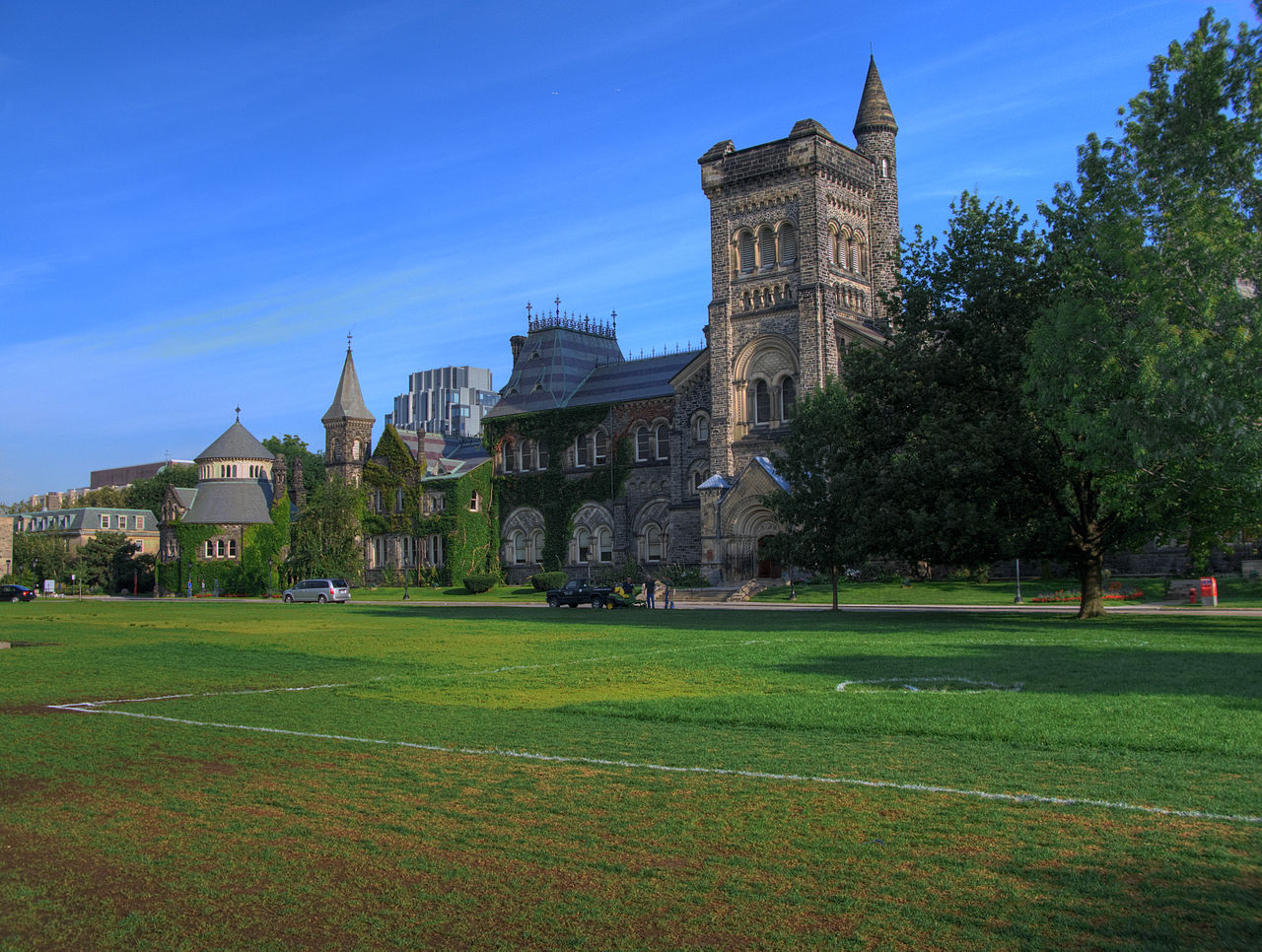
University College, University of Toronto, 31 July, 2008.
Photo by “SurlyDuff” via Wikimedia Commons.
As Brad Delong has been pointing out for years the very method of university teaching arose from a technological issue. Books were expensive. No, expensive. A scholar might amass a library of 50 volumes in a lifetime if they were assiduous at the game. Hundreds indicated an active collector spending significant sums. At which point, to educate the impecunious – students have never been known as the rich – it makes sense for education to be one person with a book reading it to a room full of others. The lecture that is.
Books are now cheap. That education method no longer needs to be.
So too with this idea of essays. Sure, it’s a good thing to be able to research, write down an argument and all these things. But that world out there has changed. Getting someone else to do it for you is now cheap. Less than the money you could earn pulling pints in the time it might take to do it. Well, -ish, -ish, around and about.
This is also all global. Changing UK law to ban the [essay] mills isn’t going to change matters a jot. Nor tittle in fact.
What needs to be changed is the method of education which leads to students being asked to produce essays unsupervised.
What’s so odd is that the educational establishment is near entirely Marxist. The state of technology determines the mode of social relations of whatever it is. OK, technology has changed, the mode of educational relations needs to change.
Essays – just as an example here – must be produced under exam conditions. Done, problem solved.
February 25, 2020
“… and men like you will teach the kids. Not poems and rubbish; SCIENCE! So we can get everything working!”
Apparently “the Artilleryman” from Jeff Wayne’s musical interpretation of War of the Worlds has taken over some important post at Oxford:

The Classics Faculty at the University of Oxford is considering whether to remove from its undergraduate courses the compulsory study in their original languages of Homer and Vergil. The reasons given are that students from independent schools, where some classical teaching is kept up, tend at the moment to do better in examinations than students from state schools, and that men do better than women. I regard this as the most important news of the week. I do so partly because I make some of my living from these languages, and so have a financial interest in their survival. I do so mainly because I see the proposal as a further enemy advance in the Culture War through which we have been living for at least the past two generations.
I could make this essay into another attack on the cultural leftists. I will come to these, as they are among the villains. They are not, however, the main villains. These are people who sometimes regard themselves, and are generally regarded by others, as conservatives. They once looked to Margaret Thatcher as their political champion, and then to Tony Blair. They were some of the most committed advocates of our departure from the European Union. They now look to the Johnson Government for the final triumph of their agenda. For these people, a nation is barely more than a giant economic enterprise – Great Britain plc. For them, the main, or perhaps the sole, purpose of education is to provide sets of skills that have measurable value in a corporatised market.
These people have been around for a long time. They were satirised by Charles Dickens in Hard Times, where Thomas Gradgrind explains his philosophy of education:
Now, what I want is, Facts. Teach these boys and girls nothing but Facts. Facts alone are wanted in life. Plant nothing else, and root out everything else. You can only form the minds of reasoning animals upon Facts: nothing else will ever be of any service to them. This is the principle on which I bring up my own children, and this is the principle on which to bring up these children. Stick to Facts, sir!
[…]
I agree that state education had become a joke where almost nothing of any kind was taught. As continued by Tony Blair, the Thatcher reforms did eventually drive up standards of literacy and numeracy. But this has been at a terrible cost. Any modern school that wants to be thought desirable must focus on its place in the league tables. This involves working the children like slaves – stuffing them in class with facts that can be regurgitated in tests and therefore graded, then handing out reams of homework that leaves no time for personal development.
The universities continue this conveyor belt approach. Around half of school leavers are pressured into “higher” education. Those who go into the “STEM” subjects – Science, Technology, Engineering, Mathematics – follow a narrow and specialised curriculum that leaves them ignorant of nearly everything outside their own subject. The rest sign up for largely worthless subjects – anything with the words “business” or “studies” in the name. There, they are kept busy with three-hour lectures. I know the value of these, as I used to give them. I fell asleep in one of them, and the students were happy when my voice finally trailed off. Progress in these subjects is measured by coursework that is increasingly plagiarised or ghost-written, or through examinations where the grades are fiddled. At the end of this, graduates – and everyone does graduate – are qualified for nothing better than employment in one of those bureaucracies of management or control that fasten on the actually productive like mistletoe on a tree. The universities look at rising numbers and the fact that graduates do find paid employment, and call this a great success. No one thinks it a disgrace if students never take up a book not on their worthless reading list, or that, having graduated, they never open another book.
Or school leavers at the bottom end are herded into courses in plumbing or hairdressing. I was once invited to teach a module in a Parking Studies degree – this for the certification of traffic wardens. I suppose people are needed to keep the roads clear, and I suppose they should be given some idea of their legal rights and duties. I am not at all sure if they need to have degrees. I am sure that skilled trades of undoubted value are best taught, as they always used to be, through private apprenticeships or informally on the job.
February 22, 2020
QotD: Veblen’s “leisure class” evolve into the “luxury belief class” in truly affluent cultures
Thorstein Veblen’s famous “leisure class” has evolved into the “luxury belief class.” Veblen, an economist and sociologist, made his observations about social class in the late nineteenth century. He compiled his observations in his classic work, The Theory of the Leisure Class. A key idea is that because we can’t be certain of the financial standing of other people, a good way to size up their means is to see whether they can afford to waste money on goods and leisure. This explains why status symbols are so often difficult to obtain and costly to purchase. These include goods such as delicate and restrictive clothing like tuxedos and evening gowns, or expensive and time-consuming hobbies like golf or beagling. Such goods and leisurely activities could only be purchased or performed by those who did not live the life of a manual laborer and could spend time learning something with no practical utility. Veblen even goes so far as to say, “The chief use of servants is the evidence they afford of the master’s ability to pay.” For Veblen, Butlers are status symbols, too.
Building on these sociological observations, the biologist Amotz Zahavi proposed that animals evolve certain displays because they are so costly. The most famous example is the peacock’s tail. Only a healthy bird is capable of growing such plumage while managing to evade predators. This idea might extend to humans, too. More recently, the anthropologist and historian Jared Diamond has suggested that one reason humans engage in displays such as drinking, smoking, drug use, and other physically costly behaviors is because they serve as fitness indicators. The message is: “I’m so healthy that I can afford to poison my body and continue to function.” Get hammered while playing a round of golf with your butler, and you will be the highest status person around.
Rob Henderson, “Thorstein Veblen’s Theory of the Leisure Class — A Status Update”, Quillette, 2019-11-16.
February 12, 2020
Rebecca Black, nine years after the release of “Friday”
CNN‘s Scottie Andrew talked to Rebecca Black about her experiences and the reactions to her debut video:
Partyin’, partyin’, YEAH! “Friday,” the accidental anthem of 2011 and an ode to the best day of the week, is officially nine years old.
It became something of a national joke when it debuted. But to a then-13-year-old Rebecca Black, the single’s star, the jokes made at her expense were immensely damaging.
Black, now 22 but still a pop singer, is remarkably well-adjusted for someone whose life was upended by a music video. She marked the 9th anniversary of the song that started it all with a note to her younger self — and advice for her followers to love themselves a little better.
[…]
Black was only in middle school when she filmed the infamous video. She paid a company called Ark Music Factory to write her a song and film a music video for it, starring her and her friends.
It’s not an artistic achievement, but it’s fitting for the young star at its center. In it, Black sways and sings her way through a Friday — she wakes up, she eats cereal, she can’t decide which seat in a convertible to take. Typical teen stuff.
The negative comments rolled in almost immediately, and nearly all of them lambasted Black.
At the time, I linked to a couple of deconstructions of the video that amused me. One was from The Awl:
She offers the camera a hostage’s smile, forced, false. Her smoky eyes suggest chaos witnessed: tear gas, rock missiles and gasoline flames. They paint her as a refugee of a teen culture whose capacity for real subversion was bludgeoned away somewhere between the atrocities of Kent State and those of the 1968 Democratic Convention, the start of a creeping zombification that would see youthful dissent packaged and sold alongside Pez and Doritos.
“Look and listen deeply,” she challenges. An onanistic recursion, at once Siren and Cassandra, she heralds a new chapter in the Homeric tradition. With a slight grin, she calls out to us: “I sing of the death of the individual, the dire plight of free will and the awful barricades daily built inside the minds of all who endure what lately passes for American life. And here I shall tell you of what I have done in order to feel alive again.”
***Ms. Black first appears as her own computer-generated outline: wobbly, marginal, a dislocated erasure. The days of the week flip by accompanied by dull obligations — “essay due” — and tired clichés — “Just another manic Monday …” Her non-being threatens to be consumed by this virtual litany of nothing at all until, at long last — Friday.
[…]
Yet here the discerning viewer notes that something is wrong. Because it is a simple matter of fact that in this car all the good seats have already been taken. For Rebecca Black (her name here would seem to evoke Rosa Parks, a mirroring that will only gain in significance) there is no actual choice, only the illusion of choice.
The viewer knows that she’ll take the only seat that’s offered to her, a position so very undesirable as to be known by a derisive — the “Bitch” seat.
She might well have been better off on the school bus, among the have-nots. But Rebecca Black’s world is so advanced in the craft of evisceration that this was never a consideration. John Hughes died while out jogging, these are the progeny of his great materialist teen-villain, James Spader, a name that would come to be synonymous with desperate sex and high-speed collision. And as she gets in the car Ms. Black’s joy is as patently empty as her liberation.
“Partying, Partying,” she sings, in hollow mantra.
“Yeah!” an unseen mass replies, a Pavlovian affirmation.
The other was from Jeffrey Tucker in the Christian Science Monitor:
Far more significant is the underlying celebration of liberation that the day Friday represents. The kids featured in the video are of junior-high age, a time when adulthood is beginning to dawn and, with it, the realization of the captive state that the public school represents.
From the time that children are first institutionalized in these tax-funded cement structures, they are told the rules. Show up, obey the rules, accept the grades you are given, and never even think of escaping until you hear the bell. If you do escape, even peacefully of your own choice, you will be declared “truant,” which is the intentional and unauthorized absence from compulsory school.
This prison-like environment runs from Monday through Friday, from 8 a.m. to late afternoon, for at least ten years of every child’s life. It’s been called the “twelve-year sentence” for good reason. At some point, every kid in public school gains consciousness of the strange reality. You can acquiesce as the civic order demands, or you can protest and be declared a bum and a loser by society.
“Friday” beautifully illustrates the sheer banality of a life spent in this prison-like system, and the prospect of liberation that the weekend means. Partying, in this case, is just another word for freedom from state authority.
The largest segment of the video then deals with what this window of liberty, the weekend, means in the life of someone otherwise ensnared in a thicket of statism. Keep in mind here that the celebration of Friday in this context means more than it would for a worker in a factory, for example: for the worker is free to come and go, to apply for a job or quit, to negotiate terms of a contract, or whatever. All of this is denied to the kid in public school.

January 30, 2020
French immersion is still like private school for the middle class
Chris Selley talks about the differences between Canadian official bilingual opinion and reality for Canadian students:
Inevitably in these discussions, however, someone dares mention the unspeakable truth: that when it comes to bilingualism, not all Canadians are born equal. Conservative MP and possible leadership candidate Michelle Rempel Garner suggested bilingualism was a matter of “privilege” — “either financially, access to education, or time required.” And the National Post‘s Alberta correspondent, Tyler Dawson, ventured that in most of the country, “it’s nearly impossible to finish high school fluent in French and English.”
These perfectly axiomatic observations produced the standard anecdote-laden blowback. Author and journalist Chris Turner boasted of his “fully bilingual” 14-year-old daughter, the beneficiary of “a public immersion program in Calgary, which is maybe Canada’s least French city.” Former Parliament Hill reporter Rosemary Thompson claimed “there are many options in the public school system for French” in “rural Alberta.” Shannon Phillips, the Alberta NDP’s finance critic, claimed “there is French-language education of high quality almost everywhere in this country.”
It’s frankly bizarre that Canadians who think bilingualism is important could be this misinformed. The internet is full of studies, papers and op-eds from the Official Languages Commissioner, the Senate’s Standing Committee on Official Languages and the various chapters of Canadian Parents for French bemoaning widespread lack of access to French-as-a-second-language education.
The numbers back that up. Never mind graduating high school bilingual; the vast majority of Canadian students aren’t even studying it after elementary. In the 2017-18 school year, excepting Quebec and New Brunswick, just under 50 per cent of Canadian Grade 9 students were in either core French or French immersion programs. In Grade 10 that was down to 22 per cent; in Grade 11, 15 per cent; in Grade 12, eight per cent.
Where French classes are available, moreover, they are too often shoddy. A 2017 report from the Senate committee noted a study finding 78 per cent of teachers teaching core French in British Columbia “felt uncomfortable speaking French.” Why would parents waste their kids’ time with that, if competent instruction in Mandarin, Punjabi or Japanese were available down the hall? (French isn’t mandatory at any grade level in British Columbia.)
As for French immersion, demand vastly outstrips supply. Lotteries and waiting lists are de rigueur. The Senate report told of cases where parents “camp(ed) outside schools to enrol their child in French immersion programs (for) up to four days.” Most parents have to go to work.
Back in 2015, Aaron Hutchins covered this for Maclean’s:
French-English bilingualism rates may be on the decline in Canada, but when it comes to getting kids into French immersion programs — which have come to be seen by many as a free private school within the public school system — there is nothing, it seems, that a Canadian parent won’t do.
Alyvia is now in Grade 2 and loving French classes. But for every student who graduates from French immersion, there’s at least one other who has been bumped out of the program and put into an English-only stream that many deem inferior. Well-meaning parents may feel that French immersion is the answer for every child. In reality, it has become an elitist, overly restrictive system, geared to benefit a certain type of student.
[…]
“What a program like French immersion does is it siphons off those kids who have engaged families who make sure the kids do all their homework,” says Andrew Campbell, a Grade 5 teacher in Brantford, Ont. “Because of that, the opportunities in the rest of the system are affected because the modelling and interaction those kids would provide for the other kids in the system aren’t there anymore.”
The immersion program creates division along lines of gender, social class and special needs students, wrote a 2008 study from the Canadian Research Institute for Social Policy looking at French immersion in New Brunswick. Girls are more likely to be enrolled than boys and the French stream has fewer kids in need of extra help. All things being equal in New Brunswick, every class — French or English — should have 3.4 students with special needs. But when a school offered French immersion, the average number of special needs students ending up in the English stream was 5.7. This kind of segregation is not unique to that province.
The richer the family, the more likely their kids will be immersed in French, according to figures from a Toronto District School Board study. In 2009-10, 23 per cent of all French immersion students came from families in the top 10 per cent of income. Meanwhile, only four per cent of French immersion students came from the bottom 10 per cent of family income.
“The program is open to lots of people, but it gets whittled down,” says Nancy Wise, a French immersion educational consultant and former special education teacher in the York region, just outside Toronto. “If you can’t cut it, you probably fall into one of these categories: [you’re a] new Canadian, this is your third language, you’ve got some learning challenges, or there’s a socio-economic factor. They jump on it in the schools and show them the door — and it’s just not right.”
January 22, 2020
The general unpleasantness of life in the “groves of academe”
David Warren on the state of play on the intellectual and political battlefronts of academia:
University College, University of Toronto, 31 July, 2008.
Photo by “SurlyDuff” via Wikimedia Commons.
As the latest reports from our universities confirm, we live in an age of juvenile anachronism. So far as the past is acknowledged at all, it is to be judged, by the incredibly narrow standards of “social justice,” itself two words of a lie. Anyone who tries to resist this — even tenured professors — will be demoted, fired, or “placed on probation.” As in Soviet universities, this was enough to keep most dissenters secret. There is, after all, at least one mouth to feed, and not everyone is equipped to become a martyr. Among the better academics, some particles of truth can be snuck into lectures, past the inquiring minds of ignorant thugs.
But as technology has now blessed us with portable, and easily concealed recording devices, they must stay constantly on guard. A slight ideological slip could end the most promising career, apart from surrounding the speaker with shrieking Antifa who, if they manage to injure him, will not be prosecuted by campus or municipal sensitivity police.
It’s actually no better for (most of) the students than it is for the professors:
… after family breakdowns and the re-education of a generation of public school teachers, the crop of new students are so dull and docile that, unless they are radicalized, they will sit there aloof, like zombies. There are “conservative” students, whose complacency can serve any mission. Many have “common sense” enough to play along. They are only there to acquire the minimum credentials for paid work on the outside. It is a prison term. Once graduated, they will then adopt the customs and tone in their workplace environment which, except for “professions” like journalism, are unlikely to be radical. The feigned “social justice warrior” is transformed into a feigned enthusiast for capitalism, by self-interest, almost overnight.
January 21, 2020
QotD: “Safe spaces” do not produce strong people
No, It merely makes of them mollycoddles, weaklings, and in some important ways barely or not even human. That’s the effect of a safe space, to render those who hide in them weak and ignorant.
There are things worse than the safe space, though. That only weakens your brain by making sure you never have to reason about or argue in defense of your beliefs. And, at least, this moral weakening and brain-deadening thing is voluntary. Much worse is the movement to restrict free speech and to manipulate speech for political ends. This does what the safe space does, of course, but a simple saunter down memory lane shows it does so much more. Want to starve ten or twenty or fifty million of your own people to death? Want to gas a few million members of a despised minority? Want to hack to death half a million countrymen? Job one is attack speech.
Don’t you find it odd that your teachers have led you away from any history that would tend to show you that destruction and perversion of free speech is generally followed by massive murder? Don’t you find it a little odd that they place offending someone as worse somehow than starving, gassing, or shooting them to death?
Tom Kratman, “It’s Up to You, Millennials. Deflect or Be Doomed”, Milo, 2017-12-06.
January 20, 2020
A Drag Queen speaks out against Drag Queen Story Hour for kids
Libby Emmons reports on a rare bird indeed — a Drag Queen who doesn’t think it’s appropriate to have other Drag Queens visit schools and libraries to read to pre-teen kids:
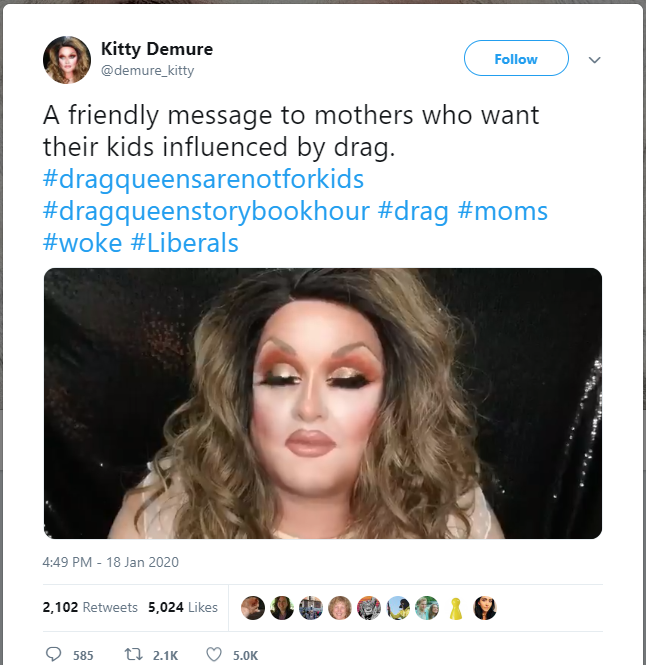
Drag Queen Kitty Demure has taken to Twitter to speak out against the sexualization of children by woke people co-opting drag culture and rebranding it as an educational tool.
“I have absolutely no idea why you would want [drag queens] to influence your child. Would you want a stripper or porn star to influence your child?”
A friendly message to mothers who want their kids influenced by drag. #dragqueensarenotforkids #dragqueenstorybookhour #drag #moms #woke #Liberals pic.twitter.com/EmOovz4E3F
— Kitty Demure (@demure_kitty) January 19, 2020
Demure notes that just as you wouldn’t take your kids out to see porn stars or strippers read stories while in full dress and makeup, you shouldn’t take them to see drag. There’s an effort to introduce kids earlier and earlier to adult sexuality. The idea is that this will help kids be more open-minded and understanding about the difference. What it really does is normalize deviant adult behaviour in children’s minds and override their own instincts. Giving children access to sexual content makes them think this kind of thing is for them, it opens doors that should stay closed until a child is of age.
Demure says here what all of us know: drag culture is adult entertainment. The look is sexualized. The names are sexualized. In fact, the entire concept of drag is a send-up of beauty queen culture. Beauty queen culture is sexualized as well, and while that is sometimes subsumed beneath the surface, it’s obviously fully part of it. That’s what drag plays on. Drag can be lots of fun, but it’s grown-up fun, not for kids.
January 19, 2020
QotD: Bad fiction writers often know little or no economic theory
It is clear that she comes from an academic background, since she thinks that shelves are allotted by order of “importance.”
This is a problem for me as a reader often because I run into a lot of writers like her. It’s less important in things like romance, though even there it can get weird, like when some authors assume that the best thing possible in the Regency would be being a duke AND a doctor. (Head>desk, repeat.) This is because they misunderstand the relative wealth and importance of earning a living in the professions.
But there are a ton of books in mystery that hit the wall. Those that require understanding of how the world worked. So the economics these writers write are what you expect from exquisitely maleducated people. They learned sociology and various grievance studies. So you know, factories are bad places where people are forced to work in terrible conditions — for the 21st century. None of these darlings has the slightest idea what actual conditions were like at farms in the Regency, say — and do not even get health care or counseling, and are probably totally deprived of free ice cream.
I have now walled mysteries, some romances and a few fantasies, because they assume people who build and run factories are “evil exploiters” and villains. (As opposed to you know not building anything and letting the peasants starve.)
I’ve walled even more of them when the villain becomes “reformed” and just gives his whole fortune away to people who probably drink it away within a week and, presumably, dies in a gutter shortly thereafter.
In science fiction and fantasy this is even more painful. You’ll have entire worlds getting paid for things, without it making any sense, since there is no galactic agreement on money, no universally agreed upon standard, nothing that makes whatever they hand you worth anything. We have entire worlds paid for things that make no sense to transport inter-world with the money existent at that time. You have “exploited” groups, that you can’t figure out why anyone would exploit or what sense it makes.
Then there is the soc jus in these worlds, which often consists of upending historic injustices by creating worse injustices and, oh, yeah, incidentally making it impossible for the economics to function and starving everyone in the world. If you’re going to do that call it Planet Venezuela already, okay?
And don’t get me started on the economics of worlds with magic, where monetizing magic is somehow either wrong or no one ever thought of doing it (because everyone in that world is born mentally impaired.)
Sarah Hoyt, “A Fundamental Misunderstanding of Supply and Demand”, According to Hoyt, 2019-11-06.
January 8, 2020
QotD: Diversity in academia
“America’s one-party state”, The Economist, 2004-12-02.
January 5, 2020
More from Severian about modern girls at university
Having regaled us with shocking tales of the Basic College Girl (linked here), Severian now gets down to the not-very-salacious details of modern female mating behaviour at US colleges:
University College, University of Toronto (not one of the post-secondary institution Severian used to teach at).
Photo by “SurlyDuff” via Wikimedia Commons.
When people find out I’m retired from “higher” “”education,”” if they’re anything but rabid Leftists they usually ask me a series of questions: Why are professors such hypocritical assholes? and Is there really any point to ___ Studies? and Why do they pay the football coach umpteen zillion dollars a year to never finish higher than third in the conference? If the questioner is a man, though, and we’re out drinking, after a few martinis they always get around to: But what about … you know … the girls?
Where to start? Since there’s no avoiding prurience here let’s get one thing out of the way up front. This is TLP, not me, but it holds for coeds, too:
These people are prone to two errors. A psychological one: fetishization; and a biological one: mistaking for beauty what is merely youth.
Taking the second first: I made the same mistake. I came to the ed biz later than most, having had a “real” job back in my other life, so when I first got to grad school I was amazed at how hot the girls were. Like everyone else I was a TA for Intro to Studies 101, but unlike everyone else I must’ve gotten the “sorority girls only” section, because every single chick in it was a knockout.
Now I’ll cop to being a little slow on the uptake, but I’m not that dumb. So I started looking a little closer — purely in the interests of science, you understand — and it wasn’t long until I realized that yeah, what I thought at first was smokin’ hotness was just youth. Back in the office I’d been surrounded by women who were equally attractive, but not equally young. A few years in a high-stress job puts a lot of miles on you.
But the other, fetishization element came into it too. Not like that, get your minds out of the gutter, let me explain:
I don’t think it ever really was, but if “coed” was a fetish its days are long past. In a country where the vast majority of people have at least a semester or two of college, not even “sorority girl” really moves the needle much. Rather, all the “fetish” stuff comes from the other side. After spending oh-god-sooooo-many hours getting harangued by the HR ladies about “sexual harassment,” even the most cynical teacher finds himself wondering what he’d do if some slinky young thing really did show up at office hours, close the door, and declare she’ll do anything to pass the class…
Which never happens, of course. I’ve never even heard of it, and I taught at lots of places, for many years, among male colleagues (and a lot of lesbians) who were desperately horny losers. The reason is twofold. The first, and most obvious, is that even if some girl really is that mercenary / sociopathic — and y’all have me on record, at great length, describing what little sociopaths modern kids are — there’s a much simpler alternative available: Straight-up bribery. But notice that’s the one thing you never even hear suggested, though it’s the easiest thing in the world. TAs get paid peanuts; I don’t know how low the bidding could’ve gone, but having seen the squalor in which lots of my fellow grad students lived, twenty bucks doesn’t seem unreasonable …
[…]
Ironically, I’d bet #MeToo and the rest of it actually result in more, not less, of this behavior. Like I always say, today’s blue-haired, nose-ringed slam poet is tomorrow’s obergruppenfuhrer, and one of the main reasons I say it is that I’ve been around a LOT of college people. Shrinking violets who need “safe spaces” everywhere very obviously long to knuckle under to power, any power. Goofy losers who suddenly find themselves with a lot of power naturally start carrying on like Heinrich Himmler. Put them together in the closest possible proximity, in a place explicitly designed to shield them from the real world, and, well, you figure it out.


