
Should we consider mandatory graphic warning labels on bottles of booze? Our science reporter Tom Blackwell reviewed various Canadian discussions of the idea in these pages yesterday, suggesting that it is being looked at behind the scenes by addiction researchers. Labels with colour images of diseased esophagi on liquor labels would, of course, mimic the approach Canada has already taken toward cigarettes. So, well, why not? They say if you have a hammer, everything looks like a nail: by a similar token, if your field is addiction, no doubt everything that has addictive qualities looks like an unsolved problem.
But there is one very obvious way in which liquor is not like cigarettes: scientists are reasonably sure that light drinking has positive public-health consequences. If you don’t believe me, you can look up articles like the one I have in front of me here from a 2013 issue of Annals of Oncology: its title is “Light Drinking Has Positive Public Health Consequences.” As a layman I obviously can’t be certain I have summarized this editorial correctly, but you’ll have to trust me.
Colby Cosh, “The real problem with liquor warning labels — there’s such a thing as good drinking”, National Post, 2015-12-17.
December 29, 2015
QotD: The health benefits of moderate drinking
December 28, 2015
Alberta’s carbon tax scheme
Some thoughts from Dave’s Insight on Alberta’s attempt to signal their new-found carbon virtues:
First, let me set the premise. When giving seminars on Tax and/or Profits, I like to ask the question. What is a word for a Company that does not pass all its expenses, including its taxes on to its customers? The answer of course is bankrupt. Maybe not immediately, but eventually. Something I always ask when dealing with businesses, non-profits and governments when they are talking about spending is: Where is the money going to come from? Well, where is the money going to come from?
The NDP government may claim that it will only be three or four hundred dollars per person, sorry, per family. But let’s cut to the chase. In almost the same breath they claim it will raise 3-4 billion dollars per year revenue for the provincial government. Possibly double that in a few years. So where is this coming from? At the end of the day, one way or another it has to come from our pockets. While at first you might think that we export so we can export the tax. However, our exports have to compete with all the other available sources of supply, so we cannot export the tax. If we could, we would still be charging over $100 per barrel for oil, but we cannot. That leads me back to: Where is this 3 to 4 Billion dollars per year (more later) to come from?
Well, there is really only one answer; it might be somewhat invisible, but we Albertan’s will have to pay it, and that my friend works out to about $1,000 per person per year, or $4,000 per family of four. And if it brings in $8 billion in a few years, that is over $8,000 per family of four per year. We will pay it in the form of higher transportation costs (both public and private); higher heating costs and to a lesser extend in the cost of everything we buy from groceries to toys. Of course some will pay more and some less, but to be clear, this will hurt the poorest the most.
H/T to Small Dead Animals for the link.
December 27, 2015
The refit and modernization program for the RCN’s Halifax class frigates
In the Chronicle Herald, Andrea Gunn reports on the Royal Canadian Navy’s refit program for the twelve ships in the HMCS Halifax class, being done in Victoria and Halifax:
A $4.3-billion, decade-long life extension and modernization of Canada’s Halifax-class frigates has now been completed on more than half the fleet.
Work started in 2010 on the mid-life refit and modernization process, which has been concluded on HMCS Halifax, Fredericton, Montreal and Charlottetown at the Irving-owned Halifax Shipyard, and on HMCS Calgary, Winnipeg and Vancouver at Seaspan in Victoria.
The other five vessels, HMCS St. John’s, Ottawa, Ville de Quebec and Toronto, have all entered refit and are at various stages of completion and testing. All major work for the program, which is on schedule and on budget, is set to be finished by 2019.
The project’s aim is to extend the lifespan of the fleet to sustain Canada’s naval operations during the design and construction phase of the new fleet of Canadian surface combatants, set to be delivered by 2033. The Halifax-class frigates have been in operation since 1992, and planning and preparation for the modernization project began in 2002.
Royal Canadian Navy Commodore Craig Baines, commander of the Atlantic fleet, recently returned from two months of major multinational exercises that utilized three of the modernized vessels. HMCS Halifax, Montreal and Winnipeg participated in Joint Warrior, and Winnipeg and Halifax participated in Trident Juncture, the largest NATO military exercise since the Cold War.
“From where we were previously to where we are now, it’s like you have a brand new ship,” Baines told The Chronicle Herald.
The modernized vessels are equipped with a new radar suite and have had major upgrades to the communications and warfare systems. But it’s the $2-billion upgrade to the fleet’s combat management systems — a completely redesigned command and control centre with plenty of new features — that is largely responsible for that new ship feel.
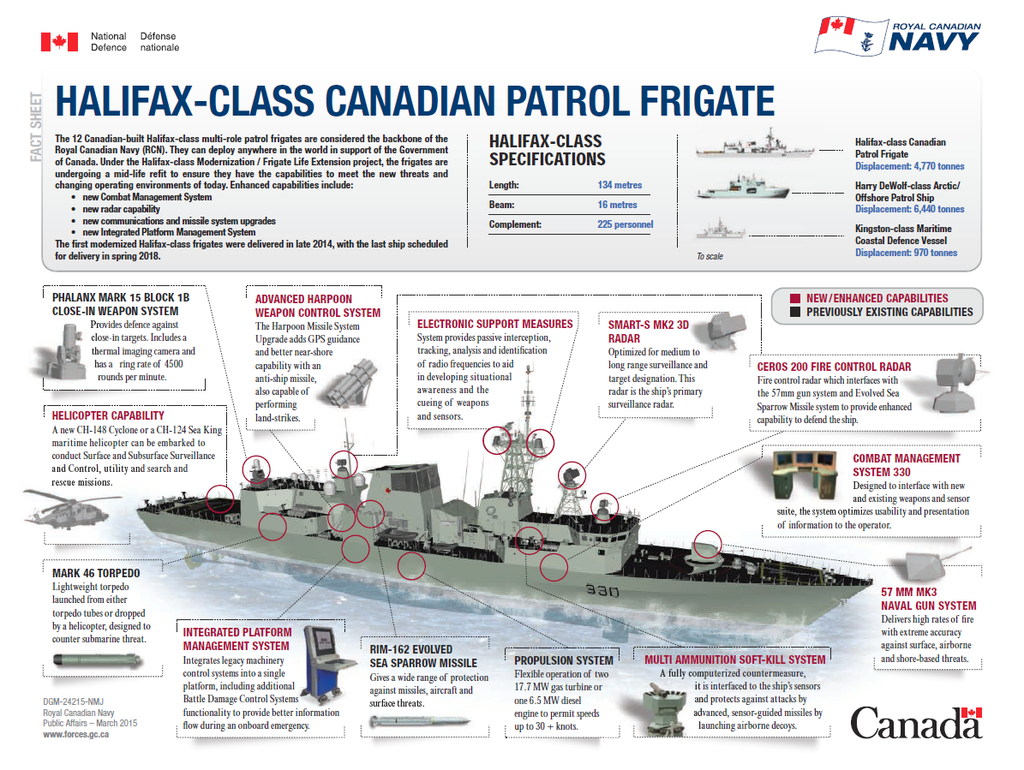
Click image to see full-sized. H/T to @RUSI_NS for the link.
December 18, 2015
Canadian Forces report $4.4 million in lost, stolen, and damaged items
Four point four million dollars might sound like a lot, but for an organization the size of the Canadian Forces (the largest department of the Canadian government), that’s actually a pretty reasonable figure. Embassy‘s Marie-Danielle Smith rounds up some of the highlights:
The Canadian Armed Forces are short more than $4.4 million worth of equipment stolen, damaged or lost—or discovered to have been lost — in the 2014-15 financial year, according to the government’s annual public accounts tabled in Parliament this month.
The Department of National Defence does not expect to recover much of this amount, says the document — there’s no Lost and Found for pistols or hammers.
In addition to more than $1.5 million in lost combat clothing alone, items that were stolen, damaged or lost included computers, machinery, technical equipment, transportation equipment, tools and weapons and accessories.
“DND and the CAF take all complaints and allegations of missing and stolen weapons seriously and all cases are investigated with due diligence by the proper authorities,” a spokesperson for the department, Ashley Lemire, said. “Every effort is made to account for weapons used in the performance of CAF mandates.”
Stolen items were worth $332,797. That’s a big jump from the year before, when a total of $44,568 in equipment was stolen from the Department of National Defence.
Part of the 2014-15 chunk includes the “theft of information technology equipment and computer peripheral” valued at $281,094.
Asked what type of equipment this is, or what exactly it is used for, Ms. Lemire said the information couldn’t be disclosed because the theft is currently before the provincial court of Ontario.
“As this matter is now before the courts, it would be inappropriate to discuss details that may affect the outcome of the court case,” she told Embassy in an email. The document says the department expects to recover the full cost in a future year.
Stolen items categorized as “tools” — only nine of them in 2014-15, worth $429 — included several types of knives, hammers, axes, cutter straps and rulers, Ms. Lemire said. Another 975 “tools” were reported lost.
December 17, 2015
The rise of the “transageist community”
Carl Trueman comments on what he calls the transageist community:
The case of Stefonknee Wolscht, the Canadian man who has decided that he is not simply a woman trapped in a man’s body but actually a six year old girl trapped in the same, has attracted some web attention. At first, I thought the story was a hoax but, no, it would appear that the lunatics have taken over the asylum and it is indeed true. Even if a sick joke, however, it would still offer insights into the inner logic of the politics of identity as currently played by the Left. Thus, for example, the U.K.’s Pink News reports that parts of the trans community are upset. Not, of course, at the harm done to Wolscht’s wife and children, those symbols of bourgeois oppression who are thus just so much collateral damage in the Glorious Revolution of the Self(ish). No. They are upset because his claim to be a different age “discredits their cause.”
A moment’s reflection would indicate that this condition, whereby a person is really a small child incarcerated within a much older adult body, is increasingly prevalent in today’s society. Recent events on the campuses of some of America’s top (sic) universities (sic) clearly show that the transageist community is rapidly growing in size, influence and belligerence. Still, as with all vanguard movements, some opposition is to be expected. The concerned reaction of sections of the transgender community is therefore understandable.
[…]
No doubt opponents will say that such a view will create chaos. Law courts must recognize an age of consent and an age of criminal responsibility; Schools need an objective standard of age to structure their curricula; And it is in everyone’s best interest that one-year-olds are not allowed to drive on the highways or drink Scotch or play in their cribs with loaded AK-47s. Well, yes, of course — but, please, do not shoot the messenger. I have not created the politics of repudiation which drives so much of the Left today. I am merely pointing out that its logic is inexorable. Those who accept its premises and yet seek to curb its power according to their own tastes are merely so many desperate postmodern Canutes, shouting impotently at the relentless waves of ecstatic nihilism that are even now crashing against the shore.
H/T to David Warren for the link.
December 15, 2015
Asthma and the “Hygiene Hypothesis”
An older report at the BBC News website discusses recent research into childhood asthma:
Being exposed to “good bacteria” early in life could prevent asthma developing, say Canadian scientists.
The team, reporting in Science Translational Medicine, were analysing the billions of bugs that naturally call the human body home.
Their analysis of 319 children showed they were at higher risk of asthma if four types of bacteria were missing.
Experts said the “right bugs at the right time” could be the best way of preventing allergies and asthma.
In the body, bacteria, fungi and viruses outnumber human cells 10 to one, and this “microbiome” is thought to have a huge impact on health.
The team, at the University of British Columbia and the Children’s Hospital in Vancouver, compared the microbiome at three months and at one year with asthma risk at the age of three.
Children lacking four types of bacteria – Faecalibacterium, Lachnospira, Veillonella, and Rothia (Flvr) – at three months were at high risk of developing asthma at the age of three, based on wheeze and skin allergy tests.
The same effect was not noticed in the microbiome of one-year-olds, suggesting that the first few months of life are crucial.
Further experiments showed that giving the bacterial cocktail to previously germ-free mice reduced inflammation in the airways of their pups.
One of the researchers, Dr Stuart Turvey, said: “Our longer-term vision would be that children in early life could be supplemented with Flvr to look to prevent the ultimate development of asthma
“I want to emphasise that we are not ready for that yet, we know very little about these bacteria, [but] our ultimate vision of the future would be to prevent this disease.”
December 12, 2015
QotD: The economic non-issue of a “federal minimum wage”
… the other new strategic wrinkle was much worse in that regard: the announcement of a policy for a restored “federal minimum wage.”
Provinces set minimum wages for most employees under the Constitution, but Ottawa has an unused right to set a national minimum in private industries regulated under Part III of the Canada Labour Code. The major categories are banking, interprovincial and international transport, and broadcasting. You may be wondering how many people in these technically complicated lines of business are actually making the minimum wage. In the most recent survey of the federal labour jurisdiction (taken in 2008), the answer arrived at by Statistics Canada was: 416 people. In the entire country.
The New Democrats were pretty clearly counting on the press to foul up the story, and it obliged. Some Postmedia newspapers, for example, wrote headlines implying that the new wage floor was for “federal workers.” Economists, who mostly dislike minimum wages anyway, will probably tear into the NDP for a misleading measure that, to a close approximation, helps nobody. And it probably won’t matter much, as New Democrats go on repeating the words “federal minimum wage” for a year.
Colby Cosh, “How to ignore the NDP’s new talking points”, Maclean’s, 2014-09-18.
December 11, 2015
“It’s fun to read a real scientific paper than says ‘bulls***’ 200 times”
Doug Bolton reports on a recent Canadian university study:
A new scientific study has found that those who are receptive to pseudo-profound, intellectual-sounding ‘bulls***’ are less intelligent, less reflective, and more likely to be believe in conspiracy theories, the paranormal and alternative medicine.
PhD candidate Gordon Pennycook and a team of researchers from the University of Waterloo in Ontario, Canada, tested hundreds of participants to make the link, detailing their findings in a paper entitled ‘On the reception and detection of pseudo-profound bulls***’, which mentions the word ‘bulls***’ exactly 200 times (surely some sort of record).
Defining bulls*** is a tricky task, but Pennycook and his team tried their best in the paper.
As an example, they gave the following ‘pseudo-profound’ statement: “Hidden meaning transforms unparalleled abstract beauty.”
The paper says: “Although this statement may seem to convey some sort of potentially profound meaning, it is merely a collection of buzzwords put together randomly in a sentence that retains syntactic structure.”
[…]
Almost 300 test subjects were asked to rate the profundity of these sentences on a scale of one to five.
The mean profoundness rating was 2.6, indicating the quotes were generally seen as between ‘somewhat profound’ and ‘fairly profound’. Around 27 per cent of participants gave an average score of three or more, however, suggesting they thought the sentences were profound or very profound.
In the second test, the team confronted the participants with real-life examples of bulls***, asking them to read tweets posted by Deepak Chopra, a writer known for his New Age views on spirituality and medicine, as well as using the computer-generated statements from the first test.
The results in this test were very similar, indicating many participants were unable to spot the bulls***.
December 9, 2015
December 7, 2015
Rescuing Yazidi captives from ISIS
Hannah James reports on Montreal’s “Jewish Schindler”:
From his office at The Prancing Horse — a high-end car and motorcycle dealership in Montreal — Steve Maman is scrolling through picture after picture of Yazidi women and girls he’s helped liberate. They were held as slaves in northern Iraq by fighters with the Islamic State group.
“You relive the emotions,” Maman explains as he looks through his files of dozens of women and children. “It’s anger. Right now I’m getting angry. That’s all it is. It builds anger. You get angry.”
In August 2014, IS militants raided villages in the Sinjar District of northern Iraq. It’s an area occupied by many Yazidis – a religious minority practicing an ancient religion, pre-dating Islam.
IS considers the Yazidis heretics, and set out to purge the villages of men, and to kidnap thousands of women and children to sell as sexual and domestic slaves.
Not long after the invasion of Sinjar, an IS video surfaced, showing a group of men laughing and joking about buying and selling Yazidi girls.
“Can you prove to her you’re a man?” one of the men asks another.
Maman, a car dealer specializing in luxury vintage automobiles, saw the news coverage of the massacres across Sinjar, and says he felt he had to take action. He calls his mission not a “choice” but “divine providence.” He says he’s inspired by his religious beliefs, and also by Oskar Schindler, the German businessman who rescued 1,200 Jews during the holocaust.
December 6, 2015
Does Canada have a “hero complex”?
At Spiked, Irene Ogrizek looks at Canada’s view on the Syrian refugee crisis:
The Syrian refugee crisis is testing the limits of public compassion. As Sweden and Germany struggle with overwhelmed infrastructures, some states in the US have simply said no to refugees. For those Americans, memories of 9/11 were revived by the Paris attacks, and a collective sense of hunkering down and sitting out the finger-pointing asserted itself. In Canada, our new prime minister, Justin Trudeau, promised to bring 25,000 refugees over before Christmas. He has since taken the advice of his advisers and come up with a more reasonable timeframe. Canada will accept 10,000 before Christmas and 15,000 in the two months following.
As a nation of immigrants, there is reflexive awareness around the issue of immigration in Canada. It evokes deep feelings of patriotism and provides an opportunity for collective and individual heroism. Even a cursory look at our mainstream media reveals the pressure to be heroic. ‘As a nation, we must step up to the plate’ and ‘Canadians are compassionate and sponsor refugee families’, are common refrains. As the refugee crisis has unfolded, this desire to be heroic has manifested itself in an attempt to conquer perceived public fears of terrorism – and migration’s alleged role in spreading it.
However, in this, our politicians and media outlets are being disingenuous. It isn’t terrorism per se that frightens Canadians, but the domestic loss of freedom that so often follows terrorist attacks — a freedom, as evidenced in our laissez-faire attitude to law enforcement, that Canadians cherish. No offence to Brits or Americans, but Canadians don’t want to live under constant surveillance or become vigilant, gun-toting citizens. We really do prefer our boring status quo.
So why is the template of heroism so important? Mythologist and author Joseph Campbell says the hero’s adventure is ‘one he is ready for’ and that the ‘landscape and the condition of the environment will match his readiness’. But what happens if there are no opportunities to prove oneself, especially in a country as sedate as Canada? The late New York Times columnist David Carr said of his drug-addicted young self: ‘Tucked in safe suburban redoubts, kids who had it soft like me manufactured peril. When there is no edge, we make our own.’ There is a similar edge to this explosion of pro-refugee altruism in Canada — and, just like Carr’s experience, it has its roots in intoxication.
December 4, 2015
Don’t bet on Quebec recapturing all that gambling money
Michael Geist on the Quebec government’s latest attempt to limit the freedom of Quebec internet users:
If there is a first rule of the Internet in Canada, it is “thou shall not block.” Canadian Internet service providers face a wide range of policies that have implications for accessing content including net neutrality rules and the copyright notice-and-notice system. Yet in virtually all cases, blocking or removing content is simply not done (the lone exception is a limited, private sector led initiative to block child pornography images).
My weekly technology law column […] notes that unlike other countries which have dabbled in mandated takedowns or Internet filtering, Canada has largely defended an “open Internet”. Canadian law does not mandate that Internet providers take down content due to unproven allegations of copyright infringement or allow them to alter or change content. In fact, the Telecommunications Act stipulates that “a Canadian carrier shall not control the content or influence the meaning or purpose of telecommunications carried by it for the public.”
Despite the clear legal mandate to avoid blocking, earlier this month the Quebec government introduced unprecedented legislation that would require Internet providers to engage in content blocking. The new bill targets unlicensed online gambling websites as part of the government’s efforts to increase revenues from its own online gambling service, which has thus far failed to meet expectations.
December 2, 2015
What did the ministry officials tell new minister Mélanie Joly about copyright?
Michael Geist commends the federal government for transparency when they published the briefing information provided to new Heritage minister Mélanie Joly, but points out that the information isn’t complete:
Last week, Canadian Heritage posted the Ministerial briefing book that officials used to bring new minister Mélanie Joly up-to-speed on the issues in her portfolio. The proactive release is a great step toward further transparency. While the mandate letter from the Prime Minister provides insight into government policy priorities, the briefing book sheds light on what department officials view as priorities and how they frame key issues.
The copyright presentation is particularly revealing since it presents Minister Joly with a version of Canadian copyright lacking in balance in which “exceptions are always subject to certain conditions” but references to similar limitations on rights themselves are hard to find. Department officials present a frightening vision of emerging copyright issues, pointing to mandated Internet provider blocking, targeting copyright infringement that occurs on virtual private networks, and “hybrid” legal/illegal services that may be a reference to Canadians accessing U.S. Netflix. The suggestion that Canadian Heritage officials have identified site blocking or legal prohibitions on VPN or U.S. Netflix usage as emerging copyright issues should set off alarm bells well in advance of the 2017 copyright reform process.
So what didn’t officials tell Minister Joly? The reality is that the Minister would benefit from a second presentation that discusses issues such as:
- the emergence of technological neutrality as a principle of copyright law
- how Canada may be at a disadvantage relative to the U.S. given the absence of a full fair use provision
- the growth of alternate licensing systems such as Creative Commons
- how term extension for sound recordings was passed even though the issue was scarcely raised during the 2012 reform process
- why extending the term of copyright (as proposed by the TPP) would do enormous harm to Canadian heritage.
Yet none of these issues are discussed in the briefing.
December 1, 2015
Hell’s Handmaiden – Canadian Flying Ace Billy Bishop I WHO DID WHAT IN WORLD WAR 1?
Published on 30 Nov 2015
William “Billy” Bishop was not only the top Canadian flying ace but also one of the most successful flying aces of World War 1. With 72 confirmed victories, he soon became the fear of the German Jagdstaffeln who actually put a bounty on his head and called him Hell’s Handmaiden. Surviving one of the bloodiest theatres of war, the sky above the Western Front, Billy Bishop’s skill made him a national hero.
A Canadian “Swatter”
Cory Doctorow on the intersection of adolescent rage and police militarization, complicated by an international border:
“Obnoxious” is the online name of British Columbia teenager who spent years destroying the lives of women who had the audacity to create popular, lucrative channels on Twitch in which they streamed their amazing video-game play.
Obnoxious would get their IP addresses, dox them, DDoS them, try to blackmail them into befriending him and then to performing on-camera sex-acts for him, he would order pizzas and other crap to their homes, and then he would swat them.
“Swatting” is when you call someone’s local police force and pretend that you are a crazed gunman/bomber in their house, so that the cops show up locked and loaded, fingers on the trigger. At best, you terrorize your victim and her family; at worse, you get the police to murder one or more of them.
Jerks and people with emotional problems have used bomb threats and similar methods for decades. I went to a school where one kid — who was already in and out of residential psychiatric facilities — would routinely call in bomb threats. The precautionary principle applied — we’d go stand on the lawn and the cops would search the building — but there was none of today’s auto-immune disorder, no MRAPs parked on the lawn and cops in Afghanistan-surplus military gear hup-hupping through hallways with their fingers on the triggers.
Shutting down “Obnoxious” proved to be nearly impossible. The jurisdictional problems of getting Canadian cops to care about crimes in America, combined with American cops’ ignorance of “cyber” and tendency to blame the victims (a cop told one survivor of repeat swattings was told to stop playing games and “just pick up a book” to avoid more trouble), combined with the diffused nature of the crimes meant that Obnoxious operated with near-total impunity as he attacked more and more women.


