
Protectionists always speak of tariffs and other import restrictions as impositions the burdens of which fall exclusively on foreign producers (usually, as in the case of antidumping cases, on foreign producers who have the audacity to sell their wares to us at prices that are especially low). And while domestic protectionist measures do indeed harm foreign producers, every protectionist measure is also – indeed, chiefly – a restriction on the freedom of domestic consumers to spend their money as they choose. Tariffs, antidumping duties, and all protectionist impositions make domestic citizens less free (by closing off areas of voluntary exchange that they would otherwise choose to engage in) and less prosperous (by diminishing the volume of goods and services available in the domestic market for people to consume).
Protectionism is rank economic idiocy and an unquestionable assault on liberty. And it becomes no smarter or prettier just because it is costumed in moralistic language (such as “fair trade” or “leveling the playing field”) or is pushed by your preferred political party rather than by some other political party.
Don Boudreaux, “Quotation of the Day…”, Café Hayek, 2016-12-06.
November 10, 2018
QotD: Protectionism helps domestic producers but hurts domestic consumers
November 7, 2018
Quebec cabbies sue provincial government for declining revenues and lost capital cost due to Uber competition
William Watson makes the argument that it’s the ripped-off taxi customers who should be suing, not the cabbies:
There are at least two problems with the court case, one technical, one regarding fairness. The technical one: Cabbies want compensation for both declining revenue and the capital loss on their permits. But that’s double-counting. The permit is an entitlement to earn the revenues. Its value falls only because expected revenues have fallen. Give operators one or the other, if the law eventually says you must, but not both. They can have their compensation but not eat it, too.
The fairness question concerns where the taxi cartel’s surplus came from all these years, which is no mystery: It came from taxi users. But what are we, chopped liver? Why don’t we start a class action suit of our own to get back all the money ripped off from us over decades of artificially restricted taxi supply?
Basic fairness would certainly require that. Unfortunately, the law may not. The taxi drivers’ case against the government is that, despite statutes on the books about needing a taxi permit in order to provide taxi services, when Uber came along the government decided not to enforce the law. That created two classes of taxi driver: Uber drivers, whom the government turned a blind eye to, and regular taxi drivers, whom it continued to subject to close regulation. That double standard was an unfairness, yes, but a minor one compared to the long-lasting aggravated rip-off of consumers.
Bottom line: Taxi drivers lobby for and get a law allowing them to overcharge their customers. When in a bout of good policy sense (a “Taxi Spring” you might say) the government decides not to enforce it, the taxi drivers set about suing taxpayers instead. However unfair that may seem — and it’s exasperating! — I suppose, in the end, supply-and-demand must take notice of the principle of rule of law.
November 4, 2018
QotD: LEED indulgences
I am not religious but am fascinated by the comparisons at times between religion and environmentalism. Here is the LEED process applied to religion:
- 1 point: Buy indulgence for $25
- 1 point: Say 10 Our Fathers
- 1 point: Light candle in church
- 3 points: Behave well all the time, act charitably, never lie, etc.
It takes 3 points to get to heaven. Which path do you chose?
Warren Meyer, “When Sustainability is not Sustainable”, Coyote Blog, 2013-07-30.
November 2, 2018
Operation Choke Point
In Forbes, John Berlau details how expansive regulatory powers and vindictive bureaucrats make doing business in the United States less “free enterprise” and more “shame if something were to happen to it”:
Every Halloween, there exists the temptation for bloggers, pundits, and commentators to describe routine events in the news with adjectives like “scary” and “frightening.” Sensitive to sounding clichéd or inflammatory, I try usually to avoid using such terminology in my descriptions of the policy process.
Yet after reading through new documents introduced into a lawsuit stemming from the Obama administration’s “Operation Choke Point,” I find that “scary” and “frightening” actually fit. These documents show that powerful bank regulatory agencies engaged in an effort of intimidation and threats to put legal industries they dislike out of business by denying them access to the banking system.
While I am often outraged about things the government does, now I am truly scared and frightened about the ability of government bureaucrats to shut down arbitrarily whole classes of businesses they deem to be “politically incorrect.” As one who champions the FinTech sector and the benefits it can bring, I also worry that such powers may be uses to shut down innovative new industries, such as cryptocurrency, that carry some perceived or real risks.
Choke Point was a multi-agency operation in which several entities engaged in a campaign of threats and intimidation to get the banks that they regulate cut off financial services – from providing credit to maintaining deposit accounts — to certain industries regulators deemed harmful a bank’s “reputation management.” The newly released documents – introduced in two court filings in a lawsuit against Choke Point — show that the genesis of Choke Point actually predated Barack Obama’s presidency, and began when President George W. Bush was in power.
[…]
When the Obama administration came into power, the FDIC would expand the definition of “reputation risk” even further, and other federal agencies, bureaus, and departments would soon jump on the proverbial bandwagon. Much of Operation Choke point would again be accomplished by “guidance documents,” which my Competitive Enterprise Institute colleague Wayne Crews refers to as “regulatory dark matter,” since they have legal force but allow regulators to bypass the sunlight of the notice-and-comment process of a formal rule.
In 2011, an FDIC guidance document featured a chart of business categories engaged in what it called “high-risk activity.” These included “dating services,” “escort services,” “drug paraphernalia,” “Ponzi schemes,” “racist materials,” “coin dealers,” “firearm sales,” and “payday loans.” The FDIC would post this and similar lists in other guidance documents and on its web site.
A staff report of the House Government Reform and Oversight Committee puzzled over many of these categories. “FDIC provided no explanation or warrant for the designation of particular merchants as ‘high-risk,’” the report observed. “Furthermore, there is no explanation for the implicit equation of legitimate activities such as coin dealers and firearm sales with such patently illegal or offensive activities as Ponzi schemes, racist materials, and drug paraphernalia.”
November 1, 2018
Change appears to be inevitable for North American railways
In a recent column in Trains, Fred Frailey examines the long-term impact of the late Hunter Harrison’s railway management reforms:

Union Pacific locomotive 5587, a General Electric AC4400CW-CTE(AC44CWCTE)
Photo by Terry Cantrell via Wikimedia Commons.
In the year since Hunter Harrison’s death, Precision Scheduled Railroading, or PSR, has progressed from crackpot railroading (in the eyes of some railroaders and shippers) to the gold standard. And it happened so fast we are still trying to wrap our arms around what it means for the future of this industry.
The facts are these: Canadian National, Canadian Pacific, and CSX Transportation have been put through Harrison’s PSR wringer, emerging in every case much leaner in terms of productive assets — cars, locomotives, trackage, and employees. That meant tons of savings to hand to investors. Interesting to me is what happened after that. CN, which Harrison ran as president or CEO from 1998 through 2009, went on a growth spurt in that period that continues to this day. Revenue ton miles at CN — the most basic measure of what a railroad does — rose 48 percent between Harrison’s retirement in 2009 and 2017. So it’s clear that downsizing the railroad’s assets didn’t inhibit Canadian National’s growth, because no other railroad even approaches what it accomplished during this period. Revenue ton miles rose slightly during Harrison’s tenure at Canadian Pacific and are now rising faster. His successor there, Keith Creel, says CP is game to grow. That’s the same story coming from Jim Foote, who succeeded Harrison late in 2017 at CSX.
Harrison’s impact on the other railroads of North America is palpable. The man was scarcely buried before financial analysts forgot the chaos he unleashed in his hurry to implement PSR at CSX and began asking other railroads why they weren’t more like CN, CP and CSX. Union Pacific, the oldest surviving nameplate in American railroading, capitulated and began implementing PSR practices last October on the eastern part of the railroad, with a goal of expanding the transformation to the entire system within several years. Chief Executive Lance Fritz insists this isn’t a case of PSR Lite.
[…] To change the railroad, you must change the culture. Harrison did it in every instance by force majeure — if you didn’t embrace his plan, goodbye. Who will change the culture at Union Pacific? I am at a loss to know. My sources say the impetus for PSR came not from within the railroad, but from the board of directors, which puts Lance Fritz in a thankless position. He must lead the effort, but this isn’t his idea, and morale in management ranks is low to begin with. His chief operations officer is new to the job, and nothing in the man’s background shouts to me that he is up to this.
Yet there are a lot of smart people at Union Pacific, and no company of its stature launches something of this magnitude with a will to fail. I am heartened that UP began by pruning its management ranks — in 2017 it counted 3,678 executives, officials and staff assistants, versus BNSF’s 1,511. (In fairness, BNSF outsources its information technology, whereas UP does not, accounting for some of the difference.) UP revealed in late 2018 it would eliminate 500 nonunion jobs by year’s end, plus 200 contract workers.
But let’s face it: As done by Harrison, you begin the PSR process by stripping a railroad to its underwear. At CSX it meant cutting every conceivable cost, denuding the railroad of field supervisors and just about everything else, until it began to be dysfunctional. That’s when he knew he had cut enough and could add back assets to make the railroad workable. This method is like becoming pregnant; there is no half way. Union Pacific began Precision Scheduled Railroading with a go-slow approach, not wanting to punish shippers and arouse regulators. Hmm. The way to looks to me now, UP may achieve some good financial results but not the sort that Hunter Harrison could or that its directors might expect. It would be a lot easier for UP to simply buy Canadian Pacific and let Keith Creel, a Harrison acolyte who knows PSR inside and out, come in as an outsider and do the dirty work. And if the process will be hard for Union Pacific, imagine the barriers to PSR in front of BNSF, KCS, and NS, all under pressure to walk the walk but so far unwilling to do so.
The Living Wage Makes It Harder to Make a Living
Foundation for Economic Education
Published on 11 Oct 2018We take big risks with people’s livelihoods when we make demand about what people should be paid. The reality is, people don’t necessarily need a “living wage” to make a living.
October 31, 2018
Premier Ford’s promise to lower electricity rates in Ontario
In the Financial Post, Lawrence Solomon says Doug Ford can’t risk abandoning his promises about Ontario electricity costs, despite his cabinet’s worries about provincial reputation damage:

Ford has every reason to return the power system to some semblance of economic sanity. Ontario is now burdened by some of the highest power rates of any jurisdiction in North America, throwing households into energy poverty and forcing industries to close shop or move to the U.S. The biggest reason by far for the power sector’s dysfunction is its renewables, which account for just seven per cent of Ontario’s electricity output but consume 40 per cent of the above-market fees consumers are forced to provide. Cancelling those contracts would lower residential rates by a whopping 24 per cent, making good on Ford’s promise to aid consumers.
[…]
To date, Ford has stopped renewable developments that haven’t been completed, which will prevent things from getting worse, but he has failed to tear up the egregious contracts of completed developments, which will prevent things from getting better. Based on conversations that I and others have had with government officials, it appears that Ford is inclined to cancel the contracts and honour his signature promise, but he is being thwarted by cabinet colleagues who fear that Ontario’s reputation will take a hit in the business community if they don’t play nice.
Except, there’s nothing nice about betraying a promise to the voters who democratically put you in power in order to avoid pressure from lobby groups who think governments are entitled to hand out sweetheart deals to their favoured cronies. There’s also nothing democratic about it. It is an axiom of parliamentary government that “no government can bind another.”
Canadian governments, including Ontario governments, have in the past torn up odious contracts, including those in the energy sector. When they did, upon passing binding legislation, they were able to reset the terms, offering as little or as much compensation as they wished. Outraged business lobbies’ claims that the reputation of governments would be affected were not borne out. Moreover, such rightings of political wrongs serve the interest of small government and free markets, because businesses have always understood that there’s an inherent risk in contracting with governments that are able to unilaterally rewrite contracts. To overcome that inherent risk, businesses add a risk premium when getting in bed with government, helping to explain the rich contracts the renewables developers demanded. That risk premium acts to make business-to-business dealings more economic than business-to-government dealings.
October 30, 2018
The plight of Gab
Unlike other social media platforms that have hosted (and continue to host) legal-but-“hateful” content, Gab has suffered a de-platforming and is currently scrambling to get the service operational with a new service provider (reported to be a non-US site). On Monday, the Gab team posted the following static page in place of their normal UI:
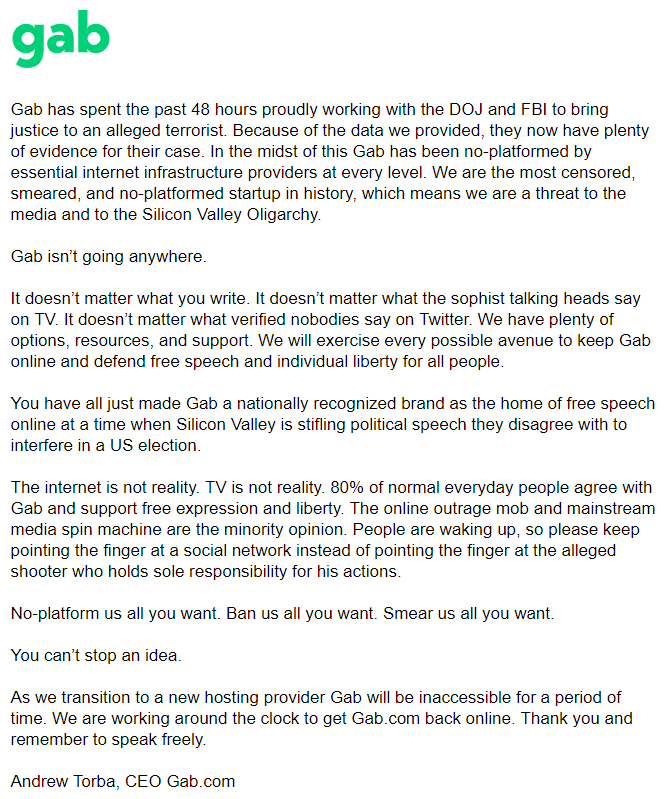
The Z Man explains:
The question that normal people ask is how this is possible. After all, these companies sign contracts and in theory, we still have courts where contracts can be enforced by impartial judges. While that is a laughable fiction now, the reality is these companies are not bound by standard business agreements. They have been allowed to carve out new law for themselves, forcing their vendors and customers to sign off on what is called an adhesion contract. This gives the tech giants absolute power over everyone else.
An adhesion contract or “standard form contract” is a contract drafted by one party and signed by another party. The second party typically does not have the power to negotiate or modify the terms of the contract. Adhesion contracts are commonly used for things like insurance or rental contracts. When you rent a car or purchase car insurance, you just sign the contract, because you have to in order to rent the car or get insured. Every technology service provider is now basing their relationships on these types of contracts.
It used to be that the courts carefully scrutinized these types of arrangements, so the contract had to adhere to some basic principles. The courts would often use the “doctrine of reasonable expectations” to void all or part of these contracts, when there was lack of notice, unequal bargaining power, or blatant and substantive unfairness. The reason for this should be obvious. When a powerful company has the right to dictate the terms of the contract to their customers, they have all the power in the contractual relationship.
In western jurisprudence, a valid contract is one in which both parties freely engage and have equal opportunities to negotiate. When one party imposes the conditions on the other, that’s not a contract. That’s slavery. In a world where a handful of people control the public space, these types of contract give them arbitrary power over public discourse. If they become vexed with what you say, they can claim you have violated their terms of service and remove you from the internet. Again, the terms are dictated, not negotiated.
October 29, 2018
The $15 Minimum Wage Is Turning Hard Workers Into Black Market Lawbreakers
ReasonTV
Published on 11 Oct 2018An in-depth look at New York’s car wash industry, and the real world consequences of politicians interfering with a complex industry they don’t understand.
Reason is the planet’s leading source of news, politics, and culture from a libertarian perspective. Go to reason.com for a point of view you won’t get from legacy media and old left-right opinion magazines.
—————-
On March 4, 2015, a group of union leaders, activists, and elected officials were arrested for blocking traffic during a protest in front of a Vegas Auto Spa, a small car wash in Park Slope, Brooklyn. Chanting “No contract, no peace!” and “Si se puede!,” they had come in support of striking workers, who had walked out demanding a union contract after allegedly being subjected to dismal working conditions.
For David Mertz, the New York City director and a vice president at the Retail, Wholesale and Department Store Union (RWDSU), it was an inspirational moment in an ambitious six-year campaign to unionize the city’s car washes industry.
“These workers were willing to stand out there during one of the coldest winters … literally in decades to fight for their rights and for basic human dignity,” says Mertz, who was also arrested that day. “You have the ability to make change by coming together, and when you do that sometimes you find that you’ve got some friends on your side.”
In the past six years, the car wash industry, which employs low-skilled, mostly immigrant workers, has also been the target of lawsuits for alleged underpayment of wages, including a handful of cases spearheaded by the New York State Attorney General’s office. Working conditions in the industry were also cited as a raison d’être in the successful campaign to raise the state minimum wage to $15 per hour, which takes full effect at New York City car washes in January of 2019.
As Reason chronicled in a feature story in our July 2016 issue, the real world impact of the unionization drive, the lawsuits, and the $15 minimum wage has been mainly to push car washes to automate and to close down.
Two years later, there are more unintended consequences. The $15 minimum wage is fostering a growing black market—workers increasingly have no choice but to ply their trade out of illegal vans parked on the street, because the minimum wage has made it illegal for anyone to hire them at the market rate.
The minimum wage is also cartelizing the industry: Businesses that have chosen to automate are benefiting from the $15 wage floor because outlawing cheap labor makes it harder for new competitors to undercut them on price and service.
As a sequel to the 2016 article, this video takes an in-depth look at the real world consequences that result when politicians interfere with a complex industry they don’t understand, enabled by media coverage that rarely questions the overly simplistic tale of exploited workers in need of protection.
Written, shot, edited, and narrated by Jim Epstein.
October 27, 2018
The Progressive case for Americans to pay higher drug prices than the rest of the world
Tim Worstall carefully explains — in full compliance with Progressive philosophy and pointing out that Trump is wrong (which is extra bonus Progressive points) — why Americans should continue to pay more for drugs that are cheaper in other countries:
Working out which drugs work and how is expensive. There’s then another expensive in actually proving this well enough to gain a licence. All in costs are in the $1 to $2 billion range dependent upon who you want to listen to. Unfortunately, once you’ve done all that and paid all that anyone could just come along and copy your drug. Which means you don’t make your $2 billion back – that in turn meaning that no one does spend $2 billion, we don’t get new drugs and we all die in ditches.
This is a classic public goods problem and the solution we use – not the only one, not even the only viable one – is patents. You get about 10 years, the time between approval and patent expiry, to make your $2 billion back. Then anyone can copy it and we all get cheap copy drugs.
For this system to work it is not necessary that everyone pay these high patent protected prices. There’s no point in trying to charge some farm worker in S Africa $10,000 a year for HIV retrovirals anyway, they don’t have the cash and demanding it will gain nothing except their death. We just need some group to pay the high prices so that drug development still happens. Everyone else can get drugs at some margin above their manufacturing, not development, costs.
So, who is it who should be carrying this cost of producing this public good? Good progressive principles tell us that it should be the rich folk. Imagine that we used some other system of drug development, maybe taxpayers cough up for it all. It’ll still be the rich doing the paying, right? So, patents, where the rich pay full freight for drugs, the poor don’t, this meets our equity criterion.
And who are the rich in this global sense, for we’re talking about a global public good here? That would be the citizens of the richest large nation, the largest rich nation, the United States of America. So, yes, Americans should be paying high prices for drugs and the rest of us shouldn’t.
Do note that we’ve used impeccable redistributionist logic to reach this conclusion. It’s only if you think the rich shouldn’t be paying to benefit the poor that this is a bad idea. Which might be why Trump is agin it but it still puzzles as to why the progressives would be.
QotD: The gender pay-gap
If you mean the pay gap that exists between women, anybody with an ounce of statistical sense knows that it is insignificant when it comes to actual equivalent jobs with equivalent requirements. Once you factor in that women are statistically more likely to take time away from their careers for child rearing and factor that in, the pay difference is statistically insignificant. Unless you work in the Obama White House, because fuck you is why.
Men also tend to work more in dangerous or physically demanding jobs by choice, which also pay better. Nobody forces them to go into those fields. Men also get more STEM degrees and women get more LAS degrees. STEM pays better. Nobody is forcing these men to do math, but men and women are different. If you don’t understand why my accounting degree is more valuable that your gender studies degree, you don’t understand basic econ 101 and supply and demand. So yes, I would like fries with that.
If you mean the gender gap in voting between the parties, just about every psychological study ever conducted by somebody not huffing paint understands that women tend to make decisions more emotionally and men tend to make them more logically. I see you reaching for you Sexist Card, but I said tend. This is not always the case, it is simply a trend. If you don’t like it or find that sexist, you can fuck off and die. Men and women are different. Most of us happen to like that. Some men think more emotionally (like pajama boy metrosexual hipster douchebags for example), and some women think more logically (like hot republican warrior babes), but a trend is a trend.
Larry Correia, “Run Forrest Run!”, Monster Hunter Nation, 2014-11-05.
October 22, 2018
The right to repair
Companies have always tried to corral their customers into behaving in ways that maximize the companies’ profits, even if that’s not best for the customers: forcing you to use “official” printer ink, to buy your printers and terminals from the same company that sold you your mainframe, to get your apps from the company that sold you your phone.
One especially effective profit-maximization strategy is controlling repairs. If a company can force you to use its official repair services, they can set prices for parts and service, and force you to use original manufacturer’s parts, rather than third-party parts or refurbished parts. And, of course, they can refuse to repair a product after a certain number of years: in the absence of a third-party repair option, this means that you have to throw away your product and buy another one from the company.
Though the urge to control customers to maximize profits is as old as business, the digital era has seen an important shift in the tactics used to make business models mandatory. The abuse of laws like Section 1201 of the DMCA (which bans breaking DRM), the Computer Fraud and Abuse Act (which lets companies treat their “license agreements” as though they had the force of law), as well as trade secrecy and monopolistic supply-chain control has literally criminalized many forms of independent repair, and it’s getting worse.
Last year, 18 state level Right to Repair bills were crushed by a big business coalition led by the tech industry. These bills would end companies’ war on independent service by forcing them to supply parts, manuals, and diagnostic codes to independent technicians.
October 19, 2018
Ontario’s lack of retail cannabis stores – “What have they been smoking at Queen’s Park?”
In the Financial Post, William Watson points out the weirdness of Ontario’s decision to delay the opening of legal cannabis stores until next Spring:

For several years now, dozens of dispensaries have been operating quite openly. (They call themselves dispensaries to further the narrative that, like your grandmother’s rye, marijuana is for medicinal purposes.) Only now, with pot use becoming legal, are these dispensaries being shut down — although Toronto’s chief of police says not right away, as he doesn’t have [the] person power to do it all at once.
If they don’t shut down, they may forfeit their chance at a licence to sell pot legally once licensed retail operations do finally start in the province on (when else?) April 1st of next year — 166 days after legalization. Why would they not be granted a licence? Not because they trafficked in marijuana when its use was strictly illegal, if seldom prosecuted. But because they continued to traffic in marijuana after it became legal but before the government gave them a licence, an offence that will be prosecuted slowly, if at all.
Silly me. I thought marijuana legalization would simply say that after a certain date the police wouldn’t arrest you for having such-and-such an amount of marijuana in your possession. End of story.
[…]
Countrywide, as the Financial Post’s Vanmala Subramaniam recently reported, a big roadblock to timely legal supply has been the need to seal products with federal excise revenue stamps. But there’s only one supplier and the stamps come without adhesive. Stamps! In 2018!
In American movies of the 1930s and 1940s, moonshiners and bootleggers waged war against “revenuers,” federal agents charged with levying excise taxes on booze. It seems the revenuers have now taken charge of Canada’s marijuana industry. You might plausibly argue that the former illegal market operated in the interests of consumers. There seems little doubt the new legal market will operate in the interest of governments, their unions and their revenue departments.
When cops did enforce the country’s no-toking laws, they could plausibly tell themselves they were doing it to protect young people and other innocents. Now when they enforce the laws they’re doing it to protect legally privileged producers against producers who find themselves offside with often arbitrary licensing laws. Protecting kids was one thing. Protecting cartels is quite another.
October 16, 2018
Fast food outlets cluster in poorer areas – because they’re low-margin businesses
Tim Worstall debunks the “fast food restaurants are preying on the poor” myth:
Contrary to the musings of Rod Liddle in the Sunday Times there is a cause and effect going on over the placings of fast food restaurants or outlets in British towns. The provision of burnt chicken and maybemeatburgers to the hoi polloi is a hugely competitive business. This means that it is also low margin. So, where do you put the places that are in a low margin line of business?
[…] this is about clustering of those nosh joints. Why are they in the poor areas? Well, for the same reason the poor are in the poor areas. They’re cheap. This being rather the defining point about poor people, they look for cheap places to live. The two are therefore synonymous, poor and cheap. And what is it we’ve just said about nosh? That it’s a low margin business. Therefore purveyors of the deep fried and battered saveloy – that joy of the ages – are going to be clustered in the poor part of town where they can afford the rents.
And that’s our cause and effect. Some poor people are poor because they’re, or have been, ill. They’re in the cheap part of town because they’re poor. Fried gut shops are in poor areas because they don’t make much money therefore they’re in the poor part of town. Absolutely any analysis of the phenomenon which doesn’t account for this is wrong. And no analysis done by anyone does take account of it – therefore all current analyses of the point are indeed wrong.
There are also other factors to consider, including the fact that poor people are less likely to have the ability or facilities to prepare their own meals (or the habit of cooking for themselves), so the easy availability of high-calorie fast food or snacks is rather important to them. When you’re hungry and don’t have a fridge or freezer full of food at home, a burger or fried chicken has a much stronger appeal than it does to more wealthy folks with well-stocked pantries. If you’ve been raised on high-fat/high-salt foods, the “healthier” alternatives may not appeal, as they also are less flavourful than their fast food options.
October 13, 2018
On the cusp of legalization
Colby Cosh finally gets to take a victory lap:
On Thursday the marijuana company Sundial Growers held a ribbon-cutting for its new grow-op in the Alberta town of Olds. I am not sure whether “grow-op” is an acceptable word in the new setting of giant legal cannabis cultivation facilities, but let’s stick with it, if only to call attention to the extraordinariness of what we are witnessing this month in Canada. The launch was held in a small office, and Sundial only received its cultivation licence from Health Canada on Sept. 14, but the first fruits of its pot business are already budding in a room nearby.
The company intends to have a 500,000-square-foot growing facility built in 2019, but its press release points out that it can add more space quickly. I might have been stopped short by the spectacle of the mayor and the (United Conservative) MLA rejoicing as a CEO explained the details of his craft weed business and remarked on plans for a “Sweet Jesus” varietal. But what really struck me is something the mayor said: When the company is up and fully running, he observed, it is going to hire 500 people in Olds, becoming the town’s largest single employer. Olds is, of course, home to Olds College, a century-old agriculture and food research institute: this was a major reason for the new marijuana industry to locate there.
How long ago would this scene — being played, as it is, in a naturally conservative part of the Alberta hinterland — have seemed like science fiction or parody? The Sundial facility is dwarfed by the 800,000-square-foot Aurora Sky factory, strategically located near Edmonton’s awkwardly remote international airport in the suburb of Nisku. Everyone who has ever tried to flee Edmonton or come to it through that airport has complained about its preposterous distance from the capital’s downtown, but this turns out to have an unimagined advantage. You can build a spacious agri-pharmaceutical facility at low cost practically next to the runway, establish an ultra-secure, ultra-short supply chain, and presto hemp-o: overnight response to a worldwide medical market for cannabis products becomes a snap.
I am someone who is entitled to a victory lap for having insisted years ago that we were not, as a country, properly imagining the dimensions of a legally unleashed cannabis industry. We had no idea how much economic activity was being annihilated by a perverse, illogical feature of criminal law. Maybe it is time, as Finally Doing The Obvious Thing Day nears, for me to take that victory lap.


