IT’S HISTORY
Published 17 Aug 2015With the dynasties of the Ming and the Qing came social security and flourishing international trade. The White Lotus Movement advocated progressive thinking in the time of the conservative Ming dynasty. In 1616 the Qing dynasty came to power. Also known as the Manchu dynasty, the Qing refused to open their borders to limitless trade which led to frustrated European merchants. This caused hostility and mistrust of the “barbaric Chinese”. Shortly thereafter China’s economy lost its race against European Colonialism and would lose military influence after gunpowder reached Europe. All about the fall of the former Chinese superpower in this episode on IT’S HISTORY!
» SOURCES
Videos: British Pathé (https://www.youtube.com/user/britishp…)
Pictures: mainly Picture Alliance
Content:
Twitchett, Denis and Loewe, Michael. The Cambridge History of China. Cambridge University Press.
Wilkinson, Endymion, Chinese History: A New Manual. Harvard University, Asia Center
Loewe, Michael; Shaughnessy, Edward L. The Cambridge History of Ancient China. Cambridge University Press
John M. Roberts A Short History of the World. Oxford University Press
Xu, Pingfang The Formation of Chinese Civilization: An Archaeological Perspective. Yale University Press.
Fairbank, J. K.; Goldman, M. China: A New History. Harvard University Press. ”» ABOUT US
IT’S HISTORY is a ride through history – Join us discovering the world’s most important eras in IN TIME, BIOGRAPHIES of the GREATEST MINDS and the most important INVENTIONS.» HOW CAN I SUPPORT YOUR CHANNEL?
You can support us by sharing our videos with your friends and spreading the word about our work.» CAN I EMBED YOUR VIDEOS ON MY WEBSITE?
Of course, you can embed our videos on your website. We are happy if you show our channel to your friends, fellow students, classmates, professors, teachers or neighbors. Or just share our videos on Facebook, Twitter, Reddit etc. Subscribe to our channel and like our videos with a thumbs up.» CAN I SHOW YOUR VIDEOS IN CLASS?
Of course! Tell your teachers or professors about our channel and our videos. We’re happy if we can contribute with our videos.» CREDITS
Presented by: Guy Kiddey
Script by: Guy Kiddey
Directed by: Daniel Czepelczauer
Director of Photography: Markus Kretzschmar
Music: Markus Kretzschmar
Sound Design: Bojan Novic
Editing: Markus KretzschmarA Mediakraft Networks original channel
Based on a concept by Florian Wittig and Daniel Czepelczauer
Executive Producers: Astrid Deinhard-Olsson, Spartacus Olsson
Head of Production: Michael Wendt
Producer: Daniel Czepelczauer
Social Media Manager: Laura Pagan and Florian WittigContains material licensed from British Pathé
All rights reserved – © Mediakraft Networks GmbH, 2015
March 2, 2020
Downfall of the Superpower China – Ming and Qing Dynasty l HISTORY OF CHINA
February 24, 2020
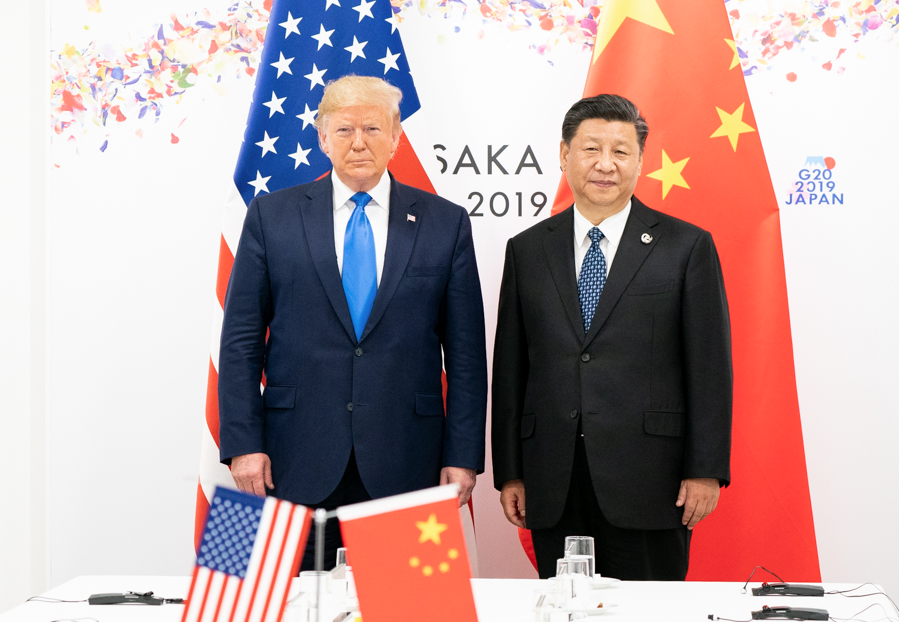
Canadian-American relations (and Canadian foreign relations in general) in the 21st century
Ted Campbell looks at the undisputable fact that Canada barely matters in Washington DC, and that this has been true since the end of the first Bush administration. He discusses a recent Globe and Mail article by David Mulroney which examines the need for the Canadian government to formally rethink “Canada’s role in the world” in that light:

Justin Trudeau meets with President Donald Trump at the White House, 13 February, 2017.
Photo from the Office of the President of the United States via Wikimedia Commons.
Mr Mulroney sees two major problems that confront Canada fifty years after A Foreign Policy for Canadians was published:
- First, he says, “Canada is again dealing with a threat to our autonomy from a major power, but this time, it comes not from the United States, but from the new world that was coming into being 50 years ago. The threat is now China, which is using its economic power to influence and silence us, is undermining our national security, and is challenging the rules-based international system that the review itself championed;” and
- Second, “we again need to face up to the consequences of our diminished status, but this time much closer to home. Fifty years on, the problem isn’t that the United States wants to dominate us, but that it has largely forgotten us. While it is tempting to blame this on the chaos of the Trump era, the painful reality is that the relationship has been in decline for some time, something that was manifestly evident in the cool detachment that marked Barack Obama’s management of relations with Canada.”
I think that second is, actually, more serious than the first. I believe we can wrap our collective mind around the fact that China doesn’t like us, that it regards us as an irritant and that it is using us as a whipping boy to send a message to its other, more important, trading partners. What has been harder to grasp is that Ameria no longer cares. It isn’t just Donald Trump, it was even just Barack Obama. George W Bush didn’t care either. Despite the great debates in Canada, it seems clear that President Bush never even asked for our help in either Afghanistan or Iraq, the “pressure” to do something to stand with the USA was entirely self-generated within Canada’s own foreign affairs and defence establishments. Bush, Chaney, Rumsfeld and Myers (the latter was Chairman of the Joint Chiefs of Staff from 2001 to 2005) were, possibly, grateful for the help on the ground, when they noticed it at all, but quite uninterested in Canada’s views on any of the issues concerned. Nor did Bill Clinton care about our views on or our actions in e.g. the Balkans. We, as a country, and our leaders, Jean Chrétien, Paul Martin, Stephen Harper and Justin Trudeau, did not and do not count for anything in Washington. Neither Chrystia Freeland nor Erin O’Toole nor any other Canadian prime minister, Conservative or Liberal, will fare any better. The last time Canada mattered was when Brian Mulroney and George H W Bush renegotiated the Canada-US Free Trade deal, making it into NAFTA, over a quarter-century ago. And the end of the halcyon days of Canada-US relations came a full decade before that, in the Mulroney-Reagan years. That can only change if Canada makes itself matter.
[…]
We, Canadians, must accept ~ and millions will not want to accept this ~ that, as Mr Mulroney says, “International influence … [and that includes influence where it counts most, with the USA] … is enabled by a strong economy, robust national infrastructure and institutions, and the willingness to invest in national defence and security.” One of the impacts of Pierre Trudeau’s policies was to divert spending from National Defence to social spending. That was immensely popular with many, actually with most Canadians … something for (a perceived) nothing always is. None of Brian Mulroney, Paul Martin or Stephen Harper, all of whom, it seemed to me, wanted to reverse course and act responsibly were able to change what Pierre Trudeau had put in place. The political price was suicide. But it has been fifty years and Canada is at risk of being totally irrelevant in an increasingly complex and dangerous world.
David Mulroney’s second challenge ~ recovering “the confident elaboration of national identity,” is, I suspect, much more difficult, especially given the “post-national state” quasi-intellectual rubbish that Justin Trudeau says was part of “his father’s vision.” It’s lunacy, of course, but it’s the sort of lunacy that appealed to many in the 1960s and appeals, again, a half-century later.
While I don’t disagree with Mr. Campbell’s analysis (and that of David Mulroney), I think getting our domestic house in order is the top priority, and the current Trudeau government does not appear to be doing much constructive on that sheaf of issues. With the very rule of law threatened at home, there’s little to no point in casting our eyes across the 49th parallel or overseas: we need to address the breakdown of internal governance first.
February 23, 2020
China’s government and the coronavirus epidemic
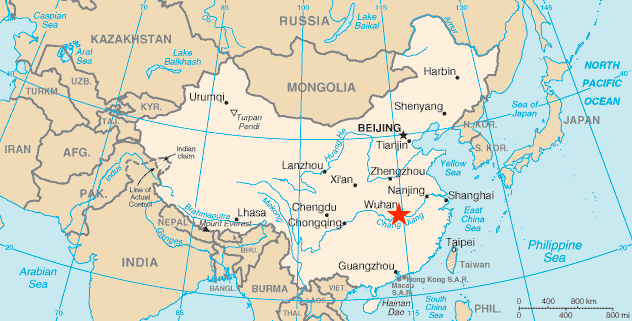
In Quillette, Aaron Sarin shows how the Chinese government has systematically failed to respond adequately to the epidemic which broke out late in 2019in Wuhan and risks “losing the Mandate of Heaven”:
As of this writing, the epidemic’s death toll is still rising, and many of these deaths can ultimately be traced to the paranoid rigidity of the Xi Jinping administration. By late December 2019, doctors in Wuhan were already sounding the alarm over cases of what appeared to them to be SARS. Instead of listening to their warnings, the authorities summoned eight of these doctors for a dressing-down. They were warned of the punishments they could face for “rumour-mongering.” News of their detention was broadcast to tens of millions: a clear message to anyone else who might have been thinking about discussing viruses in public.
The Party’s leaders actually knew enough to be worried by this point — they alerted the World Health Organisation on December 31st — and yet still they hid the truth from the public. This neurotic obsession with secrecy has certainly cost lives. If the medical community had been informed of the outbreak back in December, hospitals could have stockpiled the necessary supplies. But now there are drastic shortages, and patients are dying in hallways and waiting rooms.
Even the critics of authoritarian dictatorship will usually agree that the system beats democracy for sheer efficiency, but the coronavirus debacle has turned that old wisdom on its head. Where we might have expected cold and methodical governance, we have found dithering bureaucrats, unable to take a step in any direction, paralysed by what Xu Zhangrun calls “systemic impotence.” Weeks went by and citizens swarmed in and out of Wuhan, picking up the virus and transporting it to the far corners of the country. Local government officials stayed quiet, wary of the heavy hand of Xi Jinping. On January 23rd, a citywide quarantine was finally announced, but eight long hours passed before it was enacted — time enough for a million or more to flee the city.
The Wuhan lockdown was repeated in other parts of the country (most recently the southern megacity of Guangzhou), and some observers praised the speed with which new hospitals were constructed from scratch. These very visible displays of its power aside, the Party has moved far too slowly at every stage of the crisis. Diagnostic testing required samples to be sent all the way to a laboratory in Beijing, and this delayed the distribution of testing kits to many of the hospitals in Wuhan. Even when testing kits were available, patients still found themselves trapped in a Kafka-esque web of bureaucracy. According to Reuters, the tests have been refused to people who fail to make it through a complex reporting system involving hospital authorities, district authorities, city health authorities, and disease control officials.
None of this should come as a surprise. The cliché about the efficiency of authoritarian systems was always, on closer analysis, something of a low-resolution image. In the old days of the Soviet Union, speedy industrial growth obscured the reality of a fragile system largely devoid of autonomous decision making. During the 1920s, the Communist Party’s state planning committee Gosplan was established with the impressive-sounding mission of creating a series of five-year plans to govern the economy. But over the next 70 years, the vast majority of these plans were radically revised and rewritten, or more frequently ignored altogether in favour of Joseph Stalin’s arbitrary dictates. Indeed, Gosplan actively tried to avoid making decisions at all, because committee members knew Stalin would have them shot and replaced if their ideas produced unwelcome results. In the end, fear saps the efficiency of all authoritarian regimes, and the Chinese Communist Party is no exception.
Li Wenliang has emerged as the most vivid symbol of the Party’s latest failure. Li was one of the Wuhan doctors disgraced for discussing the coronavirus on social media. A few days after his police warning, he contracted the virus himself, and on February 6th he died. It was during the period of Li’s short illness that the Party apparently realised its error and decided to absolve the doctors, but still the central government would accept no blame for the tragedy. Instead, the Supreme Court (which is controlled by the CCP) scolded the local government in Wuhan — an unusual move, no doubt designed to create a scapegoat for surging public anger. The truth is that the city’s officials had been faced with an impossible job. They obediently followed orders, and now they will be punished for it.
February 9, 2020
The lightbulb conspiracy again
I’ve banged on a few times over the years about lightbulbs, specifically about our government’s passionate desire for us to abandon the tried-and-tested (and cheap) incandescent bulbs to move first to (ultra-expensive, dim, and potentially dangerous) compact fluorescent bulbs and now to (cheaper, but still not living up to longevity promises) LED bulbs instead. Tim Worstall explains how governments were persuaded to enforce this crony capitalist plot over the years (he’s discussing the European market, but Canadian regulators were doing exactly the same thing):
We all recall when we used to use incandescent light bulbs. Simple, cheap, the result of a century’s worth of fiddling with the basic technology to make it around and about right for the use to which it was put.
Then they were banned. Sure, there was that energy and thus planet saving argument but that was always very weak indeed. It was an excuse, not the actual reason itself. The reason was that the big three manufacturers, Phillips, Osram and GE, had invested heavily in the next generation of technology, compact fluorescents. These cost not pennies per bulb but pounds. Rather better profit margins that is. Oh, and also, not subject to that crippling competition from China.
So, we get the EU ban on incandescents, driven entirely by the manufacturers. There’s a lot of the Baptist and Bootlegger in here given the environmentalist support for it.
The problem with the technology being the use of mercury in those bulbs.
An aside, I made my living for a number of years selling weird metals that are added to that mercury. I do actually know quite a bit about the nuts and bolts here. I’m also out of the business and have been for a decade and more. So it’s knowledge driving this, not knife sharpening.
Mercury’s not good stuff to have floating around. So, what happens next? Yep, a decade or a bit more after the incandescents were banned so now they’re coming for the CFLs.
The mercury issue was not as well publicized here in Canada as it was in Australia, for example:
How many of them have looked up the Environment Department’s website to find what its bureaucrats falsely describe as the “simple and straightforward” precautions to take against poisoning should one of these lamps smash:
- Open nearby windows and doors to allow the room to ventilate for 15 minutes before cleaning up the broken lamp. Do not leave on any air conditioning or heating equipment which could recirculate mercury vapours back into the room.
- Do not use a vacuum cleaner or broom on hard surfaces because this can spread the contents of the lamp and contaminate the cleaner. Instead scoop up broken material (e.g. using stiff paper or cardboard), if possible into a glass container which can be sealed with a metal lid.
- Use disposable rubber gloves rather than bare hands.
- Use a disposable brush to carefully sweep up the pieces.
- Use sticky tape and/or a damp cloth to wipe up any remaining glass fragments and/or powders.
- On carpets or fabrics, carefully remove as much glass and/or powdered material using a scoop and sticky tape; if vacuuming of the surface is needed to remove residual material, ensure that the vacuum bag is discarded or the canister is wiped thoroughly clean.
- Dispose of cleanup equipment (i.e. gloves, brush, damp paper) and sealed containers containing pieces of the broken lamp in your outside rubbish bin – never in your recycling bin.
- While not all of the recommended cleanup and disposal equipment described above may be available (particularly a suitably sealed glass container), it is important to emphasise that the transfer of the broken CFL and clean-up materials to an outside rubbish bin (preferably sealed) as soon as possible is the most effective way of reducing potential contamination of the indoor environment.
February 8, 2020
ESR on the Wuhan coronavirus
He’s backing away from his — to me unfathomable — earlier belief in the accuracy of official Chinese government statistics:
My willingness to believe the official line didn’t stem from any credulity about what the Chinese government would do if it believed the truth wouldn’t serve. As Communists they are lying evil scum pretty much by definition, and denial would have been politically attractive for as long as they thought they could nip the pandemic in the bud. I thought their incentives had flipped and they would now be honest as a way of assisting their own countermeasures and seeking international help.
My first clue that I was wrong about that came from a friend who is plugged into the diaspora Chinese community. According to him, there is terrifying video being sent from Chinese clans to the overseas branches they planted in the West to prepare a soft landing in case they have to bail out of China. Video of streets littered with corpses. And of living victims exhibiting symptoms like St. Vitus’s Dance (aka Sydenham’s chorea), which means the virus is attacking central nervous systems.
My second clue was the Tencent leak. […] the takeaway is that there is now reason to believe that as of Feb 1st the actual coronavirus toll looked like this: confirmed cases 154023, suspected cases 79808, cured 269, deaths 24589.
Compare that with the Johns Hopkins tracker numbers for today, a week later: Confirmed cases 31207, cured 1733, deaths 638. Allowing for the Tencent leak being roughly one doubling period earlier, the official statistics have been lowballing the confirmed case number by a factor of about 8 and the deaths by a factor of about 80. And then inflating cures by a factor of about 12.
Even given what I’d heard about the video, I might have remained skeptical about the leak numbers if someone (don’t remember who or where) hadn’t pointed out that the ratio between reported cases and deaths has been suspiciously constant in the official Chinese statistics. In uncooked statistics one would expect more noise in that ratio, if only because of reporting problems.
So my present judgment, subject to change on further evidence, is that the Tencent-leak numbers are the PRC’s actual statistics. And that has a lot of grim implications.
February 7, 2020
Did WW2 Start in 1937? – The Rape of China | BETWEEN 2 WARS I 1937 Part 1 of 2
TimeGhost History
Published 6 Feb 20201937 marks the beginning of the Second Sino-Japanese War. And whether or not this is the “actual” starting point of World War Two, it definitely was a devastating conflict which led to the deaths of hundreds of thousands and the displacement of millions.
Join us on Patreon: https://www.patreon.com/TimeGhostHistory
Subscribe to our World War Two series: https://www.youtube.com/c/worldwartwo…
Hosted by: Indy Neidell
Written by: Francis van Berkel
Directed by: Spartacus Olsson and Astrid Deinhard
Executive Producers: Bodo Rittenauer, Astrid Deinhard, Indy Neidell, Spartacus Olsson
Creative Producer: Joram Appel
Post-Production Director: Wieke Kapteijns
Research by: Francis van Berkel
Edited by: Daniel Weiss
Sound design: Marek Kaminski
Research and Writing Assistance: Rune Vaever HartvigSources:
Photo of Shanghai 1932. from 2013 Adrienne Livesey, Elaine Ryder and Irene BrienColorizations by Daniel Weiss
Soundtracks from Epidemic Sound:
– “The Beast” – Dream Cave
– “Split Decision” – Rannar Sillard
– “March Of The Brave 10” – Rannar Sillard – Test
– “Disciples of Sun Tzu” – Christian Andersen
– “The Inspector 4” – Johannes Bornlöf
– “Death And Glory 1” – Johannes Bornlöf
– “Magnificent March 3” – Johannes Bornlöf
– “Trapped in a Maze” – Philip Ayers
– “Last Man Standing 3” – Johannes Bornlöf
– “Not Safe Yet” – Gunnar Johnsen
– “Under the Dome” – Philip Ayers
– “First Responders” – Skrya
– “The Charleston 3” – Håkan ErikssonA TimeGhost chronological documentary produced by OnLion Entertainment GmbH.
From the comments:
TimeGhost History
1 day ago (edited)
Okay, so we’re not actually telling you unequivocally that World War Two started in 1937. Technically things only got global when the European powers became involved with the backing of their colonies (and in Britain’s case, the Commonwealth). What we are trying to tell you here is that how you periodize or define a historical event depends on whose perspective you are writing from. The people of Eastern Asia experienced World War Two as the progressive escalation from 1937 (or even 1931), to 1941, to 1945. In the same way the German invasion of Poland in September 1939 marks for many in Europe the outbreak of war, the Marco Polo Bridge Incident in July 1937 marks for many in Eastern Asia the start of the very same event. Let us know what you think of this in the comments. Does it make you think differently about the war?
Cheers, Francis.
January 21, 2020
The Korean War – THE COLD WAR Turns Hot!
IT’S HISTORY
Published 23 May 2015Not so long after World War 2, the Cold War had its first very hot conflict. After the separation of Korea into a communist north and a pro-western south, the stage was set for war. A war that escalated quickly and brought new innovations to the front that were only in a testing phase a few years earlier. The conflict cooled down into an armistice and created the DMZ that we still know today.
» SOURCES
Videos: British Pathé (https://www.youtube.com/user/britishp…)
Pictures: mainly Picture Alliance
Content:
Mulholland, Andrew: The Korean War: History in an Hour, William Collins, 2013
Malkasian, Carter: The Korean War, Osprey Publishing, 2014
Hastings, Max: The Korean War, Pan, 1987» ABOUT US
IT’S HISTORY is a ride through history – Join us discovering the world’s most important eras in IN TIME, BIOGRAPHIES of the GREATEST MINDS and the most important INVENTIONS.» HOW CAN I SUPPORT YOUR CHANNEL?
You can support us by sharing our videos with your friends and spreading the word about our work.» CAN I EMBED YOUR VIDEOS ON MY WEBSITE?
Of course, you can embed our videos on your website. We are happy if you show our channel to your friends, fellow students, classmates, professors, teachers or neighbors. Or just share our videos on Twitter, Reddit etc. Subscribe to our channel and like our videos with a thumbs up.» CAN I SHOW YOUR VIDEOS IN CLASS?
Of course! Tell your teachers or professors about our channel and our videos. We’re happy if we can contribute with our videos.» CREDITS
Presented by: Indy Neidell
Based on the script by: Daniel Hungerford
Directed By: Daniel Czepelczauer
Director of Photography: Markus Kretzschmar
Music: Markus Kretzschmar and Daniel Czepelczauer
Sound Design: Bojan Novic
Editing: Franz JänichA Mediakraft Networks original channel
Based on a concept by Florian Wittig and Daniel Czepelczauer
Executive Producers: Astrid Deinhard-Olsson, Spartacus Olsson
Producer: Daniel Czepelczauer
Social Media Manager: Florian Wittig and Laura PaganContains material licensed from British Pathé
All rights reserved – © Mediakraft Networks GmbH, 2015
January 19, 2020
Mao Against Everyone – China at War and Civil War – WW2 – 073 – January 18, 1941
World War Two
Published 18 Jan 2020The Chinese Communists and Nationalists clash while they’re also both facing Japanese armies in the North. And although the Communists are not the obvious victor this week, the battle has bigger ramifications. Other action takes place in Cambodia and the Mediterranean.
Join us on Patreon: https://www.patreon.com/TimeGhostHistory
Or join The TimeGhost Army directly at: https://timeghost.tvFollow WW2 day by day on Instagram @World_war_two_realtime https://www.instagram.com/world_war_t…
Join our Discord Server: https://discord.gg/D6D2aYN.
Between 2 Wars: https://www.youtube.com/playlist?list…
Source list: http://bit.ly/WW2sourcesWritten and Hosted by: Indy Neidell
Produced and Directed by: Spartacus Olsson and Astrid Deinhard
Executive Producers: Bodo Rittenauer, Astrid Deinhard, Indy Neidell, Spartacus Olsson
Creative Producer: Joram Appel
Post-Production Director: Wieke Kapteijns
Research by: Indy Neidell
Edited by: Mikołaj Cackowski
Map animations: Eastory (https://www.youtube.com/c/eastory)Colorizations by:
– Dememorabilia – https://www.instagram.com/dememorabilia/
– Julius Jääskeläinen – https://www.facebook.com/JJcolorization/Sources:
Imperial War Museum (E872; E 6600)
Narodowe Archiwum CyfroweSoundtracks from Epidemic Sound:
Phoenix Tail – “At the Front”
Johannes Bornlof – “Death And Glory 2”
Johannes Bornlof – “Last Man Standing 3”
Yi Nantiro – “Watchman”
Johan Hynynen – “Dark Beginning”
Reynard Seidel – “Deflection”
Bonnie Grace – “Imperious”Archive by Screenocean/Reuters https://www.screenocean.com.
A TimeGhost chronological documentary produced by OnLion Entertainment GmbH.
January 12, 2020
Fighting Far Away From Home – Allied Advance in Africa – WW2 – 072 – January 11 1941
World War Two
Published 11 Jan 2020Action in Albania. Action in North-Africa. Action in East-Africa. Action in China and action on the Mediterranean. It looks like every belligerent party is amping up its efforts to get a foothold wherever they are. And if your enemy is gaining ground? You just throw more material and men at them.
Join us on Patreon: https://www.patreon.com/TimeGhostHistory
Or join The TimeGhost Army directly at: https://timeghost.tvFollow WW2 day by day on Instagram @World_war_two_realtime https://www.instagram.com/world_war_t…
Join our Discord Server: https://discord.gg/D6D2aYN.
Between 2 Wars: https://www.youtube.com/playlist?list…
Source list: http://bit.ly/WW2sourcesWritten and Hosted by: Indy Neidell
Produced and Directed by: Spartacus Olsson and Astrid Deinhard
Executive Producers: Bodo Rittenauer, Astrid Deinhard, Indy Neidell, Spartacus Olsson
Creative Producer: Joram Appel
Post-Production Director: Wieke Kapteijns
Research by: Indy Neidell
Edited by: Daniel Weiss
Map animations: Eastory (https://www.youtube.com/c/eastory)Colorizations by:
– Dememorabilia – https://www.instagram.com/dememorabilia/
– Julius Jääskeläinen – https://www.facebook.com/JJcolorization/Sources:
IWM (A 4161), (E 872), (A 4162), (A 9793), (A 13509).
Division Coat of Arms by Noclador
oil barrel by BomSymbols from the Noun Project
can by Anniken & Andreas from the Noun ProjectSoundtracks from Epidemic Sound:
– “Arriving in Ancient Rome” – Kikoru
– “Easy Target” – Rannar Sillard
– “Split Decision” – Rannar Sillard
– “Road To Tibet 5” – Rannar Sillard
– “Death And Glory 1” – Johannes Bornlöf
– “The Inspector 4” – Johannes Bornlöf
– “Not Safe Yet” – Gunnar JohnsenArchive by Screenocean/Reuters https://www.screenocean.com.
A TimeGhost chronological documentary produced by OnLion Entertainment GmbH.
From the comments:
World War Two
3 days ago (edited)
It looks like all fronts are heating up this week. And that the German reaction to the British offensive in North-Africa and the Greek progress in Albania is to move more German troops southward. This week already shows how that potentially threatens Britains position in the Mediterranean. Well, just like the British and Germans, we hope to increase our manpower in 1941. Do your part and expand our community of loyal supporters and history buffs by joining the TimeGhost Army on https://www.patreon.com/timeghosthistory and https://timeghost.tv. The war effort needs you!
Cheers, Joram
January 5, 2020
It’s 1941 – A World at War – WW2 – 071 – January 4 1941
World War Two
Published 4 Jan 20201941 begins with action in North-Africa and China, but Indy also takes a moment to assess the current stakes and stakeholders in the East-Asian theatre. What is sure, is that 1941 will be an eventful year!
Join us on Patreon: https://www.patreon.com/TimeGhostHistory
Or join The TimeGhost Army directly at: https://timeghost.tvFollow WW2 day by day on Instagram @World_war_two_realtime https://www.instagram.com/world_war_t…
Join our Discord Server: https://discord.gg/D6D2aYN.
Between 2 Wars: https://www.youtube.com/playlist?list…
Source list: http://bit.ly/WW2sourcesWritten and Hosted by: Indy Neidell
Produced and Directed by: Spartacus Olsson and Astrid Deinhard
Executive Producers: Bodo Rittenauer, Astrid Deinhard, Indy Neidell, Spartacus Olsson
Creative Producer: Joram Appel
Post-Production Director: Wieke Kapteijns
Research by: Indy Neidell
Edited by: Iryna Dulka
Map animations: Eastory (https://www.youtube.com/c/eastory)Colorizations by:
– Adrien Fillon – https://www.instagram.com/adrien.colo…
– Julius Jääskeläinen – https://www.facebook.com/JJcolorization/Sources:
– IWM: MH 2718, C 1850, E2294, E 18542, E 378, E 443, E 3721E, E 1573
– Bundesarchiv, Bild 101I-783-0104-09 / Moosmüller / CC-BY-SA 3.0
– Prison by FORMGUT. from the Noun Project
– Artillery by Creative Mania from the Noun ProjectSoundtracks from Epidemic Sound:
– “Easy Target” – Rannar Sillard
– “The Inspector 4” – Johannes Bornlöf
– “Magnificent March 3” – Johannes Bornlöf
– “March Of The Brave 10” – Rannar Sillard
– “March Of The Brave 9” – Rannar Sillard
– “Deviation In Time” – Johannes Bornlof
– “Disciples of Sun Tzu” – Christian Andersen
– “Last Point of Safe Return” – Fabien TellArchive by Screenocean/Reuters https://www.screenocean.com.
A TimeGhost chronological documentary produced by OnLion Entertainment GmbH.
From the comments:
World War Two
2 days ago (edited)
Happy New Year to you all!! We hope you all had a great turn of the decade. We certainly have! Here’s a casual, spoiler-free statement: 1941 will be an interesting year. We are all very grateful for those who found us at the very start with the Invasion of Poland, during the Phoney War, the early fighting Northern and Western Europe and the more recent conflicts in Greece and North-Africa. Those of you who joined the TimeGhost Army and support us financially on patreon.com/timeghosthistory or Timeghost.tv deserve extra praise – as we would not have made 1941 without you! And we have BIG plans for the coming year, so please consider supporting us as well! Make history with us and join the TimeGhost Army!!Here’s to a great 2020 and ‘interesting’ 1941.
Cheers, Joram
December 29, 2019
Winter is coming, peace is not – the frozen fronts – WW2 – 070 – December 28, 1940
World War Two
Published 28 Dec 2019Italy finds itself in a dire position in Albania as Christmas is celebrated in a war-torn Europe and fighting continues in China.
Join us on Patreon: https://www.patreon.com/TimeGhostHistory
Or join The TimeGhost Army directly at: https://timeghost.tvFollow WW2 day by day on Instagram @World_war_two_realtime https://www.instagram.com/world_war_t…
Join our Discord Server: https://discord.gg/D6D2aYN.
Between 2 Wars: https://www.youtube.com/playlist?list…
Source list: http://bit.ly/WW2sourcesWritten and Hosted by: Indy Neidell
Produced and Directed by: Spartacus Olsson and Astrid Deinhard
Executive Producers: Bodo Rittenauer, Astrid Deinhard, Indy Neidell, Spartacus Olsson
Creative Producer: Joram Appel
Post-Production Director: Wieke Kapteijns
Research by: Indy Neidell
Edited by: Iryna Dulka
Map animations: Eastory (https://www.youtube.com/c/eastory)Colorizations by:
– Dememorabilia – https://www.instagram.com/dememorabilia/
– Julius Jääskeläinen – https://www.facebook.com/JJcolorization/
– Adrien Fillon – https://www.instagram.com/adrien.colo…Sources:
– IWM: CH 251, A12882, FL 1905, A 1732, H 6285, D 717Soundtracks from Epidemic Sound:
– “March Of The Brave 4” – Rannar Sillard
– “March Of The Brave 9” – Rannar Sillard
– “Walk With Legends” – Bonnie Grace
– “The End Of The World 2” – Håkan Eriksson
– “March Of The Brave 10” – Rannar Sillard
– “Easy Target” – Rannar Sillard
– “Guilty Shadows 4” – Andreas Jamsheree
– “Deviation In Time” – Johannes BornlofArchive by Screenocean/Reuters https://www.screenocean.com.
A TimeGhost chronological documentary produced by OnLion Entertainment GmbH.
Changing western views about China
John Gray charts the image of China that has held steady for years among western countries but which has been severely shaken with the unrest in Hong Kong and the Chinese government’s reactions:

“The Chinese People’s Liberation Army is the great school of Mao Zedong Thought”, 1969.
A poster from the Cultural Revolution, featuring an image of Chairman Mao, published by the government of the People’s Republic of China.
Image via Wikimedia Commons.
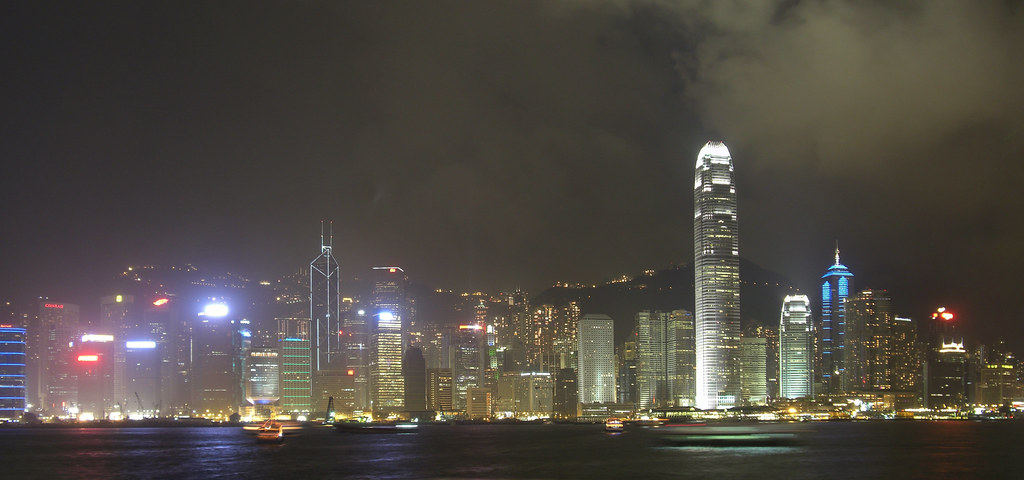
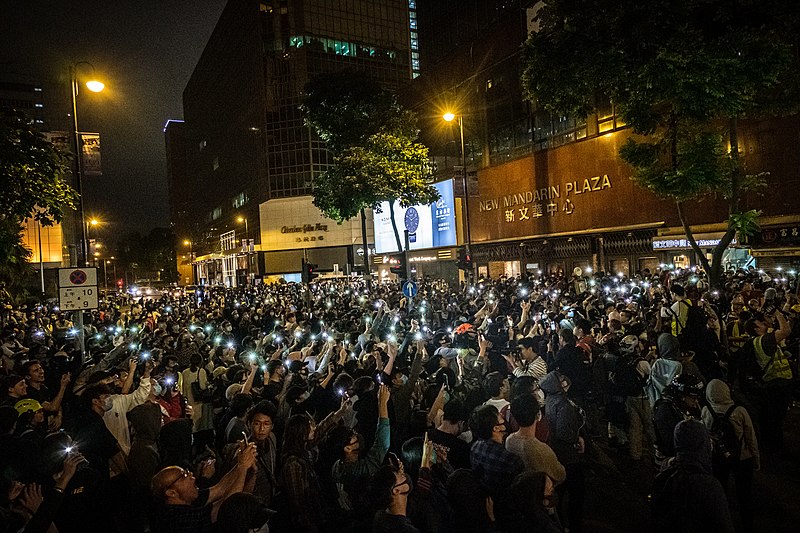
The most important year of the decade is the one that is just ending. The struggle that will most deeply shape the global scene in years to come is not occurring in Britain, the US, Europe or any Western country. It is underway in Hong Kong, where a popular demand for democracy is confronting the immovable power of the world’s most highly developed authoritarian state.
It is a struggle no government wants to see escalate. More realistic than its Western counterparts, the Chinese leadership shows few signs of believing the conflict can be definitively resolved any time soon. Incremental concessions and large-scale repression both carry high levels of risk for Xi Jinping’s regime. The ideal end-state for Beijing is probably long-term containment. But the situation in the former colony is not stable, and it is difficult to exaggerate the impact that suppressing the protestors by force would have on China’s position in the world.
It is often pointed out that Hong Kong’s economic importance has dwindled with the rise of mainland cities such as Shanghai. But this leaves out how much two-system governance shapes global perceptions of China and its future. Xi’s progress towards a neo-totalitarian surveillance state has deflated the Western elites’ confidence that China is on a path of slow evolution towards liberal democracy. Yet the fantasy still lingers. The likelihood that China will be an authoritarian great power in any realistically imaginable future is too disturbing to contemplate.
“Hong Kong night Panorama” by Andos_pics is licensed under CC BY-NC-SA 2.0
It is worth recalling the comforting tale on which Western governments have modelled China’s development. The country was getting rapidly richer, and while average incomes remained low by international standards, the middle class was steadily growing. This process of embourgeoisement would lead to stronger demands for democratic freedoms, and China would become ever more like the West. Embedded in practically every Western government and regularly invoked by the Western businesses that operate in China, this is a story with almost no basis in reality.
It is true that the rise of the middle classes in early 19th-century Europe coincided with an expansion of liberal freedoms in some countries. This was the main thrust of Marx’s analysis of bourgeois democracy. (A little-noted aspect of recent liberal thinking is that it relies heavily on a crude version of Marxian class analysis.) But there is nothing in the historical record that says the middle classes are inherently a force promoting liberalism. In the late 19th century, they backed the restoration of monarchy and empire in France and militarism In Prussia. In the early 20th century, large sections of the European middle classes embraced ethnic nationalism and then fascism. There was not much sign of the freedom-loving bourgeoisie in interwar Europe.
While it is so far less developed, a similar pattern of bourgeois support for illiberal politics has emerged in many European countries since the collapse of the Soviet Union. Across the continent, far-Right parties enjoy the support of significant sections of the middle classes. In America, Trump’s constituency includes many from precarious middle income groups.
So, the linkage between the middle classes and liberal values is tenuous throughout Western countries. In the UK and other English-speaking countries, it is middle class students, professors and administrators that have shut down freedom of inquiry and expression in higher education. Woke capitalism and much of the mainstream media are continuing this trend. Threatened by what they call populism, bourgeois liberals have ditched the values that once defined them. Far from being a universal law, middle class support for liberalism looks like a brief historical accident.
December 13, 2019
Communist Boots Are Made For Walking – Mao‘s Long March | BETWEEN 2 WARS I 1935 Part 3 of 4
TimeGhost History
Published 12 Dec 2019From 1927 to 1934, the Chinese Communists lived in a state within the National Chinese State led by Chiang Kai-Shek. In 1935, the Nationalists strike and the Communists follow their leader Mao Zedong on a Long March Northwards.
Join us on Patreon: https://www.patreon.com/TimeGhostHistory
Hosted by: Indy Neidell
Written by: Joram Appel
Directed by: Spartacus Olsson and Astrid Deinhard
Executive Producers: Bodo Rittenauer, Astrid Deinhard, Indy Neidell, Spartacus Olsson
Creative Producer: Joram Appel
Post-Production Director: Wieke Kapteijns
Research by: Joram Appel
Edited by: Daniel Weiss
Sound design: Marek KaminskiColorizations:
– Klimbim – https://klimbim2014.wordpress.comA TimeGhost chronological documentary produced by OnLion Entertainment GmbH.
December 3, 2019
Canada and China
Ted Campbell discusses Canadian foreign policies — or perhaps more accurately Canada’s lack of policies — on China:

“The Chinese People’s Liberation Army is the great school of Mao Zedong Thought”, 1969.
A poster from the Cultural Revolution, featuring an image of Chairman Mao, published by the government of the People’s Republic of China.
Image via Wikimedia Commons.
There were many things that history might find regrettable about the Mulroney years but I doubt that it will fault him for having a principled and coherent foreign policy.
That all changed with Jean Chrétien, who was almost a neo-mercantilist, and for whom principle could never stand in the way of profit.
In the modern (Chrétien-Martin-Harper-Trudeau) era, Conservatives have been, broadly, anti-China, sometimes for reasons that are less than coherent or principled, and Liberals have been too prepared to “go along to get along” with China. This is because both parties reflect the incoherent views of the whole country. But political leaders shouldn’t (mustn’t) just reflect the views of their voters ~ that sort of populism is nonsensical ~ they must, as Edmund Burke said, bring his or her “unbiased opinion … mature judgment … [and] … enlightened conscience” to bear on each issue. But I’m afraid that too many (most?) modern Canadian political tacticians hold all those things in scant regard.
In the 2020s Canadians must listen to a few clear voices who will tell them that China is a competitor in many “markets” including in the marketplace of ideas, ideals, institutions and values. The current Chinese leadership is overtly hostile to Weterm liberal-democratic values and is not unwilling to punish any country with which it disagrees. It is protectionist, relatively rich and growing in military, political and economic power, but, still, somewhat cautious, and Xi Jinping’s China seems to be able to separate its own short-term political interests from its firm, long term, strategic goals. China, as Kevin Rudd reminded us just a few days ago “is contemptuous of weakness and prevarication,” which explains why it is so obviously contemptuous of Justin Trudeau’s Canadian government.
It is a fact that the Sino-Canadian relationship is “unbalanced:” China is a great power, Canada is not; China is an autocracy, Canada is a democracy; and so on but, as Kevin Rudd said (link just above) “China too has net strengths and weaknesses of which … [our] … strategists should be aware in framing our own strategy … [and we] … should be equally aware of our own strengths, weaknesses and vulnerabilities.” Canadian strategists need to educate Canadians about China so that a solid, informed majority will want a coherent and principled policy ~ one that puts our national vital interests first […]
Our policy towards China needs to be just one part of a coherent, principled foreign policy which Canadians understand and, broadly, support, and that, in turn, needs to be part of a Canadian grand strategy that aims to secure a place, as Paul Martin suggested, “of pride and influence in the world” ~ that, of course, was a place we enjoyed under St Laurent, Diefenbaker and Pearson, all of whom were acutely aware of the many and varied (and very divergent) views about Canada in the world that existed then and persist today in Canada’s many and varied communities.
December 2, 2019
China Rules the Seas – The Invention of the Junk l HISTORY OF CHINA
IT’S HISTORY
Published 19 Aug 2015Imperial China was a great seafaring nation. With the invention of the junks — massive, nearly unsinkable ships — it is safe to say that by the 14th century China had the best sea vessels in the world. The invention of the compass made navigation trustworthy as never before and Admiral Zheng He’s treasure fleet eagerly explored the Seven Seas. The first Chinese navy also depended on the mighty junk for their fighting tactics. But not all emperors were convinced of seafare and so the Chinese maritime power ended somewhat abruptly, giving the rest of the world time to catch up. Learn all about China on the water on IT’S HISTORY.
» The Complete PLAYLIST: http://bit.ly/HistoryOfChina
» SOURCES
Videos: British Pathé (https://www.youtube.com/user/britishp…)
Pictures: mainly Picture Alliance
Content:
“Hadingham, Evan (2001): Ancient Chinese Explorers: http://www.pbs.org/wgbh/nova/ancient/…
Needham, Joseph (1986): Science and Civilization in China, Volume 4, Physics and Physical Technology, Part 3, Civil Engineering and Nautics. Taipei”» ABOUT US
IT’S HISTORY is a ride through history – Join us discovering the world’s most important eras in IN TIME, BIOGRAPHIES of the GREATEST MINDS and the most important INVENTIONS.» CREDITS
Presented by: Guy Kiddey
Script by: Martin Haldenmair
Translated by: Guy Kiddey
Directed by: Daniel Czepelczauer
Director of Photography: Markus Kretzschmar
Music: Markus Kretzschmar
Sound Design: Bojan Novic
Editing: Markus KretzschmarA Mediakraft Networks original channel
Based on a concept by Florian Wittig and Daniel Czepelczauer
Executive Producers: Astrid Deinhard-Olsson, Spartacus Olsson
Head of Production: Michael Wendt
Producer: Daniel Czepelczauer
Social Media Manager: Laura Pagan and Florian WittigContains material licensed from British Pathé
All rights reserved – © Mediakraft Networks GmbH, 2015