
In The Conservative Woman, Alex Story outlines the three distinct ways that western opinions differ on the ongoing struggle with Iran:
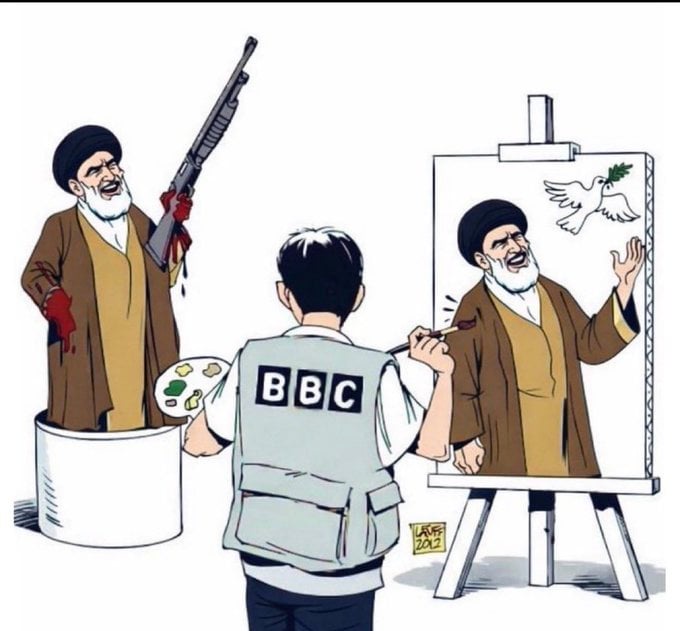
The BBC has a long history of … careful wording in describing events in Iran since 1979. I don’t think this cartoon is unfair in portraying that.
TRUTH is the first casualty of war.
Opinions on a conflict depend deeply on the prevailing culture, erasing nuance in the process. The less of it there is, the easier it is to convince yourself of your righteousness and your opponents’ wickedness.
For instance, the Iranian question divides the world in three main groups.
The first staunchly believes that the Israeli tail wags the American foreign policy dog, working around the clock to recreate Israel’s “from the river of Egypt to the great river, the River Euphrates” Old Testament borders as described in Genesis 15:18.
The second will accept the long-standing Islamic Republic of Iran’s evil nature and its core philosophy of perpetual warfare leading in due course to the unbeliever’s submission but are sceptical if it can be removed solely by this war. As David, an exiled Iranian, said: “I’m caught between wishing for the end of the regime and the very real prospect of its entrenchment through external violence”.
The third will argue that the Iranian leadership should be obliterated. Ending the regime’s five-decades long barbarism, exemplified by the slaughter of “40,000 Iranians” across the country in January 2026 in Prince Reza Pahlavi’s recent words, would make the world a better place. Having lived by the sword, the mullahs should die by the sword, they will say, adding that few will miss them.
Positions turn into intellectual fortresses at the speed of light, fed by a constant stream of “news” destined to further harden preconceived ideas. Little is provided that offers any hope of peaceful co-existence. Data is used, ignored and abused, thus ensuring escalation and lying becomes the accelerator for a world on its irrevocable path to war.
But while truth dies early in the antagonists’ deadly exchanges, war eventually reveals it, and its revelations tend towards the astounding.
In our case, for instance, it has become crystal clear that Britain is now effete, irrelevant and defanged. It is a flotsam on rough international seas, bullied by some, ridiculed by others and ignored by all who have not yet emasculated themselves.
The United Kingdom, the former global hegemon and only European country to come out of the Second World War justified, is not the same country it once was, dismantled stone by stone by an establishment haughtily bent on demise over decades and encouraging others, partially successfully, to follow them down to the Gates of Hades.
Our end, however, cannot all be pinned on Starmer, Hermer, Sands, the Fabians and purple-haired socialists.
He then goes on to make the case that only a counter-revolution will rescue Britain from its current path to misery and global irrelevance.


