After joining with Hitler’s Third Reich to dismember Poland, and occupying the Baltic states of Latvia, Lithuania, and Estonia, Stalin turned his attention to Finland. From the Soviet point of view, the Finnish border was uncomfortably close to Leningrad and the fortified defensive lines along the Karelian Isthmus were a reminder that the Finns could cause trouble if a war came. Stalin’s solution was to demand that the Finns give up the region northwest of Leningrad (including the defences), along with several islands in the Gulf of Finland and allow a Soviet naval base to be established on the Finnish coast near Helsinki. All this in exchange for a larger chunk of Soviet territory north of Lake Ladoga and the “firm friendship of the Soviet Union” for whatever that might be worth. The Soviets backed up their claim with an overwhelming military superiority in men, tanks, artillery and air power. The Finns declined the generous offer, which took Stalin aback:
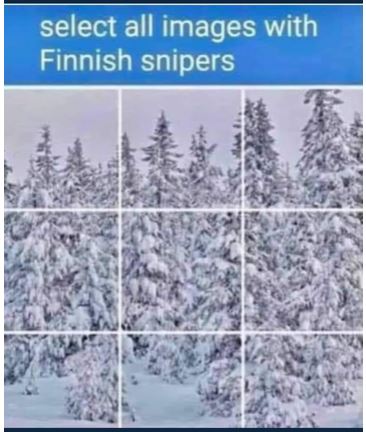
Not actually much of an exaggeration: Finnish snipers were a constant threat to Soviet military operations in Finland during the Winter War and the Continuation War.
On 30 November 1939, the Soviet Union invaded Finland through an immensely samey, tree-covered morass. Across hundreds of miles of deep snow and borderland, the Red Army unleashed 450,000 men, roughly 1,100 tanks, and hundreds of combat aircraft, expecting to overwhelm its smaller neighbour through sheer weight of armour, heavy artillery, and manpower.
Joseph Stalin overturned the original campaign plan, discarding the slower but sounder 4-month plan for a lightning campaign in just two months. Beneath that rigid political deadline lay an atmosphere of terror. No senior Soviet commander dared challenge Stalin, correct his unrealistic timetables, or point out that the Red Army was unready for a winter invasion. Officers who raised logistical concerns risked being branded defeatists or traitors—a real possibility the purges proved.
This fear spread in the ranks.
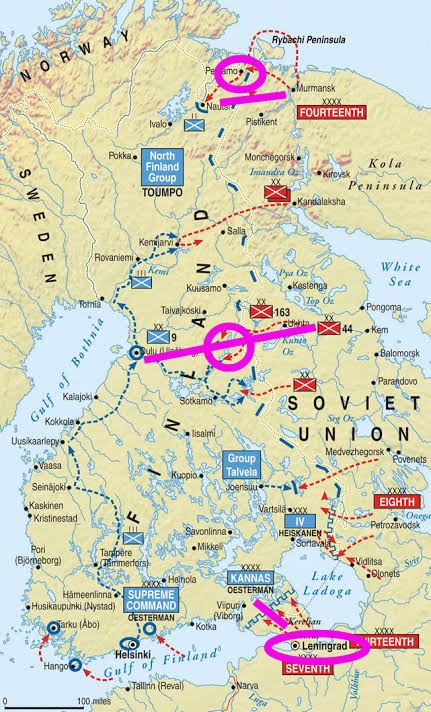
Despite the low state of morale, the Red Army struck along three operational axes:
- The Southern Main Effort (Karelian Isthmus): The heavy Soviet 7th Army would drive toward Helsinki, intent on punching through the main Finnish defences: the Mannerheim Line.
- The High North (Lapland & Arctic Coast): The 14th Army would advance across the tundra to seize Finland’s ice-free Arctic port at Petsamo, to cut off fears of foreign supplies inbound to aid the Finns.
- The Central Thrust (the “Waist” of Finland): The Soviet 9th Army would strike west across the country’s narrowest stretch toward Oulu on the Gulf of Bothnia.
Soviet pressure in three main spots, excuse my art!
Image and caption from WW2 MattersIn the central sector, Soviet planners harboured an ambitious but possible objective: advance west toward Oulu, reach the Gulf of Bothnia, and slice Finland in two.
The plan looked reasonable on map overlays at Leningrad headquarters. The target was Suomussalmi — a quiet logging settlement enveloped by lakes, swamps, and primaeval pine. Its importance lay not in its economic value, but in its position on the regional dirt road network running west toward Oulu. A successful Soviet drive here would sever the rail network connecting northern and southern Finland, cutting the vital land artery to neutral Sweden through which western supplies flowed.
To execute this strategic cut, Soviet planners committed two heavily reinforced divisions under the 45th Rifle Corps — the 163rd Rifle Division and the 44th “Blue” Rifle Division. With their attached tank battalions, corps artillery, and massive logistical columns, this combined force brought nearly 50,000 men into the narrow forest corridors.
In the Suomussalmi sector, the Finns initially faced fewer than 1,000 local Civil Guardsmen, later reinforced into Colonel Hjalmar Siilasvuo’s 9th Division to total 11,000 to 17,000 men. Outnumbered more than four to one, the Finns had no tanks and only 11 outdated artillery pieces — some dating back to the 1904 Russo-Japanese War — and severely rationed shells.
The Soviet plan depended on numerical dominance. But in the dense taiga forests of northeastern Finland, it became a bloody lesson in the difference between possessing a large army and knowing how to use it.