
H/T to Chris Blattman. This is from a collection of recruiting videos put together by Gawker.
September 4, 2010
Swedish army gets serious about recruiting women
Comments Off on Swedish army gets serious about recruiting women
September 2, 2010
“How can you fall in love if you can’t see her face?”
Along with the manifold military problems facing the troops in Afghanistan, there are some social issues that tend to boggle the minds of the western soldiers:
Western forces fighting in southern Afghanistan had a problem. Too often, soldiers on patrol passed an older man walking hand-in-hand with a pretty young boy. Their behavior suggested he was not the boy’s father. Then, British soldiers found that young Afghan men were actually trying to “touch and fondle them,” military investigator AnnaMaria Cardinalli told me. “The soldiers didn’t understand.”
[. . .]
Sociologists and anthropologists say the problem results from perverse interpretation of Islamic law. Women are simply unapproachable. Afghan men cannot talk to an unrelated woman until after proposing marriage. Before then, they can’t even look at a woman, except perhaps her feet. Otherwise she is covered, head to ankle.
“How can you fall in love if you can’t see her face,” 29-year-old Mohammed Daud told reporters. “We can see the boys, so we can tell which are beautiful.”
Even after marriage, many men keep their boys, suggesting a loveless life at home. A favored Afghan expression goes: “Women are for children, boys are for pleasure.” Fundamentalist imams, exaggerating a biblical passage on menstruation, teach that women are “unclean” and therefore distasteful. One married man even asked Cardinalli’s team “how his wife could become pregnant,” her report said. When that was explained, he “reacted with disgust” and asked, “How could one feel desire to be with a woman, who God has made unclean?”
It’s a telling point that western troops were committed to Afghanistan without being fully briefed on the social customs of the people for whom and among whom they’d be doing their jobs. Ignorance isn’t a solid basis for any kind of trust, and without gaining the trust of locals, the troops will always be at a severe informational disadvantage.
Comments Off on “How can you fall in love if you can’t see her face?”
August 23, 2010
Sex sells, even especially in MMOs
Justin Olivetti acknowledges the obvious:
The other day, a group of us in the Massively office watched the latest TERA demo video in a sort of horrified awe as the skimpily clad character ran with her fanny flying in the wind and gyrated her hips to cast a spell. It sparked an intense discussion among us as to the fine line between sexing a game up and over-sexing it just to draw in stereotypical drooling male gamers.
It’s a well-known adage that sex sells, and like it or hate it, attractive characters and skimpy outfits have been a part of MMORPGs for quite some time now. From World of Warcraft‘s seductive succubus to Age of Conan‘s topless extravaganza to Star Trek Online‘s character creation “breast slider,” game studios tend to play the sex card first and frequently to pull in customers. This is why, for example, male armor tends to always be practical (if oddly flamboyant) while female armor isn’t even big enough to protect one’s dignity, never mind one’s internal organs.
Comments Off on Sex sells, even especially in MMOs
How to become an instant expert on Afghanistan
P.J. O’Rourke had a few days to visit Afghanistan and managed to become an expert on the nation, its people, and the problems they face:
Women cover themselves in public but not more than my grandmother did at Mass. An occasional down-to-the-ground burka is seen but not as often as in London. In the malls, clothing shops predominate. Men’s and women’s clothes are shinier and more vividly colored than those seen in a traditional society such as New Hampshire.
Traditionalism being one of the things that makes Afghanistan so hard for Americans to understand. We Americans have so many traditions. For instance our political traditions date back to the 12th-century English Parliament if not to the Roman Senate. Afghans, on the other hand, have had the representative democracy kind of politics for only six years. Afghanistan’s political traditions are just beginning to develop. A Pashtun tribal leader told me that a “problem among Afghan politicians is that they do not tell the truth.” It’s a political system so new that that needed to be said out loud.
The Pashtun tribal leader was one of a number of people that Amin arranged for me to interview. Tribalism is another thing that makes Afghanistan hard to understand. We Americans are probably too tribal to grasp the subtlety of Afghan tribal concepts.
The Pashtun tribal leader was joined by a Turkmen tribal leader who has a Ph.D. in sociology. I asked the Turkmen tribal leader about the socioeconomic, class, and status aspects of Afghan tribalism.
“No tribe is resented for wealth,” he said. So, right off the bat, Afghans show greater tribal sophistication than Americans. There is no Wall Street Tribe upon which the Afghan government can blame everything.
Even the worst of Afghan governments never acquired the special knack of pitting tribe against tribe that is vital to American politics — the Squishy Liberal Tribe vs. the Kick-Butt Tribe; the Indignantly Entitled Tribe vs. the Fed-Up Taxpayer Tribe; the Smug Tribe vs. the Wipe-That-Smirk-Off-Your-Face Tribe.
There you have it: the reason we all find Afghan politics so hard to unravel!
Comments Off on How to become an instant expert on Afghanistan
August 11, 2010
iPhone girls are easy
Colby Cosh links to a dating website that actually provides useful photography information:
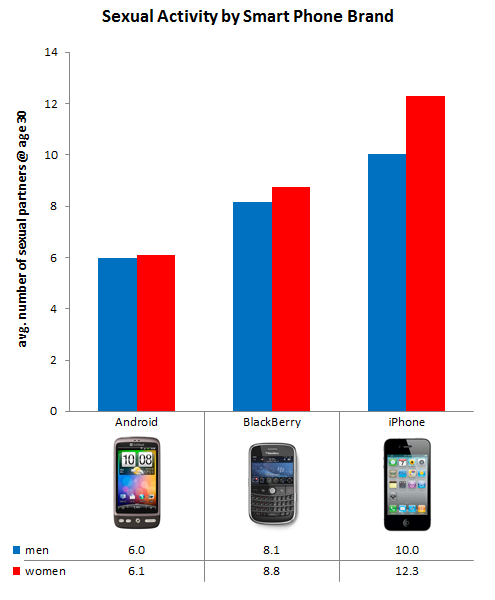
oh, also — iPhone users have more sex.
File this under “icebreakers, MacWorld ’11”. Finally, statistical proof that iPhone users aren’t just getting fucked by Apple:
The chart pretty much speaks for itself; I’ll just say that the numbers for all three brands are for 30 year-olds, so it’s not a matter of older, more experienced people preferring one phone to another. We found this data as part of our general camera-efficacy analysis: we crossed all kinds of user behaviors with the camera models and found we had data on the number of sexual partners for 9,785 people with smart phones.
Okay, I’ve posted the funny bit. The rest of the article actually does have useful photography tips, especially if you’re a user of dating websites.
August 10, 2010
Hey kids, are your parents uptight about you having sex?
That’s to be expected. They’re even more uptight about their parents having sex:
Over the last few months there have been numerous headlines about the sex lives of the over-50s — almost all negative. The HIV infection rate in this group has doubled, we are told. The numbers of over-50s suffering from chlamydia, syphilis, gonorrhoea, herpes and genital warts is growing. One doctor even wrote about his shock at treating the sexual diseases of what he called “cheerfully promiscuous” baby boomers.
It is true there are probably some people at middle age who mistakenly think their sexual partners are above suspicion, and others who did not enter their dating lives using condoms. Safer sex practices may not come so easily for them, yet the prominence and style of these articles underscores the sexual ageism that pervades our society. Where are the positive messages about the sex lives of people in their 50s, 60s, 70s and beyond? Do we ever hear the truth about how sexually vibrant they can be — without an attached warning about physical dangers and moral pitfalls? Sex among elders is surely one of the greatest sexual taboos in western society.
Comments Off on Hey kids, are your parents uptight about you having sex?
August 7, 2010
August 4, 2010
Canada’s (lack of) abortion rules
Apparently lots of Canadians think that the country’s laws are far more restrictive of abortion than they really are:
Two-thirds of Canadians do not know that Canada has no abortion law, according to a new poll that indicates Canadians are woefully misinformed about a landmark ruling in the country’s history.
The poll, which asked 1,022 Canadian adults about their understanding of the country’s abortion regulations, found that just 22% of Canadians correctly identified a woman’s right to an abortion with no governmental restrictions. Canada has not had legislated abortion rules since 1988, making the country an “absolute outlier” on the issue, according to a medical ethicist.
“There’s really only a very small number of Canadians that correctly identify the current situation in Canada,” says pollster Jaideep Mukerji, who worked on the Angus-Reid poll, which was released on Tuesday. “That could be problematic.”
This was highlighted over the last couple of months, with the government and opposition wrangling over Stephen Harper’s initiative to increase funding for maternal health in the developing world. Because opinions widely differ over what the law covers in Canada, it was easy for the opposition to portray Harper’s plan as being ideological rather than humanitarian due to the exclusion of abortion.
Canadians don’t want to re-open the debate, although most appear to want more restrictions in place.
Comments Off on Canada’s (lack of) abortion rules
July 31, 2010
That 77 cents myth again
Have you heard that women earn only 77 cents for each dollar earned by men? Do you believe it? I hope not, because it’s provably false:
Blau and Kahn found that 59% of the gender differential could be explained by non-discriminatory things: experience, chosen occupation, chosen industry, etc. So the “77 cents” statistic can’t be due to discrimination:
- Estimated wage gap based on “77 cents” statistic = $0.23 per hour
- Amount explained by nondiscriminatory factors = $0.14 per hour
- Amount NOT explained = $0.09 per hour
According to Blau and Kahn, the most that could be attributed to discrimination is $0.09 per hour. And this assumes that their model accounts for ALL legitimate nondiscriminatory factors.
Are there legitimate nondiscriminatory factors that were omitted from their model? Probably — no model is perfect. Some people have argued that men are better negotiators than women, and because of this men tend to get higher starting salaries. Are differences in negotiating skills discriminatory? Perhaps, based on the way that we raise our daughters (that’s a sociological issue). But the employer can’t be held responsible for differences in negotiating skills, can he?
Something else to consider: overtime hours, shift premiums, etc., may cause a difference in earnings between men and women, even though their base rates of pay are the same. If a woman chooses to work fewer overtime hours than her male counterpart, resulting in lower earnings, is that discrimination?
H/T to Walter Olson for the link.
July 29, 2010
Replacing one impossible ideal with another
Colby Cosh linked to this Guardian article, saying “I’m afraid she’s right. ‘Thin’ is something every girl can at least strive for. Only God can make Christina Hendricks.”
When it comes to the ideal female body-shape the pipe cleaner is out, the hourglass is in — or at least it will be if the new equalities minister, Lynne Featherstone, manages to chisel out her will on the perfect body image.
“In the autumn the minister will convene the first of a series of roundtable discussions with members of the fashion industry, including magazine editors, models and advertisers, to discuss how to boost body confidence among the young,” the Sunday Times reported yesterday.
One might think that one of the first steps to boost such confidence might be to abolish school weigh-ins and make puppy fat a normal rite of passage rather than the subject of a health warning via the National Child Measurement Programme. (Can any woman think of anything more likely to have produced a fear of being on the chunky side than turning up to school one morning and being plonked on a set of scales?)
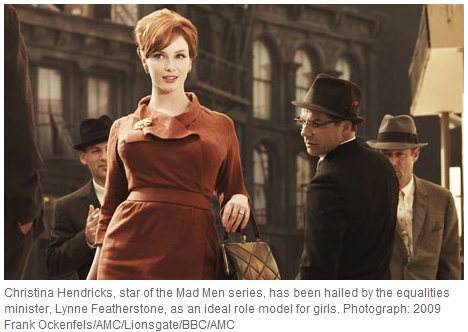
While I’m happy to have any excuse to post a photo of the delightful “YoSaffBridge”, this is another example of Nanny State thinking: (some) women have body image issues, therefore we must spring into action and fix it.
Rather than replacing the old impossible images with new impossible images (as the creative director of Harper’s Bazaar pointed out, the fashion industry exists to create the fantasy you’ll never live up to) an equalities minister should throw out all notions of obsessing about feminine beauty and concentrate on helping young girls think about the size of their achievements rather than the flatness of their navels, and the scale of their ambitions rather than — in Joanie’s case — the rather spectacular power of their bosoms.
Comments Off on Replacing one impossible ideal with another
July 23, 2010
July 16, 2010
Addressing the science and technology gender gap
It must be the start of the silly season, as lots of words are being flung around about the low number of women in science, technology, engineering, and math (STEM). The numbers are well short of gender parity, which some are latching on to as prima facie proof of misogyny, prejudice, and deliberate stunting of women’s career choices. Legislative and regulatory “fixes” are being suggested. Not so fast, says Eric S. Raymond:
Let’s get one shibboleth out of the way first: Larry Summers was right to be skeptical about the prospects for “equality” in STEM (science, technology, math, engineering) fields in general. Just the difference in dispersion of the IQ curves for males and females guarantees that, let alone the significant differences in mean at spatial visualization and mathematical ability. Removing all the institutional, social and psychological barriers will not achieve a 1:1 sex ratio in these fields; the best we can hope for is a large, happy female minority — that is, as opposed to a small and unhappy one.
[. . .]
I don’t mean to deny that there is still prejudice against women lurking in dark corners of the field. But I’ve known dozens of women in computing who wouldn’t have been shy about telling me if they were running into it, and not one has ever reported it to me as a primary problem. The problems they did report were much worse. They centered on one thing: women, in general, are not willing to eat the kind of shit that men will swallow to work in this field.
Now let’s talk about death marches, mandatory uncompensated overtime, the beeper on the belt, and having no life. Men accept these conditions because they’re easily hooked into a monomaniacal, warrior-ethic way of thinking in which achievement of the mission is everything. Women, not so much. Much sooner than a man would, a woman will ask: “Why, exactly, am I putting up with this?”
Correspondingly, young women in computing-related majors show a tendency to tend to bail out that rises directly with their comprehension of what their working life is actually going to be like. Biology is directly implicated here. Women have short fertile periods, and even if they don’t consciously intend to have children their instincts tell them they don’t have the option young men do to piss away years hunting mammoths that aren’t there.
Eric feels that the big problem (at least in computing) is that the field has become the modern sweatshop: better paid by far than sweatshops of the non-digital nature, but still the kind of work that only appeals to the obsessives, the ones who like to focus monomaniacally on goals. As a general rule, men are much more likely to accept this kind of work, as men tend to have a bias towards monomania that most women don’t.
There’s also the social aspect: geeks don’t talk to one another in the same way or for the same lengths of time as non-geeks do. They may communicate by email or instant messaging or other non face-to-face media, but conversation — unless it’s focused on the task at hand — isn’t a preferred activity during work hours (which, for a true geek, may be all the hours not spent sleeping or eating). Looking at that kind of environment doesn’t attract people who are well socialized and who are used to more interaction with co-workers.
As a comment on Eric’s post put it: “You’re saying the real “problem” with the gender ratios is not sexism, its that most women have more sense than we males do!”
Comments Off on Addressing the science and technology gender gap
July 15, 2010
Facebook usage patterns differ by gender
I have a Facebook account, but I use it infrequently (the vast majority of my FB activity is just status posts echoed from my Twitter account, actually). For certain groups, however, Facebook is far more critical to their lives . . . young women, for example:
According to a new report released by Oxygen Media and Lightspeed Research, about one-third of women on Facebook between 18 to 34 in age check this social networking site in the morning as the first thing even before going to bathroom. Some of the other astonishing facts deduced from this research on young women are as follows.
* 21% of women age 18-34 check Facebook in the middle of the night
* 63% use Facebook as a networking tool
* 42% think it’s okay to post photos of themselves intoxicated
* 79% are fine with kissing in photos
* 58% use Facebook to keep tabs on “frenemies”
* 50% are fine with being Facebook friends with complete strangers
Clearly there haven’t been enough stories about people losing their jobs over inappropriate posts on Facebook . . . maybe they aren’t being posted to Facebook itself.
Comments Off on Facebook usage patterns differ by gender
June 7, 2010
More progress toward equality in the US Navy
Strategy Page reports on two recent developments:
For the first time, a female officer will serve as CAG (commander of the air group on an aircraft carrier.) This is no surprise to those in navy. It’s a situation that’s been developing for decades. In the mid 1970s, the U.S. Navy began letting women into Annapolis (the Naval Academy) and flight school. Some 35 years later we have women commanding combat aircraft squadrons, cruisers, an amphibious task force (expeditionary strike group) and a strike group (a carrier task force.)
The newly appointed CAG, recently promoted captain Sara Joyner had, two years earlier, as F-18 pilot, Commander Joyner, completed a tour as the first female commander of a navy combat squadron (VFA 105). This included a seven month cruise to the Persian Gulf aboard the USS Harry S. Truman, where her dozen F-18Cs flew about 412 hours each. The squadron had 245 officers and sailors, including pilots and maintenance personnel. The squadron commander flew combat missions, in addition to running the squadron.
[. . .]
Another female Naval Academy graduate (Class of 1985) recently received an even more senior naval aviation command. This year, Rear Admiral Nora Tyson took command of Task Force 73 (CVN USS George H W Bush and escorts). This was another first.
Probably the most hopeful thing about these two appointments is that they’re pretty clearly not token appointments for political reasons: both women have earned their promotions and are deemed fully qualified for their new roles. That’s a far more positive thing for all women in the armed forces than attempting to meet arbitrary criteria based solely upon gender balance concerns.
Comments Off on More progress toward equality in the US Navy
May 26, 2010
Evolutionarily speaking, everything old is new again
An idea that seemed fairly common in the 1960s and 70s appears to be regaining credibility:
When two drunken men fight over a woman, alcohol and stupidity may not be the only things at work. Sadly, evolution may have shaped men to behave this way. Almost all of the traits considered to be masculine — big muscles, facial hair, square jaws, deep voices and a propensity to violence — evolved, it now seems, specifically for their usefulness in fighting off or intimidating other men, allowing the winner to get the girl.
That, at least, is the contention of David Puts, an anthropologist at Pennsylvania State University, in an upcoming paper in Evolution and Human Behavior. Dr Puts is looking at how sexual selection gave rise to certain human traits. A trait is sexually selected if it evolved specifically to enhance mating success. They come in two main forms: weapons, such as an elk’s horns are used to fight off competitors; and ornaments, like a peacock’s tail, which are used to advertise genetic fitness to attract the opposite sex.
Researchers have tended to consider human sexual selection through the lens of the female’s choice of her mate. But human males look a lot more like animals designed to battle with one another for access to females, says Dr Puts. On average, men have 40% more fat-free mass than women, which is similar to the difference in gorillas, a species in which males unquestionably compete with other males for exclusive sexual access to females. In species whose males do not fight for access to females, males are generally the same size as, or smaller than, females.


