
If you were hovering above Earth looking to be born randomly into any time period in human history, you’d pick now if you had any brains. And if you could pick a place, you’d pick a Western liberal democracy, and probably the United States of America (though as much as it pains me to say it, you wouldn’t be crazy to pick Canada or the U.K. or Holland). Sure, if you could pick being rich, white, and male — and didn’t really care too much about the plight of others — you might take the 1950s. But even then, your choices for food, entertainment, etc. would be terribly curtailed compared to today. If you chose to be a billionaire in 1917, you could still die from a minor infection, and good Thai food would be entirely unknown to you. You’d certainly never enjoy watching a Star Wars movie on an IMAX screen in air conditioning. In other words, while your homes would be bigger and cooler if you were a billionaire in 1917, a typical orthodontist in Peoria in 2017 is in many respects much richer than a billionaire a century earlier.
Still, that’s not the deal on offer. You have to buy an incarnation lottery ticket, and the results would be random.
I’m not big on dividing people up by abstract categories, and I certainly don’t mean them to be pejorative. But as a historical matter, being born poor, gay, black, Jewish, ugly, weird, handicapped, etc. today may certainly come with some problems or challenges, but on the whole those traits are less of a shackle or barrier than at any time in the past. The only trait where I think it might be a closer call is dumbness. All other things being equal, a not-terribly-intelligent person with a good work ethic and some decent values might have had more opportunities before machines replaced strong backs. But even here, I can think of lots of exceptions.
Jonah Goldberg, “America and the ‘Original Position'”, National Review, 2017-12-22.
February 21, 2020
QotD: Thought experiment
February 13, 2020
Here’s a deceptive factoid … time for you to get angry to suit someone’s political agenda
Did you know that “Three Billionaires Have More Wealth Than Half of America”!!!???!!! Are you angry now? You’re supposed to be, because this factoid was concocted specifically to make people irrationally angry. Daniel C. Jensen explains how this sound bite was created:

Amazon’s Jeff Bezos, Microsoft’s Bill Gates, and Berkshire Hathaway’s Warren Buffet.
Fox Business.
People between 0 and 24 years of age account for about 32 percent of the United States population of 320 million. Almost all of them are going to be in the bottom half of the wealth distribution for reasons including diaper rash and puberty. That means they account for about 63 percent of the “bottom half of the wealth distribution.” Should it surprise us that some kid fresh out of college does not “hold any stocks or bonds”? Or a kid fresh out of the womb?
Then we must consider people with mental and physical disabilities. They will also tend to be in the bottom half of the wealth distribution because they face greater challenges to building wealth. “About 56.7 million people — 19 percent of the population — had a disability” at last count, according to the United States Census Bureau. But there is overlap between the disabled 19 percent and the young 32 percent of the population. If we assume disabilities are evenly distributed in the population, then young people and non-young disabled people account for 45 percent of the population. So we have now accounted for 90 percent of the “160 million Americans in the bottom half of the wealth distribution.”
Next, we must think about other groups who have had limited wealth-building opportunities. What about the 2.2 million people in jail and prison? What about people in their late twenties who pursued PhDs, law degrees, medical residencies, etc., and are just beginning their careers? Now we are close to accounting for 100 percent of the “bottom half of the wealth distribution.” But this wealth distribution is not what any sensible person would expect it to be.
Maybe the factoid is true. Maybe Jeff Bezos, Bill Gates, and Warren Buffet have more wealth than all of the infants, children, students, handicapped, prisoners, and postgrads combined. But you don’t need a PhD to figure out that’s not useful knowledge. Even if the factoid is true, it’s deceitful. Whoever created it was obviously trying to manipulate people. And we uncovered this deception with nothing but some simple knowledge of the US population.
Next time you encounter an economic factoid, remember that it might be pitting a bunch of newborns against Jeff Bezos, and that hardly seems fair. Thankfully, you can save those babies from certain defeat simply by knowing some basic statistics about your country.
January 22, 2020
QotD: National “wealth”
While working on my book, I read all these different accounts of where capitalism comes from. I was amazed by how many of them start from the assumption that wealth is … stuff. Depending on which Marxist you’re talking to, capitalism is the ill-gotten-booty of the Industrial Revolution, slavery, imperialism, and the rest. I don’t want to get into all of that here — there will be plenty of time when the book comes out.
But all of these assumptions are based on the idea that having stuff makes you rich. Now, in fairness, that’s true for individuals. But it doesn’t really work that way for societies. Writing about Venezuela earlier this week is what got this in my head. Venezuela is poor and getting poorer by the minute: Babies are dying from starvation.
Meanwhile, Venezuela has the largest proven oil reserves in the world. According to lots of people, not just Marxists, this should make no sense. Oil is valuable. If you have more of it than anyone else, you should be able to make money. For a decade, the American Left loved Hugo Chávez and then Nicolás Maduro because they allegedly redistributed all of the country’s wealth from the rich to the poor. These dictators were using The Peoples’ resources for the common good. Blah blah blah.
It turns out that the greatest resource a country has is its institutions. In economics, an institution is just a rule, which is why the rule of law in general and property rights in particular are the most important institutions there are, with the exception of the family. Take away the rule of law in any country, anywhere and that country will get very poor, very fast. Stop protecting the fruits of someone’s labor, enforcing legal contracts, guarding against theft from the state or the mob (a distinction without a difference in Venezuela’s case) and wealth starts to evaporate.
But even that is too complicated. Oil is worthless on its own. If you went back in time to the Arabian Peninsula before oil became a valuable commodity, you wouldn’t look at the squabbling nomads and call them rich, even though they were playing polo with a goat’s head above billions of barrels of oil. Go get lost in the Amazon by yourself. What would you rather have, a map or big-ass diamond? The diamond only has value once you get out of the jungle, but you can’t get out without the map.
Jonah Goldberg, “America and the ‘Original Position'”, National Review, 2017-12-22.
December 12, 2019
Explaining the decline in library usage
At the Continental Telegraph, Tim Worstall refutes the claims that it’s the evil right wingers (in this specific case, British Tories) that are driving the library out of business:

“Nottingham central library” by JuliaC2006 is licensed under CC BY 2.0

Despite spending more money, library use, measured in terms of at least one visit per year, fell from 48.2% of adults to 39.7% of adults. I make that as roughly 1/5th of the adults that were using them not doing so in 5 years. 17% sounds slightly on the conservative side.
And if this was about “austerity”, you’d expect visits to be rising, rather than falling from 39.7% to 32.9% since the Conservatives/Lib Dems took over. Because the thing with libraries is that they suit the time rich and cash poor. If you’ve not got much else to do, you can spend time walking to a library, getting a book, walking home and easily finding time in the fortnight to read it. And 9-5 hours don’t bother you. There’s areas of the country, like Weston-Super-Mare, stuffed full of retired people and libraries are popular.
If you’re working all week you have to get to a library in your day, park your car, pay for parking, same on return, and make sure to set aside the time to do the reading, you might decide libraries aren’t that convenient.
The decline of libraries is a success story for us. We created them because books were very expensive once. Owning a giant library was the mark of a rich man. Paper was expensive, printing was expensive, binding was expensive. Over the decades, we figured out how to do this cheaper. Then we figured out how to do retailing cheaper. And then we got e-books which take production costs to near zero. Books are cheap. Cheap enough that most of us don’t want the faff of libraries. So, close some of them.
November 27, 2019
The “Gentrification” debate
In Quillette, Coleman Hughes explains the furor over gentrification in many big American cities:

“Shoreditch Graffiti” by Kit-Kat is licensed under CC BY-NC-SA 2.0

The word “gentrification” was coined in 1964 to describe the influx of wealthy newcomers into low-income inner-city neighborhoods, resulting in rising property values, changes in neighborhood culture, and displacement of original residents. Though gentrification predates the modern era, it has only become the target of criticism in recent decades, as cities like Washington, D.C., Atlanta, and Boston have witnessed rapid transformations. Opponents of gentrification have ranged from residents directly affected by it to wealthy college students directly responsible for it, as well as prominent Democrats such as Bernie Sanders, Cory Booker, and Alexandria Ocasio-Cortez.
Critics of gentrification give two main reasons for their opposition: (1) wealthy newcomers drive up monthly rents, thereby displacing original residents; and (2) rapid change to neighborhood culture represents an injustice to original residents. Both critiques are magnified by the presumed skin color of the gentrifiers and the gentrified, who tend to be white and black or Hispanic, respectively.
Though such critiques may seem reasonable at first glance, neither of them survive scrutiny. Not only is gentrification harmless, it’s actually beneficial. Indeed, for reasons I will lay out, it’s exactly the kind of thing that progressives should support.
Let’s begin with the charge that gentrification displaces original residents. Two economists used data from the 2000 U.S. Census and the 2010-2014 American Community Survey to track individual outcomes for all residents of “gentrifiable” — or low-income inner-city — neighborhoods in America’s one hundred largest metropolitan areas. The largest study of its kind, it divided residents of gentrifiable neighborhoods into two categories based on educational attainment. Their findings refute the displacement narrative conclusively.
[…]
On the whole, progressives ought to love gentrification. It makes black inner-city homeowners wealthier. Among less-educated homeowners — who are majority non-white and comprise over a quarter of the total population in gentrifiable neighborhoods — those who remained in gentrified neighborhoods saw a $15,000 increase in the value of their homes due to gentrification. Among more-educated homeowners — who are also majority non-white — those who remained saw a $20,000 increase in property value.
What’s more, gentrification breaks up concentrated poverty and reduces residential segregation. Progressives have frequently observed that poor blacks are more likely to live in concentrated poverty than poor whites. As a result, they lose out on the advantages that come with living in a mixed-income neighborhood. Gentrification helps solve this problem. Moreover, progressives often observe that residential segregation remains pervasive half a century after the 1968 Fair Housing Act. Gentrification helps solve that problem too.
November 17, 2019
QotD: Socialist beliefs about “capitalism”
- Wealth is either fixed in amount, or, while it might be destroyed or diminished by certain human activities (such as war), if wealth grows this growth occurs largely independently of human ideas, choices, actions, and institutions;
- trade and commerce, therefore, are largely zero-sum – that is, each exchange situation pits a party who will win against one who will lose;
- trade and commerce, in turn, involve activities are thus, at best, suspect; trade and commerce too often reward greediness and duplicity while penalizing generosity and honesty;
- the “distribution” of wealth – whether conceived as financial flows or assets, or as access to real goods and services – is determined largely by power;
- prices set on markets are largely arbitrary; prices seldom play any role beyond determining how much one party “wins” from trade and how much the other party “loses.”
- each of a handful of large groups of people, mostly as conceptualized by intellectuals with no understanding of economics, has its own “interests” – interests that are shared by all members of the group and that are at odds with the interests of other groups; for example, “labor” has interests that are are shared by all workers and that are at odds with the interests of “employers”;
- while the state can be captured by ill-intentioned people, the state – especially under unlimited majoritarian rule – is also the only possible savior of the powerless against the predations and frauds of the powerful;
- absent vigorous state intervention, ordinary people – people whose main asset is the value of their own labor – lack both the power to get their fair share of society’s wealth and the intelligence or self-discipline to use wisely whatever share of wealth they do manage to secure;
- social progress is achieved by the powerless grabbing power under the leadership of men and women of singular vision, intelligence, and courage; “the People” will be led to the Promised Land – can be led to the Promised Land – only if they faithfully follow their caring messiahs;
- those who argue in favor of free markets are either soulless mercenary cronies for the powerful propertied class or they are ideologically blinded dupes for this class; no intelligent and decent person could possibly deny the enormous benefits available to “the People” when the state is empowered to work on their behalf against the propertied few.
Don Boudreaux, “Some Links”, Café Hayek, 2017-10-08.
October 23, 2019
QotD: Climbing Maslow’s Pyramid again
If people want little orchards of native (well, you know) apples then people should have little orchards of native apples. As long as, of course, they’re creating and maintaining those little orchards of native apples at their own expense. This is, after all, what liberalism means, that the peeps get to do what the peeps want. And if we’re to add some Burkean conservatism so that it’s the little platoons sorting it out for themselves then all the better.
As long as no one is being forced to pay for this through taxation then what could possibly be the problem?
At another level this is climbing Maslow’s Pyramid again. At one level of income we’ll take fruit in the only way we can, seasonally and in a limited manner. We get richer, technology advances, we can have apples year round – but that does mean trade, commercially sized operations and the inevitable limited selection. We get richer again and now we’ve more than sufficiency, let’s have that variety back again.
After all, it’s not as if we’re not seeing this right across the food chain, is it?
That roast beef of Olde Englande was most certainly better than the bully beef from Argentina or the Fray Bentos pie. As is the best grass fed British beef of today. But we moved through the cycle to get from most not being able to eat any beef, to all being able to have bad beef, to now again thinking more about the quality – we have a more than sufficiency of beef and can be picky about it.
Tim Worstall, “I fully approve of this”, Tim Worstall, 2017-10-22.
October 21, 2019
QotD: Poverty versus relative poverty
However, viewers took to Twitter to insist that Andy and Kim Leamon and their two children from Southampton who have £170 a week to spend on food, clothes and socialising after paying their mortgage and bills are certainly not struggling.
It’s not, by local standards, exactly great riches, to be sure. But that is £2,210 of disposable income per person per year. That’s on the fringes of the top 30% of all global incomes. 70% or so are poorer.
Note again, this is their disposable income, after housing, bills and taxes, the global income number is before all of that. Or, as we might also put it, this is unimaginable riches by global or historical standards.
Tim Worstall, “Well, yes, there’s a point here”, Tim Worstall, 2017-10-20.
October 5, 2019
Losing our religion
Arthur Chrenkoff found another report on the inverse relationship between development and religious belief:
A few weeks ago I wrote a longish blog post arguing that for many people in the developed world environmentalism has become a religion, filling up the gap in spirituality left by the decline of Christianity. I don’t claim any originality or new insight in this observation; it has been noted many times before, including by my friend, former artilleryman and now man of God, Rev Donald Sensing, and it has made an appearance quite a few times subsequent to my piece, a propos Greta Thunberg’s performance at the United Nations and the reaction it inspired around the (developed) world.
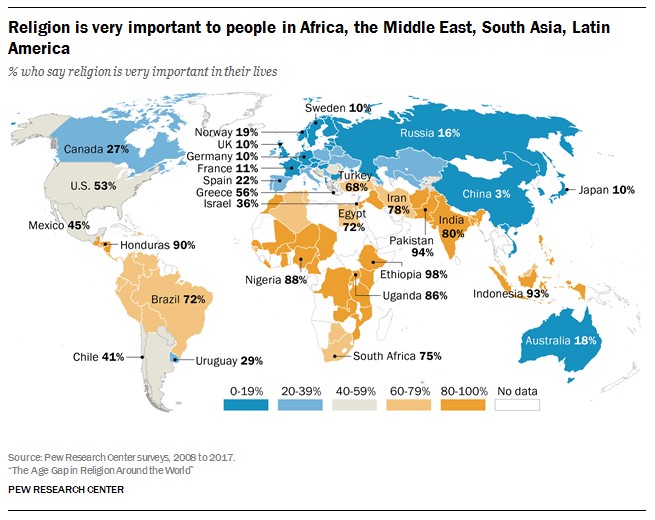
Today, I chanced upon another interesting analysis by Pew Research Center, about religious belief and commitment around the world. Results are not surprising but are nevertheless interesting, including this world map:
Unfortunately, Pew does not provide additional data on those for whom religion might be “important” or “somewhat important” so as to paint a slightly fuller picture of religious sentiment, but the results illustrated above are probably quite indicative. The developed world is well and truly secular now, with the United States and Greece being the only outliers (and by a long mile), while most of the developing world (with the notable exception of China after seven decades of communism) remains extremely religious. Thus, Pew notes that “if current trends continue, countries with high levels of religious affiliation will grow fastest. The same is true for levels of religious commitment: The fastest population growth appears to be occurring in countries where many people say religion is very important in their lives.”
As the main topic of this Pew study is the age gap in religious faith around the world, it should be noted that the younger generations in the developed world are even less religious than their elders, often significantly less, putting the already low rates across the West in an even starker perspective (by contrast, throughout most of the developing world, there is little, if any, gap in religious commitment between the young and the old).
October 4, 2019
“Economics is … the science of not being able to have your cake and eat it”
Philip Booth on Greta Thunberg’s message and its economic over-simplifications:
In many senses, economic problems are more complex than scientific problems and Thunberg is, implicitly at least, pronouncing on economic matters. Whilst knowledge about climate science is uncertain, a judgement has to be and can be made on the balance of evidence. But economic decisions involve trade-offs. Economics is, as Lionel Robbins put it, the science of not being able to have your cake and eat it. We cannot both decrease carbon emissions hugely and enjoy standards of living increasing at the rate that would have been possible if emissions were not reduced.
It is tempting the believe the green rhetoric that we will all have fluffy green jobs and a green standard of living without any hardship from reducing emissions. We cannot. Reducing carbon emissions quickly to zero means that we will have much less of everything else. We might prefer decarbonisation to other goods and services, but it is not a cost-free choice. We considering this, we should remember that the average income in the UK is ten times the average income in the rest of the world. When other people face these trade-offs the sacrifice of decarbonisation is that much greater.
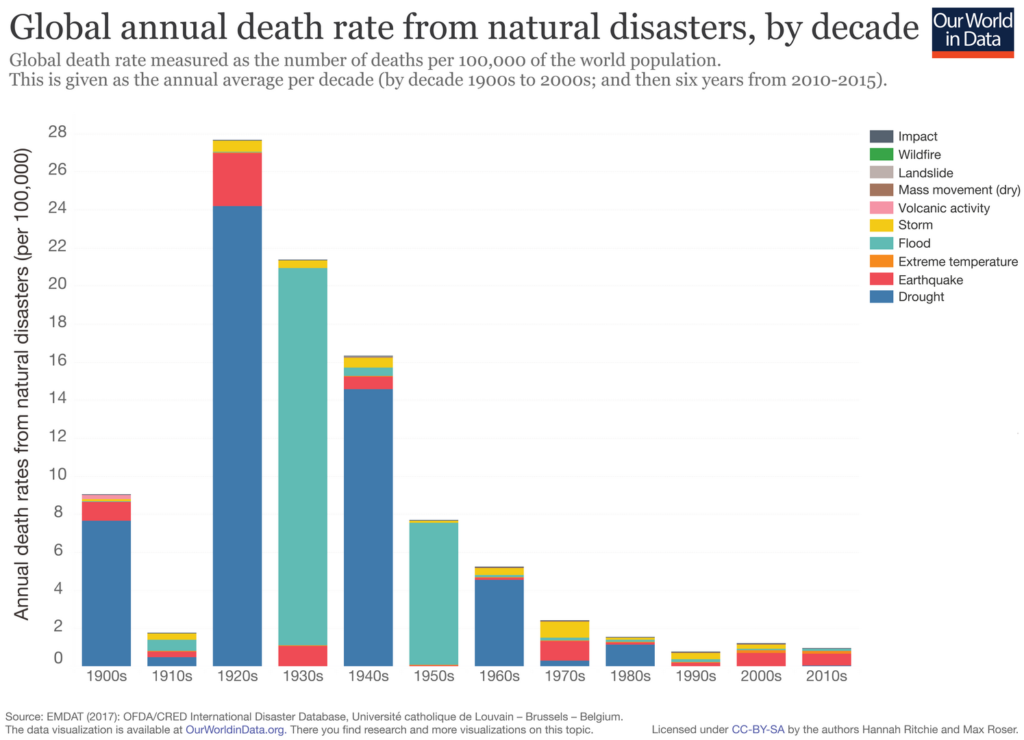
One of the advantages of being richer is that we are more resilient to natural disasters. It follows from this that there is a trade-off between decarbonisation, which might lead to fewer natural disasters, and our ability to cope with them, which might reduce if we become less rich. As we have become richer, deaths from natural disasters have plummeted. The figure shows the fall in deaths in natural disasters over the last century – they have reduced by, perhaps, 90 per cent.
The use of air conditioning illustrates this trade-off in a rather stark way. In a letter on the environment written by Pope Francis in 2015 called Laudato si, the pontiff strongly criticised the adoption of air conditioning in the strongest terms. An academic paper on air conditioning in the US produced such remarkable results that the abstract is worth quoting at length:
“the mortality effect of an extremely hot day declined by about 80% between 1900-1959 and 1960-2004. As a consequence, days with temperatures exceeding 90°F were responsible for about 600 premature fatalities annually in the 1960-2004 period, compared to the approximately 3,600 premature fatalities that would have occurred if the temperature-mortality relationship from before 1960 still prevailed. Second, the adoption of residential air conditioning (AC) explains essentially the entire decline in the temperature-mortality relationship. In contrast, increased access to electricity and health care seem not to affect mortality on extremely hot days.”
Air conditioning leads to higher carbon emissions and, most likely, higher global temperatures. But the increase in resilience arising from air conditioning is astonishing – it has led to an 80 per cent drop in deaths from heat.
September 24, 2019
QotD: Conditions for the rise of tyrants in the Greek city states
Force can only ever be part of the answer. The poor have always been the majority, and sometimes the great majority. Armies of mercenaries to protect the rich have not always been available, and they have never by themselves been sufficient to compel obedience on all occasions in every respect.
Force, therefore, has always been joined by religious terrors. In Egypt, the king was a god, and the privileged system of which he was the head was part of a divine order that the common people were enjoined never to challenge. In the other monarchies of the near east, the king might not actually be a god. But all the priests taught that he was part of a divinely ordained order that it was blasphemy to challenge.
In the Greek city states until about a century before the birth of Epicurus, securing the obedience of the poor had not been a serious problem. There had been some class conflict, even in Athens. But most land was occupied by smallholders, and excess population could be decanted into the colonies of Italy and the western Mediterranean. There were rich citizens, but they were usually placed under heavy obligations to contribute to the defence and ornament of their cities.
Then a combination of commercial progress and the disruptions of the war between Athens and Sparta created a steadily widening gulf between rich and poor. There was also a growing problem of how to maintain large but unknown numbers of slaves in peaceful subjection.
The result was a class war that destabilised every Greek state. The sort of democracy seen in Athens could survive in a society where citizens were broadly equal. Once a small class of rich and a much larger class of the poor had emerged, there was a continual tendency for democratic assemblies to be led by demagogues into policies of levelling that could be ended only by the rise of a tyrant, who would secure the wealth of the majority — but who could secure it only so long as the poor could be terrified into submission. Once they could not be terrified by the threat of overwhelming force, they would rise up and dispossess the rich, until a new tyrant could emerge to subdue them again.
Unlike in the monarchies of the near east, no settled order could be maintained in Greece by religious terrors. During the sixth and fifth centuries, the Greek mind had experienced the first enlightenment of which we have record. There had been a growth of philosophy and science that revealed a world governed by laws that could be uncovered and understood by the unaided reason.
Now, enlightenments are always dangerous to an established religion. And the Greek religion was unusually weak as a counterweight to reason. The Greeks had no conception of a single, omnipotent God the Creator. Instead, they had a pantheon of supernatural beings who had not created the world, but were subject to many of its limitations. These were frequently at war with each other, and so they could be set against each other by their human worshippers with timely sacrifices and other bribes. They did not watch continually over human actions, and beyond the occasional punishment and reward to the living, they had no means of compelling observance of any code of human conduct.
And so, when the intellectual disturbance of philosophy and science spilled over into demands for a reconstruction of society in which property would be equalised, there was no religious establishment with the authority to stand by the side of the rich.
Sean Gabb, “Epicurus: Father of the Englightenment”, speaking to the 6/20 Club in London, 2007-09-06.
September 13, 2019
NDP leader Jagmeet Singh gets his tax plans vetted by the Parliamentary Budget Office
A recent innovation for political campaigns is that they can ask the Parliamentary Budget Office to provide an estimate for the impact of any taxation proposals, and NDP leader Jagmeet Singh was the first out of the gate to have his “super-wealth tax” evaluated. The PBO estimates that the levy would net out some $6 billion in the first full year of implementation. Sounds like a lot of money! Colby Cosh explains why it’s not quite what it might seem:
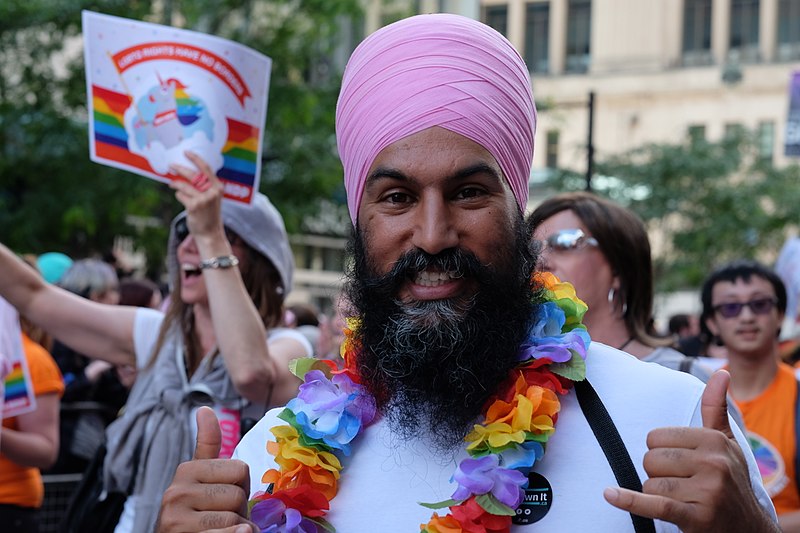
Federal NDP leader Jagmeet Singh taking part in a Pride Parade in June 2017 (during the leadership campaign).
Photo via Wikimedia.
Alas, the bean-counters always swoop in to spoil things. Singh’s wealth-tax scheme is instructive not only because he availed himself of PBO costing, but because it usefully reveals the limits of what the PBO or any other economic modeller can do. Look, in other words, at the fine print.
The PBO’s job was to estimate what you can extract from “an annual net wealth tax on Canadian resident economic families equal to one per cent of net wealth above $20 million.” In the PBO model this is a simple multiplication, but the roughly $6 billion take is arrived at only by reducing the revenue by 35 per cent to correct for “behavioural response” — that is, lawful (and unlawful) tricks employed to avoid the new tax by the rich targets. The net revenue is what’s left after you deduct another two per cent to cover administrative costs.
And, as the PBO immediately insists, “the estimate has high uncertainty” on both counts. This means they’re educated guesses. Jennifer Robson, a social policy prof at Carleton University’s Arthur Kroeger College, pointed out on Twitter that right now we don’t tax economic families per se and we don’t report assets and debts routinely to Revenue Canada. Ideas for pure wealth taxation (which is rare in practice) are predicated on the creation of, essentially, a new tax system — one which would have to detect and perpetually update how much, for example, the furniture in your house costs. The 35 per cent loss from behavioural response is at the high end of historic estimates from real-world examples. Even within our current tax system, Robson observes, we only get two extra dollars for every one we spend on expanding collections and compliance against the existing tax base.
As a practical matter, a wealth tax would mostly be, or would act most efficiently as, a tax on bank balances and investment accounts. Of course, there is always real estate. The super-rich seem to have a lot of that, and it is relatively easy to tax, and the resentment of Torontonians and Vancouverites who don’t own some is, for better or worse, a major reason the NDP is trying to weaponize envy.
But this reminds us that property taxes and taxes on property transfers perform a similar function, although they are not used primarily for income redistribution as such here — and in Canada ours are relatively high. The OECD does a little league table of tax structures, and compared with other industrialized countries Canada’s take from property taxes is about double the average. In a 36-country list we are near the bottom (33rd) in our dependence on taxing goods and services, and about average (12th) in dependence on corporate taxation, but fifth highest in dependence on personal taxation — and third in dependence on property taxes.
August 27, 2019
So much for nil nisi bonum
The old Latin phrase De mortuis nihil nisi bonum encourages us to only speak well of the dead. The recent death of libertarian billionaire David Koch has brought forth a torrent of vituperation from many people in media and politics, as James Piereson and Naomi Schafer Riley record:
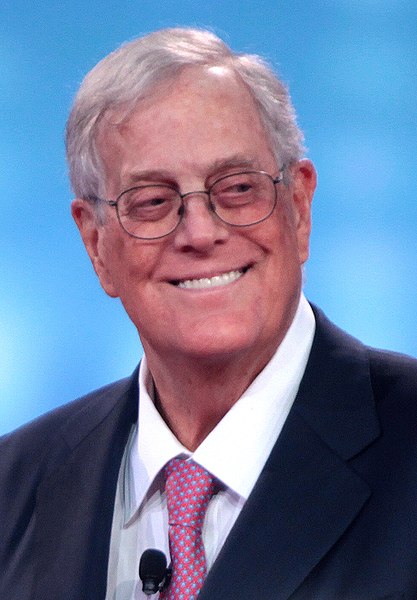
David Koch speaking at the Defending the American Dream Summit in Columbus, Ohio, 21 August 2015.
Photo by Gage Skidmore via Wikimedia Commons.
“Yesterday David Koch of the zillionaire Koch brothers died … of prostate cancer. I guess I’m going to have to reevaluate my low opinion of prostate cancer.” That was Bill Maher last Friday night, joking before his approving audience. Maher went on to say, “The Amazon is burning up. I’m glad he’s dead.” Maher is not known for his kindness toward those with whom he disagrees. In that sense, he reflects the thinking of a growing number of progressives and leftists who openly despise conservatives and libertarians. David Koch, along with his brother Charles, have for decades been targets of harsh rhetoric from the far Left.
What is it about David Koch that inspired such hatred? “We live in the world that he helped build, and it is on fire,” wrote Sarah Jones in New York, denouncing Koch’s “monstrous legacy.” In Esquire, Charles Pierce writes: “Except for his surviving brother, Charles, no man had a worse effect on American politics since the death of John C. Calhoun. Every malignancy currently afflicting us can be traced in one way or another into their wallets, and that’s not even to mention the lasting damage they’ve done to the planet as a whole.”
This is the kind of language that religious cults reserve for heretics and apostates — and in many ways, David and Charles Koch were blasphemers to the liberal orthodoxy. They believed in smaller government and thus criticized the welfare state, excessive taxation, and a great deal of government regulation. At the same time, they criticized America’s wars abroad, along with high levels of defense spending, and were sympathetic to the causes of gay rights and gay marriage. They were consistent in their views across a range of issues, antagonizing liberals but also vexing conservatives. The claim that David Koch was a reflexive right-winger is a caricature of his beliefs.
The Kochs believed in smaller government. Whether it was gay marriage or land wars in Asia, they consistently argued that less government intervention would produce freer and happier people. Their support for drug legalization and abortion rights irked plenty of conservatives, but it drove few over the edge as their support for lower taxes and greater school choice did for liberals. Perhaps nothing irked liberals more, though, than the Kochs’ fight for less environmental regulation. Blaming Charles and David Koch for singlehandedly destroying the rainforests or raising the temperature of the earth seems to be a common theme among critics — an attribution of immense power beyond the capacity of any man or family or company.
August 26, 2019
QotD: Princesses
How do you spot a Princess? She’ll be keen on pampering to an extent which indicates to the casual onlooker that her natural self must be extraordinarily rank if it takes such effort and expense to keep in check. (Princesses shouldn’t be confused with Professional Beauties, most of whom retain a healthy contempt for the business of exchanging physical gifts for fiscal rewards, from Hedy Lamarr saying “Any girl can be glamorous — all you have to do is stand still and look stupid” to the catwalk models who invariably live in jeans and sneakers after shrugging off the stupid clothes which Princesses pine for.)
The Princess believes that retail therapy is the answer to everything, even though the rest of us avert our eyes from this most obvious manifestation of the essential hollowness of a life that an over-enthusiasm for clothes-shopping invariably indicates in anyone out of their teens. They’ll have long nails, ostensibly to show that they’re ladies of leisure, but signalling to the rest of us that they’re very likely parasites with low sex-drives. They like big weddings — and as a liking for big weddings often goes hand in hand with humourlessness, they often have very short marriages. They are in short practitioners of the Violet Elizabeth Bott school of feminism – less about equal rights and fulfilling one’s potential than about stamping your foot till you get what you want.
They dislike men, seeing them not as flesh-and-blood people so much as platinum-and-titanium meal-tickets, and they mistrust women, seeing them as competition. An ageing Princess is more than likely to end up lonely — and with no life of the mind to comfort her, this loneliness may make her mentally addled at a comparatively young age. Once the sheen is off her skin, the Princess has nothing that would make one seek her out; like a lot of people over-keen on spangles and glitter, they are at heart rather drab people — drains not radiators, personality-wise — who never make things happen or drive things forward but rather wait to be rescued. They tend to find themselves eternally in the passenger seat of their life’s journey, stranded on the hard shoulder with their souvenirs, waiting in vain for hunky help to arrive.
Julie Burchill, “The Princess generation needs to grow up”, The Spectator, 2017-07-18.


