Quotulatiousness

August 18, 2011

The comfortable myth that the London rioters were “incited” by Facebook and Twitter

Filed under: Britain, Law, Technology — Tags: , , , , , — Nicholas @ 09:41

Brendan O’Neill points out the absurdity of the notion that the rioters in London and other English cities were organized and co-ordinated by use of social media like Facebook and Twitter:

The nonsense notion that the riot was orchestrated by thugs on social media is exposed in the fact that Twitter and Facebook and BlackBerry Messenger were stuffed with rumour and misinformation during the nights of rioting, rather than with clear instructions for where and how to cause mayhem. The use of social media was secondary to the violence itself, which sprung from the fact that urban youth now seem to have so little moral or emotional attachment to the communities they live in that they are willing to smash them up, and the fact that the police, the so-called guardians of public safety, had no clue how to respond and therefore stood back and let it happen. Incapable even of acknowledging, far less discussing, this combination of urban social malaise and crisis of state authority which inflamed the riots and allowed them to spread, our rulers prefer instead to fantasise that England was simply rocked by opportunists who love a bit of violence. And to fantasise that taking away their BlackBerries or restricting what they can say on Facebook — that is, curtailing youths’ freedom of speech — will make everything okay again.

August 11, 2011

You have to wonder why it took them this long

Filed under: Law, Media, Technology — Tags: , , , , — Nicholas @ 12:20

The New York City police department announced that it’s setting up a group to monitor Facebook, Twitter, and other social media in order to detect criminals who are stupid enough to boast about their crimes online:

According to The New York Daily News, freshly-appointed assistant commissioner Kevin O’Connor — styled as the NYPD’s “online and gang guru” — will head the new unit, which will trawl Web 2.0 for information on “troublesome house parties, gang showdowns, and other potential mayhem”.

The idea is to pinpoint net-savvy un-savvy juveniles who divulge their criminal plans on the web or boast about crimes already committed. You might think of them as Idiots 2.0.

In his former post with a north Manhattan gang unit, O’Connor apparently tapped the net for vital information on “a number” of shooting cases. In March, the Daily News says, the NYPD nabbed an eighteen-year-old who was part of a fatal beating after he boasted about the killing on Facebook.

July 22, 2011

Has Twitter entered the political sphere?

Filed under: Media, Politics, Technology — Tags: , , — Nicholas @ 09:39

There has to be more to the story, but Erick Erickson is quite concerned:

Today, Twitter not only shut down the Empower Texans twitter feed, but it also shut down the twitter feeds of every individual who works for Empower Texans.

Twitter is a private organization. It can do what it wants. But I am very troubled that it did so without explanation and without anyone for Empower Texans to contact.

If this was an orchestrated effort on the part of others to flag Empower Texans as a spam account such that Twitter’s computer system would automatically can it, Twitter has a serious security problem.

It was a man made decision, Twitter has even bigger problems.

July 1, 2011

Guardian contributer learns not to confuse “sociopathy” with “social network”

Filed under: Britain, Media, Technology — Tags: , , , , — Nicholas @ 11:40

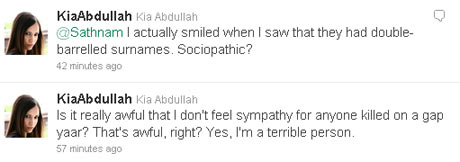
Kia Abdullah will think twice before letting her inner sociopath out on Twitter in future:

In the early hours of Tuesday morning, three young British men were killed in a bus crash in Thailand, just days after starting their gap year travels. A deeply tragic case — and one that will have left many British parents sick with worry. Annually about 100,000 young Brits take gap years.

But here’s a Twitter reaction from Kia Abdullah, a Guardian contributor:

Even if you think this sort of thing, sending it out immediately over Facebook or Twitter is just asking for a landslide of public abuse to land on your head. People who work in media have the least excuse for this kind of absent-minded faux pas, as they often pounce on celebrity or politician errors of exactly this sort.

June 23, 2011

Your social media reputation and your future employment prospects

Filed under: Cancon, Media, Technology — Tags: , , , , , — Nicholas @ 09:30

Chris Greaves posted this link, which should be a warning to everyone to be (even more) careful about your online reputation:

Camille Cacnio, a part-time receptionist at a car dealership, was caught in a 3-second video clip, stealing clothing from a looted store during the Stanley Cup riots.

She was fired.

Professional mountain biker Alex Prochazka posed in front of a burning car, while wearing a T-shirt from his sponsor Oakley.

The sunglass company promptly dropped him.

Carpenter Connor Mcilvenna declared the riots “awesome” on his Facebook page, and posted several pro-riot status updates, such as “atta boy vancity!!! show em how we do it!!!” and “vancouver needed remodeling anyway….”

RiteTech Construction was listed as his employer on his Facebook profile, and the next morning, Mcilvenna was fired.

His boss said he was flooded with emails and didn’t want the company’s reputation linked to the man.

“I think this will be a turning point in how employers look at social media,” said Peter Eastwood, a partner at Borden Ladner Gervais in Vancouver. “This is an extremely powerful tool that has potentially enormous and immediate consequences for a business.”

This is something the early bloggers had to face, that what you post online (or what is posted about you) will be there forever. No rational employer is going to offer you a job in future without at the very least running a Google search on you, and there’s already a niche market for employers to explore (doing a deeper search on prospective employees). Background check and personal references? I’m starting to wonder why employers even bother going through the motions any more.

June 22, 2011

Carr: LulzSec versus the CIA

Filed under: Government, Technology, USA — Tags: , , , , — Nicholas @ 07:50

Paul Carr is somewhat dismissive of the hacking exploits of the LulzSec group:

For the past few weeks, a hacker collective called LulzSec has been leading American and British authorities a merry dance. The group’s targets are seemingly random – Sony, the CIA, contestants of a reality TV show, the Serious Organised Crime Agency (Soca) – but their stated motive has remained constant: “we’re doing it for laughs”, or, to put it in internet parlance, “lulz”.

If one is to believe the media coverage – particularly here in the US‚ no one is safe from the ingenious hackers and their devilishly complex attacks. The truth is, there’s almost nothing ingenious about what LulzSec is doing: CIA and Soca were not “hacked” in any meaningful sense, rather their public websites were brought down by an avalanche of traffic — a so-called “distributed denial-of-service” (DDoS) attack. Given enough internet-enabled typewriters, a mentally subnormal monkey could launch a DDoS attack — except that mentally subnormal monkeys have better things to do with their time.

Even the genuine hacks are barely worthy of the word. Many large organisations use databases with known security holes that can easily be exploited by anyone who has recently completed the first year of a computer science degree: it’s no coincidence that so many of these hacker collectives appear towards the end of the academic year.

May 30, 2011

Yet another politician has Twitter exposure issues

Filed under: Cancon, Law, Politics, Technology — Tags: , , , — Nicholas @ 10:47

First, it was the turn of congressman Anthony Weiner to have his Twitter account hacked. Now it’s an Ontario Tory candidate whose Blackberry was stolen, and a picture of his genitals posted on his Twitter account:

Rookie PC candidate George Lepp says he’s embarrassed that a photo of his family jewels was posted on his campaign Twitter account for about 20 minutes before it was quickly unzipped.
Alan Sakach, communications director for the Ontario Conservatives, said the photo was inadvertently taken by Lepp’s BlackBerry when it was in his front pocket. The photo was posted after someone took it from the candidate for the riding of Niagara Falls, according to Sakach.

“He is pretty upset and embarrassed,” Sakach said of a photo that was posted on Lepp’s account Sunday. “It was removed as soon as it came to his attention.”

The Toronto Sun obtained grainy copies of the Twitter page images before they were removed.

The pictures — too graphic to reproduce in the newspaper — are of a man naked from the waist down, showing a close up of his penis and his crossed legs.

As commenters on that article point out, it’s hard to believe the “official” story in this case:

Antinephalist:
George Lepp’s pockets are transparent, are they? And the photo was taken while he wasn’t wearing pants, that apparently have transparent pockets?

jaysfan33:
so wait…this guy’s phone took a picture of his twig and berries from his pocket??!?! Then his phone happened to be stolen…then the thief looked through all the guys pictures on the phone found the shot in question and then uploaded it to twitter…yeah that sounds pretty likely.

what probably happened: this prev took a shot of his junk when boozed up and then thought it would be funny to post it online, some time passed and he remember oh wait, im running for office, this might not look good, so he took it down…unfortunately for him the snake was out of the bag

H/T to “Lickmuffin”, who posted this link in a comment on the original article about Congressman Weiner.

May 29, 2011

Jim Treacher calls for investigation into hacking of Rep. Anthony Weiner’s Twitter and Facebook accounts

Filed under: Law, Politics, Technology, USA — Tags: , , , — Nicholas @ 11:13

He’s quite right: this sort of thing must be stopped:

I don’t agree much with Rep. Weiner politically, but he’s a congressman and this is a serious crime he’s alleging. Not to mention that identity theft can happen to any of us at any time. Therefore, Rep. Weiner must call for an official investigation. He owes it to himself, to all other victims of cybercrime, and to his fellow members of Congress who might also be at risk. Defrauding someone’s online accounts in order to embarrass and defame them is unconscionable. The culprit must be brought to justice.

And if Rep. Weiner doesn’t want an investigation, somebody should ask him why not.

If you haven’t been following this, the smart money is betting that he won’t want any such investigation to be launched.

April 18, 2011

Happy thought of the day

Filed under: Law, Liberty, Media, Technology, USA — Tags: , , , , — Nicholas @ 15:43

Darlene Storm offers this cheery little nugget of information (from a post back in December):

Dear Americans: If you are not “authorized” personnel, but you have read, written about, commented upon, tweeted, spread links by “liking” on Facebook, shared by email, or otherwise discussed “classified” information disclosed from WikiLeaks, you could be implicated for crimes under the U.S. Espionage Act — or so warns a legal expert who said the U.S. Espionage Act could make “felons of us all.”

As the U.S. Justice Department works on a legal case against WikiLeak’s Julian Assange for his role in helping publish 250,000 classified U.S. diplomatic cables, authorities are leaning toward charging Assange with spying under the Espionage Act of 1917. Legal experts warn that if there is an indictment under the Espionage Act, then any citizen who has discussed or accessed “classified” information can be arrested on “national security” grounds.

H/T to Bruce Schneier for the link.

March 18, 2011

Old Spice Man – marketing hits and misses

Filed under: Media, USA — Tags: , , , , — Nicholas @ 10:04

Gary Vaynerchuk reviews the Old Spice Man campaign:

Unless you were living under a rock, you probably saw at least one of the Old Spice commercials starring Isaiah Mustafa that began airing the day after the 2010 Super Bowl. With this campaign, Procter & Gamble, Old Spice’s parent company, showed the world how a brand can play a kick-ass game of media Ping-Pong.

First, it started with outstanding content, spoofing every stereotype of masculinity they could come up with through clever writing and picture-perfect casting. As soon as a bare-chested Mustafa finished gliding around from one paperback-romance scenario to another, reassuring women that even if their man didn’t look like him, they could smell like him if they stopped using lady-scented body wash, millions of people rewound their DVRs and watched the ad again. And again. Then they started talking about it on Facebook and Twitter and making spoof videos on YouTube.

[. . .]

Did the Campaign Work?
It depends on whom you ask. For example, sales of Old Spice Body Wash, which were already on the rise, rose sharply — by 55 percent — over the three months following the first aired TV commercial, then soared by 107 percent (a statistic that included me, because I bought my first stick of Old Spice during that time) around the time the response videos began showing, but some seem to question whether the uptick might have been due to a two-for-one coupon promotion rather than a well-integrated social media campaign.

[. . .]

The Huge Miss
The Old Spice campaign is considered a huge social media win, one that hundreds of social media experts have praised, but here’s where the story takes a bit of a surprising turn. I was sure that Old Spice planned to use the information it has on its almost 120,000 Twitter followers to start engaging with each and every one of them on a personal, meaningful level. Every one of those people should have received an email, thanking the followers for watching the videos and offering them a reason to keep checking in. I’d love to be proven wrong, but I don’t think that happened. As of September 2010, almost two months after Old Spice ambushed Twitter, the Old Spice account has tweeted only twenty-three times, and not one of the tweets talks or interacts with an actual person or user of the brand. Ad Age published an article that begins “Old Spice Fades Into History . . .”

February 27, 2011

Athletes in the age of Facebook and Twitter

Filed under: Football, Media, Technology — Tags: , , , , — Nicholas @ 10:29

John Holler makes several good points in this story about a couple of NFL hopefuls who are having to defend their reputations due to the wonderful rumour-spreading abilities of social media and the willingness of sports reporters to try to create controversy:

Saturday at the Scouting Combine in Indianapolis, we got our first intense view of this media “New World Order.” Cam Newton and Ryan Mallett are two of the top quarterback candidates in this year’s draft. Yet, both of them spent significant portions of their media access to address questions that have nothing to do with football.

Newton, who has been under the media microscope for the last several months, had to clarify a comment he made about wanting to be “an entertainer” and “an icon.” It was a flippant comment made by a kid who is going to turn 22 in May. In his case, the question should be, “Yeah, so?” not a sanctimonious rant by media “entertainers” and/or “icons” to pass judgment that he is not focused on being a football player, but more interested in being a rock star.

Guess what? Newton should have nothing to apologize for. If you’re a star in the NFL, you are an entertainer. People drop hundreds of dollars to watch you perform for three hours. There are thousands of people employed to discuss what you do for a living. There is little difference between Peyton Manning and Bruce Springsteen. They do the same thing — entertain packed houses wherever they perform. [. . .]

Mallett is a different story. He has been called to task by what everyone reporting on it claims are rumors that he not only has taken drugs in college (no!) but might have an addiction to the party lifestyle. If it is true, he won’t be the first and he won’t be the last college football player to do things he wouldn’t put on his résumé. The timing of the accusations, the week of the NFL Scouting Combine, seems interesting. However, his response was hard to justify.

If there was no basis to the accusations, Mallett should have been advised to come out aggressive — denying the charges immediately and owning the situation before he gets his 15 minutes with NFL teams. Instead, he deflected the questions, which only gives rise to more speculation. In the Facebook/TMZ world we live in now, you can bet that media members are going to be provided with information — some will pay for it, others won’t — that will portray a bad side of Mallett that he likely doesn’t deserve, but will surely have to answer to.

The stakes are high for both of these young men: a badly chosen phrase could lose them literally millions of dollars by lowering their chances of being a high draft choice. It’s tough enough for media personalities and politicians to tap-dance around awkward situations, but young 20-something athletes don’t have the experience to avoid falling into the verbal traps.

February 13, 2011

Jay Rosen analyses the “Twitter Can’t Topple Dictators” meme

Filed under: Media, Technology — Tags: , , , , , — Nicholas @ 10:42

Jay Rosen has been seeing too many facile dismissals of the actual impact of Twitter and other social media tools in recent uprisings:

In other words, tools are tools, Internet schminternet. Revolutions happen when they happen. Whatever means are lying around will get used. Next question!

So these are the six signs that identify the genre, Twitter Can’t Topple Dictators. 1.) Nameless fools are staking maximalist claims. 2.) No links we can use to check the context of those claims. 3.) The masses of deluded people make an appearance so they can be ridiculed. 4.) Bizarre ideas get refuted with a straight face. 5.) Spurious historicity. 6.) The really hard questions are skirted.

If that’s the genre, what’s the appeal? Beats me. I think this is a really dumb way of conducting a debate. But I cannot deny its popularity. So here’s a guess: almost everyone who cares about such a discussion is excited about the Internet. Almost everyone is a little wary of being fooled by The Amazing and getting carried away. When we nod along with Twitter Can’t Topple Dictators we’re assuring ourselves that our excitement is contained, that we’re being realistic, mature, grown-up about it.

This feeling is fake. A real grown-up understands that the question is hard, that we need facts on the ground before we can start to answer it. Twitter brings down governments is not a serious idea about the Internet and social change. Refuting it is not a serious activity. It just feels good… for a moment.

January 23, 2011

John Scalzi on Facebook

Filed under: Technology — Tags: , , , — Nicholas @ 13:18

John Scalzi has been online for a long time. He even “handrolled his own html code and then uploaded it using UNIX commands because he was excited to have his own Web site, and back in 1993 that’s how you did it.” He’s not excited about Facebook. Not at all:

A friend of mine noted recently that I seemed a little antagonistic about Facebook recently — mostly on my Facebook account, which is some irony for you — and wanted to know what I had against it. The answer is simple enough: Facebook is what happens to the Web when you hit it with the stupid stick. It’s a dumbed-down version of the functionality the Web already had, just not all in one place at one time.

Facebook has made substandard versions of everything on the Web, bundled it together and somehow found itself being lauded for it, as if AOL, Friendster and MySpace had never managed the same slightly embarrassing trick. Facebook had the advantage of not being saddled with AOL’s last-gen baggage, Friendster’s too-early-for-its-moment-ness, or MySpace’s aggressive ugliness, and it had the largely accidental advantage of being upmarket first — it was originally limited to college students and gaining some cachet therein — before it let in the rabble. But the idea that it’s doing something better, new or innovative is largely PR and faffery. Zuckerberg is in fact not a genius; he’s an ambitious nerd who was in the right place at the right time, and was apparently willing to be a ruthless dick when he had to be. Now he has billions because of it. Good for him. It doesn’t make me like his monstrosity any better.

[. . .]

I look at Facebook and what I mostly see are a bunch of seemingly arbitrary and annoying functionality choices. A mail system that doesn’t have a Bcc function doesn’t belong in the 21st Century. Facebook shouldn’t be telling me how many “friends” I should have, especially when there’s clearly no technological impetus for it. Its grasping attempts to get its hooks into every single thing I do feels like being groped by an overly obnoxious salesman. Its general ethos that I need to get over the concept of privacy makes me want to shove a camera lens up Zuckerberg’s left nostril 24 hours a day and ask him if he’d like for his company to rethink that position. Basically there’s very little Facebook does, either as a technological platform or as a company, that doesn’t remind me that “banal mediocrity” is apparently the highest accolade one can aspire to at that particular organization.

I have a Facebook account, but only really check it every few days. Twitter, on the other hand I’ve found to be an excellent tool for a blogger: lots and lots of interesting stuff has come to my attention first through a Twitter update from journalists, bloggers, celebrities, and just ordinary folks. And it doesn’t try to worm its way into everything I do.

Some folks felt John was being too harsh on Facebook users, rather than the site itself, so he posted an update later that day:

* In comments here and elsewhere there was interpretation of me saying that Facebook wasn’t for someone like me, but it was for normal people as a) a way to signal that I am awesome and smart and also awesome, and b) normal people are stupid and suck, and that’s why they use Facebook. Yeah, no. It’s not for me because the functionality doesn’t map well for what I want to do or have for my online experience, and “normal” in this case doesn’t mean “stupid people who suck,” it means “people who don’t want to make the time/energy commitment to run their own site.”

It’s always a problem with written work . . . some people will misunderstand or misinterpret what you’re saying — deliberately or otherwise — and it’s difficult to make something so clear that it can’t be twisted. Did I say difficult? I should have said impossible.

December 4, 2010

QotD: “Every futuristic vision that starts with a clean slate has a genocide or an apocalypse lurking in it”

Filed under: Media, Quotations — Tags: , , , , , , — Nicholas @ 10:11

Here’s a clip of HG Wells in 1943 predicting the demise of the newspaper, as people abandon print journalism in favor of using their telephones for up-to-the-minute news.

In one way, it’s very prescient — “using the telephone to get the news” isn’t so far off from what we do on the web today. But in another way, it’s exactly wrong (after all, it’s been nearly 70 years and there are still newspapers), And it’s wrong in a way that futurists are often wrong: it assumes a clean break with history and the positive extinction of the past. It predicts an information landscape that is reminiscent of the Radiant Garden Cities that Jane Jacobs railed against: a “modern” city that could only be built by bulldozing the entire city that stood before it and building something new on the clean field that remained. Every futuristic vision that starts with a clean slate has a genocide or an apocalypse lurking in it. Real new cities are build through, within, around, and alongside of the old cities. They evolve.

As Bruce Sterling says, “The future composts the past.” What happened to newspapers is what happened to the stage when films were invented: all the stuff that formerly had to be on the stage but was better suited to the new screen gradually migrated off-stage and onto the screen (and when TV was invented, all the “little-screen” stories that had been shoehorned onto the big screen moved to the boob-tube; the same thing is happening with YouTube and TV today). Just as Twitter is siphoning off all the stuff we used to put on blogs that really wanted to be a tweet.

Cory Doctorow, “Newspapers are dead as mutton – HG Wells, 1943 (No, they’re not)”, BoingBoing, 2010-12-03

December 2, 2010

The Two Scotts in a split decision

Filed under: Football, Humour — Tags: , , , — Nicholas @ 07:56

Scott Feschuk and Scott Reid like different results in this week’s matchup between Minnesota and Buffalo:

Buffalo (plus 6.5) at Minnesota

Feschuk: So Buffalo’s Steve Johnson butterfingered a game-winning pass against the Steelers and, naturally, rushed to Twitter to blame it all on God.

Good for Johnson. It’s about time someone had the courage to call out God for the terrible season He’s having. Dude is the Randy Moss of deities — totally going through the motions. Come on, God: we’ve seen you torment the Bills and Lions for the last eon. TRY SOMETHING NEW. And what were you thinking when you let Satan get away with working his evil magic so that both Matt Millen and Joe Theismann are calling the Thursday night games? Not cool, God. Not cool at all. Pick: Buffalo.

Reid: You mean God isn’t a Buffalo fan? This IS news!

Pick: Minnesota.

Feschuk also has an excellent question that the league hasn’t yet answered:

The league’s ruling on Andre Johnson warrants a revisiting of what occurred on the field. Responding to the trash talk and rough play of Cortland Finnegan — the only NFL player whose name sounds like an Irish hotel chain — the Texans’ receiver ripped off Finnegan’s helmet and punched him repeatedly in the head and face.

Johnson’s punishment? The exact same fine that Chad Ochocinco had to pay for tweeting too close to game time. It raises the question: what do you have to do to get suspended by the NFL? Do you have to actually murder a linebacker? Defile the corpse of a Hall of Famer? Fail to gently lower Tom Brady to the ground and tenderly kiss him on the forehead while sacking him?

« Newer PostsOlder Posts »

Powered by WordPress