Here’s a clip of HG Wells in 1943 predicting the demise of the newspaper, as people abandon print journalism in favor of using their telephones for up-to-the-minute news.
In one way, it’s very prescient — “using the telephone to get the news” isn’t so far off from what we do on the web today. But in another way, it’s exactly wrong (after all, it’s been nearly 70 years and there are still newspapers), And it’s wrong in a way that futurists are often wrong: it assumes a clean break with history and the positive extinction of the past. It predicts an information landscape that is reminiscent of the Radiant Garden Cities that Jane Jacobs railed against: a “modern” city that could only be built by bulldozing the entire city that stood before it and building something new on the clean field that remained. Every futuristic vision that starts with a clean slate has a genocide or an apocalypse lurking in it. Real new cities are build through, within, around, and alongside of the old cities. They evolve.
As Bruce Sterling says, “The future composts the past.” What happened to newspapers is what happened to the stage when films were invented: all the stuff that formerly had to be on the stage but was better suited to the new screen gradually migrated off-stage and onto the screen (and when TV was invented, all the “little-screen” stories that had been shoehorned onto the big screen moved to the boob-tube; the same thing is happening with YouTube and TV today). Just as Twitter is siphoning off all the stuff we used to put on blogs that really wanted to be a tweet.
Cory Doctorow, “Newspapers are dead as mutton – HG Wells, 1943 (No, they’re not)”, BoingBoing, 2010-12-03
December 4, 2010
QotD: “Every futuristic vision that starts with a clean slate has a genocide or an apocalypse lurking in it”
December 2, 2010
The Two Scotts in a split decision
Scott Feschuk and Scott Reid like different results in this week’s matchup between Minnesota and Buffalo:
Buffalo (plus 6.5) at Minnesota
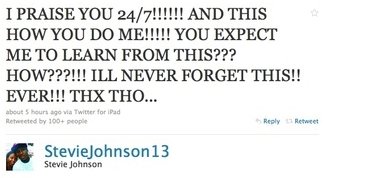
Feschuk: So Buffalo’s Steve Johnson butterfingered a game-winning pass against the Steelers and, naturally, rushed to Twitter to blame it all on God.
Good for Johnson. It’s about time someone had the courage to call out God for the terrible season He’s having. Dude is the Randy Moss of deities — totally going through the motions. Come on, God: we’ve seen you torment the Bills and Lions for the last eon. TRY SOMETHING NEW. And what were you thinking when you let Satan get away with working his evil magic so that both Matt Millen and Joe Theismann are calling the Thursday night games? Not cool, God. Not cool at all. Pick: Buffalo.
Reid: You mean God isn’t a Buffalo fan? This IS news!
Pick: Minnesota.
Feschuk also has an excellent question that the league hasn’t yet answered:
The league’s ruling on Andre Johnson warrants a revisiting of what occurred on the field. Responding to the trash talk and rough play of Cortland Finnegan — the only NFL player whose name sounds like an Irish hotel chain — the Texans’ receiver ripped off Finnegan’s helmet and punched him repeatedly in the head and face.
Johnson’s punishment? The exact same fine that Chad Ochocinco had to pay for tweeting too close to game time. It raises the question: what do you have to do to get suspended by the NFL? Do you have to actually murder a linebacker? Defile the corpse of a Hall of Famer? Fail to gently lower Tom Brady to the ground and tenderly kiss him on the forehead while sacking him?
November 21, 2010
He comes not to bury Twitter, but to praise it
Linked from one of Walter Olson’s Twitter updates, an interesting summary by Alan Rusbridger on the things that Twitter does for media folks:
I’ve lost count of the times people — including a surprising number of colleagues in media companies — roll their eyes at the mention of Twitter. “No time for it,” they say. “Inane stuff about what twits are having for breakfast. Nothing to do with the news business.”
Well, yes and no. Inanity — yes, sure, plenty of it. But saying that Twitter has got nothing to do with the news business is about as misguided as you could be.
Here, off the top of my head, are 15 things, which Twitter does rather effectively and which should be of the deepest interest to anyone involved in the media at any level.
There are lots of people who send Twitter updates on what they made for dinner, or what they’re watching on TV, but you don’t have to follow them. I’ve been amazed at how useful Twitter has been to me for keeping on top of what I think of as “blogfodder” items: things that I think my own readers would be interested in.
November 16, 2010
It was such an urgent threat that only a week later, the authorities reacted
A good round-up of the “Twitter bomber” case:
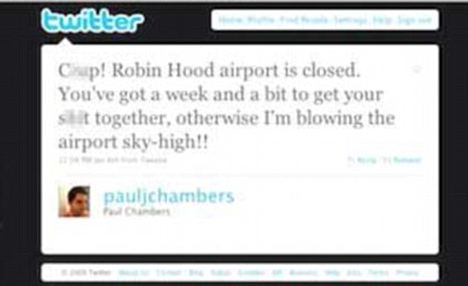
It all started with a moment of grumpy sarcasm on Twitter. Frustrated that his planned trip to Northern Ireland was put in jeopardy by heavy snow at Robin Hood Airport in Doncaster, Mr Chambers whipped out his iPhone and posted the following message on the social networking site: ‘C***! Robin Hood Airport closed. You have got a week to get your s*** together, otherwise I’m blowing the airport sky high!’
A week later, he was in a police station being quizzed as a potential terrorist. He was eventually prosecuted under a law aimed at nuisance calls rather than under legislation for bomb hoaxes, which requires stronger evidence of intent.
After all, it was plain as a pikestaff that Mr Chambers didn’t have any intent to bomb anything at all. Even so, he was hauled before magistrates, found guilty of sending a menacing electronic communication and fined £385. A few days ago, Mr Chambers lost his appeal against his conviction and sentence.
He will now have to pay £2,600 legal costs as well. Judge Jacqueline Davies, who was sitting with two magistrates, ruled the tweet was ‘menacing in its content and obviously so’, claiming ‘any ordinary person’ would ‘be alarmed’ by it.
October 9, 2010
I know what they meant to say
The original wording:

Then the corrected version:

September 6, 2010
Fifteen albums/fifteen minutes
I got tagged with this Facebook meme by David Stamper a little while ago, but I’m only now just getting around to addressing it. Here’s the description I was sent:
The rules: Do this if it’s fun. Don’t take too long to think about it. Fifteen albums you’ve heard that will always stick with you. List the first fifteen you can recall in no more than fifteen minutes. Tag fifteen friends, including me, because I’m interested in seeing what albums you choose.
So, because I’m too lazy to do it in Facebook, I’m doing it here (eventually, through the magic of Twitter, the link’ll appear in Facebook anyway). Roughly in chronological order:
- Rush, A Farewell to Kings
- Al Stewart, Past, Present & Future
- Led Zeppelin, Led Zeppelin IV
- The Alan Parsons Project, Tales of Mystery and Imagination
- Dire Straits, Dire Straits
- Kate Bush, Hounds of Love
- Neil Young, Live Rust
- Pink Floyd, Wish You Were Here
- King Crimson, In the Court of the Crimson King
- Kitaro, Silk Road
- Stan Rogers, Northwest Passage
- Dead Can Dance, The Serpent’s Egg
- The Pogues, If I Should Fall From Grace With God
- John Coltrane, A Love Supreme
- Charles Mingus, The Black Saint and the Sinner Lady
I had to take it in chronological order to limit it to only fifteen, so no really recent stuff . . . but perhaps that’s fair as it’ll take time to show if more recent stuff will hold up to long-term listening. Not quite making it onto the list was Sketches of Spain by Miles Davis & Gil Evans.
August 5, 2010
US governments still finding this “free speech” thing annoying
If you support the notion of free speech, it is most important to support it during elections . . . but not everyone feels this way:
The Associated Press reports that California’s Fair Political Practices Commission (FPPC) is considering “how to regulate new forms of political activity such as appeals on a voter’s Facebook page or in a text message.
Not whether to regulate these new forms of political speech, but how.
The recommendations apparently include “requiring tweets and texts to link to a website that includes . . . full disclosures, although some people feel the disclosure should be in the text itself no matter how brief . . . .”
To paraphrase Chief Justice John Roberts, this is why we don’t leave our free speech rights in the hands of FPPC bureaucrats. To bureaucrats like those at the FPPC, the Federal Election Commission or their analogues, there seems to be no need to show any evidence that Twitter, Facebook or text messages actually pose any threat to the public. It is enough that they these new forms of low-cost media aren’t currently regulated, but could be. Their primary concern, apparently, is that the regulation of political speech be as comprehensive as possible.
Free speech can be a messy thing — but censorship is worse.
July 23, 2010
July 15, 2010
Facebook usage patterns differ by gender
I have a Facebook account, but I use it infrequently (the vast majority of my FB activity is just status posts echoed from my Twitter account, actually). For certain groups, however, Facebook is far more critical to their lives . . . young women, for example:
According to a new report released by Oxygen Media and Lightspeed Research, about one-third of women on Facebook between 18 to 34 in age check this social networking site in the morning as the first thing even before going to bathroom. Some of the other astonishing facts deduced from this research on young women are as follows.
* 21% of women age 18-34 check Facebook in the middle of the night
* 63% use Facebook as a networking tool
* 42% think it’s okay to post photos of themselves intoxicated
* 79% are fine with kissing in photos
* 58% use Facebook to keep tabs on “frenemies”
* 50% are fine with being Facebook friends with complete strangers
Clearly there haven’t been enough stories about people losing their jobs over inappropriate posts on Facebook . . . maybe they aren’t being posted to Facebook itself.
Apple to hold news conference on iPhone 4 today
BBC News reports that Apple has called a surprise news conference:
The company has refused to give details about whether the event will address reception problems that some users have reported with the phone, launched just last month.
Apple has faced mounting criticism from analysts and consumers over its handling of the issue.
Industry watchers said the firm was in danger of damaging its “rock star” reputation over how poorly it had dealt with what would normally be a minor problem.
“It seems there has been a real crisis of leadership here,” said Patrick Kereley, senior digital strategist for Levick Strategic Communications which deals in crisis managment and reputation protection.
“There are so many conflicting reports about this issue and a lot of confusion in the marketplace. They need a plan of attack. Today’s companies have to react quickly before chatter on Facebook or Twitter turns into news headlines as is the case here,”
Of course, blaming the problem on Facebook and Twitter users isn’t particularly appropriate: there is a problem with the iPhone 4 and even the most pro-Apple folks are noticing it and complaining. Apple has reacted very badly to their most enthusiastic customers, and (for a change) appears to be damaging their reputation. Now that they’re no longer seen as underdogs, the haughty and uninformative response won’t work.
June 12, 2010
In this case, a tie is (kinda) okay
In international competitions, it’s always hard to watch when your first and second favourite teams play head-to-head. Had Canada made it to the World Cup, I’d be cheering for Canada first, England second, and USA third. Canada didn’t qualify (again), so I had to watch my other two preferred teams fight it out. A draw at least leaves both teams alive for advancing out of the group stage.
To see how the game unfolded according to the Twitterati, check this Guardian page, where it tracks the progress of the game against the hashtagged posts on Twitter.
June 2, 2010
Tweet of the day
IMAO_ (Frank J. Fleming): You can’t watch “It’s a Wonderful Life” these days without thinking how much sense Mr. Potter is making about irresponsible lending.
April 13, 2010
Another interesting use of Twitter
The brief log entries at RAF Duxford, a Royal Air Force airfield in Cambridgeshire, will move from the historical Operations Record Book to Twitter to mark the 70th anniversary of the Battle of Britain:
Every squadron, station and certain other units in the Royal Air Force had to complete an Operations Record Book, known as a Form 540.
Those for RAF Duxford and No 19 Squadron from 1940 show events such as patrols over Dunkirk, the problems encountered with early cannon-armed Spitfires, and the arrival of Czech pilots to form 310 Squadron.
They describe the sorties carried out by No 19 Squadron and pilots’ experiences during dogfights over south-east England.
A museum spokesman said: “This exciting new campaign will give a direct insight into Battle of Britain history, and will show how the campaign built in momentum throughout 1940.
Follow RAFDuxford1940 on Twitter.
April 12, 2010
Updating Romeo & Juliet for the YouTube/Twitter generation
The Guardian looks at a new Royal Shakespeare Company production of Romeo and Juliet:
But soft! What tweet through yonder iPhone breaks? It is the east, and @julietcap16 is the sun.
Actually, Juliet Capulet is probably offline at the moment: being only 16, she has to go to school even on her birthday, where to her indignation Twitter is banned. She’ll be back. And there’s a big party planned tonight that could change all their lives: does any of this sound at all familiar?
The Royal Shakespeare Company today joined with the cross-platform production firm Mudlark and Channel 4’s digital investment fund, 4iP, to launch Such Tweet Sorrow, a drama in real time and 4,000 tweets, very roughly based on Shakespeare’s Romeo and Juliet.
The Bard of Avon’s 1597 tragedy of flirty, street-fighting teenagers disastrously caught up in the double trauma of real love and their parents’ murderous small-town rivalries is already one of the most adapted of his works. It has been continuously reinvented as an opera, a ballet, a musical, a lesbian love story, a geriatric love story and even an ice show.
This time, Juliet is the daughter of a successful property developer. Her mother died in a car driven by the artist Montague; her father will no longer tolerate any of his works in the house, much less his son. Her brother Tybalt is well on his way to being expelled from his latest boarding school, and their older sister Jess, nicknamed Nurse, keeps well out of the way of their new stepmother.
I’m usually pretty conservative about “re-imagining” Shakespeare, but this sounds like an interesting performance.
Update, 13 April: Full story so far here.
February 24, 2010
Tweet of the day
colbycosh:
Remind me how this clownish, feeble US team beat us? Oh, right, our goalie in that game was 52 years old and tripping balls on peyote.