Quotulatiousness

January 29, 2012

EFF says “Keep Twitter Honest”

Filed under: Law, Liberty, Media, Technology — Tags: , , , , — Nicholas @ 12:47

The Electronic Frontier Foundation explains the facts about Twitter’s recent announcement that it will be able to remove Tweets on a country-by-country basis:

Yesterday, Twitter announced in a blog post that it was launching a system that would allow the company to take down content on a country-by-country basis, as opposed to taking it down across the Twitter system. The Internet immediately exploded with allegations of censorship, conspiracy theories about Twitter’s Saudi investors and automated content filtering, and calls for a January 28 protest. One thing is clear: there is widespread confusion over Twitter’s new policy and what its implications are for freedom of expression all over the world.

Let’s get one thing out of the way: Twitter already takes down some tweets and has done so for years. All of the other commercial platforms that we’re aware of remove content, at a minimum, in response to valid court orders. Twitter removes some tweets because they are deemed to be abuse or spam, while others are removed in compliance with court orders or DMCA notifications. Until now, when Twitter has taken down content, it has had to do so globally. So for example, if Twitter had received a court order to take down a tweet that is defamatory to Ataturk — which is illegal under Turkish law — the only way it could comply would be to take it down for everybody. Now Twitter has the capability to take down the tweet for people with IP addresses that indicate that they are in Turkey and leave it up everywhere else. Right now, we can expect Twitter to comply with court orders from countries where they have offices and employees, a list that includes the United Kingdom, Ireland, Japan, and soon Germany.

Twitter’s increasing need to remove content comes as a byproduct of its growth into new countries, with different laws that they must follow or risk that their local employees will be arrested or held in contempt, or similar sanctions. By opening offices and moving employees into other countries, Twitter increases the risks to its commitment to freedom of expression. Like all companies (and all people) Twitter is bound by the laws of the countries in which it operates, which results both in more laws to comply with and also laws that inevitably contradict one another.

China and the censorship state

Filed under: China, Government, Liberty, Media — Tags: , , , , , — Nicholas @ 12:02

Rebecca MacKinnon in the National Post on the ways and means of ensuring “harmony” in China’s corner of the internet:

In fall 2009, I sat in a large auditorium festooned with red banners and watched as Robin Li, CEO of Baidu, China’s dominant search engine, paraded onstage with executives from 19 other companies to receive the “China Internet Self-Discipline Award.” Officials from the quasi-governmental Internet Society of China praised them for fostering “harmonious and healthy Internet development.” In the Chinese regulatory context, “healthy” is a euphemism for “porn-free” and “crime-free.” “Harmonious” implies prevention of activity that would provoke social or political disharmony.

China’s censorship system is complex and multilayered. The outer layer is generally known as the “great firewall” of China, through which hundreds of thousands of websites are blocked from view on the Chinese Internet. What this system means in practice is that when one goes online from an ordinary commercial Internet connection inside China and tries to visit a website such as hrw.org, the website belonging to Human Rights Watch, the web browser shows an error message saying, “This page cannot be found.” This blocking is easily accomplished because the global Internet connects to the Chinese Internet through only eight “gateways,” which are easily “filtered.” At each gateway, as well as among all the different Internet service providers within China, Internet routers — the devices that move the data back and forth between different computer networks — are all configured to block long lists of website addresses and politically sensitive keywords.

These blocks can be circumvented by people who know how to use anti-censorship software tools. It is impossible to conduct accurate usage surveys, but it is believed likely that hundreds of thousands of Chinese Internet users deploy these tools to access Twitter and Facebook every day. Yet researchers estimate that out of China’s 500 million Internet users, only about 1% or so (a number somewhere in the single-digit millions — still a large number of people but not enough percentage-wise to shape majority public opinion) use these tools to get around censorship, either because most do not know how or because they lack sufficient interest in, or awareness of, what exists on the other side of the “great firewall.”

January 19, 2012

SOPA delenda est!

Filed under: Law, Liberty, Technology, USA — Tags: , , , , , — Nicholas @ 12:17

Matt Peckham on the results of yesterday’s blackout:

On Wikipedia’s SOPA Initiative/Lean More page, the site notes that over 12,000 people commented on the Wikimedia Foundation’s post announcing the blackout — ”A breathtaking majority supported the blackout.” On Twitter, Wikipedia says the hashtag topic #wikipediablackout “at one point…constituted 1% of all tweets,” and that SOPA-related Twitter posts were popping off at a rate of a quarter-million every hour. And finally: Wikipedia says over eight million visitors used the site’s zip code tool to look up their elected representatives.

All the traffic to Congressional websites definitely had an impact: At one point Senator Ron Wyden (D-OR) tweeted “Anti- #PIPA, #SOPA traffic has temporarily shut down our website.” Other Congressional websites were reportedly slow to load throughout the day or returned error messages for visitors.

And then, the political dominoes began to fall: Senator Marco Rubio (R-FL) renounced his support for SOPA (he co-sponsored the bill) yesterday on Facebook, Senator Jim DeMint (R-SC) used Twitter to tell the world he now opposes the bill and Senator John Cornyn (R-TX) told his Facebook followers “better to get this done right rather than fast and wrong.”

The New York Times reports “then trickle turned to flood,” noting that Senators Mark Kirk (R-IL), Roy Blunt (R-MO), Jeff Merkley (D-OR) and Chuck Grassley (R-IA) as well as Representatives Lee Terry (R-NE) and Ben Quayle (R-AZ) announced their opposition to the bill. The Times adds that “at least 10 senators and nearly twice that many House members announced their opposition.”

My own tiny contribution wasn’t particularly conclusive: traffic to the blog (in spite of the anti-SOPA clickthrough page) was up by about 20% over the previous week’s average.

December 22, 2011

Britain, Argentina, and the Falkland Islands

Filed under: Americas, Britain, History, Military — Tags: , , , , , — Nicholas @ 15:39

Yesterday, I sent a Twitter update linking an article about rising tensions between Argentina and the United Kingdom over the Falkland Islands:

The South American trade group Mercosur, wrapping up a two-day summit in Uruguay, has sided with Argentina in its ongoing dispute about the Falkland Islands, which it calls the Malvinas, announcing it will ban boats with Falkland Islands flags from their ports.

[. . .]

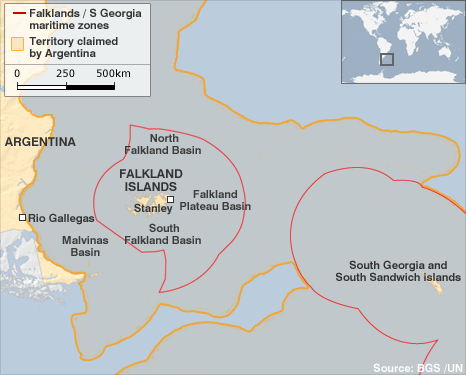
Note the flurry of activity since 2010. The dispute has become heightened over resources, as British firms explore for oil in the waters surrounding the islands.
I described the article at the link as “early moves in the next Falklands War”. I then followed up with a another Tweet: “Of course, if Argentina decides to take the Falkland Islands, Britain no longer has the navy to stop them. No carriers = no force projection”

This struck Craig Chandler as seriously misunderstanding the risks: “War can still happen. Do not delude yourself.” I responded that I was “Not deluded about risk of war. Just realistic about outcome.” That is, I didn’t think Britain had any chance of pulling off a victory if Argentina resorted to the military option (again).

Craig had a remarkably positive view of British military power: “Britain would crush them. Missiles, Jets etc… Lot’s of ways to fight a modern war” and “Britain allies would join with them. An attack on one of us is an attack on all of us. Thus, victory would be 100% for Britain”. I responded “Even Reagan had to be cajoled into supporting Thatcher in 82. Obama? Doubt he feels any strong attachment to the UK.” “The UK would have to lodge protest in UN, impose trade sanctions, sit back and accept facts on the ground.”

I was starting to struggle with Twitter’s 140 character limit, as there was much I wanted to say that couldn’t easily be condensed into Twitter-friendly lengths. I’ve said on the blog that Britain’s scrapping of the Harriers and decommissioning/scrapping the remaining aircraft carriers was an open invitation to Argentina to try the Falklands issue again. Argentina’s President Cristina Kirchner wouldn’t be using words like “arrogant” (describing the British government) and characterizing the Prime Minister’s comments as an “expression of mediocrity and almost of stupidity” without good reason.
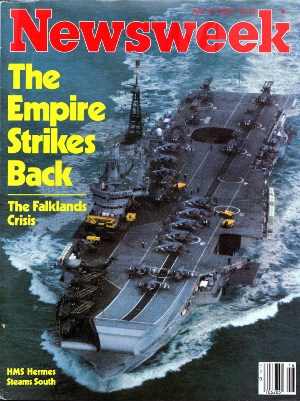
Britain was lucky in 1982, as the government of the day was desperately seeking economies in the budget and (as there was no war with anyone on the horizon), scrapping their aircraft carriers looked like a great way of reducing costs. They’d reduced their military presence in the South Atlantic in an attempt to both save money and appease Argentinian feelings. The announced reductions prompted Argentina’s military rulers to use an external war for internal political benefit. Argentina struck before the intended “economizing” took place. Had they waited six months, Britain would not have had the means to launch the counter-attack that retook the Falklands.
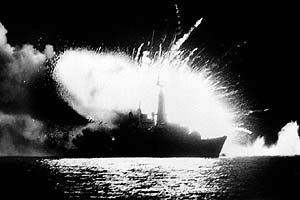
Even with the aircraft carriers HMS Hermes and HMS Invincible each operating several extra Harriers, the British were just barely able to keep enough aircraft going to fend off the majority of Argentinian attacks (losing two destroyers, two frigates, and several support ships sunk or severely damaged). With the Argentinian navy almost entirely confined to base after the sinking of the ARA Belgrano, the British could concentrate on air defence.

Having fought the fleet into position for the invasion, it was possible to pull the more vulnerable ships further out of range for Argentinian air strikes (as even at this stage, losing one of the carriers would endanger the entire mission). While it was much more than a “mere matter of marching”, the smaller but much better trained British forces (primarily Royal Marines, paratroops, Guards, and Gurkhas) were able to defeat the Argentinian troops and bring the military campaign to a close.

Anyway, Craig had an even more positive view of Britain’s likely political and military support today: “The USA owes the UK much for Iraq and Afghanistan there is also the entire Common Wealth. Argentina would be invaded.” “It would be all out war. No acceptance. The Common Wealth and other UK allies would come to support.” I think there’d be some forms of support short of military action: in 1982, for example, New Zealand sent a frigate to the Indian Ocean to replace a Royal Navy ship that was needed to support the Task Force. The rest of the Commonwealth gave verbal and diplomatic support, but no significant military assistance. Today’s Commonwealth is hardly a significant military player — Canada, Australia, and New Zealand combined could not even provide a full division of troops, and none of them would be willing to get involved in a land war in South America on Britain’s behalf.

As far as the islands themselves, there have been some significant changes since 1982, the most significant being a new Royal Air Force base with permanently stationed modern Typhoon fighters (although only four of them at last report). The island transportation net has vastly improved since 1982 — when the only permanent roads were within Port Stanley proper — with all-weather roads now linking all mainland settlements. In addition to the RAF base personnel, there is a British garrison force of a reinforced infantry company and supporting troops, and the Falkland Islands Defence Force which is a company-sized unit of part-time troops.

Argentina’s armed forces have also changed significantly since the war. Two of the most significant changes were post-war fall of the military Junta and the elimination of conscription (creating a more modern, better-trained professional army, navy and air force). The Argentinian navy no longer has a purpose-built landing ship (the ARA Cabo San Antonio was retired shortly after the war and replaced with a modified cargo vessel). They have three submarines in service (replacing the one sub active in 1982), and have replaced all their WW2-vintage ships with more modern designs from France and Germany. The marines, who were the best of the Argentinian troops in 1982, are organized in five battalions of infantry, with supporting artillery, anti-aircraft, engineering and special forces detachments.

Anyway, back to the Twitter exchange that started this. After I’d responded to Craig’s last comment, Colby Cosh joined the discussion: “Sign me up for a bet on 2 PARA if it comes to that, will you?”. I’ll just reproduce the rest of the exchange in approximately correct order below:

NR: “Admire the Paras, but you can’t drop from that far away.”
CC: “I guess they must have teleported onto Goose Green last time.”
NR: “They certainly didn’t fly in from Heathrow!”
CC: “I’m guessing they’ll use the Bay-class ships they built for pretty much that exact mission?”
NR: “Not without air cover.”
CC: “I’m no admiral, but somehow I did get the memo about the fetish for “capital ships” being obsolete.”
NR: “Carriers still relevant.”
CC: “Meanwhile, the Argie navy has not exactly thrived under civilian rule. Not sure if that’s relevant?”
NR: “For a short-haul invasion, you don’t need a massive navy. Air cover is the key. UK only has 1 sub in region normally.”
NR: “No way at all to prevent an invasion, but in 82 UK still had (barely enough) carrier air to cover counter-attack. No longer true”
CC: “Air cover *less* important for Bay class now with close-in antimissile guns. And RN is still operating two carriers, you know.”
NR: “UK paid off Ark Royal and Invincible. Replacement ships still years from launching.”
CC: “The RN just tried out HMS Ocean (I think it was Ocean) as a platform for Apache in the Gadhafi raids.”
CC: “Replacements for fixed-wing capability, yes. Ocean & Illustrious are configured for choppers now.”
NR: “Chopper-equipped force versus missile-armed fighters? Outcome not good for choppers without lots of luck.”
CC: “Helicopters are the name of the game in an amphib op anyway; hence the reconfig.”
NR: “For amphibious work, choppers are great support. Not designed to fight against fixed-wing fighters.”
CC: “We’re forgetting that the islands themselves are garrisoned much more heavily than in ’82.”
NR: “Still indefensible vs Arg”
CC: “The Typhoons that are there are certainly at the sharp end until RN’s Harriers are replaced.”
NR: “Not enough of them to matter.”
CC: “You’ve convinced me to worry about this a little more than I would’ve”
NR: “I’ll post a “Mission Accomplished” banner. ;-)”

Colby did point out some weaknesses in my original contention: for example, I’d forgotten about the construction of the new RAF base, but it isn’t equipped to fight a war: it’s an expensive trip-wire. Four aircraft aren’t going to be enough (especially as Britain had, as of the Libya campaign, only 69 qualified Typhoon pilots). I’ll admit I’m a bit less sanguine about Argentina just waltzing in to Port Stanley this time, but I still think if they can pull off a quick disabling strike followed by a landing, Britain will not be able to reverse the outcome like they did in 1982.


December 7, 2011

Beijing’s “smog blog” at the US Embassy

Filed under: China, Environment, Media, USA — Tags: , , , , — Nicholas @ 12:04

The official line is that the smog in Beijing is merely inconvenient, while the US Embassy’s Twitter account sends out regular readings that conflict with the official story:

It was a contest over smog that was being fought across two social networks in two completely different languages between two contenders separated by the world’s biggest firewall. At stake was the authority to define “unhealthy air” and, as a result, to shape public perceptions and expectations.

On one side was an automated air quality monitoring station set up by the US embassy in Beijing that issues hourly updates via Twitter on the @beijingair account. It states the date, time, pollutions readings for ozone and PM2.5 and a terse English summary of the health implications. At 8am, it read “very unhealthy” — an improvement on the “hazardous” level of the previous day and the alarming “beyond index” of last Friday.

On the other side was the personal microblog of Du Shaozhong, the deputy director of the Beijing Municipal Environmental Protection Administration, who has taken his passionate defence of the city’s policies onto China’s most influential website, Sina Weibo. One of his most recent posts read: “It is understandable if people hate bad weather, but venting your emotions is not helpful.”

December 6, 2011

The Battle of Ortona

Filed under: Cancon, Germany, History, Italy, Military, WW2 — Tags: , , , — Nicholas @ 10:16

The Laurier Centre for Military Strategic and Disarmament Studies is marking the anniversary of the Battle of Ortona in 1943 by sending Twitter updates from @BattleOfOrtona to outline the historical events of the 1st Canadian Division and the 1st Canadian Armoured Brigade in this key battle of the Italian Campaign. Here is the situation just before the battle opened, from Terry Copp:

The Canadians were involved in a series of isolated battles in the mountains of Central Italy in November 1943 when General Bernard Law Montgomery issued orders for an advance up the Adriatic Coast to seize control of the east-west road Pescara to Rome. The American 5th Army was to launch a direct advance towards Rome at the same time.

The Canadians were still in the mountains when British, Indian, and New Zealand troops fought their way across the Sangro River, forcing a German withdrawal to the Moro River. The 78th British “Battleaxe” Division had shot its bolt at the Sangro and Montgomery ordered the fresh, full strength Canadian Division to take over the advance on the coastal flank. The move was to be completed by the night of 5 December.

The German 10th Army, responsible for the defence of Italy east of the Appenine Mountains, contained 12 divisions — 10 infantry and 2 armoured. The 76 Panzer Corps held the river lines south of Pescara with 1st Parachute, 90th Panzer Grenadier, 26th Panzer and 65th Infantry divisions. Normally an attacker needs to outnumber the defender by at least 3:1. This ratio could not be achieved in December 1944 and with the beginning of heavy winter rains air power could only play a small role. Everyone but the infantry was optimistic.

December 1, 2011

A defence of Jeremy Clarkson’s “strikers should be shot” comment

Filed under: Britain, Liberty, Media, Technology — Tags: , , , , , , — Nicholas @ 09:32

From, of all places, the Guardian:

How are your outrage levels today? Seen a sweary racist on a tram? Heard a TV personality make a bad joke about shooting public sector workers? Retweeted it and carefully added the correct hashtag?

Were you really, genuinely outraged?

Think about how you would have reacted to the story of an obnoxious woman on a tram seven years ago (pre-YouTube — PYT if you like). Would you have told everyone you know? Would you have asked them to tell everyone they know? Or would you have shrugged, mumbled something about the world going to hell in a handcart, and gone back to watching Top Gear, only to be confronted by Jeremy Clarkson making a hilarious joke about Spanish woman gypsy drivers (shrug again, change channel).

YouTube and Twitter are wonderful, wonderful things that have changed how we interact with the world, to the extent that I’m not sure I can remember life PYT. But they have created a mechanism by which we can we can monitor and record behaviour, whether of private citizens or public figures, play them over and over again, and share them with an alarming rapidity. Perhaps this heightened speed also leads us to feel forced into heightened reactions. Without the time to digest context and meaning we can only choose from a range of default reactions, largely based on our own prejudices.

[. . .]

Likewise with angry racist tram lady. My initial reaction to the video was “God, that’s horrible”, but as the storm grew, to the point where even Mia Farrow felt the need to tell us that she thought racism in south London was, y’know, just awful, I couldn’t help but feel sorry for the woman who had become a vessel for everyone else’s outrage. The sheer volume of righteousness becomes off-putting.

And now Clarkson, who has made a dull golf club bar joke about striking public sector workers needing to be shot. God knows the man doesn’t need my pity, but I feel driven towards feeling sorry for anyone who has several thousand people calling for their head simply because they’ve noticed that he’s done the same kind of thing he’s always done. I don’t think there’s a single reasonable person there who actually believes that Clarkson wants people to be shot for going on strike, so why do people feel the need to react the way we do? Lord knows we’re not talking about the most subtle of jokes here, but must we be so literal and unsubtle in our reaction?

Update: Just saw an update from BBCBreaking that Clarkson has apologized for the “should be shot” comment.

November 27, 2011

Scalzi tweets the Lord of the Rings movies

Filed under: Humour, Media — Tags: , — Nicholas @ 11:28

Stream of consciousness tweets as John Scalzi has an at-home movie marathon:

“The Mimes of Moria” is the name of my next band.

Wife is at a rock concert tonight. I’m watching cable TV at home. Thus are illustrated the differences between us.

OSHA clearly has no jurisdiction in Moria.

[. . .]

The Two Towers now I on. I hold the minority view that it is the best film of the trilogy.

That said, I’d’ve trimmed back the ent scenes pretty severely.

I SWEAR I did not realize I was making a tree pun in that last tweet.

I am suddenly aware of just how little difference there is between Orlando Bloom’s Legolas and certain sparkly vampires one could name.

Orcs vs. Stormtroopers. GO. On second thought, never mind. Neither side aims well enough for it to be interesting.

[. . .]

Fun fact: Shadowfax, the horse Gandalf rides, had a younger, hipper sibling named “Darktweet.”

I wonder what dentists think when they look at Orcs. I suspect “that’s a sailboat right there.”

They could have just distracted the Wargs by throwing a bunch of red bouncy balls and yelling “fetch.”

The orcs would be awesome in a Road Warrior movie. The orcs probably WERE in a Road Warrior movie.

November 20, 2011

If you’re not paying for the service, you are the product

Filed under: Economics, Media, Technology — Tags: , , , , , — Nicholas @ 10:07

John Naughton points out that TANSTAAFL still applies, even to “free” services on the internet like Facebook and Twitter:

Physics has Newton’s first law (“Every body persists in its state of being at rest or of moving uniformly straight forward, except insofar as it is compelled to change its state by force impressed”). The equivalent for internet services is simpler, though just as general in its applicability: it says that there is no such thing as a free lunch.

The strange thing is that most users of Google, Facebook, Twitter and other “free” services seem to be only dimly aware of this law. Facebook, for example, handles the pages of 750 million users, enables more than half of that number to visit and update their pages every day and hosts more than 70 billion photographs. The cost of the computing and communications resources — in terms of server farms, energy, bandwidth and technical expertise — required to make this happen doesn’t bear thinking about. And my guess is that most Facebookers don’t think about it.

But it costs money — millions of dollars a month, every month. The monthly amount is called the “burn rate”. It comes from investors who make their cash available for burning in the hope that it will eventually pay off in terms of a stock market flotation or the evolution of a profitable business whose shares will be worth holding. In the internet era, the favoured strategy has been to “get big fast” (the title of a famous book about Amazon — that is, add users/subscribers at an exponential rate, and then find a way of monetising the resulting hordes.

November 15, 2011

Salman Rushdie: Facebook is run by morons

Filed under: Books, Bureaucracy, Media, Technology — Tags: , — Nicholas @ 09:09

There’s this chap on Facebook called Ahmed Rushdie. He’s a tad unhappy with Facebook over their naming policies:

Facebook has upset Salman Rushdie after the company initially refused to let the controversial author use his common name rather than his first name when signing up to the network.

The writer, who is a newcomer to the Web2.0 game, explained on Twitter that his full name is Ahmed Salman Rushdie.

“Amazing. 2 days ago FB deactivated my page saying they didn’t believe I was me. I had to send a photo of my passport page. THEN…” he tweeted, “they said yes, I was me, but insisted I use the name Ahmed which appears before Salman on my passport and which I have never used.

“NOW… They have reactivated my FB page as ‘Ahmed Rushdie,’ in spite of the world knowing me as Salman. Morons. @MarkZuckerbergF? Are you listening?”

The author of The Satanic Verses, who was forced into hiding in 1989 when a fatwa ordering Muslims to kill Rushdie was issued against him by Iran’s Ayatollah Khomeini, continued to rant about his Facebook plight on Twitter.

November 9, 2011

Recapping World War 2 through Twitter updates

Filed under: History, Military, Technology, WW2 — Tags: — Nicholas @ 08:56

It’s a huge undertaking, but Alwyn Collinson will be sending out frequent Twitter updates with 72-year-old “breaking news”:

The account, @RealTimeWWII, features up to 40 tweets each day and has attracted almost 45,000 followers as German forces tear across Europe in the autumn of 1939.

It covers major military and political developments, as well as featuring eyewitness testimony from the battlefield, contemporary photography and newsreel footage.

Created by 24-year-old Alwyn Collinson, the project is an attempt to “help people feel like they’re there”.

“I’m hoping to use Twitter to help bring the past to life, helping people understand the past as people at the time saw it, without the benefit of hindsight,” he said.

“I want them to see that people then were just like they are.”

I’d follow this myself, but I’m already overwhelmed with all the Twitter accounts I currently follow. This is a much bigger undertaking than the “live tweeting” of the Battle of Britain by the Imperial War Museum.

November 7, 2011

Charles Stross on “evil social networks”

Filed under: Law, Liberty, Media, Technology — Tags: , , , — Nicholas @ 09:29

You could say that Charles Stross isn’t a fan of social networks in general, and Klout in particular:

“If you’re not paying for the product, you are the product.”

In the past I’ve fulminated about various social networking systems. The basic gist is this: the utility of a social network to any given user is proportional to the number of users it has. So all social networks are designed to tweak that part of the primate brain that gets a dopamine reward from social activity — we are, after all, social animals. But providing a service to millions of customers is expensive, and your typical internet user is a cheapskate who has become accustomed to free services. So most social networks don’t charge their users; they are funded indirectly, which means they’ve got to sell something, and what they’ve got to sell is data about your internet usage habits, which is of interest to advertisers.

So the ideal social network (from an investor’s point of view) is one that presents itself as being free-to-use, is highly addictive, uses you as bait to trap your friends, tracks you everywhere you go on the internet, sells your personal information to the highest bidder, and is impossible to opt out of. Sounds like a cross between your friendly neighbourhood heroin pusher, Amway, and a really creepy stalker, doesn’t it?

So what is it about Klout that sets it apart from the other social networks?

Klout operates under American privacy law, or rather, the lack of it. If you created a Klout account in the past, you were unable to delete it short of sending legal letters (until November 1st, when they kindly added an “opt out” mechanism). More to the point, Klout analyse your social graph and create accounts for all your contacts without asking them for prior consent. It also appears to use an unwitting user’s Twitter or FB credentials to post updates on their Klout scores, prompting the curious-but-ignorant to click on a link to Klout, whereupon they will be offered a chance to log in with their Facebook or Twitter credentials. So it spreads like herpes and it’s just as hard to get rid of. Is that all?

[. . .]

Anyway: if you sign up for Klout you are coming down with the internet equivalent of herpes. Worse, you risk infecting all your friends. Klout’s business model is flat-out illegal in the UK (and, I believe, throughout the EU) and if you have an account with them I would strongly advise you to delete it and opt out; if you’re in the UK you could do worse than send them a cease-and-desist plus a request to delete all your data, then follow up a month later with a Freedom of Information Act request.

October 9, 2011

Is this the beginning of the end for Bernard Berrian as a Viking?

Filed under: Football — Tags: , , , , , — Nicholas @ 12:56

Tom Pelissero has the story:

Minnesota Vikings wide receiver Bernard Berrian was a surprise inactive for Sunday’s game against the Arizona Cardinals at the Metrodome.

Cornerback Antoine Winfield also was inactive, but that doesn’t come as a surprise given that he did not practice last week because of a neck injury. Chris Kluwe, who was bothered by a hamstring injury and missed two days of practice last week, will handle the punting duties for the 0-4 Vikings.

Berrian was not listed on the injury report during the week and although he has only two receptions this season, the move almost certainly comes as punishment for Berrian’s exchange on Twitter last Sunday with Rep. John Kriesel, R-Cottage Grove.

[. . .]

Frazier clearly was not pleased and made that clear on Monday.

“I have talked to Bernard and we do … matter of fact Bob (Hagan, the Vikings director of public relations) and some of our PR people actually talk with our team once we come to training camp,” Frazier said. “Just about social media and what our relationship should be with social media.

“It’s something we’ve talked about, something we’ll continue to deal with and talk about. Bernard kind of knows where we stand on that issue and we’ll move on from there. … We want to make sure that our focus is on football and trying to win football games. I think going forward he’ll handle things the right way.”

September 13, 2011

QotD: Responding to the “Climate Reality Project”

Today begins the 72-hour observance of the Climate Reality Project’s “24 hours of reality” info-event on the so-called “climate crisis” on Facebook and Twitter. I know, I know. Why call it “24 hours of reality” when you’re going to spend 72 hours doing it? Because SHUT UP YOU DENIALIST NAZI SYMPATHIZER!

I’m not on Twitter, but let me share what I’ve communicated to my friends on Facebook:

If ANYONE allows that fat bastard access to their Facebook account in order to spam me with their “THE SKY IS FALLING AND IT’S ALL YOUR FAULT, WINGNUTZ” crap; not only will I de-friend you and refuse to speak to your dumb ass strictly out of principle, I solemnly vow that I will mail a LIVE OPOSSUM to your house in a big box full of styrofoam peanuts.

LIVE. OPOSSUM.

Please don’t test me. I’m serious here. Much like me, live opossums don’t care about fake science. They’re more interested in breaking stuff and having panicked bowel movements on the top shelf of your china hutch.

“Russ from Winterset”, “My Response to ‘The Climate Reality Project'”, Ace of Spades H.Q., 2011-09-13

September 10, 2011

Opposing the EDL as a way of expressing class hatred?

Filed under: Britain, Media, Politics — Tags: , , , — Nicholas @ 11:50

The English Defence League (EDL) has come in for a lot of criticism for its provocative approach to expressing their concerns about issues like immigration. The critics, however, are not all pure in their opposition, however:

This video, currently causing a stink on Twitter, rather confirms what draws many young middle-class liberals towards anti-English Defence League campaigning: it provides them with a semi-legit cover for expressing their fear and loathing of the white working classes.

In the video, two well-bred kids say things about working-class EDL supporters that could have been lifted straight from the pages of John Carey’s The Intellectuals and the Masses, that exposé of early twentieth-century snobs’ disdain for vulgar little people. The anti-EDL campaigners describe a female supporter of the EDL as “the most tattooed, horrible scrote of a woman” they have ever seen and then laugh as they talk about how she was “kicked up the arse” by a left-wing protester. It’s not normally okay to hit women, they admit, but you can make an exception when it comes to female EDL supporters because “they aren’t women — they’re dogs”.

The video has proved enormously embarrassing for Left-wing campaigners against the EDL, who are desperately trying to distance themselves from the naked class hatred expressed by these two twits. Yet the fact is that a great deal of anti-EDL protesting is driven by a barely disguised hatred for that apparently ugly, uncouth, un-PC blob of white flesh that inhabits inner-city council estates. The two guys in the video have only stated it in a more explicit fashion.

« Newer PostsOlder Posts »

Powered by WordPress

