
Categorizing a political position according to some simple left-right scale of values leaves something to be desired. Political views cover such a wide variety of issues that it is impossible to describe adequately any one person merely by identifying where he sits on a lone horizontal line.
Use of the single left-right scale makes impossible a satisfactory description of libertarian (and classical-liberal) attitudes toward government. Libertarians oppose not only government direction of economic affairs, but also government meddling in the personal lives of peaceful people. Does this opposition make libertarians “rightists” (because they promote free enterprise) or “leftists” (because they oppose government meddling in people’s private affairs)? As a communications tool, the left-right distinction suffers acute anemia.
Nevertheless, despite widespread dissatisfaction with the familiar left-right — “liberal-conservative” — lingo, such use continues. One reason for its durability is convenience. Never mind that all-important nuances are ignored when describing someone as being, say, “to the right of Richard Nixon” or “to the left of Lyndon Johnson”. The description takes only seconds and doesn’t tax the attention of nightly news audiences.
Don Boudreaux, “Coercivists and Voluntarists”, The Freeman, 1997-08-01.
April 15, 2020
QotD: The limited utility of the “left-right” scale in political debate
April 4, 2020
The media’s grasp of modern logistics
Kurt Schlicter — who, spoiler, isn’t a fan of our news media in general — on the demands by newsbeings for the impossible to be done immediately:
We Americans are truly blessed by having a mainstream media full of brilliant renaissance men, women, and gender non-specific entities who are masters of so many varied and intermittently useful skills and who are eager to share their knowledge with us benighted souls. The pandemic has revealed that every urban Twitter blue check scribbler, MSNBCNN panelist, NYT/WaPo doofus, and barely legal “senior editor” of a website you never heard of, is a Nobel Prize-winning epidemiologist, a master logistician, and a diversity consultant to boot.
[…]
Another hitherto unknown skill that the media believes it possesses is logistics. “Why hasn’t Trump commanded a million ventilators to appear?!” the reporters demand. It’s pretty easy to see where they might have gotten the idea that the moment one articulates a desire to possess something that it magically appears. Capitalism has pretty much made that a reality. If you want something, you can go to a store and get it 24/7, or you can go on Amazon and it’ll be at your Manhattan apartment in 48 hours. Since they have never built anything or transported anything or distributed anything, only benefited from the labor of the unhip people who do those things, it’s only natural that the delayed adolescents who make up our media class imagine that material goods can be simply wished into being. After all, for all practical purposes during normal times, because of the efforts of Americans they look down upon, material goods pretty much can be simply wished into being. But prosperity takes work, not that the media would know.
[…]
Apparently, the media class thinks there are giant warehouses with an endless supply of goods just sitting there, somewhere, waiting. They have no idea about how logistics work, how goods flow quickly from producer to market and how expected resupply levels need a few days to adjust from a 10 percent daily turnover to a 30 percent daily turnover. They have zero appreciation for inventory management because no one they know does unglamorous stuff like that.
It’s all much easier in a socialist command economy. You get nothing and like it. Or don’t like it. Whatever. Here’s your weekly bean allowance. Workers of the world unite. You have nothing to lose but access to toothpaste and toilet paper.
The best part is when the media – the same media that was collectively soiling its Dockers because that mean old Trump was barring direct flights from China because of racism and stuff – demands to know why, back in December, Trump was not commanding a zillion Wuhan Flu tests, a zillion masks, and a zillion ventilators be created, while locking down all of America. Leaving aside the whole lack of an enumerated power to do that thing, in what world would have Trump have convinced anyone – least of all the media that was slobbering over his bogus impeachment at the time – that some bat soup-derived pathogen in BumFoo, China, was going to black swan all over America’s economy? The lack of seriousness by the people who presume to be reporting the news to us is more breathtaking than the damn ChiCom grippe.
April 1, 2020
Getting the federal government out of the media business
Far from subsidizing the faltering mainstream media, the Canadian government should follow Ted Campbell’s advice here:

Direct subsidies will make many Canadians suspicious that the media has been bought and paid for and is little better than a government PR agency. Government advertising will bring charges of taxpayers’ money being used to publish propaganda. I wonder if tax breaks might help … maybe, as long as they are available, equally, to The Star and Rebel Media, and the North Renfrew Times, too I suppose. But where does it stop? Is my blog a news source? No, quite clearly not, it is almost 100% opinion, but what about blogs like Vivian Krause’s Fair Questions? It looks a lot more like reporting than what I do. In fact, some of her reporting looks a lot better than what the CBC does, doesn’t it? So where would the bureaucrats who draft the laws and regulations and then implement them draw the lines? Let’s assume that the traditional, mainstream media ~ the Globe and Mail and Global TV and so on ~ get tax breaks, and let’s assume that I don’t qualify. Who else does? Who makes that decision? Is it a politician, someone like the current Heritage Minister Steven Guilbeault? Is it another the so-called “arm’s-length” boards that act as surrogates for the ministers? Or is it a team of bureaucrats? Who do we trust? None of the above?
The better answer, it seems to me, is to do pretty much exactly the opposite of what Daniel Bernhard recommends:
- First: defund most of the CBC. Make it a national (and international) radio network (actually, two networks: one English and one French). Sell off ALL of the CBC’s TV broadcast licences and ALL of its TV production facilities and many of its major radio production facilities, too. Keep a fair number of local studios, especially in rural and remote regions, and a handful (five or six?) larger regional news centres and two (one English, one French) national and international newsrooms that will provide both voice and text reports ~ over the air and on the internet, free for all Canadians and totally free of copyright so that any news agency can use them;
- Second, provide no, zero, nada, zilch funding to any news organization. Watch and see how they shake out in this rapidly changing environment. Remove or reduce most foreign ownership restrictions. Encourage “bundling” ~ allow e.g. telecom companies like Bell and Rogers to own and to integrate newspapers and TV stations and radio stations and internet platforms and entertainment sources, too; and
- Third, get the CRTC out of the business of the internet and cable. There is a legitimate role for an independent regulator to manage scarcity. Over-the-air radio and TV channels are always in limited (and often in short) supply and they need to be allocated (licensed) to individual broadcasters; that’s a useful job for the CRTC. There is no scarcity of capacity on the landlines, cables and even satellite links in Canada. The market does a first-rate job of regulating them; the CRTC does, at best, a third-rate job.
I am certain that there are useful, profitable business models for media out there. The fact that we don’t seem to have one in Canada is, in my opinion, because of the existence of the CBC, which distorts the market too much, and the constant efforts of governments (national, provincial and even local) to try to “support” commercial favourites. The right move is to stand back and remove the heavy hand of bureaucracy and let the media find its own, profitable business model. There is a very limited role for government but Canada does not need a Ministry of Truth.
March 31, 2020
QotD: How the old “mainstream media” fell for fake news
One reason for this is that the internet has turned into a big stage where anyone can try out their act on the public. In the old days, a carny bimbo would have been confined to a traveling carnival, Hollywood, New York or community theater. Maybe she would have ended up in pornography. It was not an easy way to make a living. Today, she can have a twitter account where she flashes photo-shopped pics of herself. Thirsty losers send her money through PayPal or super chats on her YouTube channel.
The low barrier to entry means every female with a desire for the carny life can get on stage from the privacy of her studio apartment. It’s not just females working the new rackets. In a prior age, Mike Cernovich would have been traveling from town to town selling his monkey mind juice to gullible townies at state fairs. Alex Jones would have been mailing people his mimeographed newsletter, where he explained how space aliens control the Federal Reserve Bank.
Most likely, it is the communications revolution that has caused the news media to commit suicide. In the old days, when the audience was fixed, the focus was on maintaining the facade of objectivity. No one was under any illusions about growing the audience, so they focused on keeping the audience. The internet promised a global market and unlimited market share. A relentless drive for eyeballs gave rise to the clickbait journalists turning the media into fake news.
The Z Man, “Carny Town”, The Z Blog, 2019-12-29.
March 27, 2020
The Wuhan Coronavirus sucks, our data on it sucks … but our media suck most of all
The all-hysteria, all the time media will have much to regret once the worst of the Wuhan Coronavirus epidemic has run its course:

- The data we have sucks, and thus any conclusions we are drawing mostly suck too. The data is worse than just being incomplete or bad — if it was randomly distributed, we could live with that. But the lack of test kits and how we have deployed the few we have means that the data is severely biased. We are only testing people who are strongly symptomatic. If there is a normal distribution of outcomes from this disease, we are only testing on the right side of the distribution. We have no idea where the median is or how long the tail is to the left side of asymptomatic outcomes. The only thing we absolutely know about the disease is its not as deadly as the media is portraying as we are missing hundreds of thousands of cases in the denominator of the mortality rates. The media has also been terrible about reporting on risk factors of those who died. When a bunch of people died suddenly in Seattle, one had to read down 5 paragraphs into the story to find that they were all over 70 in an old-age home. Or when prime-of-life people die, facts such as their being type 1 diabetics — a known severe risk factor for this virus (and one that makes it different from the flu) are left out.
- The media is constantly confusing changes in measurement technique and intensity with changes in the underlying progress of the virus itself. Changes in case numbers have as much to do with testing patterns and availability than they do with the real spread of the disease.
- While COVID-19 is likely worse than the normal flu, our perceptions of how much worse are strongly affected by observer bias. Frankly, if every news broadcast every night spent 15 minutes reciting flu deaths each day, we would all be hiding in our homes away from flu. They present a healthy man in his thirties dying clearly as the tragedy it is, but the spoken or unspoken subtext is, “this is abnormal so this thing is much worse.” But it seems abnormal because we do not report on the very real stories of healthy young people who die of the flu. My nephew who was 25 years old and totally healthy with no pre-existing conditions died of the flu last month — and no one featured this tragedy on the national news.
- The data we are getting sucks worse because the media has decided, as one big group, that for our own good they are going to limit all facts about the virus to only the bad ones. There is a strong sense — you see it on Twitter both in Twitter’s policies as well as Twitter group attacks — that saying anything that might in any way reduce one’s fear of the disease should be banned for our own good. One of the more prominent examples was Medium removing an article NOT because it was proven wrong but because it took one side of a very open question and it was obviously decided it was “unsafe” to allow that side to even be aired.
March 22, 2020
“Basically, CBC ended itself. It almost beggars belief”
Chris Selley notes the abject failure of Canada’s “national broadcaster” to rise to the occasion during the Wuhan Coronavirus epidemic:
I scuttled into National Post headquarters Wednesday night to liberate some things from my desk before Postmedia’s meatspace newsrooms officially locked their doors “until further notice.” (I and my housebound colleagues remain at your service in the meantime.) Among my correspondence was a copy of David Taras’ and Christopher Waddell’s new book, The End of the CBC? It argues that Canada’s public broadcaster must rapidly and quite savagely reinvent itself or risk “oblivion.” And it is nothing if not timely reading.
On Wednesday, in a moment history may well note as Mother Corp’s rock bottom, CBC announced it was scuppering all its local television newscasts. Instead it would feed us all Canadians a mixture of national and local news from the same Toronto-based spigot.
Basically, CBC ended itself. It almost beggars belief.
Brodie Fenlon, editor-in-chief of CBC News, took to his blog to explain the decision — but didn’t, really. He talked of “staffing challenges” stemming from employees self-isolating and working from home. “Television is especially resource-intensive, and many jobs are difficult to do at home,” Fenlon wrote. “Our systems are overtaxed.”
[…]
This coronavirus has turned a harsh, bright light on several defects in Canadian society that we’ve been happy enough to ignore. We should be keeping a list of those things, and vowing to address them comprehensively once we’ve beaten COVID-19 back. A full-on top-to-bottom mandate review for the Canadian Broadcasting Corporation, especially its English TV operations, ought to be on that list — and the status quo must not be an option.
March 18, 2020
What is really driving the Wuhan Coronavirus panic
… besides the wall-to-wall hysteria in the mainstream media, I mean. Severian discusses the insights of “perverted old cokehead” Sigmund Freud on anxiety and its effects, then segues to our current, shared, plight:
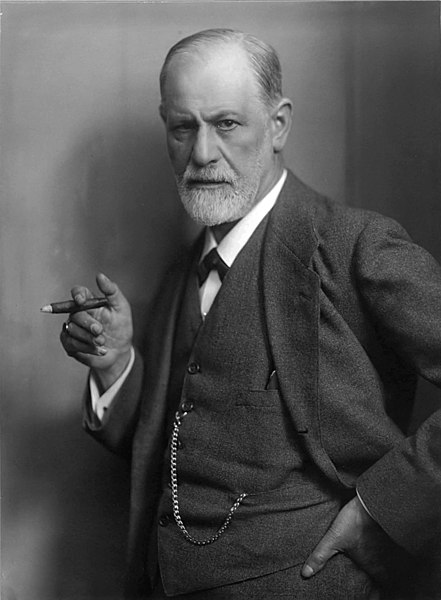
Photographic portrait of Sigmund Freud, signed by the sitter (“Prof. Sigmund Freud”) by Max Halberstadt (c. 1921)
Wikimedia Commons
Everyone who has thought about it for five minutes knows that something’s not right. […] As y’all have noted, actual hard information on the coronavirus is hard to come by. Is it fully air-transmissible? What are the infection rates? Hell, what are the death totals? And speaking of the death totals, even if you trust China’s figures (which no reasonable person can possibly do), they seem … low. Like, really low. I actually trust Italy’s government to deliver some vague approximation of the truth, and even there, where they’re in full-blown freakout mode, it seems to kill off old folks with compromised immune systems and lung problems at a fractionally higher rate than your garden-variety flu.
So, you know … it’s the flu. Not great by any means, and more infectious (possibly) than some other flus in our recent past, but for all that just the flu. The ongoing sky-is-falling global freakout has next to nothing to do with the actual bug. We live in a deeply anxious age, and that anxiety has to discharge somehow. It’s global hysteria — classic hysteria, Freudian hysteria, an excess of stress that must be discharged by “converting” it into behavior.
The people who are freaking out about it aren’t worried about dying from it. No, really, they’re not. Nor should they be — no reasonably healthy person under age 70 has any reason to be worried about that. Instead, what they’re worried about is powerlessness. We’ve all long suspected that we’re ruled by idiots and grifters. We’ve all long sensed that our “leaders” hold us in deep contempt. And we’ve long known that none of our problems are worth anything to the global pirate capitalist class. The only reason those bastards care if we all drop dead from the plague is that they can’t sell enough iCrap to each other to keep the company stock price up.
We know this. But we can’t say it, and we can’t act on it, because doing so goes against our self-image. Our media, our education system, our “culture” (such as it is) has spent the last half-century telling us what special and unique snowflakes we all are, even as it’s forcing us into ever-greater conformity. We’ve broken all the taboos, transgressed all the boundaries, liberated all the oppressed. If there ever were to be such a thing as “social justice,” then truly we’ve achieved it, here in this best of all possible worlds where you can lose your job for not addressing your co-worker as a wingless golden-skinned dragonkin and 6’2″ dudes with beards down to their collarbones can go wee-wee in the little girls’ room …
… and yet. And yet. And yet feminists (just to stick with a theme), despite running everything for the last 30 years, still can’t get that lousy 25 cent raise. Seven out of every five college girls are sexually assaulted the minute they step on campus, despite boys being as rare as sasquatches on most campuses (and despite the ever-growing clamor for free college for everyone). You’re free to — hell, you’re practically required to — make up your own pronouns, but you’re not allowed to ask just how a degree in “gender studies” could be worth even one dollar in student loan debt, let alone one hundred thousand dollars. We keep agitating for change, keep voting for it, keep tweeting about it … and nothing happens.
That profound sense of powerlessness is exactly, and I do mean exactly, what screwed up Anna O. She hated her father for not allowing her any personal agency. In her heart of hearts she wanted him dead. And yet she knew herself to be a loving daughter, so that overwhelming sense of relief — indeed, of joy — she felt when he kicked the bucket sent her around the bend.
March 12, 2020
QotD: Cryptocurrency versus cash in a modern economy
If you try to deposit it in the bank, they will file a report, and you will shortly be explaining to the government where that money came from. Unless you have a good explanation, you will then be desperately trying to hire a lawyer in order to avoid a trip to the pokey.
Nor can you simply buy a house or a car with that cash, which will raise many, many eyebrows at the bank, and then at the government that bank reports to. You basically can’t make any large purchase in cash without raising a lot of questions. This is why drug dealers spend so much effort figuring out how to launder their ill-gotten gains. Unless you can find some way to put the money in a bank without the government getting suspicious, then all you have, in the words of Jason Bateman’s character, is (approximately) “groceries and gas for the rest of your life.”
And that’s dollars, which are indisputably legal tender. Your cryptocurrency will be even harder to spend. Who wants to trade you legal cash for scrip that’s only good for buying on the black market? How do you find that person? What discount will they demand for giving up their cash?
Bitcoin is currently good for transferring money out of failing states like Venezuela, because in those places, the local currency is so worthless that you’re better off trading it for bitcoin, or for that matter, cans of mackerel. But that presumes there are countries elsewhere with stable governments and strong economies where bitcoins can be turned into real goods. If bitcoins become a good way to evade those governments, those governments will ban them, and desperate people will go back to smuggling diamonds and dollars.
Megan McArdle, “Bitcoin Is an Implausible Currency”, Bloomberg View, 2017-12-27.
March 11, 2020
QotD: Orthorexia
Our culture accepts as a scientific fact that organic food is healthier than non-organic food. You can watch TV, read popular magazines, or listen to healthy-living gurus, and overwhelmingly you will be told that organic food is healthier than non-organic food. Recipes tend to call for organic produce and ingredients. And it goes beyond organic foods. Genetically-modified foods are slandered as “frankenfoods” concocted by mad scientists in a laboratory. Further, we are admonished to avoid anything that is not “natural.”
OK then. Vaccines are genetically modified, lab-made, and certainly not natural. Being anti-vax seems a logical extension of the natural, organic lifestyle.
I know several people — including family members — who have so completely bought into the natural-organic hype that they genuinely believe GMO and non-organic foods are poisonous. They would rather starve themselves and their children to death than ingest a gram of non-organic food. They look at the shelves of a regular grocery store and see rows and rows of poison. There is a medical term for this fear of safe healthy food — it’s called “orthorexia.” I am not shocked that some of these individuals are anti-vaxxers. Instead, I am shocked (and relieved) that some of the orthorexics I know actually do vaccinate themselves and their children.
Buck Throckmorton, “Organic Food & Anti-Vaxxers – Does The Fear of Safe Food Lead to Fear of Safe Vaccines”, Ace of Spades H.Q., 2019-12-08.
March 8, 2020
Trope Talk: Macguffins
Overly Sarcastic Productions
Published 6 Mar 2020Edit: DANG IT YES I MEANT THOR 2 EVERYONE LEAVE ME ALONE
Everybody wants ’em! Very few people get ’em! Sometimes, the things we call macguffins turn out not to be macguffins at all! But what IS the elusive macguffin, and how do we go about understanding, writing, OR acquiring it?
Got a favorite macguffin or macguffin-centric storyline? Drop it in the comments!
Our content is intended for teenage audiences and up.
PATREON: https://www.Patreon.com/OSP
MERCH LINKS: https://www.redbubble.com/people/OSPY…
DISCORD: https://discord.gg/h3AqJPe
OUR WEBSITE: https://www.OverlySarcasticProductions.com
Find us on Twitter https://www.Twitter.com/OSPYouTube
Find us on Reddit https://www.Reddit.com/r/OSP/

March 6, 2020
Bren Ten: The Most Tactical Pistol!
Forgotten Weapons
Published 30 Sep 2015http://www.patreon.com/ForgottenWeapons
Hammer price: $2,500
The Bren Ten is an interesting story of handgun development and business failure. The gun was first developed by Dornaus & Dixon, with the consulting help of the iconic Col. Jeff Cooper. It was intended to be a handgun to improve upon the venerable 1911 in every way.
To satisfy the adherents to the theory of large-caliber handgun cartridges, the gun was designed around a new 10mm cartridge designed by Norma. This cartridge would propel a 200 grain bullet at 1200 fps from a 5 inch barrel, making it the most powerful service handgun cartridge in production. It would use a 10-round magazine, and also be convertible to .45ACP.
The gun itself was based on the excellent Czech CZ-75 (made at Brno, which is where the “Bren” portion of the pistol’s name came from). It had full length slide rails, a DA/SA trigger that could be carried cocked and locked, and nice big sights.
Unfortunately, a combination of production quality problems, inadequate magazine design, preorders, and other issues led to the company quickly falling into tough financial straits. The guns were only manufactured for about 2 years before bankruptcy ended production. Some had been shipped without magazines, and Bren Ten magazines remain a sought-after commodity today.

February 27, 2020
Tuesday night’s Democratic debacle debate
Mark Steyn reports on the casualties from the latest Democratic presidential debate:

Henry Kissinger’s famous line on the Iran/Iraq war was that it’s a shame they can’t both lose. In Tuesday night’s primary debate they somehow contrived for everyone to lose, including both the Democrat Party and the media. It reached its peak of perfection early on when all seven candidates began shrieking over each other and, as with some hideous atonal aleatoric modernist cacophonous symphony, its very unlistenability seemed an impressive feat of organization.
Five insipid moderators sat there like dowagers declining to catch the eye of the shrieking nutter on the Piccadilly Line as Elizabeth Warren ate up all the opening airtime with charges that Michael Bloomberg would make you kill your babies (she’s not concerned about the baby-killing, only that it shouldn’t be Bloomberg ordering the hit). Realizing that the show was in danger of degenerating into Screech White and the Six Dwarves, her comrades belatedly began screaming along, shredding the alleged “rules” even as the hopelessly inept moderators gamely persisted with all the usual bland over-formatted props of leaden telly debates – like making a big deal about interactively selecting random Twitter-submitted questions about the besieged Syrian city of Idlib.
Mayor Pete looked earnestly into the camera and declared, “I stand with the people of Idlib.” Which, translated out of of Demoblather, means: You guys are screwed. Still, the ability to adlib a line about Idlib is not to be disdained.
In other news, Joe Biden got tough with China: “They must play by the rules. Period. Period. Period.” Actually, I think “period period period” is an ellipsis… Which is oddly Bidenesque. But he was assessed by the experts to have delivered a killer performance – if only because he appeared to know what state he was in and which office he was running for, and did not claim to have been arrested on the streets of Soweto while trying to see a South African prisoner in a gaol cell nine hundred miles away. Great job, Joe!
On the other hand, he did assert that, thanks to Bernie’s crazy pro-gun Second Amendment absolutism, 150 million people had been killed since 2007. Which would be half the population of America. And is 149,997,230 people more than the coronavirus, and roughly a thousand times the entire population of Idlib, so you’d think somebody would have noticed it.
February 25, 2020
QotD: Canadian content rules
I tried making this case to a left-leaning friend. She said, half-joking, “I know you are speaking Canadian but I can’t understand any of the words.” I am reminded every day of my former communication studies undergrads who would argue for Canadian content rules (I am told these represent “regulation” and not “censorship”) and, with no change of expression, cheerfully explain they never watch Canadian television because it is uniformly awful. Such is the naked truth of ideology.
Ghost of a Flea, “Poisoning the Well”, Ghost of a Flea, 2005-08-12.
February 23, 2020
QotD: Go eat bugs, plebs!
What is with these people?
This bug bingeing is a running theme in the mainstream media. The New York Times, taking a break from passively aggressively correcting its garbage takes, asks “Why Aren’t We Eating More Insects?” The answer is, of course, “Because they are insects, you weirdos.”
CNN goes on about “Bugs: The Food That Can Feed, And Maybe Save, The Planet,” as if Brian “Tater” Stelter is going to give up stuffing Cheetos in his talk-hole in exchange for caterpillars.
And National Geographic manages to do the impossible and make us hate the United Nations even more by informing us that the “U.N. Urges Eating Insects,” and offering us “8 Popular Bugs to Try.” Popular with whom?
The Economist is talking about people munching millipedes in Congo, and you have to wonder why we would take Congo’s lead in anything. It’s the Congo – you should carefully examine what the Congo does, then do the opposite. That goes for other strange countries too. Frankly, foreign countries are generally terrible and there is not a lot that other countries have to teach us – I lived on two other continents and this bizarre notion liberal Americans have about other countries being better than us is grossly misplaced. Other countries are mostly terrible.
Exhibit A: They eat bugs.
Do you think the people of Congo are saying, “Beef? Pass. Hand me that plate of maggots!” You don’t eat grasshoppers because you have other options. No one’s first choice is fruit flies.
Kurt Schlicter, “Tell The Nags To Go Pound Sand”, Townhall.com, 2019-11-19.
February 12, 2020
“… perhaps the biggest Internet cash grab in the OECD with mandated payments and levies on thousands of Internet services with Canadian users”
Michael Geist refutes the claim that the recent Broadcast and Telecommunications Legislative Review Panel report does not recommend a “Netflix tax”:
The reference to a Netflix tax in the overview is the only such reference in the 235 page report. It was likely included in the overview in the hope that media coverage would jump on the claim and seek to re-assure Canadians that there was no Netflix tax or higher prices likely for consumers as a result of the report’s recommendations.
Yet the reality for anyone that reads beyond the overview is that the panel’s report not only recommends what would widely be considered a Netflix tax but proposes perhaps the biggest Internet cash grab in the OECD with mandated payments and levies on thousands of Internet services with Canadian users. This includes online streaming services, social media companies, news aggregators, and online communications services such as Skype, WhatApp, and Viber. In the view of the panel, any service or site with Canadian users is part of the “Canadian system” and should be expected to contribute to the development of Canadian content, Canadian news organizations, or building broadband connectivity. Note that all of this is above and beyond sales taxes, which the panel also recommends should be implemented with respect to foreign services.
Some of the panel’s plans are admittedly somewhat confusing. For example, the panel states:
Media curation undertakings brought under the regime – including Netflix and other online streaming services – would be required to devote a portion of their program budgets to Canadian programs.
That statement, along with chair Janet Yale’s comment at the opening press conference that there was no need for Netflix to spend additional money on Cancon but rather merely divert existing on foreign location and service production spending in Canada, has been interpreted by some to mean that Netflix would not have to increase its Canadian programming budget. But that is apparently not what the panel means. I spoke with Yale who confirmed that the panel expects the CRTC to establish a minimum Cancon spend requirement on Netflix based on its Canadian revenues. In other words, the requirement has nothing to do with its existing spending on production in Canada. For Netflix, that could certainly represent an increase in spending costs in Canada with those costs likely passed along to consumers.
Yet the panel’s plan extends far beyond just online streaming services such as Netflix. It also envisions mandatory levies against social media services and news aggregators that would be used to fund Canadian news services. It similarly targets a myriad of communications services that would pay into funds to support broadband development.


