
Anyone who has ever appeared on a radio discussion programme will know how frustrating the whole business is. The time allotted even for the most serious subjects is short: a BBC producer once invited me on to a “long” discussion about the burning issue of the day, and when I asked what she meant by long, she replied with neither irony nor shame, but perfectly matter-of-factly, “Six minutes”. Since there were to be three other guests on the programme, in-depth analysis was hardly the order of the day. Brevity these days is not the soul of wit: it is the guarantor of triviality.
Anthony Daniels, “The European Working Time Directive & the Sound-Bite Culture: why the latter makes arguing against the former impossible”, The Social Affairs Unit, 2004-08-09.
October 17, 2020
QotD: The inherent triviality of most “news” programs
October 14, 2020
QotD: The frenetic pace of cancel culture
You want to say: Slow down, young’uns! First you seize power and send all your class enemies to the camps or the grave. Then you turn on your own to purge the ideologically wobbly or those who are insufficiently zealous.
But these idiots are eating their own before they have power. Harry Potter author J. K. Rowling? Off to the gulag for believing in biological sex. The New York Times editorial-page editor earned defenestration for believing in free speech. Day after day on Twitter there’s a frenzy of witch-burning and heretic-stoning; the entire platform is like a self-lubricating guillotine.
Then again, it might be seen as a new, efficient model. After you’ve overthrown the tyrants and set up the People’s Committee, you have a new world to build. Even if you devote the morning to inventing a postcapitalist paradigm and spend the afternoon figuring out how to get fresh water and sanitation to your typhus-infested camp, that means you have to spend the evening drawing up proscription lists. Purging is necessary, but who has the time?
So they’re getting it out of the way now, purging the culture and the Twitter lists of people and things that need to be extirpated for the good of all.
Perhaps this is what happens when people who have been bingeing on TV shows for three months with no place to go decide to have a revolution. Instead of watching the shows once a week and pacing themselves, it’s a whole season in one day.
James Lileks, “Twinkling’s Canceled, Little Star”, National Review, 2020-07-06.
October 9, 2020
QotD: How to analyze complex multivariate systems for the popular press
- Choose a complex and chaotic system that is characterized by thousands or millions of variables changing simultaneously (e.g. climate, the US economy)
- Pick one single output variable to summarize the workings of that system (e.g. temperature, GDP)
- Blame (or credit) any changes to your selected output variable on one single pet variable (e.g. capitalism, a President from the other party)
- Pick a news outlet aligned with your political tribe and send them a press release
- Done! You are now a famous scientist. Congratulations.
Warren Meyer, “Modern Guide to Analyzing Complex Multivariate Systems”, Coyote Blog, 2018-06-25.
October 1, 2020
Far from being in trouble, Canadian film and TV investment has nearly doubled in the last 10 years
The Canadian government — particularly Canadian Heritage minister Steven Guilbeault — is eager to pass legislation to “get money from the web giants” and their primary justification is the claim that Canadian TV and movie funding has been shrinking. As Michael Geist explains, that’s a pants-on-fire lie:

CMPA Profile – Financing, Sources: CMPA Profile 2019, 2016, 2013
Canadian Heritage Minister Steven Guilbeault has said that his top legislative priority is to “get money from web giants.” While much of the attention has focused on his ill-advised plan to require Facebook to obtain licences for linking to news articles, his first legislative step is likely to target Internet streamers such as Netflix, Amazon and Disney with new requirements to fund Canadian content and to increase its “discoverability” by making it more prominent for subscribers. Based on his comments at several town halls, Guilbeault is likely to also create new incentives for supporting indigenous and persons of colour in the sector with a bonus for those investments (potentially treating $1 of investment as $1.50 for the purposes of meeting Cancon spending requirements). Much of the actual implementation will fall to the CRTC, which will be granted significant new regulatory powers and targeted with a policy direction.
Guilbeault’s case for establishing new mandated payments is premised on the claim that support for the film and television sector is declining due to the emergence of Internet streaming services, which have resulted in decreased revenues for the conventional broadcast sector and therefore lower contributions to Cancon creation. In fact, Guilbeault recently told Le Devoir that without taking action there would be a billion dollar deficit in support in the next three years. He says that his objective is to actually generate a few hundred million more per year in local production by the Internet streamers. In other words, he’s expecting roughly $2 billion in new investment over three years in Cancon from U.S. entities due to his planned regulations (moving from a billion dollar deficit to a billion dollars in extra spending).
While Guilbeault frames these regulatory requirements as a matter of fairness and “rebalancing”, industry data over the past decade tell a much different story. Indeed, there has been record setting film and television production in recent years, much of it supported by companies such as Netflix. CRTC chair Ian Scott last year said that Netflix is “probably the biggest single contributor to the [Canadian] production sector today.” While that is not entirely true – the data suggests that Canadian taxpayers are the biggest contributor with federal and provincial tax credits consistently the largest source of financing – the claim that there is a billion dollar deficit coming or that foreign streamers do not contribute to film and television production in Canada without a regulatory requirement is simply false.
July 30, 2020
QotD: The “strong female protagonist” in movies and on TV
Now I perfectly understand the legitimacy of feminist concerns regarding the portrayal of women in the media as consistently demure, retiring, and subservient to men. I grant that, in most of the action/adventure movies that I saw growing up, women would typically twist an ankle or get captured and then require rescuing by the swashbuckling male hero — and I realize how galling this must have been to generations of women. And therefore, a certain correction was undoubtedly in order. But what is problematic now is the Nietzschean quality of the reaction, by which I mean, the insistence that female power has to be asserted over and against males, that there is an either/or, zero-sum conflict between men and women. It is not enough, in a word, to show women as intelligent, savvy, and good; you have to portray men as stupid, witless, and irresponsible. That this savage contrast is having an effect especially on younger men is becoming increasingly apparent.
In the midst of a “you-go-girl” feminist culture, many boys and young men feel adrift, afraid that any expression of their own good qualities will be construed as aggressive or insensitive. If you want concrete proof of this, take a look at the statistics contrasting female and male success at the university level. And you can see the phenomenon in films such as Fight Club and The Intern. In the former, the Brad Pitt character turns to his friend and laments, “we’re thirty year old boys;” and in the latter, Robert De Niro’s classic male type tries to whip into shape a number of twenty-something male colleagues who are rumpled, unsure of themselves, without ambition — and of course under the dominance of an all conquering female.
It might be the case that, in regard to money, power, and honor, a zero-sum dynamic obtains, but it decidedly does not obtain in regard to real virtue. The truly courageous person is not threatened by another person’s courage; the truly temperate man is not intimidated by the temperance of someone else; the truly just person is not put off by the justice of a countryman; and authentic love positively rejoices in the love shown by another. And therefore, it should be altogether possible to hold up the virtue of a woman without denying virtue to a man. In point of fact, if we consult the “all conquering female” characters in films and TV, we see that they often exemplify the very worst of the traditional male qualities: aggression, suspicion, hyper-sensitivity, cruelty, etc. This is what happens when a Nietzschean framework has replaced a classical one.
Bishop Robert Barron, “The Trouble With the ‘You Go Girl’ Culture”, Word on Fire, 2016-10-18.
July 23, 2020
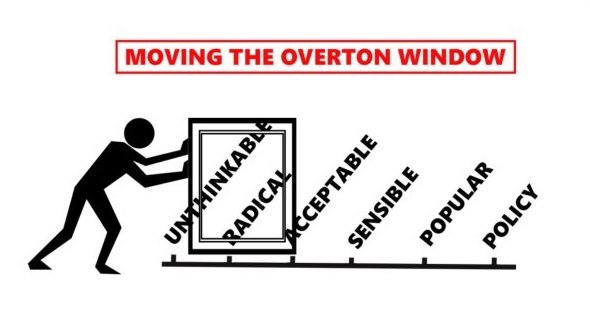
Justin Trudeau and the Overton Window
Ted Campbell explains how Canada’s mainstream media work so hard to move the Overton Window to benefit Justin Trudeau and the Liberal Party:
… this explanation from Politico might help:
The concept of the “Overton window,” the range of ideas outside which lie political exile or pariahdom, was first batted around in a series of conversations by the late free-market advocate Joseph Overton in the 1990s. After Overton’s untimely death in a plane crash in 2003, his friend and colleague at the libertarian Mackinac Center, Joseph Lehman, formalized and named the idea in a presentation meant to educate fellow think-tank warriors on the power of consistent advocacy. Ring the bell loudly for your idea, no matter how unpopular, and back it up with plenty of research and evidence, so the thinking went. Today’s fringe theory can become tomorrow’s conventional wisdom by the shifting of the finely tuned gears that move popular opinion; to Overton and Lehman the role of the think tank was to at least familiarize voters with these ideas, giving them an institutional home when public opinion finally moved their way.
Or, and even more brief visual explanation is:
Anyway, I believe that the Liberal Party of Canada and its allies in e.g. the CBC, The Star, and amongst the others who speak for the Laurentian Elites are working very hard, right now, to move the Overton Window frame of one idea from “Unthinkable” to at least barely “Acceptable.” That idea is that Justin Trudeau’s personal corruption (I believe that’s the right word) is acceptable because the alternative is a Conservative government that is, by Liberal/Laurentian Elite definition, authoritarian (fascist), homophobic, militaristic, racist, and sexist.
That’s right, the Liberal/Laurentian Elites admit that Justin Trudeau is dishonest, that he, unthinkingly, breaks the rules, over and over again ~ because, you see, he’s a really nice person but, sadly, he’s just not very smart. I have even made that case for them. I suggested, almost a year ago, that Justin Trudeau is an intellectual lightweight who is in no way qualified to hold high office … but he has the “second hand” celebrity of a famous name and he’s photogenic, too, and so, in 21st-century Canada he’s electable.
July 22, 2020
A brief look at the life of Thomas Cromwell, Henry VIII’s “main fixer”
Michael Coren discusses the career and reputation of Henry VIII’s powerful and capable Lord Chamberlain until he fell from favour and was executed in 1540:
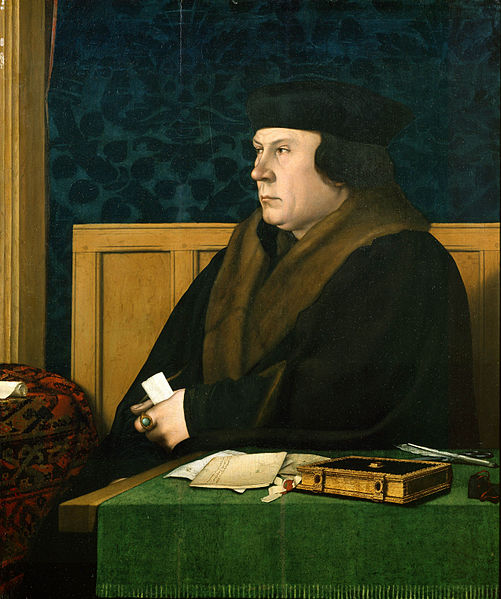
Portrait of Thomas Cromwell, First Earl of Essex painted by Hans Holbein 1532-33.
From the Frick Collection via Wikimedia Commons.
The panoply of British history doesn’t include too many monsters. The nation was founded more on meetings than massacres, and other than the usual round of chronic blood-letting in the Middle Ages, and a civil war in the seventeenth-century, the English have left it to the French, the Russians, and the Germans to provide the mass murderers and the genuine villains. But if anyone was generally regarded as being unscrupulous, with a touch of the devil always around his character, it was Thomas Cromwell, the main fixer for Henry VIII in the 1530s, and according to the Oscar-winning movie A Man for all Seasons, the dark politician who had hagiographical Thomas More executed. For decades both on British television and in Hollywood epics it was this self-made man who was willing to smash the monasteries, torture innocent witnesses into giving false evidence, and assemble lies to have that nice Anne Boleyn beheaded.
This was the dictatorship of reputation. Historians provided the framework, and popular entertainment dressed it all up in countless Tudor biopics. But then it all began to change.
The first person to seriously challenge the caricature was himself a victim of lies and hatred. The revered Cambridge historian GR Elton was born Gottfried Rudolf Otto Ehrenberg, son of a German Jewish family of noted scholars, who fled to Britain shortly before the Holocaust. He’s also, by the way, the uncle of the comedian and writer Ben Elton. GR, Geoffrey Rudolph, was one of the dominant post-war historians, and insisted that modern Britain, with its secular democracy and parliamentary system, was very much the child of Thomas Cromwell the gifted administrator and political visionary.
So we had the Cromwell wars. On the one side were the traditionalist, often Roman Catholic, writers who insisted that Cromwell was a corrupt brute and a cruel tyrant; and the rival school that regarded him as the first modern leader of the country, setting it on a road that would distinguish it from the ancient regimes of the European continent. But there was more. While previous political leaders – the term “Prime Minister” didn’t develop until the early eighteenth-century – had sometimes been of relatively humble origins, and Cromwell’s mentor and predecessor Thomas Wolsey was the son of a butcher, they were invariably clerics. Cromwell wasn’t only from rough Putney on the edge of London, and the son of a blacksmith, but he was a layman, and someone who had lived abroad, even fought for foreign armies.
Here was have the embodiment of the great change: the autodidact who was multi-lingual, well travelled, reformed in his religion and politics, and prepared to rip the country out of its medieval roots. Yet no matter how many historians might believe and write this, the culture is notoriously difficult to change, and understandably indifferent to academics. Not, however, to novelists. And in 2009 the award-winning author Hilary Mantel published Wolf Hall, a fictional account of Cromwell’s life from 1500 to 1535. Three years later came the sequel, Bring Up the Bodies. Both books won the Man Booker Prize, an extraordinary achievement for two separate works. The trilogy was completed recently with The Mirror and the Light. The first two volumes were turned into an enormously successful stage play and a six-part television show. Forget noble academics working away in relative obscurity, this was sophisticated work watched and read by tens of millions of people. Cromwell was back.
“It is as a murderer that Cromwell has come down to posterity: who turned monks out on to the roads, infiltrated spies into every corner of the land, and unleashed terror in the service of the state”, wrote Mantel in the Daily Telegraph back in 2012. “If these attributions contain a grain of truth, they also embody a set of lazy assumptions, bundles of prejudice passed from one generation to the next. Novelists and dramatists, who on the whole would rather sensationalise than investigate, have seized on these assumptions to create a reach-me-down villain.”
July 21, 2020
“Journalists” and photographers in the media
David Warren considers the decline of boots-on-the-ground reporting and the rise of comfortable bourgeois “journalism”:

Andy Ngo after being assaulted during Antifa protests in Portland, Oregon on 29 June 2019.
When I was a “journalist” — God help me, but it was an increasingly long time ago — my understanding was that the job involved getting into the riot. Andy Ngo may be the only journalist left, unless we count “talking heads” and “scribblers.” Well-informed, at first hand, on events in such towns as Seattle and Portland — where the bourgeoisie now enjoy their “summer of love” — he has been beaten up a few times. For journalism was meant to be a dangerous sport, quite unlike ping-pong.
Alas, and already in Vietnam, I discovered that only the photographers looked directly on the face of battle. This is because they were getting paid for the pics — in cash, but sometimes in prizes. The people who wrote the (frequently misleading) captions were safe in a bar, back in Saigon, or more likely, in the editorial suites of New York. It interested me that the photographers were often rightwing crazies. Whereas, the scribblers were, generally, leftists to a man, or in those days, the very occasional woman. I liked to get my information from photographers, whenever possible, but the scribblers did not. In possession of a fully-formed “narrative” from New York, they had already written their stories.
Am I exaggerating? Less than usual. My caricature points to a flaw in the meejah — cowardice, ignorance, arrogance, and malice, stirred into a rather potent brew. Then we had “editors,” to do the distillation.
July 14, 2020
The End of the World Will be Televised | The Cuban Missile Crisis I Day 07
TimeGhost History
Published 13 Jul 2020On October 22, in the world’s first televised announcement of an international military crisis, US President John F. Kennedy sets off panic and sudden fear of a third world war, with nuclear arms involved.
Join us on Patreon: https://www.patreon.com/TimeGhostHistory
Hosted by: Indy Neidell
Written by: Spartacus Olsson
Director: Astrid Deinhard
Producers: Astrid Deinhard and Spartacus Olsson
Executive Producers: Astrid Deinhard, Indy Neidell, Spartacus Olsson, Bodo Rittenauer
Creative Producer: Joram Appel
Post-Production Director: Wieke Kapteijns
Research by: Spartacus Olsson
Edited by: Daniel Weiss
Sound design: Marek KaminskiColorizations:
– Carlos Ortega Pereira (BlauColorizations) – https://www.instagram.com/blaucoloriz…Sources:
PX 65-105:179 from LOOK Magazine 8405-1-26Soundtracks from Epidemic Sound:
– “Cold Eyes” – Elliot Holmes
– “From the Depths” – Walt Adams
– “Juvenile Delinquent” – Elliot Holmes
– “When They Fell” – Wendel Scherer
– “Kid Me Not” – Elliot HolmesArchive by Screenocean/Reuters https://www.screenocean.com.
A TimeGhost chronological documentary produced by OnLion Entertainment GmbH.

July 12, 2020
QotD: “Getting tough on crime”
It is a bipartisan habit; progressives may talk enthusiastically about ending mass incarceration, but switch the topic to male sex offenders (or, say, 2008 bankers) and what you’ll hear often sounds like a recap from some Republican law-and-order conference, circa 1984. The belief that crime is a soluble problem if we’re willing to be mean enough is apparently nestled deep in the human psyche.
Megan McArdle, “Killing drug dealers won’t stop the opioid epidemic”, Washington Post, 2018-03-20.
June 30, 2020
“The Squadrons Are Coming” – HMS Ark Royal aviation operations
Aircraft Games Movies
Published 1 Jul 2010In the Western Approaches, Ark Royal welcomes her air group back aboard, with the occasional hairy approach for newly qualified aviators.
This appears to be footage from episode 3 of Sailor, a BBC television series from 1976 about life aboard HMS Ark Royal.
The Wikipedia entry for HMS Ark Royal (R09) begins:
HMS Ark Royal (R09) was an Audacious-class aircraft carrier of the Royal Navy and, when she was decommissioned in 1979, was the Royal Navy’s last remaining conventional catapult and arrested-landing aircraft carrier. She was the first aircraft carrier to be equipped with angled flight deck at its commissioning; her sister ship, HMS Eagle, was the Royal Navy’s first angle-decked aircraft carrier after modification in 1954. Ark Royal was the only non-United States vessel to operate the McDonnell Douglas Phantom at sea.
[…]
While Ark Royal‘s career spanned 24 years from the time of her commissioning (her name was a household word), she spent as much time in refit; repair and reserve and modernisation as in commissioned service (12 years). It required a lot of effort from her engineers to keep her serviceable between yard periods. Ark Royal had been poorly preserved during its lengthy construction from 1942 to 1955, and much of its machinery was obsolete by its completion, including its dated DC electrics, supplemented later by some AC systems, resulting in a ship which experienced regular defects and mechanical failure. Eagle was a more reliable and well-built ship, and spent far more time at sea than her sister. The scrapping of Ark Royal in 1980, two years after Eagle, marked the end of conventional fixed-wing aircraft operations aboard Royal Navy carriers. She had borne so many innovations, yet her replacement was not equipped with any of these. There was some discussion about preserving her as a museum ship, and some private funds were raised; the MOD would not sanction these efforts.

June 13, 2020
QotD: The liberal media
This is a universal principle. Everyone knows something about something, and is very backward on that which he knows. The one exception may be journalists, who know nothing about anything, and are therefore liberal all round.
David Warren, “I’ll be a Welshman”, Essays in Idleness, 2018-03-01.
June 3, 2020
QotD: From “the media’s” point of view
Bias. Everyone leans a certain way politically. Ideally, that wouldn’t affect the way a reporter covered a city council meeting or a police news conference. But to tell the truth, I’ve probably worked with 10 times more liberal-leaning journalists than conservative-leaning journalists over the past three decades. The profession attracts people with an affinity for underdogs. That has to have some impact on the stories we choose to do and the ones we don’t.
Sensationalism. It depends how you define it. If we talk to the relatives of a murder victim, are we doing it to make money? I hope we’re there because we’re trying help the community grieve together. But let’s face it, that story is going to be well-read so maybe it will make more money in some click-based, page-view algorithm that I’ll never understand.
Negativity. We don’t make cars crash. We don’t bomb civilians. The world can be an ugly place and these things won’t stop if we ignore them. On the other hand, I haven’t met many reporters who would rather cover a parade than a murder trial. Darker stories seem, by their nature, more important. So maybe we are negative.
But I’ve already fallen into the trap of thinking in terms of “us” and “them.” There should be no distinction. It’s here where the media are their own worst enemies. We tend to think we’re infallible because we’re doing God’s work. But if we want more people on our side, we could do a much better job of showing the public what we do, why we do it and how we do it. We like to crow about open courts, but what about open newsrooms?
Maybe we should trust people enough to let them in on the process. To boil it down to one example, if the police shoot an Indigenous man and we decide to mention his race in coverage, we should tell people why we thought it was relevant and maybe admit that we agonize over such decisions. It might not stop the haters but it would at least give “them” a chance to understand “us.”
Cam Fuller, “Do people really hate us and if so, why?”, Saskatoon StarPhoenix, 2018-03-03.
May 16, 2020
The Wuhan Coronavirus, the excuse for an emergency without end
Mark Steyn on the seven-hundred-and-fifty-third day of our captivity:

Emergency without end is the staple of almost every futuristic dystopia — and that’s true for real life, too. So Americans shuffle shoeless through the airports for twenty years while their governments negotiate with the very organization that enabled those attacks — the Taliban — to restore them to power. Is a culture that cannot see off goatherds with fertilizer really going to rouse itself to decouple from a global superpower that supplies everything from its crappy “These Colors Don’t Run” T-shirts to its surgical masks and pharmacy medications?
~For my own part, I have been reading ancient accounts from Occupied France and Vichy for tips on finding workarounds for restraints on the citizenry. As wily and innovative as the French Resistance were, I wonder if their efforts would even be possible in an age when cheap Chinese-made drones can hover unseen and monitor every conversation.
[…]
Even without governors terrorizing those tavern-keepers or hairdressers who defy them, the lockdown has exaggerated the contradictions: The state wants open borders for “migrants” but a security perimeter around the homes of its citizens. Maybe the absurdities become so obvious that there is widespread rejection of them. Or maybe, one by one, the poor put-upon over-surveilled citizenry take a cue from their undocumented non-brethren. Perhaps I should just mug an illegal immigrant and steal his fake ID…
~The emergency is already feeling permanent. It starts with the social norms: Dr Fauci tells us the handshake is gone for good. That’s not a small loss. I don’t care for the suggested replacements, like the lame-o hand-on-heart gesture. I bow from the neck to the Queen — and just last year I did so to her Canadian vicereine, Mme Payette. Her Excellency then stepped forward and gave me a hug. But I don’t suppose she’s doing that anymore…
People ask me why I haven’t been on TV lately. Well, I mainly like going on TV to behave like a person who’s on TV. So, if you notice, on the “Fox & Friends” live-audience shows, I come bounding in like Tigger and do a lot of gladhanding with those on the aisle (including the odd hug), and then I give Steve and Brian manly handshakes and do a little light kissy-kissy with Ainsley. And all that — the basic language of telly for seventy years — is gone, apparently forever.
[…]
The WHO, the Beijing public relations firm whose pronouncements the BBC, The New York Times et al insist on taking as gospel, now says Covid-19 is here to stay — like HIV. With HIV, it wasn’t that difficult to avoid catching it, because it required the exchange of bodily fluids, which is a fairly intense and specific degree of intimacy. With Covid, we are rolling a protective condom down over every routine social intercourse.
A contributor at the Continental Telegraph explains why he no longer supports the lockdown:
First, it turns out that the drastic steps we were taking were based on one model. That no one outside the team using it was allowed to review. We were even told that we couldn’t check the coding because it was so old & patched together that it’s too hard to follow. That’s like saying you can’t check the brakes because you won’t be able to see all the duct tape and Velcro we’re using. Further, we’re told that this software doesn’t provide the same results from one run to the next.
Next, I heard about Dr. Ferguson’s history of wildly overestimating the fatalities from mad cow disease and bird flu (50k compared to <200, 200 million versus <500 respectively). Also, the CDC’s estimate of Ebola deaths in Sierra Leone (1.4 million compared to 8k). And let’s not forget the U.S. Public Health Service’s overshoot on the number of AIDS infections in 1993 (450k versus 17k). At this point I gave more thought to the issue of modeling – prior to retiring I was an actuary and modeling was what I did for a living. A few points about how modeling works: The more complex a system is, the more difficult it is to build a good model. And, more importantly, the more difficult it becomes to test your model and confirm that it accurately mirrors the real world. And this looks like one of the most complex systems to model I’ve ever heard of. How can you test this against reality? I don’t think you can. You can run simulations and confirm it looks like you expected, but that doesn’t mean the virus behaves like your model. Another point about modeling is that the results are extremely dependent on the assumptions you’re using. And in this case two critical assumptions are how infectious the virus is and how lethal it is. We still have a poor understanding of these variables months after we started Lockdown. Then a lot of us noticed that the goal shifted from “flattening the curve” to avoid a catastrophic overflow at hospitals to Lockdown until “fill in the blank” (in some states a vaccine, in others no deaths for 14 days, etc.). And the lockdown rules are inconsistent and illogical – in Michigan you can’t buy plant seeds but you can buy lottery tickets. To add insult to injury, many of the people with their foot on our necks violate the rules (the mayors of Chicago and New York, Dr. Ferguson, etc.). I’m stunned and angry at how little attention the human costs of the Lockdown receive. We know that this will lead to increased suicides, homicides and drug overdoses. Let’s not forget more child abuse, domestic violence, depression, drug and alcohol abuse, the list of miseries goes on a very, very long way (I may write up an article just on this, the Lockdown harpies should have to admit to all the harm they’re so enthusiastically spreading).
April 27, 2020
The NFL may have a problem … everyone seems to have liked the virtual draft better than the “real” thing
It is usually difficult to muster much sympathy for the National Football League, but the record-setting popularity of the 2020 draft is a huge surprise:

The unique presentation of the 2020 NFL Draft established new all-time highs for media consumption in every category. With over 600 camera feeds from homes across the United States, all telecasts of the 2020 NFL Draft reached more than 55 million total viewers across Nielsen-measured channels over the three-day event, up +16% vs. 2019. An average audience of over 8.4 million viewers watched all three days of the 2020 NFL Draft across ABC, ESPN, NFL Network, ESPN Deportes, and digital channels easily breaking the previous high of 6.2 million viewers in 2019 (+35%).
Each day of the 2020 NFL Draft established new highs as an average audience of over 15.6 million viewers watched Round 1 on Thursday (+37% vs. 2019), over 8.2 million viewers watched Rounds 2 & 3 on Friday (+40% vs. 2019), and over 4.2 million viewers watched Rounds 4-7 on Saturday (+32% vs. 2019).
All seven rounds of the 2020 NFL Draft were presented across ABC, ESPN, and NFL Network – the second straight year that The Walt Disney Company partnered with the National Football League to offer a multi-network presentation of the entire Draft.
“I couldn’t be more proud of the efforts and collaboration of our clubs, league personnel, and our partners to conduct an efficient Draft and share an unforgettable experience with millions of fans during these uncertain times,” said NFL Commissioner Roger Goodell. “This Draft is the latest chapter in the NFL’s storied history of lifting the spirit of America and unifying people. In addition to celebrating the accomplishments of so many talented young men, we were pleased that this unique Draft helped shine a light on today’s true heroes – the healthcare workers, first responders, and countless others on the front lines in the battle against COVID-19. We are also grateful to all those who contributed to the NFL family’s fundraising efforts.”
“This year’s NFL Draft clearly took on a much greater meaning and it’s especially gratifying for ESPN to have played a role in presenting this unique event to a record number of NFL fans while supporting the league’s efforts to give back,” said ESPN President Jimmy Pitaro. “The success of this year’s Draft is a testament to the unprecedented collaboration across the NFL, ESPN, and The Walt Disney Co. in the midst of such a challenging time.”
The unique situation of having the vast majority of televised sports activities suspended clearly made a big difference — when you’re the only game in town, you can expect a wider audience — but the online draft seems to have been popular even among people who normally would have tuned in for the event anyway.


