Quotulatiousness

November 26, 2015

Tom Kratman’s “Dear Russia” letter

Filed under: Europe, Middle East, Military, Russia — Tags: , , — Nicholas @ 05:00

Tom Kratman looks at what is known about the Turkish military’s attack on a Russian aircraft earlier this week:

Firstly, my condolences on the recent murder of your two pilots. While one might argue that shooting descending parachutists (as opposed to paratroopers) would be permissible in some circumstances, as when there is no reasonable possibility of capture, in this case there was such a possibility. Obviously, you’ll want revenge. I – and I think most Americans, at least such as are not in favor of a large and viciously fundamentalist Islamic state in the Middle East – understand and, generally speaking, approve of things like that, where called for. The situation, however, is more complex than that. Because of that complexity, I strongly encourage you to dispense with emotion, to the utmost of your ability, and reason carefully before acting.

I can’t offer condolences on the initial shoot down of your Sukhoi-24, because I really don’t know what happened. If it drifted into Turkish airspace, and the Turks shot it down, even if they pursued it out of Turkish airspace…well, you’re in an unenviable moral position to complain about any of that, given the conduct your predecessor in interest, the USSR, with regard to KAL 007. If, however, it never violated Turkish airspace, and the Turks crossed over to attack it, you may well have a casus belli against Turkey.

If the Turks are offering war I strongly advise you to decline the invitation. They are very nearly a peer competitor, having similarly sized armed forces, quite possibly better trained, an economy almost as strong as your own, and likely rather stronger when you count out export of raw materials. They’re not as technologically sophisticated as you are, but they have friends who are more so. And you just wouldn’t believe the long-standing love affair between the US Army and the Turkish Army, based on their performance in Korea in the early fifties.

*****

A little aside is in order at this point. I’m not really so concerned about the incident that just took place, with one of your planes shot down by the Turks, and the ejected pilots murdered on the way down. What’s really bugging me is the almost instantaneous assumption of people over here that this was the first set of shots in World War V, World War III having been the Cold War, and World War IV the on-again, off-again, fiasco with the Islamics. On its own, this should not be capable of doing that. Add in paranoia, self-fulfilling prophecy, idiotic foreign policy on many fronts, from many fonts, a fairly inscrutable Turkey…I’m a little concerned that things might spiral out of control.

*****

Earlier in this missive I said I don’t know what happened. Nonetheless, here’s what I think happened. I think that Sukhoi was on a strike mission against the Turkmen Brigades in Syria. I think you’ve been occasionally bombing the crap out of the Turkmen Brigades in Syria for a while now. That would tend to explain the vindictiveness of the folks on the ground who shot at your descending pilots. I think because of that bombing, the Turks, or at least one of the Turks, north of the border decided to help his or their close cousins in Syria. I think it made not a bit of difference whether or not you crossed the border; the Turks wanted to set an example and instill a little fear and friction on you, so would have crossed themselves even if you hadn’t. I suspect the order to do this came from the highest levels in Turkey, probably Erdogan, himself.

No, that doesn’t mean that whipping out the Polonium 210 dispensers would be a good idea.

November 6, 2015

The Third Battle of the Isonzo – French Despair On The Western Front I THE GREAT WAR Week 67

Filed under: Europe, France, History, Italy, Military, WW1 — Tags: , , — Nicholas @ 05:00

Published on 5 Nov 2015

For the third time the Italians had tried to conquer the Austrian positions at the Isonzo front and for the third time they had failed. And like the other defeats before, the Third Battle of the Isonzo came with an extreme amount of casualties due to the difficult terrain in the Alps. At the same time, Lord Kitchener visits the front in Gallipoli and realises that evacuation is the only logical decision to make. On the Western Front, the French had suffered well over 200.000 casualties during the autumn offensives at Artois and in the Champagne.

Turkish politics, post-election

Filed under: Europe, Middle East, Politics, Religion — Tags: , , , , , — Nicholas @ 03:00

Austin Bay looks at Turkey’s domestic political situation following the re-election of Recep Erdoğan’s Justice and Development Party:

The threat to Turkish democratic institutions is a man notoriously jealous of Ataturk, current president Recep Tayyip Erdoğan. The snap election gave Erdoğan and his Justice and Development Party, AKP, overwhelming control of parliament (316 of 550 seats). The AKP had controlled parliament since 2002, but in the June 7 election it lost its one-party majority. Political haggling among opposition parties, including Ataturk’s Republican Peoples Party, the CHP, failed to produce a coalition government; a new election was necessary.

However, in the intervening month’s domestic terrorist incidents, the fitful war with the Islamic State in the Levant and Syria’s violent chaos dominated Turkish politics.

Erdoğan portrayed himself as the only leader capable of addressing Turkey’s deteriorating security situation. Domestic security certainly diminished; why it did stirs angry accusations. Erdoğan’s political opponents maintain that he used the violence to solidify political support. His more vicious critics accuse him of intentionally permitting violence. For example, they argue his government could have prevented the Oct. 10 terror bombing of a peace march in Ankara, now attributed to ISIL. Over 100 people were murdered in that attack.

Is it an over the top conspiracy theory-type accusation? Possibly. Erdoğan himself, however, believes over the top conspiracy theories, and he uses conspiratorial doubt and fear as political tools. His record for jailing journalists and intimidating political opponents associated with his alleged conspiracies is fact, not theory. The election didn’t assuage his fears — it ignited another surge of arrests. On Nov. 3, police arrested scores of people associated with Erdoğan critic and Muslim cleric Fethullah Gulen. At one time Gulen supported Erdoğan and the moderate Islamist AKP. However, Gulen broke with Erdoğan over credible charges of corruption within Erdoğan’s governing circle.

Daniel Pipes isn’t convinced that the terror stampeded voters in Erdoğan’s direction (especially Kurdish voters), and he suspects fraud in the election results:

Like other observers of Turkish politics, I was stunned on November 1 when the ruling Justice and Development Party (Adalet ve Kalkınma Partisi, or AKP) was reported to have increased its share of the national vote since the last round of elections in June 2015 by 9 percent and its share of parliamentary seats by 11 percent.

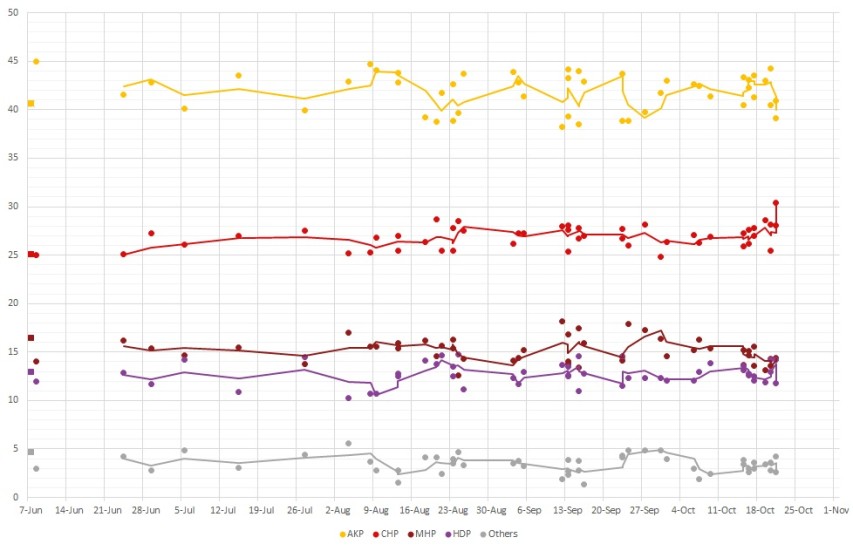
The polls had consistently shown the four major parties winning about the same number of seats as in June. This made intuitive sense; they represent mutually hostile outlooks (Islamist, leftist, Kurdish, nationalist), making substantial movement between them in under five months highly unlikely. That about one in nine voters switched parties defies reason.

Polling results between the June and November 2015 Turkish elections

Polling results between the June and November 2015 Turkish elections

The AKP’s huge increase gave it back the parliamentary majority it had lost in the June 2015 elections, promising President Recep Tayyip Erdoğan a semi-legal path to the dictatorial powers he aspires to.

But, to me, the results stink of fraud. It defies reason, for example, that the AKP’s war on Kurds would prompt about a quarter of Turkey’s Kurds to abandon the pro-Kurdish party and switch their votes to the AKP.

October 30, 2015

Russia Stems The Tide – Winter Is Coming I THE GREAT WAR Week 66

Filed under: Europe, Germany, History, Military, Russia, WW1 — Tags: , , , — Nicholas @ 05:00

Published on 29 Oct 2015

After the Great Retreat during the summer, the Russians are finally able to fight back the Germans at Dvinsk. With a new type of trench warfare, they are able to render August von Mackensen’s artillery useless and only take on small numbers of Germans at the same time. The German army is successful in Serbia though and so the situation for the Serbs looks grim. Meanwhile Benito Mussolini writes in his diary that the worst enemy is not Austria-Hungary, but lice. All of the soldiers and generals know one thing: Winter is coming.

October 22, 2015

The decline of democracy in Turkey

Filed under: Europe, Middle East, Politics, Religion — Tags: , , , , — Nicholas @ 03:00

Last week, Daniel Pipes looked at the increasingly dictatorial ambitions of Turkish president Recep Tayyip Erdoğan:

The Republic of Turkey is undergoing possibly its greatest crisis since the founding of the state nearly a century ago. Present trends suggest worse to come as a long-time Western ally evolves into a hostile dictatorship.

The crisis results primarily from the ambitions of one very capable and sinister individual, Turkey’s 61-year old president, Recep Tayyip Erdoğan. A career politician who previously served four years as the mayor of Turkey’s megacity, Istanbul, and then eleven years as the country’s prime minister, he forwards two goals hitherto unknown in the republic: dictatorship and full application of the Shari’a, Islam’s law code.

During his first eight years of power, 2003-11, Erdoğan ruled with such finesse that one could only suspect these two aspirations; proof remained elusive. This author, for example, wrote an article in 2005 that weighed the contradictory evidence for and against Erdoğan being an Islamist. A combination of playing by the rules, caution in the Islamic arena, and economic success won Erdoğan’s party, Justice and Development (Adalet ve Kalkınma Partisi, or AKP), increasing percentages of the vote in parliamentary elections, going from 34 percent in 2002, to 46 percent in 2007, to 50 percent in 2011.

That 2011 election victory, his third in succession, gave Erdoğan the confidence finally to remove the armed forces from politics, where they had long served as Turkey’s ultimate power broker. Ironically, this change ended the increasing democratization of prior decades for his fully taking charge allowed Erdoğan to develop an oversized ego, to bare his fangs, flex his despotic muscles, and openly seek his twin objectives of tyranny and Shari’a.

Indeed, Erdoğan made his power felt in every domain after 2011. Banks provided loans to the businessmen who kicked back funds to the AKP. Hostile media found themselves subject to vast fines or physical assault. Ordinary citizens who criticized the leader found themselves facing lawsuits, fines, and jail. Politicians in competing parties faced dirty tricks. Like a latter-day sultan, Erdoğan openly flouted the law and intervened at will when and where he wished, inserting himself into legal proceedings, meddling in local decisions, and interfering with police investigations. For example, he responded to compelling raw evidence of his own and his family’s corruption by simply closing down the inquiry.

October 6, 2015

Bulgaria in World War 1 – The New Central Power I THE GREAT WAR – Special

Filed under: Europe, Greece, History, Military, WW1 — Tags: , , — Nicholas @ 04:00

Published on 5 Oct 2015

Thank you Plamen Ganev for helping with the research for this episode!

Bulgaria joined the ranks of the Central Powers in World War 1 in October 1915 and shortly after invaded neighbouring Serbia to support the German-Austro offensive on Belgrade. A lot of promises about territory were made towards Ferdinand I and especially the chance of getting back territories lost in the Balkan Wars was music to Bulgarian ears. Find out all about Bulgaria joining World War 1 in our special episode.

September 9, 2015

Byzantine Empire: Justinian and Theodora – Lies – Extra History

Filed under: Europe, History, Italy — Tags: , , , , , — Nicholas @ 02:00

Published on 1 Aug 2015

We take a rest in the middle of our Justinian and Theodora series to look back at the story so far and correct a few things! But the errors we made (minarets on the Hagia Sophia!) and the questions viewers have asked us give us the opportunity to expand on many parts of the story that we had to leave out of the series, and we encourage you to perform a full dive into this history to learn about the Hagia Sophia‘s construction, early doctrines of Christianity, and many more details about the life of Belisarius. Plus, James can’t resist the temptation to play Five Degrees of Walpole to see how our infamous meddler from the South Sea Bubble series can be connected to the history of Justinian and Theodora!

September 4, 2015

The problem of moral pornography

Filed under: Media, Middle East — Tags: , , , , , — Nicholas @ 02:00

In the Spectator, Brendan O’Neill explains why sharing a photo of a dead Syrian child is a symptom of moral pornography:

Have you seen the dead Syrian child yet? Look at his lifeless body. His head buried in the sand. His sad, resigned posture after he and his family made the treacherous journey from Syria to Turkey only to wash up dead on a Turkish beach. Isn’t this just the saddest photo you’ve ever seen? And gross too? Quick, share it! Show it to your friends — on Twitter, Facebook — so that they will feel sad and grossed-out too. Gather round, everyone: stare at the dead Syrian child.

We all know about the problem of sexual pornography on the internet. Now we need to talk about the problem of moral pornography. And nothing better illustrates it than the photo of Aylan, a three-year-old Syrian who drowned alongside his five-year-old brother Galip, his mother and others fleeing the hell of Syria.

The global spreading of this snapshot — which appears on the front page of the Independent today and inside the Guardian, and is even callously being turned into a meme by sections of the weeping Twitterati — is justified as a way of raising awareness about the migrant crisis. Please. It’s more like a snuff photo for progressives, dead-child porn, designed not to start a serious debate about migration in the 21st century but to elicit a self-satisfied feeling of sadness among Western observers.

[…]

Did the newspapers who put this kid on their front pages contact his remaining family members in Syria to seek their permission? Doesn’t look like it. When it comes to producing moral porn for the right-on, it seems the normal rules of journalism — and civilisation — can be suspended. And he’s only Syrian, right? It’s not like his poor, war-battered next of kin will be looking at the internet. Except the Guardian has now discovered that he has family in Canada, so they will very likely see the photo. Oh well, no matter: crack on, publish it, marvel at the purity of your emotional response to it, and be sure to tell everyone what your emotional response was. ‘I cried so hard’ thousands of tweeters are saying. The operative word here being ‘I’.

July 10, 2015

Adapt or Die – The Artillery Barrage I THE GREAT WAR – Week 50

Filed under: Europe, Germany, History, Military, Russia, WW1 — Tags: , , , — Nicholas @ 04:00

Published on 9 Jul 2015

The Great Retreat of the Russians during the last weeks has shown one thing: Artillery is the key to success. More specifically, a new kind of artillery tactic called the artillery barrage which focuses shelling on one part of the front. August von Mackensen had actually stolen this approach from John French. The Entente tried to use it on the Western Front a few months earlier without the expected breakthrough.

July 3, 2015

On the Move but going Nowhere – Optimism is Failing! l THE GREAT WAR Week 49

Filed under: Europe, Germany, History, Military, Russia, WW1 — Tags: , — Nicholas @ 05:00

Published on 2 Jul 2015

Two months after landing in Gallipoli the fight has become a trench warfare. In Mesopotamia British troops were losing the optimism, they had felt just a few weeks ago. The change of seasons brought more heat, turning the weather from bearable to excruciating. Heat became a deadly foe. While the German crown prince Wilhelm unsuccessfully tried to break through the Western front in the Ardennes, the Austro-German force managed to drive back the Russians in the East.

June 15, 2015

The Key To Success Is Artillery I THE GREAT WAR Week 45

Filed under: Britain, Europe, Germany, History, Military, Russia, WW1 — Tags: , , , — Nicholas @ 05:00

Apologies for presenting this one out of order, but last week was a bit disordered. The next Great War video will be week 47, probably on Friday.

Published on 4 Jun 2015

When Przemysl falls for the 2nd time and when the British and ANZAC troops fail at Gallipoli again, one thing becomes clear: Artillery is the key for future battles. August von Mackensen had used it with great success at the Gorlice-Tarnow-Offensive and the French even diverted one million men to shell factories. Meanwhile German Zeppelins bombed London and the US sent submarines for aid.

May 22, 2015

Przemyśl Falls Again – Winston Churchill Gets Fired I THE GREAT WAR Week 43

Filed under: Britain, Europe, France, History, Military, WW1 — Tags: , , — Nicholas @ 05:00

Published on 21 May 2015

The big success of the Gallipoli Campaign never came, thousands of soldiers died and so Winston Churchill is forced to resign. At the same time August von Mackensen is pushing back the Russians and forcing them to hide in Przemyśl fortress – the same fortress they just conquered from the Austro-Hungarians a few weeks earlier.

May 20, 2015

Mustafa Kemal Atatürk I WHO DID WHAT IN WORLD WAR 1?

Filed under: Europe, History, Middle East, WW1 — Tags: , , , — Nicholas @ 04:00

Published on 18 May 2015

Mustafa Kemal or simply Atatürk was the founder of the modern, secular Turkish Republic. He earned his stripes as an officer in World War 1 as the defender of Gallipoli against the ANZAC troops. You can find out all about Mustafa Kemal Atatürk during the last years of the Ottoman Empire in our biography.

May 15, 2015

Artillery Crisis on the Western Front – The Fall of Windhoek I THE GREAT WAR Week 42

Filed under: Africa, Britain, Europe, France, Germany, Military, Russia, WW1 — Tags: , , — Nicholas @ 04:00

Published on 14 May 2015

The 2nd Battle of Ypres is still going but no side can gain a decisive advantage. The main reason on the British side is a lack of artillery ammunition. Even the delivered shells are not working correctly. But even the German supply lines are stretched thin. At the same time German South-West Africa falls to South African troops under Louis Botha.

May 8, 2015

The Lusitania Sinking & The Gorlice–Tarnów Offensive I THE GREAT WAR – Week 41

Filed under: Europe, Germany, History, Military, USA, WW1 — Tags: , , — Nicholas @ 03:00

Published on 7 May 2015

Ignoring the warnings and cruising carelessly slow the RMS Lusitania is hit by a torpedo of the German U-Boat U20. Almost 2000 people die during the sinking of the Lusitania, a sister ship of the famous RMS Titanic. At the same time the German and Austro-Hungarian army start a combined surprise offensive in the Carpathians. The Gorlice-Tarnów Offensive is a huge success for German commander August von Mackensen.

« Newer PostsOlder Posts »

Powered by WordPress