
Published on 7 May 2015
Ignoring the warnings and cruising carelessly slow the RMS Lusitania is hit by a torpedo of the German U-Boat U20. Almost 2000 people die during the sinking of the Lusitania, a sister ship of the famous RMS Titanic. At the same time the German and Austro-Hungarian army start a combined surprise offensive in the Carpathians. The Gorlice-Tarnów Offensive is a huge success for German commander August von Mackensen.
May 8, 2015
The Lusitania Sinking & The Gorlice–Tarnów Offensive I THE GREAT WAR – Week 41
Comments Off on The Lusitania Sinking & The Gorlice–Tarnów Offensive I THE GREAT WAR – Week 41
April 26, 2015
The Haka at Gallipoli
In the New Zealand Herald, Kurt Bayer recounts the story of New Zealand’s Maori contribution to the allied forces in World War 1:
The fierce Maori haka has put the fear of God into opposing international rugby teams for decades.
A century ago, however, when the bloodcurdling war cry rang out across the dusty, sloping battlefields of Gallipoli, it was not done in the name of sport: the Maori Contingent were coming to kill the Turkish defenders.
While the doomed World War I escapade needlessly cost tens of thousands of lives, Gallipoli helped forge the early identity of the Maori in fledgling New Zealand.
It secured their reputation as fierce fighters and loyal New Zealanders, and put them on an equal footing with their Pakeha brothers for the first time.
But when New Zealand joined Britain to declare war on Germany on August 5, 1914, the enthusiasm of many Maori to sign up was mixed.
Some opposed fighting for a Crown that had dispossessed them of land in the 19th century.
Other Maori were, like thousands of other young New Zealanders, keen to answer the call for King and Country, as well as the prospect of an adventure and to be “home by Christmas”.
However, Imperial policy initially opposed the idea of native peoples fighting in a war among Europeans.
Historian Matthew Wright wrote in Shattered Glory: The New Zealand Experience at Gallipoli and the Western Front that many Maori believed that contributing to the war effort might improve their position in what was then an effectively segregated society.
“The idea gained ground among iwi [tribes] and was pushed in Parliament during September by Maui Pomare, James Carroll, Apirana Ngata and Te Rangi Hiroa [Peter Buck]. [William] Massey’s Government had not envisaged a Maori contingent but bent to the pressure and – somewhat grudgingly – allowed a small force to be assembled.”
Military historian Dr Christopher Pugsley told the Herald that opposition to a Maori Contingent, as opposed to individual Maori serving in the ranks, came from the British Government and not New Zealand.
Update: Somehow managed to get the newspaper’s name wrong and forgot to hat-tip Roger Henry for the link.
Comments Off on The Haka at Gallipoli
April 17, 2015
Hubris – A General’s Worst Enemy I THE GREAT WAR Week 38
Published on 16 Apr 2015
This week, generals on three different fronts show that they are not able to realise their mistakes. Basra falls to the British, the quick victory at the Dardanelles is getting more and more unlikely and the Russians are loosing their advantage in the Carpathians. But not the commanders have to pay the price for their mistakes, the soldiers have to.
Comments Off on Hubris – A General’s Worst Enemy I THE GREAT WAR Week 38
April 13, 2015
Scrapping the Royal Navy’s decommissioned ships
In the Telegraph, Alan Tovey looks at a British ship-breaking firm trying to retain some of the market for dismantling decommissioned ships of the Royal Navy:
A British family firm is fighting to end the forlorn sight of once-proud Royal Navy warships being torn to pieces for scrap on foreign beaches.
Swansea Drydocks is vying for the contract to break up three decommissioned British frigates. The company is hoping to beat foreign competition — primarily from Turkey — to win the tender to recycle unwanted Type 42 destroyers HMS Edinburgh, HMS Gloucester and HMS York.

HMS York (D98) destroyer located at St. Helier, Jersey, Channel Islands for the Jersey Boat Show 2009 (via Wikipedia)
However, Swansea Drydocks Ltd (SDL) says it is facing an uphill battle on the soon to be announced contract because of cheaper labour costs abroad as the Ministry of Defence’s disposal arm looks to award contract — as well as less onerous environmental controls in some non-EU countries.
Last year the company won the contract to scrap Type 22 frigate HMS Cornwall, a deal the MoD said had to go to a UK ship-breaker to show this country had the ability to dispose of vessels. This was so the Navy’s fleet of decommissioned nuclear submarines can be recycled in Britain to safeguard the technology they contain.
But other than HMS Cornwall, few other from Royal Navy ships have been scrapped in the UK.
Comments Off on Scrapping the Royal Navy’s decommissioned ships
April 3, 2015
Between The Fronts – War Refugees I THE GREAT WAR Week 36
Published on 2 Apr 2015
Not only the soldiers are suffering on the Eastern and Western Front, the Dardanelles or since this week also in Macedonia. More and more civilians become refugees in this modern war. Even far away from the battle grounds they are not safe anymore when German submarine sink civilian ships.
Comments Off on Between The Fronts – War Refugees I THE GREAT WAR Week 36
March 23, 2015
What’s in a name?
Mark Steyn linked to this rather amusing communication from the British embassy in Moscow, back in 1943:

If it’s not quite legible, he also provided a text version:
H.M. EMBASSY
MOSCOWLord Pembroke
The Foreign Office
London6th April 1943
My Dear Reggie,
In these dark days man tends to look for little shafts of light that spill from Heaven. My days are probably darker than yours, and I need, my God I do, all the light I can get. But I am a decent fellow, and I do not want to be mean and selfish about what little brightness is shed upon me from time to time. So I propose to share with you a tiny flash that has illuminated my sombre life and tell you that God has given me a new Turkish colleague whose card tells me that he is called Mustapha Kunt.
We all feel like that, Reggie, now and then, especially when Spring is upon us, but few of us would care to put it on our cards. It takes a Turk to do that.
Archie
Sir Archibald Clark Kerr
H.M. Ambassador
Comments Off on What’s in a name?
March 6, 2015
Djinn accused of murder … by victim’s boyfriend
While we’re on the topic of odd beliefs in the middle east, here’s a fascinating court case:
If the East ever perfects its own version of the courtroom drama — Piri Mason, say — it will surely consist of dramatic moments like this: Koksal Sahin, a Turkish man accused of murdering his girlfriend, stealing her valuables, and fleeing from Istanbul to Izmir, pleaded not guilty this week and offered the court revelatory testimony of what actually happened. “As far as I understood,” Mr. Sahin told the court, “a genie attacked her.”
According to the defendant, when this genie saw an Islamic amulet that was hanging from Mr. Sahin’s neck, the malevolent entity went berserk. Mr. Sahin realized what was happening because his late girlfriend was “saying something in Arabic” while attacking herself. The genie not only caused Mr. Sahin’s girlfriend to stab herself in the stomach and cut her own throat, he testified, but it also grabbed Mr. Sahin himself and flew him off to Izmir, where he found himself registered as a guest in a hostel, apparently in possession of the girlfriend’s valuables.
But Mr. Sahin’s story is not as ironclad as it may seem. While several aspects of the story are consistent with the behavior of genies — or djinn — according to traditional lore and even some judicial precedent, others are previously unrecorded. Djinn are certainly believed to be able to possess human beings and to influence their behavior, and they have a long mischievous history of flying people about and depositing them in distant places, especially when the humans are asleep. And while cases of djinn killing people may exist in the lore, instances of djinn murdering their own human hosts unprovoked are highly unusual.
Comments Off on Djinn accused of murder … by victim’s boyfriend
February 19, 2015
February 6, 2015
Gas! – A New Horror On The Battlefield I THE GREAT WAR Week 28
Published on 5 Feb 2015
After more than 6 months of stalemate, the German Empire is playing two new cards to gain a decisive advantage. On the Eastern Front, the Germans use gas on a huge scale for the first time. While the attack fails, the foundation for gas warfare is laid. At the same time Kaiser Wilhelm II agrees to unrestricted submarine warfare – any ship can be sank at any time.
Comments Off on Gas! – A New Horror On The Battlefield I THE GREAT WAR Week 28
January 30, 2015
All Or Nothing – Winter Offensive In The Carpathians I THE GREAT WAR Week 27
Published on 29 Jan 2015
Konrad von Hötzendorf has to prevent the Russian army from entering the Hungarian plains. So, he starts a huge offensive in the Carpathian Mountains — in mid winter. He also wants to demonstrate his power to Italy and Romania who are considering entering the war for the Entente. Meanwhile, in the Northern Sea the first Battle of Dogger Bank takes place which leads to the sinking of the German ship SMS Blücher.
Comments Off on All Or Nothing – Winter Offensive In The Carpathians I THE GREAT WAR Week 27
March 22, 2014
March 7, 2014
Turkish government threatens to ban YouTube and Facebook
After an embarrassing leak, Prime Minister Erdogan has threatened to ban the services that carried the leaked voice recordings:
Turkey’s prime minister has threatened drastic steps to censor the Internet, including shutting down Facebook and YouTube, where audio recordings of his alleged conversations suggesting corruption have been leaked in the past weeks, dealing him a major blow ahead of this month’s local elections.
In a late-night interview Thursday, Recep Tayyip Erdogan told ATV station that his government is determined to stem the leaks he insists are being instigated by followers of an influential U.S.-based Muslim cleric. He has accused supporters of Fethullah Gulen of infiltrating police and the judiciary and of engaging in “espionage,” saying that the group even listened in on his encrypted telephone lines. The Gulen movement denies involvement.
“We are determined on the issue, regardless of what the world may say,” Erdogan said. “We won’t allow the people to be devoured by YouTube, Facebook or others. Whatever steps need to be taken we will take them without wavering.”
Comments Off on Turkish government threatens to ban YouTube and Facebook
August 26, 2013
Suddenly of greater interest to the media – where are the carriers now?
Zero Hedge pulled a quick summary of US, French, and British naval units in light of the rumours of some kind of attack on Syria:
- A U.S. military source said on Friday the U.S. Navy was increasing its number of cruise missile-carrying destroyers in the Mediterranean to four from three by delaying the return to the United States of the Arleigh Burke class destroyer USS Mahan.
- The aircraft carrier USS Harry S Truman, by far the most powerful warship in the region, left the Mediterranean last weekend, passing through the Suez Canal into the Red Sea.
- Defence experts say the carrier could still strike Syria from south of Suez. As well as the strike aircraft carried by the Truman, several of her escort ships are also capable of firing Tomahawk land attack cruise missiles.
- Since earlier this year, the United States has also had F-16 jets in Jordan, where they remained after a major military exercise this year at the request of the Jordanian government. It also has a major air base at Incirlik in Turkey that could easily house multiple aircraft as part of a wider military campaign.
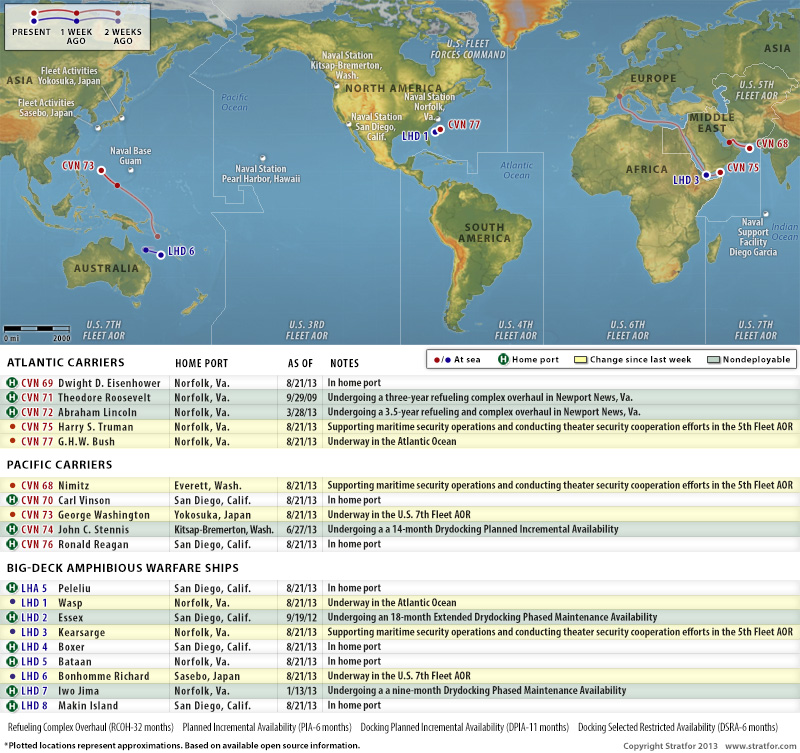
The French aircraft carrier Charles de Gaulle is still in or near Toulon, while the Royal Navy is said to have at least one Trafalgar or Astute class submarines in the Mediterranian. The RN no longer has in-service aircraft carriers, so any British air support would have to be from the RAF, possibly based in Cyprus (but subject to local government approval).
Update: This report says that the USS Ramage is also being retained in the Mediterranean along with the USS Mahan.
Update, 27 August: It was just mentioned (no link) that the Charles de Gaulle has been ordered to leave port, bound for the Eastern Mediterranean.
Comments Off on Suddenly of greater interest to the media – where are the carriers now?
July 11, 2013
Call it what you like, it’s still (petty) abuse of power and position
BBC News Magazine collects a few euphemisms for bribes:
If you are stopped by traffic police in North Africa the officer may well ask you to sponsor his next cup of “kahwe“, or coffee. In Kenya you might be stopped by traffic policemen and asked to contribute to “tea for the elders” (“chai ya wazee” in Swahili). But in Turkey, the police would rather you give them “cash for soup”, or “chorba parasi” — soup is traditionally eaten at the end of a night of heavy drinking.
[. . .]
The phrase “a fish starts to stink at the head” (balik bashtan kokar) comes from Turkey, reminding us that petty bribes at street-level are often matched by greater corruption at the top of organisations and institutions. Mexican officials looking to earn a kickback for arranging a business deal will demand they are given “a bite” (una mordida), while their Columbian counterparts are said to “saw” (serrucho) off a part of a government contract for themselves.
[. . .]
Large-scale corruption has its own vocabulary, often created by the media. The “cash for questions” scandal involving British politicians comes to mind, as well as the Italian “tangentopoli” (“bribesville”) scandal in the early 1990s. Combining “tangente” meaning kickback, and “-poli” meaning city, the term referred to kickbacks given to politicians for awarding public works contracts.
Comments Off on Call it what you like, it’s still (petty) abuse of power and position
June 28, 2013
Turkish PM throws treason accusation against BBC journalist
I guess the BBC is doing a fair job of agitating the powers-that-be, at least in Turkey:
Selin Gerit, a London-based presenter for BBC’s Turkish service, was until last week relatively unknown in her home country. However, that changed when Recep Tayyip Erdoğan told parliament she was guilty of treason over her coverage of the anti-government protests sweeping the nation.
The prime minister’s condemnation has triggered concerns among fellow journalists, who believe Erdoğan — who accuses the media of fanning the demonstrations — is attempting to stifle dissent.
The campaign against Girit was launched last weekend when the mayor of Ankara, Melih Gökçek, posted a series of angry tweets. The BBC criticised what it called government intimidation. The corporation’s comments triggered Erdoğan to claim in parliament the following day that Girit was “part of a conspiracy against her own country”.
Turkish journalists see the focus on Girit as a warning to them all — an example to cow the rest of them into submission. Serdar Korucu, editor of a major domestic news outlet, said: “The prime minister is telling us, ‘Be careful what you say and do, or you can easily be next’.”
The mainstream media have ignored much of the unrest, with CNNTürk airing a documentary on penguins while the central square in Istanbul became the scene of street protests unprecedented in Erdoğan’s 10-year rule. The public was outraged, and protests were staged outside local news outlets.
Many journalists, however, were not surprised. Fatma Demirelli, managing editor of Today’s Zaman, the English-language daily, said self-censorship had long become the norm in newsrooms. “Journalists now have a sort of split brain: on the one hand you see what the news is, but on the other you immediately try to gauge how to report it without stepping on anyone’s foot,” she said. “Self-censorship has become an automatic reflex.”
Comments Off on Turkish PM throws treason accusation against BBC journalist


