Quotulatiousness

June 3, 2013

Turkey’s unexpected wave of protests

Filed under: Europe, Government, Media, Politics — Tags: , , , — Nicholas @ 08:51

The Economist explains what is happening in Turkey:

The wave of unrest was completely unexpected. The protestors cut across ideological, religious and class lines. Many are strikingly young. But there are plenty of older Turks, many of them secular-minded, some overtly pious. There are gays, Armenians, anarchists and atheists. There are also members of Turkey’s Alevi Muslim minority. What joins them is the common sentiment that an increasingly autocratic Mr Erdogan is determined to impose his worldview. The secularists point to a raft of restrictions on booze; liberals to the number of journalists in jail (there are more journalists in prison than in any other country in the world). Thousands of activists of varying stripes (mainly Kurds), convicted under Turkey’s vaguely worded anti-terror laws, are also behind bars. Then there are those incensed by mega urban-development projects, including a third bridge over the Bosphorus, which will entail felling thousands of trees. Scenting the public mood, retailers announced that they had pulled out of the planned arcade in Taksim Square. “This is not about secularists versus Islamists — it’s about pluralism versus authoritarianism,” commented a foreign diplomat.

Mr Erdogan wants to be elected president when the post comes free in August 2014. And he has made no secret of his desire to boost the powers of the presidency “a la Turca” as he put it, spurring accusations that what Erdogan really wants is to become a “Sultan”.

“Tayyip [Erdogan] istifa”, a call for the prime minister to resign, was the slogan most commonly chanted by the protestors. Not that most Turks would have known. Media bosses fearful of jeopardising their other business interests shunned coverage of the protests for nearly two days, opting instead to screen programmes about breast-reduction surgery and gourmet cooking. Faced with a public outcry, the main news channels began broadcasting live from Taksim Square. But pro-government papers continue to point the finger of blame at provocateurs and “foreign powers” bent on undermining Turkey. It seems an odd description of the thousands of housewives leaning over their balconies clanging their pots.

November 10, 2012

What Ataturk accomplished to create modern Turkey

Filed under: Europe, Greece, History, Middle East, WW1 — Tags: , , — Nicholas @ 11:35

History Today posted that today is the anniversary of the death of Mustafa Kemal Ataturk, the man who carved modern Turkey out of the ruins of the Ottoman empire:

Mustapha Kemal Pasha was given the honorific title ‘father of the Turks’ at the height of a revolution which he was pushing forward intuitively and idiosyncratically, there being no precedent for such a fundamental sea change in a Muslim state.

Inevitably, it took someone standing outside the Islamic tradition of Ottoman Turkey to create a new state out of Anatolia — rising from the wreck of the empire. But as The Times was to say in its obituary, this was a man of extraordinary qualities; a Cromwell of the Middle East and also a maverick with an almost feminine subtlety in handling crises on the path to supreme power. He had an iron will and displayed single-mindedness when it came to ensuring the security of the state, even to hanging former confederates who plotted against his revolution.

Ataturk was born of an Albanian mother in Salonika and, without connections followed a military career in which, after being involved with the Young Turks reformist movement, he made his name in 1915 by rushing reinforcements to the Gallipoli beach-head and holding the ANZAC assault.

[. . .]

The Kemalists formed a provisional government in the small town of Ankara, in the middle of the desolate Anatolian plateau. On the Aegean and Mediterranean coasts the Greeks and Italians laid claim to what they regarded as their Asia Minor birthright, hoping to recreate some sort of classical empire. Kemal disabused the Greeks, who soon, of all the Allies hoping for a piece of Anatolia, were alone in arms against the nationalist forces. Halted in a blistering hot wilderness just short of Ankara, the Greeks, who had out-marched their supply lines, were outflanked and thrown back by Kemal’s outnumbered and ragged levies at the Sakaria river. A retreat became a headlong flight and the Greek forces joined their fellow nationals and the Armenians and foreigners who had formed the mercantile community of Smyrna, in a panic-stricken evacuation of the sacked and blazing port. Kemal is supposed to have indulged in a drinking orgy as Smyrna went up in flames — a Tartar conqueror’s celebration of total victory.

The Greeks quit the struggle and their sponsor, the British Prime Minister, Lloyd George, who had threatened armed British intervention backed by the fleet to keep Constantinople an open port under British protection, followed suit. The French and Russians signed separate treaties, giving the Kemalists recognition and aid.

November 3, 2012

Not your ordinary religious decision

Filed under: Middle East, Religion — Tags: , , — Nicholas @ 09:12

I’m not sure how other religious organizations might handle a request like this one:

A transsexual living in Mersin who underwent surgery to become a woman has requested a change in regulations so that she can return to being a man by having a penis reattached to her body.

D.K., a 34-year-old originally from the eastern province of Van who describes herself as a believing Muslim, asked the Directorate of Religious Affairs whether it was religiously permissible to receive a penis transplant from a cadaver, but religious officials said it was impermissible unless the penis originally belonged to the transplant recipient.

H/T to Blazing Cat Fur for the link.

August 28, 2012

Rehabilitating Florence Nightingale’s reputation

Filed under: Britain, Health, History, Military, Russia — Tags: , , , , — Nicholas @ 08:31

History Today has a defence of the much-maligned Florence Nightingale:

Jamaican-born Mary Seacole (1805-81), voted top of the list of the 2004 ‘100 Great Black Britons’ poll, is now slated to replace Florence Nightingale (1820-1910) as the true ‘heroine’ of the Crimean War. She is to be honoured as no less than the ‘Pioneer Nurse’ with a massive statue to be erected at St Thomas’ Hospital in London. This in spite of the strong links between Nightingale and the hospital, her base for over 40 years. It was there she established the first secular school for nurses in 1860 with funds raised in her name for her work in the Crimean War during the conflict of 1854-56. The Nightingale School operated for over a century from the hospital, whose redesign in the 1860s Nightingale also influenced.

[. . .]

The campaign promoting Seacole over Nightingale builds on 30 years of books, articles and films denigrating the latter. While she always had detractors, the serious assault on Nightingale’s reputation can be dated to 1982, with the publication of the Australian historian F.B. Smith’s Florence Nightingale: Reputation and Power (Croom Helm, 1982). The next major hit came in 1998 with Florence Nightingale: Avenging Angel (Constable, 1998) by a retired management consultant Hugh Small, which argues that Nightingale was actually responsible for the high death rates of the Crimean War and had a nervous breakdown as a result when she supposedly recognised this. Neither claim is supported by any serious documentation. Social media goes even further: see Facebook ‘Florence Nightingale was a Murdering Bitch’, later renamed ‘Florence Nightingale: The World’s Worst Nurse’, where she is described as a ‘deluded power hungry bitch’, who ‘looks like an uptight bitch’, so that ‘the day she died’ was ‘the best thing that ever happened to the field of nursing’.

[. . .]

The French were the instigators of the Crimean War, sent more troops and were better prepared than the British. Their death rates were lower in the first year. But the British government learned from the commissions it sent out and made enormous changes. British death rates fell dramatically, from 23 per cent in the first winter to 2.5 per cent in the second — no greater than deaths among soldiers in peacetime barracks in London, as Nightingale proudly showed in a chart. In contrast, the French (lower) 11 per cent death rate in the first winter, rose to 20 per cent in the second winter. Since the French were late in publishing their statistics, neither Nightingale nor the royal commission could use them for comparison. However French doctors themselves credited the British reforms for their superior performance. Once they were properly cleansed and functioning Nightingale was proud of the Crimean hospitals. In her own charts she separated the two periods, before and after the sanitary and supply commissions, to emphasise the crucial role they played in reducing mortality.

Her analysis of what went wrong was widely accepted and led to major changes to health care in the British Army. The ‘Nightingale Fund’ raised in her honour for that work paid for the training school at St Thomas’, which led to raising nursing to the level of a profession throughout much of the world. Her experience of the war, and her reputation and research as a result of it, grounded all the social and public health work she did for the rest of her life. Her vision for health reform included bold statements, such as the belief that the poor should receive as good quality hospital care as private patients and warnings as to the dangers of hospital acquired infections. Nightingale, in short, is no mere historical figure. Her lamp should not be retired but shone brightly onto the hospital and health care problems of today.

June 17, 2012

Royal Navy submarine wreck discovered in the Dardanelles

Filed under: Britain, History, Middle East, Military, WW1 — Tags: , , , — Nicholas @ 09:26

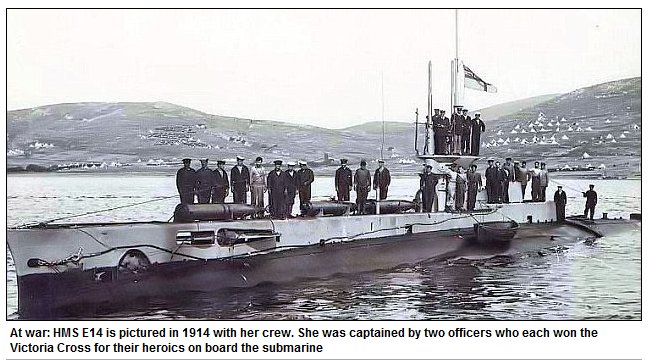
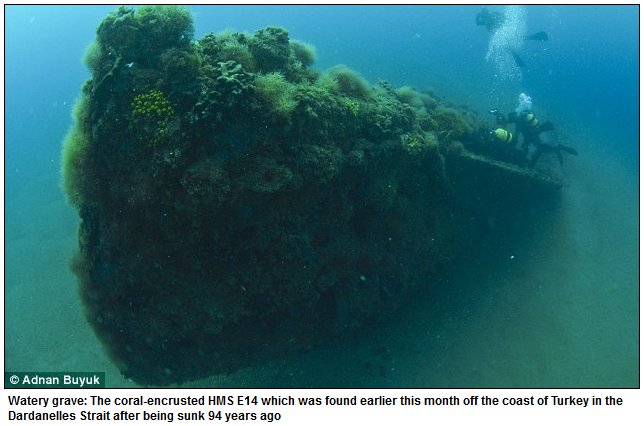
What appears to be the wreck of the E14 has been located just 800 feet offshore in the Straits of the Dardanelles:

Its precise location in the eastern Mediterranean remained a mystery until this month when a Turkish marine engineer and a diver detected it on the seabed off the town of Kumkale – just 800ft from the beach.

The wreck was discovered by marine expert Selçuk Kolay and film-making diver Savas Karakas, who had spent three years trying to find it.

After studying documents at the national Archives in Kew, west London, and surveying Turkish defences, they scanned an unusual object from a boat on the surface.

But they could not establish what it was because it was near the mouth of the straits — a sensitive military area where diving was forbidden.

It took two years to get permission from the military before their team were able to dive to the wreck and confirm it was the E14 earlier this month.

April 22, 2012

Protecting the Turkish identity should not include ignoring history

Filed under: Education, History, Liberty, Middle East, WW1 — Tags: , , , — Nicholas @ 12:11

Ayşe Kadıoğlu is a Turk who went to university in the United States. Part of the experience was meeting Armenian-American students in Boston and learning about events in Turkish history that have been rigorously suppressed in aid of bolstering “Turkishness”:

I grew up in Turkey, where the prevailing education system still conceals certain historical facts in primary and secondary school curricula lest they harm the “indivisibility of the state with its country and nation”, an expression that is used several times in the current Turkish constitution. Perhaps the fear about deeds that can harm the unity of the state and nation is best symbolised in the Turkish national anthem, which begins with the lyrics “Do not fear”.

When fears nurture and sustain taboos, the ability to retain experiences declines. Enduring an education that is laden with either false historical facts or an eerie silence makes it impossible for people to exit the state of self-imposed immaturity.

[. . .]

There are many taboos in Turkey that mainly concern the protection of the “indivisibility of the state and nation”. There are also many laws that make it a crime to break these taboos. When taboos are sustained by law, the minds (and, many times, bodies) of citizens end up being imprisoned. One such taboo involves the founder of the Turkish republic, Mustafa Kemal Atatürk. In Turkey, it is a crime to insult his memory and harm his statutes. Another taboo involves the sacredness of the armed forces. This is sustained by a law against discouraging people from performing their compulsory military service.

[. . .]

Taboos, enforced by law, are fetters in front of the ability to reason. It is possible to be released from the spell of taboos and strengthen the ethos of democracy by upholding the realm of public debate and deliberation. Therefore, yes, I agree with Free Speech Debate’s fourth draft principle, “We allow no taboos in the discussion and dissemination of knowledge”, because we try not to be trapped in a state of immaturity and want to do our utmost to fulfil our capacities as reasonable human beings.

March 22, 2012

Syria is a “nation made up of little pieces, and they all are about to fall to the floor”

Filed under: History, Middle East, Politics, Religion — Tags: , , , — Nicholas @ 10:02

Geoffrey Clarfield on the history of Syria and the possible future of the region:

From outside Syria, it appears that a government is waging war against citizens who are demanding change and democracy. That is certainly how many media outlets are reporting the ongoing violence in that country. But as many Syrians know, this war is about something else entirely. Something much larger.

A century ago, Syria was still part of the Ottoman Empire. Although the administrative sub-districts of what is now called Syria changed many times under the Turks, by the early 20th century they comprised a number of distinct administrative units that centred around key cities, such as Damascus and Aleppo. Beginning in 1874, they also included the areas around Jerusalem (which had a Jewish majority). The British called the area “the Levant.”

The area was, and still is, made up of a number of occasionally co-operating, occasionally competing ethnic groups: Sunni Arabs, Maronite Christians, Arabic-speaking Greek Orthodox Christians, Aramaic-speaking Christians, Arabic-speaking Alawis, Muslim Gypsies, Armenians, Jews, Yezidis, Kurdish-speaking Sunnis and nomadic Sunni Bedouin — each with their own distinctive history, loyalties and competing interests.

[. . .]

As the Sunni Arab elites of Aleppo and Damascus clamoured for independence from the French, they became enamored with three overlapping ideologies. The first was that of Pan-Islam, which many rejected because it was seen as too similar as that of the defunct and discredited Ottoman Empire. The second was Pan Arabism, which held that the Arab world was once one country, and was destined to become one again. (This school of thought would survive until Nasser’s era in the 1950s and 1960s, but no one talks about it anymore.)

The third was “Greater Syria.” This theory held that the peoples of the eastern Mediterranean were all members of one unit — including present-day Syria, Lebanon, Jordan, Israel and southwestern Turkey. Extreme versions of the “Greater Syria” ideology include Cyprus and the Sinai desert. In none of these worldviews is there any room for an independent Jewish homeland, a Christian Lebanon or, in the masimalist cases, even a Greek Orthodox Cyprus. Unlike Pan Arabism, the ideology of Greater Syria still has some resonance in the region.

January 3, 2012

Turkey’s problem with evolution

Filed under: Government, Liberty, Middle East, Religion, Science — Tags: , , , , — Nicholas @ 12:10

It’s not just certain US states that have strong reservations about Charles Darwin and the theory of evolution:

Worrying news from Turkey, where a government body has moved to block sites that mention evolution or Charles Darwin.

The Council of Information Technology and Communications (BTK) released the “Secure Internet” filtering system on 22 November. Sites that includes the words “evolution” or “Darwin” are filtered if parents select the child-friendly settings on the filter, as though it’s porn. Among the sites banned, according to Reporters Without Borders, is Richard Dawkins’ website richarddawkins.net. The homepage of Adnan Oktar, an Islamic creationist, is still accessible. The system has already attracted controversy: apparently it bans terms linked with the Kurdish separatist movement, and Reporters Without Borders has accused the Turkish government of “backdoor censorship”.

As New Scientist reported in 2009, Turkey is something of a centre for Islamic creationism. The editor of a popular science magazine, Bilim ve Teknik, was sacked that year after trying to run a front-page article celebrating Darwin’s 200th birthday. The aforementioned Oktar, under his pen name of Harun Yahya, claims in large, lavishly illustrated books that evolution is a “disproved” theory (just for the record: it isn’t. It’s the absolute cornerstone of everything in biology, without which nothing makes sense) imposed by Western imperialists to keep Muslims in their place. A 2006 survey of 34 countries put Turkey 34th, just behind the US, in the rate of popular acceptance of evolution.

September 18, 2011

“One would have to go back to 1973 to find a more perilous time for the Jewish state”

Filed under: Middle East, Politics — Tags: , , , — Nicholas @ 11:58

David Harsanyi on the increasing UN pressure on Israel:

Sure, the United Nations has historically vacillated between deep irrelevance and monumental ineffectiveness. But with all its prevaricating and impotence on genuine threats to human rights across the world, next week it will be actively precipitating violence and endorsing ethnic cleansing.

It is understood that one of the preconditions for the existence of a Palestinian state is the judenrein West Bank. It will be purified of Jews, regardless of their political inclinations, Zionist or not, because effectively speaking no Jew will be able to live in the West Bank or East Jerusalem safely. Palestine Liberation Organization’s ambassador to the United States, Maen Rashid Areikat, has admitted as much.

[. . .]

Another onetime ally the increasingly Islamic Turkey has similarly turned on Israel, kicking out the Israeli ambassador, and ending military ties and trade pacts. Prime Minister Recep Tayyip Erdogan vowed to send warships as escorts to “aid ships” in the next activist-filled flotilla trying to reach the Palestinians. A United Nations failure will only provoke more hostility and put the two nations in a potentially catastrophic position.

Supporters of Israel often speak in perfunctory tones about the existential threat Israel faces. But one would have to go back to 1973 to find a more perilous time for the Jewish state. With this vote, the United Nations is simply giving in to its seemingly pathological need to undermine Israel — no matter the circumstance, no matter the consequence.

There can be no other reason for a vote that is simultaneously so dangerous and so utterly useless.

Then again, that’s the perfect way to describe the United Nations.

September 6, 2011

Turkey approaching combat situation with Israel?

Filed under: Media, Middle East, Military — Tags: , , , — Nicholas @ 10:00

Strategy Page has a summary of the situation:

Turkey’s Islamic government has backed itself into a corner by demanding Israel apologize for defending itself when halting the 2010 blockade-breaking ships. The Turks demand an apology, compensation and an end to the blockade. This, despite the fact that Hamas (and many other groups in Gaza) are recognized as international terrorists and that Turkish activists on the ships were videoed attacking the Israeli boarding party. The Turks will not back down, and now threaten to send warships to escort yet another group of blockade breakers. This is pretty extreme, as the Israeli Navy has a lot more combat experience, and the Turks would be in waters long patrolled by the Israelis. This could easily escalate into an air war, another area where the Israelis have a lot more experience. The Arabs and Palestinians are all for this, as the Israelis have consistently defeated Arab forces, but the Turks are seen as much more capable. But are they capable enough?

Here are links to earlier reports on the flotilla incident, Turkey’s conspiracy theorists, and the very weird world of Turkish media.

Update, 8 September: Turkey escalates the threat level for combat with Israel:

Turkish warships will escort any Turkish aid vessels to Palestinians in the Gaza Strip, Recep Tayyip Erdogan, the prime minister, has announced.

He also said Turkey had taken steps to stop Israel unilaterally exploiting natural resources from the eastern Mediterranean, according to al-Jazeera’s Arabic translation of excerpts of an interview conducted in Turkish.

His comments came after Turkey’s ruling party said the country’s ties to Israel could be normalised if the Jewish state apologised for the killing of nine pro-Palestinian activists last year and accepted it should pay compensation to their families.

I am not a lawyer, but I’d imagine that an attempt to use naval vessels to break a legal blockade would be tantamount to a declaration of war. I have a hard time believing that Turkey is that eager to test Israel’s resolve (and military might).

June 8, 2011

“RAF’s new superfighter was thrashed in the very type of combat it is supposed to be best at by a 1970s-era plane”

Filed under: Asia, Britain, Middle East, Military, Technology — Tags: , , , — Nicholas @ 07:24

Lewis Page talks about claims from a Pakistani Air Force fighter pilot that their F-16s had “shot down” Royal Air Force Typhoons in three separate air training exercises in Turkey.

The RAF Typhoon, formerly known as the Eurofighter, should nonetheless have been vastly superior in air-to-air combat whether BVR or close in within visual range (WVR). The cripplingly expensive, long-delayed Eurofighter was specifically designed to address the defects of its predecessor the Tornado F3 — famously almost useless in close-in, dogfighting-style air combat. The Typhoon was meant to see off such deadly in-close threats as Soviet “Fulcrums” and “Flankers” using short-range missiles fired using helmet-mounted sight systems: such planes were thought well able to beat not just Tornados but F-16s in close fighting, and this expectation was borne out after the Cold War when the Luftwaffe inherited some from the East German air force and tried them out in exercises.

Thus it is that huge emphasis was placed on manoeuvring capability and dogfighting in the design of the Eurofighter. The expensive Euro-jet was initially designed, in fact, as a pure fighter with no ground attack options at all — bomber capability has had to be retrofitted subsequently at still more expense. Despite lacking various modern technologies such as Stealth and thrust-vectoring the resulting Typhoon is generally touted as being one of the best air-to-air combat planes in the world right now. Certainly it is meant to be good in close fighting: it is armed with the Advanced Short Range Air to Air Missile (ASRAAM) which as its name suggests is intended for the close WVR fight.

Perhaps the account above is simply a lie, or anyway a bit of a fighter pilot tall story. But the pilot quoted will be easily identifiable inside his community if not to the outside world, and he could expect a lot of flak for telling a lie on such a matter in public. It seems likelier that the story is the truth as he perceived it: that the RAF’s new superfighter was thrashed in the very type of combat it is supposed to be best at by a 1970s-era plane, albeit much modernised.

May 13, 2011

Iatrogenic gullibility?

Filed under: Randomness — Tags: , , , , — Nicholas @ 12:20

Bruce Schneier summarizes a report that is either a very late April Fool story or proof that the sight of a white coat and stethescope induces compliant behaviour:

This is a pretty scary criminal tactic from Turkey. Burglars dress up as doctors, and ring doorbells handing out pills under some pretense or another. They’re actually powerful sedatives, and when people take them they pass out, and the burglars can ransack the house.

According to the article, when the police tried the same trick with placebos, they got an 86% compliance rate.

The linked report shows that people are nearly as likely to open the door when the caller claims to be a robber.

April 7, 2011

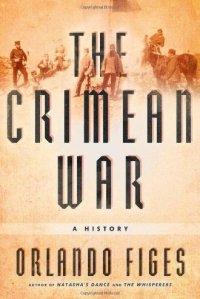
Briefly noted – The Crimean War by Orlando Figes

Filed under: Britain, France, History, Middle East, Russia — Tags: , — Nicholas @ 13:24

I just picked this up last night at the “World’s Biggest Bookstore” in Toronto. I’m quite enjoying it, as it discusses much more than just the war itself: about 50 pages in, I think I’ve learned far more about middle eastern history and Russia’s geostrategic problems.

The various books and articles I’ve read on this conflict have pretty uniformly concentrated on the purely military aspects, and generally just on the battles involving British and French troops. One reason for the relative obscurity of such a major conflict is that the background is essential to understand just why Britain and France were fighting Russia on the Black Sea coast. Without that background, the war appears totally senseless and this is heightened by the well-worn tales of military incompetence (the Charge of the Light Brigade), brief moments of heroism (the “Thin Red Line”), and criminally awful medical and sanitary situation (Florence Nightingale).

If the remaining 450 pages are as good as the first 50, this will be one of my candidates for book of the year.

February 19, 2011

When “hacker army” is not an exaggeration

Filed under: Britain, China, Government, Military, Russia, Technology — Tags: , , , , , — Nicholas @ 10:07

Strategy Page counts noses of the various semi-organized hacker armies out in the wild:

Despite spending over a billion dollars a year defending their government networks, Britain recently complained openly of hackers getting into the communications network of the Foreign Office. The government also warned of increasing attacks on British companies. The recent attacks government and corporations were all targeting specific people and data. While China was not mentioned in these official announcements, British officials have often discussed how investigations of recent hacking efforts tended to lead back to China. There is also a strong suspicion, backed up by hacker chatter, that governments are offering large bounties for information from foreign governments. Not information from China, but from everyone else.

China one of many nations taking advantage of the Internet to encourage, or even organize, patriotic Internet users to obtain hacking services. This enables the government to use (often informally) these thousands of hackers to attack targets (foreign or domestic.) These government organizations arrange training and mentoring to improve the skills of group members. Turkey has over 45,000 of hackers organized this way, Saudi Arabia has over 100,000, Iraq has over 40,000, Russia over 100,000 and China, over 400,000. While many of these Cyber Warriors are rank amateurs, even the least skilled can be given simple tasks. And out of their ranks will emerge more skilled hackers, who can do some real damage. These hacker militias have also led to the use of mercenary hacker groups, who will go looking for specific secrets, for a price. Chinese companies are apparently major users of such services, judging from the pattern of recent hacking activity, and the fact that Chinese firms don’t have to fear prosecution for using such methods.

It was China that really pioneered the militia activity. It all began in the late 1990s, when the Chinese Defense Ministry established the “NET Force.” This was initially a research organization, which was to measure China’s vulnerability to attacks via the Internet. Soon this led to examining the vulnerability of other countries, especially the United States, Japan and South Korea (all nations that were heavy Internet users). NET Force has continued to grow. NET Force was soon joined by an irregular civilian militia; the “Red Hackers Union” (RHU). These are nearly half a million patriotic Chinese programmers, Internet engineers and users who wished to assist the motherland, and put the hurt, via the Internet, on those who threaten or insult China. The RHU began spontaneously in 1999 (after the U.S. accidentally bombed the Chinese embassy in Serbia), but the government has assumed some control, without turning the voluntary organization into another bureaucracy. The literal name of the group is “Red Honkers Union,” with Honker meaning “guest” in Chinese. But these were all Internet nerds out to avenge insults to the motherland.

You have to wonder how many script kiddies ever thought they’d end up being government operatives.

January 27, 2011

They’ll be around to collect his “man card” any moment

Filed under: Europe, Germany, Randomness — Tags: , , — Nicholas @ 12:50

Poor guy can’t get enough sleep because of his sex-mad spouse:

An exhausted Turkish man living in Germany has asked cops to protect him from his sex-mad missus, Bild reports.

The bleary-eyed victim of his wife’s “voracious embraces” walked into a police station in the southwestern city of Waiblingen on Tuesday to explain he’d spent four years kipping on the sofa in a vain attempt to get some shut-eye.

« Newer PostsOlder Posts »

Powered by WordPress