
And so, Foucault tells us, in the fifteenth century there is a sudden emergence of a complex of artistic and philosophical themes linking madmen, the sea, and the terrible mysteries of the world. These culminate in the “Ship Of Fools”:
Renaissance men developed a delightful, yet horrible way of dealing with their mad denizens: they were put on a ship and entrusted to mariners because folly, water, and sea, as everyone then knew, had an affinity for each other. Thus, “Ships of Fools” crisscrossed the seas and canals of Europe with their comic and pathetic cargo of souls. Some of them found pleasure and even a cure in the changing surroundings, in the isolation of being cast off, while others withdrew further, became worse, or died alone and away from their families. The cities and villages which had thus rid themselves of their crazed and crazy, could now take pleasure in watching the exciting sideshow when a ship full of foreign lunatics would dock at their harbors.
This was such a great piece of historical trivia that I was shocked I’d never heard it before. Some quick research revealed the reason: it is completely, 100% false. Apparently Foucault looked at an allegorical painting by Hieronymus Bosch, decided it definitely existed in real life, and concocted the rest from his imagination.
Foucault apologists try to rescue this, say that he was just being poetic in some way. He wasn’t. Page 8 in my copy: “Of all these romantic or satiric vessels, the Narrenschiff [Ship Of Fools] is the only one that had a real existence — for they did exist, these boats that conveyed their insane cargo from town to town.” He really, really doubled down on this point. As far as I can tell, this is just as bad a failing of scholarship as it sounds – and surprising, since everything else about the book gives the impression of Foucault as an incredibly knowledgeable and wide-ranging scholar.
Scott Alexander, “Book review: Madness and Civilization”, Slate Star Codex, 2018-01-04.
April 13, 2020
QotD: Foucault’s “Ship of Fools”
March 10, 2020
Thought-saving inventions
In the latest issue of his Age of Invention newsletter, Anton Howes considers the innovations that helped provide short-cuts for thought, rather than labour:

The world on Mercator projection between 85°3’4″S and 85°3’4″N, such that image is square. 15° graticule. Imagery is a derivative of NASA’s Blue Marble summer month composite with oceans lightened to enhance legibility and contrast. Image created with the Geocart map projection software.
Image by Strebe via Wikimedia Commons.
When we think of labour-saving inventions, the kind of labour that springs to mind tends to be manual. We think of machines replacing the muscle of limbs and the dexterity of fingers, and we worry about their effects on unemployment and unrest. But there’s a subset of labour-saving inventions that rarely gets discussed. They might best be called thought-saving.
A few weeks ago I mentioned the introduction of mathematical techniques to navigation. Before the mid-sixteenth century in England, pilots very rarely even knew how to calculate their latitude, let alone their longitude. But over the course of just a few decades, England became one of the world leaders in navigational improvements. A handful of mathematicians saved pilots the trouble of calculation, by coming up with tables, instruments, diagrams, and rules of thumb. In the process, they improved navigation’s accuracy, and ushered in an age of English dominance of the high seas.
The historian Eric H. Ash gives a few great examples. In the 1590s, the explorer John Davis shared a way to calculate the time of high tide, without requiring multiplication. Likewise, William Bourne, a self-taught mathematician and gunner, in the 1560s provided an easy means of calculating the linear distance in one degree of longitude, at any given latitude. He provided a diagram — really an instrument, even if it wasn’t made of wood or brass — which with just a simple piece of string could be used to derive the answer without needing to understand cosines, or really any trigonometry.
The mathematicians did the same with maps, too (after all, aren’t all maps thought-saving?) The sixteenth-century cartographic innovations simplified the pilot’s ability to chart a route, for example by taking away all need to worry about the curvature of the earth. The famous 1560s map projection of Gerardus Mercator stretched the distance between the lines of latitude as they got closer to the poles, so that charting a course on such a map was a simple matter of drawing straight lines rather than complex trigonometry. The Mercator projection may well make Africa look smaller than Greenland — it’s actually almost fifteen times as large — but it made life significantly easier for mariners. For similar reasons, the mathematician John Dee designed a special chart — what he called the “paradoxall compass” — to aid the English explorers who in the 1550s went in search of a northeast and northwest passage to Asia. Conventional charts made navigating high latitudes confusing, as the north pole was a straight line — the map’s top border. Dee’s map made things easier by putting the pole at the centre, as a point, with the lines of latitude as concentric circles.
March 7, 2020
RCN’s Arctic and Offshore Patrol Ships delayed again
In the Ottawa Citizen, David Pugliese reports on the latest hold-up in getting the Arctic and Offshore Patrol Ships (AOPS) into the RCN’s hands:
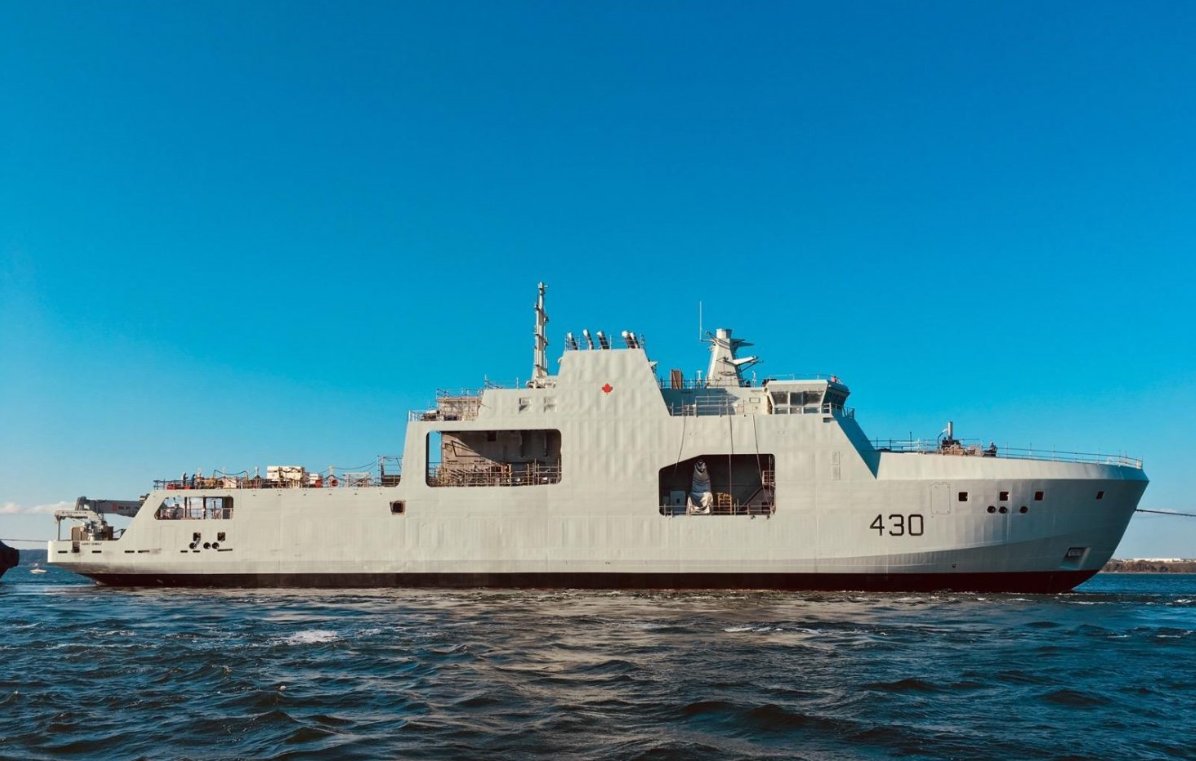
The delivery of the first Arctic and Offshore Patrol Ship to the Royal Canadian Navy has been delayed once more and the arrival of the second ship has also fallen behind schedule.
In November, the Department of National Defence stated the first Arctic and Offshore Patrol Ships, or AOPS, was expected by the end of March.
That won’t be happening, DND confirmed to this newspaper.
The department can’t provide any specific details on a new delivery date for the ship being built by Irving Shipbuilding Inc. on the east coast. But it noted that delivery would happen sometime before June 21.
The first AOPS was to have been delivered in 2013, with Arctic operations set for 2015. But ongoing problems with the government’s national shipbuilding program and delays in awarding the contract continued to push schedules back.
There is some risk the first vessel could be delayed beyond the June timeframe, DND acknowledged. In addition, the department confirmed the delivery of the second AOPS has also fallen behind schedule. The scheduled delivery of the other ships could also slip.
“Lessons are being learned from the construction of the first ship, and are benefiting the construction of the second ship,” explained DND spokeswoman Jessica Lamirande. “However, as some inefficiencies are still being resolved, and because resources were focused on the first ship, delivery of the second ship has been delayed. The delivery timelines for the second to sixth ships are still being assessed, and updates will be shared once available.”
The second AOPS was supposed to be delivered in late 2020. The last of the six ships was supposed to arrive in 2024.
February 19, 2020
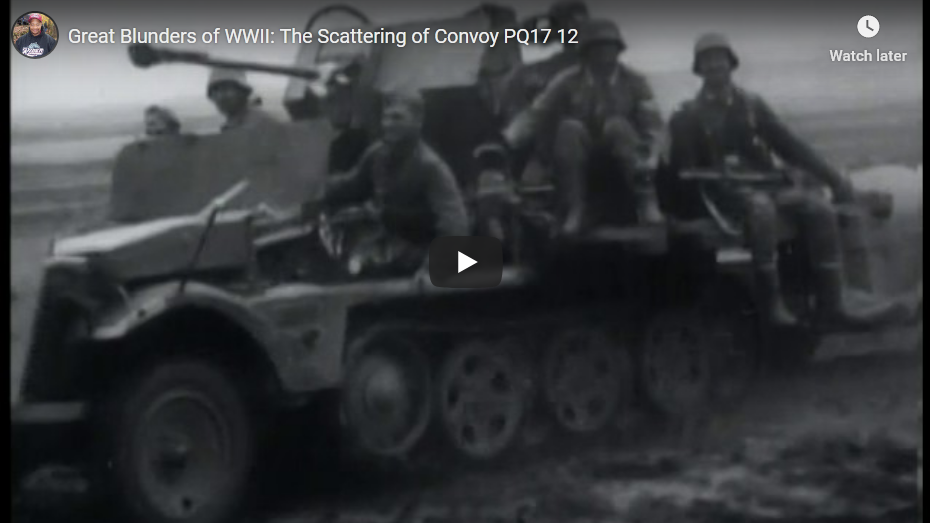
Great Blunders of WWII: The Scattering of Convoy PQ17
Anthony Coleman
Published 4 Nov 2016From the History Channel DVD series Great Blunders of WWII.
This is of interest for many reasons, but particularly because my late father-in-law served in the Royal Navy on the Arctic convoys and spent a full winter in the Soviet Union when his convoy couldn’t return before the ice closed the convoy route.
February 14, 2020
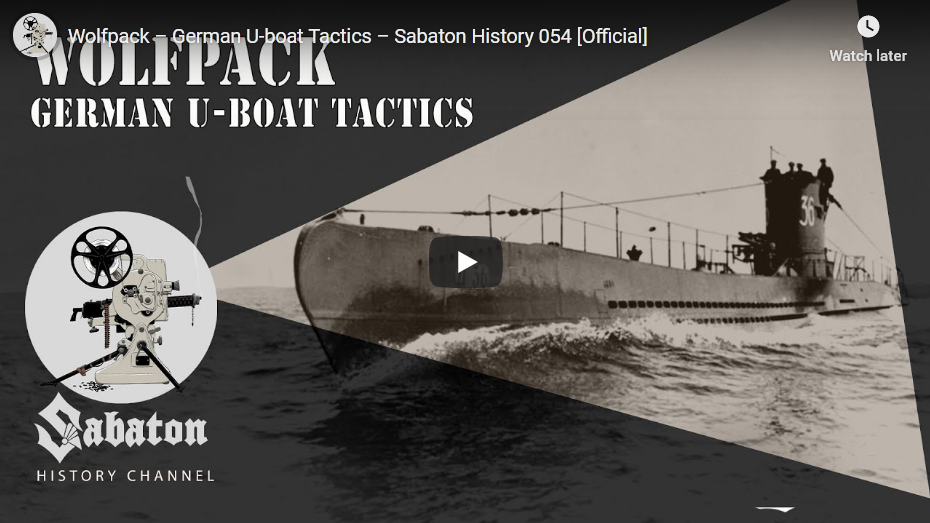
“Wolfpack” – German U-boat Tactics – Sabaton History 054 [Official]
Sabaton History
Published 13 Feb 2020The Battle of Britain had saved the United Kingdom from imminent invasion by the German Wehrmacht, however the war was far from over. To destroy Britain’s economic capabilities to wage war, the German Kriegsmarine had to win the tonnage war in the North Atlantic. The German submarines — the U-Boote, were sent out to hunt. As the British Royal Navy returned to the convoy system to protect its merchant fleet, the Germans as well began organizing their submarines in groups to attack in unison. These hunter-killer teams, the Wolfpacks, would soon haunt the depths of the North Atlantic.
Support Sabaton History on Patreon: https://www.patreon.com/sabatonhistory
Listen to “Wolfpack” on the album Primo Victoria:
CD: http://bit.ly/PrimoVictoriaStore
Spotify: http://bit.ly/PrimoVictoriaSpotify
Apple Music: http://bit.ly/PrimoVictoriaAppleMusic
iTunes: http://bit.ly/PrimoVictoriaiTunes
Amazon: http://bit.ly/PrimoVictoriaAmzn
Google Play: http://bit.ly/PrimoVictoriaGooglePlayCheck out the trailer for Sabaton’s new album The Great War right here: https://www.youtube.com/watch?v=HCZP1…
Listen to Sabaton on Spotify: http://smarturl.it/SabatonSpotify
Official Sabaton Merchandise Shop: http://bit.ly/SabatonOfficialShopHosted by: Indy Neidell
Written by: Markus Linke and Indy Neidell
Directed by: Astrid Deinhard and Wieke Kapteijns
Produced by: Pär Sundström, Astrid Deinhard and Spartacus Olsson
Creative Producer: Joram Appel
Executive Producers: Pär Sundström, Joakim Broden, Tomas Sunmo, Indy Neidell, Astrid Deinhard, and Spartacus Olsson
Post-Production Director: Wieke Kapteijns
Edited by: Iryna Dulka
Sound Editing by: Marek Kaminski
Maps by: Eastory – https://www.youtube.com/c/eastoryArchive by: Reuters/Screenocean https://www.screenocean.com
Music by Sabaton.Colorizations:
– Olga Shirnina, a.k.a. Klimbim – https://klimbim2014.wordpress.com/Sources:
– IWM: HU 16546, A 30292
– Bundesarchiv
– Otis Historical Archives, National Museum of Health and Medicine
– Narodowe Archiwum Cyfrowe
– Canadian ship being attacked, photo courtesy of the Government of Canada, https://www.canada.ca/en/navy/service…An OnLion Entertainment GmbH and Raging Beaver Publishing AB co-Production.
© Raging Beaver Publishing AB, 2019 – all rights reserved.
December 7, 2019
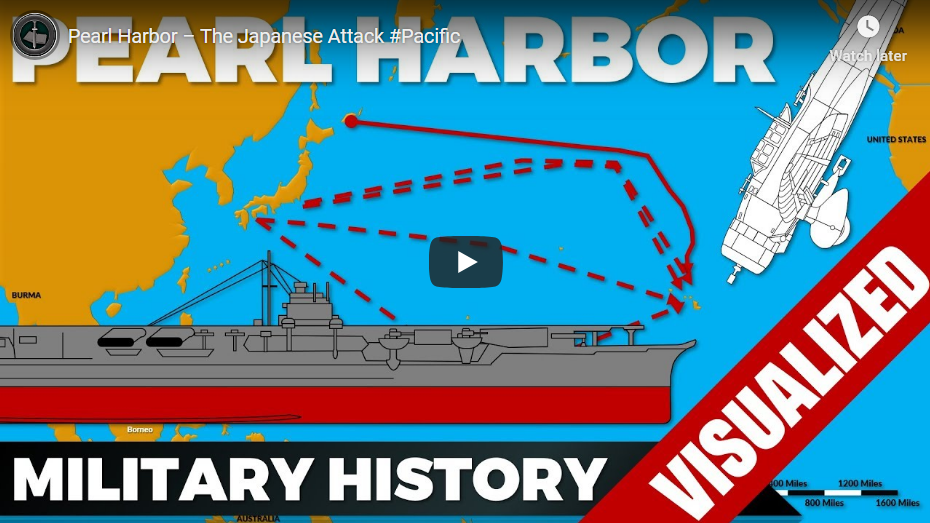
Pearl Harbor – The Japanese Attack
Military History Visualized
Published 29 Nov 2016» HOW YOU CAN SUPPORT MILITARY HISTORY VISUALIZED «
(A) You can support my channel on Patreon: https://www.patreon.com/mhv(B) Alternatively, you can also buy “Spoils of War” (merchandise) in my online shop: https://www.redbubble.com/people/mhvi…
(C) If you want to buy books that I use or recommend, here is the link to the Amazon Store: http://astore.amazon.com/ytmh-20 which has the same price for you and gives a small commission to me, thus it is a win/win.
» SOURCES & LINKS «
Kuehn, John T.: “The war in the Pacific, 1941-1945”; in: Cambridge History of the Second World War, Volume 1
Amazon.com (affiliate): http://amzn.to/2g82o9aDull, Paul S.: The Battle History of the Imperial Japanese Navy.
Amazon.com (affiliate): http://amzn.to/2gPBxhJGermany & The Second World War – Volume VI
Amazon.com (affiliate): http://amzn.to/2g85hqtDas Deutsche Reich und der Zweite Weltkrieg, Band 6.
Amazon.de (affiliate) http://amzn.to/2gc49RaZimm, Alan D. The Pearl Harbor Myth
http://www.historynet.com/pearl-harborZimm, Alan D. Attack on Pearl Harbor: Strategy, Combat, Myths, Deceptions.
Amazon.com (affiliate): http://amzn.to/2gc0LWk» ADDITIONAL LINKS «
Maps
http://pacificwarbirds.com/pearl-harb…https://spotlights.fold3.com/2011/12/…
Verifying the Submarine loss
https://www.history.navy.mil/research…http://www.combinedfleet.com/I-70.htm
Bonus Link (not used): Original Damage Reports
https://archive.org/download/WorldWar…» CREDITS & SPECIAL THX «
Song: Ethan Meixsell – “Demilitarized Zone”» DISCLAIMER «
Amazon Associates Program: “Bernhard Kast is a participant in the Amazon Services LLC Associates Program, an affiliate advertising program designed to provide a means for sites to earn advertising fees by advertising and linking to amazon.com.”Bernhard Kast ist Teilnehmer des Partnerprogramms von Amazon Europe S.à.r.l. und Partner des Werbeprogramms, das zur Bereitstellung eines Mediums für Websites konzipiert wurde, mittels dessen durch die Platzierung von Werbeanzeigen und Links zu amazon.de Werbekostenerstattung verdient werden können.
December 2, 2019
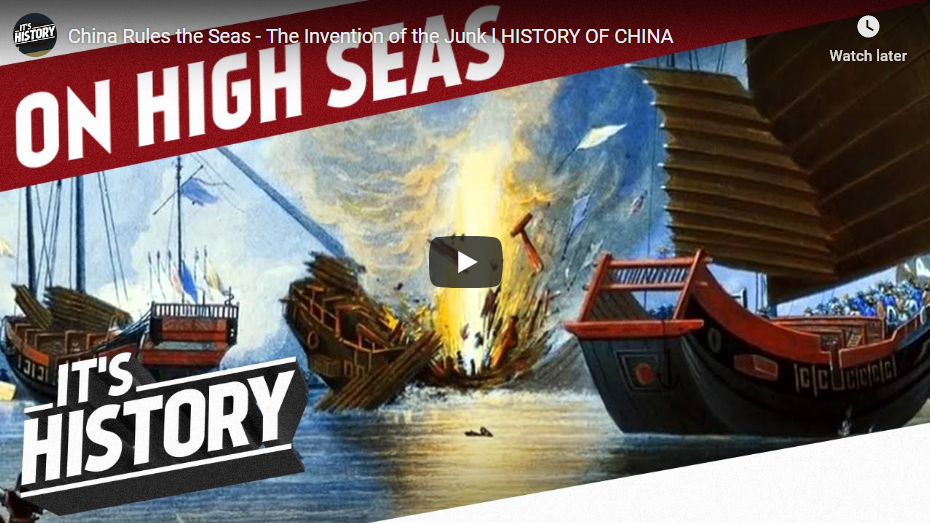
China Rules the Seas – The Invention of the Junk l HISTORY OF CHINA
IT’S HISTORY
Published 19 Aug 2015Imperial China was a great seafaring nation. With the invention of the junks — massive, nearly unsinkable ships — it is safe to say that by the 14th century China had the best sea vessels in the world. The invention of the compass made navigation trustworthy as never before and Admiral Zheng He’s treasure fleet eagerly explored the Seven Seas. The first Chinese navy also depended on the mighty junk for their fighting tactics. But not all emperors were convinced of seafare and so the Chinese maritime power ended somewhat abruptly, giving the rest of the world time to catch up. Learn all about China on the water on IT’S HISTORY.
» The Complete PLAYLIST: http://bit.ly/HistoryOfChina
» SOURCES
Videos: British Pathé (https://www.youtube.com/user/britishp…)
Pictures: mainly Picture Alliance
Content:
“Hadingham, Evan (2001): Ancient Chinese Explorers: http://www.pbs.org/wgbh/nova/ancient/…
Needham, Joseph (1986): Science and Civilization in China, Volume 4, Physics and Physical Technology, Part 3, Civil Engineering and Nautics. Taipei”» ABOUT US
IT’S HISTORY is a ride through history – Join us discovering the world’s most important eras in IN TIME, BIOGRAPHIES of the GREATEST MINDS and the most important INVENTIONS.» CREDITS
Presented by: Guy Kiddey
Script by: Martin Haldenmair
Translated by: Guy Kiddey
Directed by: Daniel Czepelczauer
Director of Photography: Markus Kretzschmar
Music: Markus Kretzschmar
Sound Design: Bojan Novic
Editing: Markus KretzschmarA Mediakraft Networks original channel
Based on a concept by Florian Wittig and Daniel Czepelczauer
Executive Producers: Astrid Deinhard-Olsson, Spartacus Olsson
Head of Production: Michael Wendt
Producer: Daniel Czepelczauer
Social Media Manager: Laura Pagan and Florian WittigContains material licensed from British Pathé
All rights reserved – © Mediakraft Networks GmbH, 2015
November 29, 2019
England’s early search for new markets
In the latest installment of Anton Howes’ Age of Invention, he looks at the multiple crises that afflicted England in the mid-sixteenth century and some of the reactions to those setbacks:
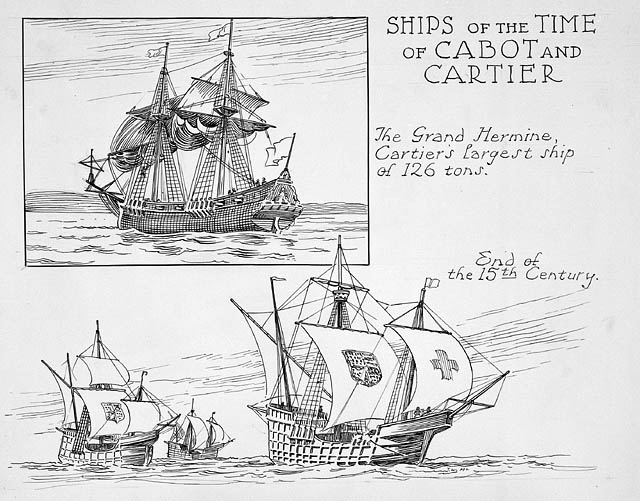
Ships from the period of John Cabot (Giovanni Caboto) and Jacques Cartier.
Illustration by Thomas Wesley McLean (1881-1951) via Wikimedia Commons.
From the 1540s through to the 1560s, [England] was beset by religious uproar, high inflation, hunger, rural and then urban unemployment, a fall-off in its major export trades, and widespread unrest. It was diplomatically isolated too. And I did not even mention the epidemics: the terrifying “sweating sickness” returned in 1551, deadly influenza swept the country in 1557, and in 1563 some 17,000 people in London were reportedly killed by the plague.
Yet, in the face of such problems, innovation in England began to pick up pace. The country, having once been a scientific and technological backwater, began to show signs of catching up. Why?
[…] The fall-off in trade with Europe, for example, seems to have had something to do with spurring the voyages of exploration in search of a north-west and north-east passage to the East Asia. Having lost Antwerp as a place to sell cloth in 1551, the English went in search of an arctic route to northern China and Japan. The expert geographers believed that those regions had a similar climate to that of Antwerp and the surrounding Netherlands, and so reasoned that the Japanese would therefore demand the same kinds of cloth. Although the English expeditions from 1553 onwards did not find a passage to Japan, they did establish trade routes with Russia via the White Sea, and they began to more actively consider the exploration and colonisation of North America. More importantly, with those voyages of exploration came greater experience of navigation, and it was not long before English ships were circumnavigating the globe (Francis Drake in 1577-80). Improvements to navigational techniques and instruments, as well as the ships themselves followed.
So it is tempting to think that necessity was initially the mother of invention, and that the many navigational and shipbuilding improvements of late-sixteenth-century England were its result. But I don’t think that this narrative quite works. I do not believe that necessity was the mother of invention.
For a start, voyages of navigation had already been attempted a number of times, long before the more successful ones in the early 1550s. The first explorers had reputedly gone west from Bristol in 1465, and certainly from 1480. And soon after the announcement of Columbus’s discoveries in the 1490s, the Venetian Zuan Chabotto (aka John Cabot), had sailed from Bristol with Henry VII’s blessing and claimed Newfoundland for both crown and Catholicism. Cabot had even hoped to found a penal colony on his second voyage in 1497, though for some reason the king did not provide the criminals. Throughout the early sixteenth century, the voyages continued. John Rastell, brother-in-law to Thomas More, the famous statesman and author of Utopia, in 1517 went in search of a north-west passage (though he never got beyond Ireland, because his crew decided it would be better to leave him there and sell the ship’s cargo in Bordeaux). Yet another voyage went west with Henry VIII’s support in 1527, but it mostly just found other Europeans — fishing fleets from Spain, Portugal, and France off the coast of Newfoundland (the English had made some catches there in the early 1500s, but apparently could not compete), and the Spanish everywhere else. The expedition made its way down to the Caribbean and then went home, with little to report. So people had already gone off exploring, long before the mid-sixteenth-century English commercial crisis. It suggests that there had already been both a latent supply and demand for such explorations.
November 20, 2019
The Sinking of the Royal Oak
Eoin MacFreeman
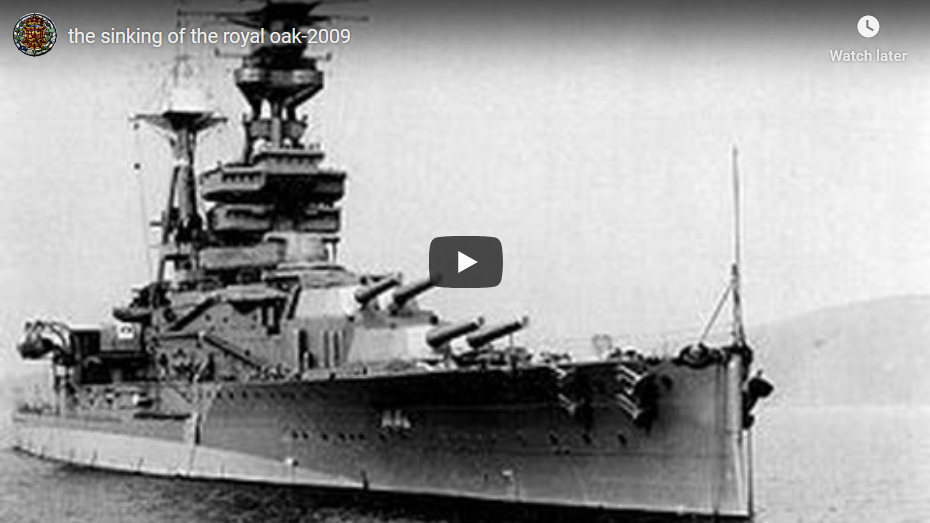
Published 19 Sep 2014STV and History channel documentary to coincide with the 70th anniversary of the sinking of HMS Royal Oak at Scapa Flow in Scotland. With harrowing eye witness accounts from survivors. Narrated by oor Alex Norton. We will remember them.
On 14 October 1939, Royal Oak was anchored at Scapa Flow in the Orkney Islands, Scotland, when she was torpedoed by the German submarine U-47. Of Royal Oak‘s complement of 1,234 men and boys, 833 were killed that night or died later of their wounds. The loss of the old ship – the first of the five Royal Navy battleships and battlecruisers sunk in the Second World War – did little to affect the numerical superiority enjoyed by the British navy and its allies, but the sinking had considerable effect on wartime morale. The raid made an immediate celebrity and war hero out of the U-boat commander, Günther Prien, who became the first German submarine officer to be awarded the Knight’s Cross of the Iron Cross. Before the sinking of Royal Oak, the Royal Navy had considered the naval base at Scapa Flow impregnable to submarine attack, and U-47‘s raid demonstrated that the German navy was capable of bringing the war to British home waters. The shock resulted in rapid changes to dockland security and the construction of the Churchill Barriers around Scapa Flow.
November 17, 2019
The three cycles of a naval ship’s career
Last month, there was some concern over the state of the Royal Navy’s current fleet, based on things the Secretary of State for Defence had said to the Commons Defence Select Committee:
While discussing the size of the navy, and the minister made a valid point that it is hard to go to the Treasury and argue for more new warships when the RN is unable to make full use of the vessels already in service. “If I had more of our current fleet working, then I would have much more freedom to deploy to meet some of our ambitions and tasks. I’ve made it very clear to the First Sea Lord one of my priorities is to get what we’ve got working” he said.
Unfortunately the Minister then rather confused the issue by stating that the RN has “only” 57 of its 76 surface ships available. This statement is technically true but it needs a great deal of context. It is only possible to reach the 76 figure by counting absolutely everything in commission that floats including the MCMVs, OPVs, Royal Fleet Auxiliary vessels, the hydrographic ships and the two small boats of the Gibraltar Squadron. 16 small unarmed P2000 patrol/training boats and inshore survey boat HMS Magpie are also included in this total. These vessels all have important roles to play but major surface combat vessels number just 23, even if both aircraft carriers and both LPDs are counted. Of that 23, about 10 are active at the time of writing. (HMS Queen Elizabeth (not yet fully operational) Albion, Defender, Dragon, Montrose, Kent, Argyll, Sutherland, Northumberland and Westminster)
In fact, 57 vessels “available” from a fleet of 76 would be very impressive. Any navy that has 75% of its ships ready for operations would be doing exceptionally well. But it rather depends on your definition of “available” as ships are in constant cycle at differing levels of readiness. A more normal approximate ‘rule of thirds’ would apply for most serious navies; a third on operations, a third preparing for operations, in transit, training or maintenance and a third at very low readiness in deep refit. This cycle is simply unavoidable, warships are highly complex pieces of engineering that are exposed to the harsh marine environment and must be maintained.
What Ben Wallace was really talking about is improving the readiness of the frigates and destroyers. As we have reported before, delays to the frigate LIFEX refits are contributing to lower than usual numbers of ships available. Currently, more than half of the frigate fleet are all either awaiting refit or undergoing refit at Devonport.
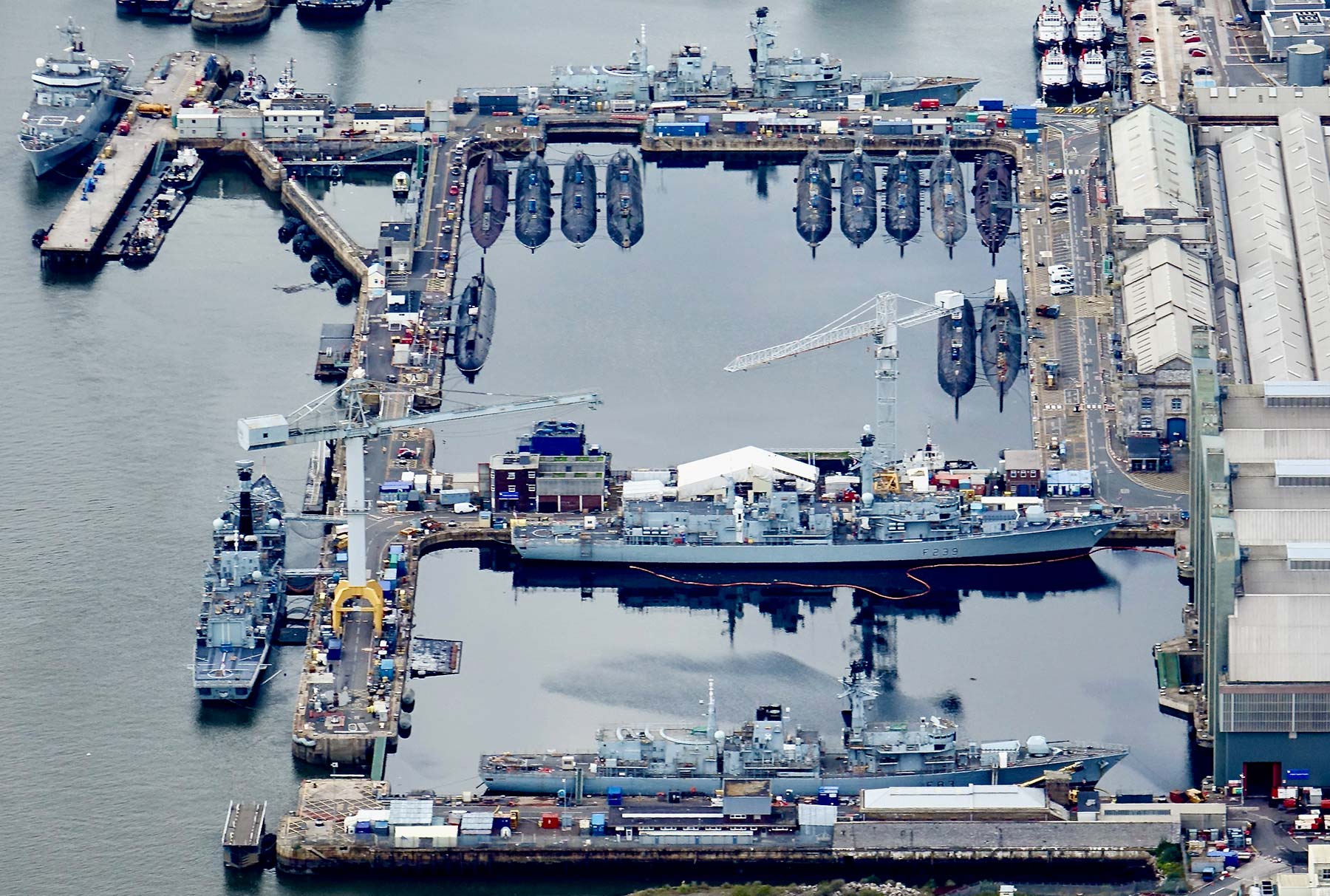
A view of Royal Navy ships at Devonport, 19th October 2019. (Top) HMS Monmouth out of routine and awaiting refit. (Middle) The depressing sight of the decommissioned nuclear submarine “flotilla” awaiting disposal, comprising more boats than are currently active. In the basin are (top) HMS Richmond, first of the frigates to receive new engines and (bottom) HMS St. Albans. HMS Portland, Somerset and Iron Duke are inside the covered refit complex to the right. (Left) alongside at No.1 Wharf is HMS Lancaster.
Photo by Andy Amor, originally posted at Save The Royal Navy, 2019-10-25.
November 16, 2019
The British army’s “Tractable” shows the continued importance of logistics
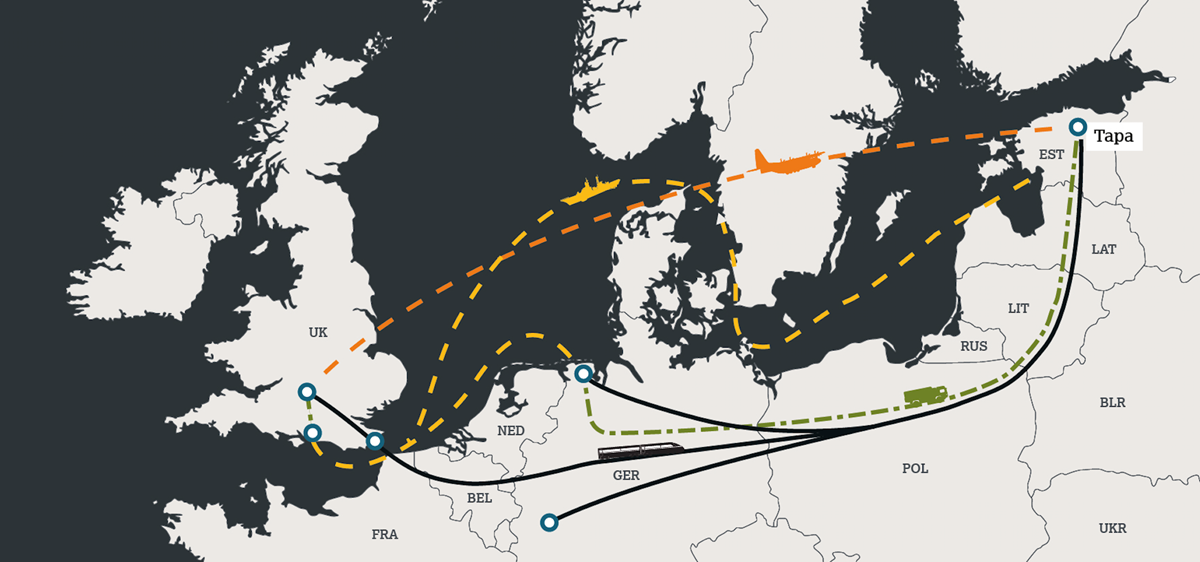
Sir Humphrey discusses the ongoing commitment of nearly a thousand British soldiers to Estonia, and how the logistics to get them and their equipment there illustrates a rarely discussed but critical military capability:
One of the most significant exercise commitments this year has been the British Army and “Tractable” (sometimes referred to as either “Op” or “Exercise” but without a title on the British Army website. This major undertaking has been running for some weeks now and has highlighted how the British Army continues to excel at undertaking large scale movements of units in order to be ready to conduct operations as required.
The genesis of Tractable was the need to rotate assets out of Estonia and send new vehicles from the UK in their place. It is often overlooked that the UK now has over 900 British Army personnel permanently stationed in Estonia as part of wider NATO work to help send a strong signal to deter aggression from nations like Russia – which given its recent history of attacking and invading other countries and acting in a remarkably uncivilised manner is certainly required.
[…]
This may sound an obvious and straightforward thing to say, but investment in logistical tail is rarely something that features in many peoples “fantasy Army ORBAT” threads that litter the internet. Most people focus on combat power, looking at how many tanks or self propelled guns an Army has and then considering what this means for its combat power from there.
For the British Army, the investment in heavy armour, APCs and artillery is important, but equally so is the important in assets like logistics enablers – the ability to lift by train or sealift in order to actually get the Army where it needs to be, and not stuck somewhere irrelevant. The purpose of Tractable has as much been to test that the Army can still do this well, and that the various enablers work as intended to deliver a force that can fight.
In practical terms this has meant a focus on areas that often get relatively little attention. For example the skills required to pull vehicles out of storage, conduct road and rail moves across Europe and then deliver them to Estonia are complex and perishable. There is a lot of work required to ensure that a train can be safely loaded with the right armoured vehicles and then sent through the Channel Tunnel for onwards travel.
Air, land, and sea transportation routes from the UK to Tapa, Estonia.
This work often puts significant responsibility in the hands of very junior soldiers who are responsible for ensuring that millions of pounds of equipment is safely handled and put in place properly. One slip up could have huge consequences and potentially cost lives as well. It is only by practising this activity regularly that it can be done safely and effectively for real though.
In the case of Tractable what it has demonstrated is the critical importance of the Royal Logistics Corp to the wider British Army. While logistics may not be a supremely “sexy” subject to many people, being able to ensure that the Army has the right equipment, people and training to be able to do this sort of work is essential – without it, things would rapidly grind to a halt.
Similarly, Tractable has helped focus attention on other critical capabilities like strategic sealift. The use of the “POINT” class strat ro-ro ferry force to help move vehicles across the channel and into Emden (and then onto Estonia) has helped show how key these vessels are to British Army capability. Without them it would be much harder to do the complex business of deploying overseas. Here too we are also reminded of the critical importance of units like 17 Port and Maritime Regiment, one of the most unusual (and vital) units in the Army today, responsible for co-ordinating the sealift and deployment of vehicles around the globe.
Report on the collision that sank HNoMS Helge Ingstad last year
The Norwegian frigate HNoMS Helge Ingstad was eventually declared a total loss due to the damage from the collision and the resulting water damage as the ship sank near the Sture Terminal in November 2018. The first part of the report on the accident has been released:
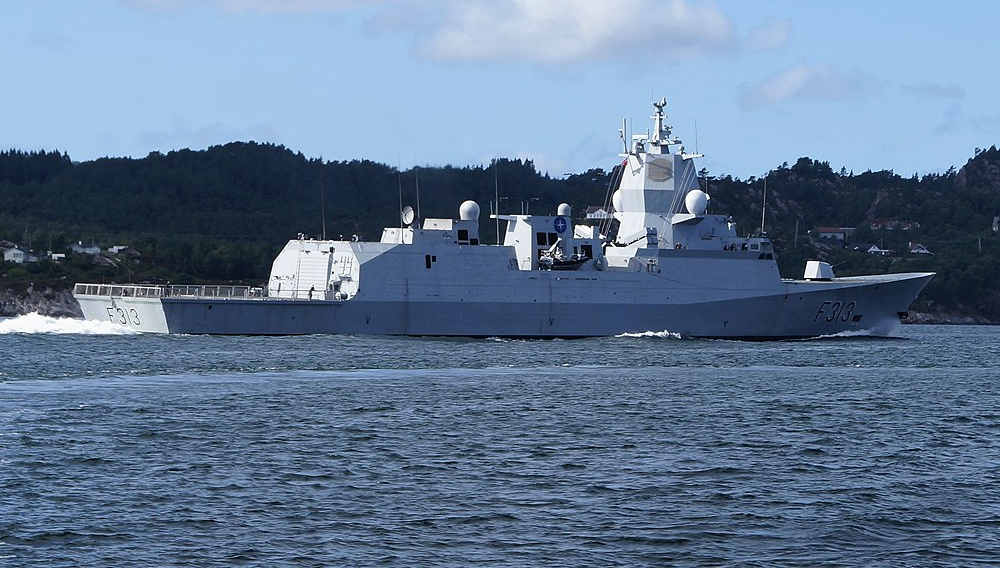
HNoMS Helge Ingstad, a Fridtjof Nansen-class frigate commissioned in 2009.
Photo detail via Wikimedia Commons.
The frigate HNoMS Helge Ingstad and the tanker Sola TS collided in the Hjeltefjord in the early hours of 8 November 2018. The frigate had 137 persons on board with a mix of conscripts and permanent crew. A total of seven watchstanding personnel were present on the bridge, including two trainees. The tanker Sola TS was operated by the Greek shipping company Tsakos Columbia Shipmanagement (TCM) S.A. There was a total of 24 persons on board. The bridge was manned by four persons, including the pilot.
HNoMS Helge Ingstad sailed south at a speed of approximately 17–18 knots with the automatic identification system (AIS) in passive mode, i.e. no transmission of AIS-signal. The frigate’s bridge team had notified Fedje Vessel Traffic Service (VTS) of entering the area and followed the reported voyage. Sola TS had been loaded with crude oil at the Sture Terminal, and notified Fedje VTS of departure from the terminal. Sola TS exhibited navigation lights. In addition some of the deck lights were turned on to light up the deck for the crew who were securing equipment etc. for the passage.
In advance of the collision, Fedje VTS had not followed the frigate’s passage south through the Hjeltefjord. The crew and pilot on Sola TS had observed HNoMS Helge Ingstad and tried to warn of the danger and prevent a collision. The crew on HNoMS Helge Ingstad did not realise that they were on collision course until it was too late.
At 04:01:15, HNoMS Helge Ingstad collided with the tanker Sola TS. The first point of impact was Sola TS‘ starboard anchor and the area just in front of HNoMS Helge Ingstad‘s starboard torpedo magazine.
HNoMS Helge Ingstad suffered extensive damage along the starboard side. Seven crew members sustained minor physical injuries. Sola TS received minor damages and none of the crew were injured. Marine gas oil leaked out into the Hjeltefjord. The Institute of Marine Research has ascertained the effect of the oil spill had little impact on the marine environment.
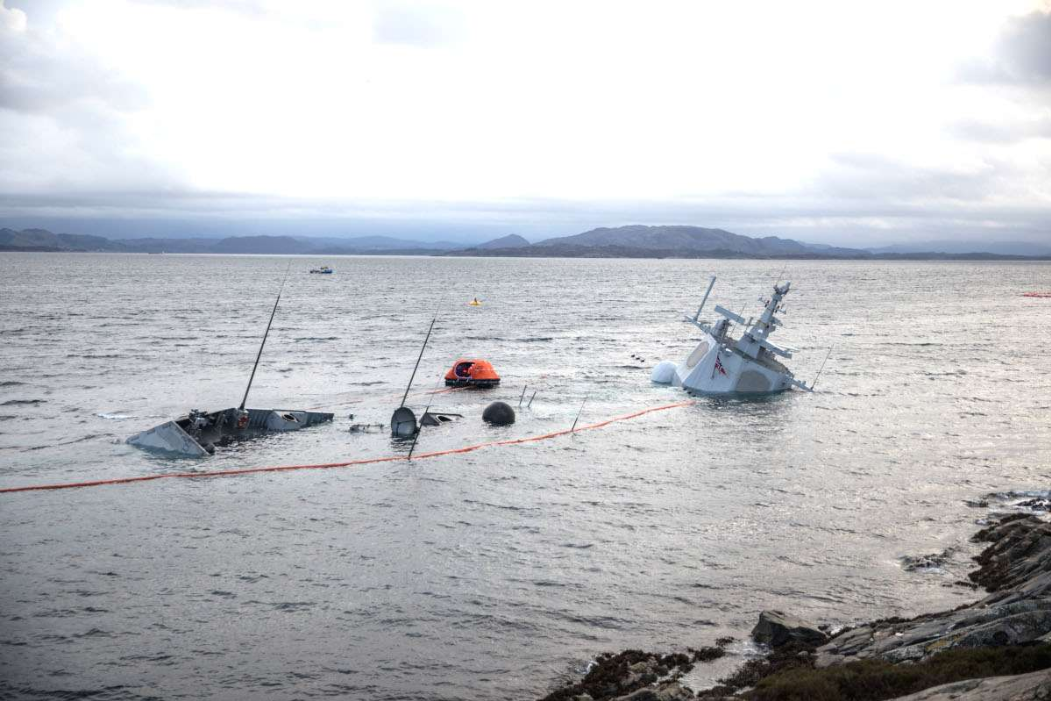
HNoMS Helge Ingstad after grounding, 13 November 2018. Due to the steep nature of the seabed at the shoreline, the frigate slid down until it was almost totally underwater after initial grounding.
Photo via The Drive.
There is an embedded video with the report that neatly summarizes the series of events leading up to the collision.
November 12, 2019
Speculations on South Korean or Japanese F-35 deployment
Last week, Strategy Page considered the options available for both South Korea and Japan to convert some of their F-35 orders to F-35B variants which would allow operations from small helicopter carriers in service or in plan for both navies:
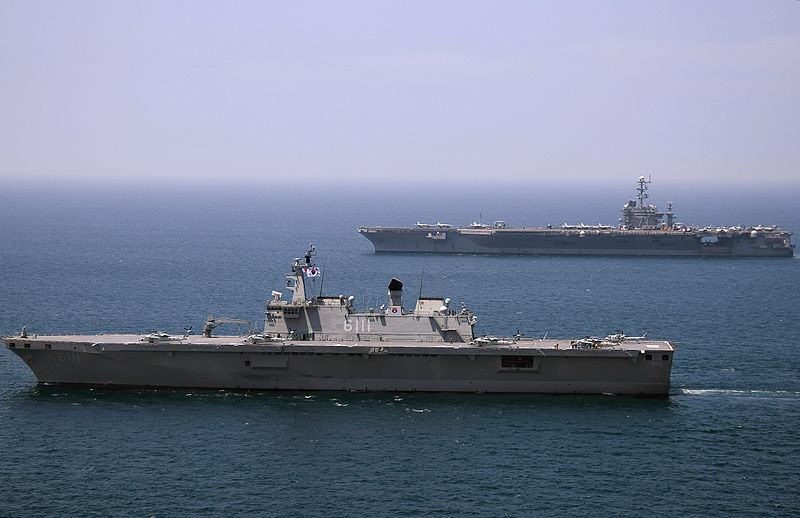
The Republic of Korea Navy amphibious landing ship ROKS Dokdo (LPH 6111) and the aircraft carrier USS George Washington (CVN 73) transit the Sea of Japan (July 27, 2010).
U.S. Navy photo by Mass Communication Specialist 3rd Class Charles Oki via Wikimedia Commons.
In October South Korea announced it was buying 20 more F-35 stealth fighters. There are already 40 on order and South Korea will have received 13 by the end of 2019. Those 60 F-35s will cost $9.7 billion and a decision still has to be made as to whether any of the second 20 will be the VTOL (Vertical Take-Off and Landing) F-35B version. The first 40 will all be the basic F-35A which just operates from land-based airfields. But South Korea has ships that F-35Bs could operate from.
By 2018 South Korea had two 14,500 ton Dokdo class large amphibious ships. These South Korea LPHs (Landing Platform Helicopter) are similar in appearance and operation to the larger American amphibious ships. The LPH flight deck can handle helicopters, as well as vertical takeoff jets like the F-35B. The Koreans deny that the ship will be used with these jets, but the capability is there. The LPH normally carries 720 combat troops and their heavy equipment. Dokdos also carry fifteen aircraft; two V-22 vertical takeoff transports and 13 helicopters. Marado, the second Dokdo, has a redesigned flight deck that can handle two V-22s at once instead of just one. In addition to a more powerful 3-D surveillance radar for tracking aircraft, Marado has to Phalanx anti-missile system.
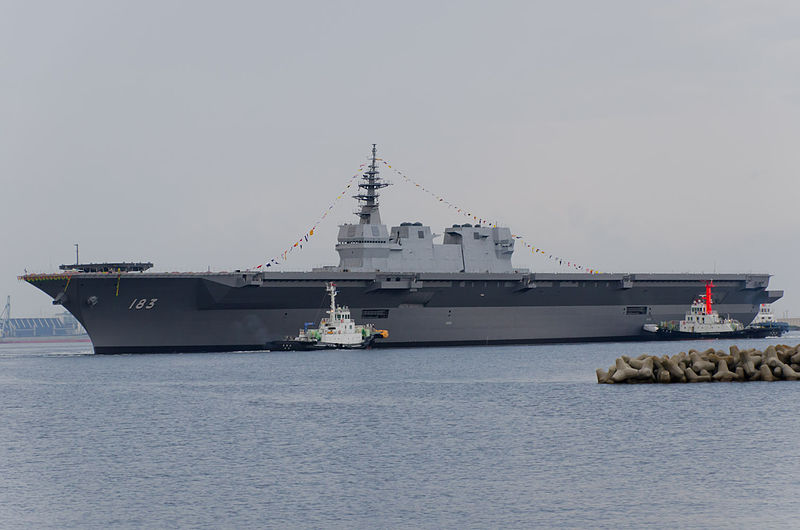
JS Izumo DDH-183
South Korea is also planning to build one or more 30,000 ton ships that look like the Japanese DDH (destroyer helicopter carrier) and could handle a dozen F-35Bs. Neighboring Japan has already ordered some F-35Bs so that it can experiment with some of these aircraft aboard the existing Japanese DDHs. Since 2017 Japan has had two 27,000 ton “destroyers” (DDH type ships) that look exactly like an aircraft carrier. These Izumo class ships can carry up to 28 helicopters or up to ten vertical takeoff aircraft. The carriers are armed only with two 20mm Phalanx anti-missile cannon and launchers with sixteen ESSM missiles for anti-missile defense. The DDH have powerful engines capable of destroyer-like speeds of over fifty-four kilometers an hour. Izumo has considerable cargo capacity, which is intended for moving disaster relief supplies quickly to where they are needed. Apparently, some of these cargo spaces can be converted to carry additional weapons and equipment needed to support F-35B fighter-bombers. Izumo could carry and operate at least ten F-35Bs once modifications are made to the flight deck to deal with the extremely high temperatures the F-35B generates when taking off or landing vertically (like a helicopter). When the first DDH entered service in 2015 Japan made no mention of buying F-35Bs or modifying the LPH flight decks to handle the very high temperatures. The Izumos already have an elevator (to the hanger deck under the flight deck) powerful enough to carry an F-35B fighter.
Another factor that makes operating F-35Bs from an LPH or DDH possible is the availability of smart bombs and small air-to-ground guided missiles for warplanes. A LPH or DDH was not designed to haul a lot of munitions for aircraft but, the amount of smart bombs and missiles needed to make five or ten F-35Bs effective would not be large. These ships already carry a lot of fuel for helicopters and have space for maintenance gear to support many helicopters. South Korean and Japanese naval planners noted this when they suggested using LPHs and DDHs as platforms for F-35Bs.
October 31, 2019
A mathematical revolution in late medieval English ship design and construction
In the latest installment of Anton Howes’ newsletter on the Age of Invention, he discusses how geometry and mathematics helped transform late Medieval English shipbuilding:
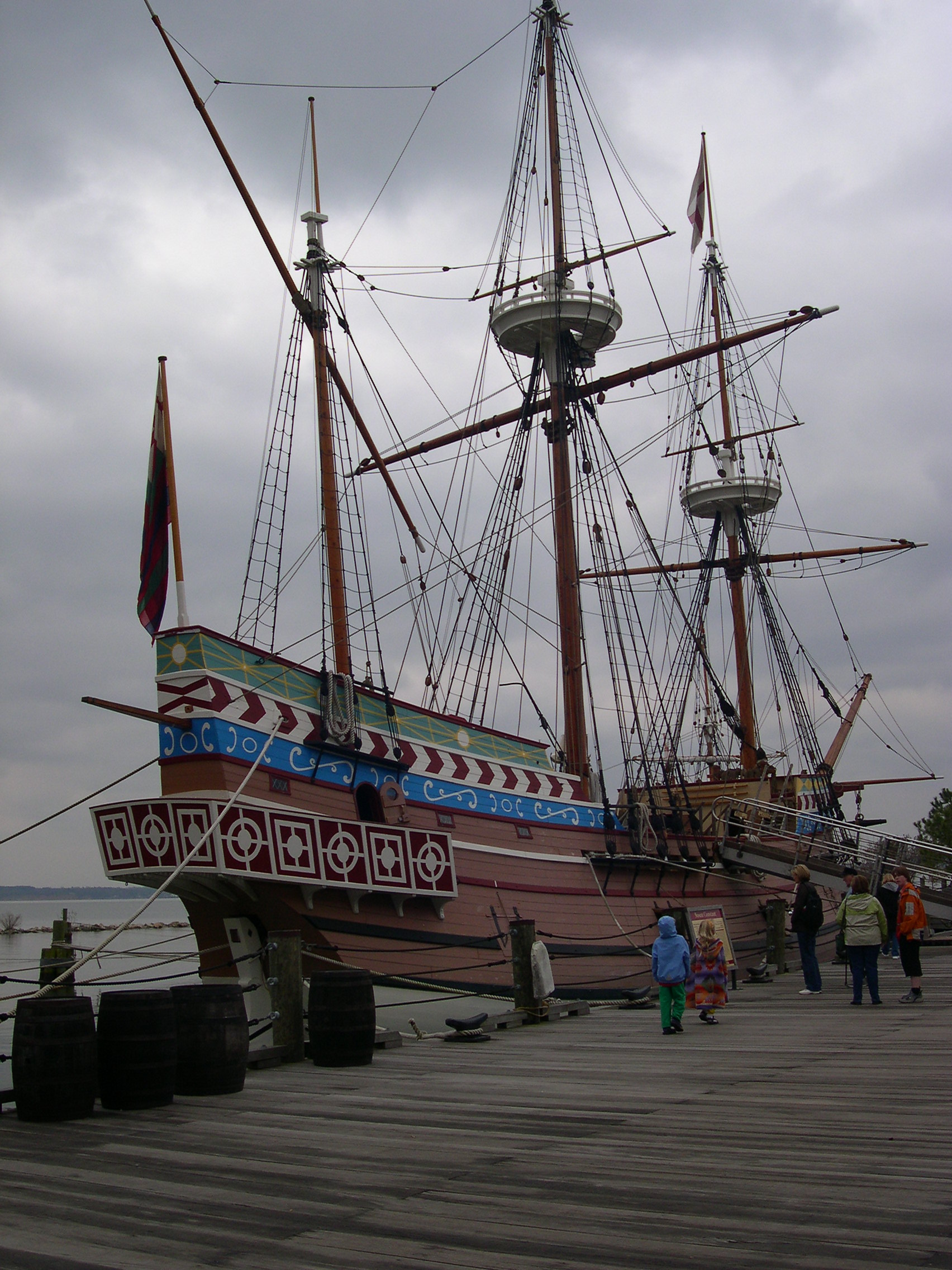
An English ship of a slightly later period: this is a replica of the Susan Constant at the Jamestown Settlement in Virginia. The original ship was built sometime before 1607 and rented by the Virginia Company of London to transport the original settlers to Jamestown.
Photo by Nicholas Russon, March 2004.
Since about 1500, an Italian and Portuguese method of making ships had come into ever wider use in northern Europe. This was to construct the ship’s skeleton first, and then lay the planking around it. This contrasted with the older “clinker” method, by which the planks were laid from the keel upwards, with each plank slightly overlapping the one below – the rest of the skeleton was filled in later to strengthen it. The new “carvel” method, instead of having overlapping planks, allowed for a smooth hull. But it also required more planning.
The master shipwright had to first design full-sized templates, or frames, which were placed along the keel to determine the width and height of the hull, like cross-sections up and down the length of the ship. To the edges of these frames were then fixed ribbands — long, pliable boards running down the ship’s length. Altogether, the frames and ribbands formed a temporary, basket-like structure, to guide the moulding of the ship’s permanent hull around it.
But calculating the size of the frames at each point was tricky. After the placement of the first few, which might be pre-specified in size, the next ones along were typically determined according to the curve of the ribbands. Calculation was certainly involved, but it took place in the form or marking and adjusting the wood itself. Design and construction both took place in the shipyard, and through the medium of wood.
What Matthew Baker did in the 1570s was to take the design process out of the shipyard, and onto paper. He drew his ships, to scale. And by using pen and paper, with geometry to make such drawings possible, he opened up grand new possibilities for design. His process allowed him to jot down the latest innovations from the Mediterranean, to speculate about the designs of Noah’s ark and the ships of the ancient world, and to cheaply conduct his own experiments. He drew out new designs for frames, using geometry to work out how any variation would affect the overall shape of the hull, as well as its weight and carrying capacity – all at the cost of only time, ink, and paper, and avoiding the huge potential waste of conducting experiments at full scale in wood. His process allowed him to innovate more easily, and even to design new measuring instruments.
October 28, 2019
The Surrender of the Imperial German High Seas Fleet
Historigraph
Published 26 Oct 2019Buy Historigraph Posters here! https://teespring.com/en-GB/surrender…
Support the channel on Patreon: https://www.patreon.com/historigraph#SurrenderOfTheHighSeasFleet #OperationZZ #Historigraph
►Twitter: https://twitter.com/historigraph
►Instagram: https://www.instagram.com/historigraph
►Patreon: https://www.patreon.com/historigraph
►Discord: https://discord.gg/vAFTK2DMusic:
Crypto, Incompetech https://incompetech.com
Rynos Theme, Incompetech https://incompetech.com
Britain’s Naval March, “Hearts of Oak”
Kaiserlicher Marinemarsch “Gruß an Kiel“



