CGP Grey
Published 30 May 2020‣ Adapted largely from The Invisible Hook. It’s great, go read it: https://amzn.to/36PLKSE
‣ Thank you, my Patrons, for making this video possible: https://www.patreon.com/posts/37699725## Special Thanks
Peter T. Leeson for reviewing a draft of the script. Check out his newest book, WTF?!: An Economic Tour of the Weird: https://amzn.to/3eEMm09
## Crowdfunders
Steven Snow, Bob Kunz, John Buchan, Nevin Spoljaric, Donal Botkin, BN-12, Chris Chapin, Richard Jenkins, Phil Gardner, Martin, سليمان العقل, Steven Grimm, Colin Millions, Saki Comandao, Jason Lewandowski, Andrea Di Biagio, David F Watson, Ben Schwab, Elliot Lepley, rictic, Bobby, Marco Arment, Shallon Brown, Shantanu Raj, emptymachine, George Lin, Henry Ng, Jeffrey Podis, Thunda Plum, Awoo, David Tyler, Derek Bonner, Derek Jackson, Fuesu, iulus, Jordan Earls, Joshua Jamison, Mikko, Nick Fish, Nick Gibson, Orbit_Junkie, Ron Bowes, Tómas Árni Jónasson, Tyler Bryant, Zach Whittle, Oliver Steele, Kermit Norlund, Kevin Costello, Ben Delo, Arctic May, Bear, chrysilis, David Palomares, Emil, Erik Parasiuk, Esteban Santana Santana, Freddi Hørlyck, Frederick The Great, John Rogers, ken mcfarlane, Leon, Maarten van der Blij, Peter Lomax, Rhys Parry, ShiroiYami, Tijmen van Dien, Tristan Watts-Willis, Veronica Peshterianu, Dag Viggo Lokøen, John Lee, Maxime Zielony, Bryan McLemore, Elizabeth Keathley, Alex Simonides, Felix Weis, Melvin Sowah, Giulio Bontadini, Paul Alom, Ryan Tripicchio, Scot Melville
## Music
David Rees: http://www.davidreesmusic.com
June 1, 2020
How to be a Pirate 🏴☠️
May 29, 2020
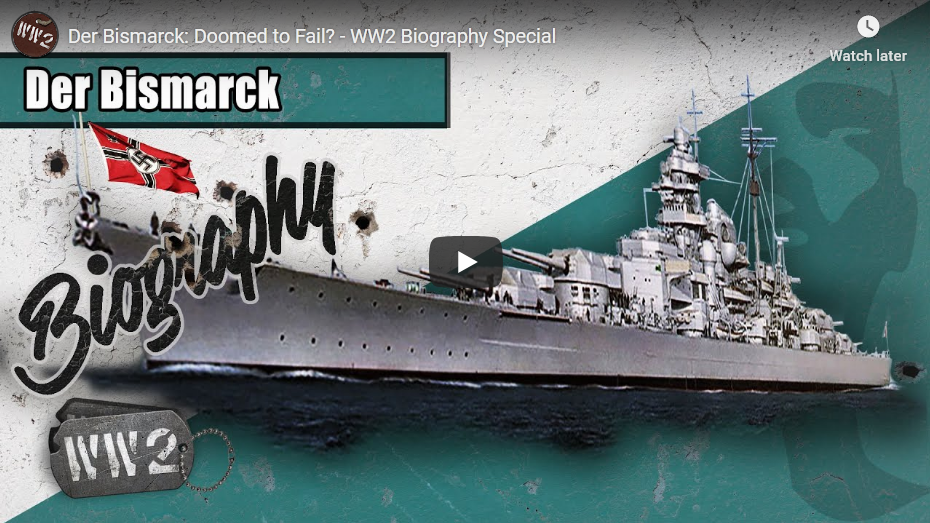
Der Bismarck: Doomed to Fail? – WW2 Biography Special
World War Two
Published 28 May 2020The Bismarck is without a doubt a force to be reckoned with. But with the Kriegsmarine experiencing an identity crisis throughout the 1930s, the Bismarck‘s design and strategic purpose foreshadow a dramatic ending.
Join us on Patreon: https://www.patreon.com/TimeGhostHistory
Or join The TimeGhost Army directly at: https://timeghost.tv
Check out our TimeGhost History YouTube Channel: https://www.youtube.com/c/timeghost?s…Follow WW2 day by day on Instagram @World_war_two_realtime https://www.instagram.com/world_war_t…
Between 2 Wars: https://www.youtube.com/playlist?list…
Source list: http://bit.ly/WW2sourcesHosted by: Indy Neidell
Written by: Joram Appel
Director: Astrid Deinhard
Producers: Astrid Deinhard and Spartacus Olsson
Executive Producers: Astrid Deinhard, Indy Neidell, Spartacus Olsson, Bodo Rittenauer
Creative Producer: Joram Appel
Post-Production Director: Wieke Kapteijns
Research by: Joram Appel
Edited by: Mikołaj Cackowski
Sound design: Marek Kamiński
Map animations: Eastory (https://www.youtube.com/c/eastory)Colorizations by:
Ruffneck88, Wikimedia Commons
Norman Stewart – https://oldtimesincolor.blogspot.com/Sources:
Bundesarchiv
IWM HU 374, HU 67486, HU 1041, HU 108392, A 6155, D 2373, HU 55631
From the Noun Project: Game by Ecem Afacan, Shield by Nikita KozinSoundtracks from the Epidemic Sound:
Phoenix Tail – “At the Front”
Johannes Bornlof – “The Inspector 4”
Rannar Sillard – “March Of The Brave 10”
Max Anson – “Ancient Saga”
Johannes Bornlof – “Deviation In Time”
Reynard Seidel – “Deflection”Archive by Screenocean/Reuters https://www.screenocean.com.
A TimeGhost chronological documentary produced by OnLion Entertainment GmbH.
May 8, 2020
QotD: Measuring beauty
Helen of Troy was renowned as a very beautiful woman, said to have possessed “the face that launched a thousand ships” (i.e. to invade Troy and rescue her). Her name has thus become a unit of measure of beauty. For example, a millihelen has been defined as “the amount of beauty needed to launch a single ship”, whereas a negative helen is “the amount of negative beauty (i.e. ugliness) that can beach a thousand ships”.
Peter Grant, “How do you measure up?”, Mad Genius Club, 2018-01-28.
May 7, 2020
Interesting change in shipping patterns … to avoid the Suez canal
Colby Cosh linked to this story at gcaptain.com which would have been an unbelievable one in the pre-epidemic world:

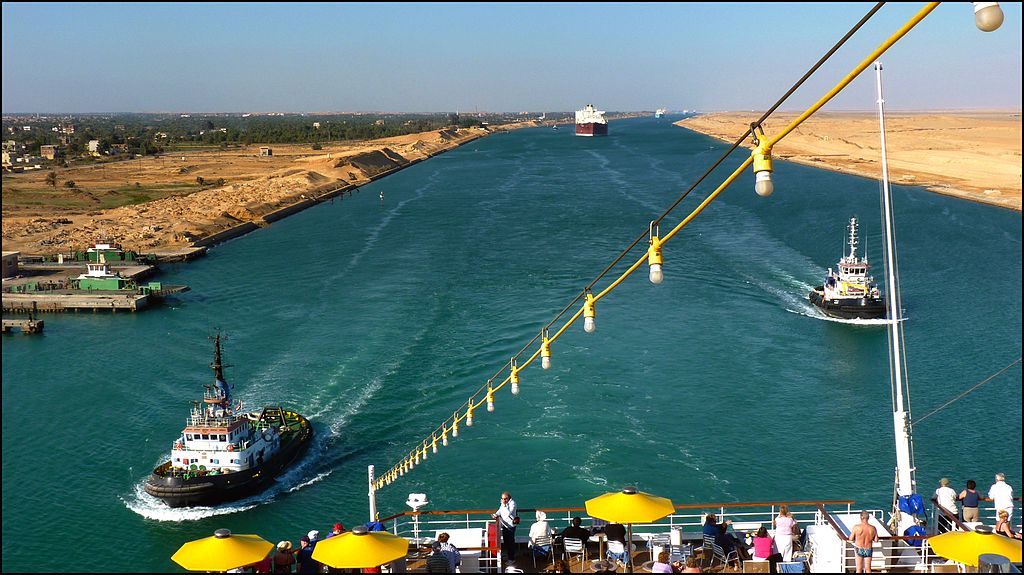
A column of ships along the Suez Canal on 3 December, 2011.
Photo by https://web.archive.org/web/20161022104657/http://www.panoramio.com/user/2433337?with_photo_id=64163879 via Wikimedia Commons.
The Suez Canal Authority (SCA) is set to lose over $10m in revenue from container lines routing vessels via the Cape of Good Hope rather than its waterway.
According to new Alphaliner research, “the number of containerships that have opted to use the Cape route and bypass the Suez Canal has risen to a historic peace-time high,” including at least 20 sailings on the Asia-Europe, Europe-Asia and North America east coast-Asia trades.
“A unique combination of a container tonnage surplus and rock-bottom bunker prices has increasingly prompted ocean carriers to avoid the canal – and thus its fees,” the analyst noted today.
“Rather unusually, even three westbound Asia-Europe headhaul sailings have opted for the Cape route, all operated by CMA CGM.
“Carriers very rarely choose this longer route for the time-sensitive headhaul, but the low bunker price and lack of demand in European markets, hit by the Covid-19 lockdowns, have suddenly made such moves viable,” it added.
April 21, 2020
QotD: Admiral Jackie Fisher’s five keys to “lock up the world”
Geography plays an important part in all of this. While the sea surface itself is without geography, naval forces are dependent on shore facilities for support. In the age of sail, this was mostly for supply and repair, while coaling stations defined naval geography during the early age of steam, giving the British a huge advantage over all opponents. The US, lacking such facilities, built bigger, longer-ranged ships. Today, we’ve created forward bases in Europe and Japan, to allow our ships to spend more time on station, and replenishment ships to allow ships to spend more time at sea.
Moreover, a huge fraction of global trade flows through a few key choke points. A century ago, Jackie Fisher described “Five keys [that] lock up the world! Singapore. The Cape. Alexandria [Suez]. Gibraltar. Dover.” Today, we’d have to add the Strait of Hormuz, but the basic truth remains the same. Control of trade through these critical areas gives immense power, and it is in the interest of a maritime power to have that control, or at least to have great influence over how it is used.
“bean”, “Basics of Naval Strategy”, Naval Gazing, 2018-01-22.
April 16, 2020
The (temporary) return of “dazzle” paint schemes for the Royal Canadian Navy
Well, two RCN ships, if not the entire fleet … Joseph Trevithick reports for The Drive:

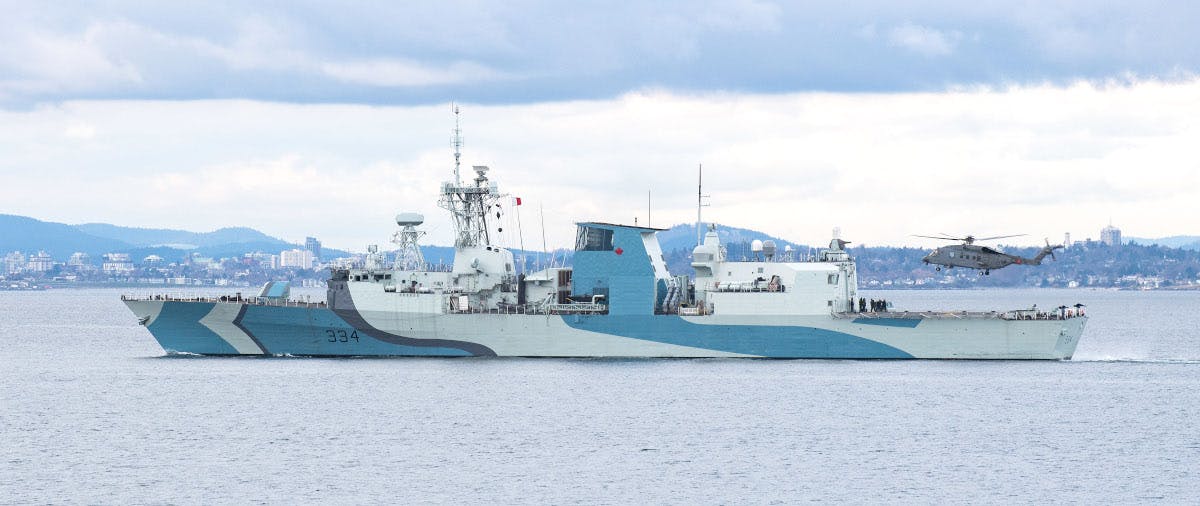
HMCS Regina in her dazzle camouflage paint taking part in Task Group Exercise 20-1 in April, 2020.
Canadian Forces photo via The Drive.
Air forces around the world will often give their aircraft specialized paint jobs to commemorate anniversaries and other notable occasions, but it’s far less common to see navies do the same thing with their ships. Recently, however, the Royal Canadian Navy’s Halifax class frigate HMCS Regina recently took part in a training exercise wearing an iconic blue, black, and gray paint job, commonly known as a “dazzle” scheme, a kind of warship camouflage that first appeared during World War I.
At the end of March 2020, Regina, and her unique paint job, had joined HMCS Calgary, another Halifax-class frigate, along with the Kingston-class coastal defense vessel HMCS Brandon and two Orca-class Patrol Craft Training (PCT) vessels, Cougar* and Wolf*, for Task Group Exercise 20-1 (TGEX 20-1) off the coast of Vancouver Island in the northeastern Pacific Ocean. The training continued into the first week of April. TGEX 20-1 was part of Calgary‘s Directed Sea Readiness Training (DSRT) in preparation for that particular ship’s upcoming deployment.
Regina had first emerged in the dazzle scheme in October 2019 ahead of the U.S. Navy-led Rim of the Pacific (RIMPAC) exercise, a massive naval training event that takes place every two years and includes U.S. allies and partners from around the Pacific region. It reportedly took 272 gallons of paint and cost the Royal Canadian Navy $20,000 to give Regina the dazzle treatment.
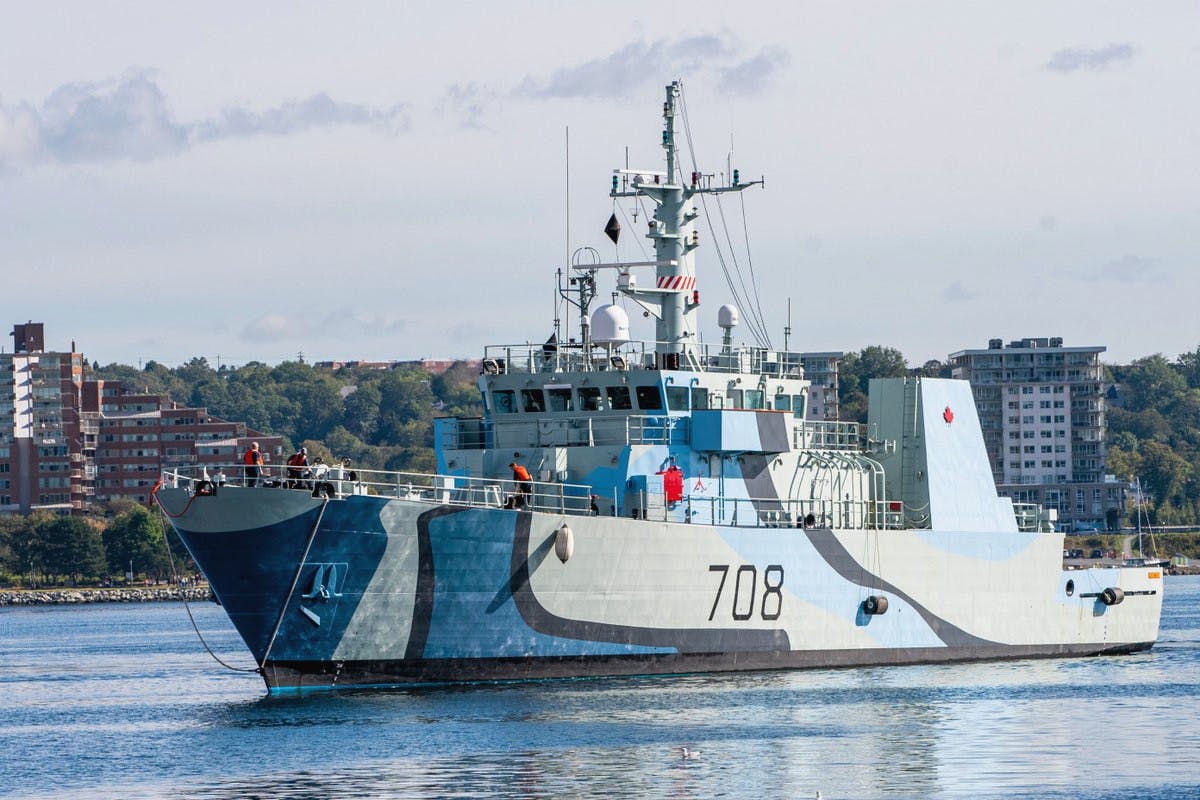
The frigate will wear the camouflage pattern until the end of 2020. The Royal Canadian Navy also painted up the Kingston-class HMCS Moncton, which is homeported in Halifax on the other side of the country, in a similar scheme. The paint job on both ships is in commemoration of the 75th anniversary of the end of the Battle of the Atlantic. This refers to the Allied fight to both enforce a naval blockade of Germany during World War II and secure critical maritime supply routes from North America to Europe. The battle officially ended with the surrender of the Nazi regime in May 1945.
* Wikipedia points out that the Orca-class are not formally commissioned ships in the RCN and therefore do not carry the designation “Her Majesty’s Canadian Ship” (HMCS).
April 13, 2020
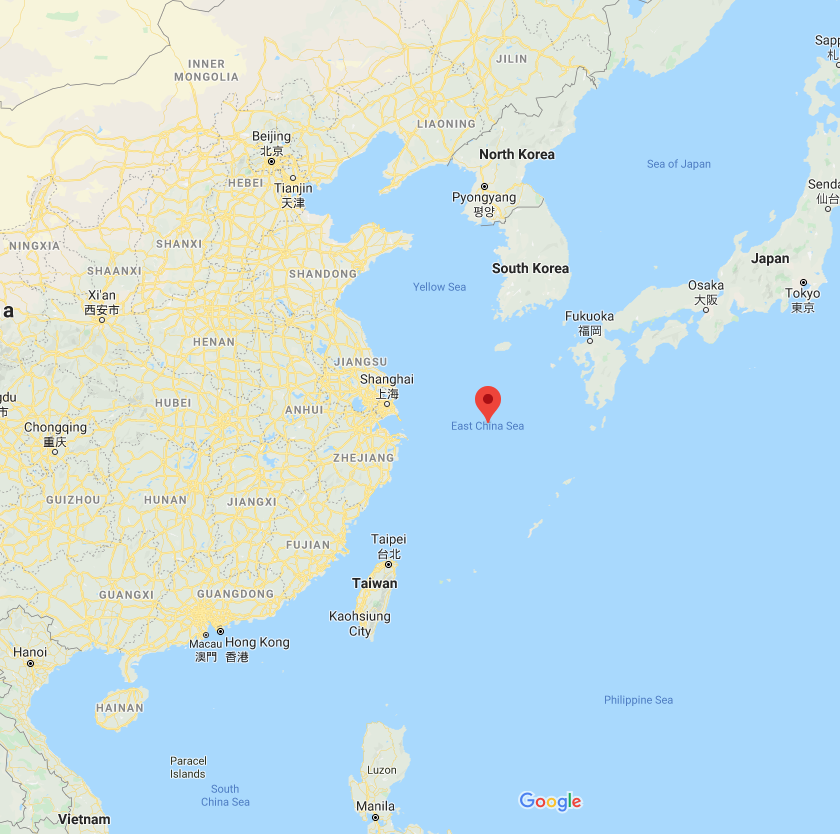
Increasing hazards to navigation in the East China Sea
It’s odd that all the increased collisions seem to involve Chinese vessels:

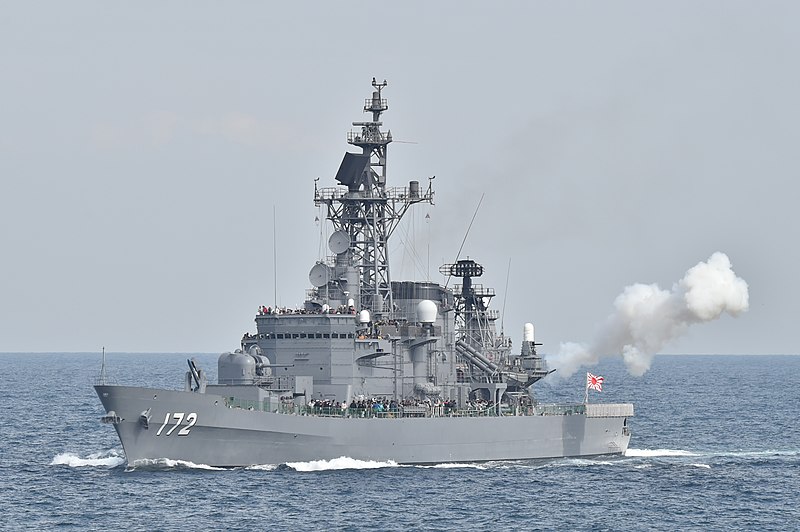
Japanese Maritime Self-Defence Force ship JS Shimakaze (DDG-172), the second ship of the Hatakaze class, commissioned in 1988. She was slightly damaged in a collision with a Chinese fishing boat in the East China Sea on 30 March 2020.
Image via Wikimedia Commons.
Sci-fi genius Robert Heinlein warned readers never to attribute to villainy behavior that was adequately explained by stupidity. In other words, he believed malice should be the explanation of last resort for puzzling conduct on the part of people or groups of people; it shouldn’t be the default. Better to hunt for more benign explanations first. With apologies to Heinlein, I would amend his “razor,” or heuristic, slightly. It’s too narrow. There are other candidates than stupidity or purposeful villainy to account for misconduct. Factors like incompetence, bureaucratic inertia, and sheer accident form — and sometimes deform — human thought and action. They belong on the stupidity side of Heinlein’s ledger.
How about this: Never attribute to villainy behavior that can be adequately explained by human failings. That preserves the essence of Heinlein’s razor while widening its scope to fit reality.
Let’s use his revised heuristic to evaluate the Sino-Japanese collision. It’s certainly possible the mishap came about by accident. It took place at night, in crowded waters. If the U.S. Navy collisions of 2017 taught us nothing else, it’s that the crews of even frontline warships can suffer from a host of maladies, from overwork to shoddy personnel practices to doctrinal or training shortfalls. No amount of high technology — whether it’s Aegis radar or satellite navigation — can altogether forestall human error. It may be that the Japanese crew, the Chinese crew, or both blundered around in the dark and came to grief. By Heinlein’s lights that’s the generous and proper assumption until the facts become known. If they do.
Nevertheless, a silent corollary has to be appended to Heinlein’s razor: But don’t rule out villainy, either.
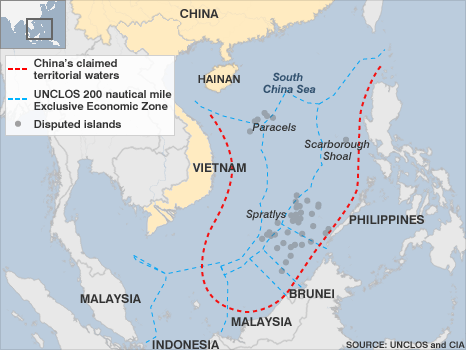
Especially when it comes to the Chinese Communist Party (CCP). For decades Beijing has made militiamen embedded in the Chinese fishing fleet an arm of maritime strategy. The maritime militia is an irregular adjunct to regular naval forces, including the People’s Liberation Army Navy (PLA Navy) and especially the musclebound China Coast Guard fielded over the past decade. Beijing touted the militia’s combat prowess as long ago as 1974, when Chinese naval forces wrested a tottering South Vietnam’s holdings in the Paracel Islands from it in a brief but bloody sea battle. Militia craft backed by the coast guard have been a fixture in the South China Sea ever since 2009, when Beijing declared “indisputable sovereignty” over the vast majority of that body of water — including seas allocated to its neighbors by treaty. The irregular force went into overdrive in 2012 during the standoff with the Philippine Navy and Coast Guard at Scarborough Shoal, deep within the Philippines’ exclusive economic zone. Fishing craft flood the zone in CCP-claimed waters and dare local coast guards or navies to repulse them. If the locals resist, the China Coast Guard backs up the militia. PLA regular forces provide a backstop should things go awry.
H/T to Blazing Cat Fur for the link.
QotD: Foucault’s “Ship of Fools”
And so, Foucault tells us, in the fifteenth century there is a sudden emergence of a complex of artistic and philosophical themes linking madmen, the sea, and the terrible mysteries of the world. These culminate in the “Ship Of Fools”:
Renaissance men developed a delightful, yet horrible way of dealing with their mad denizens: they were put on a ship and entrusted to mariners because folly, water, and sea, as everyone then knew, had an affinity for each other. Thus, “Ships of Fools” crisscrossed the seas and canals of Europe with their comic and pathetic cargo of souls. Some of them found pleasure and even a cure in the changing surroundings, in the isolation of being cast off, while others withdrew further, became worse, or died alone and away from their families. The cities and villages which had thus rid themselves of their crazed and crazy, could now take pleasure in watching the exciting sideshow when a ship full of foreign lunatics would dock at their harbors.
This was such a great piece of historical trivia that I was shocked I’d never heard it before. Some quick research revealed the reason: it is completely, 100% false. Apparently Foucault looked at an allegorical painting by Hieronymus Bosch, decided it definitely existed in real life, and concocted the rest from his imagination.
Foucault apologists try to rescue this, say that he was just being poetic in some way. He wasn’t. Page 8 in my copy: “Of all these romantic or satiric vessels, the Narrenschiff [Ship Of Fools] is the only one that had a real existence — for they did exist, these boats that conveyed their insane cargo from town to town.” He really, really doubled down on this point. As far as I can tell, this is just as bad a failing of scholarship as it sounds – and surprising, since everything else about the book gives the impression of Foucault as an incredibly knowledgeable and wide-ranging scholar.
Scott Alexander, “Book review: Madness and Civilization”, Slate Star Codex, 2018-01-04.
March 10, 2020
Thought-saving inventions
In the latest issue of his Age of Invention newsletter, Anton Howes considers the innovations that helped provide short-cuts for thought, rather than labour:

The world on Mercator projection between 85°3’4″S and 85°3’4″N, such that image is square. 15° graticule. Imagery is a derivative of NASA’s Blue Marble summer month composite with oceans lightened to enhance legibility and contrast. Image created with the Geocart map projection software.
Image by Strebe via Wikimedia Commons.
When we think of labour-saving inventions, the kind of labour that springs to mind tends to be manual. We think of machines replacing the muscle of limbs and the dexterity of fingers, and we worry about their effects on unemployment and unrest. But there’s a subset of labour-saving inventions that rarely gets discussed. They might best be called thought-saving.
A few weeks ago I mentioned the introduction of mathematical techniques to navigation. Before the mid-sixteenth century in England, pilots very rarely even knew how to calculate their latitude, let alone their longitude. But over the course of just a few decades, England became one of the world leaders in navigational improvements. A handful of mathematicians saved pilots the trouble of calculation, by coming up with tables, instruments, diagrams, and rules of thumb. In the process, they improved navigation’s accuracy, and ushered in an age of English dominance of the high seas.
The historian Eric H. Ash gives a few great examples. In the 1590s, the explorer John Davis shared a way to calculate the time of high tide, without requiring multiplication. Likewise, William Bourne, a self-taught mathematician and gunner, in the 1560s provided an easy means of calculating the linear distance in one degree of longitude, at any given latitude. He provided a diagram — really an instrument, even if it wasn’t made of wood or brass — which with just a simple piece of string could be used to derive the answer without needing to understand cosines, or really any trigonometry.
The mathematicians did the same with maps, too (after all, aren’t all maps thought-saving?) The sixteenth-century cartographic innovations simplified the pilot’s ability to chart a route, for example by taking away all need to worry about the curvature of the earth. The famous 1560s map projection of Gerardus Mercator stretched the distance between the lines of latitude as they got closer to the poles, so that charting a course on such a map was a simple matter of drawing straight lines rather than complex trigonometry. The Mercator projection may well make Africa look smaller than Greenland — it’s actually almost fifteen times as large — but it made life significantly easier for mariners. For similar reasons, the mathematician John Dee designed a special chart — what he called the “paradoxall compass” — to aid the English explorers who in the 1550s went in search of a northeast and northwest passage to Asia. Conventional charts made navigating high latitudes confusing, as the north pole was a straight line — the map’s top border. Dee’s map made things easier by putting the pole at the centre, as a point, with the lines of latitude as concentric circles.
March 7, 2020
RCN’s Arctic and Offshore Patrol Ships delayed again
In the Ottawa Citizen, David Pugliese reports on the latest hold-up in getting the Arctic and Offshore Patrol Ships (AOPS) into the RCN’s hands:
The delivery of the first Arctic and Offshore Patrol Ship to the Royal Canadian Navy has been delayed once more and the arrival of the second ship has also fallen behind schedule.
In November, the Department of National Defence stated the first Arctic and Offshore Patrol Ships, or AOPS, was expected by the end of March.
That won’t be happening, DND confirmed to this newspaper.
The department can’t provide any specific details on a new delivery date for the ship being built by Irving Shipbuilding Inc. on the east coast. But it noted that delivery would happen sometime before June 21.
The first AOPS was to have been delivered in 2013, with Arctic operations set for 2015. But ongoing problems with the government’s national shipbuilding program and delays in awarding the contract continued to push schedules back.
There is some risk the first vessel could be delayed beyond the June timeframe, DND acknowledged. In addition, the department confirmed the delivery of the second AOPS has also fallen behind schedule. The scheduled delivery of the other ships could also slip.
“Lessons are being learned from the construction of the first ship, and are benefiting the construction of the second ship,” explained DND spokeswoman Jessica Lamirande. “However, as some inefficiencies are still being resolved, and because resources were focused on the first ship, delivery of the second ship has been delayed. The delivery timelines for the second to sixth ships are still being assessed, and updates will be shared once available.”
The second AOPS was supposed to be delivered in late 2020. The last of the six ships was supposed to arrive in 2024.
February 19, 2020
Great Blunders of WWII: The Scattering of Convoy PQ17
Anthony Coleman
Published 4 Nov 2016From the History Channel DVD series Great Blunders of WWII.
This is of interest for many reasons, but particularly because my late father-in-law served in the Royal Navy on the Arctic convoys and spent a full winter in the Soviet Union when his convoy couldn’t return before the ice closed the convoy route.
February 14, 2020
“Wolfpack” – German U-boat Tactics – Sabaton History 054 [Official]
Sabaton History
Published 13 Feb 2020The Battle of Britain had saved the United Kingdom from imminent invasion by the German Wehrmacht, however the war was far from over. To destroy Britain’s economic capabilities to wage war, the German Kriegsmarine had to win the tonnage war in the North Atlantic. The German submarines — the U-Boote, were sent out to hunt. As the British Royal Navy returned to the convoy system to protect its merchant fleet, the Germans as well began organizing their submarines in groups to attack in unison. These hunter-killer teams, the Wolfpacks, would soon haunt the depths of the North Atlantic.
Support Sabaton History on Patreon: https://www.patreon.com/sabatonhistory
Listen to “Wolfpack” on the album Primo Victoria:
CD: http://bit.ly/PrimoVictoriaStore
Spotify: http://bit.ly/PrimoVictoriaSpotify
Apple Music: http://bit.ly/PrimoVictoriaAppleMusic
iTunes: http://bit.ly/PrimoVictoriaiTunes
Amazon: http://bit.ly/PrimoVictoriaAmzn
Google Play: http://bit.ly/PrimoVictoriaGooglePlayCheck out the trailer for Sabaton’s new album The Great War right here: https://www.youtube.com/watch?v=HCZP1…
Listen to Sabaton on Spotify: http://smarturl.it/SabatonSpotify
Official Sabaton Merchandise Shop: http://bit.ly/SabatonOfficialShopHosted by: Indy Neidell
Written by: Markus Linke and Indy Neidell
Directed by: Astrid Deinhard and Wieke Kapteijns
Produced by: Pär Sundström, Astrid Deinhard and Spartacus Olsson
Creative Producer: Joram Appel
Executive Producers: Pär Sundström, Joakim Broden, Tomas Sunmo, Indy Neidell, Astrid Deinhard, and Spartacus Olsson
Post-Production Director: Wieke Kapteijns
Edited by: Iryna Dulka
Sound Editing by: Marek Kaminski
Maps by: Eastory – https://www.youtube.com/c/eastoryArchive by: Reuters/Screenocean https://www.screenocean.com
Music by Sabaton.Colorizations:
– Olga Shirnina, a.k.a. Klimbim – https://klimbim2014.wordpress.com/Sources:
– IWM: HU 16546, A 30292
– Bundesarchiv
– Otis Historical Archives, National Museum of Health and Medicine
– Narodowe Archiwum Cyfrowe
– Canadian ship being attacked, photo courtesy of the Government of Canada, https://www.canada.ca/en/navy/service…An OnLion Entertainment GmbH and Raging Beaver Publishing AB co-Production.
© Raging Beaver Publishing AB, 2019 – all rights reserved.
December 7, 2019
Pearl Harbor – The Japanese Attack
Military History Visualized
Published 29 Nov 2016» HOW YOU CAN SUPPORT MILITARY HISTORY VISUALIZED «
(A) You can support my channel on Patreon: https://www.patreon.com/mhv(B) Alternatively, you can also buy “Spoils of War” (merchandise) in my online shop: https://www.redbubble.com/people/mhvi…
(C) If you want to buy books that I use or recommend, here is the link to the Amazon Store: http://astore.amazon.com/ytmh-20 which has the same price for you and gives a small commission to me, thus it is a win/win.
» SOURCES & LINKS «
Kuehn, John T.: “The war in the Pacific, 1941-1945”; in: Cambridge History of the Second World War, Volume 1
Amazon.com (affiliate): http://amzn.to/2g82o9aDull, Paul S.: The Battle History of the Imperial Japanese Navy.
Amazon.com (affiliate): http://amzn.to/2gPBxhJGermany & The Second World War – Volume VI
Amazon.com (affiliate): http://amzn.to/2g85hqtDas Deutsche Reich und der Zweite Weltkrieg, Band 6.
Amazon.de (affiliate) http://amzn.to/2gc49RaZimm, Alan D. The Pearl Harbor Myth
http://www.historynet.com/pearl-harborZimm, Alan D. Attack on Pearl Harbor: Strategy, Combat, Myths, Deceptions.
Amazon.com (affiliate): http://amzn.to/2gc0LWk» ADDITIONAL LINKS «
Maps
http://pacificwarbirds.com/pearl-harb…https://spotlights.fold3.com/2011/12/…
Verifying the Submarine loss
https://www.history.navy.mil/research…http://www.combinedfleet.com/I-70.htm
Bonus Link (not used): Original Damage Reports
https://archive.org/download/WorldWar…» CREDITS & SPECIAL THX «
Song: Ethan Meixsell – “Demilitarized Zone”» DISCLAIMER «
Amazon Associates Program: “Bernhard Kast is a participant in the Amazon Services LLC Associates Program, an affiliate advertising program designed to provide a means for sites to earn advertising fees by advertising and linking to amazon.com.”Bernhard Kast ist Teilnehmer des Partnerprogramms von Amazon Europe S.à.r.l. und Partner des Werbeprogramms, das zur Bereitstellung eines Mediums für Websites konzipiert wurde, mittels dessen durch die Platzierung von Werbeanzeigen und Links zu amazon.de Werbekostenerstattung verdient werden können.
December 2, 2019
China Rules the Seas – The Invention of the Junk l HISTORY OF CHINA
IT’S HISTORY
Published 19 Aug 2015Imperial China was a great seafaring nation. With the invention of the junks — massive, nearly unsinkable ships — it is safe to say that by the 14th century China had the best sea vessels in the world. The invention of the compass made navigation trustworthy as never before and Admiral Zheng He’s treasure fleet eagerly explored the Seven Seas. The first Chinese navy also depended on the mighty junk for their fighting tactics. But not all emperors were convinced of seafare and so the Chinese maritime power ended somewhat abruptly, giving the rest of the world time to catch up. Learn all about China on the water on IT’S HISTORY.
» The Complete PLAYLIST: http://bit.ly/HistoryOfChina
» SOURCES
Videos: British Pathé (https://www.youtube.com/user/britishp…)
Pictures: mainly Picture Alliance
Content:
“Hadingham, Evan (2001): Ancient Chinese Explorers: http://www.pbs.org/wgbh/nova/ancient/…
Needham, Joseph (1986): Science and Civilization in China, Volume 4, Physics and Physical Technology, Part 3, Civil Engineering and Nautics. Taipei”» ABOUT US
IT’S HISTORY is a ride through history – Join us discovering the world’s most important eras in IN TIME, BIOGRAPHIES of the GREATEST MINDS and the most important INVENTIONS.» CREDITS
Presented by: Guy Kiddey
Script by: Martin Haldenmair
Translated by: Guy Kiddey
Directed by: Daniel Czepelczauer
Director of Photography: Markus Kretzschmar
Music: Markus Kretzschmar
Sound Design: Bojan Novic
Editing: Markus KretzschmarA Mediakraft Networks original channel
Based on a concept by Florian Wittig and Daniel Czepelczauer
Executive Producers: Astrid Deinhard-Olsson, Spartacus Olsson
Head of Production: Michael Wendt
Producer: Daniel Czepelczauer
Social Media Manager: Laura Pagan and Florian WittigContains material licensed from British Pathé
All rights reserved – © Mediakraft Networks GmbH, 2015
November 29, 2019
England’s early search for new markets
In the latest installment of Anton Howes’ Age of Invention, he looks at the multiple crises that afflicted England in the mid-sixteenth century and some of the reactions to those setbacks:

Ships from the period of John Cabot (Giovanni Caboto) and Jacques Cartier.
Illustration by Thomas Wesley McLean (1881-1951) via Wikimedia Commons.
From the 1540s through to the 1560s, [England] was beset by religious uproar, high inflation, hunger, rural and then urban unemployment, a fall-off in its major export trades, and widespread unrest. It was diplomatically isolated too. And I did not even mention the epidemics: the terrifying “sweating sickness” returned in 1551, deadly influenza swept the country in 1557, and in 1563 some 17,000 people in London were reportedly killed by the plague.
Yet, in the face of such problems, innovation in England began to pick up pace. The country, having once been a scientific and technological backwater, began to show signs of catching up. Why?
[…] The fall-off in trade with Europe, for example, seems to have had something to do with spurring the voyages of exploration in search of a north-west and north-east passage to the East Asia. Having lost Antwerp as a place to sell cloth in 1551, the English went in search of an arctic route to northern China and Japan. The expert geographers believed that those regions had a similar climate to that of Antwerp and the surrounding Netherlands, and so reasoned that the Japanese would therefore demand the same kinds of cloth. Although the English expeditions from 1553 onwards did not find a passage to Japan, they did establish trade routes with Russia via the White Sea, and they began to more actively consider the exploration and colonisation of North America. More importantly, with those voyages of exploration came greater experience of navigation, and it was not long before English ships were circumnavigating the globe (Francis Drake in 1577-80). Improvements to navigational techniques and instruments, as well as the ships themselves followed.
So it is tempting to think that necessity was initially the mother of invention, and that the many navigational and shipbuilding improvements of late-sixteenth-century England were its result. But I don’t think that this narrative quite works. I do not believe that necessity was the mother of invention.
For a start, voyages of navigation had already been attempted a number of times, long before the more successful ones in the early 1550s. The first explorers had reputedly gone west from Bristol in 1465, and certainly from 1480. And soon after the announcement of Columbus’s discoveries in the 1490s, the Venetian Zuan Chabotto (aka John Cabot), had sailed from Bristol with Henry VII’s blessing and claimed Newfoundland for both crown and Catholicism. Cabot had even hoped to found a penal colony on his second voyage in 1497, though for some reason the king did not provide the criminals. Throughout the early sixteenth century, the voyages continued. John Rastell, brother-in-law to Thomas More, the famous statesman and author of Utopia, in 1517 went in search of a north-west passage (though he never got beyond Ireland, because his crew decided it would be better to leave him there and sell the ship’s cargo in Bordeaux). Yet another voyage went west with Henry VIII’s support in 1527, but it mostly just found other Europeans — fishing fleets from Spain, Portugal, and France off the coast of Newfoundland (the English had made some catches there in the early 1500s, but apparently could not compete), and the Spanish everywhere else. The expedition made its way down to the Caribbean and then went home, with little to report. So people had already gone off exploring, long before the mid-sixteenth-century English commercial crisis. It suggests that there had already been both a latent supply and demand for such explorations.