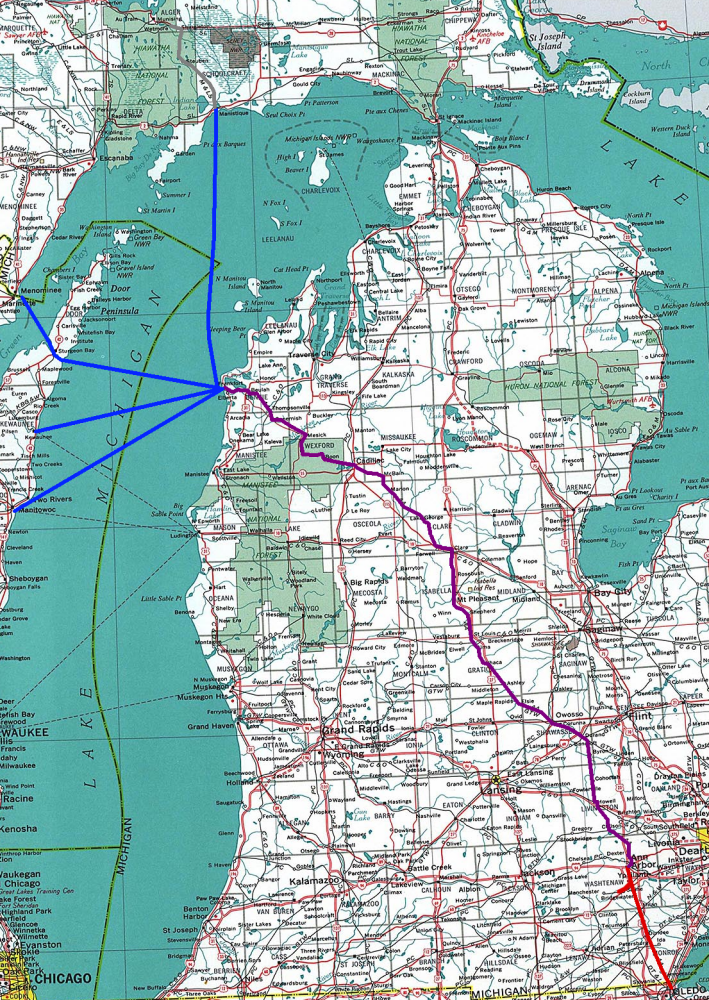
This month’s Classic Trains featured fallen flag is the Michigan-based Ann Arbor Railroad which operated rail services from Toledo, Ohio to Elberta and Frankfort, Michigan, along with lake ferry service across Lake Michigan to Manitowoc and Kewaunee, Wisconsin and Menominee and Manistique in Michigan’s Upper Peninsula. Robert I. Warrick provides an outline of the history of the line:
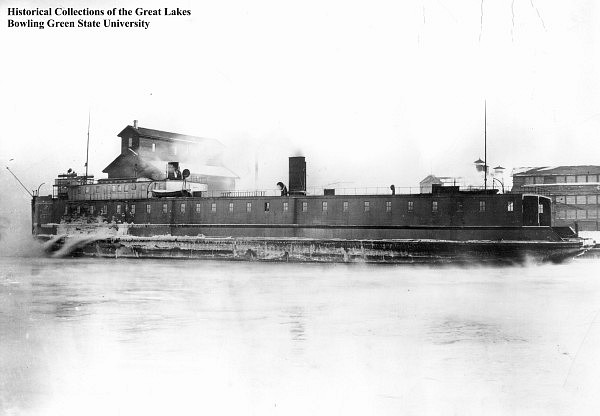
Ann Arbor No. 1, built in 1892 by Craig Shipbuilding Co. in Toledo, Ohio. She was destroyed in a fire on March 7, 1910 at Manitowoc, Wisconsin. Photo from Bowling Green State University via Wikimedia Commons.
The Ann Arbor Railroad was as much a steamship line as a railroad. Built from Toledo, Ohio, northwest to Frankfort, Mich., it existed for one reason — to move freight in car ferries across Lake Michigan to bypass Chicago. From 1910 to 1968, “the Annie” operated 320 car ferry route-miles versus 292 miles of railroad. AA was at the forefront of car ferry design and innovation, from the first wooden-hulled vessels to the most advanced car ferry to ever sail Lake Michigan.
During the 1940s, up to six ferries made the round trip from Boat Landing, as AA called its yard in Elberta on the south side of Frankfort harbor, to two Wisconsin and two Michigan Upper Peninsula ports. The boats ran year-round on a tight schedule, timed to match with three pairs of scheduled Toledo freights, where AA interchanged with five trunk lines. Well-kept 2-8-2s powered those short, fast trains across AA’s rolling profile until 1950, when Alco FA2s took over.
[…]
The Eastern mergers of the 1960s ultimately doomed the old Ann Arbor. As planning for Penn Central went on, the Norfolk & Western merged with Wabash, Nickel Plate, and two smaller roads in 1964. N&W wanted no part of the Ann Arbor and its costly ferries, so AA was foisted off on DT&I, which was profitable by the 1960s.
With ICC approval, DT&I took over the Ann Arbor on August 31, 1963, and soon replaced the tired FA2s with 10 GP35s, riding on Alco trucks and painted in DT&I orange with large “Ann Arbor” lettering. DT&I’s GPs often mixed with the Annie’s.
DT&I had ferry Wabash refitted, changed her name to City of Green Bay, and loaned AA $2.5 million to rebuild Ann Arbor No. 7. The railroad renamed No. 7 Viking, lengthened it, installed four EMD 2,500 h.p. 567 diesels. But even with the bigger boats, capacity remained an issue as car sizes increased. AA was losing money. First the ferry route to Manistique, Mich. (and AA subsidiary Manistique & Lake Superior), was discontinued, then the one to Menominee, Mich.
Ann Arbor’s fate was sealed. A firm was hired to liquidate Pennsylvania Company assets, including AA and DT&I. Ann Arbor defaulted on the loan for the Viking on November 1, 1972, and filed for bankruptcy on October 15, 1973, leading to AA’s inclusion with other bankrupts in the Regional Rail Reorganization Act of 1973 that resulted in Conrail.
Comments Off on Fallen Flag — the Ann Arbor Railroad
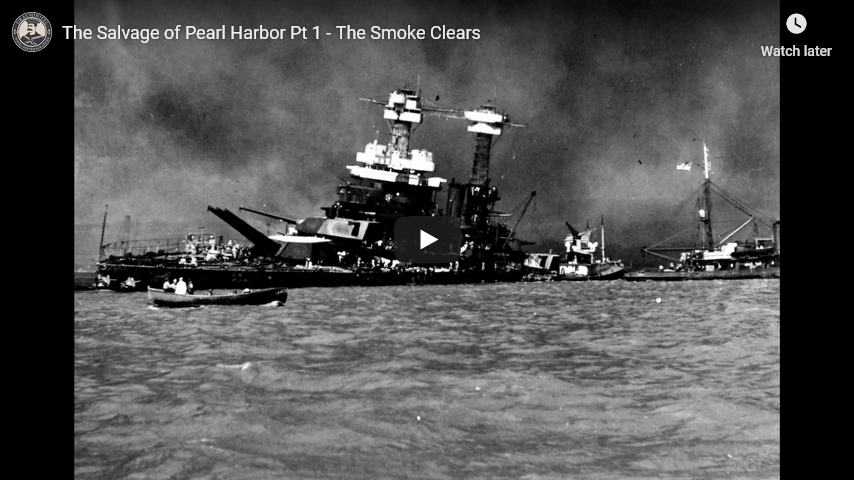
Today we look at the salvage efforts on the USS Shaw, first vessel salvaged from the remains of the attack on Pearl Harbor and the work on the last two vessels under the team’s care, the Utah and Oklahoma
Sources:
www.amazon.co.uk/gp/product/B00C0JIXJO https://www.history.navy.mil/our-coll…
www.amazon.co.uk/Pearl-Harbor-Fleet-Salvage-Appraisal/dp/0898755654
www.amazon.co.uk/Descent-into-Darkness-Harbour-Divers/dp/0891417451
Videos – US National Archives / US Department of Defense
Free naval photos and more – www.drachinifel.co.uk
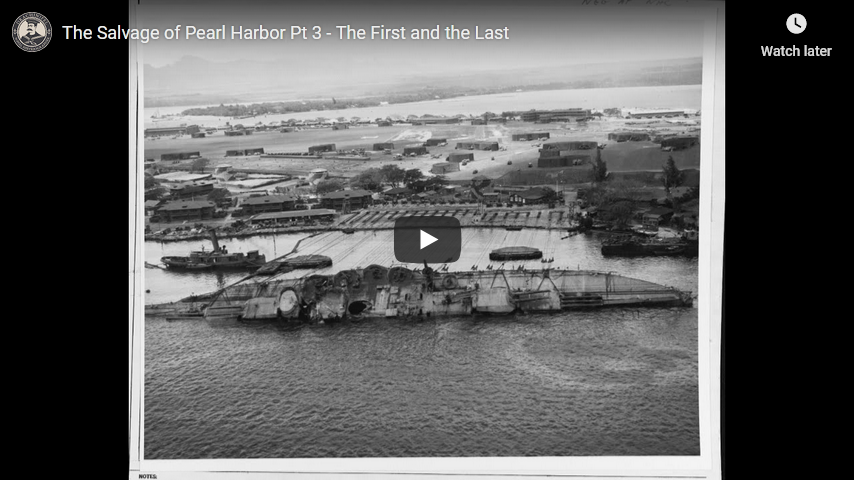
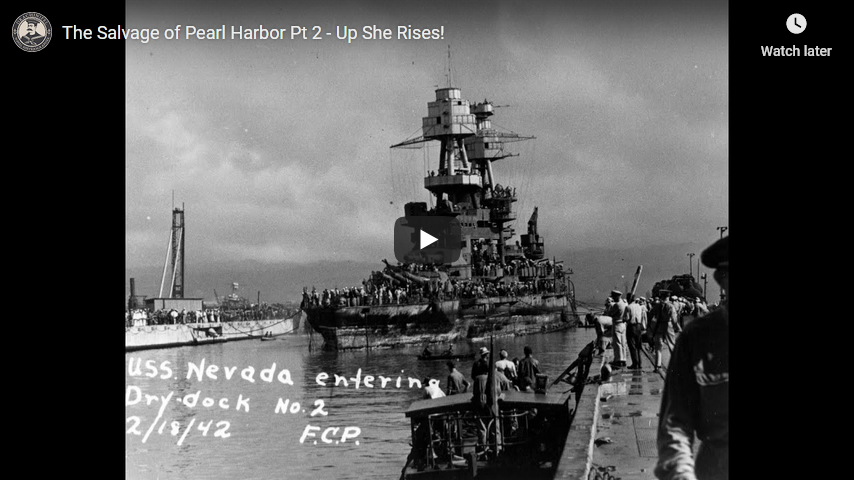
Today we look at the salvage efforts on the three battleships outright sunk in the attack on Pearl Harbor that would be returned to service.
Sources:
www.amazon.co.uk/gp/product/B00C0JIXJO https://www.history.navy.mil/our-coll…
www.amazon.co.uk/Pearl-Harbor-Fleet-Salvage-Appraisal/dp/0898755654
www.amazon.co.uk/Descent-into-Darkness-Harbour-Divers/dp/0891417451
Videos – US National Archives / US Department of Defense
Free naval photos and more – www.drachinifel.co.uk
Powered by World of Warships – https://wo.ws/PearlHarbor – Register now to receive an exclusive bonus!
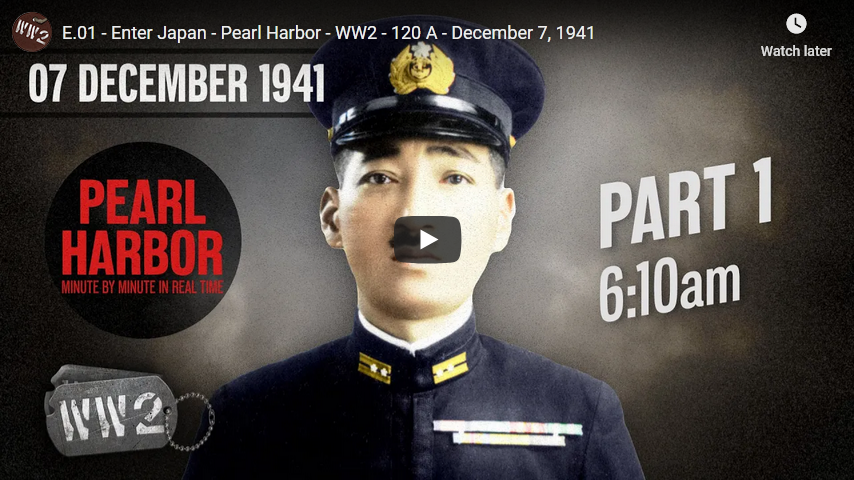
In this episode: Japan’s meticulous planning and preparation made it possible to surprise the Americans at Pearl Harbor. Alert on Oahu is largely nonexistent. It is the deep breath before the plunge.
Hosted by: Indy Neidell
Written by: Spartacus Olsson and Indy Neidell
Directed by: Wieke Kapteijns
Executive Producers: Astrid Deinhard, Indy Neidell, Spartacus Olsson, Bodo Rittenauer
Produced by: Astrid Deinhard and Spartacus Olsson
Co-Producers: Maria Kyhle and Francis van Berkel
Edited by: Iryna Dulka
Set Design by: Astrid Deinhard
Graphic Design by: Mikolaj Uchman
Map Animations by: Daniel Haczyk and Eastory
Assistant Editors: Miki Cackowski, Daniel Weiss, Karolina Dołega
Still Colorizers: Adrien Fillon, Norman Stewart, Jaris Almazani, Daniel Weiss, Mikolaj Uchman, Carlos Ortega Pereira
Research by: Indy Neidell, Spartacus Olsson, Markus Linke, Wieke Kapteijns, Bastian Gaete, Lewis Braithwaite, Tim Smith, Ian Irungu
Sound Design by: Marek Kamiński
Dogfights by: Daniel Weiss, Bastian Gaete, Ian Sowden, Dennis Stepanov
Voices:
Mitsuo Fuchida – Daniel Grieb
Ada Peggy Olsson – Shani Neidell Beard
Iyōzō Fujita – Emi Celis
James Anderson – Emi Celis
Dorinda Stagner – Zora Johnson
Jack Kelley – Ryan Socash
James McClelland – Spartacus Olsson
Phil Rasmussen – Spartacus Olsson
Dan Wentrcek – Dennis Stepanov
Thompson Izawa – Samir Mechel
Robert Isacksen – Ian Sowden
Joseph K. Taussig Jr. – Tim Smith
James Cory – Ryan Tebo
Film colorization by: Ricks Film Restoration
Naval Gameplay by: World of Warships
Archive material provided by: Reuters/Screenocean
A TimeGhost chronological documentary produced by OnLion Entertainment GmbH.
From the comments:
World War Two
1 hour ago (edited)
When we set out to do this crazy project we thought we wanted to try some really new things. As anyone knows that follows us regularly, our first and foremost goal is remembrance — to shine a light on our past and learn form our ancestors’ mistakes and achievements. We try our best to do that with a dedication to facts and details liberated from partisan, or ideological historiography. For this purpose, the attack on Pearl Harbor serves very well. It is a compact event over only a few hours that is spectacular in its nature, tragic in its effect, gripping in its drama, and has tremendous impact on WW2 on all fronts. It is also an event that is often simplified to the point of misunderstanding, has been woven into national mythology, and given rise to some pretty nutty conspiracy myths. Simply put: the Attack on Pearl Harbor is short enough, exciting enough, and misunderstood enough for us to do a limited series like this.
But more than that we also wanted to try some new technical and narrative things. Since we started doing historical documentaries with the Great War in 2014 we have tried to be on the forefront of pioneering new ways of creating historiography for the modern media world. Narratively, we have dedicated ourselves to chronologies, which in historiography is nothing new, but it is new in the world of film documentaries (at least to the level we do it) — so we thought; “heck what if we go down to minute by minute for this” — well we did and it taught us an enormous amount about Pearl Harbor, but also about how we can write. We will get back to that in further comment on the series. As for technology, it truly is technology that enables our work, well any media — for us it is social media, affordable ways to capture film, global virtual remote working spaces, digital research opportunities, digital film archives, and so on.
Two areas we had not been able to venture into was recreation of scenes using computer graphics and colorization of moving images. Using a gaming engine to create animation is also nothing new, but usually very, very expensive because you have to first create the world, the assets and the characters for your recreation. But for Pearl Harbor, World of Warships https://worldofwarships.com and World of Warplaneshttps://worldofwarplanes.com opened an opportunity to do this on a new scale at a cost that is only a fraction of what it usually costs. Along the way we also got to know Ricks Film Restorations (https://bit.ly/ricksfilmresorations and https://www.youtube.com/user/Rick88888888) who use AI technology to enhance and colorize film footage. While both of these technologies are only at the beginning of their potential, we think the results are spectacular. More than anything it has enabled us to enhance the emotional and visual experience for this series to a level we never reached before. Last but not least it enabled us to use the financial contributions of the TimeGhost Army, and World of Warships to create five hours of content for less than 1/50th — only 2% — of what it would cost to do with traditional means.
creatingstuff
In the Name of the entire TimeGhost Team,
Astrid, Indy, Spartacus, and Wieke
Episode Guide:
This is a 10 episode limited series within our weekly coverage of WW2 — to see the immediate events leading up to this day watch episode 119 from December 5, https://youtu.be/DYUzmBuX-6Y. Some of the events covered briefly as they start on this day, such as the invasions in the West Pacific will be covered in more detail in the coming weeks, especially in episode 120K (the 11th episode this week).coming out on December 12.
The History Guy: History Deserves to Be Remembered
Published 22 Apr 2019
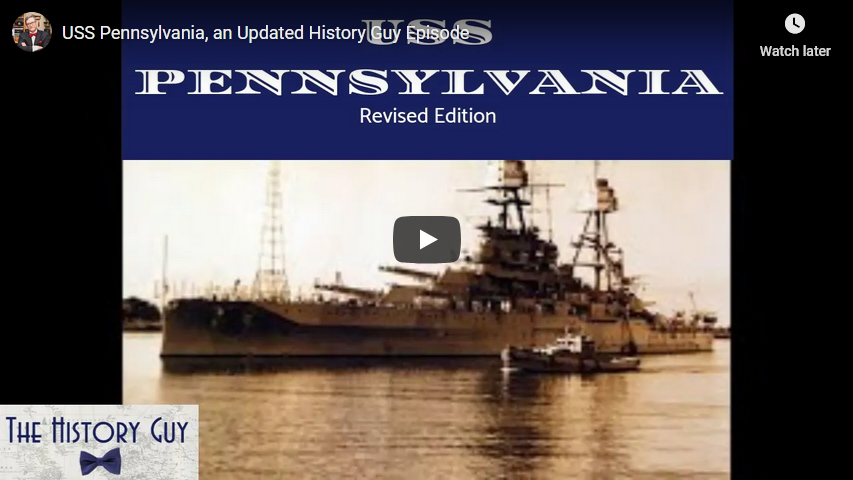
USS Pennsylvania was in dry dock when the attack came at Pearl Harbor. The History Guy remembers part of her history that may have been forgotten.
This episode was originally posted December 7, 2017. It has been updated to correct some errors in the original, and new footage of USS Pennsylvania has been added.
This is original content based on research by The History Guy. Images in the Public Domain are carefully selected and provide illustration. As images of actual events are sometimes not available, images of similar objects and events are used for illustration.
All events are portrayed in historical context and for educational purposes. No images or content are primarily intended to shock and disgust. Those who do not learn from history are doomed to repeat it. Non censuram.
The History Guy: History Deserves to Be Remembered is the place to find short snippets of forgotten history from five to fifteen minutes long. If you like history too, this is the channel for you.
The easiest tonnage to understand is displacement tonnage. This is the actual weight of the ship, called displacement because the weight of the ship is equal to the amount of water it displaces, per Archimedes’ principle. Of course, the displacement of a ship can change greatly depending on what’s aboard, so several different displacements are often used. A good reference will give three values, light, normal, and full. Light is basically an empty ship. There are some technical details, but in essence it’s what the ship weighs if we take all the people, fuel, cargo, ammunition, and supplies out of it. Full displacement is exactly what you’d expect from the name. The ship is as heavy as it’s ever going to be, with full fuel, ammo, and cargo. Normal is essentially a ship with full cargo and crew, but two-thirds fuel and ammunition. On warships, it’s common for light displacement to be 75% or so of full displacement, so it’s obvious that a poor choice of reference numbers can cause confusion about the actual sizes of the ships in question. Displacement tonnage in non-metric references is always given in long tons of 2,240 lb each. This is to allow easy conversion, as a long ton of salt water has a volume of almost exactly 35 cubic feet.
Displacement tonnage is the only tonnage value commonly used for warships, while merchant ships use a completely different set of tonnages, usually deadweight tons, gross tons, and net tons. Deadweight tonnage is at least an actual measure of weight, and specifies how much cargo the ship is able to carry, excluding the weight of the ship itself. Gross tonnage and net tonnage are both basically volumetric measures, specified using complicated formulas. Gross tonnage is based on the total volume of all enclosed spaces of the ship, while net tonnage is based only on the volume of the spaces that carry cargo or passengers. These values are used to calculate things like port duties and what regulations apply to the ship. They replaced gross and net register tons, which were also volumetric, of 100 cubic feet to the ton. These were based on a phenomenally complicated set of rules to determine what spaces were and weren’t counted, with shipowners trying to game the system and drive down their tonnage. Worse, different countries had different regulations on what counted under each value, so in 1969, register tonnages were abolished and replaced with the existing system.
While distance, speed, and “tonnage” measurements are the most prominent nautical idiosyncracies, there are a few other values that bear mentioning. The maximum width of a ship is the beam, apparently from the beams that used to run across ships during the days of sail. Draft (or draught) is how deep the hull is below the waterline. This is a very important number to make sure the ship doesn’t run aground, but it varies continually with the amount of stuff on the ship. Air draft is sometimes used for height above the water, important for clearing bridges and the like. Length, much like tonnage, comes in several values. The obvious one is length over all, LOA, which is exactly what it sounds like, measured from the furthest forward to the furthest aft point on the ship. This is obviously useful, but for hydrodynamic purposes another value, waterline length (LWL), is what the designer cares about. The last value is length between perpendiculars (LBP), measured between the vertical stem (bow) post and the vertical stern post. This is another value that was developed for civilian use. Some ships of a given LOA have a great deal of overhang at bow and stern, making them much smaller than other ships with the same nominal LOA. Using LWL is not a good solution, as it varies with draft. LBP solves both of these problems, but isn’t of great importance to warships.
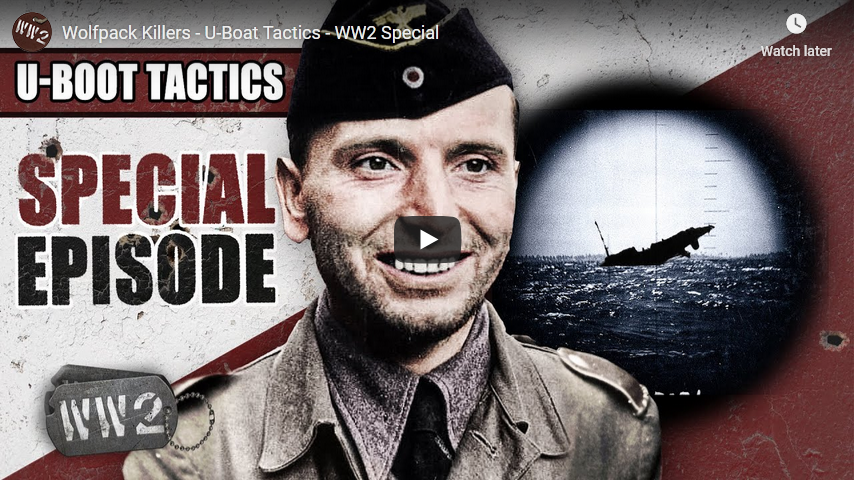
German U-Boats were a big threat to Allied shipping across the Atlantic. New inventions and tactics triggered a race to outsmart the opponent, dramatically changing the tides of the Battle of the Atlantic every few months.
Sources:
Pugsley, William H./Library and Archives Canada/PA-139273
Bundesarchiv
Narodowe Archiwum Cyfrowe
IWM CH 15219, A 31092, FL 3259
Bletchley Park Trust
from the Noun Project: Cargo Ship by Locad, explosion by Nico Tzogalis
Soundtrack from the Epidemic Sound:
Johannes Bornlof – “The Inspector 4”
Reynard Seidel – “Deflection”
Johannes Bornlof – “Deviation In Time”
Hakan Eriksson – “Epic Adventure Theme 3”
Johannes Bornlof – “Death And Glory 3”
Phoenix Tail – “At the Front”
A TimeGhost chronological documentary produced by OnLion Entertainment GmbH.
From the comments:
World War Two
1 day ago
The episode covers some of Otto Kretschmer’s 11 Points of Submarine Warfare. Here’s the full list:
1. Efficient lookouts are of prime importance.
2. It is essential not simply to spot the target, but to spot it in good time.
3. Lone ships should be attacked on the surface with gunfire in order to save expensive torpedoes.
4. Survivors should be assisted where possible.
5. Convoys should only be attacked in daylight if it is not feasible to wait for nightfall.
6. Attack at night from the dark side of the convoy, so that the target is silhouetted and the submarine is in shadow.
7. When there is little or no moonlight, attack from the windward side [to avoid a visible white bow-wave when motoring into the wind].
8. Fire one torpedo per target, not fanned salvoes.
9. Fire at close range.
10. Once the attack is launched, do not submerge except in circumstances of dire necessity. Remember that on the surface it is easier for you to spot the enemy than for the enemy to spot you.
11. Dive only for two hours before dawn each day, to rest the crew, sweep with the sound detection equipment, etc.; otherwise, remain on the surface.
Comments Off on Wolfpack Killers – U-Boat Tactics – WW2 Special
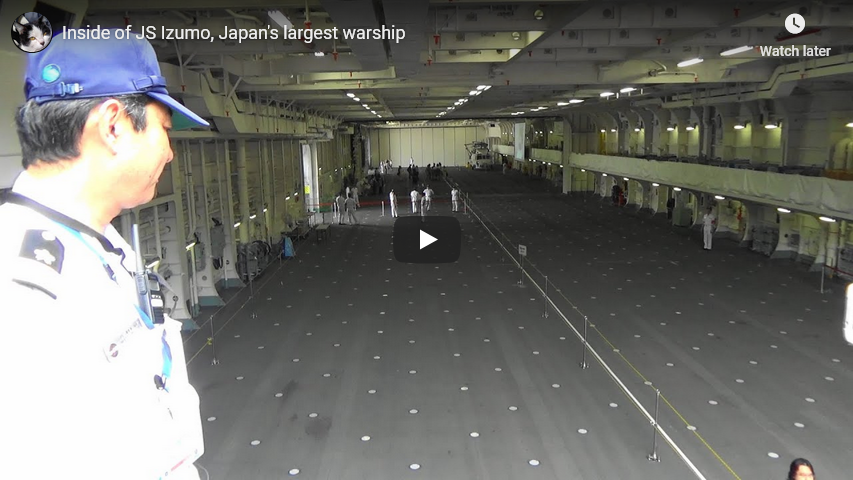
At open-house of the Japan Maritime Self-Defense Force Yokosuka Naval Base.
On June 11, 2016.
#JMSDF #MSDF
From the Wikipedia entry:
JS Izumo (DDH-183) is a helicopter carrier with a planned future conversion into an aircraft carrier. Officially classified as a multi-purpose operation destroyer, she is the lead ship in the Izumo class of the Japan Maritime Self-Defense Force (JMSDF). She is the second warship to be named for Izumo Province, with the previous ship being the armoured cruiser Izumo (1898).
The ruling Liberal Democrat Party announced in May 2018 that it favours converting Izumo to operate fixed-wing aircraft. The conversion was confirmed in December 2018 when Japan announced the change of its defense guidelines. Upon the completion of the process, Izumo will be the first Japanese aircraft carrier since World War II.
The Vikings are enjoying a new wave of enthusiasm in popular culture, but these seafaring Norsemen are still quite clearly a misunderstood force in medieval European history. So let’s take a wide look at the European world during The Viking Age!
SOURCES & Further Reading: The Vikings by Walaker Nordeide and Edwards, Vikings: A Very Short Introduction by Richards, Age of the Vikings and The Conversion of Scandinavia by Winroth, The Vikings By Harl via The Great Courses, The Viking World by Graham-Campbell, The Viking Way by Price.
Ludohistory
23 hours ago (edited)
Thanks so much for having me on and letting me help out! It was a lot of fun (even if I talked a little too fast sometimes)! To clarify a piece that I know I did cover too briefly — missionary trips to Scandinavia occurred in Denmark around 823, on the orders of Louis the Pious, and in Sweden in 829, when Ansgar, a Frankish monk, traveled to the town of Birka, where he found a very small Christian community, probably mostly enslaved or formerly enslaved people, and converted a couple of Norse people, including the town prefect. (The graveyard for that town, incidentally, is where the 10th century “female warrior” that made waves a few years ago was buried).
There’s a lot we didn’t get a chance to talk about about the diaspora and its ending, so if there’s anything you all are curious on or find unclear, let me know here or on twitter 🙂
Finally, if you liked this, all the VODs for my personal streams (where I try to ramble about history in games) can be found by clicking on my name, and tomorrow I’ll be streaming CKIII on twitch (link in the description)!
Comments Off on History Summarized: The Viking Age
Christopher Howarth on a recent BBC production that threw facts out the window in a rush to condemn British Prime Minister Winston Churchill for the famine in Bengal during 1943:
A 1945 map of Bengali districts as of 1943. Famine Inquiry Commission (1945): Report on Bengal via Wikimedia Commons.
This argument was put forward by the BBC’s own Yogita Limaye, an Indian engineer and reporter on Women’s safety, based on the book Inglorious Empire by Shashi Tharoor, who was interviewed to give his opinion that Churchill was an “odious figure of reprehensible views and racist attitudes.”
No doubt the narrative of British evil and oppression is believed in India and elsewhere, but that does not make it true or worthy of the BBC reporting it as fact without any semblance of balance. The BBC failed its licence fee paying audience in two main regards, namely, conceptually and factually.
The British ruled India, one of the largest populations on earth, for well over two centuries. Good and bad things happened, just like everywhere else ever. You can join the dots to create whatever picture you like – Dr Tharoor chose the picture he wished to create. Why is the Bengal famine uniquely interesting to a BBC audience in 2020 over say a mini-series on British Railways and development in India? BBC presenters are demonstrably more interested in the first narrative: this is a major conceptual failing on their part. Being equal mixtures primitivism and solipsism. Always the borderline racist Western assumption is that “we” did things to “them”: we had agency, they were passive brutes. They are boring, we are endlessly interesting. Let’s talk about us. However even the slightest knowledge of the British-in-India teaches one that “we” did nothing without them. How on earth could we? There were famously few of us.
Yet it’s the second great BBC failing – over accuracy – which is so especially galling. On the actual allegation the BBC is plain wrong. Churchill was not responsible for the Bengal famine as any actual delving into the facts would have shown. Note well that they didn’t even try.
In 1943 Britain was at war with Japan, who were at the gates of India having occupied Burma, a major supplier of grain to Bengal. Important facts. Bengal was in the grips of a famine, nobody disputes that. But Churchill was not responsible, neither for the weather nor the agriculture nor the Japanese aggression.
Even the BBC did not allege that Churchill instigated the famine, the charge sheet is that he refused to help when he could. There were “stockpiles [of food] in the UK” and shipping which was retained in the northern hemisphere, prioritised for use there. Stockpiles of food in the UK in 1943? Even if there was the food and shipping, transporting US corned beef to Bengal would have been ludicrous. If there was shipping and protection from Japanese naval assault the food would have come from the rest of India. So why was food not transported from other parts of India to Bengal?
Prime Minister Winston Churchill greets Canadian PM William Lyon Mackenzie King, 1941. Photo from Library and Archives Canada (reference number C-047565) via Wikimedia Commons.
Comments Off on Winston Churchill and the 1943 Bengal famine
For unlimited access to the world’s top documentaries and nonfiction series go to http://go.thoughtleaders.io/166892020… and use the promo code ‘historigraph‘ to get 30 days free access.
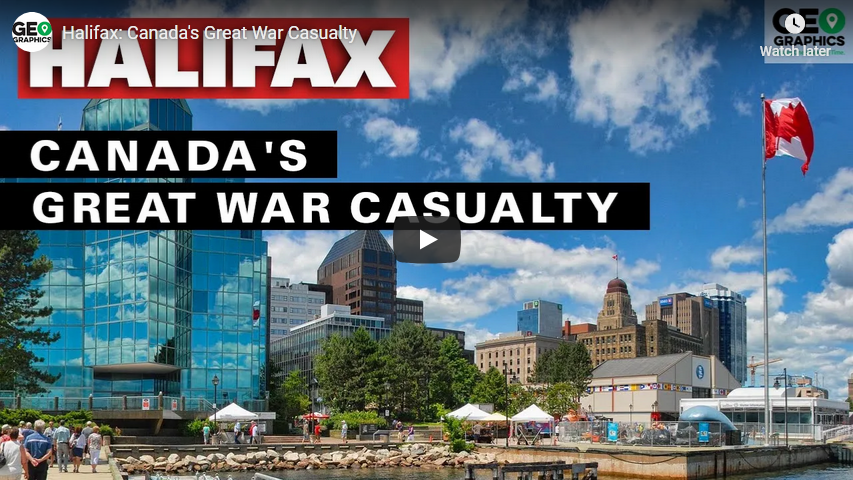
Previously unpublished photo of the Halifax explosion in December 1917 taken by Mate Reg Stevens, RCN. Original image from the Community Archives of Belleville and Hastings County, via CBC News.
“The photo has the look of a very troubling dream,” Dan Conlin says as he studies an old black-and-white image.
Conlin is a transportation historian who’s spent a lifetime studying images of ships, trains and aircraft. He’s also a former curator of Halifax’s Maritime Museum of the Atlantic, which houses a large collection of materials from the 1917 Halifax Explosion.
The image he’s studying surfaced recently on Reddit with a user from Halifax, England, wondering if it was a “new” image of the 1917 disaster.
“You have these tranquil little wavelets in the foreground and some stately, anchored vessels — including a sailing ship,” Conlin said. “But in the background there are these awful, nightmarish clouds, including a horrible column that is rising into the sky. It looks like a surreal nightmare.”
When Conlin first looked at it, the crisp details of the foreground and the blurry background raised his skeptical eyebrows. “There was quite a tradition in the World War I era of faking photos by doing composite photos, where you layer one image on top of another,” he said.
One well-known photo of the explosion taken from McNabs Island was later suspected to have been doctored by a company. They seem to have added clouds for dramatic effect — and to sell more postcards.
But Conlin thinks in the nightmarish photo, it’s more likely that the clouds are moving from the force of the explosion, while the ships were untroubled by any winds. The disaster killed nearly 2,000 people and badly hurt thousands more. It levelled the Richmond district in the north end.
“It’s carnage and destruction out of Dante at the base of that cloud. People are dying and fires are starting and this awful event has hit Halifax in the distance,” he said.
“That angry cloud gives you an idea of the violence and tragedy that is unfolding even as the shutter clicks. It’s really rare and that photo, as far as I can tell, has never been published.”
Comments Off on A previously unpublished photo of the 1917 Halifax explosion