Quotulatiousness

June 8, 2025

“If the New York Times notices the Buddha, the enlightened one has already left town”

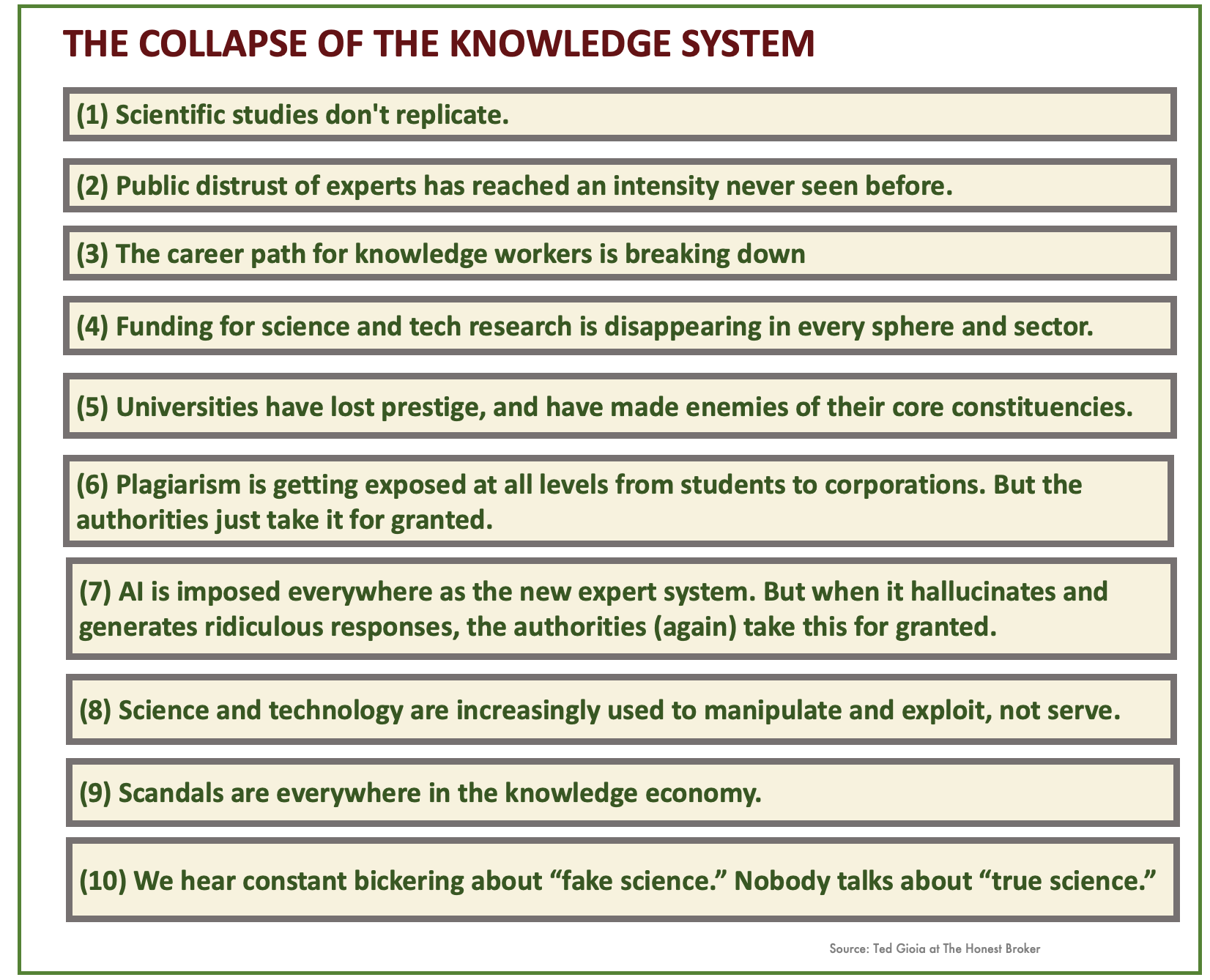
Ted Gioia points out that momentous changes in society are not often noticed until they’ve taken place, and provides ten warning signs of such a change happening right now:

Would you believe me if I told you that the biggest news story of our century is happening right now — but is never mentioned in the press?

That sounds crazy, doesn’t it?

But that is often the case when a bold new worldview appears.

  • How long did it take before the Renaissance got mentioned in the town square?
  • When did newspapers start covering the Enlightenment?
  • Or the collapse in mercantilism?
  • Or the rise of globalism?
  • Or the birth of Christianity or Islam or some other earthshaking creed?

The biggest changes often happen long before they even get a name. By the time the scribes notice, the world is already reborn.

You can take this to the bank: If the New York Times notices the Buddha, the enlightened one has already left town.

For example, the word Renaissance got introduced two hundred years after the start of the Renaissance. The game was already over.

The same is true of most major cultural movements — they are truly the elephants in the room. And the elites at the epicenter of power are absolutely the last to notice.

Tiberius may run the entire Roman Empire, but he will never hear the Good News.

There’s a general rule here — the bigger the shift, the easier it is to miss.

We are living through a situation like that right now. We are experiencing a total shift — like the magnetic poles reversing. But it doesn’t even have a name — not yet.

So let’s give it one.

Let’s call it: The Collapse of the Knowledge System.

We could also define it as the emergence of a new knowledge system.

In this regard, it resembles other massive shifts in Western history — specifically the rebirth of humanistic thinking in the early Renaissance, or the rise of Romanticism in the nineteenth century.

In these volatile situations, the whole entrenched hierarchy of truth and authority gets totally reversed. The old experts and their systems are discredited, and completely new values take their place. The newcomers bring more than just a new attitude — they turn everything on its head.

That’s happening right now.

The knowledge structure that has dominated everything for our entire lifetime — and for our parents and grandparents — is collapsing. And it’s taking place everywhere, all at once.

If this were just an isolated situation — a problem in universities, or media, or politics — the current hierarchy could possibly survive. But that isn’t the case.

The crisis has spread into every sector of society which relies on clear knowledge and respected authority.

The ten warning signs

June 2, 2025

The progressive case for unlimited immigration

Theophilus Chilton takes on the progressive arguments for bringing in as many “high quality” immigrants as humanly possible from his own professional background:

One of the constants that you can count on in any debate about the value of immigration (of every sort) is the inevitable assertion about the NECESSITY of immigration. Immigrants POWER AMERICA. Without them, NOTHING WOULD HAPPEN! They are ELITE HUMAN CAPITAL without which the White American chuds who did things like build the atom bomb and otherwise created modern technological civilisation would barely be able to keep the lights on in their single-wides. It’s not just that immigrants want a new life or might be useful — they are an absolutely necessity and the ones coming here are the cream of the world’s crop.

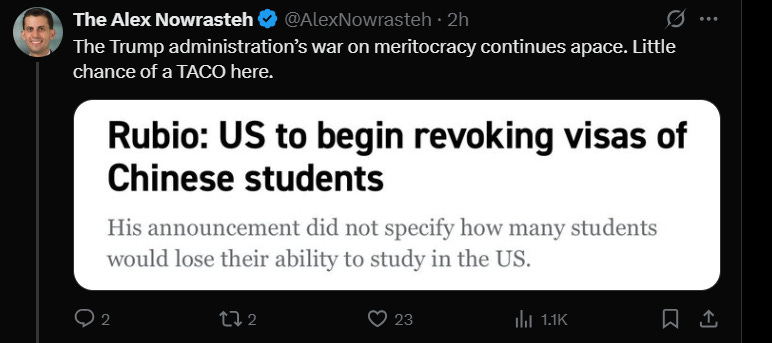
As a result, the recent move by Marco Rubio and the State Department to revoke visas from Chinese students in American universities (especially those associated with the CCP or who are in positions to commit especially damaging industrial espionage) will certainly not be well-received by this crowd. For example, witness Alex Nowrasteh, who’s whole schtick is to burble on about “meritocracy” and whine about “affirmative action for White Americans” while filling a useless sinecure at the Cato Institute that he got by being the token immigrant. He is appalled that we’d act in our own national interest rather than in the interests of a bunch of random foreigners.

Immigration man have big sad

Many people who know me on X already know this, but most readers here may not. Before I made a radical life-changing vocational choice a few years ago, I used to be a scientist in Big Pharma. For a little over two decades, I worked in the biotech/biopharma industry, covering a wide range of drug development stages and product types. I’ve developed vaccines (which is why I was skeptical about the Covid vaxx from the very beginning). I’ve developed small molecule drugs. I helped to bring to market several of the pharmaceuticals that millions take regularly and which you see advertised on television. I’ve done everything from bench scale analytical work to protein purification on 5000-liter batches used in support of human clinical trials. I’m proficient in literally dozens of different analytical techniques. Before that, in both undergraduate and graduate school, I specialised in synthetic organic small molecule development across a number of different subspecialties. And I’m good at all of this.

One other thing that I did throughout was work side-by-side with, and later manage, LOTS of visa holders and immigrants, especially from “tech heavy” countries like India and China, the stereotypical “H1-Bers”. As a result, I consider myself to be a pretty good judge of the value which visa holders bring to tech fields.

My judgment is, and has been for decades, that their value is minimal and it certainly does not live up to the hype. Indeed, one of the constants that I observed among most Indian, Chinese, and other visa holders was that they did not really, truly understand the science that was involved with the products being developed and the techniques being used to develop and test them. Most of these folks were the living embodiment of cramming to pass the test. When the test methods and the SOPs being employed were straightforward, these folks were great. They had a robot-like efficiency that comes with repetitively doing the same thing over and over and over again. Unfortunately, for anything requiring innovative or independent thinking, they’d be totally lost. If results from a test deviated from expectations and required some commonsense interpretation? That’s where the wheels came off. I mean, there was little to no capacity to deal with anything that wasn’t completely textbook.

Even basic scientific sense was often missing. At one job, there was an Indian guy who would takes dumps in the bathroom and then walk straight out back to his manufacturing suite in the cell line division without even washing his hands. I know this because I observed it for myself several times. I mean, even if you don’t care about getting fecal coliform bacteria all over door handles and whatnot, at least don’t carry them back into the suite where you’re helping to grow batches of genetically engineered E. coli. I assume he was properly gowned before going in, but still, there’s just that basic lack of sense there.

And then there are the ethics (or lack thereof) displayed by many visa holders (especially Chinese and Middle Eastern). Data manipulation, tweaked results, etc. etc. These tend to occur because both of those groups are under intense social pressure within their own cultures to “get the right results” rather than just dealing with the results you get. The “tiger mom” mentality carries over into the workplace. There is a reason for why these two groups are disproportionately overrepresented on the FDA’s debarment list. Indians can be subject to serious lapses in integrity as well, though theirs tend to revolve more around cutting corners and mistreating underlings, as I illustrated in a thread on X about three years ago where I recounted my time working for an Indian-owned company.

Over the years, my observations have been substantiated and reiterated by any number of people in various tech-heavy industry to whom I’ve related them. Whether it’s pharma or IT or medicine or metallurgy or whatever else, the familiar story is told. It’s really, really difficult to reconcile this mass of lived experience with the theoretical assertions made by people like Nowrasteh that immigrants are this valuable resource that we absolutely need to be or remain competitive in world markets.

In effect, the goal with this type of white-collar mass immigration is to “roboticise” tech fields which can’t be given over to AI or actual robotics just yet. The formula is to import masses of workers who can simply follow a script and save companies money on labour costs. If you think about it, this is really a low IQ, high time preference approach by corporations whereby they sacrifice real innovativeness and future competitiveness for short-term savings. I’d argue that the entry of H1-B and other visa holders in large numbers into American tech industries which accelerated around the late 2000s-early 2010s has actually led to a slowdown in real innovation. We may have tons of new apps for our phones, but fewer truly groundbreaking advances in tech across the board.

May 14, 2025

The Bomber Mafia & The Norden Bombsight – What The Heck Happened? The Bomber War Episode 2

HardThrasher
Published 28 Oct 2023

Selected Internet Sources
Target for Today (1944) – Target For Today (1944)
https://www.navsea.navy.mil/Home/Warf… – LTE Thompson, first lead scientist at Dahlgren
https://www.amazon.co.uk/Scientist-Ex… – Donald Jacobs
The Fairey Battle – Light Bomber, Hea…
https://en.m.wikipedia.org/wiki/Point…
https://en.m.wikipedia.org/wiki/Butt_…
https://en.m.wikipedia.org/wiki/Area_…
https://en.m.wikipedia.org/wiki/Casab…
https://discovery.nationalarchives.go… – Western War Plan W5a and W6

Selected Bibliography
America’s Pursuit of Precision Bombing 1910-1945 – McFarland et al.
Dresden – Sinclair McKay
Dresden; Tuesday … – Fredrick Taylor
Absolute War – The Firebombing of Tokyo – Chris Bellamy
Black Snow
Bomber Command – Max Hastings
Bomber Command’s War Against Germany, An Official History – Nobel Franklin et al.
The Bomber Mafia – Malcolm Gladwell
Undaunted and Through Adversity (Vol 1 &2) – Ben Kite
United States Strategic Bombing Survey (European War) (USSBS) Sept 1945 – Var. – https://collections.nlm.nih.gov/catal…
America’s Pursuit of Precision Bombing 1910-1945, McFarland
Big Week – James Holland

May 6, 2025

Online tools for the curious autodidact

Filed under: Books, Education, Technology — Tags: , , , — Nicholas @ 03:00

Like many people, I was generally not a good student and in primary and middle school, I was notorious for reading the “wrong” parts of books because they were closer to my interests than the assigned readings, but I generally was able to scrape together enough marks to pass the tests on the stuff I skimmed or ignored. This is hardly the way to make an academic career — not that I would ever have done so, unless they just let me study what I wanted to learn about. A useful Substack for my fellow autodidacts [Wiki] is a side project of military historian Bruce Ivar Gudmundsson called Extra Muros, and his latest post provides some information on tools for online research that you may find helpful:

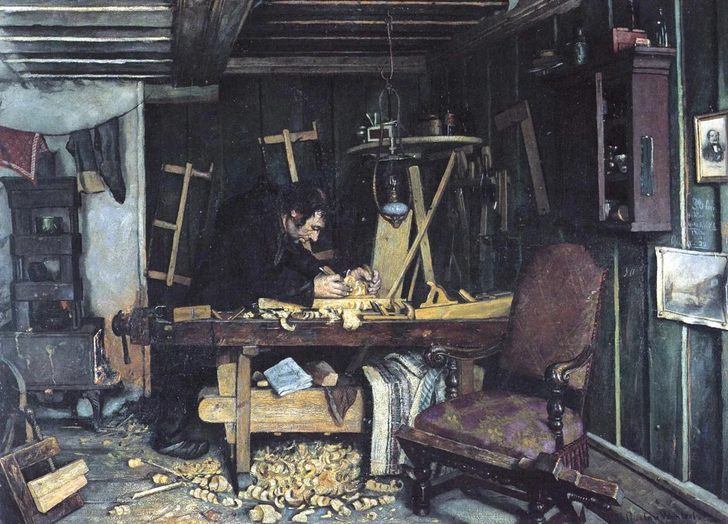
Gustav Wenzel – “A Carpenter’s Workshop” (1881)

The “advanced search” page of the Internet Archive allows you to …

  • download copies, in various electronic formats, of
  • – books and magazines published before 1929

    – works (such as those created by the US Federal Government) that have always belonged to the public domain

    – relatively recent works uploaded by people in countries (such as India) with less restrictive copyright laws

  • examine books that you might want to acquire for enjoyment the old-fashioned way
  • find higher-quality copies of items that you found on Google Books
  • obtain an overview of the works (to include foreign language translations)
  • – of a particular author

    – on a particular subject

The “advanced search” page on the website of the Hathi Trust allows you to do many of the things you might otherwise do on the Internet Archive. Alas (and, indeed, alack), the interface restricts the direct download of complete volumes to “participating institutions”. As a result, mere mortals must either seek the PDF in question on Google Books (to which Hathi provides a direct link) or use a bit of freeware called Hathi Download Helper.

The Hathi Trust search engine also makes it easy for you to search within books for specific words and phrases, as well as the mention of particular places and personalities. Doing the former turns the Hathi Trust database into a kind of dictionary, a way of discovering ways that people in various climes and times have used the expression. Doing the latter converts that cornucopia into an encyclopedia.

The NGram Viewer performs a similar service. However, as it sits atop a smaller collection and suffers from a number of irritating defects, it has proved less useful to me than the website of the Hathi Trust.

April 3, 2025

QotD: When the History Department at Flyover State committed slow motion suicide

Filed under: Education, History, Politics, Quotations, USA — Tags: , , , , — Nicholas @ 01:00

It started when they hired a radical feminist lesbian. Radical by ivory tower standards, I mean, which as you can imagine is a bar so high, Mt. Everest could limbo under it without breaking a sweat. This was the kind of “scholar” whose work was like that dude we mentioned a while back, who claimed that the US Civil War was really about “gay rights” — something that’s not merely wrong, but impossible, as the mid-19th century lacked the conceptual vocabulary to even suggest such a thing. In other words, they hired this persyn to be professionally obnoxious, and xzhey were happy to oblige.

Now, you have to understand something about the academy at this point: Though these people are profoundly ideologically enstupidated, they’re still pretty cunning where their wallets are concerned. Indeed, that’s the whole reason they allow “scholarship” on left-handed LatinX truck drivers in the Ming Dynasty or whatever that persyn’s book was, to pull that kind of stunt — only “original” “research” gets published, and since all the true facts have been ascertained long ago, you have to make shit up if you want tenure. Publish or perish, baby!

A clever plan, but with one teensy tiny flaw: “Tenure” requires a university, and universities require students, which means that, while pretty much all professors hate teaching, they have to do it … and not only that, they have to actually appeal to those icky little deplorables, the students, in sufficient numbers to keep the faculty employed. If, back in your own college days, you wondered if maybe the only reason Western Civ I or whatever was required was that it gave Professor Jones something to do, congrats, you were right. But you can’t require History majors, and there’s only enough Western Civ to go around, which means you have to have 200- through 400-level classes that students actually want to take …

You can see where this is going, and to their credit, some of the faculty at Flyover State saw it, too. At the time, there were still enough upperclassman History majors (and grad students) that the class on LatinX truck drivers in the Ming Dynasty would fill … barely … but that situation obviously would not continue. Nor could you simply stick the new hire in Western Civ classes, because in addition to the other obvious problems, of course xzhey would immediately turn “Western Civ I” into “LatinX truck drivers in the Ming Dynasty … and maybe, if there’s time, the Roman Empire or some shit.”

You know what the Department ended up doing (hint: nothing), and so the first semester after the new hire went exactly like you knew it would. And so did the next, and the next, because as we all know, chicks of both sexes and however-many-we’re-up-to-now genders are herd animals. Hiring the radical lesbian gave all the slightly-less-radical lesbians, again of both sexes and however-many genders, permission to let their freak flag fly. Which, of course, they did. Pretty soon you couldn’t find a History class that wasn’t some bizarre, micro-specialized SJW mad lib. Sure, they’d still call it “The US in the Civil War Era” or “Modern Germany” or whatever, but the course description made it perfectly clear that the class was really about transsexual cabaret acts on the New York Bowery … and maybe, if there’s time, secession or some shit.

And soon enough there were no more History majors, and thus no more History Department. At one of the small schools that collectively make up “Flyover State”, the former History, Psychology, and Classics departments have been folded into something called the “Humanities Department” … to which, last I heard, the former English Department will soon be added.

Severian, “The Dunbar Problem”, Founding Questions, 2021-10-06.

March 19, 2025

The Trumpocalypse – “The outlook for universities has become dire”

Filed under: Education, Media, Politics, USA — Tags: , , , , , — Nicholas @ 05:00

John Carter suggests that American higher education needs to find a new funding model that doesn’t depend on governments to shower their administrative organizations with unearned loot:

Shortly after taking power, the Trump administration announced a freeze on academic grants at the National Science Foundation and the National Institute for Health. New grant proposal reviews were halted, locking up billions in research funding. Naturally, the courts pushed back, with progressive judges issuing injunctions demanding the funding be reinstated. Judicial activism has so far met with only mixed success: the NSF has resumed the flow of money to existing grants, but the NIH has continued to resist. While the grant review process has been restarted at the NSF, the pause created a huge backlog, resulting in considerable uncertainty for applicants.

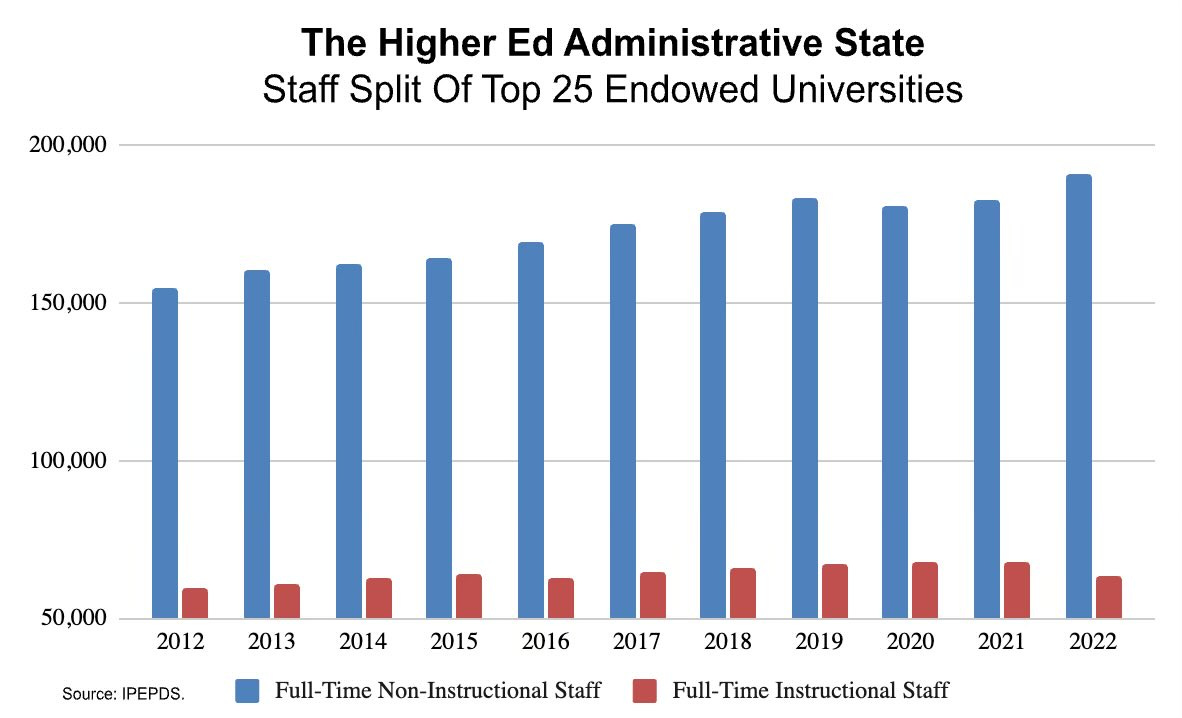
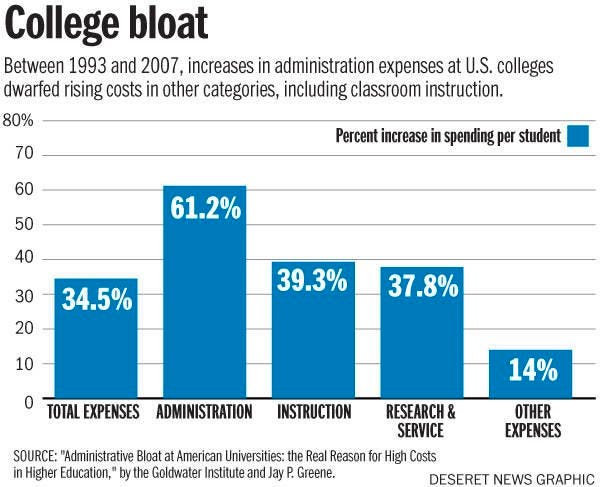
The NIH has instituted a 15% cap to indirect costs, commonly referred to as overheads. This has universities squealing. Overheads are meant to offset the budgetary strain research groups place on universities, covering the costs of the facilities they work in – maintenance, power and heating, paper for the departmental printer, that kind of thing. Universities have been sticking a blood funnel into this superficially reasonable line item for decades, gulping down additional surcharges up to 50% of the value of research grants, a bounty which largely goes towards inflating the salaries of the little armies of self-aggrandizing political commissars with titles like Associate Vice Assistant Deanlet of Advancing Excellence who infest the flesh of the modern campus like deer ticks swarming on the neck of a sick dog. Easily startled readers may wish to close their eyes and scroll past the next few images btw, but I really want to make this point here. When you look at this:

A 15% overhead cap, if applied across the board, has an effect on the parasitic university administration class similar to a diversity truck finding parking at a German Christmas market. Thoughts and prayers, everyone.

Meanwhile at the NSF, massive layoffs are ongoing, and there are apparently plans to slash the research budget by up to 50%. While specific overhead caps haven’t been announced at the NSF yet, there’s every reason to expect that these will be imposed as well, compounding the effect of budget cuts.

There is no attempt to hide the motivation behind the funding freeze, which is obvious to both the appalled and the cuts’ cheerleaders. Just as overheads serve as a blood meal for the administrative caste, scientific research funding has been getting brazenly appropriated by political activists at obscene scales. A recent Senate Commerce Committee report found that $2 billion in NSF funding had been diverted towards DEI promotion under the Biden administration. In reaction to this travesty, as this recent Nature article notes, there are apparently plans to outright cancel ongoing grants funding “research” into gay race communism. DEI programs, formerly ubiquitous across Federal agencies, have already been scrubbed both from departmental budgets and web pages. Indeed, killing those programs was one of the first actions of the MAGA administration.

The outlook for universities has become dire, and academics have been sweating bullets all over social media. Postdocs aren’t being hired, faculty offers are being rescinded, careers are on hold, research programs are in limbo. This comes at the same time that budgets are being hit by declining enrolment due to the demographic impact of an extended period of below-replacement fertility along with rapidly declining confidence in the value of university degrees, with young men in particular checking out at increasing rates as universities become tacitly understood as hostile feminine environments. They’re hitting a financial cliff at the same point that they’ve burned through the sympathy of the general public.

The entire sector is in grave danger.

Politically, going after research funding is astute. Academia is well known to be a Blue America power centre, used to indoctrinate the young with the antivalues of race Marxism, provide a halo of scholarly legitimacy to the left’s ideological pronouncements, and hand out comfortable sinecures to left-wing activists. The overwhelming left-wing bias of university faculties is proverbial. The Trump administration is using the budgetary crisis as a handy excuse to sic its attack DOGE on the unclean beast – starting with cutting off funding to the most ideological research projects, but apparently also intending to ruin the financial viability of the progressives’ academic spoils system as a whole.

Cutting the NSF budget by half may seem at first glance like punitive overkill, and no doubt the left is screeching that Orange Hitler is throwing a destructive tantrum like a vindictive child and thereby endangering American leadership in scientific research. After all, for all the attention that NASA diversity programs have received, the bulk of research funding still goes to legitimate scientific inquiry, surely? However, the problems in academic research go much deeper than its relentless production of partisan activist slop. Strip out all of the DEI funding, fire every equitied commissar and inclusioned diversity hire, and you’re still left with a sclerotic academic research landscape that has spent decades doing little of use – or interest – to anyone, and doing this great nothing at great expense.

March 8, 2025

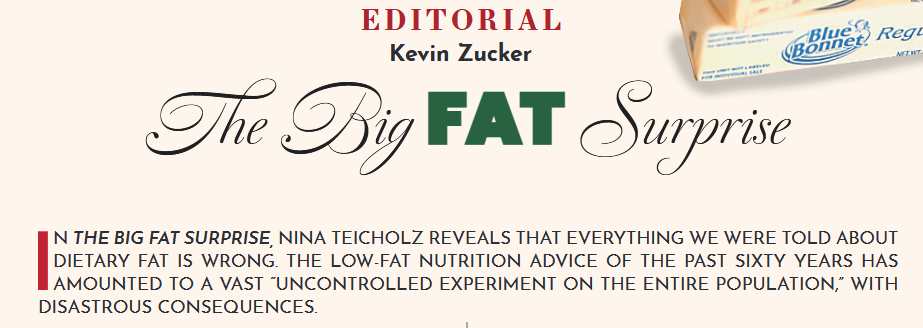
Kevin Zucker on “The Big Fat Surprise”

Filed under: Media, Politics, USA — Tags: , , , , , — Nicholas @ 03:00

I just got the most recent free Wargame Design PDF from Operational Studies Group and found that Kevin Zucker, the head of the company and one of the best wargame designers ever, had indulged in a little bit of non-wargame writing to open this issue:

For decades, Teicholz tells us,

    … we have been told that the best possible diet involves cutting back on fat, especially saturated fat, and that if we are not getting healthier or thinner it must be because we are not trying hard enough. But what if the low-fat diet is itself the problem? What if the creamy cheeses, the sizzling steaks are themselves the key to reversing the epidemics of obesity, diabetes, and heart disease? Misinformation about saturated fats took hold in the scientific community, but recent findings have overturned these beliefs. Nutrition science has gotten it wrong, through a combination of ego, bias, and premature consensus, allowing specious conclusions to become dietary dogma.1

We are conditioned to think that some specialist always knows better than we do. Despite the common wisdom, I always ate butter, not margarine, despite the “experts”, because I trusted my instincts.2 With experts influencing you to disregard your senses and what you already know, you can learn to believe the opposite of what is natural and true … “Boys and girls are the same”; “men and women are the same”. The French structuralists, who have somehow taken over academia, talk as if the whole world is merely a verbal construct, and whatever we speak becomes literally true if repeated enough.3

In the 1960’s and ’70’s, males joined the feminine on a quest for identity through music, love and drugs. I too was taken-in by the “men and women are the same” argument, and fancied myself a feminist. For me, that illusion was eventually shattered upon contact with reality. Today, instead of liberation, in many quarters the feminine principle is actively denied and suppressed; to prove a point, many women have short-circuited their feminine side, while masculinity is reviled as toxic. So now we have feminized men and masculine women, and neither side is happy. Seventy percent of divorces are initiated by women.

During the recent campaign, women’s anger was used to divide the sexes. A wife filed for divorce in November because her spouse voted for the wrong candidate. Supporters of the two sides cannot even be in the same house, much less discuss their differences rationally. After all, someone might get “triggered”, a brand-new coinage that promotes a fatal lack of reflection. The media have abandoned the fig leaf of nuance and balance and have hit their stride in stirring up fear and polarizing hatred.

The main tool of the demagogue is to stir up one group against another: divide and conquer. How does a society remove the influence of demagogues? History shows that once democracy is destroyed, it doesn’t just grow back. Undemocratic methods, such as censorship, brainwashing, propaganda, and the stifling of dissent, cannot “protect” democracy — just the opposite. A government is only an instrumentality of power, and it is only as democratic as its administrative cogwheels. Power is either administered democratically or it is usurped by a strong man, by the administrative state, or by oligarchs such as the World Economic Forum (who meet regularly in Davos, Switzerland). So that is the choice we face at the moment. Ten years ago, a study by professors Martin Gilens and Benjamin Page found America to be no longer a democracy, but a functional oligarchy. Aside from the eternal vices of greed and projection, we urgently need a strong repudiation of the folly of structuralism. This conversation should be taking place in academia, whose original purpose was to foster such discussions, but academia has now become the stronghold of “safe spaces” where open dialogue cannot be held.

The main reason for studying history, in my view, is to understand the present moment: Where are we, where did we come from, how did we get here, where are we going?4

Today, I am hopeful, for the first time since January 2009. In a chat with my good friend John Prados, I remarked, “Surely, like the proverbial stopped clock, by sheer accident, Trump might be correct about a few things”.

“No, Kevin, everything he says is a calculated lie,” reducing politics to a cartoonish level. We are, after all, the first generation raised on cartoons, where good and evil are simplistically segregated into representative types. Donald Trump has been cast as “Bluto”. The President has certainly brought grist for the mill by his tweet of 15 February, echoing Napoleon: “He who saves his country does not violate any law”.5 We might not have Trump in office today if his first campaign hadn’t been assisted by the Clinton machine in 2016. He was the candidate they wanted to run against, so they promoted his tweets and made a star out of him — just to help him in the primaries. Unfortunately, they created a monster.

It is obvious that the two candidates in the recent election are not the best our country has to offer. This reveals the absolute corruption of the political system. It has been obvious for some time that most of our institutions are vastly corrupt, with disastrous consequences for all of us. As a historian it is not my job to take sides or make predictions about the future. In my view, no one can predict the future: neither of the stock market, nor even tomorrow’s weather. A historian has to be concerned with facts, known, established and well-documented, not gloomy prognostications. Many pundits make their gravy by spouting dire predictions, but there is no one to hold them to account if they are inaccurate or flat-out lies. The voices of hysteria are still tooting like they hadn’t been repudiated at the ballot box.

I was asked recently, which sources of information I trust. I don’t trust any of them. I agree with Suzanne Massie, a scholar of Russian history: “Trust, but verify”. With historical research, a single source is insufficient, especially on controversial issues. As you dig deeper, you find a more three-dimensional view that often lays bare the simplistic assumptions of your primary source.

I cannot claim to have any particular insight into the first five weeks of the Trump Administration, but I look forward to seeing how it all turns out.


    1. The Big Fat Surprise: Why Butter, Meat and Cheese Belong in a Healthy Diet, Simon & Schuster, 2014. Nina Teicholz

    2. Margarine can also affect the nervous system and lead to depression and mental illness.

    3. https://humanidades.com/en/structuralism/

    4. D’où Venons Nous, Que Sommes Nous, Où Allons Nous — Paul Gauguin

    5. Celui qui sauve sa patrie ne viole aucune loi—Maximes et pensées de Napoléon by Honoré de Balzac (1838), a compilation of aphorisms attributed to the emperor.


February 24, 2025

Dawn of the Atomic Age – W2W 007

TimeGhost History
Published 23 Feb 2025

In 1946, the world’s fate is rewritten in fire. The first peacetime nuclear tests shake the Pacific, while Stalin accelerates the Soviet push for the bomb. With the power to destroy the entire world now a reality, global leaders face a defining choice — will the bomb usher in the peace of our time, or lead to nuclear doom? The arms race has begun, and there’s no turning back.
(more…)

February 15, 2025

QotD: The absurdly high early expectations for genetic research

Filed under: Health, Media, Quotations, Science — Tags: , , , — Nicholas @ 01:00

For decades, people talked about “the gene for height”, “the gene for intelligence”, etc. Was the gene for intelligence on chromosome 6? Was it on the X chromosome? What happens if your baby doesn’t have the gene for intelligence? Can they still succeed?

Meanwhile, the responsible experts were saying traits might be determined by a two-digit number of genes. Human Genome Project leader Francis Collins estimated that there were “about twelve genes” for diabetes, and “all of them will be discovered in the next two years”. Quanta Magazine reminds us of a 1999 study which claimed that “perhaps more than fifteen genes” might contribute to autism. By the early 2000s, the American Psychological Association was a little more cautious, was saying intelligence might be linked to “dozens – if not hundreds” of genes.

The most recent estimate for how many genes are involved in complex traits like height or intelligence is approximately “all of them” – by the latest count, about twenty thousand. From this side of the veil, it all seems so obvious. It’s hard to remember back a mere twenty or thirty years ago, when people earnestly awaited “the gene for depression”. It’s hard to remember the studies powered to find genes that increased height by an inch or two. It’s hard to remember all the crappy p-hacked results that okay, we found the gene for extraversion, here it is! It’s hard to remember all the editorials in The Guardian about how since nobody had found the gene for IQ yet, genes don’t matter, science is fake, and Galileo was a witch.

And even remembering those times, they seem incomprehensible. Like, really? Only a few visionaries considered the hypothesis that the most complex and subtle of human traits might depend on more than one protein? Only the boldest revolutionaries dared to ask whether maybe cystic fibrosis was not the best model for the entirety of human experience?

Scott Alexander, “The Omnigenic Model As Metaphor For Life”, Slate Star Codex, 2018-09-13.

January 18, 2025

Incentives matter even to “objective” scientists

Filed under: Cancon, Government, Health, Politics, Wine — Tags: , , , , — Nicholas @ 03:00

A 2019 Canadian “study” ideally illustrates that scientists are just as human as anyone else where they are incentivized to provide “desired” outcomes:

“The Beer Store” by Like_the_Grand_Canyon is licensed under CC BY-NC 2.0

Earlier this year, a major Canadian study on alcohol policy provided an excellent illustration of this. As news headlines across the country reported, 16 scientists and researchers at various universities and institutions had, through their Canadian Alcohol Policy Evaluation, shown that provincial governments are “failing to address alcohol problems”.

The scientists evaluated provincial government policies and assigned a grade in the “D” range to seven of Canada’s 13 provinces or territories, while five received an “F”. The policy evaluation, however, was a curious one. Strangely, the policy evaluation did not evaluate whether government policies were beneficial to those who want to buy or sell alcohol.

Instead, provincial governments were evaluated more favorably if they devoted greater efforts toward afflicting buyers and sellers of alcohol through punitive taxes, price controls, heavy restrictions on the sale and marketing of alcoholic beverages, higher minimum legal drinking ages, and so on.

Even in the most restrictive markets, the researchers found that alcohol was too cheap, or that its purchase was too convenient, or that governments did not do enough to discourage or restrict its sale and consumption.

Predictably, and perhaps exemplifying Berlinski’s point on scientists grasping for government funds, the report authored by 16 scientists whose livelihoods involve raising public alarm about alcohol consumption concluded that there ought to be more government funding for public education on the dangers of alcohol consumption.

The report also advocated more government funding for bureaucracies to discourage drinking, more government funding for a lead organization to implement restrictive alcohol policies, more government funding for independent monitoring of such implementation, and more government funding to track and report the harm caused by alcohol consumption.

Like the CEO of a domestic automobile company insisting that tariffs against car imports — which would cause a massive wealth redistribution from consumers’ wallets into his own and those of the company’s shareholders — are in the national interest, the anti-drinking scientists insisted in the name of public health and wellness upon income redistribution from taxpayers and consumers to their own industry.

November 29, 2024

Dr. Jay Bhattacharya nominated as Director of the US National Institutes of Health

From the point of view of the establishment, the barbarians are well and truly inside the gates, as President-elect Donald Trump has nominated Stanford epidemiologist Dr. Jay Bhattacharya as the next director of the National Institutes of Health:

Dr. Jay Bhattacharya, Donald Trump’s nominee as Director of the National Health Institutes.
Photo by Taleed Brown, 2020, via Wikimedia Commons.

Four years ago, Jay Bhattacharya was ostracized by his colleagues at Stanford and censored on social media platforms thanks to a campaign against him by the public-health establishment. The director of the National Institutes of Health, Francis Collins, sent an email to another NIH official, Anthony Fauci, urging a “quick and devastating published takedown” of Bhattacharya and his fellow “fringe epidemiologists”.

Bhattacharya is far from the fringe today. Donald Trump nominated him this week for Collins’s old job, director of the NIH. Assuming the Senate confirms him, it will be a major victory for science and academic freedom — and a serious threat to the universities that suppressed scientific debate and promoted disastrous policies during the pandemic, causing public trust in science to plummet. Academic researchers and administrators have mostly refused to acknowledge their mistakes, much less make amends, but Bhattacharya promised yesterday to “reform American scientific institutions so that they are worthy of trust again”.

As NIH director, he would wield a potent tool to induce reform: money. Stanford and more than a dozen other universities each get more than $500 million annually in grants from the NIH, the world’s largest funder of biomedical research. The NIH grants support not only researchers but also their universities’ bureaucracies, which collect a hefty surcharge to cover supposed overhead costs. The federal largesse has helped finance the administrative bloat at universities, including the expansion of diversity, equity, and inclusion bureaucracies under the Biden administration, which took into account a university’s commitment to DEI principles when deciding whether to award grants from the NIH and other agencies.

Those priorities are about to change. Trump has vowed to rescind immediately Biden’s executive order directing federal agencies to promote DEI. During his first term, Trump threatened to issue an executive order barring universities from receiving federal funds if they suppressed free speech. He didn’t issue that order, but whether or not he does so in his next term, the NIH director will already have the power to consider a university’s commitment to academic freedom in deciding whether or not to award funds.

“For science to thrive and progress, we must be open-minded and allow vigorous and passionate debate,” says Martin Kulldorff, a former professor of medicine at Harvard. “Why should taxpayers subsidize universities that don’t allow that?” Kulldorff, an eminent epidemiologist, lost his job at Harvard after he became an early and outspoken critic of pandemic policies. In 2020, he joined with Bhattacharya and Sunetra Gupta, an epidemiologist at Oxford, to write the Great Barrington Declaration, a critique of lockdowns that was signed by tens of thousands of scientists and physicians.

Bhattacharya, who has a Ph.D. in economics as well as an M.D. from Stanford, hung on to his job as professor of health policy at the latter’s medical school, but his views were taboo on campus. After he and colleagues did a field study at the start of the pandemic showing that the Covid fatality rate was much lower than the doomsday number used to justify lockdowns, they were vilified by academics and journalists, and Stanford subjected them to a two-month inquiry by an outside legal firm. (They were vindicated by the inquiry and also by subsequent research confirming their findings.)

November 8, 2024

“The Science™, that thing we’re supposed to believe in and obey – is distinctly and increasingly political”

President-elect Donald Trump has a vast array of options to tackle in the traditional first hundred days of his administration. Chris Bray says that one of the very first of these should be the depoliticization of the federal science agencies:

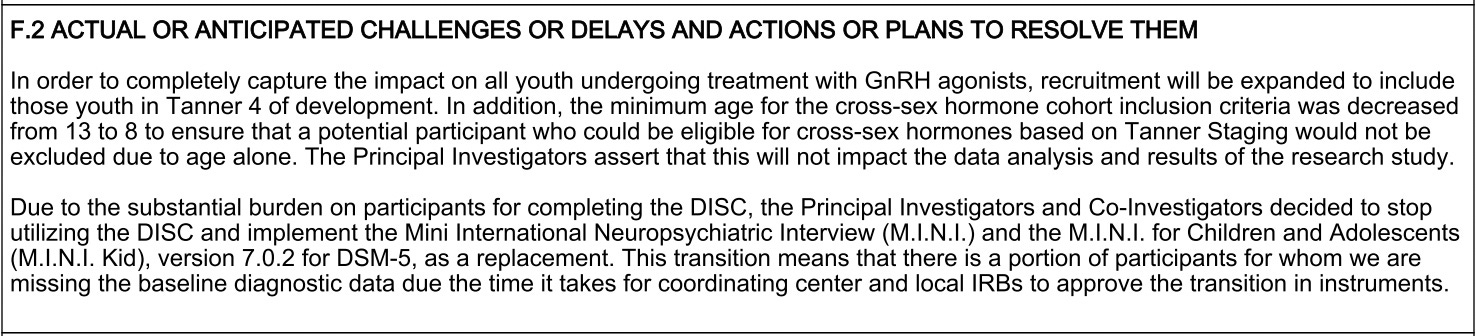
Donald Trump has spoken very clearly about his day-one determination to end the mutilation of children in the service of gender ideology, but let’s look for the roots of that poison tree. Via Billboard Chris, here’s a sample descriptive section from a National Institutes of Health grant given to a pediatric gender physician in Los Angeles, and read this carefully to find the most important sentence:

Dr. Johanna Olson-Kennedy has worked to push gender hormone treatment down to eight year-olds, with research funding from the federal government. Now, big finish: the dates on the NIH grant that Billboard Chris highlighted:

This is a project — gender hormones for eight year-olds — that operated with federal funding during the first Trump administration. Policy expressed in words meets policy expressed in cash. This is what matters, year after year, through Republican and Democratic administrations alike (click to enlarge):

The money, the money, and the money. What you fund is what you’re doing. It may not seem like a big target, but the politicization of federal science funding is a root cause of institutional decay and pathological narrative-making, and cutting the money pipeline to politicized science is the policy action that will matter for decades. Remaking the funding pipeline for federal science grants is a day one priority, because the money will shape policy far more than any declaration of intent.

The problem is everywhere: the NIH, the NSF, NASA, NOAA, and so on. SpaceX is catching rockets; NASA is funding this: “21-EEJ21-0020 ASSESSMENT OF THE GULF COAST ENVIRONMENTAL JUSTICE LANDSCAPE FOR EQUITY.”

And this: “EXPLORING SYNERGISTIC OPPORTUNITIES BETWEEN CHARLOTTE-AREA ENVIRONMENTAL JUSTICE INITIATIVES AND NASA EARTH SCIENCE INFORMATION.”

Pick a federal science grant website and spend some time exploring it. Here’s the National Science Foundation’s funding opportunities page. Sample grant program: “Growing Research Compliance Support and Service Infrastructure for Nationally Transformative Equity and Diversity”.

Today’s funded program for transformative science equity and environmental justice is tomorrow’s new policy measures. This is the pipeline to programs. What you fund today is what you’re going to do in five years.

October 13, 2024

The Soviet Union’s surplus of math nerds

Filed under: History, Russia, Science — Tags: , , , , — Nicholas @ 05:00

The most recent review from Mr. and Mrs. Psmith’s Bookshelf is John Psmith’s musings on Math from Three to Seven: The Story of a Mathematical Circle for Preschoolers by Alexander Zvonkin, and he starts by talking about something the Soviets did better than the west:

To me, one of the greatest historical puzzles is why the Cold War was even a contest. Consider it a mirror image of the Needham Question: Joseph Needham famously wondered why it was that, despite having a vastly larger population and GDP, Imperial China nevertheless lost out scientifically to the West. (I examined this question at some length in this review.) Well, with the Soviets it all went in the opposite direction: they had a smaller population, a worse starting industrial base, a lower GDP, and a vastly less efficient economic system. How, then, did they maintain military and technological parity1 with the United States for so long?

The puzzle was partly solved for me, but partly deepened, when those of us who grew up in the ‘90s and ‘00s encountered the vast wave of former Soviet émigrés that washed up in the United States after the fall of communism. Anybody who played competitive chess back then, or who participated in math competitions, knows what I’m talking about: the sinking feeling you got upon seeing that your opponent had a Russian name. These days, the same scenes are dominated by Chinese and Indian kids. But China and India have large populations — the Russians were punching way above their weight, demographically speaking. Today, those same Russians are all over Wall Street and Silicon Valley and Ivy League math departments, still overrepresented in technical fields. What explains it? Are Russians just naturally better at math and physics?

When I related these questions to an Ashkenazi-supremacist friend of mine, he immediately suggested that “maybe it’s because they’re all Jewish”. (I’ve noticed that the most philosemitic people and the most antisemitic people sometimes have curiously similar models of the world, they just disagree on whether it’s a good thing.) My friend’s question wasn’t crazy, since there are definitely times when asking “were they all Jewish?” yields an affirmative answer. But in this case I had to disappoint him with the knowledge that many of these Russian math and chess superstars were gentiles.2 What’s more, by the ’60s and ’70s the Soviets had an entire discriminatory apparatus dedicated to keeping Jews out of the scientific establishment, so it would be impressive indeed if they were the foundation of its success.

Another possible explanation actually hinges on the relative poverty of the Soviet Union. Assume there are a lot of people out there with natural mathematical talent, but who given their druthers would major in underwater basket-weaving instead. The United States, because it’s so wealthy, can afford to “waste” a huge proportion of our talented population on humanities, arts, and other stuff that doesn’t involve you sitting in the school library until 3am. In other words, not going into a technical field is a form of luxury, which America can afford to consume. The Soviets, rather like the Chinese today, were forced by their underdog status to allocate human capital more efficiently (and had the authoritarian means to do so by force if necessary). This theory is related to the curious fact that, on average, the more feminist your society, the fewer women there are in math and science — which makes total sense if you assume that on average women are good at math but uninterested in it.

The thing is, the émigré superstars I encountered didn’t seem at all grudging or resentful about their studies. If anything it was the opposite. I’ve previously complained about how much I hate Russian mathematician Edward Frenkel’s3 book, but one thing it gets across well is just how important passion is to being a great mathematician, and passion was the thing the émigrés seemed to have a surfeit of. In college, the joke was that seminars by American professors would last an hour, whereas seminars by Russian professors would turn into boisterous debates lasting all night. People have been writing for centuries about Russians having a tendency towards “maximalism” — whether aesthetic or ideological or anything else. Maybe a culture-wide commitment to not doing anything by half-measures explains it?


    1. There are scientific sub-disciplines where even at the end the Soviets had a clear lead, including several fields of math. Even crazier, there are sub-disciplines where we have not yet gotten back to where the Soviets were (for instance phage therapy).

    2. Undeterred, my friend pointed out that many modern Russian gentiles have significant Jewish ancestry. The Soviets actively promoted mixed marriages, to the point where in some cities the average urban gentile Russian is as much as 25% Jewish. I still don’t think this explains Soviet scientific prowess, but it’s an interesting data point because the most highly urbanized areas are the ones where most of the mathematicians (and most of the émigrés) came from.

    3. Before you ask, I looked it up and Frenkel is half Jewish, half gentile. I will leave it to you whether you count that as evidence for or against my friend’s theory.

August 29, 2024

QotD: The Price of Speed

Filed under: Books, Quotations — Tags: , — Nicholas @ 01:00

Recently, over lunch, Mrs. Muros regaled me with tales of authors who treat their readers to several new novels a year. As she waxed rhapsodic on the subject of the people who put the “p” in “prolific”, I scribbled notes on a credit card receipt. “Why is it”, I wrote, “that these ink-strained Atalantas can fill several pages with reasonably readable prose in the time it takes me to assemble a simple Substack post?”

The answer, I mused, might have something to do with sex. All of the authors mentioned by My Yankee Sweetheart, after all, were fully paid-up members of the distaff half of humanity. Could it be that my words fail to flow like summertime honey because my brain has been pickled in androgens? Or, to be somewhat less of a bio-Calvinist, could it be that my refusal to engage in the formal study of literature — a policy which owed much to my belief that the subject was “for girls” — left me bereft of some of the most useful tools of the writer’s trade?

Later that day, as I ransacked back issues of obscure journals in the hope of finding an uncooperative fact, a warm yellow bulb of incandescent understanding appeared above my head. ‘Twas not the writing that slowed me down, I realized, but the research. Indeed, were it not for the pesky puzzle piece I was trying to find, my article would have been done and dusted well before The Love of My Life and I sat down to our midday meal.

Before it faded, my wee epiphany bore two sprogs. The elder of these reminded me that, like other forms of mass production, the prodigious productivity of the quill-drivers in question owed much to the avoidance of novelty. That is, they were able to write so much because, in effect, they made repeated use of familiar formulae, tried-and-true tropes, and recurring turns-of-phrase. The younger of my mind-sparks added that, in addition to taking up time that an writer might otherwise spend at the keyboard, the discovery of a new fact will often lead to a quest for fresh forms of expression.

So, to quote the immortal words of David Crowther, you pays your money and you takes your choice. You can write quickly, or you can say something new, but you can’t do both.

Bruce Ivar Gudmundsson, “The Price of Speed”, Extra Muros, 2024-05-21.

August 26, 2024

The craft of the historian, then and now

Filed under: Books, History — Tags: , , — Nicholas @ 03:00

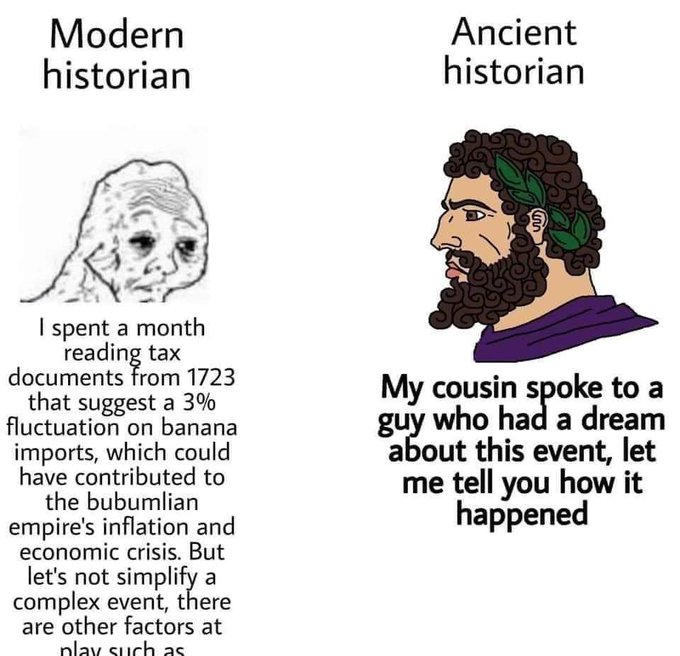
At Extra Muros, Bruce Ivar Gudmundsson contrasts the way historians used to research and write their books with the much more convenient, yet still imperfect methods of modern historians:

Another difference between ancient historians and their modern counterparts.

In days of yore, when visiting an archive required long journeys by sea, or, at the very least, a tiring trek o’er moor and mountain, considerate historians stuffed their works, with extensive excerpts from primary sources.1 Later, when trains, planes, and automobiles made it easier for people to visit the places where original documents could be found, these quotations shrank, eventually to the point where the word “citation”, which had once described the products of scholarly stenography, came to designate the label that enabled readers to locate the one-of-a-kind text in question.

No doubt, this development saved many trees from the woodman’s axe. At the same time, however, it changed the role played by historians. Rather than showcasing selections from the correspondence of old-timey movers and shakers, Clio’s children devoted most of the ink that they spilled to the explanation of texts that, despite the blessings bestowed by coal and petroleum, most readers would not be able to read.

Many a noble soul resisted the temptation to sacrifice verbatim reproduction on the altar of erudite interpretation. Realizing that readers might prefer a faithful facsimile of the real McCoy to a ponderous paraphrase, these saints of the scriptorium prepared primary sources for the press. However, rather rewarding these benefactors of the historically curious with condign praise, the denizens of the faculty lounge often dismissed them as “editors” and, in moments of especial cruelty, “antiquarians”.

In the fullness of time, the convenience provided by recent interpretations led many historians to prefer them to the relics of bygone bureaucracies. After all, reading a fresh-smelling, neatly-bound, clearly-printed, recently-written book asks less of a scholar than the deciphering of unfamiliar turns-of-phrase scribbled on the dusty, mite-bitten contents of cardboard boxes. Moreover, while the reader of a scholarly monograph often enjoys a wide choice of restaurants and coffee shops, and, at the very least, the delights of his own kitchen, the archival archaeologist must often make do with the decidedly institutional offerings of a ground-floor cafeteria.

Ostentatious reliance on recent interpretations also enables a scholar to exhibit his collegiality. “See”, the favorable footnote screams, “someone noticed your work and, marvelous to say, made use of it”. Conversely, failure to cite the work of a peer, let alone a scholar of superior standing, signals a degree of nonchalance bordering on contempt. “I am fully aware”, it says to the author of the unreferenced work, “that you poured your heart and soul, as well as a dozen years of your life, into your study, but I could not be bothered to type out its title, let alone turn a page to discover its date of publication”.

Finally, the making of new monographs out of the pieces of slightly older ones honors the founding fable of the research university, the myth of scholarly progress. The monograph still warm from the press, we presume, offers more in the way of insight and understanding than one that has been sitting on the shelf for decades. (If you wish to drive a dagger into the heart of an older academic, describe one of his earlier works, especially one that once made a splash in the kiddie-pool of his subfield, as “somewhat dated”.)2

Prejudice in favor of up-to-date interpretations creates a paradox. Historians, who exist to bring the past to life, favor interpretations created on the eve of now. The speakers for the dead (hat tip to Orson Scott Card) limit themselves to the thoughts of the living.


    1. For a brief, and delightfully documented, description of the work of the paragon of this approach to the writing of history, Angelo Fabroni (1732-1803), see Anthony Grafton The Footnote: A Curious History (Cambridge: Harvard University Press, 1997) pages 82 and 83.

    2. Ask me how I know!

« Newer PostsOlder Posts »

Powered by WordPress