
I truly believe that Tim Pool is absolutely right about where the political poisoning of our National culture comes from.
Shows like Saturday Night Live, the Daily Show, late night television …
They take the news, spin it through a comedy filter, and present it to the masses. This presents an easily digestible, and thus easily believable, simplified and polarized view of events, that their viewers are then encouraged to apply to the news that is coming from real news sources. Anyone who objects to this is “overreacting, or doesn’t have a sense of humor” and thus is dismissed as irrelevant.
And thus the culture of lies continues, and gets ramped up as it spreads.
It’s sickening.
James Resoldier, posting to MeWe‘s “Hoyt’s Huns” group, 2022-06-16. (private group, so no public URL available)
September 18, 2022
QotD: Late night TV’s negative impact on US national culture (aka “Clown nose on, clown nose off”)
September 15, 2022
The promise of grand “green” plans versus the reality when the plans are implemented
Elizabeth Nickson on the contrast between how things like the “Green New Deal” are represented by their proponents and the media and what their actual real-world outcomes are like:

“Forest fire” by Ervins Strauhmanis is licensed under CC BY 2.0 
 .
.
Ever wonder what happens to a region once it is “preserved”? Right now, all through the US and Canada, governments are taking giant bites of land, and locking them down under the guidance of the UN’s Agenda 2030, which means a full 30% of the land and waters will be “saved”. If anyone notices, the local media preens and praises itself. Aren’t we all so wonderful and enlightened and caring, the PR says, and the newspapers copy it line-for-line.
No, it’s terrible. It is possibly the very worst thing ever. Set-aside land degrades. There aren’t enough bureaucrats in the world to take care of it. Besides out in the forest or up on the ranges is decidedly not where a civil servant wants to be. As a result none of them know what they have done. It’s a loop, politicians, stupid women and beta males, civil servants engaged in a masturbatory celebration of their goodness and triumph over commerce. From hipster neighborhoods all over North America a song of self-praise rises like smoke into the air.
Except now, right now, I sit in a smoke haze courtesy of the set aside forests in Washington State which are burning. Look, this is simple to think through. In the early 90’s Clinton ratified the spotted owl preservation plan and hundreds of millions of acres of forest were left to themselves, no cutting, no grazing, no firewood collection, no thinning, no fire breaks, no removal of dead trees, especially not beetle-killed trees. In fact, no touch.
What happens when a formerly industrial forest is left to itself? A thousand tiny trees start to grow right up against each other. They grow like carrots that haven’t been thinned. They grow so thick they can’t get light. They draw all the water from the ground, they end up like tinder. Around them brush grows — it too cannot get light or much water so it too is desiccated. It grows up the trees, trying to get at the water in the trees, and acts as a fire ladder
Boom.
Massive canopy fires, which, since they decommissioned the roads into the forest, are very very difficult to either brake or put out.
On every single environmental metric, in every single system, these people destroy the land. What they do is exactly the opposite of what they claim. They take massive amounts of tax money to “save” land and then they destroy the resource. And the towns in the resource area. And the families, and the tax base.
I could go through every environmental goal, and tear it apart. None of them use science that is provable. It can’t be duplicated, its assumptions are wrong, its statistics fiddled. Tens of thousands of papers are used to create these policies, written by the environment movement through its NGOs, funded by rich morons from old families, most of whose ancestors created environmental devastation themselves. I can refute the math and assumptions of EVERY SINGLE ONE OF THEM given a maximum of four hours and one phone call. No one challenges these studies, and these abominations then become law. Law that destroys the water and land.
“Presentism is … a disease, a contagion here in America as infectious as the Wuhan flu”
Jeff Minick on the mental attitude that animates so many progressives:
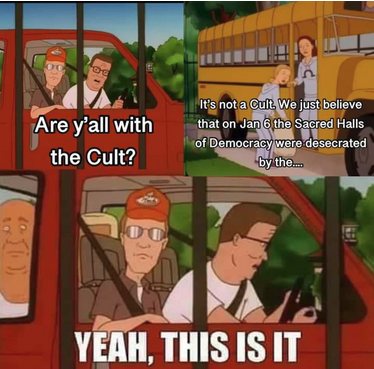
My online dictionary defines presentism as “uncritical adherence to present-day attitudes, especially the tendency to interpret past events in terms of modern values and concepts”. To my surprise, the 40-year-old dictionary on my shelf also contains this eyesore of a word and definition.
To be present, of course, is a generally considered a virtue. It can mean everything from giving ourselves to the job at hand — no one wants a surgeon dreaming of his upcoming vacation to St. Croix while he’s cracking open your chest — to consoling a grieving friend.
But presentism is altogether different. It’s a disease, a contagion here in America as infectious as the Wuhan flu. The latter spreads by way of a virus, the former through ignorance and puffed-up pride.
Presentism is what inspires the afflicted to tear down the statues of such Americans as Washington, Jefferson, and Robert E. Lee for owning slaves without ever once asking why this was so or seeking to discover what these men thought of slavery. Presentism is why the “Little House Books” and some of the early stories by Dr. Seuss are attacked or banned entirely.
Presentism is the reason so many young people can name the Kardashians but can’t tell you the importance of Abraham Lincoln or why we fought in World War II.
Presentism accounts in large measure for our Mount Everest of debt and inflation. Those overseeing our nation’s finances have refused to listen to warnings from the past, even the recent past, about the clear dangers of a government creating trillions of dollars out of the air.
Presentism has led America into overseas adventures that have invariably come to a bad end. Afghanistan, for example, has long been known as the graveyard of empires, a cemetery which includes the tombstones of British and Russian ambitions. By our refusal to heed the lessons of that history and our botched withdrawal from Kabul, we dug our own grave alongside them.
H/T to Kim du Toit for the link.
September 13, 2022
Society would be happier if we all paid even less attention to “the tossers of Tinsel Town”
Ian O’Doherty on the malign influence pretty people who mouth other people’s words for the cameras still exude in our popular culture:
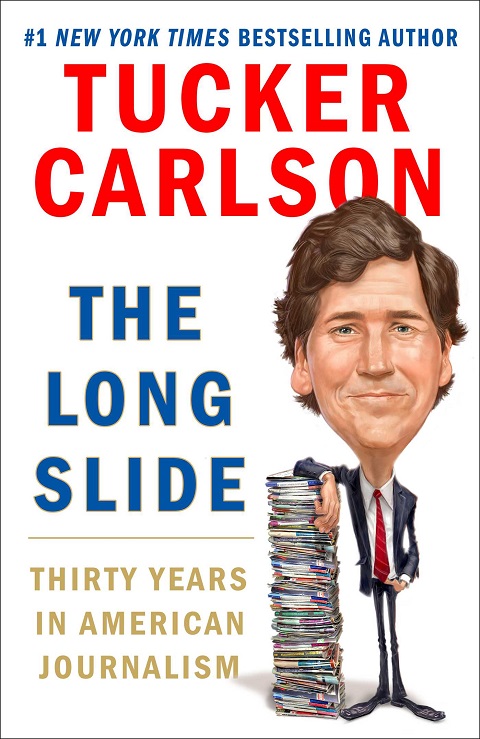
Tucker Carlson … the man from Jennifer Lawrence’s nightmares, apparently.
They never learn, do they? If the tumultuous events we have all watched with growing horror over the past few years taught us one thing, it is this – people don’t care what the pampered starlets of Hollywood have to say about politics. If we did, then Hillary Clinton would be comfortably enjoying her second term as the pantsuit POTUS, Jeremy Corbyn would be prime minister of the UK and we would all be driving electric cars.
But regular people are smarter than actors, which seems to drive the luvvies wild with fury. Rather than accepting that maybe, just maybe, there is another side to the argument, the tossers of Tinsel Town insist that anyone who doesn’t fully embrace the so-called progressive agenda is simply a monster.
We saw this recently when Jennifer Lawrence, who used to be quite refreshingly down to Earth, proudly admitted that she had to “work so hard … to forgive my dad and my family” for voting Republican. She also, quite wonderfully, spoke about having “recurring nightmares” about Fox News anchor Tucker Carlson.
In the course of her interview for the cover issue of Vogue magazine – that renowned bastion of proletarian agitation – the Hunger Games actress claimed that she was born a Kentucky Republican, was raised as a Kentucky Republican and had considered herself to be a Kentucky Republican, until she watched an episode of 30 Rock. And then her worldview completely changed.
Now most of us would agree that 30 Rock was a brilliant sitcom. After all, it was so ingenious in its construction that it even managed to make Alec Baldwin look likeable. But would anyone think that Liz Lemon’s line, “I’m not a crazy liberal – I just think people should drive hybrid cars”, would be enough to utterly transform someone’s political beliefs?
Apparently, this is what changed everything for Lawrence. She even seemed proud of the fact that a throwaway line in a sitcom triggered some sort of Damascene conversion to what is now so tediously known as “the right side of history”.
Predictably, following the Vogue interview, Lawrence was hailed as a modern-day Joan of Arc – for refusing to be “passive about politics”. But there is no real bravery involved in simply having the courage of other people’s convictions – she knows which way the political wind is blowing and is bending to it. That’s not all that brave, is it?
The Boise Pride Festival’s “Drag Kids on Stage”
I’m not sure I could accurately place Boise on a map, but the city’s relative obscurity doesn’t mean it can’t have a really progressive LGBT scene, including a special “Drag Kids” event planned for their Pride Festival:
Remember that California has just passed a new law, SB 1100, to protect local legislative bodies against “bullying” from people who do hateful things like disagreeing with them, and that the recent failure of another (spectacularly offensive) bill in the state legislature was the product of “harassment”, by which the author of the bill meant that the peasantry forcefully and persistently criticized it. And you should definitely read this two–part essay from Bat Cattitude on the technocratic presumption that disagreement with technocrats can only be dangerous extremism.
With that background in mind, consider a modest victory in the most dismal battlefield of the culture war, and then watch the response to it.
This one happens in Boise, a purple town in a red state. This year’s Boise Pride Festival was all set to feature an event called Drag Kids:
“Now it is time to see the kids”, sexy eleven year-olds shaking that dirty little moneymaker on the stage. So hot. So empowering!
[…]
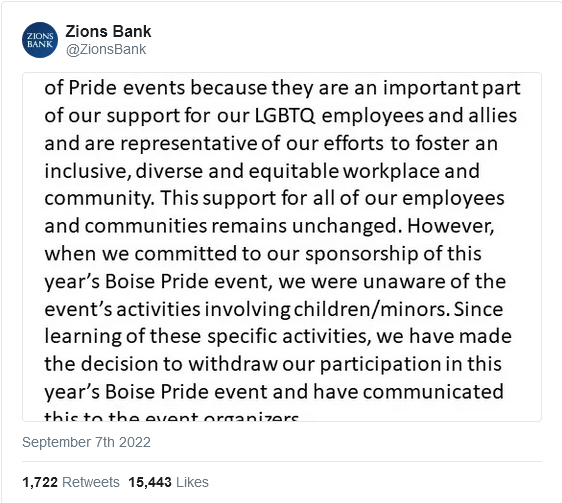
Now, the Big Pivot: Boise Pride pays its bills by soliciting the support of corporate sponsors, so a bunch of corporations suddenly found themselves sponsoring the sexuality-incorporating performances of some hot little eleven year-olds. They quickly began to jump clear of the thing:
Because bigotry still prevails in Amerikkka, see, corporations aren’t brave enough to stand up and support the sexy eleven year-olds in their extremely hot sexiness. Atavists! Prudes!
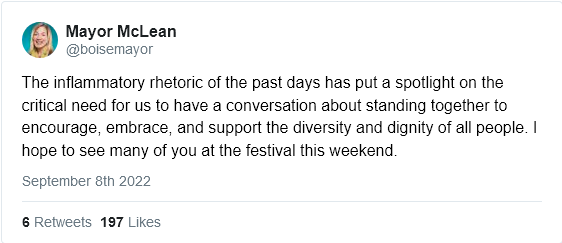
Now, here come the politicians. The mayor of Boise, Lauren McLean, is Very Disappointed In You All™:
Slogan slogan slogan, slogan slogan, slogan slogan slogan. A spotlight on the critical need for a conversation about standing together!
If you challenged Mayor NPC to publicly identify specific pieces of inflammatory rhetoric that were important and central to the controversy, she couldn’t; she just knows that the “inflammatory rhetoric” box has to be checked, because Mean Republicans objected to something involving an LGBT event, specifics not important. Nor could she explain how sexy children represent the dignity of all people, or respond coherently to a discussion about sexual commodification and the erasure of childhood. She has a list of slogans. She deploys them.

September 10, 2022
Magical Monetary Theory (MMT) – You’re soaking in it
At the Foundation for Economic Education, Kellen McGovern Jones outlines the rapid rise of MMT as “the answer to everyone’s problems” in the last few years and all the predictable problems it has sown in its wake:

“Inflation & Gold” by Paolo Camera is licensed under CC BY 2.0 .
Modern Monetary Theory (MMT) was the “Mumble Rap” of politics and economics in the late 2010s. The theory was incoherent, unsubstantial, and — before the pandemic, you could not avoid it if you wanted to.
People across the country celebrated MMT. Alexandria Ocasio-Cortez, the Democrat Congresswoman from New York heralded MMT by proclaiming it “absolutely [must be] … a larger part of our conversation [on government spending].” The New York Times and other old-guard news sources authored countless articles raising the profile of MMT, while universities scrambled to hold guest lectures with prominent MMT economists like Dr. L. Randall Wray. Senator Bernie Sanders went as far as to hire MMT economists to his economic advisory team.
The most fundamental principle of MMT is that our government does not have to watch its wallet like everyday Joes. MMT contends that the government can spend as much as it wants on various projects because it can always print more money to pay for its agenda.
Soon after MMT became fashionable in the media, the once dissident economic theory leapt from being the obscure fascination of tweedy professors smoking pipes in universities to the seemingly deliberate policy of the United States government. When the Pandemic Hit, many argued that MMT was the solution to the pandemics problems. Books like The Deficit Myth by Dr. Stephanie Kelton became New York Times bestsellers, and the United States embarked on a massive spending spree without raising taxes or interest rates.
Attempting to stop the spread of Covid, state and federal governments coordinated to shut down nearly every business in the United States. Then, following the model of MMT, the federal government decided to spend, and spend, and spend, to combat the shutdown it had just imposed. Both Republican and Democrat-controlled administrations and congresses enacted trillions of dollars in Covid spending.
It is not hard to see that this spray and pray mentality of shooting bundles of cash into the economy and hoping it does not have any negative consequences was ripe for massive inflation from the beginning. Despite what MMT proponents may want you to believe, there is no way to abolish the laws of supply and demand. When there is a lot of something, it is less valuable. Massively increasing the supply of money in the economy will decrease the value of said money.
MMT economists seemed woefully unaware of this reality prior to the pandemic. Lecturing at Stoney Brook University, Kelton attempted to soothe worries about inflation by explaining that (in the modern economy) the government simply instructs banks to increase the number of dollars in someone’s bank account rather than physically printing the US Dollar and putting it into circulation. Somehow — through means that were never entirely clear — this fact was supposed to make people feel better.
In reality, there is no difference between changing the number in someone’s bank account or printing money. In both cases, the result is the same, the supply of money has increased. Evidence of MMTs inflationary effects are now everywhere.
September 9, 2022
“Far from fighting against the establishment, the woke are the establishment”
In Spiked, Andrew Doyle discusses the reactions to his announcement that he was writing a book about the ongoing culture wars:

“Titania McGrath” and Andrew Doyle
My new book is about intolerance. I am fascinated by those who prefer only to associate with people who share their own identical worldview, and who interpret the slightest point of political disagreement as evidence of evil. The new religion of group identity and “social justice” has driven once rational people into a state of frenzied bigotry. I want to understand why.
So, back in May, when I announced I was working on a book called The New Puritans, I wasn’t all that surprised to see so many self-proclaimed advocates of “social justice” rush to demonstrate the very phenomenon that I was attempting to explore. Some suggested that they would acquire copies only to burn them. One said that he intended to kick it under the bookshop shelf “so that it could rot in darkness”. Another simply declared that I was “pure scum”. Were any of these people aware that they were proving my point?
Byline Times even claimed that I was waging “a perpetual battle against social justice – fighting against a contrived present world of aggressive ‘woke snowflakes’ in order to return to an imagined past”. This was news to me, given that my book is a defence of progressive and liberal values, and it explicitly criticises those who resort to the “snowflake” slur. I particularly enjoyed the suggestion that my book was an example of someone imagining enemies into existence in order to fight them. It takes some chutzpah to make such a claim of a book you haven’t actually read.
It would seem that the title alone – The New Puritans: How the Religion of Social Justice Captured the Western World – was enough to stir the ire of these culture warriors. In a sense, this is unsurprising. One of the key aspects of this ideological movement is that its adherents treat all challenges as a form of heresy that must be quashed. For all that they like to smear their detractors as “bigots”, they forget that the main definition of the word – “a person who is utterly intolerant of any differing creed, belief or opinion” – applies most accurately to themselves.
Why is it, for instance, that JK Rowling can be so routinely monstered as “hateful” and “transphobic” despite having never said anything hateful or transphobic? Only this week, the Harry Potter author found herself in an exasperating Twitter exchange with someone claiming she had been “outwardly hateful of an entire community”. Rowling quite rightly asked for evidence, to which her detractor replied: “I don’t know where you said it, but I bet you do.” For those taking part in the witch-hunt, the total lack of evidence is simply an inconvenience to be brushed aside.
This is why my book draws comparisons between the hysteria of the “woke” movement and the witch hunts of Salem in the late 17th century. In a burst of collective madness that lasted a little over a year (from February 1692 to May 1693), 20 people were executed for witchcraft on the basis of the testimony of local girls. All of the prosecutions were secured on the basis of “spectral evidence” – what today we might call “lived experience”. The girls simply declared that they had seen these innocent people sign the devil’s book, or that they had been “sending out their spirits” to torment people. This was their “truth”, and so it had to be believed.
September 8, 2022
Surprise! Liz Truss can successfully locate Canada on a map!
In UnHerd, Marshall Auerback details some of the Canadian connections of Britain’s new PM:

British Prime Minister Liz Truss, 1 May 2022.
Official portrait via Wikimedia Commons.
Faced with soaring costs of living, increased collateral damage from the war in Ukraine, and widening national inequality, Liz Truss seemed curiously optimistic in her first speech as Prime Minister. What could possibly be driving such bullishness? Absent any sign of a coherent plan of action, we might find her motivation in an Instagram post from 2018, where Truss cited the time she spent in Canada as a teenager as “the year that changed my outlook on life … #pioneercounty #optimism #maplespirit”.
As profound an impact as that year might have had on Truss’s optimistic psyche, she would do well to look more closely at Canada’s faltering “success story” in recent years. Today, the country is no longer the land of milk and honey (even if it does still produce a fair amount of maple syrup), but suffers many of the same problems as the UK, and a number that are significantly worse: rising inflation, profound income inequality, the challenges posed by climate change, and an increasing host of social problems — not least the mass stabbing spree last weekend in Saskatchewan that left 10 people dead.
However, to the extent that the Trudeau Administration has attempted to remedy some of these problems, there are clear lessons for Truss. Unlike in the UK, many of Canada’s energy problems are largely self-inflicted, a result of a progressive government ignoring its comparatively resource-rich environment, even as its European allies (including the UK) suffer severe consequences of being cut off from Russian gas supplies and the corresponding rise in energy prices.
A few weeks ago, German Chancellor Olaf Scholz visited Canada to secure more gas for his country. This being Canada, the German Chancellor was treated politely, but the underlying plea for Ottawa to increase liquefied natural gas (LNG) production to offset the loss of Russian gas was given short shrift. The Canadian government, one of the biggest producers of natural gas in the world, has misgivings about whether becoming an even bigger producer and exporter would actually be profitable.
Leaving aside the broader debate as to whether the dangers of man-made climate change have been confounded with natural weather and climate variability, natural gas, although a fossil fuel, emits roughly half the amount of carbon dioxide when combusted in a new, efficient natural gas power plant. This would suggest that Canada’s absolutist stance is not only a major geopolitical mistake, but also an economic own goal. The country is foregoing a major growth opportunity, which would both alleviate global inflationary pressures by increasing the supply of natural gas to the global markets, while simultaneously enhancing the prospect for a plethora of new high-paying jobs that would buttress Canada’s declining middle class.
Canada is also home to substantial supplies of copper, nickel, lithium, and cobalt — all of which will be essential to producing the infrastructure required to transition from fossil fuels to greener sources of energy, such as wind and solar. But mining itself remains a “brown” industry, one that creates substantial carbon emissions and environmental degradation. It seems conceivable, then, that the Trudeau government’s green energy purity could soon discourage the increased mining activity needed to facilitate this energy transition.
[…]
Yet in many respects, Canada’s problems are more easily resolved, given that so many are self-inflicted. And not only are there ample natural resources to offset the current energy crisis, but also broad institutional mechanisms to alleviate regional inequalities. Canada, then, cannot provide all the solutions that Truss needs. For all her boosterism, Britain remains a country fatigued by her party’s ongoing political churn and the non-stop travails still emanating from Brexit. If she is to succeed, Truss must begin by removing her rose-tinted view of Canada. The Great White North can certainly serve as an inspiration — but that is all. Canada may have changed Truss’s “outlook on life”. But if Britain is to “ride out the storm”, as she suggested yesterday, an entirely new approach is needed.
September 6, 2022
Fixing the American education system (other than burning it to the ground and starting over)
At First Things, M.D. Aeschliman reviews The Knowledge Gap: The Hidden Cause of America’s Broken Education System — and How to Fix It by Natalie Wexler:
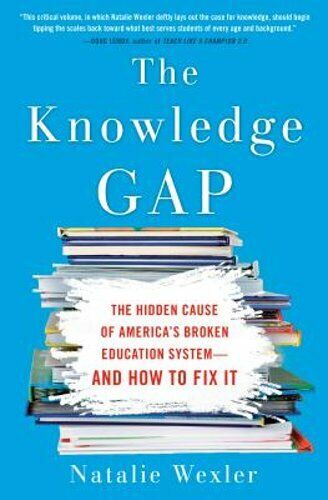
E.D. Hirsch Jr., distinguished scholar of comparative literature, is the most important advocate for K–12 education reform of the past seventy-five years. Natalie Wexler’s recent book The Knowledge Gap is a helpful examination of Hirsch’s critical analyses and intellectual framework, as well as the elementary school curriculum that he designed — Core Knowledge.
One of Hirsch’s key focal points is the vapid, supposedly “developmentally appropriate” fictions that dominate language arts curricula in elementary schools — mind-numbingly banal stories with single-syllable vocabularies and large pictures. These silly literary fictions and fantasies have helped “dumb down” a hundred years of American students by eliminating or forbidding any substantial reading of expository prose about history and science in the first eight grades. A poignant narrative well worth reading is Harold Henderson’s Let’s Kill Dick and Jane, which details a noble but ultimately losing fight waged by a family firm from 1962 to 1996 against the big textbook publishers.
After a teaching career of fifty years, I agree with Hirsch that the primary problem in American public education is not the high schools, but the poorly organized, ineffective elementary school curricula, including the idiotic books of childish fiction. As Wexler writes, the governing “approach to reading instruction … leaves … many students unprepared to tackle high-school-level work”. Pity the poor high school teachers.
A hundred years ago John Dewey and his lieutenants from Columbia Teachers College, especially William H. Kilpatrick, started dismantling academic “subjects” in favor of “the project method”. They also worked to redefine history as “social studies”, a degenerative development that has continued without cease in our K–12 schools, leading to ludicrous presentism. Dewey and the progressives also attacked traditional language classes — especially phonics but also Latin — opening the way for “naturalistic” literacy instruction that has proved to be ineffective. Yet it should be obvious that students must “learn to read” well early on so as to “read to learn” for high school and college and the rest of their lives. And what they read early on is important.
The “progressive” educational assault on traditional American education had another source, which might be called “soft utopianism”. Twenty-five years ago Hirsch was already writing powerfully — in The Schools We Need and Why We Don’t Have Them — about this romantic-progressive “soft utopianism” and how it conflicted with what is wisest and best in the thinking, writings, and achievements of the founding fathers and their early republic. Yet he also knew — as himself a repentant progressive “mugged by reality” — that in the nineteenth century the republican educational legacy was already under intellectual assault by Rousseau’s American disciples Emerson, Thoreau, and Walt Whitman. Whitman’s egalitarian naturalism was one of Dewey’s greatest inspirations by the early twentieth century.
The progressives particularly dislike history, and our current “Great Awakening” indicates this. A few years ago, the former superintendent of the school system of one of our most “liberal” states said to me in private conversation that “the progressives hate history and won’t tolerate it in the curriculum”. They hate it because any thinking about history requires ethical assumptions and qualitative judgments: What in the past is worth studying? How do we structure our narratives? How do we fairly evaluate historical personalities and events? Which ones were virtuous and beneficial? These and related questions require some standard of justice and the idea that most individuals — in the past and present — have some degree of free will and some disposition to ethics: the “self-evident truths” of our founding document, and of civilization itself.
September 2, 2022
US Navy to get its very own Zampolit cadre
CDR Salamander reports on the latest politically correct doings at the US Naval Academy, which he points out always filter down to the active duty fleet, both good and bad … and I don’t think he considers this particular initiative to be a good one:

The quasi-woke religion as promoted by the CNO provided all the supporting fires they needed and the commissariat decided to make hay while the sun shines.
You know the drill.
Do you want Political Officers, USNA’s own Zampolit? You’ll get them.
Want blue and gold Red Guards? You’re going to have them.
You want red in tooth and claw racism, quotas, and different standards based on self-identified racial groups? You’re going to have more of it.
First let’s pull some nice bits from the governing document; COMDTMIDNINST 1500.5, the “Diversity Education Program” from February of this year. You can read it at the link, or below the pull quotes;
BEHOLD!
1. Purpose. To provide guidance and designate responsibilities for implementation of the Diversity Peer Educator (DPE) Program.
…
b. DPEs support moral development at USNA by facilitating small group conversations that educate and inform midshipmen, faculty, and staff and foster a culture of inclusion across the Yard, resulting in cohesive teams ready to exert maximal performance and win the Naval service’s battles.
I’m not sure you could get more Orwellian … but they’re going to try;
4. Responsibilities
a. USNA Chief Diversity Officer. The Chief Diversity Officer is the final approving authority for all matters pertaining to the DPE Program and will ensure the program is in line with Department of the Navy and Superintendent’s guidance in reference (a).
a. DPE Program Manager. The program manager for DPE is an active-duty officer appointed by the Chief Diversity Officer. Faculty/staff from the Stockdale Center for Ethical Leadership, the Naval Academy Athletic Association (NAAA), or other cost-centers on the Yard will aid the program manager.
Yes, the football booster organization will “help” the Zampolits. Huh. You see that, yes? Pull that thread …
c. Brigade Dignity and Respect Officer. Reference (c) delineates the roles and responsibilities of the Brigade Dignity and Respect Officer (BDRO) who is accountable for the training, development, and qualification of the DPEs. However, the DPEs are organized and managed by the Midshipman DPE Lead.
d. Midshipmen DPE Lead. A midshipman selected annually by the DPE Program Manager and confirmed by the USNA Chief Diversity Officer. The Midshipmen DPE Lead is typically a First Class Midshipman. Responsibilities include:
(1) Work with the DPE Program Manager to ensure the mission of the program is met.
(2) Provide feedback and keep the DPE Program Manager informed regarding anything that may impact the DPE program.
(3) Serve as the senior DPE, and as the program representative to the BDRO.
(4) Lead and provide guidance to the DPE Midshipmen.
(5) Appoint and manage DPE leads in each battalion, company, varsity athletic team and club sport team.I’ll let you do the math on how many bodies “each” means. That is a lot of Zampolits. I guess MIDN have a lot of extra time.
Again, I want you to ponder the opportunity cost of this across USNA and how it relates to professional development.
August 30, 2022
QotD: The secret language of tattoos
We normal folks have the same problem when confronted with Leftists. Just to stick with a theme, consider tattoos. A quick googling suggests that something like 20% of Americans ages 18 and older have at least one tattoo. This Federalist piece doesn’t cite its source, but the claim that 40% (!!!) of those aged 18-29 are tatted up sure feels right — anecdotes aren’t data, of course, but I taught college for years; I’ve got lots of anecdotes. Kids these days are slathered in garish, gaudy ink.
Now, it’s probably safe to assume that those tats don’t mean anything criminal … but how would you know? Back when only sailors and military types had tattoos — you know, those dim dark days before about 1994 — tats had fairly obvious meanings. Globe and anchor — Semper Fi, buddy. But these days they seem entirely random. Which is the point — if you catch yourself wondering “What kind of idiot would get that permanently etched into his flesh?”, then by definition the message isn’t for you. But think about how much time, effort, and money is expended on tattoos. They mean something, I promise you.
Dealing with Liberals is like that. Every element of every tattoo is recognizable, but the meaning of the whole is utterly opaque. So it goes with Leftist language, Leftist gestures. We understand all the words that they say, and they do all the things normal people do, but not for any reason any normal person can figure out. We don’t live in their world.
Actually it’s worse than that. We think we know what they’re doing. We’ve got a cute label for it: “Virtue-signaling”. But that doesn’t go far enough. What virtue, specifically, are they signalling? Figure that out, and we might be able to find a way to break it.
I suggest that the key to understanding Leftism is: Conspicuous consumption. I think it’s the point of all those weird college-kid tattoos, too. The whole point of the exercise is to show that you have the resources — the money, tight young skin, and above all time — to undergo such a laborious process. Time is the most precious commodity of all. All the money in the world won’t buy you a single second more. Every second you spend worrying about your pronouns is a second you can’t spend doing anything productive … which is, I submit, the entire point of worrying about your pronouns. Only the young, or those stuck in permanent adolescence, can be so profligate with time.
Severian, “Skin in the Game”, Rotten Chestnuts, 2019-10-28.
August 29, 2022
QotD: Refuting the “children want to learn” notion
“Progressivism rests on the idea that children want to behave and they want to learn, the teacher needs to step back and allow the child to explore their natural curiosity, which will motivate them and keep them engaged,” Mr Bennett said.
Isn’t that fun as an assumption? Because if it were true then we wouldn’t need trained teachers in schools, would we? The brats want to learn, they will learn therefore. Actually, we don’t even need schools. Just release them into the wild somewhere near a library and they’ll get on with it themselves. [Perhaps the best known historical exponent of this theory was Jean-Jacques Rousseau, in Émile, a treatise on education.]
Ah, you say, that wouldn’t work? Then and therefore our assumption about all just wanting to learn is wrong, isn’t it?
To approach the same point alternatively. If kiddies just thirst for that knowledge to be imparted then why do we monitor truancy? If the first assertion is true then there won’t be any of the second. If we have incidence of the second – and we do indeed have a system to both monitor and try to prevent it – then the first assertion cannot be true. Not of all, all the time that is. And that’s all we need to be able to insist that a teaching method based upon its universal existence is wrong.
Not for the first time Progressivism fails when applied to actual human beings.
Jacob Rosser, “When Progressive Teaching Meets The Reality of Human Children — Not A Pretty Sight”, Continental Telegraph, 2019-05-13.
August 27, 2022
The hallmark of modern government is the institutionalization of corruption
In the New English Review, Theodore Dalrymple identifies one of the unifying trends of governments throughout the western world:

One of the most remarkable developments of recent years has been the legalization — dare I say, the institutionalization? — of corruption. This is not a matter of money passing under the table, or of bribery, though this no doubt goes on as it always has. It is far, far worse than that. Where corruption is illegal, there is at least some hope of controlling or limiting it, though of course there is no final victory over it; not, at least, until human nature changes.
The corruption of which I speak has a financial aspect, but only indirectly. It is principally moral and intellectual in nature. It is the means by which an apparatchik class and its nomenklatura of mediocrities achieve prominence and even control in society. I confess that I do not see a ready means of reversing the trend.
I happened to read the other day an article in the Times Higher Educational Supplement titled “Can army of new managers help HE [Higher Education] tackle big social challenges?” The article is subtitled “Spate of new senior roles created as universities seek answers on addressing sustainability, diversity and social responsibility.” One’s heart sinks: The old Pravda must have made for better reading than this.
As the article makes clear, though perhaps without intending to, the key to success in this brave new world of commissars, whose job is to draw a fat salary while enforcing a fatuous ideology, is mastery of a certain kind of verbiage couched in generalities that it would be too generous to call abstractions. This language nevertheless manages to convey menace. It is difficult, of course, to dissent from what is so imprecisely asserted, but one knows instinctively that any expressed reservations will be treated as a manifestation of something much worse than mere disease, something in fact akin to membership in the Ku Klux Klan.
It is obvious that the desiderata of the new class are not faith, hope, and charity, but power, salary, and pension; and of these, the greatest is the last. It is not unprecedented, of course, that the desire for personal advancement should be hidden behind a smoke screen of supposed public benefit, but rarely has it been so brazen. The human mind, however, is a complex instrument, and sometimes smoke screens remain hidden even from those who raise them. People who have been fed a mental diet of psychology, sociology, and so forth are peculiarly inapt for self-examination, and hence are especially liable to self-deception. It must be admitted, therefore, that it is perfectly possible that the apparatchik-commissar-nomenklatura class genuinely believes itself to be doing, if not God’s work exactly, at least that of progress, in the sense employed in self-congratulatory fashion by those who call themselves progressives. For it, however, there is certainly one sense in which the direction of progress has a tangible meaning: up the career ladder.
August 26, 2022
The rise of “Davos Man”
Conrad Black on the early days of the World Economic Forum’s annual Davos gatherings:

… if any place could be identified as the birthplace of the Great Reset, it must be the small, drab, German-Swiss Alpine town of Davos, a center of contemporary anticapitalism, or at least radically altered and almost deracinated capitalism, and site of an ever-expanding international conference. (It grew exponentially and has spawned regional versions.)
I attended there for many years by invitation in order to ascertain what my analogues in the media business around the world were doing. The hotels are spartan and the town is very inaccessible. When I first attended nearly forty years ago, the Davos founder, the earnest and amiable Klaus Schwab, had ingeniously roped in a number of contemporary heads of government and captains of industry and leaders in some other fields and had sold huge numbers of admissions to well-to-do courtiers and groupies from all over the world, attracted by the merits of “networking”.
Davos, and its regional outgrowths across the world, gradually came to express a collective opinion of the virtues of universal supranationalism (the Davos variety of globalism): social democracy; environmental alarmism; the desirability of having a nonpolitical international bureaucracy; a public sector-reflected image of the Davos hierarchy itself (and in fact, in many cases, preferably the very same individuals); and gently enforcing a soft Orwellian conformity on everybody. It must be said that many of the sessions were interesting, and it was a unique experience being amid so many people capable in their fields, and this certainly includes almost all of those who were revenue-producing, “networking” spectators and not really participants.
Davos is for democracy, as long as everyone votes for increased public sector authority in pursuit of green egalitarianism and the homogenization of all peoples in a conformist world. It was the unfolding default page of the European view: capitalism was to be overborne by economic redistribution; all concepts of public policy were to be divorced from any sense of nationality, history, spirituality, or spontaneity and redirected to defined goals of imposed uniformity under the escutcheon of ecological survival and the reduction of abrasive distinctions between groups of people—such obsolescent concepts as nationality or sectarianism. (My hotel concierge stared at me as if I had two heads when I inquired where the nearest Roman Catholic Church was and was even more astonished when I trod two miles through the snow there and back to receive its moral succour; the parishioners appeared a sturdy group.)
The Covid-19 pandemic caused Davos Man to break out of his Alpine closet and reveal the secret but suspected plan: the whole world is to become a giant Davos — humorless, style-less, unspontaneous, unrelievedly materialistic, as long as the accumulation and application of capital is directed by the little Alpine gnomes of Davos and their underlings and disciples. This is a slight overstatement, and Klaus Schwab would earnestly dispute that the purpose of Davos is so comprehensive, anesthetizing, and uniform. His dissent would be sincere, but unjustified: the Great Reset, a Davos expression, is massively ambitious and is largely based on the seizure and hijacking of recognizable capitalism, in fact and in theory.
There has indeed in the last thirty years been a war on capitalism conducted from the commanding heights of the academy and very broadly assisted by the Western media that has been gathering strength as part of the great comeback of the Left following their bone-crushing defeat in the Cold War. As international communism collapsed and the Soviet Union disintegrated, it was difficult to imagine that the Left could mount any sort of comeback anytime soon. We underestimated both the Left’s imperishability and its gift for improvisation, a talent that their many decades of predictable and robotic repetitiveness entirely concealed.
QotD: The WARG rating – “Wins Above Replacement Goldstein”
Obviously that ain’t gonna work in Clown World, Cthulhuvious and Sasqueetchia being notso hotso on the STEM. They’ll always need a Goldstein, then, and that’s a real problem, because whatever else Bad Orange Man is, he’s also pushing 80 years old. How long would he have, even in a sane world? 10 more years, tops? And the candidates for Replacement BOM are generally a sorry lot … but even if they weren’t, they’re about to get purged, too. The WARG is already going negative …
For overseas readers (and those not conversant with “Moneyball”: Baseball has these weird “sabermetric” stats that purport to compare players from different teams and eras in terms of absolute value. It’s acronymed (it’s a word) WAR, Wins Above Replacement; “replacement” being an absolutely average player. Like all baseball “sabermetrics” it quickly gets ridiculous, but see here. According to this guy, then, Babe Ruth has a per-season WAR of 10.48 in right field. That means Babe Ruth, himself, personally, alone, was worth 10 and a half wins above your “average” player. If Ruth goes down for the season in a tragic Spring Training beer mishap, you can go ahead and take 10 wins off the Yankees’ record that season (assuming they replace the Bambino with some scrub just off the bus, which back then is what would’ve happened).
WARG, then, is Wins Above Replacement Goldstein. I’d say that Orange Man set the bar for Goldsteins, but that’s not statistically useful, since Trump Derangement Syndrome is so far the apex of liberal lunacy. To make statistical comparisons useful — to find a “replacement Goldstein,” as it were — we have to have someone the Left considered an existential enemy at the time, but who didn’t really do much in the grand scheme of things. So I nominate George W. Bush. If Bush is the “Replacement Goldstein,” then his WARG is a nice round zero. Trump would have a Babe Ruth-ian WARG.
This gives us a convenient measurement for looking at various Republicans, both current and historical. Richard Nixon would have a pretty high WARG — he drove them even more nuts than W. did — and Ronnie Raygun would be up there, too. Gerald Ford would have a slightly negative WARG, since not even the New York Times could pretend Gerald fucking Ford was a threat to the Progressive takeover. Your steeply negative WARGs would be those “Republicans” actively working with the opposition, like Bitch McConnell.
I’d argue that Ron DeSantis and maybe Greg Abbott still have positive WARGs … for now. But they’re going to get gulaged here in pretty short order. Who’s the next guy on the bench? Your Marjorie Taylor Greenes and whatnot drive certain segments of the Left insane, but she’s just too ludicrous to have a positive WARG. And then things start getting really pathetic …
The Law of Diminishing Returns makes the WARG problem even more acute. Freakout fatigue is a real thing. The Media will give it the old college try, of course, but you really just can’t convince people that a goof like Greene is some kind of existential threat to Our Democracy. Her WARG goes negative every time she opens her mouth.
Severian, “Salon Roundup”, Founding Questions, 2022-08-20.


