Quotulatiousness

July 19, 2022

How dating apps have changed the dating world

Filed under: Health, Media, Technology, USA — Tags: , , , , , , , — Nicholas @ 03:00

Rob Henderson on the changes dating sites have accelerated in the dating community:

    In the United States, 35 percent of Tinder users are college students ages 18 to 24 … ‘I’ve heard a joke on campus that goes something like this: ‘First base is hooking up, second base is talking, third base is going on a date and fourth base is dating’. (source).

I am just old enough to remember what the dating scene was like before the rise of Tinder and other dating/hook-up apps. It has changed a lot.

2012 was another world in many ways.

The situation has changed for everyone on the dating market. Even those who don’t use these apps. This is because even for the people who don’t use the apps, they still live in an environment where others use them. Over time, those who don’t use apps must adapt to the preferences and behavior of those who use them. Not the other way around.

One example of how the scene has changed. I have a friend from college. A good-looking guy. He showed me how many women he has matched with: More than 21,000. Twenty-one thousand. Tinder actually identified him as a valuable user early on, and gave him free perks and upgrades. They lifted his radius restrictions. This allowed him to match with even more women. I have another friend. Doesn’t have the best pictures on his profile. But not a bad looking guy. Over roughly the same period of time as my other friend, he has matched with seven women.

Some findings on dating apps:

  • 18 to 25 percent of Tinder users are in a committed relationship.
  • Women aged 23 to 27 are twice as likely to swipe right (“liked”) on a man with a master’s degree compared with a bachelor’s degree.
  • Men swipe right (“liked”) on 62 percent of the women’s profiles they see; women swipe right (“liked”) on only 4.5 percent of the men’s profiles they see.
  • Half of men who use dating apps while in a committed relationship reported having sex with another person they met on a dating app. All women who used dating apps while in a committed relationship reported having sex with another person they met on a dating app.
  • 30 percent of men who use Tinder are married.
  • In terms of attractiveness, the bottom 80% of men are competing for the bottom 22% of women and the top 78% of women are competing for the top 20% of men.

One way dating apps might be changing the dating scene. People used to have to go out to meet people. And it was costly to lose a relationship partner, in part because of the process involved in meeting someone new. Today, people know that a new partner is a few swipes away. Partners might be more replaceable. If things start deteriorating with their current partner, some can pull out a goldmine in their pocket.

There may be some sexual stratification going on as well. My two friends are examples of the above finding that being slightly more attractive as a man leads to far more matches.

June 14, 2022

QotD: Generation snowflake

Filed under: Economics, Education, Politics, Quotations, USA — Tags: , , — Nicholas @ 01:00

Think of all the traits and characteristics, most of them negative, associated with the Millennials in the popular mind. They are said to be unrealistic and have both the inflated expectations of life and the inflated perceptions of selves. They think the world owes them a living – a good one too – though without necessarily too much effort. Things came very easily to them when they were growing up; when that suddenly stops – when the reality finally intrudes – they get angry, frustrated, lost: the world is deeply unfair and is conspiring against them. They are narcissistic, self-possessed and self-obsessed. They expect instant rewards and instant gratification. Having been told their whole lives how special they are, they tend to be over-sensitive and find it difficult to cope with criticism or obstacles. They’re lazy, flighty and easily distracted. Remember: these are all generalisations, but stereotypes stick because they ring true.

So no, no surprises here. Their collective personality makes the Millennials unusually suited for the flirtation with socialism. They are a great match; if this was Tinder, Marx would be getting super liked all the time.

Socialism is the response of a spoiled child when faced with the world that does not genuflect to its every wish the way their parents did – the world as it is must therefore be evil and has to be changed to something radically different. Gen Y, of course, did not just magically became the way they are – they were brought up like that, so we all bear the blame and the responsibility for a generation who resents not being managers in their 20s and not being recognised as special anymore by all their elders. Clearly, the capitalism has failed when I’m not showered down with money after I graduate from my double in media and gender studies.

Arthur Chrenkoff, “Socialism as a Millennial religion”, The Daily Chrenk, 2019-02-19.

May 1, 2022

Despite the ever-present smartphone, people are still reading actual books in pretty good numbers

Filed under: Books, Business, Media, USA — Tags: , , — Nicholas @ 05:00

In the latest SHuSH newsletter, Kenneth Whyte provides some mildly hopeful numbers for both readers and writers:

I was having coffee this week with a former star journalist who now (like so many) works in a journalist-adjacent industry. “Who reads books?” she wondered.

It’s a question I’m often asked by journalists who these days get a lot of their information from Twitter. The chore of keeping up with their feed leaves little time for anything else. My guest still read books and belongs to a book club, but she asked the question all the same.

According to the authorities at the PEW Institute, 77% of Americans read books in 2021 (or, to be more precise, read one or more books in one or more format—print, audiobook, ebook). That’s not bad considering only 86% of American adults can read.

Only 21% of women read no books, and 26% of men. Eighty per cent of white people read books (as compared to 62% of Hispanics).

Good news for the future of book reading: 81% of adults under the age of fifty read books compared to 72% of adults over the age of fifty.

More on the demographics: 69% of those earning less than $30,000 a year read books, while 85% of those earning over $75,000 read books; 61% of those with a high-school (or less) education read books; 89% of college graduates read books.

According to PEW, the average reader manages twelve a year.

There is some evidence that reading is a declining habit: according to the Bureau of Labor Statistics, average time spent reading for pleasure declined from twenty-three minutes a day to seventeen minutes a day from 2005 to 2017. But the least decline was among young adults, 18 to 34 (less than 1%).

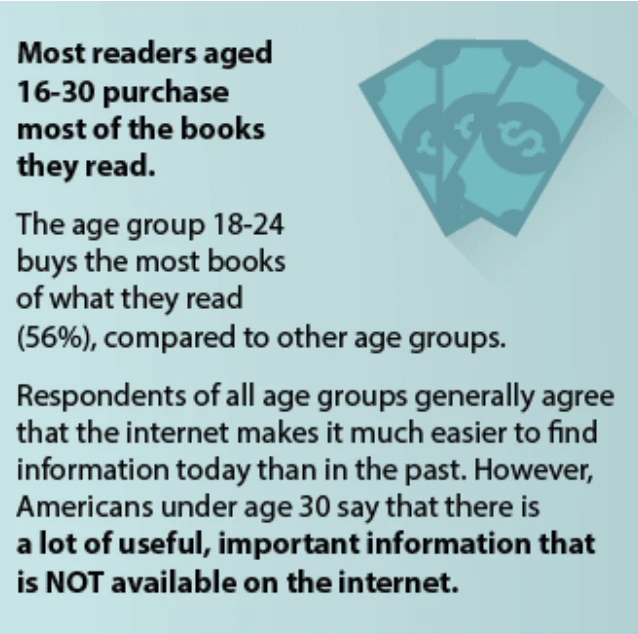
In fact, there is good evidence that the much-maligned millennials read more than their parents, and they overwhelmingly prefer hard copies to digital books. Even better, the millennials pay for their books:

April 18, 2022

Jen Gerson raises the banner of revolution against the Boomergeoisie

In the free-to-read portion of last week’s weekend post from The Line, Jen Gerson channels the anger and frustration of the Millennial sans-culottes (or should that be the sans-maisons?) who are being systematically locked out of the housing market in Canada to protect the paper investments of the Boomer generation:

“Green suburbs” by Pierre Metivier is licensed under CC BY-NC 2.0

It’s come to the attention of several of the editors at The Line that some of you Boomers are mad at us. Or, more specifically, you’re mad at co-founder Jen Gerson who popped up a particularly scathing screed about the housing market earlier this week.

To wit:

    Our Boomer got his and that’s what matters. We have an entire government apparatus set up to protect that guy. The guy with the money and the guy who votes. The rich-on-paper people are happy, and as long as everybody gets a seat somewhere on this pyramid, then everybody else should be happy too.

We will admit that Gerson didn’t intend this column to come across as an anti-Boomer harangue. She intended it as an anti-government-housing-policy-that-favours-boomers-over-young-people rant, but we can understand why some of our more mature readers took umbrage. We would say we were sorry but … we’re mostly not. A few points:

Firstly, when we talk about macroeconomics and intergenerational equity issues, we are emphatically not talking about individuals. Nobody born between the years 1946 and 1964 is personally, individually morally culpable for the state of the housing market, or the economy, or climate change or any other tragedy of the commons.

[Otherwise, we’d be adopting the tactics of the CRT movement and talking about “Boomer Fragility” and other similar kafkatraps where denial is proof of guilt.]

If you bought a $40,000 house in the ’80s, you couldn’t possibly have known that that purchase would eventually lead to a six-figure real estate portfolio by 2020: you took a risk on the economy as it existed at the time, even struggling through a rough patch of high interest rates, and that risk paid off. No Millennial would have done any differently had we been in your position.

But, let’s be honest, if you are a Canadian Boomer, you were probably born in a country that hadn’t been bombed to the ground just before an historic economic boom so grand that it allowed unprecedented investment in your health, education, development and well being.

That doesn’t mean you didn’t also work hard, and suffer setbacks, as all humans must do over the course of a lifetime. Some of you made bad decisions, and some of you were unlucky, certainly. The bell curve tolls for us all. But you did get to play the game of life during a particularly fortuitous period of history. That period is now ending and the currents of history aren’t going to be as kind to your kids as they were to you (although let’s not kid ourselves. Canadian Millennials and Zers don’t have it so bad in the greater scheme of things, either.) Recognizing this — let’s call it Boomer privilege — doesn’t cost you anything. It doesn’t hurt you. It’s not a personal attack.

What we do find fascinating is the Boomers among our readership who take discussions about intergenerational equity and demographic advantage very, very personally. Forgive us for playing pop psychologist, but it almost feels like some of you park so much of your worth as human beings into your ability to earn wealth that to have someone point out that this wealth accumulation was helped by macroeconomic factors over which you had no control — luck, essentially — seems to be read as an attack on your sense of self, purpose, and identity. (Is this why so many of you struggle to retire? Is there a frisson of guilty conscience at play?)

That is … your issue. Being lucky isn’t an indictment of your character. We assume all of our Line subscribers are genuinely good people who knit little paw mittens for orphaned cats, okay? Otherwise, why else would you be here?

August 29, 2021

QotD: “LEEEERRRROOOYYYY JEEEEENNNNKIIIIINS!”

Filed under: Gaming, Humour, Quotations — Tags: , — Nicholas @ 01:00

Would it be confessing too much to admit that one of my generation’s formative moments happened in the massively multiplayer online role-playing game World of Warcraft?

The year was 2005, and a diverse collection of mages and warriors were about to storm a mythical castle swarming with flying dragon-like creatures, particularly deadly to their guild. Like true and proper nerds, they met beforehand to discuss their strategy, and with all the detached analysis of a corporate board discussing the latest results of a focus group convened to discuss a brand refresh.

“Christ. OK. Well what we’ll do I’ll run in first, gather up all the eggs,” the leader begins. “I will use Intimidating Shout to kind of scatter them so they don’t have to fight a whole bunch of them at once. When my shout is done, I’ll need Anthony to come in and drop his shout too so we can keep them scattered.

“We’re going to need Divine Intervention on our mages … it is a pretty good plan. We should be able to pull it off this time. What do you think, Abdul? Can you do a number crunch real quick?”

The resident numbers guy responds: “Uh, yeah, give me a second. I’m coming up 32.33 — repeating, of course — percentage of survival.”

“Ah, that’s a lot better than what we usually do …”

Then one of the guild’s resident numbnuts breaks into this dull planning.

“Thumbs up. Let’s do this.

LEEEERRRROOOYYYY JEEEEENNNNKIIIIINS.”

“Oh my God, he just ran in.”

His team dutifully follows … and proceeds to get slaughtered by the dragon things.

“Goddamnit, Leeroy. You moron.”

Whether or not the scene was staged is irrelevant. The guild, “Pals for Life”, may have died in that fight, but glory lives forever. Or, at least, meme glory does. It was a perfect encapsulation of what happens when the best-laid plans come to nothing, when life goes pear shaped, when the odds are bad so, fuck it, you storm the castle anyways.

Jen Gerson, “Alberta goes Leeroy Jenkins on Summer”, The Line, 2021-05-28.

August 13, 2021

Millennial maternalism

Filed under: Media, Politics, Technology — Tags: , , , , , — Nicholas @ 03:00

In The Critic, Kittie Helmick considers the Millennial generation and their pronounced maternalistic worldview:

“Millennials” by EpicTop10.com is licensed under CC BY 2.0

The popular conception of millennials paints the generation as immature, living an extended adolescence: late to marry, late to have children, late to buy houses. Even the retort — that society hasn’t delivered on its promises; that an unfavourable job market has prevented them from living the lives expected of adults — reads as a refusal to accept responsibility.

The response to Simone Biles’s withdrawal from the Olympics demonstrates that the opposite is true. Millennials are not behaving like teenagers — they are responding like mothers. The breakdown in family life combined with quantum leaps in telecommunication technology has sent the 90s generation to their computer screens for meaningful connections. Instead of growing out of video games and chat rooms, millennials have grown with them. Online communities have not stunted young people’s growth, but absorbed it.

Millennials — now aged in their late 20s and early 30s, some with families of their own — have directed all the maternal instincts of adulthood towards online media. Rather than collect family albums, they amass Instagram and Tumblr accounts with thousands of images of their favourite characters and celebrities. Notifications act as little appeals for attention akin to the tug of a child’s hand. This otherwise unrealised yearning to nurture underpins much of the affective response to news stories about the latest victim of injustice.

There are many strands entangled in the knot of American leftism, but the maternalism of millennials manifests in the self-righteous defensiveness of Biles’s supporters and the emotional outrage they direct at anyone who criticizes the gymnast. Stripped of patriotic sentiments and religious traditions, millennials have nowhere to direct their human instincts of loyalty and affection but at the figures (fictional or fabled) who occupy so many of their hours.

The language of critical theory cloaks these sentiments in intellectual rigor, lending some dignity not only to the mouthpieces of these ideas, but also to the intended objects of their affections. Millennials don’t have to worry about infantilising Biles if they call her an “exceptional Black woman”, even while they simultaneously invoke the moral standards of a kindergarten classroom in asking, “How do we make it our responsibility to love and protect each other?”

Witness these impulses play out in the more thinly veiled account of a father who wonders if he has turned “soft” because his parental cares now eclipse his admiration of Kerri Strug’s feat during the 1996 Olympics: performing a “one-legged vault” on an injured ankle. The father implies that only a monster could cheer when a teenage girl sacrifices her health for victory. He makes no secret of the reason behind his change of heart: “Now that I have two young daughters in gymnastics, I expect their safety to be the coach’s number one priority.”

There is nothing amiss in his love for his daughters, or the extension of that concern to other children, but this father has lost sight of other principles that might compete for priority in the spotlit, split second decisions of athletes and trainers in Olympic competitions. Loyalty to something greater than oneself — to Strug’s teammates, to the country she represented — has fallen out of the picture, leaving behind only the petty incentive of winning. This perspective permits no higher motive to the coach responsible for urging Strug on, than greed for a gold medal.

Millennial parents run to the opposite extreme of the Spartan mother: instead of inculcating self-sacrifice for the good of the community, they insist, “Not my child.” They see their role as shielding children from the dangers of the outside world, rather than preparing them to face it.

November 21, 2020

Brendan O’Neill: My Beef With Millennials

Filed under: Britain, Liberty, Politics — Tags: , , , , — Nicholas @ 04:00

Independent Man
Published 13 Aug 2017

Original Video: https://www.youtube.com/watch?v=iV5Qv…

PATREON: https://www.patreon.com/independentman
IM SHOP: https://shop.spreadshirt.com/INDEPEND…
PayPal: https://www.paypal.me/IndependentMan
TWITTER: https://twitter.com/Independt_Man
MINDS https://www.minds.com/IndependentMan
VIDME: https://vid.me/independentman

July 8, 2020

Harry Potter fandom, Millennials, and the continued decline of traditional religious beliefs

Filed under: Books, Britain, Religion, USA — Tags: , , , , , , , , — Nicholas @ 05:00

In The Critic, Oliver Wiseman talks to Tara Isabella Burton about her book Strange Rites:

J.K. Rowling’s Harry Potter books have been pivotal for many Millennials in encouraging them to move away from traditional religious beliefs.

I want to start with Harry Potter, which is — perhaps surprisingly — central to the argument you make in the book, so, as an introduction to your broader thesis, what does Harry Potter have to do with America’s new religions?

It’s funny. When Harry Potter first came out in the nineties, there was a flurry American Christian voices saying “This book promotes witchcraft. There’s going to be a whole new religious movement devoted to Harry Potter books.” In the way they meant it, that was absolutely not true. But I think that there was something to it in terms of an inadvertent change to the religious landscape.

What Harry Potter did, or, more accurately, what it was the canary in the coal mine for, was a transformation, linked to the rise of at-home internet access, in how we talk about cultural properties andhow we relate to cultural properties. The transition to an internet space defined by user-generated content and what is often called participatory culture coincided with the publication of the Harry Potter books.

Between the first Harry Potter book’s release in 1997 and the fourth book’s publication in 2000 we went from 19 million Americans with internet access to more than 100 million. It’s that backdrop that really explains the shift. You did have fan cultures before. There were Star Wars conventions, for example, but there was quite a high bar to entry. You had to get on the right mailing list and it was done via post. It was quite a lot of work. You couldn’t just log on and enter a community, which is really what could happen with Harry Potter fandom.

J.K. Rowling was also one of the first major writers to openly accept and embrace fan fiction. So what you ended up seeing was something that started with Harry Potter fandom that then became an element of fandom online more broadly which in turn, I would argue, shaped millennial-and-younger culture. It was this idea that you weren’t just a reader of consumer of texts. It wasn’t just a top down hierarchical thing. Instead, mediated through the anonymity of the internet, you a kind of tribalism from talking to people in different geographical areas as well as things like fan fiction and later meme culture that meant you could change, shift, reimagine a text in your own way. And what’s so interesting about that is that sensibility — the sensibility that we have not only the right but the responsibility, the authority as consumers to also be creators, to rework ideas outside of existing texts — has spilled over into all aspects of our political life and of our religious life. And that is really something that is the product of user generated content and the internet.

To bring this to religion more specifically, 36 per cent of Americans born after 1985 are religiously unaffiliated, compared to about 23 per cent of the national average. That’s a huge generational shift in religious affiliation and organisation. That is not the same thing as saying that these are atheists or that these people are not religious. Some 72 per cent of them say they believe in some sort of higher power. About 17 per cent say they believe in the Judaeo-Christian God.

We’re in a religious or spiritual landscape that privileges mixing and matching, and unbundling — a bit of tarot here, a bit of meditation there. And a resistance to institutional and authoritative declarations in terms of how religion should be practised is very much something that has its roots in internet culture, of which Harry Potter was a forerunner.

March 19, 2020

“Millennial[s are] every bit as shallow, irresponsible, stupid, and smart-assed as” Baby Boomers

Filed under: Education, Randomness — Tags: , , — Nicholas @ 05:00

David Warren on the awful discovery that the kids not only aren’t all right, they’re just as bad as we are:

Unlike certain oldies, I have retained some awareness of the “young people.” Curiosity alone would drive me to this, although childbearing (not by me personally) has had the same effect. In my research, I have found the so-called Millennial generation to be every bit as shallow, irresponsible, stupid, and smart-assed as my own, and what is worse, younger. I thought we were the Peter-Pan generation that would never grow up, but the claim must now be shared with successive rounds of offspring. To be fair, the rewards for growing up have been sharply curtailed, through that part of history which anyone remembers, and those who never tried were never punished.

History itself has now so far receded — it certainly is not taught in schools — that by now the kids persist on pure theory. They do what seems necessary to them, in the absence of knowledge. I cannot reasonably blame them for lacking what they’ve never come in contact with, for no one can know about what he has never heard of. On religious questions, for example, what could “transubstantiation” mean? It was easier to explain this to a South Sea Islander, in the good old days of the missionaries, before the islanders got cell phones.

On the other hand, the Millennials are human. The instinct to be human, even when repressed, often returns. Several times I have been moved, almost to tears, by a native decency suddenly expressed, by the most unlikely subject in rings and tattoos. There will always be something to work with, there.

While Millennials appear even dumber than their elders, we must allow for the progressive slide. There are just as many smart people as there once were, and some abroad have benefited from improved nutrition. If caught young, and exposed to learning, they would learn. They simply haven’t been exposed to it yet.

February 14, 2020

QotD: Canadian youth

Filed under: Cancon, Politics, Quotations — Tags: , , , — Nicholas @ 01:00

Based on my own experience, people my age have no business deciding the future of this country. Obviously there’s the knee-jerk socialism inculcated by public schooling, and Canadian media. It seems to be a passing attachment, however, and is often shaken by getting a job, and realizing that earning money is hard work, and is remarkably unrelated to the unquestionably sordid practice of stealing from poor people.

More pernicious, and ultimately, in my view, far more dangerous — should my generation ever locate their polling stations — is a poisonous, systemic anti-Americanism. The young people I know hate the United States, and hate Americans. Many people have seen the infamous poll released last June which indicated that 40% of Canadian teens viewed America as “evil.” Many people were surprised by the results. So was I.

I thought the number was low.

The average youth voter, in my personal experience, has, at most, three political principles:

  • Equality is good. (Usually interpreted as equality of results… equality of opportunity is probably ‘racist’ and ‘greedy.’)
  • Everything is relative. “Good” and “Evil” are anachronistic terms devoid of meaning … they’re just, like, your opinion, man.
  • George Bush is the living embodiment of all that is Evil. He is, literally, the anti-Christ, and he feeds on the blood of puppies and minorities. Plus, he thought our Prime Minister’s name was Poutine.

Joel Fleming, “The Youth Vote”, Joel Fleming, 2005-01-06

January 21, 2020

QotD: “Safe spaces” do not produce strong people

Filed under: Education, History, Liberty, Quotations, USA — Tags: , , , — Nicholas @ 01:00

What, after all, is the effect of shielding people from contrary opinions by designating and maintaining, under color of law or regulation, “safe spaces” for this or that minority? Does it make them stronger? Better able to deal with a harsh world? Does it change that objective world to something less harsh? No and no and no; it does none of that. Do you gain grit in a safe space? Ha. Do you learn endurance in a safe space? Oh, please.

No, It merely makes of them mollycoddles, weaklings, and in some important ways barely or not even human. That’s the effect of a safe space, to render those who hide in them weak and ignorant.

There are things worse than the safe space, though. That only weakens your brain by making sure you never have to reason about or argue in defense of your beliefs. And, at least, this moral weakening and brain-deadening thing is voluntary. Much worse is the movement to restrict free speech and to manipulate speech for political ends. This does what the safe space does, of course, but a simple saunter down memory lane shows it does so much more. Want to starve ten or twenty or fifty million of your own people to death? Want to gas a few million members of a despised minority? Want to hack to death half a million countrymen? Job one is attack speech.

Don’t you find it odd that your teachers have led you away from any history that would tend to show you that destruction and perversion of free speech is generally followed by massive murder? Don’t you find it a little odd that they place offending someone as worse somehow than starving, gassing, or shooting them to death?

Tom Kratman, “It’s Up to You, Millennials. Deflect or Be Doomed”, Milo, 2017-12-06.

January 11, 2020

QotD: “Don’t ask, don’t tell”

Filed under: Government, History, Military, Politics, Quotations, USA — Tags: , , , , , , — Nicholas @ 01:00

As all right-thinking people know, Don’t Ask, Don’t Tell was a right-wing atrocity against gays, hatched in the pernicious seventy-two degree corners of the doubleplusungood and evilwickedbadnaughty Pentagon, fought against nearly to the death by progressives …

That’s not remotely what happened. Rather, the Uniform Code of Military Justice, as enacted by Congress, has long deemed Sodomy, which covered more than just homosexual conduct, as a criminal offense potentially carrying severe penalties. Moreover, the procedure for entering into service demanded that prospective recruits deny or admit to homosexual leanings, in writing, which admissions would usually bar the man or woman from service. Of course, back when the shame of being publicly homosexual was very great, people who wanted to join the armed forces simply lied about it and then, as a general rule, hid it while in service.

Liberal Democratic President Bill Clinton, acting in his capacity as Commander in Chief of the armed forces, simply ordered that prospective recruits were not to be asked if they were gay or had homosexual leanings, and were not to volunteer the information. That, young Millennial, is where DADT came from; it came from a liberal, liberally motivated, and pandering to his liberal base.

Did you know that? No? Well, then; ask yourself, WHY didn’t you know?

What the loss of history does to you, dear Millennial, is that it robs you of the ability to reason your way to cause and effect. Never mind the crappy to the point of idiotic decisions and programs this might lead you to support, consider what it does to you as a person. What, after all, is the effect of shielding people from contrary opinions by designating and maintaining, under color of law or regulation, “safe spaces” for this or that minority? Does it make them stronger? Better able to deal with a harsh world? Does it change that objective world to something less harsh? No and no and no; it does none of that. Do you gain grit in a safe space? Ha. Do you learn endurance in a safe space? Oh, please.

Tom Kratman, “It’s Up to You, Millennials. Deflect or Be Doomed”, Milo, 2017-12-06.

January 6, 2020

Gerontophobia – “the most acceptable, widespread prejudice in society today”

In Spiked, Ella Whelan discusses one form of prejudice that is not only common, it’s practically proselytizing for new members:

Have you found yourself grimacing at Zimmer frames on the bus? Do you revel in checking the latest census data to see the average age of the nation? Do you retweet sarky comments about “youthquakes” shaking out the old fuddy-duddies? If so, you might be suffering from gerontophobia – the fear and loathing of old people – which is the most acceptable, widespread prejudice in society today.

Ageism is the one “ism” that is given a free pass. Hating on granny is all the rage. Recently, former US president Barack Obama made headlines by talking about “old people … not getting out of the way”.

The 58-year-old is not the only older politician to turn against his age group. Since the Brexit vote, 76-year-old Vince Cable has been railing against older Leave voters. On a panel with me at the How the Light Gets In festival last year, he drew laughs from a Hampstead crowd for mocking Brexit as a “Zimmer-frame revolution”. The author Ian McEwan also denounced his fellow septuagenarians when he delightedly predicted that by 2019, “1.5 million oldsters, mostly Brexiters, freshly in their graves” could swing public opinion towards remaining in the EU.

The phrase “OK Boomer” went viral last year after a young person posted a clip of herself reacting to a “baby boomer” complaining about “snowflakes” and overgrown teenagers. This derisory response of “OK Boomer”, used to shut down the so-called Baby Boomer generation, was also used by Netflix in one of its social-media posts. It was even used earnestly in the New Zealand parliament by Green politician Chlöe Swarbrick in response to an older colleague.

The instant popularity of the phrase signalled how normalised generational divides have become. There have always been tensions between younger and older generations, but never before has there been so much celebration of youngsters deriding their parents. Rather than rebelling against the old and changing the world, the OK Boomer phenomenon shows how little young people want to interact with older generations, instead preferring petulant put-downs.

Perhaps the most pronounced and sinister ageism came from the wave of interest in Extinction Rebellion (XR), Greta Thunberg and the climate-emergency panic. From Thunberg being named Time person of the year after blaming older generations for stealing “my dreams and my childhood” to XR Youth proclaiming that “adults need to be accountable to the young people”, climate activism isn’t very oldie friendly. Instead of asking questions about what political changes might be made to help the planet, and, more importantly, the people living on it, environmentalism has veered towards a cultish celebration of youth. Fawning adults have handed over all moral authority to schoolchildren.

Greta Thunberg at the EU Parliament, 16 April, 2019.
European Parliament photo via Wikimedia Commons.

November 16, 2019

QotD: Millennials as barbarians invading our civilization

Filed under: Greece, History, Humour, Media, Quotations — Tags: , — Nicholas @ 01:00

Hannah Arendt is said to have remarked that civilization is always being invaded by barbarians we call “children.” I don’t like to put a dangerously hard-to-trace quotation in the newspaper, but I first heard this half-jest decades ago and its depth has only impressed me more every year. Whoever said it first was obviously pretty learned and subtle, even if it wasn’t Arendt. “Barbarians” is a Greek word for incomprehensible, gibberish-spewing foreigners, but one of the great discoveries of the Greeks is that of the barbarians’ point of view, and the additional idea that this point of view deserved equal esteem.

Every nation believes its own customs and habits are the best, Herodotus said, and you would have to be nuts to dismiss those prejudices as though they were somehow objectively wrong. (I grant that this is a free translation, but he said it, and it is one of the intellectual breakthroughs with which we associate the Greeks.) As with nations, so it is with generations. The formative experiences, inherited expectations, and learned fears of somebody born in 1985 are hardly less different from mine than a foreigner’s would be.

If I say that my attitude toward millennials is that they are barbarians, I am asking for trouble, but I must insist on being understood: it is only that they are persons whose habits, prejudices, and values are foreign, formed by a different set of events and influences — not that they are inferior. In the right mood I can even be persuaded that their actual knowledge is simply of a qualitatively different character, rather than simply being more meagre because they have lived less long.

Colby Cosh, “‘Millennial’ gets used as an insult. But millennials aren’t actually inferior”, National Post, 2017-10-25.

October 6, 2019

QotD: Modern middle-class “cosmopolitans”

Filed under: Education, Politics, Quotations, USA — Tags: , , — Nicholas @ 01:00

We must not sneer at Jennifer and Jason, many readers are sure to point out, for choosing IKEA. Their incomes, though high in the global scale, are likely to be lower than their parents’ were, and they often have to move in order to climb the employment ladder. It is only reasonable for them to buy something inexpensive, transportable, and replaceable. IKEA fulfills an important niche in the middle-class market — for cheap furniture that still retains a semblance of respectability. The company has exploited this market to become the global empire that Sweden never had, a kind of Viking revenge on the modern age.

Still, there is a good chance that Jennifer and Jason actually like their IKEA dressers, and prefer them to the old oak chest that their grandparents tried to foist on them. Indeed, the extraordinary popularity of IKEA testifies not only to its convenience but to its ability to appeal to the middle-class self-image. Jennifer and Jason are drawn to IKEA because it reflects who they are: they too are modern, movable, and interchangeable, their wants satisfiable in any neighborhood with a food co-op and a coffee shop. More fundamentally, Jennifer and Jason are untraceable, a “composite material” made from numberless scraps and pieces. They have a long catalog of home towns, and their accents are NPR neutral. They can probably rattle off the various nationalities in their family trees — Dutch, Norwegian, Greek, and Jewish, maybe some Venezuelan or Honduran for a little color. From these backgrounds they retain no more than a humorous word or phrase, a recipe, or an Ellis Island anecdote, if that. They grew up amidst a scramble of white-collar professionals and went to college with a scramble of white-collar professionals’ kids. Their values are defined mainly by mass media, their tastes adorably quirky but never straying too far from their peers’, and like the IKEA furniture that they buy in boxes, they too cut themselves into manageable, packaged pieces and market themselves online. They are probably “spiritual but not religious.” They have no pattern or model of life that bears any relation to the past before the internet. For all intents and purposes, they sprang up de novo in the modern city. Whereas the Veneerings’ high fashion covered over an essential vulgarity, Jennifer’s and Jason’s urbane style masks a hollowness.

It may be tempting to call Jennifer and Jason, and the the group of people whom they represent, “cosmopolitans.” (And indeed, IKEA, with its vaguely exotic Swedish names, provides a dash of cosmopolitanism on the cheap.) However, Jennifer and Jason are something newer and more bizarre than cosmopolitans: as Ross Douthat aptly pointed out in the wake of the Trump election, the increasingly insulated college-educated classes of the coastal cities do not grapple with real, substantive differences in beliefs and values, associating instead with cliques of like-minded classmates. In addition, classic cosmopolitans seek out what is best in others’ traditions while showing a fierce pride in their own — a Jordanian extolling the majesty of Petra, a Mexican diplomat breaking into lines of Octavio Paz, etc. Westerners like Jennifer and Jason show no such pride or attachment, instead leaping at opportunities to mock the foibles of their native lands.

Conversely, we must also avoid cheap epithets. The word “cosmopolitan” is a double-edged sword – long a shibboleth for worldly sophistication, it has lately turned upon its makers, serving as a political weapon against urban liberals; it is not surprising that a Trump spokesman recently attacked the “cosmopolitan bias” of a journalist who questioned the White House’s immigration policies. There is nothing particularly new or insightful about attacking urbanites tainted by association with the foreign, like the Judean exiles railing against the silken whores of Babylon. Still, as shallow and hackneyed as this rhetorical strategy might be, it packs a populist punch because the very concept of “cosmopolitan” is purely relative: since no one, legally speaking, is a citizen of the world, one can be “cosmopolitan” only in contrast to someone else – a “provincial” in the Victorian terminology, or a “xenophobe” in contemporary talk. In other words, the idea of cosmopolitanism carries an unavoidable subtext of class superiority.

Samuel Biagetti, “The IKEA Humans: The Social Base of Contemporary Liberalism”, Jacobite, 2017-09-13.

« Newer PostsOlder Posts »

Powered by WordPress