
Almost half the Malleus is devoted to purely philosophical questions surrounding witchcraft. Paramount among these: why would a perfectly just God allow witches to exist?
The answer probably has something to with the Devil. And you can probably get part of the way by saying that God has a principled commitment to let the Devil meddle in human affairs until the End of Days. But then you get another issue: the Devil was once the brightest of angels. He’s really really powerful. Completely unrestrained, he can probably sink continents and stuff. So why does he futz around helping elderly women kill their neighbors’ cattle?
Put a different way, there’s a very narrow band between “God restrains the Devil so much that witchcraft can’t exist” and “God restrains the Devil so little that witches have already taken over the world”. Prima facie, we wouldn’t expect the amount God restrains the Devil to fall into this little band. But in order to defend the existence of witchcraft, Kramer has to argue that it does.
His arguments ring hollow to modern ears, and honestly neither God nor the Devil comes out looking very good. God isn’t trying to maximize a 21st century utilitarian view of the Good, He’s trying to maximize His own glory. Allowing some evil helps with this, because then He can justly punish it (and being just is glorious) or mercifully forgive it (and being merciful is also glorious). But, if God let the Devil kill everyone in the world, then there would be no one left to praise God’s glory, plus people might falsely think God couldn’t have stopped the Devil if he’d wanted to. So the glory-maximizing option is to give the Devil some power, but not too much.
Meanwhile, the Devil isn’t trying to maximize 21st century utilitarian evil. He’s trying to turn souls away from God. So although he could curse people directly, what he actually wants is for humans to sell their soul to him in exchange for curse powers. So whenever possible he prefers to act through witches.
Scott Alexander, “Book Review: Malleus Maleficarum“, Astral Codex Ten, 2022-10-27.
January 29, 2023
QotD: Questions from the Malleus Maleficarum – “Why would a perfectly just God allow witches to exist?”
January 24, 2023
The Byzantine Empire: Part 9 – The Last Centuries
seangabb
Published 30 Dec 2022In this, the ninth in the series, Sean Gabb gives an overview of the last years of Byzantium, from the Crusader sack in 1204 to the Turkish capture in 1453.
Between 330 AD and 1453, Constantinople (modern Istanbul) was the capital of the Roman Empire, otherwise known as the Later Roman Empire, the Eastern Roman Empire, the Mediaeval Roman Empire, or the Byzantine Empire. For most of this time, it was the largest and richest city in Christendom. The territories of which it was the central capital enjoyed better protections of life, liberty and property, and a higher standard of living, than any other Christian territory, and usually compared favourably with the neighbouring and rival Islamic empires.
(more…)
January 16, 2023
I thought the treadmill crane was fictional
Tom Scott
Published 26 Sep 2022The treadwheel crane, or treadmill crane, sounds like something from Astérix or the Flintstones. But at Guédelon in France, not only do they have one: they’re using it to help build their brand new castle.
▪ More about Guédelon: https://www.guedelon.fr/
(more…)
January 12, 2023
Early royal “spares” in English history
Ed West considers the time-honoured Ottoman habit of strangling the new Sultan’s half-brothers on his accession to the throne and notes that after the practice was discontinued, many notables in the empire thought it also marked a down-turn in the quality of later Sultans. The British crown never had such a formal tradition, although brotherly love seems to have been in very short supply a thousand years ago:
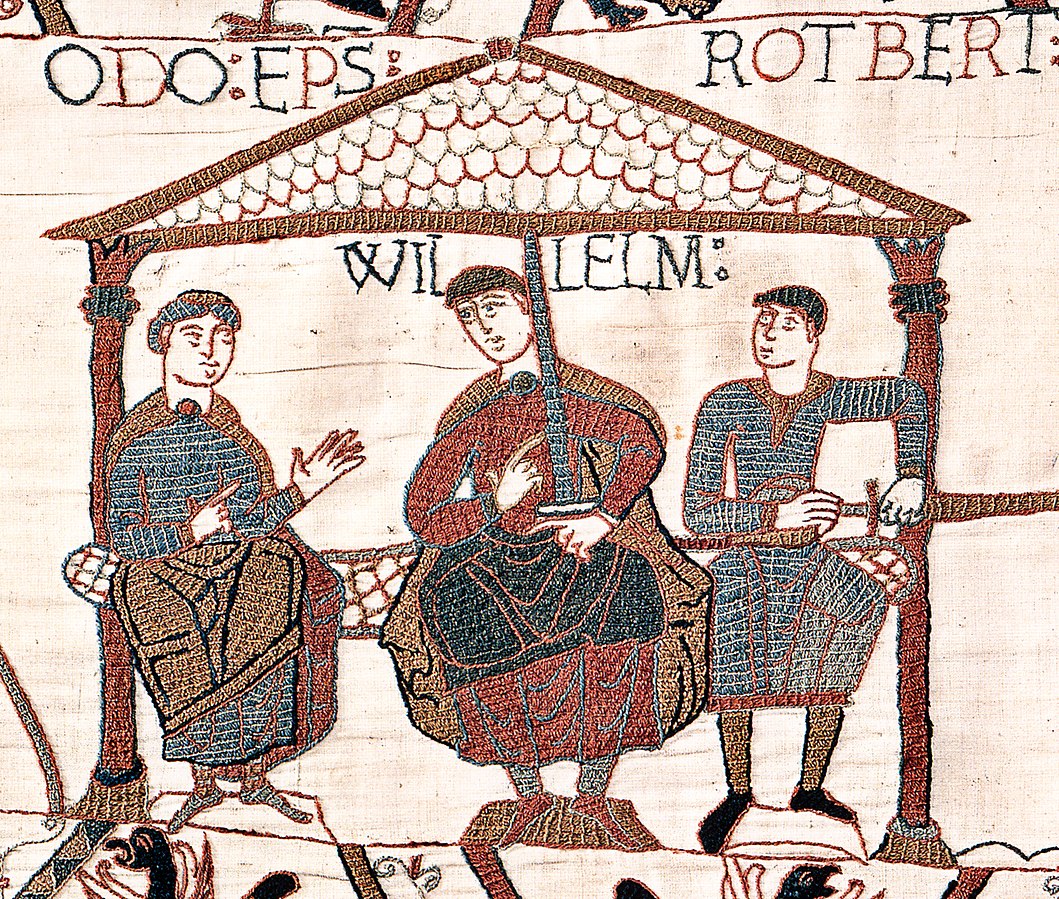
Panel from the Bayeux Tapestry – this one depicts Bishop Odo of Bayeux, Duke William, and Count Robert of Mortain.
Scan from Lucien Musset’s The Bayeux Tapestry via Wikimedia Commons.
Tales of royal brothers at war are a common theme, a staple of Norse sagas in particular, a recent example being the television series Vikings, and the brothers Ragnar and Rollo. William and Harry’s own family story in England begins with a tale told in one 14th century Icelandic saga, Hemings þáttr, which draws on older Norwegian stories to recall two royal brothers who became deadly rivals, Harold and Tostig.
Harold, as Earl of Wessex and the second most powerful man in England, had had his brother installed as Earl of Northumbria, where he had made himself immensely unpopular and provoked an uprising. When in 1065 Harold did a deal with the northerners to remove his sibling — presumably in exchange for the Northumbrians supporting his claim to the throne when the ailing King Edward passed away — Tostig fled abroad, embittered and determined to get revenge. Later accounts suggest that Harold and Tostig were rivals from an early age, one story having the young brothers fighting at the royal court as youngsters. Who knows, maybe Harold got the bigger room.
Tostig, now an exile, travelled around the North Sea looking for someone to help him invade England, finally finding his man with the terrifying Norwegian giant Harald Hardraada. Tostig had told all the Norwegians he was popular back home, but when they arrived in York they found that their English ally was in fact widely despised, and that not a single person came out to greet the former earl.
Tostig was killed soon after, in battle with his brother, having first (supposedly) exchanged words in this legendary meeting.
Harold himself would follow soon, victim of the English aristocracy’s great forefather William the Conqueror, whose success is illustrated by the naming patterns that followed. Harold’s brothers were Sweyn, Tostig, Gyrth, Leofwine and Wulfnoth; the Conqueror’s sons Robert, Richard, William and Henry. We haven’t had any Prince Wulfnoths recently.
The Conqueror’s son Richard having died in a hunting accident, the surviving Norman brothers had similarly fallen out, by one account the feud starting with a practical joke where William and Henry had poured a bucket of urine over eldest brother Robert. But mainly it was over land and power: after their father’s death Robert was made Duke of Normandy, the middle brother became William II of England, while Henry had to make do with just a cash payment.
Yet when William died in a mysterious hunting accident in the New Forest in 1100, Henry was conveniently close enough to reach the Treasury at Winchester within an hour to claim the crown. Six years later he invaded Normandy, with a partly English army, and captured his surviving brother, keeping Robert imprisoned for the rest of his life.
Henry I ruled for 35 years, but his long reign was followed by a civil war between his daughter Matilda and nephew Stephen, resulting in the rise of a new dynasty, the House of Anjou, or Plantagenets — so defined by internal conflict that Francis Bacon called them “a race much dipped in their own blood”.
Matilda’s husband Geoffrey Plantagenet had his brother Elias imprisoned, and Geoffrey’s son, King Henry II, had also gone to war with his younger brother, also Geoffrey. Even Geoffrey Plantagenet’s grandfather Fulk “the Quarreller” had spent over 30 years fighting for control of the county with his older brother, yet another Geoffrey.
Henry II in contrast fought his four sons and, after his death, his heir Richard I would also face rebellion from his younger brother John. When the Lionheart returned from crusade to deal with his deeply unlovable sibling he was remarkably forgiving, telling him: “Think no more of it, brother: you are but a child who has had evil counsellors.” This was despite John being 27 at the time.
More than two centuries later the House of Plantagenet came crashing down with a war pitting cousin against cousin, although brothers also fell out in the form of Edward IV and George, Duke of Clarence.
Both men were tall, blond and handsome, and both had a cruel and violent streak, but here the younger brother was impulsive, vain and foolish. He lacked maturity or self-control, was easily flattered and tempted into unwise decisions. He had been given vast estates and a lavish household but resented his older brother, who had also blocked his marriage to the daughter of the country’s largest landowner.
So Clarence had joined in the overthrow of Edward in 1470, while the youngest brother Richard, Duke of Gloucester, had remained loyal. However, when Edward returned to England the following March and Clarence led 4,000 men out to fight him, he was talked into changing sides again.
Clarence was forgiven, but the two brothers looked upon each other “with no very fraternal eyes”, and five years later he seems to have lost his mind after his wife died during childbirth. He accused the king of “necromancy” and of poisoning his subjects, and when brought before his brother made things much worse by claiming that Edward was a bastard. He was put to death.
Apparently, a soothsayer had also told King Edward that “G” would take his crown, and this must have fuelled his paranoia about George; after all, his other brother, the loyal Richard of Gloucester, would never do such a thing.
Such fraternal feuding ended with the rise of the Tudors and the conflicts between the House of Stuart and Parliament. There would be no more point in younger brothers threatening the monarch because the monarch no longer really had power; the royal family had evolved into a business, “the firm”, one in which hierarchies were clear and immovable, and the fortunes of family members were clearly joined.
January 7, 2023
QotD: The “camp followers” of a pre-modern army
We can start with sutlers, merchants buying or selling from the soldiers themselves (the Romans called these fellows lixae, but also called other non-soldiers in the camp lixae as well, see Roth (2012), 93-4; they also call them mercatores or negotiatores, merchants). Sutlers could be dealing in a wide array of goods. Even for armies where ration distribution was regular (e.g. the Roman army), sutlers might offer for sale tastier and fancier rations: meat, better alcohol and so on. They might also sell clothing and other goods to soldiers, even military equipment: finding “custom” weapons and armor in the archaeology of military forts and camps is not uncommon. For less regularly rationed armies, sutlers might act as a supplement to irregular systems of food and pay, providing credit to soldiers who purchased rations to make up for logistics shortfalls, to collect when those soldiers were paid. By way of example, the regulations of the Army of Flanders issued in 1596 allowed for three sutlers per 200-man company of troops (Parker, op. cit.), but the actual number was often much higher and of course those sutlers might also have their own assistants, porters, wagons and so on which moved with the army’s camp. Women who performed this role in the modern period are often referred to by the French vivandière.
For some armies there would have been an additional class of sutlers: slave dealers. Enslaved captives were a major component of loot in ancient warfare and Mediterranean military operations into and through the Middle Ages. Armies would abduct locals caught in hostile lands they moved through or enemies captured in battles or sieges; naturally generals did not want to have to manage these poor folks in the long term and so it was convenient if slave-dealer “wholesalers” were present with the army to quickly buy the large numbers of enslaved persons the army might generate (and then handle their transport – which is to say traffic them – to market). In Roman armies this was a regularized process, overseen by the quaestor (an elected treasury official who handled the army’s finances) assigned to each army, who conducted regular auctions in the camp. That of course means that these slave dealers are not only following the army, but are doing so with the necessary apparatus to transport hundreds or even thousands of captives (guards, wagons, porters, etc.).
And then there is the general category of “camp follower”, which covers a wide range of individuals (mostly women) who might move with the camp. The same 1596 regulations that provided for just three sutlers per 200-man Spanish company also provided that there could be three femmes publiques (prostitutes), another “maximum” which must often have been exceeded. But prostitutes were not the only women who might be with an army as it moved; indeed the very same regulations specify that, for propriety’s sake, the femmes publiques would have to work under the “disguise of being washerwomen or something similar” which of course implies a population of actual washerwomen and such who also moved with the army. Depending on training and social norms, soldiers may or may not have been expected to mend their own clothes or cook their own food. Soldiers might also have wives or girlfriends with them (who might in turn have those soldier’s children with them); this was more common with professional long-service armies where the army was home, but must have happened with all armies to one degree or another. Roman soldiers in the imperial period were formally, legally forbidden from marrying, but the evidence for “soldier’s families” in the permanent forts and camps of the Roman Empire is overwhelming.
The tasks women attached to these armies have have performed varied by gender norms and the organization of the logistics system. Early modern gunpowder armies represent some of the broadest range of activities and some of the armies that most relied on women in the camp to do the essential work of maintaining the camp; John Lynn (op. cit., 118-163) refers to the soldiers and their women (a mix of wives, girlfriends and unattached women) collectively as “the campaign community” and it is an apt label when thinking about the army on the march. As Lynn documents, women in the camp washed and mended clothes, nursed the sick and cooked meals, all tasks that were considered at the time inappropriate for men. Those same women might also be engaged in small crafts or in small-scale trade (that is, they might also be sutlers). Finally, as Lynn notes, women who were managing food and clothing seem often to have become logistics managers for their soldiers, guarding moveable property during battles and participating in pillaging in order to scrounge enough food and loot for they and their men to survive. I want to stress that for armies that had large numbers of women in the camp, it was because they were essential to the continued function of the army.
And finally, you have the general category of “servants”. The range of individuals captured by this label is vast. Officers and high status figures often brought either their hired servants or enslaved workers with them. Captains in the aforementioned Army of Flanders seem generally to have had at least four or five servants (called mozos) with them, for instance; higher officers more. But it wasn’t just officers who did this. Indeed, the average company in the Army of Flanders, Parker notes, would have had 20-30 individual soldiers who also had mozos with them; one force of 5,300 Spanish veterans leaving Flanders brought 2,000 such mozos as they left (Parker, op. cit. 151).
Looking at the ancient world, many – possibly most – Greek hoplites in citizen armies seem to have very often brought enslaved servants with them to carry their arms and armor; such enslaved servants are a regular feature of their armies in the sources. The Romans called these enslaved servants in their armies calones; it was a common trope of good generalship to sharply restrict their number, often with limited success. At Arausio we are told there were half as many servants (calonum et lixarum) as soldiers (Liv. Per. 67, on this note Roth (2013), 105), though excessive numbers of calones et lixae was a standard marker of bad general and the Romans did lose badly at Arausio so we ought to take those figures with a grain of salt, as Livy (and his sources) may just be communicating that the generals there were bad. That said, the notion that a very badly led army might have as many non-combatants following it as soldiers is a common one in the ancient sources. And while Roman armies were considered notable in the ancient world for how few camp servants they relied on and thus how much labor and portage was instead done by the soldiers, getting Roman aristocrats to leave their vast enslaved household staff at home was notoriously difficult (e.g. Ps.Caes. BAfr. 54; Dio Cass. 50.11.6). Much like the early modern “campaign community”, our sources frequently treat these calones as part of the army they belonged to, even though they were not soldiers.
Bret Devereaux, “Collections: Logistics, How Did They Do It, Part I: The Problem”, A Collection of Unmitigated Pedantry, 2022-07-15.
December 28, 2022
What we still don’t know about historical European swordfighting
I was for many years a member of the SCA partly for the attraction of the historical period and partly for the swordfighting. The Society developed a (mostly) safe simulation of (some) medieval combat styles and later introduced (some) renaissance rapier combat as well (initially borrowing equipment standards from modern sport fencing). Around the time the SCA began to consider expanding from high medieval sword-and-shield styles, separate organizations in Europe and the United States sprang up to be more consciously historical in how they recreated historical blade combat, these groups are often collectively referred to as Historical European Martial Arts (HEMA) or Western Martial Arts (WMA). The foundation documents for HEMA and other historical combat enthusiasts are the various surviving manuals of swordmasters and fencing school owners which cover a kaleidoscope of weapons, techniques, advice, and how-to illustrations … some of which appear to be physically impossible for ordinary human beings:
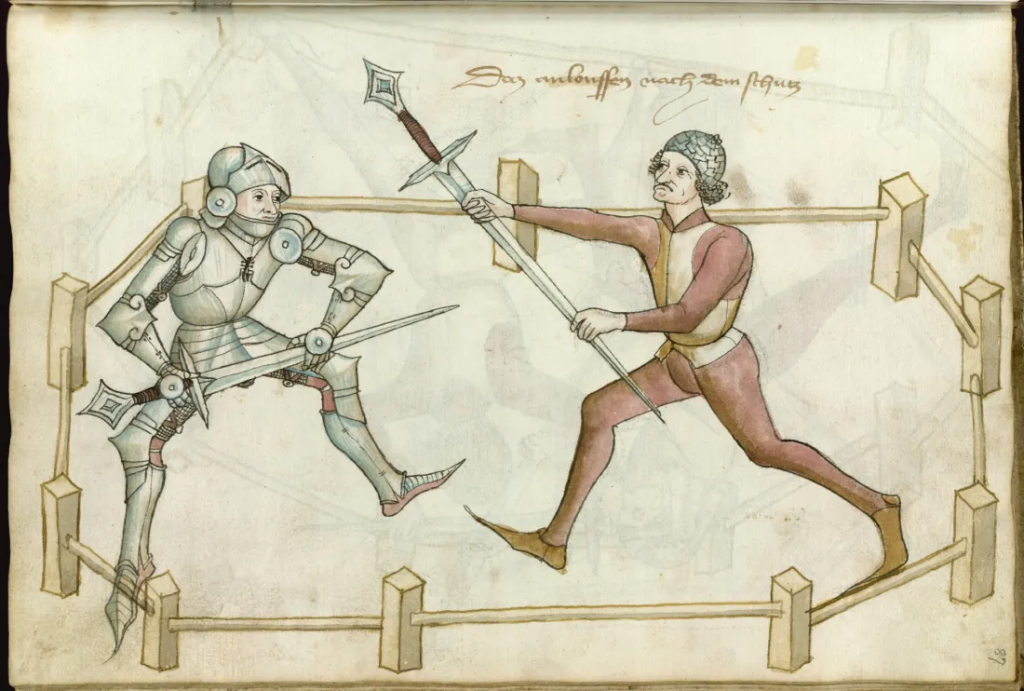
MS Thott.290.2º f.87r.
The ultimate experts in medieval sword fighting were the “fight masters” – elite athletes who trained their disciples in the subtle arts of close combat. The most highly renowned were almost as famous as the knights they trained, and many of the techniques they used were ancient, dating back hundreds of years in a continuous tradition.
Little is known about these rare talents, but the scraps of information that have survived are full of intrigue. Hans Talhoffer, a German fencing master with curly hair, impressive sideburns and a penchant for tight body suits, had a particularly chequered past. In 1434, he was accused of murdering a man and admitted abducting him in the Austrian city of Salzburg.
Fight masters worked with a grisly assortment of deadly weapons. The majority of training was dedicated to fencing with the longsword, or the sword and buckler (a style of combat involving holding a sword in one hand, and a small shield in the other). However, they also taught how to wield daggers, poleaxes, shields, and even how to fight with nothing at all, or just a bag of rocks (more on this later).
It’s thought that some fight masters were organised into brotherhoods, such as the Fellowship of Liechtenauer – a society of around 18 men who trained under the shadowy grandmaster Johannes Lichtenauer in the 15th Century. Though details about the almost-legendary figure himself have remained elusive, it’s thought he led an itinerant life, travelling across borders to train a handful of select proteges and learn new fencing secrets.
Other fight masters stayed closer to home – hired by dukes, archbishops and other assorted nobles to train themselves and their guards. A number even set up their own “fight schools”, where they gathered less wealthy students for regular weekly sessions.
[…]
For all their beauty, the hand-drawn works could also be decidedly bloodthirsty. In Talhoffer’s 1467 manual, neat sequences of moves that look almost like dancing end abruptly with swords through eye-sockets, violent impalings, and casual instructions to beat the opponent to death. Some signature techniques even have names – chilling titles like the “wrath-hew”, “crumpler”, “twain hangings”, “skuller” and “four openings”.
Despite passing through countless generations of owners, and – in some cases – centuries of graffiti, burns, theft, and mysterious periods of vanishment from the historical record, a surprising number survive today. This includes at least 80 codexes from German-speaking regions alone.
Impossible moves and missing clues
But there’s a problem. Many of the techniques in combat manuals, also known as “fechtbücher“, are convoluted, vague, and cryptic. Despite the large corpus of remaining books, they often offer surprisingly little insight into what the fight master is trying to convey.
“It’s famously difficult to take these static unmoving woodcut images, and determine the dynamic action of combat,” says Scott Nokes, “This has been a topic of debate, research and experimentation for generations.”
On some occasions these manuals seem to depict contortions of the body that are physically impossible, while those that attempt to convey moves in three dimensions sometimes give combatants extra arms and legs that were added in by accident. Others contain instructions that are frustratingly opaque – sometimes depicting actions that don’t seem to work, or building upon enigmatic moves that have long-since been lost.
Oddly, the text is often written as poetry, rather than prose – and a few authors even made it hard to interpret their works on purpose.
Lichtenauer recorded his instructions in obscure verses which remain almost incomprehensible today – one expert has gone so far as to call them “gibberish”. According to a contemporary fight master he trained, the grandmaster wrote in “secret words” to prevent them from being intelligible to anyone who didn’t value his art highly enough.
Even when it is possible to decipher what a combat manual is describing or demonstrating, some experts suspect that crucial contextual information is always missing.
December 21, 2022
Tom Holland’s Dominion
Ed West expands on the review he wrote when Holland’s book was first published in 2019:
The Romans are the most “epic” figures in history, to use my young son’s favourite word, exerting a glamour and allure that no civilisation has successfully matched. This magnetism can also appear heightened by what followed, the illiterate bleakness of the early Middle Ages, and the fun-sucking religion that came with it. Many down the years have lamented the switch from the Rome of the Caesars to the Rome of the popes.
The young Tom Holland was one of them. Raised as an Anglican, the historian’s childhood fascination with dinosaurs evolved into one for the equally glamorous ancients. “Although I vaguely continued to believe in God,” he writes: “I found him infinitely less charismatic than the gods of the Greeks: Apollo, Athena, Dionysus. I liked the way that they did not lay down laws, or condemn other deities as demons; I liked their rock-star glamour. As a result, by the time I came to read Edward Gibbon and his great history of the decline and fall of the Roman Empire, I was more ready to accept his interpretation of the triumph of Christianity: that it had ushered in an ‘age of superstition and credulity’. My childhood instinct to see the biblical God as the po-faced enemy of liberty and fun was rationalised.”
This, indeed, is a widespread view. Since Gibbon wrote his great work in the late 18th century there has existed the popular idea that the Renaissance, with its return to classical values, and the Enlightenment, which saw the birth of reason over superstition, were a reaction to Christianity, which had in those thousand dark medieval years suppressed science and freedom.
Yet the truth and paradox, as Holland shows in this truly epic account of how Christianity came to shape the West, is that the western idea of secularism is itself a very Christian one. Liberalism was never a reaction to Christianity, it was a product, perhaps one might heresy; ditto Marxism, socialism and the various progressive creeds of the modern era, right up to the current Great Awokening with its focus on the sanctity of victimhood.
All our assumptions about progress, the rights of the individual, our horror of racism and sexual exploitation, even the acceptance of gay marriage, are the products of Christianity. They are not in themselves universal or “natural”, and to the Romans these ideas of human rights and dignity would have been incomprehensible, laughable even.
Holland made his name with thrilling popular histories set in the ancient world, yet the more he studied antiquity, the more alien it became to him. It wasn’t just that Spartans or Romans killed innocents in large numbers, but that they lacked even the suggestion that the weak might be worth pitying. “That my belief in God had faded over the course of my teenage years did not mean that I had ceased to be Christian,” he writes.
Cruelties such as the exposure of infants – especially female infants – were almost universally accepted in antiquity, except among one or two small German tribes and, at the other end of the empire, a monotheistic people in the eastern Mediterranean. Perhaps the obscenest horror, however, was the practice of crucifixion, a death so cruel that Roman writers barely touched on the subject. Indeed only “four detailed accounts of the process by which a man might be sentenced to the cross, and then suffer his punishment, have survived from antiquity. Remarkably, they all describe the same execution.”
This is the story of how on that one Friday in Judea the world was changed forever — with a moral revolution like nothing before or since.
December 14, 2022
QotD: The “tooth-to-tail ratio” in armies
The Roman legion, for instance, was essentially all tooth. While there was a designation for support troops, the immunes, so named because they were immune from having to do certain duties in camp, these fellows were still in the battle line when the legion fought. The immunes included engineers, catapult-operators, musicians, craftsmen, and other specialists. Of course legions were also followed around by civilian non-combatants – camp-followers, sutlers, etc. – but in the actual ranks, the “tail” was minimal.
You can see much the same in the organization of medieval “lances” – units formed around a single knight. The Burgundian “lance” of the late 1400s was composed of nine men, eight of which were combatants (the knight, a second horsemen, the coustillier, and then six support soldiers, three mounted and three on foot) and one, the page, was fully a non-combatant. A tooth-to-tail ratio of 8:1. That sort of “tooth-heavy” setup is common in pre-industrial armies.
The industrial revolution changes a lot, as warfare begins to revolve as much around mobilizing firepower, typically in the form of mass artillery firepower as in mobilizing men. We rarely in our fiction focus on artillery, but modern warfare – that is warfare since around 1900 – is dominated by artillery and other forms of [indirect] fires. Artillery, not tanks or machine guns, after all was the leading cause of combat death in both World Wars. Suddenly, instead of having each soldier carry perhaps 30-40kg of equipment and eat perhaps 1.5kg of food per day, the logistics concern is moving a 9-ton heavy field gun that might throw something like 14,000kg of shell per day during a barrage, for multiple days on end. Suddenly, you need a lot more personnel moving shells than you need firing artillery.
As armies motorized after WWI and especially after WWII, this got even worse, as a unit of motorized or mechanized infantry needed a small army of mechanics and logistics personnel handling spare parts in order to stay motorized. Consequently, tooth-to-tail ratios plummeted, inverted and then kept going. In the US Army in WWI, the ratio was 1:2.6 (note that we’ve flipped the pre-industrial ratio, that’s 2.6 non-combat troops for every front line combat solider), by WWII it was 1:4.3 and by 2005 it was 1:8.1. Now I should note there’s also a lot of variance here too, particularly during the Cold War, but the general trend has been for this figure to continue increasing as more complex, expensive and high-tech weaponry is added to warfare, because all of that new kit demands technicians and mechanics to maintain and supply it.
[NR: Early in WW2, British Prime Minister Winston Churchill frequently harassed his various North African generals for the disparity between the “ration strength” of their commands and the much-smaller number of combat troops deployed. If General Wavell had 250,000 drawing rations, Churchill (who last commanded troops in the field in mid-WW1) assumed that this meant close to 200,000 combat troops available to fight the Italians and (later) the Germans. This almost certainly contributed to the high wastage rate of British generals in the Western Desert.]
Bret Devereaux, “Fireside Friday, April 22, 2022”, A Collection of Unmitigated Pedantry, 2022-04-22.
December 13, 2022
December 10, 2022
The “Dark” Ages were fine, actually — History Hijinks
Overly Sarcastic Productions
Published 5 Aug 2022Curb your Crusading – the artwork, literature, and scholarship are far more interesting.
SOURCES & Further Reading: China: A History by John Keay, Byzantium & Sicily & Venice by John Julius Norwich, Great Courses Lecture series Foundations of Western Civilization by Thomas F. X. Noble lectures 27 through 38: “The Emergence of the Catholic Church”, “Christian Culture in Late Antiquity”, “Muhammad and Islam”, “The Birth of Byzantium”, “Barbarian Kingdoms in the West”, “The World of Charlemagne”, “The Carolingian Renaissance”, “The Expansion of Europe”, “The Chivalrous Society”, “Medieval Political Traditions I”, “Medieval Political Traditions II”, and “Scholastic Culture”.
(more…)
QotD: The Western Roman Empire – “decline and fall” or “change and continuity”?
With that out of the way, the old view, that of Edward Gibbon (1737-1794) and indeed largely the view of the sources themselves, was that the disintegration of the western half of the Roman polity was an unmitigated catastrophe, a view that held largely unchallenged into the last century; Gibbon’s great work, The History of the Decline and Fall of the Roman Empire (1789) gives this school its name, “decline and fall“. While I am going at points to gesture to Gibbon’s thinking, we’re not going to debate him; he is the “old man” of our title. Gibbon himself largely exists only in historiographical footnotes and intellectual histories; he is not at this point seriously defended nor seriously attacked but discussed as the venerable, but now out of date, origin point for all of this bickering.
The real break with that view came with the work of Peter Brown, initially in his The World of Late Antiquity (1971) and more or less canonically in The Rise of Western Christendom (1st ed. 1996; 2nd ed. 2003, 3rd ed. 2013). The normal way to refer to the Peter Brown school of thought is “change and continuity” (in contrast to the traditional “decline and fall”), though I rather like James O’Donnell’s description of it as the Reformation in late antique studies.
Among medievalists this reformed view, which focuses on continuity of culture and institutions from late antiquity to the early Middle Ages, remains essentially the orthodoxy, to the point that, for instance, the very recent (and quite excellent) The Bright Ages: A New History of Medieval Europe (2021) can present this vision as an uncomplicated fact, describing the “so-called Fall of Rome” and noting that “there was never a moment in the next thousand years in which at least one European or Mediterranean ruler didn’t claim political legitimacy through a credible connection to the empire of the Romans” and that “the idea that Rome ‘fell’ on the other hand, relies upon a conception of homogeneity – of historical stasis … things changed. But things always change” (3-4, 12-3). As we’ll see, I don’t entirely disagree with those statements, but they are absolute to a degree that suggests there is no real challenge to the position. There have been a few cracks in this orthodoxy among medievalists, particularly the work of Robin Flemming (a revision, not a clear break, to be sure), to which we’ll return, but the cracks have been relatively few.
While some ancient historians also bought into this view, purchase there has always been uneven and seems, to me at least, now to be waning further. Instead, a process of what James O’Donnell describes as a “counter-reformation” (which he stoutly resists with his own The Ruin of the Roman Empire; O’Donnell is a declared reformer) is well underway, a response to the “change and continuity” narrative which seeks to update and defend the notion that there really was a fall of Rome and that it really was quite bad actually. This is not, I should note, an effort to revive Gibbon per se; it does not typically accept his understanding of the cause of this decline (and often characterizes exactly what is declining differently). Nevertheless, this position too is sometimes termed the “decline and fall” school. My own sense of the field is that while nearly all ancient historians will feel the need to concede at least some validity to the reformed “change and continuity” vision, that the counter-reformation school is the majority view among ancient historians at this point (in a way that is particularly evident in overview treatments like textbooks or the Cambridge Ancient History (second edition)). We’ll meet many of the core works of this revised “decline and fall” school as we go.
As O’Donnell noted in a 2005 review for the BMCR, the reformed school tends to be strongest in the study of the imperial east rather than the west (something that will make a lot of sense in a moment), and in religious and cultural history; the counter-reformation school is stronger in the west than the east and in military and political history, though as we’ll see, to that list must at this point now be added archaeology along with demographic and economic history, at which point the weight of fields tends to get more than a little lopsided.
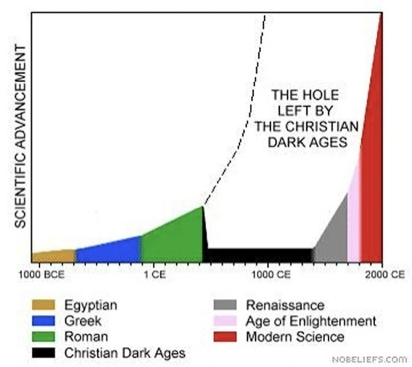
Those are our two knights – the “change and continuity” knight and the “decline and fall” knight (and our old man Gibbon, long out of his dueling days). To this we must add the nitwit: a popular vision, held by functionally no modern scholars, which represents the Middle Ages in their entirety as a retreat from a position of progress during the Roman period which was only regained during the “Renaissance” (generally represented as a distinct period from the Middle Ages) which then proceeded into the upward trajectory of the early modern period. Intellectually, this vision traces back to what Renaissance thinkers thought about themselves and their own disdain for “medieval” scholastic thinking (that is, to be clear, the thinking of their older teachers), a late Medieval version of “this ain’t your daddy’s rock and roll!”
But almost every intellectual movement represents itself as a radical break with the past (including, amusingly, many of the scholastics! Let me tell you about Peter Abelard sometime); as historians we do not generally accept such claims uncritically at face value. For a long time, well into the 19th century, the Renaissance’s cultural cachet in Europe (and the cachet of the classical period where it drew its inspiration) shielded that Renaissance claim from critique; that patina now having worn thin, most scholars now reject it, positioning the Renaissance as a continuation (with variations on the theme) of the Middle Ages, a smooth transition rather than a hard break. At the same time, knowledge of developments within the Middle Ages have made the image of one unbroken “Dark Age” untenable and made clear that the “upswing” of the early modern period was already well underway in the later Middle Ages and in turn had its roots stretching even deeper into the period. It is also worth noting here, that the term “Dark Age” has to do with the survival of evidence, not living conditions: the age was not dark because it was grim, it was dark because we cannot see it as clearly.
The popular version of this idea continues, however, to have a lot of sway in the popular conception of the Middle Ages, encouraged by popular culture that mistakes the excesses of the early modern period for “medieval” superstition and exaggerates the poverty of the medieval period (itself essentialized to its worst elements despite being approximately a millennia long), all summed up in this graph:
We are mostly going to just dunk relentlessly on this graph and yet we will not cover even half of the necessary dunking this graph demands. We may begin by noting that in its last century, the Roman Empire was Christian, a point apparently missed here.
While that sort of vision is not seriously debated by scholars, it needs to be addressed here too, in part because I suspect a lot of the energy behind the “change and continuity” position is in fact to counter some of the worst excesses of this thesis, which for simplicity, we’ll just refer to as “The Dung Ages” argument, but also because assessing how bad the fall of the Roman Empire in the West was demands that we consider how long-lasting any negative ramifications were.
Bret Devereaux, “Collections: Rome: Decline and Fall? Part I: Words”, A Collection of Unmitigated Pedantry, 2022-01-14.
December 1, 2022
Medieval Table Manners
Tasting History with Max Miller
Published 19 Jul 2022
(more…)
November 28, 2022
QotD: The Carolingian army
But below that in the Carolingian system, you have the select levy, relatively undistinguished (read: not noble, but often reasonably well-to-do) men recruited from the smaller farmers and townsfolk. This system itself seems to have derived from an earlier social understanding that all free men (or all free property owning men) held an obligation for military service; Halsall notes in the eighth century the term arimannus (Med. Lat.: army-man) or exercitalis (same meaning) as a term used to denote the class of free landowners on whom the obligation of military service fell in Lombard and later Frankish Northern Italy (the Roman Republic of some ten centuries prior had the same concept, the term for it was assidui). This was, on the continent at least, a part of the system that was in decline by the time of Charlemagne and especially after as the mounted retinues of the great magnates became progressively more important.
We get an interesting picture of this system in Charlemagne’s efforts in the first decades of the 800s to standardize it. Under Charlemagne’s system, productive land was assessed in units of value called mansi and (to simplify a complicated system) every four mansi ought to furnish one soldier for the army (the law makes provisions for holders of even half a mansus, to give a sense of how large a unit it was – evidently some families lived on fractions of a mansus). Families with smaller holdings than four mansi – which must have been most of them – were brigaded together to create a group large enough to be able to equip and furnish one man for the army. These fellows were expected to equip themselves quite well – shield, spear, sword, a helmet and some armor – but not to bring a horse. We should probably also imagine that villages and towns choosing who to send were likely to try to send young men in good shape for the purpose (or at least they were supposed to). Thus this was a draw-up of some fairly high quality infantry with good equipment. That gives it its modern-usage name, the select levy, because it was selected out of the larger free populace.
And I should note what makes these fellows different from the infantry who might often be found in the retinues of later medieval aristocrats is just that – these fellows don’t seem to have been in the retinues of the Carolingian aristocracy. Or at least, Charlemagne doesn’t seem to have imagined them as such. While he expected his local aristocrats to organize this process, he also sent out his royal officials, the missi to oversee the process. This worked poorly, as it turned out – the system never quite ran right (in part, it seems, because no one could decide who was in charge of it, the missi or the local aristocrats) and the decades that followed would see Carolingian and post-Carolingian rulers more and more dependent on their lords and their retinues, while putting fewer and fewer resources into any kind of levy. But Charlemagne’s last-gaps effort is interesting for our purpose because it illustrates how the system was supposed to run, and thus how it might have run (in a very general sense) in the more distant past. In particular, he seems to have imagined the select levy as a force belonging to the king, to be administered by royal officials (as the nation-in-arms infantry armies of the centuries before had been), rather than as an infantry force splintered into various retinues. In practice, the fragmentation of Charlemagne’s empire under his heirs was fatal for any hopes of a centralized army, infantry or otherwise, and probably hastened the demise of the system.
Beneath the select levy there was also the expectation that, should danger reach a given region, all free men would be called upon to defend the local redoubts and fortified settlements. This group is sometimes called the general levy. As you might imagine, the general levy would be of lower average quality and cohesion. It might include the very young and very old – folks who ought not to be picked out for the select levy for that reason – and have a much lower standard of equipment. After all, unlike select levymen, who were being equipped at the expense, potentially, of many households, general levymen were individual farmers, grabbing whatever they could. In practice, the general levy might be expected to defend walls and little else – it was not a field force, but an emergency local defense militia, which might either enhance the select levy (and the retinues of the magnates) or at least hold out until that field army could arrive.
Bret Devereaux, “Collections: The Battle oF Helm’s Deep, Part IV: Men of Rohan”, A Collection of Unmitigated Pedantry, 2020-05-22.
November 12, 2022
Long distance communication in the pre-modern era
In the latest Age of Invention newsletter, Anton Howes considers why the telegraph took so long to be invented and describes some of the precursors that filled that niche over the centuries:
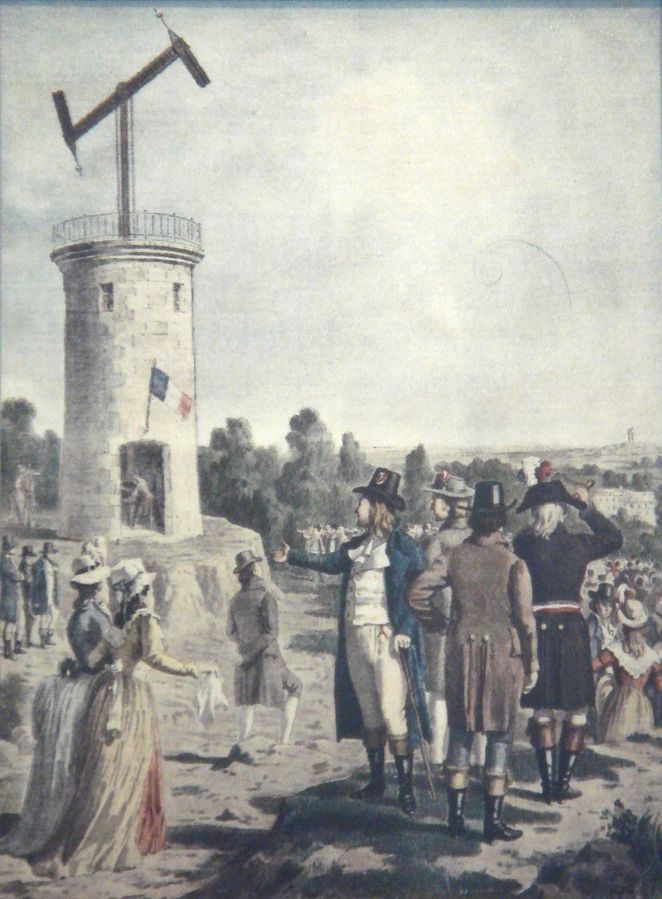
Early 19th century demonstration of Claude Chappe’s semaphore.
Wikimedia Commons.
… I’ve also long wondered the same about telegraphs — not the electric ones, but all the other long-distance signalling systems that used mechanical arms, waved flags, and flashed lights, which suddenly only began to really take off in the eighteenth century, and especially in the 1790s.
What makes the non-electric telegraph all the more interesting is that in its most basic forms it actually was used all over the world since ancient times. Yet the more sophisticated versions kept on being invented and then forgotten. It’s an interesting case because it shows just how many of the budding systems of the 1790s really were long behind their time — many had actually already been invented before.
The oldest and most widely-used telegraph system for transmitting over very long distances was akin to Gondor’s lighting of the beacons, capable only of communicating a single, pre-agreed message (with flames often more visible at night, and smoke during the day). Such chains of beacons were known to the Mari kingdom of modern-day Syria in the eighteenth century BC, and to the Neo-Assyrian emperor Ashurbanipal in the seventh century BC. They feature in the Old Testament and the works of Herodotus, Aeschylus, and Thucydides, with archaeological finds hinting at even more. They remained popular well beyond the middle ages, for example being used in England in 1588 to warn of the arrival of the Spanish Armada. And they were seemingly invented independently all over the world. Throughout the sixteenth century, Spanish conquistadors again and again reported simple smoke signals being used by the peoples they invaded throughout the Americas.
But what we’re really interested in here are systems that could transmit more complex messages, some of which may have already been in use by as early as the fifth century BC. During the Peloponnesian War, a garrison at Plataea apparently managed to confuse the torch signals of the attacking Thebans by waving torches of their own — strongly suggesting that the Thebans were doing more than just sending single pre-agreed messages.
About a century later, Aeneas Tacticus also wrote of how ordinary fire signals could be augmented by using identical water clocks — essentially just pots with taps at the bottom — which would lose their water at the same rate and would have different messages assigned to different water levels. By waving torches to signal when to start and stop the water clocks (Ready? Yes. Now start … stop!), the communicator could choose from a variety of messages rather than being limited to one. A very similar system was reportedly used by the Carthaginians during their conquests of Sicily, to send messages all the way back to North Africa requesting different kinds of supplies and reinforcement, choosing from a range of predetermined signals like “transports”, “warships”, “money”.
Diagram of a fire signal using the Polybius cipher.
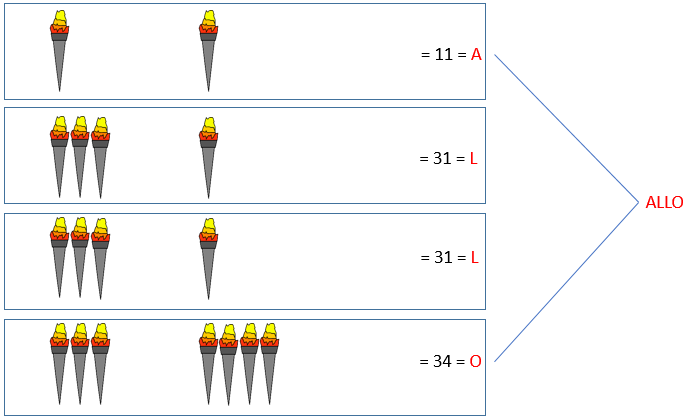
Created by Jonathan Martineau via Wikimedia Commons.By the second century BC, a new method had appeared. We only know about it via Polybius, who claimed to have improved on an even older method that he attributed to a Cleoxenus and a Democleitus. The system that Polybius described allowed for the spelling out of more specific, detailed messages. It used ten torches, with five on the left and five on the right. The number of torches raised on the left indicated which row to consult on a pre-agreed tablet of letters, while the number of torches raised on the right indicated the column. The method used a lot of torches, which would have to be quite spread out to remain distinct over very long distances. So it must have been quite labour-intensive. But, crucially, it allowed for messages to be spelled out letter by letter, and quickly.
Three centuries later, the Romans were seemingly still using a much faster and simpler version of Polybius’s system, almost verging on a Morse-like code. The signalling area now had a left, right, and middle. But instead of signalling a letter by showing a certain number of torches in each field all at once, the senders waved the torches a certain number of times — up to eight times in each field, thereby dividing the alphabet into three chunks. One wave on the left thus signalled an A, twice on the left a B, once in the middle an I, twice in the middle a K, and so on.
By the height of the Roman Empire, fire signals had thus been adapted to rapidly transmit complex messages over long distances. But in the centuries that followed, these more sophisticated techniques seem to have disappeared. The technology appears to have regressed.
November 5, 2022
The Byzantine Empire: Part 8 – The Breakdown, 1025-1204
seangabb
Published 20 May 2022In this, the eighth video in the series, Sean Gabb explains how, having acquired the wrong sort of ruling class, the Byzantine Empire passed in just under half a century from the hegemonic power of the Near East to a declining hulk, fought over by Turks and Crusaders.
Subjects covered include:
The damage caused by a landed nobility
The deadweight cost of uncontrolled bureaucracy
The first rise of an insatiable and all-conquering West
The failure of the Andronicus Reaction
The sack of Constantinople in 1204Between 330 AD and 1453, Constantinople (modern Istanbul) was the capital of the Roman Empire, otherwise known as the Later Roman Empire, the Eastern Roman Empire, the Mediaeval Roman Empire, or The Byzantine Empire. For most of this time, it was the largest and richest city in Christendom. The territories of which it was the central capital enjoyed better protections of life, liberty and property, and a higher standard of living, than any other Christian territory, and usually compared favourably with the neighbouring and rival Islamic empires.
The purpose of this course is to give an overview of Byzantine history, from the refoundation of the City by Constantine the Great to its final capture by the Turks.
Here is a series of lectures given by Sean Gabb in late 2021, in which he discusses and tries to explain the history of Byzantium. For reasons of politeness and data protection, all student contributions have been removed.
(more…)


