
Which city is our best role model in creating a healthy and creative musical culture?
Is it New York or London? Paris or Tokyo? Los Angeles or Shanghai? Nashville or Vienna? Berlin or Rio de Janeiro?
That depends on what you’re looking for. Do you value innovation or tradition? Do you want insider acclaim or crossover success? Is your aim to maximize creativity or promote diversity? Are you seeking timeless artistry or quick money attracting a large audience?
Ah, I want all of these things. So I only have one choice — but I’m sure my city isn’t even on your list.
My ideal music city is Córdoba, Spain.
But I’m not talking about today. I’m referring to Córdoba around the year 1000 AD.
I will make a case that medieval Córdoba had more influence on global music than any other city in history. That’s probably not something you expected. But even if you disagree — and I already can hear some New Yorkers grumbling in the background — I think you will discover that the “Córdoba miracle,” as I call it, is an amazing role model for us.
It’s a case study in how communities foster the arts — and in a way that benefits everybody, not just the artists.
[…] a thousand years before New Orleans spurred the rise of jazz, and instigated the Africanization of American music, a similar thing happened in Córdoba, Spain. You could even call that city the prototype for all the decisive musical trends of our modern times.
“This was the chapter in Europe’s culture when Jews, Christians, and Muslims lived side by side,” asserts Yale professor María Rosa Menocal, “and, despite their intractable differences and enduring hostilities, nourished a complex culture of tolerance.”
There’s even a word for this kind of cultural blossoming: Convivencia. It translates literally as “live together.” You don’t hear this term very often, but you should — because we need a dose of it now more than ever. And when scholars discuss and debate this notion of Convivencia, they focus their attention primarily on one city: Córdoba.
It represents the historical and cultural epicenter of living together as a norm and ideal.
Even today, we can see the mixture of cultures in Spain’s distinctive architecture, food, and music. These are both part of Europe, but also separate from it. It is our single best example of how the West can enter into fruitful cultural dialogue with the outsider — to the benefit of both.
Ted Gioia, “The Most Important City in the History of Music Isn’t What You Think It Is”, The Honest Broker, 2023-01-26.
May 2, 2023
QotD: The musical importance of the city of Córdoba
April 21, 2023
Localism versus centralism
Theophilus Chilton offers some support to localism as an antidote to the centralization of powers we’ve seen in every western nation since the early “nation state” era at the end of the Middle Ages:
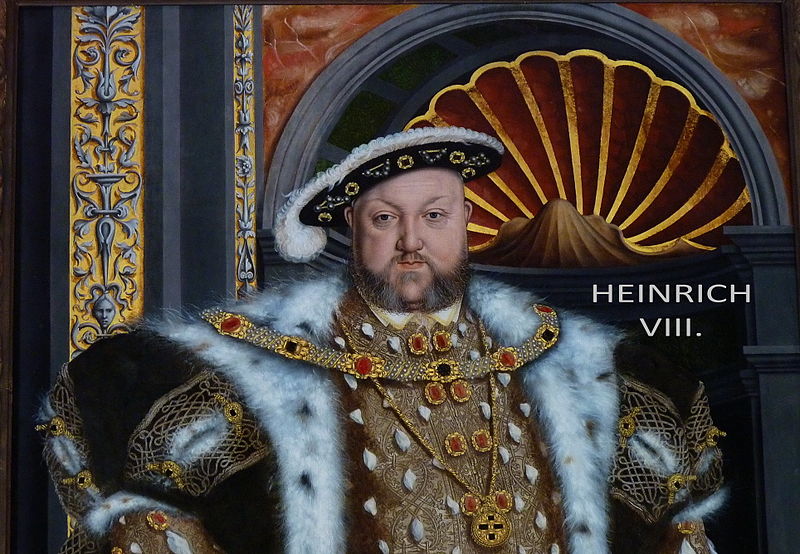
Cropped image of a Hans Holbein the Younger portrait of King Henry VIII at Petworth House.
Photo by Hans Bernhard via Wikimedia Commons.
The history of the West has, among other things, included a long, drawn-out conflict between two functional organizing principles – localism and centralization. The former involves the devolution of power to more narrowly defined provincial, parochial centers, while the later involves the concentration of power into the hands of an absolutist system. The tendency toward centralization began as far back as the high Middle Ages, during which the English and French monarchies began the reduction of aristocratic privileges and local divisions and the folding of this power into the rising bureaucratic state with a permanently established capital city and rapacious desire for provincial monies and personnel. The trend towards the development of absolute monarchy continued through the Baroque period, and the replacement of divinely-sanctioned kingship with popular forms of government (republicanism, democracy, communism) did not abate the process, but merely redirected power into different hands. The ultimate form of centralization, not yet come to pass, would be the sort of borderless one-world government desired by today’s globalists, whether they be neoconservatives or neoliberals, which would involve the ultimate consolidation of all power everywhere into one or a few hands in some place like Geneva or New York City.
[…]
The historical transition from localism to centralization in medieval Europe was seen in the decline of aristocratic rights and the institution of peer kingship, and their replacement with consolidated administrative control over a much larger and generally contiguous geographic area. This control was manifested in the person of the absolute monarch, and was exercised through an impersonal, disinterested bureaucratic apparatus which came to demand a greater and greater share of the national wealth to cover its expenses. This process, I believe, can ultimately be traced back to the strengthening of English and French royal power beginning in the 13th century, especially under Philip IV of France. Its fruition came (while monarchy still exercised effectual power in Europe) in the 17th-18th centuries before being undermined by Enlightenment and democratic dogmas which merely transferred the centralizing power to demagogues claiming to speak “for the people.”
Under the old aristocratic system, executive power formed a distributed system and rested on local nobility ruling over a local population with whom they were knowledgeable and on generally good terms. Despite the jaundiced modern view that feudalism was always “tyrannical” and “oppressive,” the fact is that most aristocrats in that era were genuinely devoted to the welfare of the commoners in their land, and it was the responsibility of the nobility to dispense justice and to right wrongs. The picture presented in Kipling’s poem “Norman and Saxon” most likely serves as a fair reflection of the relationship between lord and commoner. Kingship certainly existed, but the king was viewed as a “first among equals”, one who was the prime lord over his vassals, but who could also himself be a vassal of other kings of equal power and authority (as many of the earlier Plantagenet kings were to the Kings of France, by virtue of their holding fiefs as Dukes of Aquitaine).
False impressions about the role of the aristocracy generally correlate with false impressions about serfdom, the dominant labor relationship of the time. Contrary to popular notions, serfdom was generally not some cruel form of slavery that destroyed human dignity. Indeed, many serfs had liberties approach those of freemen, could transfer allegiances between nobles, enjoyed dozens of feast days (which were effectively vacation days to be devoted to family and community), and could even take themselves off to one of the many free cities which existed and be reasonably sure of not being compelled to return to their former master unless their case was especially egregious.
However, under centralization, the nobility was generally reduced to being ornaments of the royal court, their judicial and administrative functions removed and replaced by a bureaucracy personally loyal to the king. This, in effect, served to remove opportunities for serfs and other commoners to “get away” from the rule of a bad king. Whereas before, a serf could at least hope for the opportunity to flee a bad ruler and seek shelter with a good one, under the uniform rule of the absolute monarch, this was no longer an option unless the commoner wished to flee his entire nation and culture completely. Likewise, the ever-increasing regulation of his daily life by the bureaucracy followed him everywhere he went. By the end of the period, the centralization of power and the rise of crony capitalism led to the destruction of serfdom and the rise of wage capitalism, acting to reduce serfs and freemen alike to the status of cogs in profit-generating machines. The rise of absolute monarchy, part and parcel with the appearance of bureaucracy and the professionalization of military power, led directly to the rise of the modern managerial state.
April 17, 2023
QotD: Tenant-farming (aka “sharecropping”) in pre-modern societies
In many cases, small freeholders might also work as tenants on a nearby large estate as well. There are many good reasons for a small free-holding peasant to want this sort of arrangement […]. So a given area of countryside might have free-holding subsistence farmers who do flexible sharecropping labor on the big estate from time to time alongside full-time tenants who worked land entirely or almost entirely owned by the large landholder. Now, as you might imagine, the situation of tenants – open to eviction and owing their landlords considerable rent – makes them very vulnerable to the landlord compared to neighboring freeholders.
That said, tenants in this sense were generally considered free persons who had the right to leave (even if, as a matter of survival, it was rarely an option, leaving them under the control of their landlords), in contrast to non-free laborers, an umbrella-category covering a wide range of individuals and statuses. I should be clear on one point: nearly every pre-modern complex agrarian society had some form of non-free labor, though the specifics of those systems varied significantly from place to place. Slavery of some form tends to be the rule, rather than the exception for these pre-modern agrarian societies. Two of the largest categories of note here are chattel slavery and debt bondage (also called “debt-peonage”), which in some cases could also shade into each other, but were often considered separate (many ancient societies abolished debt bondage but not chattel slavery for instance and debt-bondsmen often couldn’t be freely sold, unlike chattel slaves). Chattel slaves could be bought, sold and freely traded by their slave masters. In many societies these people were enslaved through warfare with captured soldiers and civilians alike reduced to bondage; the heritability of that status varies quite a lot from one society to the next, as does the likelihood of manumission (that is, becoming free).
Under debt bondage, people who fell into debt might sell (or be forced to sell) dependent family members (selling children is fairly common) or their own person to repay the debt; that bonded status might be permanent, or might hold only till the debt is repaid. In the later case, as remains true in a depressing amount of the world, it was often trivially easy for powerful landlord/slave-holders to ensure that the debt was never paid and in some systems this debt-peon status was heritable. Needless to say, the situation of both of these groups could be and often was quite terrible. The abolition of debt-bondage in Athens and Rome in the sixth and fourth centuries B.C. respectively is generally taken as a strong marker of the rising importance and political influence of the class of rural, poorer citizens and you can readily see why this is a reform they would press for.
Bret Devereaux, “Collections: Bread, How Did They Make It? Part II: Big Farms”, A Collection of Unmitigated Pedantry, 2020-07-31.
April 10, 2023
QotD: Interaction between “big” farmers and subsistence farmers in pre-modern societies
And then just over the way, you have the large manor estate, or the Roman villa, or the lands owned by a monastery (because yes, large landholders were sometimes organizations; in medieval Europe, monasteries filled this function in some places) or even just a very rich, successful peasant household. Something of that sort. They have the capital (plow-teams, manure, storage, processing) to more intensively farm the little land our small farmers have, but also, where the small farmer has more labor than land, the large landholder has more land than labor.
The other basic reality that is going to shape our large farmers is their different goals. By and large our small farmers were subsistence farmers – they were trying to farm enough to survive. Subsistence and a little bit more. But most large landholders are looking to use the surplus from their large holdings to support some other activity – typically the lifestyle of wealthy elites, which in turn require supporting many non-farmers as domestic servants, retainers (including military retainers), merchants and craftsmen (who provide the status-signalling luxuries). They may even need the surplus to support political activities (warfare, electioneering, royal patronage, and so on). Consequently, our large landholders want a lot of surplus, which can be readily converted into other things.
The space for a transactional relationship is pretty obvious, though as we will see, the power imbalances here are extreme, so this relationship tends to be quite exploitative in most cases. Let’s start with the labor component. But the fact that our large landholders are looking mainly to produce a large surplus (they are still not, as a rule, profit maximizing, by the by, because often social status and political ends are more important than raw economic profit for maintaining their position in society) means that instead of having a farm to support a family unit, they are seeking labor to support the farm, trying to tailor their labor to the minimum requirements of their holdings.
[…]
The tricky thing for the large landholder is that labor needs throughout the year are not constant. The window for the planting season is generally very narrow and fairly labor intensive: a lot needs to get done in a fairly short time. But harvest is even narrower and more labor intensive. In between those, there is still a fair lot of work to do, but it is not so urgent nor does it require so much labor.
You can readily imagine then the ideal labor arrangement would be to have a permanent labor supply that meets only the low-ebb labor demands of the off-seasons and then supplement that labor supply during the peak seasons (harvest and to a lesser extent planting) with just temporary labor for those seasons. Roman latifundia may have actually come close to realizing this theory; enslaved workers (put into bondage as part of Rome’s many wars of conquest) composed the villa’s primary year-round work force, but the owner (or more likely the villa’s overseer, the vilicus, who might himself be an enslaved person) could contract in sharecroppers or wage labor to cover the needs of the peak labor periods. Those temporary laborers are going to come from the surrounding rural population (again, households with too much labor and too little land who need more work to survive). Some Roman estates may have actually leased out land to tenant farmers for the purpose of creating that “flexible” local labor supply on marginal parts of the estate’s own grounds. Consequently, the large estates of the very wealthy required the impoverished many subsistence farmers in order to function.
Bret Devereaux, “Collections: Bread, How Did They Make It? Part II: Big Farms”, A Collection of Unmitigated Pedantry, 2020-07-31.
March 23, 2023
History Summarized: Rome After Empire
Overly Sarcastic Productions
Published 11 Nov 2022“It’s gonna take more than killing me to kill me” – Rome, constantly.
Rome “Fell” in 476 … but we still have Rome. How’d that happen, and what does the Pope have to do with it?
(more…)
March 9, 2023
QotD: Iron ore mining before the Industrial Revolution
As with many ancient technologies, there is a triumph of practice over understanding in all of this; the workers have mastered the how but not the why. Lacking an understanding of geology, for instance, meant that pre-modern miners, if the ore vein hit a fault line (which might displace the vein, making it impossible to follow directly) had to resort to sinking shafts and exploratory mining an an effort to “find” it again. In many cases ancient miners seem to have simply abandoned the works when the vein had moved only a short distance because they couldn’t manage to find it again. Likewise, there was a common belief (e.g. Plin. 34.49) that ore deposits, if just left alone for a period of years (often thirty) would replenish themselves, a belief that continues to appear in works on mining as late as the 18th century (and lest anyone be confused, they clearly believe this about underground deposits; they don’t mean bog iron). And so like many pre-modern industries, this was often a matter of knowing how without knowing why.
Once the ore was located, mining tended to follow the ore, assuming whatever shape the ore-formation was in. For ore deposits in veins, that typically means diggings shafts and galleries (or trenches, if the deposit was shallow) that follow the often irregular, curving patterns of the veins themselves. For “bedded” ore (where the ore isn’t in a vein, but instead an entire layer, typically created by erosion and sedimentation), this might mean “bell pitting” where a shaft was dug down to the ore layer, which was then extracted out in a cylinder until the roof became unstable, at which point the works were back-filled or collapsed and the process begun again nearby.
All of this digging had to be done by hand, of course. Iron-age mining tools (picks, chisels, hammers) fairly strongly resemble their modern counterparts and work the same way (interestingly, in contrast to things like bronze-age picks which were bronze sheaths around a wooden core, instead of a metal pick on a wooden haft).
For rock that was too tough for simple muscle-power and iron tools to remove, the typical expedient was “fire-setting“, which remained a standard technique for removing tough rocks until the introduction of explosives in the modern period. Fire-setting involves constructing a fuel-pile (typically wood) up against the exposed rock and then letting it burn (typically overnight); the heat splinters, cracks and softens the rock. The problem of course is that the fire is going to consume all of the oxygen and let out a ton of smoke, preventing work close to an active fire (or even in the mine at all while it was happening). Note that this is all about the cracking and splintering effect, along with chemical changes from roasting, not melting the rock – by the time the air-quality had improved to the point where the fire-set rock could be worked, it would be quite cool. Ancient sources regularly recommend dousing these fires with vinegar, not water, and there seems to be some evidence that this would, in fact, render the rock easier to extract afterwards.
By the beginning of the iron age in Europe (which varies by place, but tends to start between c. 1000 and c. 600 BC), the level of mining sophistication that we see in preserved mines is actually quite considerable. While Bronze Age mines tend to stay above the water-table, iron-age mines often run much deeper, which raises all sorts of exciting engineering problems in ventilation and drainage. Deep mines could be drained using simple bucket-lines, but we also see more sophisticated methods of drainage, from the Roman use of screw-pumps and water-wheels to Chinese use of chain-pumps from at least the Song Dynasty. Ventilation was also crucial to prevent the air becoming foul; ventilation shafts were often dug, with the use of either cloth fans or lit fires at the exits to force circulation. So mining could get very sophisticated when there was a reason to delve deep. Water might also be used to aid in mining, by leading water over a deposit and into a sluice box where the minerals were then separated out. This seems to have been done mostly for mining gold and tin.
Bret Devereaux, “Iron, How Did They Make It? Part I, Mining”, A Collection of Unmitigated Pedantry, 2020-09-18.
March 8, 2023
Feeding a Medieval Outlaw
Tasting History with Max Miller
Published 7 Mar 2023
(more…)
February 27, 2023
“From nine or so I could memorise all the dates of the kings and queens of England … all of which proved hugely useful when it came to impressing the opposite sex in my teens”
The preview portion of an Ed West article on how history should be taught as black comedy rather than a morality tale:
I love history; it is my greatest passion. If I didn’t have to worry about money I’d go and live in a former Templar castle in the Languedoc and spend my afternoons reading 19th-century French historians (pretending to read in the original for my Instagram account, obviously, but actually using a translation).
From a very young age I was obsessed with the subject. The first history tale I remember being engrossed by was the story of Ethelred the Unready and Edward the Martyr. I suppose I felt some sort of nominative solidarity with Edward, the rightful king murdered by a wicked stepmother who then put her own son Ethelred on the throne — and who turned out to be the worst combination of both useless and backstabbing.
Of course, I later learned that the story was more complicated; Edward may not have been murdered, and Ethelred was dealt a very difficult hand. But as a child it sent my mind away to a far off place in a similar way that King Arthur first captured the imagination of many others. Like them, I was first attracted to history via the medieval world, with its kings, castles and sword fights, and its colourful jousts where fair maidens watched heroic knights beat the crap out of each other (although the early medieval had almost none of those things, but again, don’t let that ruin the fun).
There was obviously a very nerdy aspect to this. From nine or so I could memorise all the dates of the kings and queens of England (although I got a bit vague when it got as far as the Edwys and Edwigs), all of which proved hugely useful when it came to impressing the opposite sex in my teens.
Dates are not the most important thing, but for a certain type of mind they make it easier to connect everything. If I learned of an insane pope who liked to torture his cardinals or “Wenzel the Drunkard“, the German king fond of throwing enemies off bridges, I could put it in context that this was the time of Richard II, and it is easier to place. If I’m now reading about Chinese emperors or what was happening in the Umayyad caliphate, where the connection with England would be slim or non-existent, my understanding of English dates still makes it easier to understand.
I loved the fantasy and the expanded sense of imagination, but as I got older, I came to better appreciate the most beautiful thing about history, that it’s all one great black comedy, filled with petty emotions and motivations, and the psychodrama and human absurdity is not some side issue, but the whole point.
Yet the subject is never really taught like that, and perhaps can’t be; and the national history curriculum when I was at school seemed structured in such a way as to suck all the life out of it. It’s not just the incoherence or emphasis; everyone complains about what is taught at school, and no one will ever be satisfied. But worse was the way the subject was almost designed to make it as boring as possible. An area of study was introduced, and then almost immediately we were asked to evaluate the primary and secondary sources; the aim was to invite scepticism, but most teens and pre-teens simply drift off at this point.
Just tell us the story — we can deconstruct it later. Personally, I feel that history shouldn’t be primarily an analysis of how hegemonic power structures orchestrate public relations; it shouldn’t be a morality tale about good and evil; it shouldn’t be a means to make society more inclusive; it should be fun, and when done correctly, it’s the most fun subject in the world.
I’ve heard a lot of other folks’ complaints about how history was taught when they were in school, and it generally aligns with my own experience. The overall plan seemed to be to actively avoid anything that might interest the students (battles, treachery, romance, excitement in general) and instead concentrate on treaty negotiations, lists of dates, and any other dry-as-dust ways to fill the lecture time. As anyone can tell by the subjects I tend to include here on the blog, I’m a big history nerd, but I actively hated the topic in school even as I was reading history for myself outside of school hours.
Ed also recommends the brilliant podcast series The Rest is History with Dominic Sandbrook and Tom Holland (now also available on YouTube, which is where I started listening to it a few weeks back). I’d read several books by each of them, so it was quite a treat to discover they were co-operating on a history podcast that more than met my expectations.
February 25, 2023
QotD: Feudalism versus “Manorialism”
Bret Devereaux, “Collections: Bread, How Did They Make It? Part IV: Markets, Merchants and the Tax Man”, A Collection of Unmitigated Pedantry, 2020-08-21.
February 21, 2023
Medieval Mardi Gras
Tasting History with Max Miller
Published 22 Feb 2022
(more…)
February 17, 2023
QotD: Risk mitigation in pre-modern farming communities
Subsistence farmers generally do not do this. Remember, the goal is not to maximize profit, but to avoid family destruction through starvation. If you only farm one crop (the “best” one) and you get too little rain or too much, or the temperature is wrong – that crop fails and the family starves. But if you farm several different crops, that mitigates the risk of any particular crop failing due to climate conditions, or blight (for the Romans, the standard combination seems to have been a mix of wheat, barley and beans, often with grapes or olives besides; there might also be a small garden space. Orchards might double as grazing-space for a small herd of animals, like pigs). By switching up crops like this and farming a bit of everything, the family is less profitable (and less engaged with markets, more on that in a bit), but much safer because the climate conditions that cause one crop to fail may not impact the others. A good example is actually wheat and barley – wheat is more nutritious and more valuable, but barley is more resistant to bad weather and dry-spells; if the rains don’t come, the wheat might be devastated, but the barley should make it and the family survives. On the flip side, if it rains too much, well the barley is likely to be on high-ground (because it likes the drier ground up there anyway) and so survives; that’d make for a hard year for the family, but a survivable one.
Likewise – as that example implies – our small farmers want to spread out their plots. And indeed, when you look at land-use maps of villages of subsistence farmers, what you often find is that each household farms many small plots which are geographically distributed (this is somewhat less true of the Romans, by the by). Farming, especially in the Mediterranean (but more generally as well) is very much a matter of micro-climates, especially when it comes to rainfall and moisture conditions (something that is less true on the vast flat of the American Great Plains, by the by). It is frequently the case that this side of the hill is dry while that side of the hill gets plenty of rain in a year and so on. Consequently, spreading plots out so that each family has say, a little bit of the valley, a little bit of the flat ground, a little bit of the hilly area, and so on shields each family from catastrophe is one of those micro-climates should completely fail (say, the valley floods, or the rain doesn’t fall and the hills are too dry for anything to grow).
Bret Devereaux, “Collections: Bread, How Did They Make It? Part I: Farmers!”, A collection of Unmitigated Pedantry, 2020-07-24.
February 15, 2023
Medieval French Toast
Tasting History with Max Miller
Published 14 Feb 2023
(more…)
February 13, 2023
QotD: Oaths in pre-modern cultures
Second, I should note that I’m drawing my definition of an oath from Alan Sommerstein’s excellent introduction in Horkos: The Oath in Greek Society (2007), edited by A. Sommerstein and J. Fletcher – one of the real “go-to” works on oath-taking in the ancient Mediterranean world. As I go, I’ll also use some medieval examples to hopefully convince you that the same basic principles apply to medieval oaths, especially the all-important oaths of fealty and homage.
(Pedantry note: now you may be saying, “wait, an introduction? Why use that?” As of when I last checked, there is no monograph (single author, single topic) treatment of oaths. Rather, Alan Sommerstein has co-authored a set of edited collections – Horkos (2007, with J. Fletcher), Oath and State (2013, with A. Bayliss) and Oaths and Swearing (2014, with I. Torrance). This can make Greek oaths a difficult topic to get a basic overview of, as opposed to a laundry list of the 101 ancient works you must read for examples. Discussions of Roman oaths are, if anything, even less welcoming to the beginner, because they intersect with the study of Roman law. I think the expectation has always been that the serious student of the classics would have read so many oaths in the process of learning Latin and Greek to develop a sort of instinct for the cultural institution. Nevertheless, Sommerstein’s introduction in Horkos presents my preferred definition of the structure of an oath.)
Alright – all of the quibbling out of the way: onward!
So what is an Oath? Is it the same as a Vow?
Ok, let’s start with definitions. In modern English, we often use oath and vow interchangeably, but they are not (usually) the same thing. Divine beings figure in both kinds of promises, but in different ways. In a vow, the god or gods in question are the recipients of the promise: you vow something to God (or a god). By contrast, an oath is made typically to a person and the role of the divine being in the whole affair is a bit more complex.
(Etymology digression: the word “oath” comes to us by way of Old English āþ (pronounced “ath” with a long ‘a’) and has close cousins in Dutch “Eed” and German “Eid”. The word vow comes from Latin (via Middle English, via French), from the word votum. A votum is specifically a gift to a god in exchange for some favor – the gift can be in the present tense or something promised in the future. By contrast, the Latin word for oath is ius (it has a few meanings) and to swear an oath is the verb iuro (thus the legal phrase “ius iurandum” – literally “the oath to be sworn”). This Latin distinction is preserved into the English usage, where “vow” retains its Latin meaning, and the word “oath” usurps the place of Latin ius (along with other words for specific kinds of oaths in Latin, e.g. sacramentum)).
In a vow, the participant promises something – either in the present or the future – to a god, typically in exchange for something. This is why we talk of an oath of fealty or homage (promises made to a human), but a monk’s vows. When a monk promises obedience, chastity and poverty, he is offering these things to God in exchange for grace, rather than to any mortal person. Those vows are not to the community (though it may be present), but to God (e.g. Benedict in his Rule notes that the vow “is done in the presence of God and his saints to impress on the novice that if he ever acts otherwise, he will surely be condemned by the one he mocks“. (RB 58.18)). Note that a physical thing given in a vow is called a votive (from that Latin root).
(More digressions: Why do we say “marriage vows” in English? Isn’t this a promise to another human being? I suspect this usage – functionally a “frozen” phrase – derives from the assumption that the vows are, in fact, not a promise to your better half, but to God to maintain. After all, the Latin Church held – and the Catholic Church still holds – that a marriage cannot be dissolved by the consent of both parties (unlike oaths, from which a person may be released with the consent of the recipient). The act of divine ratification makes God a party to the marriage, and thus the promise is to him. Thus a vow, and not an oath.)
So again, a vow is a promise to a divinity or other higher power (you can make vows to heroes and saints, for instance), whereas an oath is a promise to another human, which is somehow enforced, witnessed or guaranteed by that higher power.
An example of this important distinction being handled in a very awkward manner is the “oath” of the Night’s Watch in Game of Thrones (delivered in S1E7, but taken, short a few words, verbatim from the books). The recruits call out to … someone … (they never name who, which as we’ll see, is a problem) to “hear my words and bear witness to my vow”. Except it’s not clear to me that this is a vow, so much as an oath. The supernatural being you are vowing something to does not bear witness because they are the primary participant – they don’t witness the gift, they receive it.
I strongly suspect that Martin is riffing off of here are the religious military orders of the Middle Ages (who did frequently take vows), but if this is a vow, it raises serious questions. It is absolutely possible to vow a certain future behavior – to essentially make yourself the gift – but who are they vowing to? The tree? It may well be “the Old Gods” who are supposed to be both nameless and numerous (this is, forgive me, not how ancient paganism worked – am I going to have to write that post too?) and who witness things (such as the Pact, itself definitely an oath, through the trees), but if so, surely you would want to specify that. Societies that do votives – especially when there are many gods – are often quite concerned that gifts might go awry. You want to be very specific as to who, exactly, you are vowing something to.
This is all the more important given that (as in the books) the Night’s Watch oath may be sworn in a sept as well as to a Weirwood tree. It wouldn’t do to vow yourself to the wrong gods! More importantly, the interchangeability of the gods in question points very strongly to this being an oath. Gods tend to be very particular about the votives they will receive; one can imagine saying “swear by whatever gods you have here” but not “vow yourself to whatever gods you have here”. Who is to say the local gods take such gifts?
Moreover, while they pledge their lives, they aren’t receiving anything in return. Here I think the problem may be that we are so used to the theologically obvious request of Christian vows (salvation and the life after death) that it doesn’t occur to us that you would need to specify what you get for a vow. But the Old Gods don’t seem to be in a position to offer salvation. Votives to gods in polytheistic systems almost always follow the do ut des system (lit. “I give, that you might give”). Things are not offered just for the heck of it – something is sought in return. And if you want that thing, you need to say it. Jupiter is not going to try to figure it out on his own. If you are asking the Old Gods to protect you, or the wall, or mankind, you need to ask.
(Pliny the Elder puts it neatly declaring, “of course, either to sacrifice without prayer or to consult the gods without sacrifice is useless” (Nat. Hist. 28.3). Prayer here (Latin: precatio) really means “asking for something” – as in the sense of “I pray thee (or ‘prithee’) tell me what happened?” And to be clear, the connection of Christian religious practice to the do ut des formula of pre-Christian paganism is a complex theological question better addressed to a theologian or church historian.)
The scene makes more sense as an oath – the oath-takers are swearing to the rest of the Night’s Watch to keep these promises, with the Weirwood Trees (and through them, the Old Gods – although again, they should specify) acting as witnesses. As a vow, too much is up in the air and the idea that a military order would permit its members to vow themselves to this or that god at random is nonsense. For a vow, the recipient – the god – is paramount.
Bret Devereaux, “Collections: Oaths! How do they Work?”, A Collection of Unmitigated Pedantry, 2019-06-28.
February 10, 2023
QotD: Before Star Wars or the MCU there was … the Arthurian Narrative Universe
The situation is almost exactly the same as the Marvel Cinematic Universe. We have a major character named King Arthur, but he was linked to numerous spinoffs and sequels. The other heroes connected to him soon established their own brands — including Lancelot, Merlin, Gawain, Tristan, Percival, and many others. Readers who enjoyed one of the heroes, often became fans of others.
If you make a list, the Arthurian Narrative Universe (ANU) has more than fifty protagonists. Not all of them became major brands, but that’s no different from the movie business, where even Disney can’t keep every superhero on the payroll.
Even more to the point, these stories were business initiatives, expected to enrich their owners. It’s hardly a coincidence that the most influential collection of stories about King Arthur in English, Le Morte d’Arthur published in 1485, originated as a profit-making venture by the earliest commercial publisher in Britain.
William Caxton was not only the first person to set up a printing press in England, but also the first retailer of printed books in the country. He acquired the manuscript of Le Morte d’Arthur from Thomas Malory, the Stan Lee of his day, and turned it into the single most influential secular British book between the time of Chaucer and the rise of Shakespeare.
He didn’t do it because he loved English history. (The painful truth is that very little — in fact next to nothing — in the Arthurian tales comes from documented historical events.) He didn’t even publish the book because he loved a good story. Caxton wanted to make a buck — or a pound sterling, I ought to say. He had identified the right brand franchise, much like the Walt Disney Company in the current day, and would milk it for all it was worth.
But here’s the most amazing thing about his brand franchise: Arthurian stories had been circulating in manuscript for more than 300 years at this point. And many of the details in these narratives are much older than that, reaching back to accounts of knights who fought in the Crusades, if not earlier.
We can trace the story of Lancelot and his adulterous romance with Queen Guinevere at least back to 1180. The story of the knights’ quest for the Holy Grail dates at least back to 1190. The first mention of King Arthur is no later than 828 AD.
Stop and consider the implications. King Arthur was the most popular brand franchise in secular narratives when he was 650 years old!
Of course, it was absurd. Nobody undertook knightly adventures of this sort during the Renaissance, but storytellers pretended otherwise. Everything about these narratives was outdated, unrealistic, and repetitive — the people who read these tales didn’t own suits of armor or compete in jousting tournaments. Those things had disappeared from society. But the audience still wanted these stories, so the same plots and characters got recycled again and again.
Ted Gioia, “Don Quixote Tells Us How the Star Wars Franchise Ends”, The Honest Broker, 2022-11-09.
February 9, 2023
QotD: Collecting taxes, Medieval-style
(Note: for a more detailed primer on what this kind of apparatus can look like, check out Wayne Lee’s (@MilHist_Lee) talk “Reaping the Rewards: How the Governor, the Priest, the Taxman, and the Garrison Secure Victory in World History” here. He’s got some specific points he’s driving at, but the first half of the talk is a broad overview of the problems you face as a suddenly successful king. Also, the whole thing is fascinating.)
In a pre-modern society, this task – assembling and organizing the literate bureaucrats you need to run a state – is very difficult. Literacy is often very low, so the number of individuals with the necessary skills is minuscule. Training new literate bureaucrats is expensive, as is paying the ones you have, creating a catch-22 where the king has no money because he has no tax collectors and he has no tax collectors because he has no money. Looking at how states form is thus often a question of looking at how this low-administration equilibrium is broken. The administrators you need might be found in civic elites who are persuaded to do the job in exchange for power, or in a co-opted religious hierarchy of educated priests, for instance.
Vassalage represents another response to the problem, which is the attempt to – as much as possible – do without. Let’s specify terms: I am using “vassalage” here because it is specific in a way that the more commonly used “feudalism” is not. I am not (yet) referring to how peasants (in Westeros the “smallfolk”) interact with lords (which is better termed “manorialism” than as part of feudalism anyway), but rather how military aristocrats (knights, lords, etc) interact with each other.
So let us say you are a king who has suddenly come into a lot of land, probably by bloody conquest. You need to extract revenue from that land in order to pay for the armies you used to conquer it, but you don’t have a pile of literate bureaucrats to collect those taxes and no easy way to get some. By handing out that land to your military retainers as fiefs (they become your vassals), you can solve a bunch of problems at once. First, you pay off your military retainers for their service with something you have that is valuable (land). Second, by extracting certain promises (called “homage”) from them, you ensure that they will continue to fight for you. And third, you are partitioning your land into smaller and smaller chunks until you get them in chunks small enough to be administered directly, with only a very, very minimal bureaucratic apparatus. Your new vassals, of course, may do the same with their new land, further fragmenting the political system.
This is the system in Westeros, albeit after generations of inheritance (such that families, rather than individuals, serve as the chief political unit). The Westerosi term for a vassal is a “bannerman”. Greater military aristocrats with larger holding are lords, while lesser ones are landed knights. Landed knights often hold significant lands and a keep (fortified manner house), which would make them something more akin to European castellans or barons than, say, a 14th century English Knight Banneret (who is unlikely to have been given permission to fortify his home, known as a license to crenellate). What is missing from this system are the vast majority of knights, who would not have had any kind of fortified dwelling or castle, but would have instead been maintained as part of the household of some more senior member of the aristocracy. A handful of landless knights show up in Game of Thrones, but they should be by far the majority and make up most of the armies.
There’s one final missing ingredient here, which is castles, something Westeros has in abundance. Castles – in the absence of castle-breaking cannon – shift power downward in this system, because they allow vassals to effectively resist their lieges. That may not manifest in open rebellion so much as a refusal to go on campaign or supply troops. This is important, because it makes lieges as dependent on their vassals as vassals are on their lieges.
Bret Devereaux, “New Acquisitions: How It Wasn’t: Game of Thrones and the Middle Ages, Part III”, A Collection of Unmitigated Pedantry, 2019-06-12.


