
seangabb
Published 2 May 2022In this, the seventh video in the series, Sean Gabb explains how, following the disaster of the seventh century, the Byzantine Empire not only survived, but even recovered its old position as hegemonic power in the Eastern Mediterranean. It also supervised a missionary outreach that spread Orthodox Christianity and civilisation to within reach of the Arctic Circle.
Subjects covered:
The legitimacy of the words “Byzantine” and “Byzantium”
The reign of the Empress Irene and its central importance to recovery
The recovery of the West and the Rise of the Franks
Charlemagne and the Holy Roman Empire
The Conversion of the Russians – St Vladimir or Vladimir the Damned?
The reign of Basil IIBetween 330 AD and 1453, Constantinople (modern Istanbul) was the capital of the Roman Empire, otherwise known as the Later Roman Empire, the Eastern Roman Empire, the Mediaeval Roman Empire, or The Byzantine Empire. For most of this time, it was the largest and richest city in Christendom. The territories of which it was the central capital enjoyed better protections of life, liberty and property, and a higher standard of living, than any other Christian territory, and usually compared favourably with the neighbouring and rival Islamic empires.
(more…)
October 28, 2022
The Byzantine Empire: Part 7 – Recovery and Return to Hegemony, 717-1025 AD
October 25, 2022
The Byzantine Empire: Part 6 – Weathering the Storm, 628-717 AD
seangabb
Published 16 Feb 2022In this, the sixth video in the series, Sean Gabb discusses the impact on the Byzantine Empire of the Islamic expansion of the seventh century. It begins with an overview of the Empire at the end of the great war with Persia, passes through the first use of Greek Fire, and ends with a consideration of the radically different Byzantine Empire of the Middle Ages.
Between 330 AD and 1453, Constantinople (modern Istanbul) was the capital of the Roman Empire, otherwise known as the Later Roman Empire, the Eastern Roman Empire, the Mediaeval Roman Empire, or the Byzantine Empire. For most of this time, it was the largest and richest city in Christendom. The territories of which it was the central capital enjoyed better protections of life, liberty and property, and a higher standard of living, than any other Christian territory, and usually compared favourably with the neighbouring and rival Islamic empires.
The purpose of this course is to give an overview of Byzantine history, from the refoundation of the City by Constantine the Great to its final capture by the Turks.
Here is a series of lectures given by Sean Gabb in late 2021, in which he discusses and tries to explain the history of Byzantium. For reasons of politeness and data protection, all student contributions have been removed.
(more…)
October 12, 2022
History’s Real Macbeth
Tasting History with Max Miller
Published 11 Oct 2022
(more…)
October 11, 2022
QotD: The debt we owe to the Carolingian Renaissance
The importance of the Carolingian Renaissance for text-preservation, by the by, is immediately relevant to anyone who has looked at almost any manuscript tradition: the absolute crushing ubiquity of Caroline minuscule, the standard writing form of the period, is just impossible to ignore (also, I love the heck out of Caroline minuscule because it is easy to both read and write – which is why it was so popular in this period; an unadorned, practical script – I love it; it’s the only medieval script I can write in with any meager proficiency). The sudden burst of book-copying tends to mean – for ancient works, at least, that if they survived to c. 830, then they probably survive to the present. Sponsored by Charlemagne and Louis the Pious, the scribes of the Carolingian period (mostly monks) rescued much of the Latin classical corpus we now have from oblivion. It is depressingly common to hear “hot-takes” or pop-culture references to how the “medievals” or the Church were supposedly responsible for destroying literature or ancient knowledge (this trope runs wild in Netflix’s recent Castlevania series, for instance) – the reverse is true. Without those 9th century monks, we’d probably have about as much Latin literature as we have Akkadian literature: not nothing, but far, far less. Say what you will about the medieval Church, you cannot blame the loss of the Greek or Roman tradition on them.
Bret Devereaux, “Collections: A Trip Through Dhuoda of Uzès (Carolingian Values)”, A Collection of Unmitigated Pedantry, 2020-03-27.
September 21, 2022
The Medieval Saint Diet
Tasting History with Max Miller
Published 20 Sep 2022
(more…)
September 3, 2022
The Byzantine Empire: Part 1 – Beginnings
seangabb
Published 1 Oct 2021Between 330 AD and 1453, Constantinople (modern Istanbul) was the capital of the Roman Empire, otherwise known as the Later Roman Empire, the Eastern Roman Empire, the Mediaeval Roman Empire, or The Byzantine Empire. For most of this time, it was the largest and richest city in Christendom. The territories of which it was the central capital enjoyed better protections of life, liberty and property, and a higher standard of living, than any other Christian territory, and usually compared favourably with the neighbouring and rival Islamic empires.
The purpose of this course is to give an overview of Byzantine history, from the refoundation of the City by Constantine the Great to its final capture by the Turks.
Here is a series of lectures given by Sean Gabb in late 2021, in which he discusses and tries to explain the history of Byzantium. For reasons of politeness and data protection, all student contributions have been removed.
(more…)
August 30, 2022
Barbarian Europe: Part 10 – The Vikings and the End of the Invasions
seangabb
Published 5 Sep 2021In 400 AD, the Roman Empire covered roughly the same area as it had in 100 AD. By 500 AD, all the western provinces of the Empire had been overrun by barbarians. Between April and July 2021, Sean Gabb explored this transformation with his students. Here is one of his lectures. All student contributions have been removed.
(more…)
August 28, 2022
Jersey – Millennia of Maritime Defence Preserved
Drachinifel
Published 4 May 2022Today we take a look at the island of Jersey, part of the Channel Islands off the coast of France, to examine the many generations of maritime defence that have been built and upgraded there.
It’s an excellent place to visit! https://www.jersey.com/
(more…)
August 25, 2022
Barbarian Europe: Part 8 – The Franks
seangabb
Published 1 Sep 2021In 400 AD, the Roman Empire covered roughly the same area as it had in 100 AD. By 500 AD, all the Western provinces of the Empire had been overrun by barbarians. Between April and July 2021, Sean Gabb explored this transformation with his students. Here is one of his lectures. All student contributions have been removed.
(more…)
August 20, 2022
QotD: The improbable survival of the Byzantine empire
The reason for this is that the Mediaeval Roman State was directed by creative pragmatists. Look for one moment beneath its glittering surface, and the Ancient Roman Empire was a ghastly place for most of the people who lived in it. The Emperors at the top were often vicious incompetents. They ruled through an immense and parasitic bureaucracy. They were supreme governors of an army too large to be controlled. They protected a landed aristocracy that was a repository of culture, but that was ruthless in its exaction of rent. Most ordinary people were disarmed tax-slaves, where not chattel slaves or serfs.
The contemporary historians themselves are disappointingly vague about the seventh and eighth centuries. Our only evidence for what happened comes from the description of established facts in the tenth century. As early as the seventh century, though, the Mediaeval Roman State pulled off the miracle of reforming itself internally while fighting a war of survival on every frontier. Much of the bureaucracy was shut down. Taxes were cut. The silver coinage was stabilised. Above all, the senatorial estates were broken up and given to those who worked on them, in return for service in local militias. Though never abolished, chattel slavery became far less pervasive. The civil law was simplified, and the criminal law humanised – after the seventh century, as said, the death penalty was rarely used.
The Mediaeval Roman Empire survived because of a revolutionary transformation in which ordinary people became armed stakeholders. The inhabitants of Roman Gaul and Italy and Spain barely looked up from their ploughs as the Barbarians swirled round them. The citizens of Mediaeval Rome fought like tigers in defence of their country and their Orthodox faith. Time and again, the armies of the Caliph smashed against a wall of armed freeholders. This was a transformation pushed through in a century and a half of recurrent crises during which Constantinople itself was repeatedly under siege. Alone among the ancient empires in its path, Mediaeval Rome faced down the Arabs, and kept Islam at bay for nearly five centuries. Would it be superfluous to say that no one does this by accident?
Sean Gabb, “The Mediaeval Roman Empire: An Unlikely Emergence and Survival”, SeanGabb.co.uk, 2018-09-14.
July 26, 2022
Barbarian Europe: Part 4 – The Ostrogoths in Italy
seangabb
Published 10 May 2021In 400 AD, the Roman Empire covered roughly the same area as it had in 100 AD. By 500 AD, all the Western Provinces of the Empire had been overrun by barbarians. Between April and July 2021, Sean Gabb explored this transformation with his students. Here is one of his lectures. All student contributions have been removed.
(more…)
July 22, 2022
Winemaking in the Middle Ages | The Process, Taste, Storage and Use
Kobean History
Published 31 Aug 2020
(more…)
July 21, 2022
QotD: The history of the self-portrait
Severian, “As I Can”, Founding Questions, 2022-04-18.
July 20, 2022
Climate change is nothing new, and it was warmer in England for a few hundred years in the Middle Ages
If you’ve been reading the blog for a while, you’ll have noticed that I’m not a fan of trying to panic people about climate change … catastrophism just isn’t my thing. I certainly don’t deny that climate change happens and I agree that it is happening now, but I’m highly skeptical that human action has more than a minor influence compared to the ups and downs of long-term climate shifts driven by natural forces. Ed West has a thumbnail sketch of just how much the European (and especially English) climate change impacted ordinary people during the Middle Ages:

Chart from the Journal of Quaternary Science Reviews showing Greenland ice core data over the last 10,000 years. At the end of the Minoan Warming came the Bronze Age Collapse, after the Roman Warming came the fall of the western Roman Empire.
The climate is changing, with all that entails, something we’ve known about for several decades now. Among the early proponents of the theory of climate change was mid-century climatologist Hubert Lamb, who spent most of his career at the Met Office and during the course of his studies made a curious historical discovery.
It was once widely believed that climate remained relatively stable over recorded history, civilisational lifespans being too brief to see such grand changes. But while looking into medieval chroniclers, Lamb was struck by the numerous references to vineyards in England, some as far as the midlands. As long as anyone had ever remembered, the country had been too cold to grow wine, except in tiny pockets of Sussex which occasionally produced almost-drinkable white.
William of Malmesbury, living in the 12th century, observed of his native Wiltshire that “in this region the vines are thicker, the grapes more plentiful and their flavour more delightful than in any other part of England. Those who drink this wine do not have to contort their lips because of the sharp and unpleasant taste, indeed it is little inferior to French wine in sweetness.” How could that have been?
Lamb concluded that Europe must have been considerably warmer during the Middle Ages, and in 1965 produced his great study outlining the theory of the Medieval Warm Period; this posited that Europe was at its hottest in the High Middle Ages (1000-1300) and then became unusually cool between 1500 and 1700.
Since then, Lamb’s thesis has been reinforced by analysis of pollen in peat bogs, as well as the radioactive isotope Carbon-14 found in tree rings (the less sun, the more Carbon-14). In Medieval Europe, every summer was a hot girl summer — and tiny changes could make earth-shattering differences.
The people of Europe enjoyed that extended period of warmer weather for about 300 years, then things suddenly got far worse:
Across Europe, people must have noticed a change. Farmers in the Saastal Valley in Switzerland were probably the first to observe what was happening, back in the 1250s, when the Allalin Glacier began to flow down the mountain. Surviving plant material from Iceland suggests an abrupt decrease in the temperature from 1275 — and, as Rosen points out, a reduction of one degree made a harvest failure seven times more likely. From 1308 England saw four cold winters in succession; the Thames froze, chroniclers recalling dogs chasing rabbits across the icy surface for the first time.
As with many things, change was gradual, until it was dramatic, for then came the disastrous year of 1315. The Chronicle of Guillaume de Nangis, written by a monk at the Abbey of Saint-Denis outside Paris, recorded that in April the rains came down hard — and didn’t stop until August.
Drenched and starved of sunlight, the crops failed across Europe. The price of food doubled and then quadrupled. By May 1316, crop production in England was down by up to 85 percent and there was “most savage, atrocious death”, as a chronicler put it. Hopeless townsfolk walked into the countryside, searching for any bits of food; men wandered across the country to work, only to return and find their wives and children dead from starvation. At one point, on the road near St Albans, no food could be found even for the king. Emaciated bodies could be seen floating face down in flooded fields.
The Great Famine killed anywhere between 5-12% of the European population, although some areas, such as Flanders, suffered far worse death rates, losing up to a quarter of their population to hunger.
July 6, 2022
“The Great Charter of the Liberties” was signed on June 15, 1215 at Runnymede
Ed West on the connections between England’s Magna Carta and the American system (at least before the “Imperial Presidency” and the modern administrative state overwhelmed the Republic’s traditional division of powers):
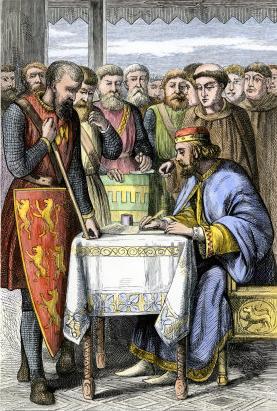
King John signs Magna Carta on June 15, 1215 at Runnymede; coloured wood engraving, 19th century.
Original artist unknown, held by the Granger Collection, New York. Image via Wikimedia Commons.
England does not really go in for national monuments, and when it does they are often eccentric. There is no great shrine to Alfred the Great, for example, the great founder of our nation, but we do have, right in the middle of London, a large marble memorial to the animals that gave their lives in the fight against fascism. And Runnymede, which you could say is the birthplace of English liberty, would be a deserted lay-by were it not for the Americans.
Beside the Thames, some 10 miles outside London’s western suburbs, this place “between Windsor and Staines”, as it is called in the original document, is a rather subdued spot, with the sound of constant traffic close by. Once there you might not know it was such a momentous place were it not for an enclosure with a small Romanesque circus, paid for by the American Association of Lawyers in 1957.
American lawyers are possibly not the most beloved group on earth, but it would be an awful world without them, and for that we must thank the men who on June 15, 1215 forced the king of England to agree to a document, “The Great Charter of the Liberties”.
Although John went back on the agreement almost immediately, and the country fell into civil war, by the end of the century Magna Carta had been written into English law; today, 800 years later, it is considered the most important legal document in history. As the great 18th-century statesman William Pitt the Elder put it, Magna Carta is “the Bible of the English Constitution”.
It was also, perhaps more importantly to the world, a huge influence on the United States. That is why today the doors to America’s Supreme Court feature eight panels showing great moments in legal history, one with an angry-looking King John facing a baron in 1215.
Magna Carta failed as a peace treaty, but after John’s death in 1216 the charter was reissued the following year, an act of desperation by the guardians of the new boy king Henry III. In 1300 his son Edward I reconfirmed the Charter when there was further discontent among the aristocracy; the monarch may have been lying to everyone in doing so, but he at least helped establish the precedent that kings were supposed to pretend to be bound by rules.
From then on Parliament often reaffirmed Magna Carta to the monarch, with 40 such announcements by 1400. Clause 39 heavily influenced the so-called “six statutes” of Edward III, which declared, among other things, that “no man, of whatever estate or condition he may be … could be dispossessed, imprisoned, or executed without due process of law”, the first time that phrase was used.
Magna Carta was last issued in 1423 and then barely referenced in the later 15th or 16th centuries, with the country going through periods of dynastic fighting followed by Tudor despotism and religious conflict. By Elizabeth I’s time, Magna Carta was so little cared about that Shakespeare’s play King John didn’t even mention it.


