
The Doolittle Board of 1945-1946 met, listened to less than half a hundred complaints, and made its recommendations. The so-called “caste system” of the Army was modified. Captains, by fiat, suddenly ceased to be gods, and sergeants, the hard-bitten backbone of any army, were told to try to be just some of the boys. Junior officers had a great deal of their power to discipline taken away from them. They could no longer inflict any real punishment, short of formal court-martial, nor could they easily reduce ineffective N.C.O.’s. Understandably, their own powers shaky, they cut the ground completely away from their N.C.O.’s.
A sergeant, by shouting at some sensitive yardbird, could get his captain into a lot of trouble. For the real effect of the Doolittle recommendations was psychological. Officers had not been made wholly powerless — but they felt that they had been slapped in the teeth. The officer corps, by 1946 again wholly professional, did not know how to live with the newer code.
One important thing was forgotten by the citizenry: by 1946 all the intellectual and sensitive types had said goodbye to the Army — they hoped for good. The new men coming in now were the kind of men who join armies the world over, blank-faced, unmolded — and they needed shaping. They got it; but it wasn’t the kind of shaping they needed.
Now an N.C.O. greeted new arrivals with a smile. Where once he would have told them they made him sick to his stomach, didn’t look tough enough to make a go of his outfit, he now led them meekly to his company commander. And this clean-cut young man, who once would have sat remote at the right hand of God in his orderly room, issuing orders that crackled like thunder, now smiled too. “Welcome aboard, gentlemen. I am your company commander; I’m here to help you. I’ll try to make your stay both pleasant and profitable.”
This was all very democratic and pleasant — but it is the nature of young men to get away with anything they can, and soon these young men found they could get away with plenty.
A soldier could tell a sergeant to blow it. In the old Army he might have been bashed, and found immediately what the rules were going to be. In the Canadian Army — which oddly enough no American liberals have found fascistic or bestial — he would have been marched in front of his company commander, had his pay reduced, perhaps even been confined for thirty days, with no damaging mark on his record. He would have learned, instantly, that orders are to be obeyed.
But in the new American Army, the sergeant reported such a case to his C.O. But the C.O. couldn’t do anything drastic or educational to the man; for any real action, he had to pass the case up higher. And nobody wanted to court-martial the man, to put a permanent damaging mark on his record. The most likely outcome was for the man to be chided for being rude, and requested to do better in the future.
Some privates, behind their smirks, liked it fine.
Pretty soon, the sergeants, realizing the score, started to fraternize with the men. Perhaps, through popularity, they could get something done. The junior officers, with no sergeants to knock heads, decided that the better part of valor was never to give an unpopular order.
The new legions carried the old names, displayed the old, proud colors, with their gallant battle streamers. The regimental mottoes still said things like “Can Do”. In their neat, fitted uniforms and new shiny boots — there was money for these — the troops looked good. Their appearance made the generals smile.
What they lacked couldn’t be seen, not until the guns sounded.
T.R. Fehrenbach, This Kind of War: A Study in Unpreparedness, 1963.
August 1, 2023
QotD: US Army culture before the Korean War
July 25, 2023
If you bet on Admiral Franchetti becoming the next CNO for the US Navy, collect your winnings
I don’t follow US military appointments closely because I’m not in the military, nor an American, so the first time I think I heard of Admiral Franchetti was back in May where Brent Ramsey’s report touted her as the one to watch for the upcoming appointment as the Chief of Naval Operations (she became VCNO in September 2022). Now, CDR Salamander confirms that Admiral Franchetti is almost certainly now the “CNO in waiting”:
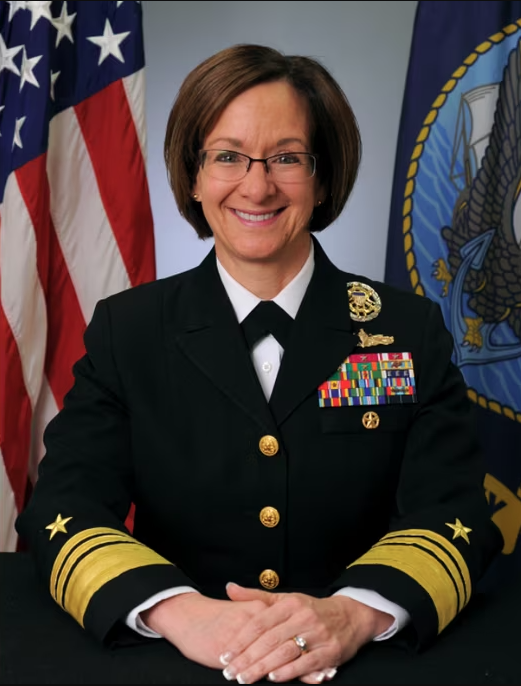
Admiral Lisa Franchetti, Vice-Chief of Naval Operations, US Navy.
I am sure that everyone here understands that at the end of last week white smoke rose over The Navy Yard signaling that we had an official nominee for the next Chief of Naval Operations (CNO).
Barring some Ottomanesque bureaucratic defenestration like we saw as Admiral Moran was set to be CNO after Admiral Richardson, the nominee to replace Admiral Gilday as CNO will be Admiral Franchetti — presently the Vice CNO.
Because people in DC can’t seem to keep their mouths shut when they should, unfortunately in mid-month there were some leaks coming out that Admiral Paparo would — surprisingly as the general consensus was the Franchetti was slotted to be the next CNO — be recommended to be the next CNO.
Read the link above it you’re interested in the state of play on the 13th, but things wound up heading as most thought with Franchetti getting the nod. Exceptionally well prepared for INDOPACOM, Paparo will head to there where he is expected to continue to do great and important things for the Navy and the nation it serves at at time where we have no luxury for a learning curve.
Despite Ramsey’s article not-so-subtly raising doubts about Admiral Franchetti’s qualifications for the post, CDR Salamander seems to be signally unruffled with the news:
Her wiki page has a nice concise summary;
Since promotion to flag rank, Franchetti has held appointments as: commander, United States Naval Forces Korea; commander Carrier Strike Group 9; commander, Carrier Strike Group 15; and chief of staff, Joint Staff, J-5, Strategy, Plans and Policy; and Commander, United States Sixth Fleet, Naval Striking and Support Forces NATO; deputy commander, United States Naval Forces Europe; deputy commander United States Naval Forces Africa; and Joint Force Maritime Component Commander.
- Western Pacific: she knows Korea and all associated areas. She also has Pappy coming in to INDOPACOM — an exceptional partner. I hope they have a solid professional relationship already.
- Fleet Challenges: from maintenance to readiness, her time leading CSG-9 and CSG-15 gave her a first person look at it. She knows it.
- JS J5: that speaks for itself.
- C6F et al: she knows Europe and has already built a working and personal relationship with many of her peers in NATO. She’s seen up close what they do and how they do it. Invaluable.
- VCNO: the most important. She’s seen OPNAV and the Potomac Flotilla up close. The greatest danger to her tenure as CNO — and as such our Navy and the nation it serves — is not spotty relationships with the SECNAV and his staff; it not Congress; is not the press; is not the economy; and it sure isn’t her Sailors writ large — no — the greatest threat is the long-dwell nomenklatura in a commuting distance of The Pentagon and The Hill who do not see their job as adjusting their responsibilities to support the CNO, but to bend the CNO towards their personal agendas, projects, and job security. There are some exceptional and valuable people there to support the CNO, but the organization is worm-ridden with rent seekers and bad actors. She’s seen that up close. She knows it.
Since making Flag, she managed to walk around all the rakes, had good luck and timing (part of any success), and she did a solid job as assigned. She has the right experience and performance.
I know a handful of people, some friends of mine for over two decades, who know her personally and have since they were both JOs. With one mild exception, these people I would trust my family with speak well of her. That combined with what I’ve seen in open source works for me.
July 22, 2023
QotD: “Managing” your way to victory
There is nothing wrong with good, sound management and management theory and management science (and, yes, I believe there actually is a such a thing) have much to teach us all, including governments and the military, about how to get the most from one’s always limited resources, especially time. But, too often, in my opinion, management becomes an end in itself and process replaces critical thinking and analysis. When this happens in both the political/bureaucratic and in the military realms, as I believe it has in Canada (which has tended, since about 1970, to follow the USA almost slavishly) then I believe that our national defence is in peril.
It is common, amongst military people, to accept that there is a “master principle of war”: Selection and Maintenance of the Aim. That means that one MUST understand what one is trying to do and then focus all one’s efforts on getting that done. The corollary is that if you don’t know what you need to be doing then getting the results you want (need) is unlikely. I believe that the Canadian Armed Forces lack good strategic direction because the Government of Canada, the Trudeau government, is unconcerned with anything past the next election. I also believe that the military leadership, lacking strategic direction, simply follows whatever new process seems to be popular in the Pentagon. Canadians, therefore, are not getting value for money from either the government they elected nor from the military forces for which they pay.
Ted Campbell, “Following the blind leader (3)”, Ted Campbell’s Point of View, 2019-05-21.
July 6, 2023
Ursula von der Leyen touted as NATO Secretary General Jens Stoltenberg’s successor
In Spiked, Fraser Myers is amazed at Ursula von der Leyen’s ability to rise above her own failures time after time:
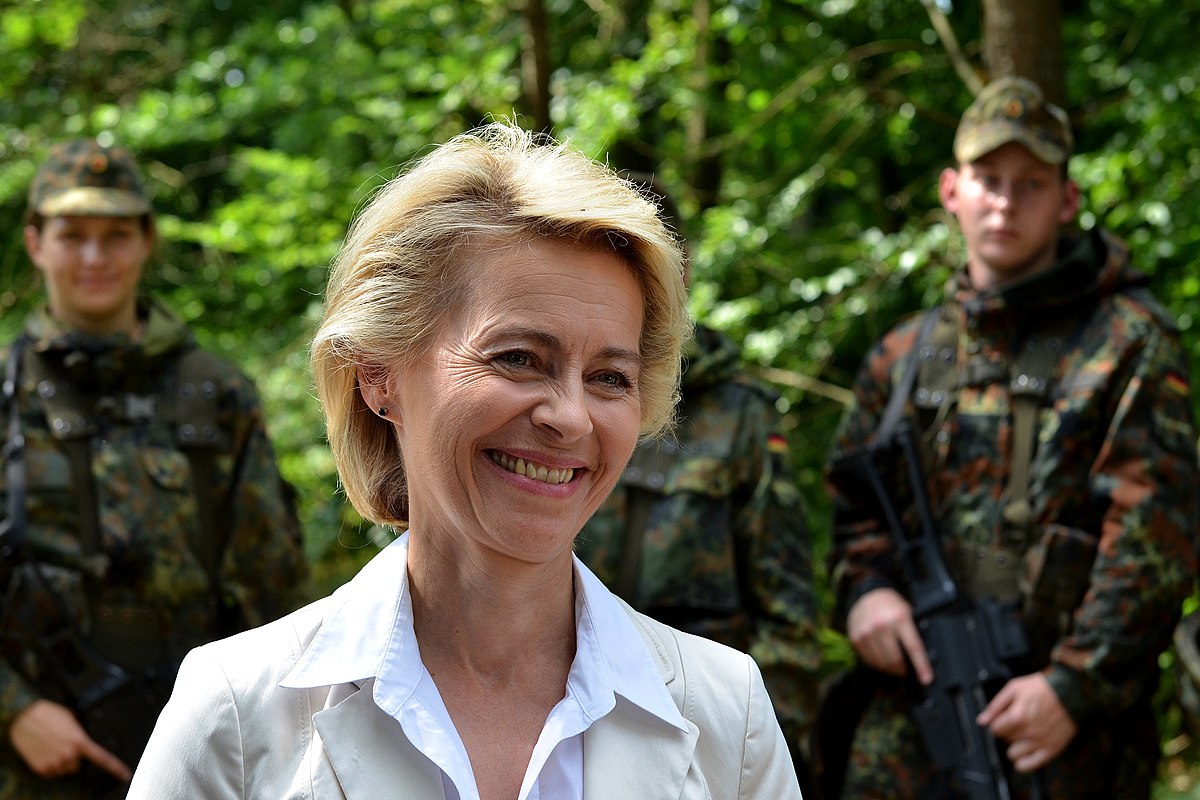
Ursula von der Leyen with German soldiers during a visit to the Field Marshal Rommel Barracks, Augustdorf, 17 July 2014.
Photo by Dirk Vorderstraße via Wikimedia Commons.
The political career of Ursula von der Leyen, president of the European Commission, has been defined by bungling and incompetence. She is deeply unpopular with voters, distrusted by colleagues and has regularly been mired in scandals. And yet, somehow, she manages to keep rising up the ranks of international politics.
Now von der Leyen has been tipped for another plum job on the global stage. According to reports in the Telegraph this week, US president Joe Biden is pushing for her to be named as secretary-general of NATO. He thinks she is best placed to replace Jens Stoltenberg when he steps down in 2024.
This ought to set off alarm bells. Whatever one thinks of NATO, there could hardly be a worse candidate to lead it than von der Leyen – especially right now, while war wages in Ukraine and NATO faces one of its most serious challenges in its 73-year existence.
Just look at her time leading the EU. She was parachuted into the role in 2019, unelected, over the heads of European citizens. She was a singularly unimpressive candidate. In fact, some argue that this was why she was selected. “When EU leaders picked von der Leyen … they deliberately eschewed candidates with greater experience, charisma or cunning”, according to a Bloomberg report. The European Council apparently wanted a Commission leader that it could easily push around. In the end, despite being the only candidate, she managed to persuade just nine MEPs to back her in the job.
MEPs were right to be sceptical. Her incompetence became all too clear when she faced her first major challenge as president – the Covid pandemic in 2020 and 2021. While von der Leyen boasted of taking “personal charge” of the EU’s vaccination programme, the rollout was infamously slow, lagging behind the rest of the world. At the time, fellow commissioners, civil servants and other officials were openly venting their distress with her leadership.
QotD: Liberalizing the US Army after WW2
And here it ruined them.
They had lived their lives in semibitter alienation from their own culture (What’s the matter, Colonel; can’t you make it on the outside?) but now they were sought after, offered jobs in business, government, on college campuses.
Humanly, the generals liked the acclaim. Humanly, they wanted it to continue. And when, as usual after all our wars, there came a great civilian clamor to change all the things in the army the civilians hadn’t liked, humanly, the generals could not find it in their hearts to tell the public to go to hell.
It was perfectly understandable that large numbers of men who served didn’t like the service. There was no reason why they should. They served only because there had been a dirty job that had to be done. Admittedly, the service was not perfect; no human institution having power over men can ever be. But many of the abuses the civilians complained about had come not from true professionals but from men with quickie diplomas, whose brass was much more apt to go to their heads than to those of men who had waited twenty years for leaves and eagles.
In 1945, somehow confusing the plumbers with the men who pulled the chain, the public demanded that the Army be changed to conform with decent, liberal society.
The generals could have told them to go to hell and made it stick. A few heads would have rolled, a few stars would have been lost. But without acquiescence Congress could no more emasculate the Army than it could alter the nature of the State Department. It could have abolished it, or weakened it even more than it did — but it could not have changed its nature. But the generals could not have retained their new popularity by antagonizing the public, and suddenly popularity was very important to them. Men such as Doolittle, Eisenhower, and Marshall rationalized. America, with postwar duties around the world, would need a bigger peacetime Army than ever before. Therefore, it needed to be popular with the people. And it should be made pleasant, so that more men would enlist. And since Congress wouldn’t do much about upping pay, every man should have a chance to become a sergeant, instead of one in twenty. But, democratically, sergeants would not draw much more pay than privates.
And since some officers and noncoms had abused their powers, rather than make sure officers and noncoms were better than ever, it would be simpler and more expedient — and popular — to reduce those powers. Since Americans were by nature egalitarian, the Army had better go that route too. Other professional people, such as doctors and clergymen, had special privileges — but officers, after all, had no place in the liberal society, and had better be cut down to size.
T.R. Fehrenbach, This Kind of War: A Study in Unpreparedness, 1963.
July 3, 2023
QotD: The key weakness of the royal cause in the English Civil War
[T]he power of the mighty hath no foundation, but in the opinion and belief of the people.
A king whose knights won’t ride out to battle on his behalf is just a weirdo in funny clothes. Charles I lost for a lot of reasons, but far from the least of them was that his “foundation” was badly cracked. However attached one might be to the notion of monarchy in the abstract, it – monarchy – is always intimately connected to the personality of the monarch … and Charles I was a real piece of work, even by the world-class standards of Renaissance princes. Parliament was outgunned, often outmanned, and suffered from what should’ve been a critical shortage of experienced leadership. But all those massive advantages were offset by the fact that the Royalist forces were fighting for Charles I, personally.
(This is not the place for a long discussion of the course of the English Civil Wars – and I’m not qualified to give you one in any case – but a quick look at the top commanders of the opposing sides will illustrate the point. Prince Rupert was arguably the equal, mano-a-mano, of any Parliamentary general, up to and including Cromwell. But he was still a Prince, and carried on like one (like a young one, to boot) … and even if he weren’t, he was still running the show on behalf of his uncle. Cromwell, on the other hand, inspired fanatic loyalty, not least because he embodied a cause that was much higher than himself).
Severian, “Hobbes (III)”, Founding Questions, 2020-12-12.
June 27, 2023
Uncancelled History with Douglas Murray | EP. 05 Winston Churchill
Nebulous Media
Published 20 Dec 2022Andrew Roberts joins Douglas Murray on this episode to discuss Winston Churchill. The two discuss the soldier, writer and prime minister in detail, leaving nothing off limits. Should the British Bulldog stay cancelled?
(more…)
June 22, 2023
CDR Salamander’s proposal to “encourage” NATO countries to meet or exceed their agreed defence targets
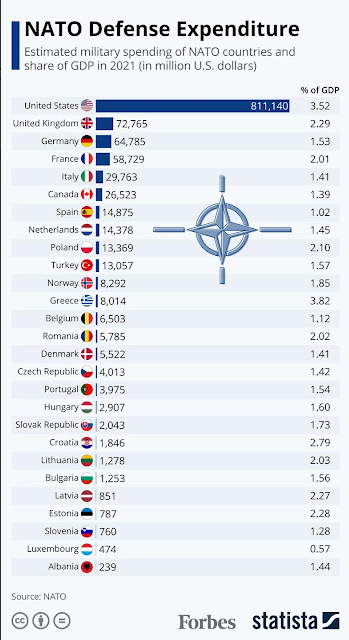
 Canada has been a notorious defence freeloader since the first Trudeau government took office in 1968. Every Canadian government since then — until the current government started telling our allies we had no intention of meeting our treaty commitments — has made more-or-less sincere noises about getting back to the 2% of GDP minimum defence budget and none have done much to make it happen (we’re around 1.39% at the moment). Several years ago, CDR Salamander proposed a new way to allocate NATO leadership roles according to how close to the minimum each member country has managed to get, and it’s surprising that something of the sort hasn’t already been implemented:
It should bring to the front that NATO can no longer allow unserious nations to play like they are anything but security free-riders. They need to contribute their fair share or pay some consequence. Alliances have benefits and responsibilities. You should not have one without the other.
While percentage of GDP is an imperfect measure of contribution, it is better than all the other ones. It is as simple benchmark of national effort.
As these are the best numbers we have, let’s look at 2021 and then forward.
It is amazing that after all Russia has shown Western Europe — both of its nature and the nature of modern warfare — that so many of our NATO allies continue to slow walk defense spending, doing the very minimum to be a full and fair partner in the alliance.
Russian victory — however they define it — or Russian defeat — however Ukraine defines it – will not change the geography or nature of Russia. She is not going anywhere.
[…]
There is so much deferred spending from our free-riding European allies.
Between 1999 and 2021, EU combined defence spending increased by 20%, according to reports by the European Defence Agency. That compares with a 66% increase by the US, and 292% by Russia and 592% by China, over the same period.
“Out years” are where dragons live, so anyone not on guide-slope to 2%+ by the end of 2023 — when one way or another the Russo-Ukrainian War should be over — will find someway to not get there in a wave of excuses and bluffing.
We should call their bluff.
As such, and this is generous, we need to finally pursue PLAN SALAMANDER for NATO “Flags-to-Post” that I first proposed almost six years ago.
In NATO, General and Flag Officer billets are distributed amongst nations in a rather complicated way, but this formula is controlled by NATO – and as such – can be changed.
Entering argument: take the present formula for “fair distribution” and multiply by .75 any nation that spends 1.5% to 1.99% GDP on defense. Multiply by .5 any nation that spends between 1.25% to 1.499%. Multiply by .25 1.0% to 1.240%. If you fall below 1%, you get nothing and your OF5 (Col./Capt) billets are halved.
1.25x for 2.01%-2.25%. 1.5X for 2.26%-2.75%; 1.75x for 2.76% -3.0%. 2x for +3.01%.
The math gets funky when a lot of people get over 2%, but we can refine it later. Doesn’t cost a penny and will unquestionably get the attention of those nations. Trust me on this. By January 1st, 2024 no more excuses. A small and symbolic punishment, but a good start that may be all that is needed. This is not the second half of the 20th Century any more.
June 14, 2023
QotD: In hindsight, calling it “Operation HONOUR” was quite ironic
Loyalty up, remember?
As a young soldier, I had actually worked for this particular NCO. He was an artifact of the Old Army and had a reputation as a hardman. He liked to brag about picking Friday night fights in Native bars out on the Prairies (he wore weighted gloves for extra knock-out power). He described to us in detail what he would do to his wife after a training weekend. He told us she would never say no, followed up with a chuckle and “like she has a choice”. If you were weak in his eyes, he’d belittle you publicly as a “queer” or a “faggot”. The funny thing was that this guy was overweight and never showed up for ruck marches or PT tests. His annual conduct-after-capture briefing was basically forty minutes of “you’re gonna get raped but that doesn’t make you gay”. One of his favourite war stories was about stray dog duty in Bosnia. He’d lure in the strays with peanut butter on the end of shotgun then blow their brains out. Riveting stuff.
Overnight I had gone from from being this man’s subordinate to being his superior, so when the General said we had a duty to report, I did my duty. The next week I was in front of the Regimental Sergeant-Major being asked why I was interfering with a strong NCO’s career prospects. That’s when I learned that loyalty up meant loyalty to the Regiment, and that sensitive matters such as this were handled internally and off the record. That one-way conversation was a major push towards putting in my application for the Regular Force. I didn’t want to be around that type of nonsense (“oh my sweet summer child” says the peanut gallery). Not long after I left, my former supervisor sexually assaulted the mess steward.
[…]
In February 2021, an investigation was opened into General Jonathan Vance, who had just finished his tenure as Chief of Defence Staff. Major Kellie Brennan, a subordinate of Vance at various times, accused him of a preventing her from disclosing their long-running affair. Since their relationship began in 2001, Vance had been married twice. DNA testing confirmed that Vance was the father of one of Brennan’s children, but he had never acknowledged or taken responsibility for the child. Vance plead guilty to obstruction of justice in March 2022 and received a conditional discharge with twelve months of probation.
The heat and light generated by an investigation of the outgoing Chief of Defence Staff led to an unprecedente level of scrutiny on the CAF’s senior leadership. In 2021 alone, the Governor General of Canada, the Minister of National Defence, the incoming Chief of Defence Staff, the Vice Chief of Defence Staff, Commander Canadian Special Operations Command, and Commander Military Personnel Command, amongst others, would resign, retire, or be re-assigned amidst allegations of impropriety. Since 2021, recruiting and retention levels have continued to free fall and the federal government has set aside $900 million in class-action lawsuit compensation for current and former CAF members who experienced sexual harassment, assualt, or discrimination. The social trap has been sprung.
“Shady Maples”, “A Question of Loyalty”, The Powder Horn, 2023-03-12.
June 13, 2023
After the Great War, the British army failed to plan for future conflicts
Robert Lyman outlines why Britain in general and the British army in particular were so materially and intellectually unready for the war that broke out in 1939:
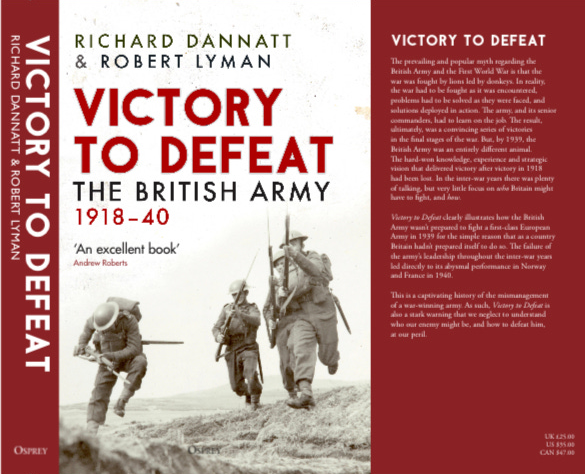
… the British Army was catastrophically unprepared for war in 1939. But it wasn’t just the Army that was unprepared. Despite a last-minute rush to re-arm, so too was the whole country. In Britain a deep-seated passivity had set in following the end the Great War. This belied the reality that in Europe the ending of the war in fact opened the door to unheralded political chaos and instability that was in time to overcome the forces of stability and would lead directly to yet another devastating war. In the years immediately following the arrival of peace in 1918 Britain hoped it could close the door on any future European or continent commitment and return to the halcyon days when its only security commitments were the defence of its widely flung Empire.
The weakness at the heart of British planning for war was a direct reflection of Britain’s strategic, political, societal and economic situation during the inter-war period. Britain – both the British public and the country’s various governments – simply wasn’t mentally prepared to go to war again so soon after the trauma of the Great War. As a result, it made no proper preparation for another full-on industrial war against a peer opponent on the continent. This was fundamentally a failure of political and military imagination; the inability to think through what a potential war might look like and to prepare for this possibility accordingly.
We have identified five primary causes of the decline of British military effectiveness in 1939. In the first place there was no clear strategic plan for the Army. Strategies are determined by having a clear understanding of who a future enemy might be. Following the end of the Great War, until the late 1930s no one seemed bothered to define this essential point of direction. There was a remarkably inadequate grand strategic conversation (i.e., at a national, governmental level) about the purpose, structure, and nature of the Army. There was plenty of talking, but very little of it focused on realistic determination as to who it might have to fight, and how. This was a problem, because it meant that Britain was unable to determine the precise structure its armed forces needed to be, and its cost. Was the focus of the army to be the continent, or the Empire, or both? No one knew. As a result, the last known plan reasserted itself – Imperial defence, à la 1914. This meant that the army wasn’t structured or equipped to fight a specified enemy in a defined set of circumstances. Instead, the British Army and its cousin, the Indian Army, was expected to be a generic jack-of-all-trades, without the structure, doctrine, training, or equipment to fight the type of war it had become the master of in 1918. While there was some doctrine, and considerable doctrinal debate, little was anchored in a clear definition of what future war was expected to look like. There was no operational design for the British Army derived directly from an analysis of the threat it faced. If it had done, the BEF would have been thoroughly prepared for the German Blitzkrieg in France and the Low Countries in 1940 or the similar Japanese Kirimoni Sakusen in 1941 and 1942. The British Army wasn’t prepared to fight a first-class European Army in 1939 for the simple reason that Britain hadn’t prepared itself to do so. Likewise, when it came to fighting the Japanese in 1941 and 1942 in Malaya and Burma, the British found that not only had it failed to prepare adequately for a potential Japanese invasion of its vulnerable Far Eastern colonies, but that it had no idea as to how to fight the Imperial Japanese Army. There were two connected failures here. The first was one of strategic preparedness, the blame for which was both governmental and strategic. The second was of training, doctrine and military preparedness by the British Army in Europe and Asia to fight. When they emerged out of their assault boats at Kota Bahru on the morning of 8 December 1942 the Japanese could as well have come from Mars, given how little the British knew about them and their warfighting methods.
Second, as a country, Britain was unprepared both politically and culturally for another war so soon after the last. In 1919 the country seemed to want to look backward to embrace the days of peace that had preceded the cataclysm of war, to drape itself with Edwardian comfort. It was tired and disillusioned, and felt no victor’s triumph. The country looked to itself, and to its Empire, eschewing the complications of commitments on continental Europe that had recently resulted in the loss of so much blood. The losses sustained in the Great War resulted in the overwhelming national sentiment that war must never again be undertaken as a form of politics. Clausewitz was dead. Part of this sentiment evidenced itself in the rise of pacifism. In the army, a pervasive belief existed that the Great War was an aberration, and nothing like it would again afflict western civilisation. Any lessons from the war were therefore irrelevant to the future structures or doctrine of the British Army, for whom the defence of the Empire was the crucial issue. But whether it liked it or not, the world was changing fast, in ways that Britain struggled to comprehend and from which it could not ultimately escape. The Russian Revolution, the rise of fascist dictators in Europe, isolationism in the USA (except for a new American assertiveness in Asia) and the increasing militancy of Japan, began changing the global landscape in ways that were hard to understand for a country seemingly once in total charge of the certainties of statecraft. Now it struggled to find its way in a new world of tension, turmoil and rapid change.
Third, no one in the British Army thought to capture the reasons for operational success in 1918. The dramatic reduction in troops numbers at the end of the Great War meant that those best able to convert the learning from 1918 into doctrine left for civilian life, taking their knowledge and experience with them. It was never recovered. There was therefore no template in the years afterward on which to build a successful military doctrine based on the successful warfighting experience that had culminated in the victories of 1918.
Fourth, political naivety led to a dramatic economic stringency being applied, including the underlying Treasury assumption in the early 1920’s of the ‘Ten Year Rule’, an assumption that kept rolling over, year after year. This meant that there wasn’t enough money to do what was necessary to protect British interests from impending harm. The Army butter was thinly spread on the imperial bread, with the result that insufficient investment was made in the core of the army’s warfighting capability. This stringency was exacerbated by the impact of the Great Depression at the end of the 1920s into the early years of the next decade.
June 2, 2023
“Montgomery was a military talent; Slim was a military genius”
Dr. Robert Lyman is a known fan of Field Marshal Slim (as am I, for the record), not only for his brilliant military achievements, but also as a writer:
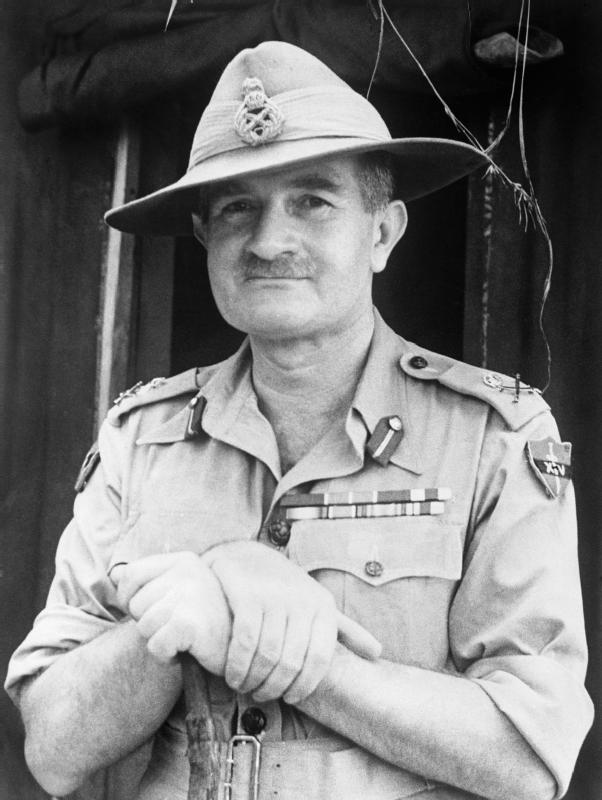
Field Marshal Sir William Slim (1891-1970), during his time as GOC XIVth Army.
Portrait by No. 9 Army Film & Photographic Unit via Wikimedia Commons.
How many British generals have been able to write as well as they could fight? Strangely perhaps, quite a few. Field Marshal Sir Michael Carver (Dilemmas of the Desert War, The Seven Ages of the British Army), General Sir David Fraser (And We Shall Shock Them), General Sir John Hackett (The Third World War) and Major General John Strawson (Beggars in Red) are four outstanding soldier-writers that spring immediately to mind. Even Monty wrote his memoirs. And in our own day I’ve read plenty of competent books from a slew of men who’ve reached the top of the profession of arms. The work of some, like that of General Sir Richard Sherriff (2017: War with Russia), Major General Mungo Melvin (Manstein) and Brigadier Allan Mallinson (Too Important for the Generals et al), could be described as outstanding. Julian Thompson and Richard Dannatt also fit this bill. But by far and away the best of Britain’s soldier-writers in the last century was also probably the greatest soldier – and field commander – of them all: Bill Slim. He was, more properly, Field Marshal William J. Slim KG, GCB, GCMG, GCVO, GBE, DSO, MC, KStJ, the onetime General Officer Commanding the famous 14th Army – the so-called Forgotten Army – of Burma fame. He was, in this author’s view, the greatest British general of the last war (to avoid further debate, let’s just agree that Monty failed as a coalition commander, whereas Slim excelled). Slim’s ability as a general is perfectly summed up by the historian Frank McLynn:
Slim’s encirclement of the Japanese on the Irrawaddy deserves to rank with the great military achievements of all time – Alexander at Gaugamela in 331 BC, Hannibal at Cannae (216 BC), Julius Caesar at Alesia (58 BC), the Mongol general Subudei at Mohi (1241) or Napoleon at Austerlitz (1805). The often made – but actually ludicrous – comparison between Montgomery and Slim is relevant here … there is no Montgomery equivalent of the Irrawaddy campaign … Montgomery was a military talent; Slim was a military genius.1
Some hint of Bill Slim’s fluency with the written word to complement his ability as a soldier came with the publication of Defeat into Victory in 1956, his superb retelling of the Burma story. Apart from its remarkable tale – the humiliation of British Arms in 1942 eventually overturned by a triumphant (and largely Indian) army in 1945 (87% of Slim’s army was Indian) – the quality of the writing was astonishing. Its author, a man who would be appointed Chief of the Imperial General Staff in 1949 (following Monty), the first Sepoy General ever to do so, and by Attlee no less, could clearly wield a pen every bit as he could destroy Japanese armies in battle (a feat he achieved twice, first in 1944 and again in 1945). When the book was first published it was an instant publishing sensation with the first edition of 20,000 selling out immediately. The Field recorded: “Of all the world’s greatest records of war and military adventure, this story must surely take its place among the greatest. It is told with a wealth of human understanding, a gift of vivid description, and a revelation of the indomitable spirit of the fighting man that can seldom have been equalled – let alone surpassed – in military history.” The London Evening Standard was as effusive in its praise: “He has written the best general’s book of World War II. Nobody who reads his account of the war, meticulously honest yet deeply moving, will doubt that here is a soldier of stature and a man among men.” The author John Masters, who served in the 14th Army, wrote in the New York Times on 19 November 1961 that it was “a dramatic story with one principal character and several hundred subordinate characters”, arguing that Slim was “an expert soldier and an expert writer”. The book remains a best seller today.
The following year Slim also published an anthology of speeches and lectures, loosely based on the theme of leadership, called Courage and Other Broadcasts. Then in 1959 he published his second book, Unofficial History, which bears out in full Masters’ description of Slim as a superb writer. It was a deeply personal, honest though light hearted account of events during his service. It received widespread acclaim. The author John Connell described it as “for the most part uproarious fun. If Bill Slim hadn’t been a first-rate soldier, what a short story writer he might have made.” For its part, The National Review wrote: “One of the most significant aspects of Field Marshal Slim’s book is the affectionate respect he shows when he writes about British and Indian soldiers. He finds plenty to amuse him too. I doubt whether a kindlier or truer description of the contemporary soldier has been given anywhere than in Unofficial History … It is one of the most delightful and amusing books about modern campaigning I have ever read.”
1. The General Wondered Why https://amzn.eu/d/45gHfOH
May 9, 2023
QotD: Changing German Panzer tactics in 1943
The following report, though obviously written in haste with little regard for elegance of expression, gives a good view of the changes in tank tactics which took place on the Eastern Front. This translation was made from a typed copy of the original and thus bears no signature. Nonetheless, there is good reason to believe that the author was the famous Fridolin von Senger und Etterlin, who commanded the 17th Armored Division at this time.
1. The tank tactics which led to the great successes of the years 1939, 1940, and 1941 must now be considered obsolete. Even if it were possible today to breakthrough an antitank front by means of the massive employment of concentrated waves of tanks, we would not be able to make use of these methods, which would once more lead to considerable losses, because of our [tank] production situation. These methods, often employed in rapid succession, would lead to such a quick reduction in tank strength that the character of an armored division would be fundamentally altered. This would lead to difficulties for the higher leadership.
The change in tank tactics is logical. The beginning successes of the weapon, the shock effect of which rested upon the technical achievement and overwhelming invincibility of the attacker, found at last its end in the development of appropriate defenses. From the point of view of production, the building of tanks could not keep pace with the building of antitank weapons. Apparently, a thousand antitank rifles, or dozens of antitank guns, can roll off the production lines for every tank.
The following are drawn from these insights.
2. The new tank tactics, which have already gained inevitable acceptance in the divisions, are outlined below.
The tank group no longer forms the nucleus of the armored division, about which other weapons are grouped as auxiliaries. The tank is a new arm acting in concert with and equal to the old arms. In cooperation with other weapons, it retains its power, even though its numbers are far below those called for by tables of organization.
Its meaning as a new arm is a function of the fact that it combines in itself a goodly portion of the two elements important to the attack: fire and maneuver. It derives these qualities from the fact that it is invulnerable, or less vulnerable, because of its armor.
Because the tank arm combines in itself firepower and mobility to a greater degree than other arms, it is the appropriate weapon for forming the main effort [Schwerpunkt].
The combat of the armored division is characterized by the fact that it is a mobile unit in all its parts and, as a result, the division commander is in a position, in the course of a battle, to chose and form a main effort [Schwerpunkt]. This principle excludes an irrevocable commitment of the tank group before an attack. Rigid employment within the framework of an already established battle plan is replaced by division commander himself holding [the tank group] in readiness and the flexibly employing it in the course of fighting against the required, or known to be appropriate, position.
The battle will begin with the infantry attack. The infantry attack provides the required foundation for the strength of the antitank front, for its length and depth. If the antitank front is known, then the tank attack can be ordered according to the classical principles for leading mobile units against the flanks or, if possible the rear, of an enemy defensive position. This attack should only be carried out exclusively by tanks when they can gain complete surprise. If surprise cannot be gained, then in this flank attack fire superiority must be fought for through the employment of artillery and, for the time being and to a certain extent the fire of the tanks themselves, until the enemy antitank front can be shaken or at least split up. If surprise can be gained, then a break-in against the flank of an antitank front can succeed without preparatory fire.
The attack against an enemy antitank front by means of a successful move against its flanks and rear cannot be carried out by tanks alone. It requires the support of artillery. In our experience, however, tank attacks carried out against the flanks and rear have outrun the artillery groups in direct support. Shifting fires by means of forward observers alone is not enough to ensure the shooting up of defensive fronts. What is needed here is thus the self-propelled batteries, which in the same manner as tanks themselves can quickly change their firing positions and thus attain the same mobility as the tank groups.
3. Now that these principles of the new tactics have been laid out, their use in practice will be explained.
a. The use of tanks as the first attack wave against a strongly fortified, deeply organized defensive position leads always to great losses and is thus false.
b. The use of tanks against deeply organized antitank positions is possible with the stipulation that it be commanded by an all-arms leader in close cooperation with other weapons after the formation of a main effort on the spot and that the further prosecution of the battle be steered by the same all-arms leader.
c. The employment of tanks leads to the greatest success when, sent into action and controlled by the all-arms leader, when they are used to strike the enemy in the flank, soon after the latter has begun an attack and before his antitank weapons have established firm antitank positions. Also in this last case, the attack must, with a view to direction and timing, be ordered by the all-arms leader on the spot. (With this last method the weak forces of the worn out 17th Armored Division annihilated one enemy division at Kuteinikowskaja on the 5th of January 1943 and another at Talowaja on the 27th of January, 1943.)
4. These new tactics are based upon the cooperation of the three main arms (infantry, tanks, and artillery) during the entire course of a battle. This cooperation can only be assured when the leader, that is to say, in all cases where the mass of the division is employed, the division commander himself, controls the cooperation of the arms on the spot throughout the entire battle. If, under the press of circumstance, as generally was the case during the battles between the Don and the Volga, widely separated battle groups [Kampfgruppen] of infantry, tanks and artillery had to be formed, it is essential that each of these battle groups be commanded by an all-arms leader, who is neither the commander of the tank element nor the infantry element of the battlegroup.
The all-arms leader’s means of command is the 10-watt radio built into a tank. With this equipment the leader is connected with the tank leaders as well as the leader of the infantry group, who, in case the proper radios are lacking, is provided with a tank. The all-arms commander is also in contact, by means of his armored personnel carrier, with battlegroups not forming part of the main effort and with his first general staff officer (Ia) working far to the rear.
The leader of the artillery group locates himself, according to the ordinary rules of command and control, with the all-arms leader. He is able, as was explained above, to give effective support only as the leader of an artillery group made up of self-propelled batteries. If he does not have access to some of these, there is always the danger the leader of the tank group would find his mobility limited by being bound to the less mobile towed artillery supporting him.
The place of the leader in combat is far forward, so that he can easily see the tank combat and, on the basis of these observations, can steer the course of the battle. He is sufficiently separated from the forward wave of tanks that he does not get involved in the tank-versus-tank and tank-versus-antitank battles, for this combat will focus his attention on the tanks fighting in the forward lines, to the point where tactical decisions which derive from the cooperation of all arms, can no longer be made.
The place of the leader can, however, rarely be chosen outside of the zone of enemy artillery fire. He can nevertheless remain mobile, thanks to the peculiar virtues of his means of command, namely voice radio. In the course of an attack in progress, he should be far enough forward to allow contact with the infantry group. Through it he can exert the leadership of a combined arms combat.
an armored personnel carrier used as a mobile command post in Russia in 1941From his location the leader should be in a position to himself assemble, according to the development of the situation and the requirements of the cooperation of arms, discrete tank groups.
Cooperation between discrete tank groups and infantry groups is possible if the all-arms leader remains in voice radio contact with the tank group in question. The attachment of tank groups to infantry groups is, as a matter of principle, always to be avoided. The infantry is not in a position to ensure the cooperation of infantry, heavy infantry weapons, and artillery as well as tanks because it is fully occupied with the conduct of the combat of other weapons. On this basis, the attachment of tanks to infantry divisions, which cannot be trained in the cooperation of the three arms, is, as a matter of principle, to be avoided.
The requirement to achieve success by the cooperation of all three arms does not exclude the concentration of all tanks in a single attack. This is still to be striven for. The concentration of tank power in the main effort [Schwerpunkt] will, however, not to striven for through systematic employment on the basis of an established plan, but rather in the course of the battle through the assembling of certain tank groups, in short, through the flexible combat leadership and formation of the main effort [Schwerpunkt] in the course of the battle through the all-arms leader himself.
This battle method, which aims at the close cooperation of the three main arms, cannot function without the formation of a special infantry group mounted in armored personnel carriers. Because it is essentially different, this group does not belong with the wheeled-vehicle mounted infantry of the division. They form, rather, an integrated part of the tank group. They can be attached to the later or will be employed according to the decision of the all-arms leader in accordance with the same principles that apply to the employment of tank waves.
The armored personnel carrier group of the infantry which is attached to the tank group corresponds closely to the self-propelled artillery. Both are special branches of their main arm, which work within the tank group itself and without which the cooperation of the tank group with the mass of the truck-mounted infantry and the towed artillery would not be possible.
5. The following deductions for the construction of tanks can be drawn from the aforementioned portrayal of the tactics and command techniques of the armored division. Because the race between tanks and anti-tank defenses can only be won by even heavier types and thus can not be guaranteed, the focus of effort [Schwerpunkt] in construction must be towards mobility and firepower.
The cooperation of arms can never be so close that artillery-infantry attacks alone can prepare an antitank front so that the tank attack can break through it in a rapid rollover. Instead, tanks must be an a position to use long-range fire to put anti-tank fronts out of action or at least so suppress them so as to make possible the further prosecution of the attack. They are only in a position to do this when they possess weapons of such a caliber that they can win superiority over immobile antitank weapons by means of fire and mobility.
According to this line of reasoning, great things can be expected from the creation of self-propelled artillery batteries. As unarmored fire units with greater range than tanks themselves they are in a position to attain that fire superiority which is necessary to gain the upper hand against the antitank defense.
During this winter’s fighting the best results were gained from assault gun battalions which, because of their great mobility and firepower, were employed and led in the same way as tanks. From the point of view of mobility, they outdid the tanks. Self- propelled guns were likewise successfully employed according to the same principles, to augment tank and assault gun groups, particularly by fire.
In contrast, the Tiger tanks, which were supposed to have fulfilled all three requirements, namely firepower, mobility, and heavy armor, were less successful, for their mobility was not sufficient for the elastic battle leadership outlined above. (In this experience it is important to take into account that the units sent fresh into battle were not at the height of their powers, especially where the use of radio was concerned. The impression of their lack of mobility, especially in rolling country with hard-frozen ground, however, would have been the same, even if the training of the personnel had been completed.)
These lessons of the more and more similar tactics of tanks, assault guns, and self-propelled artillery, which in more or less ad hoc arrangements establish the principle of fast-moving heavy firepower, causes one to wish that these weapons could be organized under a single leader with the goal of combining under him standardized training and well-schooled cooperation. This commander is the commander of the division’s tank group, that is to say, all more or less armored weapons mounted on tracked vehicles that are used for the fire battle. He must also have attached as an essential part an infantry group mounted in armored personnel carriers which should be made available according to a ratio of at least one infantry company for each three tank companies of whatever type.
The self-propelled artillery battalion should not be made an organic part of the tank group because of artillery training and the proposed design that will allow the guns to be dismounted. It should remain an organic part of the artillery regiment and be as- signed, on a case by case basis, to the commander of the tank group.
Unsigned report, probably authored by Fridolin von Senger und Etterlin, who commanded 17th Panzer Division at that time, via Bruce Gudmundsson’s Tactical Notebook, 2023-02-06.
May 5, 2023
The kinder, gentler US Naval War College
CDR Salamander on a recent symposium at the U.S. Naval War College, showing just how much the American military has adapted itself to the Current Year:

Let’s take a look around the planet with a maritime national security lens, shall we?
- The largest land war in Europe since WWII is raging on the north shore of the Black Sea.
- The People’s Republic of China surpassed the United States of America as the world’s largest navy.
- The Iranians are hijacking oil tankers willy-nilly.
- The Western economy relies on undersea cables & pipelines we have allowed to go undefended and are now the subject of attention by mal-actors on the world stage.
- The Navy is experiencing readiness and recruiting problems not seen since the 1970s.
There’s my top-5 off the top of my head this AM, yours may differ.
It sure seems to differ in Newport.
So, in the last week of April there was a 2-day symposium at the U.S. Naval War College, an opportune time to examine the most critically important challenges in 2023 — hopefully from a maritime perspective — wouldn’t you think?
Any conference, especially a 2-day affair with both on and off campus event locations, sure cost a lot of money and even more stacked manhours to plan, attend, participate, and manage.
We sure want to make sure the juice is worth the squeeze, right?
If you’re a regular here, you know where this is going. I warned everyone about this back in 2017. If you’re a new reader not fully up to speed on the broader portfolio we manage here at CDRSalamander, well, take a red pill and a seat.
Our war colleges are not what you think they are.
With each passing year there is less focus on war, and more on college. At the Naval War College, just getting additional time, money, faculty, and leadership focus on the “naval” portion has become a challenge with all the other ancillary agendas trying to keep pace with the cool kids cross-town at Salve Regina University.
Here’s a perfect example.
The Naval War College (NWC) will host its 9th annual Women, Peace and Security (WPS) Symposium, 26-28 April 2023, in Newport, Rhode Island. This year’s theme is “Women, Peace, and Security in a Fragile World: Perspectives on Warfighting, Crisis Management, and Post-Conflict Transitions“.
Well, let’s go in with an open mind. Perhaps there’s something here. Hope isn’t a plan, but when the Party demands things of you, hope is often all you have.
If you voluntarily attended (I am reliably told that Party cadre informed the proles that attendance was required for staff, at least online), what kind of panel discussions would you be able to listen to? Let’s browse over the agenda.
In totally unrelated news, Brent Ramsey updates the odds on who will be promoted to be the US Navy’s next Chief of Naval Operations:
Admiral Lisa Franchetti, Vice-Chief of Naval Operations, US Navy.
Last September, the Navy promoted and installed a new Vice Chief of Naval Operations. Then Vice Admiral Lisa Franchetti got her 4th star and was appointed to the second-highest position in the Navy. Now after a scant seven months, the betting line going around D.C. is that she will likely be the next CNO based on the identity politics track record of President Biden. When President Biden had an opportunity to appoint to the Supreme Court, before assessing anyone’s qualifications, he announced that a black woman would get that seat, and he followed up on that promise. Would an identity-based selection for the Navy’s top leader be in the best interest of the Navy and the Nation? No, the nation needs and deserves the very best warrior to lead the Navy into our threatened future.
Admiral Franchetti is a journalism graduate of Northwestern University NROTC, a non-STEM degree which itself is unusual, as the Navy strongly favors STEM degrees for officers. She has a Master’s Degree in organizational management from the University of Phoenix, an online university. Her biography does not mention any war college credential. In contrast, her predecessor Admiral William Lescher had multiple commands in combat zones, was a test pilot, had multiple advanced degrees in naval technical fields and his commands won multiple combat zone merit awards. To naval professionals, for someone to have been promoted to the Navy’s highest rank and second highest position based on a NROTC commissioning source with a liberal arts degree, an online masters, no war college or combat zone credentials, would be considered inconceivable. Perhaps her success is based on a particularly spectacular service record?
Admiral Franchetti’s career path reveals sea tours on a tender, oiler, and three destroyers including command of the USS Ross (DDG-71) and command of a destroyer squadron. Her biography does not mention any of her commands received awards while she was in command.
I’m not a betting man, but if I was, I think I’d be putting down a few jellybeans on Admiral Franchetti’s next posting …
May 2, 2023
Si vis pacem, para bellum
CDR Salamander suggests that the “War Gods of the Copybook Headings” are not happy with us, and he’s probably right:

Relief at the entrance of the Cultural Center of the Armies (formerly the Serviceman’s Casino) of Madrid (Spain), showing the Latin phrase Si vis pacem, para bellum (If you want peace, prepare for war).
Photo by Luis Garcia (Zaqarbal) via Wikimedia Commons.
Mindsets are universal.
Yes, no one can see the future. Of course, it is easy to play “got-cha” in hindsight. Yes to all the excuses … but that isn’t the point.
Two things to keep in mind as you read the below:
- Our “experts” may lack broad expertise. Always question. Defer only when earned.
- We have a horrible record of predicting even the predictable for a whole host of reasons, most bureaucratic.
- At peace, assume you have leaders who can only imagine peace unless they actively demonstrate otherwise, that they will plan and act in line with their priors. When war comes, it will be up to others to fix things (as they say in the movies, “When they get in trouble, they send for the sons of bitches“.). The harder peacetime leaders are pressed by those who understand the constants of history, the less difficult the fix will be when war comes.
This is one of the virtue/vice dualities of democratic states. In peacetime, there is no political appetite for military spending and no political party will be eager to provide the opportunity to be accused of warmongering. An opposition party might briefly call attention to defects in the standing military, but only to embarrass the governing party, not because they would address the problem if they were in power. There may be widespread passive support for the military, but this isn’t represented at the ballot box because there are always far more urgent issues that drive how the voters allocate their support … and military spending is a lot of money put into things that don’t fix the roads, improve public health, address law and order concerns, or clean the environment.
Peacetime military establishments are huge bureaucracies at the best of times, and those who want to rise through the bureaucracy need to learn how use the same tools, schemes, and stratagems as in every other civil service organization. The longer a country has been at peace, the less capable the military administration will be of transitioning to a war footing. If you haven’t seen war in twenty years or more, then every officer up to the very top of the chain of command got there not for being a good soldier/sailor/airman but for being a good peacetime manager and administrator. This is totally normal, as is the massive disruption when a real war is imminent. If you’re lucky, some of those administrators-in-uniform can make the transition to being combat leaders quickly, but many of them will not be able or willing (it’s just human nature to resent and resist sudden change of long-standing practice).
Well meaning people can be wrong. Just because they are well meaning and have tenure-reputation-rank should not mean that everyone has to defer to them or their plans.
Good leaders with sound ideas and well developed plans will welcome hard questions and informed challenges.
Bad leaders with weak ideas and compromised plans will be defensive, flinty, and more often than not will resort to appeals to authority or credentialism. Those are your warning signs.
Sadly, highly isolated decision nodes — think the Transformationalists in the first half of the ’00s — don’t think they are wrong. They have filtered their information sources and filled out their staffs with either clones or the obsequious — often found in the same person.
They are the ones who have a blinkered focus on usually something far on the horizon that can’t be measured right now — but is very attractive to them for reasons of either a broader ignorance, ego, or monetary.
They don’t fully accept “risk” – they dismiss it.
In the area of national security — such a mindset and practice can create an existential crisis and it comes from hubris.
Smart people who are so convinced of their wisdom without humility will filter out any concerns, and won’t allow questions that might challenge their wisdom.
They may be right as they didn’t, mostly, get to where they were by being wrong — and they don’t consider they may not be and hedge accordingly.
April 23, 2023
QotD: Developing “multi-disciplinary teams”
The power struggles are interminable and insoluble, for no one is truly in charge and any instructions are regarded as an infringement of or attack upon the idea of equality of disciplines and equality within disciplines. The pretence that the most junior is equal to the most senior means that supervision scarcely happens, or only retrospectively, after a disaster, when the most junior person who can plausibly be blamed is singled out.
The inevitable squabbles that result lead to accusations of bullying, usually defined in purely subjective terms: you are bullied if you feel you are (in the absence of a requirement of objective correlates of feeling, thought is, of course, quite unnecessary and probably best avoided). Such accusations can result in a Kafka-esque procedure lasting months and occupying days, weeks and months of labour-time.
Meanwhile, neglect of the real work is ascribed to a shortage of “resources” and the object of the team’s attentions, that is to say members of the public, are offered perfunctory services, for example never seeing the same member of the team twice. Between holidays, team meetings and courses on how to make the team function better, there is no time left for the elementary compassion of consistency.
Every public enquiry into every disaster that comes within the remit of the services set up to ameliorate the social pathology brought about by years of social engineering finds the same thing: lack of communication between the various parts of the multi-disciplinary teams. Time, surely, for a course on Communication Skills.
Theodore Dalrymple, “Workshops and why you must avoid them”, The Social Affairs Unit, 2009-11-18.


