Quotulatiousness

March 11, 2019

QotD: The purpose of language

Filed under: Business, Quotations — Tags: — Nicholas @ 01:00

But back to the mystics in general. I refuse to be swallowed up by their bullshit, nor do I allow myself to feel in any way inferior to their apparent greater knowledge. I once listened to some consultant describe a proposed change, and the description was filled with consultant-jargon — oh yes, they too have to impress clients with their insider language — and when he was done, I said, as succinctly as I could: “I didn’t understand a single thing you just said. Could you restate it, but in plain English this time?”

“Oh,” he stammered, “I simply meant that we need to streamline the process to shorten our product’s time-to-market.”
“You mean, the time between the thing’s production and its appearance on the retailer’s shelf?”
“Yes.”
“Then why didn’t you just say that, instead of having me waste both our time by getting you to explain it to me?”

Roger Moore put it best, I think: “The point of language is to communicate your thoughts in the shortest possible time and in the clearest possible way.” My corollary to that excellent sentiment is, “And if somebody is not doing that, he’s pursuing a different agenda or has something he wishes to disguise.”

And finally, I should point out that Moore’s “clarity” does not equal “simplistic” (I nearly wrote simplisme, but you guys would have chased me from the room, and justifiably so).

Semper claritas should be your guiding principle.

Kim du Toit, “Mystics”, Splendid Isolation, 2017-03-28.

February 21, 2019

Simplified, consistent English

Filed under: Humour — Tags: , , — Nicholas @ 06:00

You may have encountered this short article usually attributed to Mark Twain (or alternatively to M.J. Shields in a letter to The Economist):

For example, in Year 1 that useless letter “c” would be dropped to be replased either by “k” or “s”, and likewise “x” would no longer be part of the alphabet. The only kase in which “c” would be retained would be the “ch” formation, which will be dealt with later. Year 2 might reform “w” spelling, so that “which” and “one” would take the same konsonant, wile Year 3 might well abolish “y” replasing it with “i” and Iear 4 might fiks the “g/j” anomali wonse and for all.

Jenerally, then, the improvement would kontinue iear bai iear with Iear 5 doing awai with useless double konsonants, and Iears 6-12 or so modifaiing vowlz and the rimeining voist and unvoist konsonants. Bai Iear 15 or sou, it wud fainali bi posibl tu meik ius ov thi ridandant letez “c”, “y” and “x” — bai now jast a memori in the maindz ov ould doderez — tu riplais “ch”, “sh”, and “th” rispektivli.

Fainali, xen, aafte sam 20 iers ov orxogrefkl riform, wi wud hev a lojikl, kohirnt speling in ius xrewawt xe Ingliy-spiking werld.

Along the same lines, here’s a new take on the idea of making the English language phonetically consistent:

H/T to Rob Beschizza for the link.

February 19, 2019

QotD: Internal contradictions of political correctness

… there was an article in the magazine arguing, on what might loosely be called philosophical grounds, for an end to the separation of men and women in sports. Women tennis players, for example, should compete against men, even if this means (as it does) that no woman could ever again make a living as a tennis player. In the name of equality of the sexes, one sex should be eliminated from a whole field of endeavor. Presumably, also, there should be no concessions for the handicapped, who would be forced to compete not against those similarly handicapped but against the fully fit.

Though this be madness, yet there is method in it: For the greater political correctness’ violation of common sense, the better — at least if its goal is power over men’s minds and conduct. In this sense it is like Communist propaganda of old: The greater the disparity between the claims of that propaganda and the everyday experience of those at whom it was directed, the greater the humiliation suffered by the latter, especially when they were obliged to repeat it, thus destroying their ability to resist, even in the secret corners of their heart. That is why the politically correct insist that everyone uses their language: Unlike what the press is supposed to do, the politically correct speak power to truth.

One of the strange things about the politically correct is that they never seem to become bored with their own thoughts. And this leads to a dilemma for those who oppose political correctness, for to be constantly arguing against bores is to become a bore oneself. On the other hand, not to argue against them is to let them win by default. To argue against rubbish is to immerse oneself in rubbish; not to argue against rubbish is to allow it to triumph. All that is necessary for humbug to triumph is for honest men to say nothing.

Theodore Dalrymple, “Two Forms of Mass Hysteria”, Taki’s Magazine, 2017-03-11.

February 13, 2019

The origins of the word “loot”

Filed under: Britain, History, India — Tags: , , , , , — Nicholas @ 03:00

William Dalrymple wrote about the Honourable East India Company for the Guardian a few years back, including the way the word “loot” entered common English usage:

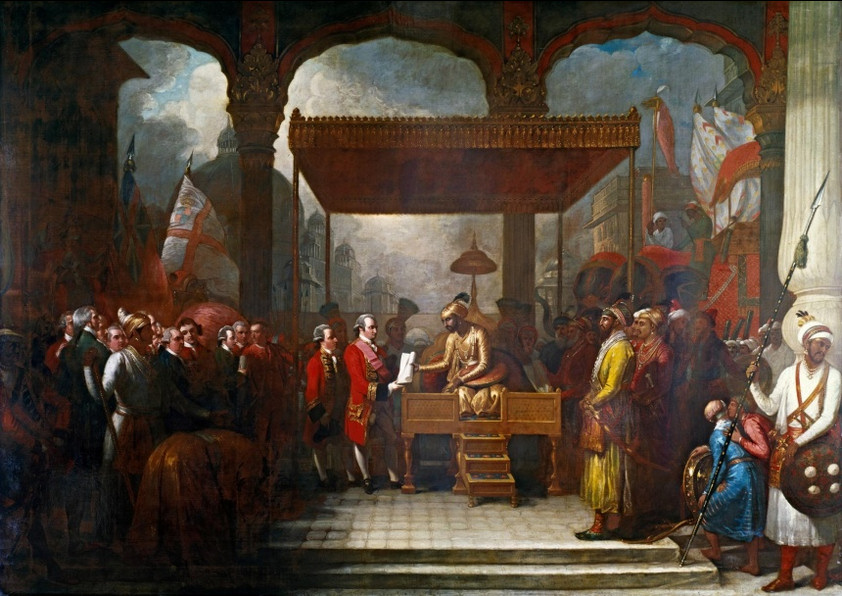
The Mughal emperor Shah Alam hands a scroll to Robert Clive, the governor of Bengal, which transferred tax collecting rights in Bengal, Bihar and Orissa to the East India Company, August 1765.
Oil painting by Benjamin West (1738-1820) via Wikimedia Commons.

One of the very first Indian words to enter the English language was the Hindustani slang for plunder: “loot”. According to the Oxford English Dictionary, this word was rarely heard outside the plains of north India until the late 18th century, when it suddenly became a common term across Britain. To understand how and why it took root and flourished in so distant a landscape, one need only visit Powis Castle.

The last hereditary Welsh prince, Owain Gruffydd ap Gwenwynwyn, built Powis castle as a craggy fort in the 13th century; the estate was his reward for abandoning Wales to the rule of the English monarchy. But its most spectacular treasures date from a much later period of English conquest and appropriation: Powis is simply awash with loot from India, room after room of imperial plunder, extracted by the East India Company in the 18th century.

There are more Mughal artefacts stacked in this private house in the Welsh countryside than are on display at any one place in India – even the National Museum in Delhi. The riches include hookahs of burnished gold inlaid with empurpled ebony; superbly inscribed spinels and jewelled daggers; gleaming rubies the colour of pigeon’s blood and scatterings of lizard-green emeralds. There are talwars set with yellow topaz, ornaments of jade and ivory; silken hangings, statues of Hindu gods and coats of elephant armour.

Such is the dazzle of these treasures that, as a visitor last summer, I nearly missed the huge framed canvas that explains how they came to be here. The picture hangs in the shadows at the top of a dark, oak-panelled staircase. It is not a masterpiece, but it does repay close study. An effete Indian prince, wearing cloth of gold, sits high on his throne under a silken canopy. On his left stand scimitar and spear carrying officers from his own army; to his right, a group of powdered and periwigged Georgian gentlemen. The prince is eagerly thrusting a scroll into the hands of a statesmanlike, slightly overweight Englishman in a red frock coat.

The painting shows a scene from August 1765, when the young Mughal emperor Shah Alam, exiled from Delhi and defeated by East India Company troops, was forced into what we would now call an act of involuntary privatisation. The scroll is an order to dismiss his own Mughal revenue officials in Bengal, Bihar and Orissa, and replace them with a set of English traders appointed by Robert Clive – the new governor of Bengal – and the directors of the EIC, who the document describes as “the high and mighty, the noblest of exalted nobles, the chief of illustrious warriors, our faithful servants and sincere well-wishers, worthy of our royal favours, the English Company”. The collecting of Mughal taxes was henceforth subcontracted to a powerful multinational corporation – whose revenue-collecting operations were protected by its own private army.

It was at this moment that the East India Company (EIC) ceased to be a conventional corporation, trading and silks and spices, and became something much more unusual. Within a few years, 250 company clerks backed by the military force of 20,000 locally recruited Indian soldiers had become the effective rulers of Bengal. An international corporation was transforming itself into an aggressive colonial power.

Using its rapidly growing security force – its army had grown to 260,000 men by 1803 – it swiftly subdued and seized an entire subcontinent. Astonishingly, this took less than half a century. The first serious territorial conquests began in Bengal in 1756; 47 years later, the company’s reach extended as far north as the Mughal capital of Delhi, and almost all of India south of that city was by then effectively ruled from a boardroom in the City of London. “What honour is left to us?” asked a Mughal official named Narayan Singh, shortly after 1765, “when we have to take orders from a handful of traders who have not yet learned to wash their bottoms?”

January 17, 2019

Tolkien and Herbert – The World Builders – Extra Sci Fi

Filed under: Books, Media — Tags: , , — Nicholas @ 04:00

Extra Credits
Published on 15 Jan 2019

Mythic worldbuilding and intentionality just weren’t staples of science fiction until the works of J.R.R. Tolkien and Frank Herbert were published. We’ll be doing an analysis of The Lord of the Rings and Dune, respectively — works that still stand out today because they are meticulously crafted.

December 11, 2018

QotD: Academia

Filed under: Humour, Quotations, USA — Tags: , — Nicholas @ 01:00

Academia has an infantilizing effect. I understand that. Many professors dress and act like adolescents right up to the time they are ready to hand in their tenure and live off their generous pensions. The Peter-Pan aspect of academia is not entirely the professors’ fault. After all, the points at which the real world intrudes upon academia are so few and so tenuous that academics may be forgiven for some of their hyperbole and inadvertently comic displays of self-importance. They exist, like kept women of yore, entirely at the pleasure of an affluent society they despise. So in a way it is not surprising that they endeavor to transform their entire campus into a sort of existential boudoir, which is French for “room for pouting in.”

Roger Kimball, “A Modest Disposal”, PJ Media, 2017-01-15.

December 9, 2018

Everyone please update your Newspeak dictionaries…

Filed under: Asia, Media, Middle East — Tags: , , , — Nicholas @ 03:00

Mark Steyn suggests we’ll soon be unable to use compass directions in spoken or written work, for fear of causing offence:

Things you can no longer say:

I was in the big city earlier this week, and so saw for the first time in ages a physical copy of The New York Times. It contained an interview with James Dyson, the brilliant re-inventor of vacuum cleaners and much else. The Times felt obliged to preface Sir James’ words with a health warning for the easily triggered:

    In this interview, Mr. Dyson expressed antiquated and at times offensive views on “racial differences” and Japanese culture. He also referred to growth markets in Asia as the “Far East.”

He used the term “Far East”!!! What the hell was he thinking?????? Good thing he has no plans to run for public office or host a cable show. The old British Foreign Office joke about the “Near East” (which is more generally referred to as the Middle East) is that they call it the Near East because it’s always nearer than you think. But start referring to the Far East and the instant vaporization of your entire career is a lot nearer than you think.

“Far East” is, I suppose, literally Eurocentric. But then so is “Midwest”. Perhaps the Times now finds any point of view or perspective “offensive”. Perhaps it is time to ban such “antiquated” concepts as north, south, east and west – and indeed the very compass. The abolition of instruments of navigation would seem a necessary condition for the future we’re sailing to.

December 8, 2018

QotD: The nationalist obsession

Filed under: Europe, History, Politics, Quotations — Tags: , , , — Nicholas @ 01:00

As nearly as possible, no nationalist ever thinks, talks, or writes about anything except the superiority of his own power unit. It is difficult if not impossible for any nationalist to conceal his allegiance. The smallest slur upon his own unit, or any implied praise of a rival organization, fills him with uneasiness which he can relieve only by making some sharp retort. If the chosen unit is an actual country, such as Ireland or India, he will generally claim superiority for it not only in military power and political virtue, but in art, literature, sport, structure of the language, the physical beauty of the inhabitants, and perhaps even in climate, scenery and cooking. He will show great sensitiveness about such things as the correct display of flags, relative size of headlines and the order in which different countries are named. Nomenclature plays a very important part in nationalist thought. Countries which have won their independence or gone through a nationalist revolution usually change their names, and any country or other unit round which strong feelings revolve is likely to have several names, each of them carrying a different implication. The two sides of the Spanish Civil War had between them nine or ten names expressing different degrees of love and hatred. Some of these names (e.g. ‘Patriots’ for Franco-supporters, or ‘Loyalists’ for Government-supporters) were frankly question-begging, and there was no single one of the which the two rival factions could have agreed to use. All nationalists consider it a duty to spread their own language to the detriment of rival languages, and among English-speakers this struggle reappears in subtler forms as a struggle between dialects. Anglophobe-Americans will refuse to use a slang phrase if they know it to be of British origin, and the conflict between Latinizers and Germanizers often has nationalists motives behind it. Scottish nationalists insist on the superiority of Lowland Scots, and socialists whose nationalism takes the form of class hatred tirade against the B.B.C. accent and even the often gives the impression of being tinged by belief in sympathetic magic — a belief which probably comes out in the widespread custom of burning political enemies in effigy, or using pictures of them as targets in shooting galleries.

George Orwell, “Notes on Nationalism”, Polemic, 1945-05.

November 22, 2018

The apparently unexpected backlash over cancelling a French-language university in Ontario

Filed under: Cancon, Education, Politics — Tags: , , , , — Nicholas @ 03:00

I suspect a lot of the uproar is actually just target-of-opportunity stuff to justify criticism of Ontario premier Doug Ford. Chris Selley points out that until the announcement, there wasn’t actually a lot of support for the new university among French-speaking Ontarians:

You would never know it since Thursday, when the Ontario government cancelled plans to open a new French-language university in Toronto, but those plans were not universally beloved. A lot of people hated the location. In an op-ed in Le Droit, University of Ottawa political scientist François Charbonneau complained it was being built to serve future francophone immigrants, not proper Franco-Ontarians in a community where they’ve been established for generations.

He called it “a historic mistake that perfectly illustrates what it means to be a minority: to have no power over one’s own destiny and to be dependent on ideological rantings with no democratic legitimacy.”

Higher-education consultant Alex Usher was among many who dismissed enrollment projections for the university as “fantasy.” Writing on the Higher Education Strategies blog, Usher called a recent survey of francophone Ontario high school students the “worst piece of social science I have ever seen.” It found lots of interest in attending the new university, but didn’t bother asking about their interest in existing bilingual alternatives like Laurentian University and the U of O.

To language hawks, bilingualism is the enemy: French always loses out in a budget crunch, and it does nothing to advance the right to live one’s life solely in French. Trouble is, very few students at French-language Ontario high schools are remotely interested in living their lives solely in French.

These are all things Premier Doug Ford and his ministers might have mentioned if they hoped to leave an impression other than that Ontario francophones just aren’t worth the money. They might wisely have chosen not to axe the French Language Commissioner in the same fiscal update, transferring its complaint-resolution powers to the ombudsman but orphaning its advocacy mandate. Finance minister Vic Fedeli hasn’t even said how much of its $1.2 million budget he hopes to recoup.

But they did what they did, all at once, and they said it was all about saving money. I suspect the whirlwind they reaped came as a surprise.

Good heavens, though, what wind.

November 15, 2018

QotD: The French language in Quebec

Filed under: Cancon, Politics, Quotations — Tags: , — Nicholas @ 01:00

To follow Quebec politics, to read a French-language Quebec newspaper, is to regularly come across trumped-up or bewildering linguistic angst. A new study or census will show French is in pretty good shape, and the language hawks will immediately start slicing and dicing the data to paint the most dire possible picture. The Habs will appoint a captain who doesn’t speak French. A newspaper columnist will hear a friendly “bonjour-hi” one too many times shopping in downtown Montreal and blow his stack. While First World parents around the world strive to have their children learn as many languages as possible, you still encounter the odd Quebec voice wondering if francophone children learning English represents an existential threat to their society.

Chris Selley, “Oh no… It really looks like Justin Trudeau truly, deeply believes all those silly Liberal myths”, National Post, 2017-01-19.

November 13, 2018

QotD: Julius Caesar’s invasion of Britain

Filed under: Britain, History, Humour, Quotations — Tags: , , , , — Nicholas @ 01:00

The first date in English History is 55 B.C., in which year Julius Caesar (the memorable Roman Emperor) landed, like all other successful invaders of these islands, at Thanet. This was in the Olden Days, when the Romans were top nation on account of their classical education, etc.

Julius Caesar advanced very energetically, throwing his cavalry several thousands of paces over the River Flumen; but the Ancient Britons, though all well over military age, painted themselves true blue, or woad, and fought as heroically under their dashing queen, Woadicea, as they did later in thin red lines under their good queen, Victoria.

Julius Caesar was therefore compelled to invade Britain again the following year (54 B.C., not 56, owing to the peculiar Roman method of counting), and having defeated the Ancient Britons by unfair means, such as battering-rams, tortoises, hippocausts, centipedes, axes, and bundles, set the memorable Latin sentence, “Veni, Vidi, Vici“, which the Romans, who were all very well educated, construed correctly.

The Britons, however, who of course still used the old pronunciation, understanding him to have called them “Weeny, Weedy, and Weaky”, lost heart and gave up the struggle, thinking that he had already divided them All into Three Parts.

W.C. Sellar & R.J. Yeatman, 1066 And All That, 1930.

October 27, 2018

Last Spartans: the survival of Laconic Greek

Filed under: Europe, Greece, History — Tags: , , — Nicholas @ 02:00

NativLang
Published on 27 Jan 2017

The story of a Greek town that I’m told still preserves the Spartan tongue. I explore why they don’t speak like the rest of Greece and dig into their connection to ancient Sparta. Will their Tsakonian language survive?

Thanks to Vlogbrothers for their sponsorship of this video.

~ CORRECTIONS & ADDITIONS ~

The man from Leonidio is a “headmaster”, not “schoolmaster”. His story and links to the recordings are in my sources doc below.

“hoplos researched” should read “hoplon researched” / “aspis researched” – my thanks to @Roelkonijn

~ SUMMARY ~

Ancient Greece was home to a variety of dialects. Athens and Sparta both put up a major fight. Long story short, the dialect of one of those cities won out. Guess which? Athens, of course. Attic Greek combined with a hefty dose of Ionic to form the Koiné (Common) Greek, the ancestor of basically all modern Greek dialects.

All but perhaps one. Travel to a small town in the south of Greece, where a headmaster leads his students up the hillsides to record the words of their elders. These aging villagers speak Tsakonian (Τσακώνικα), a special remnant that may soon crumble into another Greek artifact.

I look at pieces of the grammar and pronunciation of the language, and show you what sets it apart from Modern Greek. Search for any ancient holdouts it preserves. Consider its connection to the Doric dialect of Ancient Sparta. Finally, ponder its place in modern Greece and how much longer it will be with us.

October 25, 2018

The History of Australia

Filed under: Australia, Britain, History — Tags: , , , , , — Nicholas @ 02:00

History With Hilbert
Published on 23 Aug 2017

The entire history of Australia from the earliest humans until somewhere after World War II where I lost interest.

October 12, 2018

QotD: More words we need in English

Filed under: Books, Japan, Quotations — Tags: — Nicholas @ 01:00

There are some words out there that are brilliantly evocative and at the same time impossible to fully translate. Yiddish has the word shlimazl, which basically means a perpetually unlucky person. German has the word Backpfeifengesicht, which roughly means a face that is badly in need of a fist. And then there’s the Japanese word tsundoku, which perfectly describes the state of my apartment. It means buying books and letting them pile up unread.

The word dates back to the very beginning of modern Japan, the Meiji era (1868-1912) and has its origins in a pun. Tsundoku, which literally means reading pile, is written in Japanese as 積ん読. Tsunde oku means to let something pile up and is written 積んでおく. Some wag around the turn of the century swapped out that oku (おく) in tsunde oku for doku (読) – meaning to read. Then since tsunde doku is hard to say, the word got mushed together to form tsundoku.

Jonathan Crow, “‘Tsundoku,’ the Japanese Word for the New Books That Pile Up on Our Shelves, Should Enter the English Language”, Open Culture, 2014-07-24.

October 10, 2018

Why do we have accents? | James May’s Q&A (Ep 31) | Head Squeeze

Filed under: Britain, History, Science — Tags: , — Nicholas @ 02:00

BBC Earth Lab
Published on 26 Jul 2013

We asked Cheltenham Science Festival goers what burning science question they wanted answered and YOU voted for your favourite one!

« Newer PostsOlder Posts »

Powered by WordPress