Overly Sarcastic Productions
Published on 16 Aug 2019Go to https://NordVPN.com/overlysarcastic and and use code
OVERLYSARCASTICto get 75% off a 3 year plan and an extra month for free. Protect yourself online today!Malta, the Island of A Dozen Empires, chilling in the middle of the Mediterranean Sea, is one of the most social butterflies in History. Having played host to or fought against every major power in the Mediterranean, this island bears a gorgeous architectural and linguistic record of its past, and is still a treasure to behold in the modern day. I’ve covered a lot of nations and empires in my time here, but between the rich cultural blends, the overflowing artistic treasures, and the Still-In-One-Piece-ness of it all, Malta may have one of the strongest claims to being the Winner of History in my book. What’s so special about Malta? Watch and find out!
NOTE on 7:00 – 7:08 — I’m cheating the time-scales a little here. This church, the Rotunda of Mosta, was actually built mid 1800s. Malta’s lavish church construction continued nearly unabated from C. 1565 to the modern day, so I use this example here — but St Paul’s Co-Cathedral in Valletta, shown from 6:27-6:33 is a better example of pure original Baroque construction. Honestly, all of the churches in Malta deserve a look if you’re curious.
PATREON: https://www.Patreon.com/OSP
DISCORD: https://discord.gg/sS5K4R3
August 17, 2019
History Summarized: Malta
August 6, 2019
English has become what Esperanto was designed to be
As a teen, I was quite curious about Esperanto … enough that I ended up buying several books in the language and making a few semi-serious attempts to develop fluency. I still have those books in my library, but I never actually achieved any firm grasp of Esperanto. It was the most successful of a number of attempts to create a universal second language, intended to allow people to communicate with others who did not speak their primary tongue. When I was young, I also believed that this was a way to reduce inter-cultural frictions and in at least a small way to lower the risks of war between nations. As I got older and more cynical, I realized that Douglas Adams probably had the truth of it in describing the Babel Fish from his novels:
The Babel fish is small, yellow, leech-like, and probably the oddest thing in the Universe. It feeds on brainwave energy received not from its own carrier, but from those around it. It absorbs all unconscious mental frequencies from this brainwave energy to nourish itself with. It then excretes into the mind of its carrier a telepathic matrix formed by combining the conscious thought frequencies with nerve signals picked up from the speech centres of the brain which has supplied them. The practical upshot of all this is that if you stick a Babel fish in your ear you can instantly understand anything said to you in any form of language. The speech patterns you actually hear decode the brainwave matrix which has been fed into your mind by your Babel fish.
[…]
Meanwhile, the poor Babel fish, by effectively removing all barriers to communication between different races and cultures, has caused more and bloodier wars than anything else in the history of creation.
All that aside, Douglas Todd points out that despite all of its manifold complexities, the English language is actually taking on the role that Esperanto and other artificial languages were intended to do:
I recently travelled to the home of Ludwik Zamenhof, the Russian-Polish Jew who in 1873 invented Esperanto. It was intended to become the world’s first universal language.
Hoping it would end wars, Warsaw-based Zamenhof dreamed Esperanto would encourage people to come together under a common language. He thought that kind of connection would help overcome the distrust that can be exacerbated by the globe’s multi-language Tower of Babel.
Zamenhof’s vision of a common language caught on for hundreds of thousands. I have met people in Poland, South America and elsewhere who learned Esperanto as children. But, needless to say, the cause of Esperanto is now virtually lost.
Whether we like it or not, English is on the road to become the world’s lingua franca.
It is not the world’s most spoken language — that’s Mandarin. But English is arguably the language most commonly adopted as the medium of communication between speakers whose native languages are different.
I know I’m not the only Canadian who has travelled — in my case to Indonesia, Argentina, Denmark, Spain, Poland, Brazil, Turkey, Germany and elsewhere — and witnessed a collection of multilingual speakers suddenly revert to English, even if awkwardly, as they seek a shared way to talk.
It is a thing to behold. It is humbling.
As a native English speaker, I am not proud to say I only know about 1,500 words of French that I have trouble putting together in a meaningful way. I’m intimidated by new languages, whereas many friends and family are polyglots. So, for that matter, are most Europeans, where 97 per cent of 13-year-olds now study English.
It rarely ceases to amaze me when disparate multilingual people around the world show me and others their respect (and perhaps their pity) by speaking in English. Of course, most of them also like the chance to practise the language, since they know it is a key to new vistas.
July 29, 2019
QotD: Put up your dukes!
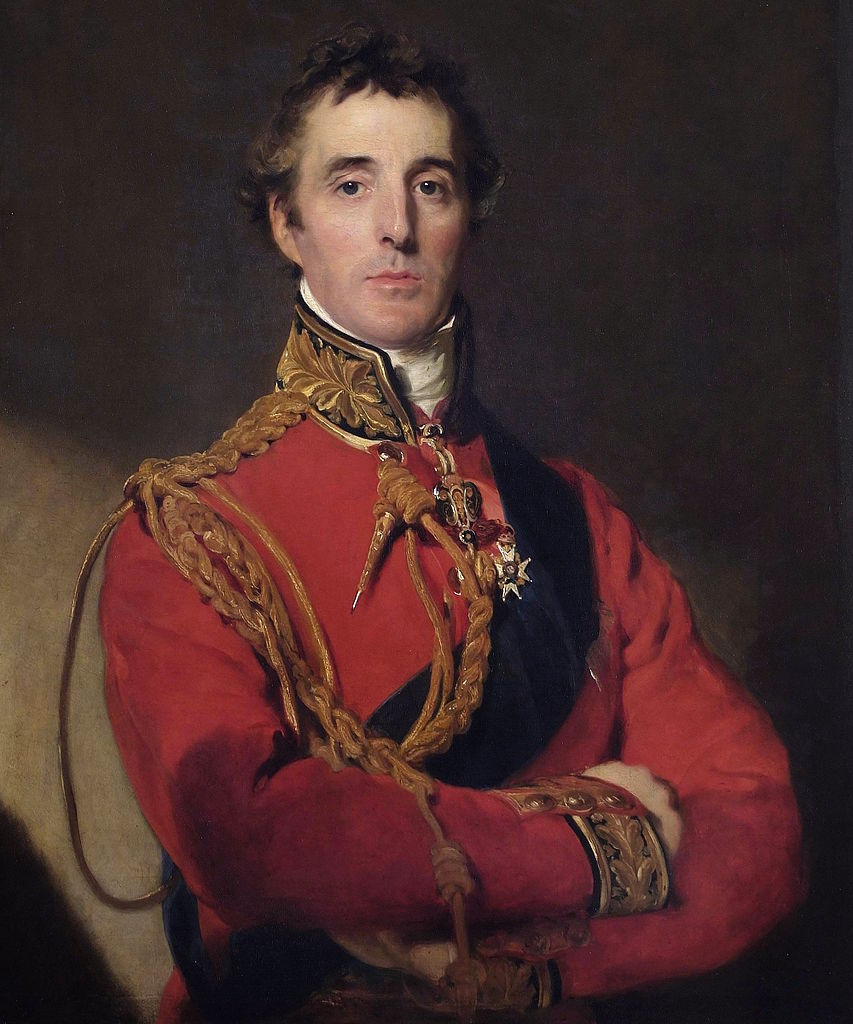
Arthur Wellesley, 1st Duke of Wellington (1769–1852) by Thomas Lawrence, circa 1815-1816.
Wikimedia Commons.The phrase “duke it out”, meaning “fight”, appears to derive ultimately from a nickname of one of the Great Captains, the Duke of Wellington (1769-1852).
It seems that the Duke had a rather prominent nose, so distinctive, in fact, that his troops often referred to him as “Old Nosey”. So the word “duke” soon became a synonym for “nose” in working class English slang, attested during Wellington’s own lifetime. That, in turn, led to the rise of the threat “bust your duke”, meaning “punch your nose”, and thus to “duke buster” as slang for “fist”, which was soon shortened to “duke”.
By further evolution, the phrase “put up your dukes” developed as an invitation to fight and “duke it out” became slang for “fight”.
While some etymologists apparently do not agree with this derivation, it’s worth noting that there is in London a mini-monument to the ducal proboscis, suggesting how notable it was.
Al Nofi, “Al Nofi’s CIC, Issue 472”, Strategy Page, 2019-06-01.
July 18, 2019
QotD: “They might speak English, but they don’t speak Western”
[Responding to a photo of a protest sign labelled “Dumbledore wouldn’t let this happen“] I swear, it’s all you ever see from them.
But something happened to me last night, I had a kind of realization. It suddenly hit me WHY that is.
It’s because Harry Potter is literally all they collectively know.
Schools don’t teach history anymore.
They no longer teach the canon of Western literature.
They certainly don’t teach the Bible.So Millennials literally have no points of common reference. It’s not that they all just want to look like complete morons by infantilizing their political metaphor to the level of a children’s book, it’s that they have no other choice.
They’re literally bereft of the allegorical language of the West. I’m sure there’s some Harry Potter monster analogy I could use to explain it to them, how it’s like monsters have come along and literally stolen their ability to speak, their common language, and their birthright.
They can no longer express or understand the set of references we have from our past, our most prized stories, and our culture’s religious quotations. They can’t do Shakespeare, Milton, or even Mark Twain because they’ve never learned any of these while they were being taught Indonesian multicultural dancing and given participation awards. They don’t know what happened at Hastings in 1066, at Runnymede in 1215, or even at Sarajevo in 28th June 1914, because they were being given feminist diversity training instead of learning the history of their civilization. They certainly don’t know what “the least of these” refers to or where it comes from, as a recent event with a White House staffer proved.
They’ve lost the entire allegorical language of the West. They might speak English, but they don’t speak Western. To them, it’s like a foreign, dead, alien language. A set of stories they do not know.
RPGPundit, “Harry Potter and the way Millennial Leftists Don’t Even Speak Western Anymore”, The RPGPundit, 2017-02-02.
July 14, 2019
The Epstein scandal is another example of the importance of accurate names
ESR has some concerns about the Epstein case, specifically on the correct terminology to use:
The sage Confucius was once asked what he would do if he was a governor. He said he would “rectify the names” to make words correspond to reality. He understood what General Semantics teaches; if your linguistic map is sufficiently confused, you will misunderstand the territory. And be readily outmaneuvered by those who are less confused.
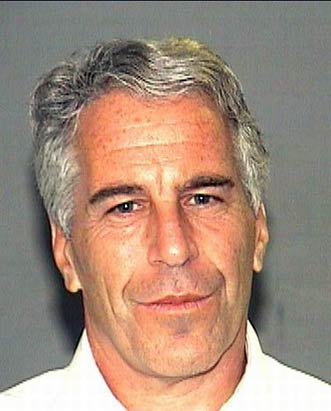
Mug shot of Jeffrey Epstein made available by the Palm Beach County Sheriff’s Department, taken following his indictment for soliciting a prostitute in 2006.
Image via Wikimedia Commons.And that brings us to the Jeffrey Epstein scandal. In particular, the widespread tagging of Epstein as a pedophile.
No, Richard Epstein is not a pedophile. This is important. If conservatives keep misidentifying him as one, I fear some unfortunate consequences.
Pedophiles desire pre-pubertal children. This is not Epstein’s kink; he quite obviously likes his girls to be as young as possible but fully nubile. The correct term for this is “ephebophile”, and being clear about the distinction matters. I’ll explain why.
The Left has a long history of triggering conservatives into self-discrediting moral panics (“Rock and roll is the devil’s music”). It also has a strong internal contingent that would like to normalize pedophilia. I mean the real thing, not Epstein’s creepy ephebophilia.
Homosexual pedophiles have been biding their time in order to get adult-on-adult homosexuality fully normalized as battlespace prep, but you see a few trial balloons go up occasionally in places like Salon. The last round of this was interrupted by the need to take down Milo Yiannopolous, but the internal logic of left-wing sexual liberationism always demands new ways to freak out the normals, and the pedophiles are more than willing to be next up in satisfying that perpetual demand.
Liberals have proven themselves utterly useless at resisting the liberationist ratchet, so I’m not even bothering to address them. Conservatives, if you want to prevent the next turn, don’t give the pedophilia-normalizers maneuvering room. Rectify the names; make the distinctions that matter.
Epstein’s behavior is repulsive because we judge young postpubertal humans to be too psychologically immature to give adult consent, but it’s nowhere near the evil that is the sexual abuse of prepubertal children.
July 11, 2019
QotD: English is weird
English started out as, essentially, a kind of German. Old English is so unlike the modern version that it feels like a stretch to think of them as the same language at all. Hwæt, we gardena in geardagum þeodcyninga þrym gefrunon – does that really mean “So, we Spear-Danes have heard of the tribe-kings’ glory in days of yore”? Icelanders can still read similar stories written in the Old Norse ancestor of their language 1,000 years ago, and yet, to the untrained eye, Beowulf might as well be in Turkish.
The first thing that got us from there to here was the fact that, when the Angles, Saxons and Jutes (and also Frisians) brought their language to England, the island was already inhabited by people who spoke very different tongues. Their languages were Celtic ones, today represented by Welsh, Irish and Breton across the Channel in France. The Celts were subjugated but survived, and since there were only about 250,000 Germanic invaders – roughly the population of a modest burg such as Jersey City – very quickly most of the people speaking Old English were Celts.
Crucially, their languages were quite unlike English. For one thing, the verb came first (came first the verb). But also, they had an odd construction with the verb do: they used it to form a question, to make a sentence negative, and even just as a kind of seasoning before any verb. Do you walk? I do not walk. I do walk. That looks familiar now because the Celts started doing it in their rendition of English. But before that, such sentences would have seemed bizarre to an English speaker – as they would today in just about any language other than our own and the surviving Celtic ones. Notice how even to dwell upon this queer usage of do is to realise something odd in oneself, like being made aware that there is always a tongue in your mouth.
John McWhorter, “English is not normal”, Aion, 2015-11-13.
June 20, 2019
A Clockwork Orange – Dystopias and Apocalypses – Extra Sci Fi
Extra Credits
Published on 18 Jun 2019Go to https://NordVPN.com/ExtraCredits to get 75% off a 3 year plan and use code
ExtraCreditsto get an extra month free. Protect yourself online today!A Clockwork Orange reflects a cultural fear of society’s moral decay in the 1960s. Its usage of a mashup slang language known as “nadsat” illustrates the complexities of rebellious youth culture. Ultimately, Anthony Burgess’s work asks us to think about if or when free will should ever be suppressed, but the major differences between the book and the film version of this story present contrasting takeaways.
Where the dystopias of Brave New World and 1984 warned against the easy slide into totalitarianism, and painted for us worlds in which freedom is nearly a forgotten thing… A Clockwork Orange presents us with a protagonist who has almost an excess of freedom, and in doing so it shows us the shift in societal fears.
June 16, 2019
History of England – Ashes – Extra History – #4
Extra Credits
Published on 15 Jun 2019Bertrand du Guesclin was the hero the French needed. Focused on fortifying defenses and cities, Guesclin rebutted the advances of the Black Prince — who ended up contracting an illness that undid his iconic image of triumph and chivalry. Edward became beset by drama in the royal court, and England started to lose power…
Thanks again to David Crowther for writing AND narrating this series! https://thehistoryofengland.co.uk/pod…
Join us on Patreon! http://bit.ly/EHPatreon
Encountering Richard Mitchell’s Less Than Words Can Say
In Quillette, Mark Andre Alexander recounts his first brush with “The Underground Grammarian”:
My first upper division English class shocked me when a dinosaur English professor, Dr. David Bell — a professor in Richard Mitchell’s mold, but not yet a curmudgeon — gave me my first C on a paper, busting my A-student self-image. That wake-up call helped me to see that, although I was published, I had much to learn about writing. Worse, in my first graduate course, Bell’s “Austen and Bronte,” I discovered that I had much to learn about reading, and that I lacked the acuity to appreciate Jane Austen’s clear, witty, and precise prose.
Not long before, I’d read Richard Mitchell’s first book, Less Than Words Can Say. I don’t recall how I stumbled upon him. I’d probably read some opinion column that referred to his work. In a publication announcement in the Underground Grammarian, Mitchell described it as “a melancholy meditation on the dismal consequences of the new illiteracy.”
He had wanted to title the book The Worm in the Brain, pointing to the dangers of administrative rhetoric. The publisher rejected that title as “too frightening and grisly,” But I knew I had found a fellow traveler when I read his Foreword:
Words never fail. We hear them, we read them; they enter into the mind and become part of us for as long as we shall live. Who speaks reason to his fellow men bestows it upon them. Who mouths inanity disorders thought for all who listen. There must be some minimum allowable dose of inanity beyond which the mind cannot remain reasonable. Irrationality, like buried chemical waste, sooner or later must seep into all the tissues of thought.
With that prophetic book, I first experienced the “cleansing fire [that] leaps from the writings of Richard Mitchell,” as George F. Will later described it.
Mitchell did title the first chapter “The Worm in the Brain,” in which he told the story of a colleague who would send him a note whenever there was some committee meeting. At first the note read something like, “Let’s meet next Monday at two o’clock, OK?” But when he aspired to become assistant dean pro tem, the simple, perfect prose changed. “This is to inform you that there will be a meeting next Monday at 2:00.” After achieving that appointment, the note read, “You are hereby informed that the committee on Memorial Plaques will meet on Monday at 2:00.” The worm in the brain had done its work.
I began to notice the worm in the brain during my everyday interactions with friends and colleagues at the university, especially the English professors. It often took the form of a label which created an image in the brain that prevented thought. One such professor, smart and engaging, returned a paper analyzing a passage in the U.S. Constitution. She gave the paper an A, but added, “I can’t help but feel that your argument is wrong, although I can’t explain why. I showed it to my husband, and he thought that it was a conservative argument.”
That statement invalidated the A, and I experienced my first taste of how subtly an abstract label can paralyze an otherwise thoughtful mind. Years later, while teaching at a business college, I saw a more pronounced form of the same phenomena. During a Business English class, I chatted with a bright student who volunteered for the NAACP. We would discuss all kinds of interesting topics, such as the similarities and differences between Martin Luther King and Malcolm X.
That is, until I noticed a change. She had stopped talking to me like a fellow human being and started talking at me like a white male. I stopped her and asked if she noticed what she had just done. She hadn’t, so I pointed out that she had shifted from talking to me to talking to an image inside her head. I told her that I would hold my hand up and block my face every time she did it. As the conversation proceeded, and I raised my hand, lowered it, and then raised it again, she became aware of the worm in her brain, a mental-emotional implant that prevented her from treating me as a colleague when certain topics were engaged.
Her implant was creating rubbish, of course, but it was insidious by nature because it disguised itself as something in the real world. Worms in the brain are like that.
June 10, 2019
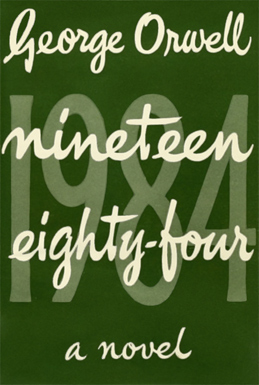
The intended message of George Orwell’s Nineteen Eighty-Four
There are few novels which have been so enthusiastically claimed by partisans of both the right and the left — sometimes simultaneously — for misunderstood reasons. Orwell wasn’t warning us about technology (although he brilliantly illustrated how technology can be harnessed in service of the state), nor was he somehow warning us about the evils of current or recent politicans (Reagan, Bush, Trump). Orwell, a dedicated life-long socialist, was warning us of the dangers of totalitarianism, particularly the communist style of totalitarianism:
June 8, 2019, marks the 70th anniversary of George Orwell’s dystopian novel 1984. There will be no shortage of think pieces that will misinterpret its legacy. They will focus on social media, security cameras, data collection, and “fake news.” The problem? The novel was not a commentary on the downside of technology. It was meant to warn against the growing spread of communism.
In the decades since the time of its publication, the context of Orwell’s magnum opus has been lost. What remains in the cultural memory are simply fragments of the larger picture: government censorship, ubiquitous surveillance cameras, and Orwell’s clever neologisms (Newspeak, doublethink, and thoughtcrime, among others). This selective recall has led to a widespread misreading of the book’s original warning.
[…]
From the left, most present-day articles and blog posts project the character “Big Brother” onto President Donald Trump, like Eliot Namay’s column in the May 6 edition of the Charleston Gazette-Mail. They typically focus on Trump’s fevered populism and his penchant for impulsive speech, which can lead him to play fast and loose with facts.
Sales of 1984 spiked dramatically after his inauguration in 2017 when White House Press Secretary Sean Spicer (incorrectly) touted the “largest audience ever to witness an inauguration.” Trump advisor Kellyanne Conway later defended the claim on Meet the Press, blurting out the now infamous phrase, “alternative facts.” Scores of news stories compared her gaffe to Orwell’s “Newspeak” and “doublethink.” It’s also fairly common to read comparisons of Trump’s rallies to the “Two Minutes Hate” depicted in 1984.
Comparisons from the right, on the other hand, generally focus on the politically correct speech codes of colleges and universities or on the massive data gathering of big tech companies like Facebook and Google, warning readers that “Big Brother is Watching You.” Kalev Leetaru explores both of these issues in his May 6 column in Forbes, where he compares the social media de-platforming trend to Orwell’s “unperson” status. Notably, sales of 1984 also spiked in 2013 after Edward Snowden leaked details of the NSA’s mass collection of internet and phone records. A slew of articles followed, asserting that 1984 had arrived.
A certain amount of hyperbole is a characteristic of today’s reporting and commentary, but current comparisons to 1984 are inappropriate. Again, George Orwell was writing about a specific regime. Big Brother was an obvious reference to “Uncle Joe” Stalin, a uniquely evil dictator. Trump has his shortcomings, but he is no Stalin. A president who is prone to exaggeration does not equal a government-controlled press (which the Soviet Union had). The “Two Minutes Hate” recalled Stalin’s public demonization of Trotzky, who dared to criticize Stalin’s tactics. Data collection is a growing concern, to be sure, but it doesn’t precede a terrifying knock on the door from the KGB.
May 11, 2019
May 4, 2019
Justin Trudeau’s (French) language problem
Colby Cosh reports on a recent academic paper that sticks the boots into the little potato and his, um, problematical French language issues:
Thursday’s hot-off-the-press Post contained a short summary (by CP’s Giuseppe Valiante) of a recent academic paper about how Justin Trudeau’s handling of spoken French is regarded in Quebec. In case you didn’t read Valiante’s summary, I’ll give you a four-word abstract: it drives people nuts. Obviously it’s hard to know how many Quebeckers are really annoyed or nauseated by the prime minister’s French, but if you judge by the newspapers, as Binghamton University French-language scholar Yulia Bosworth did in her article for the American Review of Canadian Studies, it seems Trudeau is the equivalent of fingernails scraping a chalkboard forever.
Hungry with curiosity, I got hold of Bosworth’s paper, entitled “The ‘Bad’ French of Justin Trudeau: When Language, Ideology, and Politics Collide.” As writing it suffers from the typical defects of published scholarship in the humanities: as the title suggests, it is one of those things in which every mental construct of any kind becomes an “ideology.” As scholarship it is pretty good: it contains a useful potted history of Quebecois linguistic self-hatred, and how “Quebec French” went from being a perennial object of shame to a rigid conscious standard, enforced with the same pride and viciousness as Parisian French within France.
But as disguised comedy, the article can’t be beat. When Bosworth wants to give the flavour of her sample corpus of Quebec newspaper abuse of Trudeau, she has to clear her throat professorially first. “Titles, arguably, play an important role in constructing public images; they constitute visible and frequently consumed newspaper content and help construct a linguistic landscape.” Zzzz. But then you get to the good stuff, the distilled liquor:
In Justin Trudeau’s case, headline readers encountered ‘a beautiful empty shell,’ ‘the little boy,’ ‘a privileged target,’ ‘a thinker of nothingness,’ ‘a deserter,’ a ‘mythical hero,’ ‘window dressing for radical individualism,’ ‘a young dilettante,’ and ‘Justin-the-Red.’ Among the many examples of negative descriptors pinned on Trudeau are: ‘smokescreen,’ ‘the call of the void,’ ‘hypocrisy,’ ‘lack of courage,’ and ‘Pee-Wee’s revenge.’ In terms of adjectives, Trudeau was called ‘slimy,’ ‘tricked,’ ‘attacked,’ ‘targeted,’ ‘troubled,’ and ‘criticized.’
Obviously there is a lot of that sort of talk around, and certainly JT gets a rough ride in the Post and the Alberta broadsheet papers from time to time, but I think only in Quebec do you find this language in headlines, rather than in the comment threads or your uncle’s Facebook feed. (“Radical individualism”? Really?)
April 24, 2019
April 5, 2019
If Shakespearean Insults Were Used Today – Anglophenia Ep 13
Anglophenia
Published on 24 Sep 2014Siobhan Thompson reacts to everyday office frustrations with some barbs from the Bard. Check out the Shakespeare plays from which the insults originated here: http://www.bbcamerica.com/anglophenia…
March 21, 2019
QotD: Pie language
Even in their early days, pies served different purposes for the rich and poor: as show-off delicacies for the former and portable food for the latter. So while wealthy feasts might include pies containing anything from game birds to mussels, the less well-off used simpler pies as a way to have food while doing outdoor work or travelling – the crust both carried and preserved the tasty filling.
Take, for example, the Bedfordshire Clanger: a British classic which cleverly combines main course and dessert, with savoury ingredients like pork at one end and sweet ingredients like pear at the other. The name comes from a local slang word, “clang”, which means to eat voraciously. However, cramming two courses into a pie makes a clanger rather unwieldy – and all too easy to drop, inspiring the English phrase “dropping a clanger” for a careless mistake.
Pies have been adding rich flavour to the English language for centuries. Even Shakespeare got in on the act, writing in his 1613 play Henry VIII that “No man’s pie is freed from his ambitious finger”, giving English the phrase “a finger in every pie”.
Meanwhile, the description of a drunken state as “pie-eyed” likely takes its cue from someone who, thanks to having over-imbibed, has eyes as wide and blank as the top of a pie. “As easy as pie” – first recorded as “like eating pie” in the horse-racing newspaper Sporting Life in 1886 – springs from pies’ historical role as convenience food.
“Eating humble pie”, meanwhile, comes from medieval deer hunting, when meat from a successful hunt was shared out on the basis of social status. While the finest cuts of venison went to the rich and powerful, the lower orders made do with the “nombles“: a Norman French word for deer offal. Anglicisation saw “nombles” pie become “humble” pie.
Norman Miller, “How a pocket-sized snack changed the English language”, BBC Travel, 2017-03-29.