As nearly as possible, no nationalist ever thinks, talks, or writes about anything except the superiority of his own power unit. It is difficult if not impossible for any nationalist to conceal his allegiance. The smallest slur upon his own unit, or any implied praise of a rival organization, fills him with uneasiness which he can relieve only by making some sharp retort. If the chosen unit is an actual country, such as Ireland or India, he will generally claim superiority for it not only in military power and political virtue, but in art, literature, sport, structure of the language, the physical beauty of the inhabitants, and perhaps even in climate, scenery and cooking. He will show great sensitiveness about such things as the correct display of flags, relative size of headlines and the order in which different countries are named. Nomenclature plays a very important part in nationalist thought. Countries which have won their independence or gone through a nationalist revolution usually change their names, and any country or other unit round which strong feelings revolve is likely to have several names, each of them carrying a different implication. The two sides of the Spanish Civil War had between them nine or ten names expressing different degrees of love and hatred. Some of these names (e.g. ‘Patriots’ for Franco-supporters, or ‘Loyalists’ for Government-supporters) were frankly question-begging, and there was no single one of the which the two rival factions could have agreed to use. All nationalists consider it a duty to spread their own language to the detriment of rival languages, and among English-speakers this struggle reappears in subtler forms as a struggle between dialects. Anglophobe-Americans will refuse to use a slang phrase if they know it to be of British origin, and the conflict between Latinizers and Germanizers often has nationalists motives behind it. Scottish nationalists insist on the superiority of Lowland Scots, and socialists whose nationalism takes the form of class hatred tirade against the B.B.C. accent and even the often gives the impression of being tinged by belief in sympathetic magic — a belief which probably comes out in the widespread custom of burning political enemies in effigy, or using pictures of them as targets in shooting galleries.
George Orwell, “Notes on Nationalism”, Polemic, 1945-05.
December 8, 2018
QotD: The nationalist obsession
November 22, 2018
The apparently unexpected backlash over cancelling a French-language university in Ontario
I suspect a lot of the uproar is actually just target-of-opportunity stuff to justify criticism of Ontario premier Doug Ford. Chris Selley points out that until the announcement, there wasn’t actually a lot of support for the new university among French-speaking Ontarians:
You would never know it since Thursday, when the Ontario government cancelled plans to open a new French-language university in Toronto, but those plans were not universally beloved. A lot of people hated the location. In an op-ed in Le Droit, University of Ottawa political scientist François Charbonneau complained it was being built to serve future francophone immigrants, not proper Franco-Ontarians in a community where they’ve been established for generations.
He called it “a historic mistake that perfectly illustrates what it means to be a minority: to have no power over one’s own destiny and to be dependent on ideological rantings with no democratic legitimacy.”
Higher-education consultant Alex Usher was among many who dismissed enrollment projections for the university as “fantasy.” Writing on the Higher Education Strategies blog, Usher called a recent survey of francophone Ontario high school students the “worst piece of social science I have ever seen.” It found lots of interest in attending the new university, but didn’t bother asking about their interest in existing bilingual alternatives like Laurentian University and the U of O.
To language hawks, bilingualism is the enemy: French always loses out in a budget crunch, and it does nothing to advance the right to live one’s life solely in French. Trouble is, very few students at French-language Ontario high schools are remotely interested in living their lives solely in French.
These are all things Premier Doug Ford and his ministers might have mentioned if they hoped to leave an impression other than that Ontario francophones just aren’t worth the money. They might wisely have chosen not to axe the French Language Commissioner in the same fiscal update, transferring its complaint-resolution powers to the ombudsman but orphaning its advocacy mandate. Finance minister Vic Fedeli hasn’t even said how much of its $1.2 million budget he hopes to recoup.
But they did what they did, all at once, and they said it was all about saving money. I suspect the whirlwind they reaped came as a surprise.
Good heavens, though, what wind.
November 15, 2018
QotD: The French language in Quebec
To follow Quebec politics, to read a French-language Quebec newspaper, is to regularly come across trumped-up or bewildering linguistic angst. A new study or census will show French is in pretty good shape, and the language hawks will immediately start slicing and dicing the data to paint the most dire possible picture. The Habs will appoint a captain who doesn’t speak French. A newspaper columnist will hear a friendly “bonjour-hi” one too many times shopping in downtown Montreal and blow his stack. While First World parents around the world strive to have their children learn as many languages as possible, you still encounter the odd Quebec voice wondering if francophone children learning English represents an existential threat to their society.
Chris Selley, “Oh no… It really looks like Justin Trudeau truly, deeply believes all those silly Liberal myths”, National Post, 2017-01-19.
November 13, 2018
QotD: Julius Caesar’s invasion of Britain
The first date in English History is 55 B.C., in which year Julius Caesar (the memorable Roman Emperor) landed, like all other successful invaders of these islands, at Thanet. This was in the Olden Days, when the Romans were top nation on account of their classical education, etc.
Julius Caesar advanced very energetically, throwing his cavalry several thousands of paces over the River Flumen; but the Ancient Britons, though all well over military age, painted themselves true blue, or woad, and fought as heroically under their dashing queen, Woadicea, as they did later in thin red lines under their good queen, Victoria.
Julius Caesar was therefore compelled to invade Britain again the following year (54 B.C., not 56, owing to the peculiar Roman method of counting), and having defeated the Ancient Britons by unfair means, such as battering-rams, tortoises, hippocausts, centipedes, axes, and bundles, set the memorable Latin sentence, “Veni, Vidi, Vici“, which the Romans, who were all very well educated, construed correctly.
The Britons, however, who of course still used the old pronunciation, understanding him to have called them “Weeny, Weedy, and Weaky”, lost heart and gave up the struggle, thinking that he had already divided them All into Three Parts.
W.C. Sellar & R.J. Yeatman, 1066 And All That, 1930.
October 27, 2018
Last Spartans: the survival of Laconic Greek
NativLang
Published on 27 Jan 2017The story of a Greek town that I’m told still preserves the Spartan tongue. I explore why they don’t speak like the rest of Greece and dig into their connection to ancient Sparta. Will their Tsakonian language survive?
Thanks to Vlogbrothers for their sponsorship of this video.
~ CORRECTIONS & ADDITIONS ~
The man from Leonidio is a “headmaster”, not “schoolmaster”. His story and links to the recordings are in my sources doc below.
“hoplos researched” should read “hoplon researched” / “aspis researched” – my thanks to @Roelkonijn
~ SUMMARY ~
Ancient Greece was home to a variety of dialects. Athens and Sparta both put up a major fight. Long story short, the dialect of one of those cities won out. Guess which? Athens, of course. Attic Greek combined with a hefty dose of Ionic to form the Koiné (Common) Greek, the ancestor of basically all modern Greek dialects.
All but perhaps one. Travel to a small town in the south of Greece, where a headmaster leads his students up the hillsides to record the words of their elders. These aging villagers speak Tsakonian (Τσακώνικα), a special remnant that may soon crumble into another Greek artifact.
I look at pieces of the grammar and pronunciation of the language, and show you what sets it apart from Modern Greek. Search for any ancient holdouts it preserves. Consider its connection to the Doric dialect of Ancient Sparta. Finally, ponder its place in modern Greece and how much longer it will be with us.
October 25, 2018
The History of Australia
History With Hilbert
Published on 23 Aug 2017The entire history of Australia from the earliest humans until somewhere after World War II where I lost interest.
October 12, 2018
QotD: More words we need in English
There are some words out there that are brilliantly evocative and at the same time impossible to fully translate. Yiddish has the word shlimazl, which basically means a perpetually unlucky person. German has the word Backpfeifengesicht, which roughly means a face that is badly in need of a fist. And then there’s the Japanese word tsundoku, which perfectly describes the state of my apartment. It means buying books and letting them pile up unread.
The word dates back to the very beginning of modern Japan, the Meiji era (1868-1912) and has its origins in a pun. Tsundoku, which literally means reading pile, is written in Japanese as 積ん読. Tsunde oku means to let something pile up and is written 積んでおく. Some wag around the turn of the century swapped out that oku (おく) in tsunde oku for doku (読) – meaning to read. Then since tsunde doku is hard to say, the word got mushed together to form tsundoku.
Jonathan Crow, “‘Tsundoku,’ the Japanese Word for the New Books That Pile Up on Our Shelves, Should Enter the English Language”, Open Culture, 2014-07-24.
October 10, 2018
Why do we have accents? | James May’s Q&A (Ep 31) | Head Squeeze
BBC Earth Lab
Published on 26 Jul 2013We asked Cheltenham Science Festival goers what burning science question they wanted answered and YOU voted for your favourite one!
September 25, 2018
Belgium Under German Occupation During WW1 I THE GREAT WAR On The Road
The Great War
Published on 24 Sep 2018Visit the Ijser museum: http://www.museumaandeijzer.be/ijzert…
Indy talks to Peter Verplancke about Belgium during World War 1, in particular the German occupation policies.
August 14, 2018
Sean Gabb’s view of Anglo-American relations from 1945 to today
He seems such a nice, mild-mannered chap but who else but a virtual bomb-chucking anarchist could title an article “Death to America?”
My view of America is tinged with a paranoia born from jealousy and resentment. I believe that American self-respect has, for at least the past hundred years, required the destruction of England as a great and independent nation. The Americans speak a language that did not emerge among themselves. They live within a system of law and within a set of constitutional assumptions that are also not co-existent with their nation. If their country were a minor power, they could, like Haiti, or Australia, or America before the 1870s, accept the fact of inferiority. If it were to vanish from the earth, they could look on the originator of their language and institutions with sentimental affection, as the Byzantines did on Athens and Rome.
Their problem is that, before 1940, England was a strong competitor. Since then, it has been generally subordinate, but never with full willingness. Therefore, the Americans have mixed occasional humiliation, as at Suez, with continual meddling in our politics. Our foreign policy has, since 1945, been largely set by Washington. Our leaders are mostly American Quislings, and these have systematically promoted American culture at the expense of our own. It may be that the accumulation of blocking powers by our new Supreme Court is an imitation to be welcomed. But the importation of American political correctness is not to be welcomed. Nor, I suggest, should we welcome the official replacement of English with American words and expressions — see, for example, the use of “train station” for “railway station”. This may appear, in itself, a trivial complaint. Repeated across the whole administrative and educational machinery, it has the effect of making our own recent past into a foreign country.
What the Americans want is for England to be discussed mainly in the past tense. They will study our literature, and sometimes our history. Some of their higher classes will put on Anglicised airs and graces, much as the Romans turned hellenophile after they had plundered and enslaved Greece. But to see their preferred model for living Englishmen, look at the characters played by Wilfred Hyde-Whyte, or the character of Alfred in Batman — polite, reliable, elderly, and, above all, ineffectual.
Though I dislike the European Union, I believe that the long term interests of my country lie in a close relationship with France and Germany, and in an amicable working arrangement with Russia. We have an obvious commonality with France and Germany of economic and strategic interests. We are of approximately equal weight. None is able to dominate the others. Each must work in compromise with the others. Any talk of “hands across the Atlantic” is either self-deception or a lie. Except perhaps between 1922 and 1940, there has never been an equality between England and America. Any close relationship between these countries has otherwise rested on the domination of one by the other — a domination with at best a limited overlap of interests. Though roles have changed, so it was at times before 1914, and so it has been since 1940.
July 30, 2018
QotD: Buying books but not reading them
Nick Carraway slinks away from Jay Gatsby’s party. In the library he comes across a drunken, bespectacled fat cat who starts going off about the books lining the walls. “They’re real,” he slurs, pointing to them. “What thoroughness! What realism! Knew when to stop too — didn’t cut the pages. But what do you want? What do you expect?” Uncut pages! If you know how books used to be manufactured, this means one thing and one thing only: Gatsby wasn’t much of a reader. After all, until they’re cut, book pages can’t be turned.
Collecting books and not reading them is, shall we say, textbook behavior. At least for some of you, and you know who you are. Suffering from the condition of racking up book purchases of $100, $200 or $1,000 without ever bending a spine? There’s a Japanese word for you.
Prognosis: terminal. Stats reveal that e-reading doesn’t hold a candle to the joy of reading a physical book. Although e-book sales jumped 1,260 percent between 2008 and 2010, 2.71 billion physical books were sold in the U.S. alone in 2015, according to Statista. That’s compared with the 1.32 billion movie tickets sold in the U.S. and Canada. As if every American were reading an average of more than eight books annually.
Certainly, it’s unlikely you’re going to hear the word tsundoku on the subway. But in a language where there are words for canceling an appointment at the last minute and the culture-specific condition of adult male shut-in syndrome, how can you be surprised? Other, similar words like tsūdoku (read through) and jukudoku (reading deeply) are in praise of sitting down with a book (doku means “to read”). But we think tsundoku is particularly special: Oku means to do something and leave it for a while, says Sahoko Ichikawa, a senior lecturer at Cornell University, and tsunde means to stack things.
Libby Coleman, “There’s a Word for Buying Books and Not Reading Them”, OZY, 2016-10-03.
July 16, 2018
Monty Python RAF Banter
bakerco502
Published on 30 Apr 2007secretly why I put a RAF impression together hahah
I’ve also disabled comments because people were starting to turn it into a pissing contest over who did what during the war.
June 30, 2018
Adventures in Sicilian non-verbal communication
At El Reg, Alistair Dabbs recounts some tales from a recent trip to Italy:
This isn’t the first time I have strayed into a Twilight Zone of cross-lingual and intercultural bafflement during this vacation. Throwing caution to the wind a few days earlier, I’d rashly allowed Google Maps to plot a walking route from the centre of Palermo to La Zisa. Why I did this, I cannot say, especially given my poor experience of Google Maps’ walking routes in the past. This is, after all, the app that once directed me to walk through the centre of an unlit Hyde Park at 2am and whose audio inexplicably but routinely barks “Turn left!” when you’re supposed to turn right.
On this occasion, Google Maps decided to take me on a scenic tour of the city’s most impoverished slums. Given that what few pavements existed along the way were knee high in refuse and canine excretia, it was less of a walking route than a wading route. The final 100 metres appeared to be some kind of theme park attraction along the lines of Disney World’s “Pirates of the Caribbean”, except this was “Dope-addled Inbreds of the Mediterranean”.
To access this den of iniquità, I had to pass through one of those pedestrian gates design to stop cyclists from riding through it. It was blocked by a tweenager who’d been trying to ride his bicycle through it and got stuck. The unlikely resolution of such an attempt was emphasised by two obvious challenges: it was an adult bike and the boy was so fat that he looked like an inflatable sofa. Both the bicycle and his body were at least two sizes too big for him.
By waving his arms around, he indicated that I was welcome to pass through the gate. By waving my arms back at him, I indicated that I would certainly do so after he had extricated himself. This attracted some shifty onlookers who helpfully grunted and waved their arms around at both of us until eventually we were all gesticulating like delegates at a semaphore convention.
Fearing an unfortunate outcome from this clash of cultures in unfamiliar territory, I coaxed the fat kid and his bike out of the gate and taught him to play the banjo he was carrying, ending with a spontaneous duet between the two of us. It was only by sheer luck that I’d remembered to pack my bagpipes.
June 23, 2018
Word of the day – Kakistocracy
Ann Althouse does the etymological heavy lifting:
“Kakistocracy” — based on the Greek for “worst” + “rule” — means ” The government of a state by the worst citizens”(OED).
1829 T. L. Peacock Misfortunes Elphin vi. 93 Our agrestic kakistocracy now castigates the heinous sins which were then committed with impunity [“Agrestic” = rural, rough and uncouth.]
1876 J. R. Lowell Lett. II. vii. 179 Is ours a government of the people, by the people, for the people, or a Kakistocracy rather, for the benefit of knaves at the cost of fools?I see that Salon got to the OED and deployed that word and those quotes before Trump was even sworn in: “Degeneration nation: “It takes a village of idiots to raise a kakistocracy like Donald Trump’s/Donald Trump’s government will be ‘for the benefit of knaves at the cost of fools’” (December 17, 2016):
As Amro Ali explains in a piece calling for a revival of the term “kakistrocracy” [sic] “In a world where stupidity penetrates multiple levels of government, policies and personalities; it is strange that the term coined to best describe it has actually ended up in the endangered and forgotten words books.”…
Forbes contributor Michael Lewitt reminds us that “kakistocracy” should be used to describe a state or government run by the most unscrupulous or unsuitable people: “Corrupt, dishonest and incompetent politicians, regulators and bureaucrats were put in charge by self-absorbed, selfish and ignorant citizens.” He goes on to acknowledge that we are probably not the first society to consider our leaders as part of a kakistocracy….
The word kakistocracy comes to us from Greek. Kakistos means “worst,” which is superlative of kakos — “bad” — and if it sounds like shit, that’s because it is.
That link on “if it sounds like shit” goes to an etymology dictionary entry for “kakistocracy”:
…. from Greek kakistos “worst,” superlative of kakos “bad” (which perhaps is related to PIE root *kakka- “to defecate”) + –cracy.
In that view, the real “shithole country.” When will the U.N. give us credit for having the most nerve and confidence to criticize those we elect and continually threaten to oust?
June 13, 2018
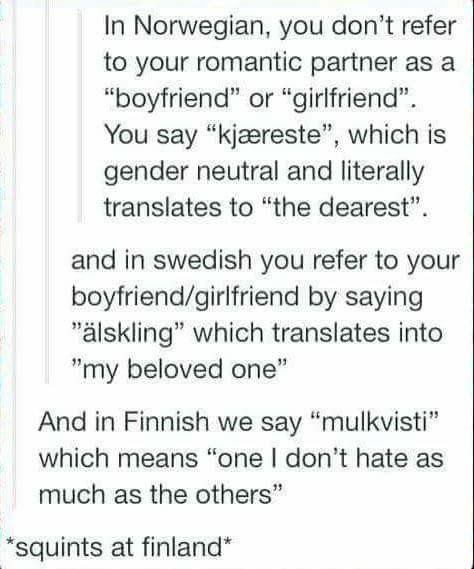
Scandinavian love
Blatantly stolen from a Facebook post that’d been shared many times: