
Forgotten Weapons
Published 10 Nov 2025Today we are going to take a look at just how much historical [information can] be read from the features and markings of an individual rifle. This is an early production Finnish M28 “ski trooper” Mosin Nagant that can be traced from Russian manufacture to WW1 Russian use, Austro-Hungarian capture, rechambering to 8x50mm Mannlicher, concession to Italy as war reparations, sale to Finland, rebuilding as a Civil Guard M28, use in the Winter War and Continuation War, transfer to the Finnish Army, and finally importation into the United States.
(more…)
March 29, 2026
Adventures in Surplus! Finnish M28 “Ski Trooper”
Comments Off on Adventures in Surplus! Finnish M28 “Ski Trooper”
March 26, 2026
From conservative, traditionalist Wilhelmine Germany to the unbridled excess of the Weimar Republic
Celina discusses the wrenching social changes Germany went through as the First World War ended, the Kaiser abdicated, and the Versailles terms were imposed on a still-young nation that didn’t think it had been defeated on the battlefield (it had been, decisively, but the truth was not revealed or understood on the home front):
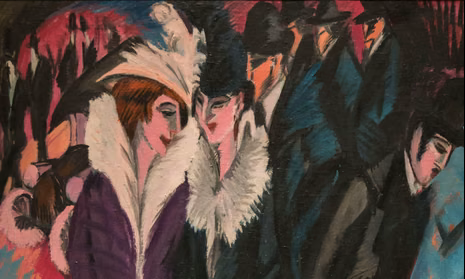
To understand the death of a civilisation, one must first walk through its ruins. The scene is Berlin, sometime in the mid-1920s, beneath the blinding, electric glare of neon and the suffocating, narcotic haze of the Berliner Luft, an atmosphere that locals gleefully described as an amphetamine-like air that made hearts race, pupils dilate, and morals evaporate until dawn.1 In the shadowed, labyrinthine alleys of a shattered empire, the streets of the capital have been entirely surrendered to a bacchanalia of unprecedented depravity. Prostitutes in various stages of undress crowd the cobblestones. They are openly aggressive, their ranks swollen by pregnant mothers, desperate war widows, and adolescents, all selling their flesh for the price of a meal.2 On every street corner, hawkers peddle cocaine, morphine, and opium to passersby, while newsstands prominently display nudist magazines dedicated exclusively to the exhibition of children.3
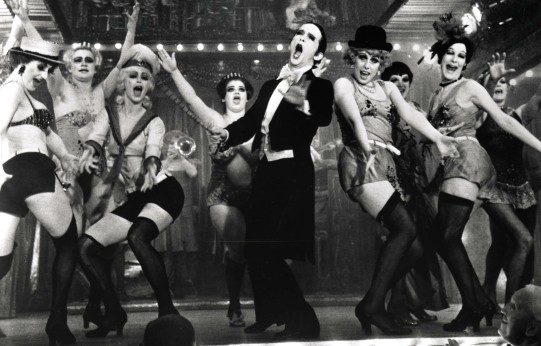
Push past the heavy, smoke-stained velvet curtains of the subterranean cabarets, and the full, suffocating scope of the abyss reveals itself. Here, glittering shows parade acres of sweaty, perfumed flesh to the applause of an audience intoxicated by a potent mixture of ecstasy, terror, and moral decay. Cross-dressing men perform grotesque pantomimes of traditional womanhood, while tuxedo-clad women mock the remnants of patriarchal authority, puffing cigars and sneering at the ghosts of their fathers.
Cabaret
For the modern, liberal apologists of the era, this explosion of libertinism is often retroactively celebrated as a vibrant, avant-garde renaissance, a brief, shining moment of progressive emancipation before the darkness of fascism fell. It is romanticised in our modern cinema and theatre as a glorious rebellion against the stuffy confines of tradition. But to the ordinary, rooted citizens of the German nation, the truth was far darker and far more evident.
The normalisation of perversion was not an expression of human flourishing, it was an aggressive, deliberate assault on the family, faith, nation, and the natural order itself. It was the deliberate dismantling of the moral architecture that had sustained European civilisation for a millennium. This was not liberation. This was civilisational suicide and the German people knew it.
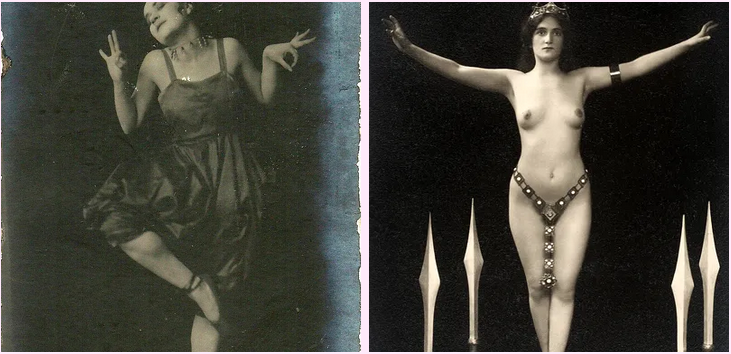
Left: Valeska Gert, Dance in Orange, Munich (1918). Right: Olga Desmond performing the ‘Sword Dance’ (1908). Photo by Otto Skowranek.
The Shattered Fatherland: Versailles and the Death of Order
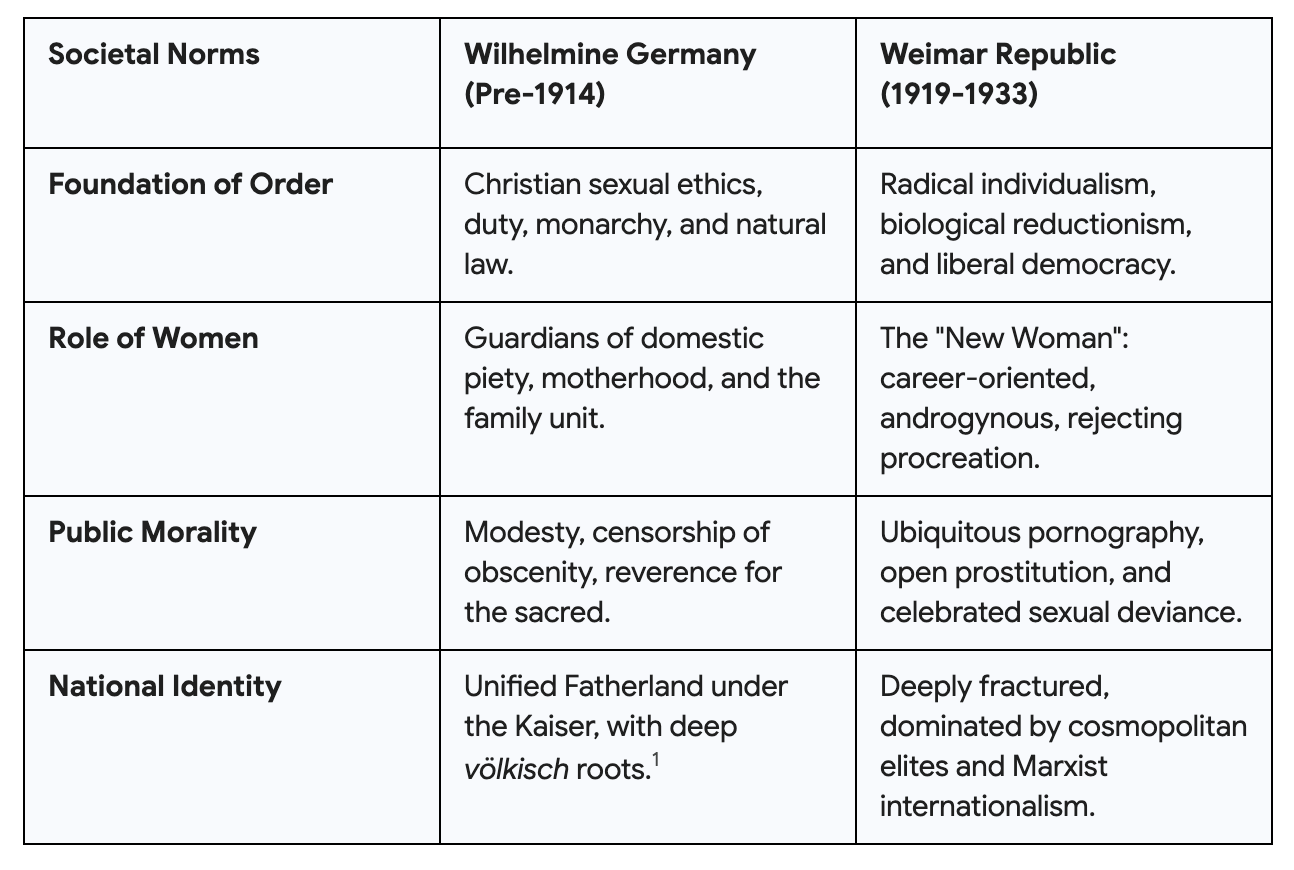
The tragedy of the Weimar Republic cannot be understood without first grasping the significant psychological and spiritual trauma that birthed it. Before 1914, Wilhelmine Germany was a society defined by structure, piety, and an organic connection to history. It was a nation grounded in Christian sexual ethics, where the family was revered as the inviolable bedrock of the state, and where duty, honour, and natural law governed public life.4 Men were expected to be providers and protectors; women were the venerated guardians of the hearth and the moral educators of the next generation.5
The cataclysm of the First World War shattered this world completely. The defeat of the German Empire brought not only physical devastation, millions of young men fed to the meat grinder of the trenches, but an unprecedented spiritual crisis. The humiliating terms of the Treaty of Versailles, specifically the “War Guilt Clause” and the crippling imposition of 130 billion marks in war reparations, stripped the nation of its dignity and its sovereignty.6 The collapse of the monarchy left a gaping void where the Fatherland had once stood, and the pervasive Dolchstoßlegende, the widely held belief that the military was stabbed in the back by domestic traitors, socialists, and cultural subversives festered in the national consciousness.7
- https://www.salon.com/2000/11/22/weimar/
- Ibid
- Ibid
- https://verso.uidaho.edu/view/pdfCoverPage?instCode=01ALLIANCE_UID&filePid=13308274540001851&download=true
- Ibid
- https://theoldshelter.com/weimar-republic-and-the-rise-of-anti-semitism/
- https://verso.uidaho.edu/view/pdfCoverPage?instCode=01ALLIANCE_UID&filePid=13308274540001851&download=true
Comments Off on From conservative, traditionalist Wilhelmine Germany to the unbridled excess of the Weimar Republic
March 22, 2026
How To Indoctrinate the Children – Death of Democracy 08 – Q4 1934
World War Two and Spartacus Olsson
Published 21 Mar 2026In this episode of Death of Democracy, we examine Germany in the final quarter of 1934, as Adolf Hitler tightens his grip on power after Hindenburg’s death and prepares the Reich for the next stage of Nazi rule. Behind a façade of order, the regime accelerates secret rearmament, deepens propaganda and youth indoctrination, pushes Jews further out of public life, and turns universities, schools, and culture into instruments of ideological control.
This documentary explores Nazi Germany in late 1934 through the looming Saar plebiscite, the growth of the Hitler myth, rising public frustration with local Nazi officials, and the regime’s deeper preparation for dictatorship, expansion, and war. If you are interested in Hitler, Nazi propaganda, rearmament, antisemitism, the Saar vote, and the collapse of democracy in Germany, this episode provides the critical context.
(more…)
Comments Off on How To Indoctrinate the Children – Death of Democracy 08 – Q4 1934
March 15, 2026
How to Go From President to King – Death of Democracy 07 – Q3 1934
World War Two and Spartacus Olsson
Published 14 Mar 2026In Q3 1934, Adolf Hitler completed the transformation of Nazi Germany from a dictatorship into an absolute Führer state. In this episode of Death of Democracy, we examine the aftermath of the Night of the Long Knives, the destruction of the SA leadership, and the consolidation of Hitler’s personal rule after the death of President Paul von Hindenburg.
From the creation of the People’s Court (Volksgerichtshof) to the rise of the SS under Heinrich Himmler, the Nazi regime tightened its grip on the state, the press, and everyday life. Meanwhile, propaganda, economic control under Hjalmar Schacht’s New Plan, and growing antisemitic persecution reshaped German society.
Using contemporary voices from Victor Klemperer, Luise Solmitz, and other witnesses, this episode explores how Hitler’s popularity soared even as terror and repression intensified. Watch the full Death of Democracy series to understand how the Nazi regime consolidated power step by step — and how ordinary societies can slide into dictatorship.
(more…)
Comments Off on How to Go From President to King – Death of Democracy 07 – Q3 1934
March 8, 2026
How to Destroy Your Own Revolution: Night of the Long Knives – Death of Democracy 06 – Q2 1934
World War Two and Spartacus Olsson
Published 7 Mar 2026In the spring of 1934, Nazi Germany stands on the edge of internal collapse. In this episode of Death of Democracy, we follow the escalating conflict between Adolf Hitler, the SA stormtroopers, and the German Army that culminates in the Night of the Long Knives. As economic cracks appear behind the Nazi “recovery”, Joseph Goebbels launches propaganda campaigns against critics while Heinrich Himmler expands SS power over the Gestapo.
When Vice-Chancellor Franz von Papen publicly challenges the regime, Hitler moves decisively. On June 30, 1934, the Nazi leader unleashes a purge that eliminates Ernst Röhm, the SA leadership, and political rivals — consolidating absolute power.
Using contemporary voices from Martha Dodd, Victor Klemperer, and underground SPD reports, this episode explores how terror, propaganda, and political maneuvering reshaped Germany in just a few months — and paved the way for dictatorship.
Watch the full Death of Democracy series to understand how democracies collapse from within.
(more…)
Comments Off on How to Destroy Your Own Revolution: Night of the Long Knives – Death of Democracy 06 – Q2 1934
February 22, 2026
How to Use a Tariff War to Disrupt the World – Death of Democracy 04 – Q4 1933
World War Two and Spartacus Olsson
Published 21 Feb 2026In Q4 1933 Hitler pivots Nazi Germany from internal takeover to outward defiance. The London Economic Conference collapses and the tariff truce unravels, Hitler withdraws from the Disarmament Conference and the League of Nations — then stages the November 12 plebiscite and one‑party Reichstag election to claim the nation stands behind him. As Goebbels tightens propaganda and press control through the Editors’ Law (Schriftleitergesetz) and daily directives, the Winter Relief campaign turns “charity” into social pressure and Volksgemeinschaft theater. In December, Reichsbank president Hjalmar Schacht hardens the transfer moratorium to conserve foreign currency for raw materials and rearmament. Using contemporary voices, this episode shows how isolation, manipulation, and “unity” accelerate Europe toward a pre‑war era.
(more…)
Comments Off on How to Use a Tariff War to Disrupt the World – Death of Democracy 04 – Q4 1933
February 21, 2026
QotD: Warren G. Harding’s successful depression-breaking policies
One is viewed as among America’s greatest presidents; the other perhaps the worst of all. One is hailed as a savior; the other as a failure. One is given memorials to enshrine his name for all time; the other is pushed into the sea of forgetfulness.
Driven by academia, this is where American history has placed Franklin Delano Roosevelt (in office 1933-1945) and Warren Gamaliel Harding (in office 1921-1923). It is impossible to see FDR absent a “great presidents” ranking; it is likewise impossible to see Harding absent the lowest rungs.
Both men came into office with an economy in tatters and both men instituted ambitious agendas to correct the respective downturns. Yet their policies were the polar opposite of one another and, as a result, had the opposite effect. In short, Harding used laissez faire-style capitalism and the economy boomed; FDR intervened and things went from bad to worse.
Despite these clear facts, in C-SPAN’s latest poll ranking US presidents, FDR finished third in the rankings, while Harding finished 37th. Surveying how both handled the economy, scholars ranked FDR third in that category, while Harding came in at 32. This is a tragedy of history.
America in 1920, the year Harding was elected, fell into a serious economic slide called by some “the forgotten depression“. Coming out of World War I and the upheavals of 1919, the economy struggled to adjust to peacetime realities, falling into a serious slump.
The depression lasted about 18 months, from January 1920 to July 1921. During that time, the conditions for average Americans steadily deteriorated. Industrial production fell by a third, stocks dropped nearly 50 percent, corporate profits were down more than 90 percent. Unemployment rose from 4 percent to 12, putting nearly 5 million Americans out of work. Small businesses were devastated, including a Kansas City haberdashery owned by Edward Jacobson and future president Harry S. Truman.
The nation’s finances were also in shambles. America had spent $50 billion on the Great War, more than half the nation’s GNP (gross national product). The national debt jumped from $1.2 billion in 1916 to $26 billion in 1919, while the Allied Powers owed the US Treasury $10 billion. Annual government spending soared more than twenty-five times, from around $700 million in 1916 to nearly $19 billion in 1919.
Harding campaigned on exactly what he wanted to do for the economy – retrenchment. He would slash taxes, cut government spending, and roll back the progressive tide. He would return the country to fiscal sanity and economic normalcy.
“We need a rigid and yet sane economy, combined with fiscal justice,” he said in his inaugural address, “and it must be attended by individual prudence and thrift, which are so essential to this trying hour and reassuring for our future”.
The business community expressed excitement about the new administration. The Wall Street Journal headlined on Election Day, “Wall Street sees better times after election”. The Los Angeles Times headlined the following day, “Eight years of Democratic incompetency and waste are drawing rapidly to a close”. Others read “Harding’s Advent Means New Prosperity” and “Inauguration ‘Let’s Go!’ Signal to Business”.
The day after Harding’s inauguration, the Times editors predicted “good times ahead”, writing, “The inauguration yesterday of President Harding and the advent of an era of Republicanism after years of business harassment and uncertainty under the Democratic regime were hailed” by the nation’s business leaders. I. H. Rice, the president of the Merchants and Manufacturers Association, told the press, “Good times are now ahead of us. Prosperity is at our door. We are headed toward pre-war conditions … Business men are well pleased with President Harding’s selections for his Cabinet and by the caliber of men he has chosen we know that he means business”.
Under Harding and his successor, Calvin Coolidge, and with the leadership of Andrew Mellon at Treasury, taxes were slashed from more than 70 percent to 25 percent. Government spending was cut in half. Regulations were reduced. The result was an economic boom. Growth averaged 7 percent per year, unemployment fell to less than 2 percent, and revenue to the government increased, generating a budget surplus every year, enough to reduce the national debt by a third. Wages rose for every class of American worker. It was unparalleled prosperity.
Ryan S. Walters, “The Two Presidents Whose Economic Policies Are Most Misunderstood by Historians”, Foundation for Economic Education, 2022-03-05.
Comments Off on QotD: Warren G. Harding’s successful depression-breaking policies
February 15, 2026
How to Make The Economy Look Better Than It Is – Death of Democracy 03 – Q3 1933
World War Two
Published 14 Feb 2026Death of Democracy returns to Nazi Germany in Q3 1933. See Hitler enforce one‑party rule, sign the Reichskonkordat, tighten propaganda and press control, and expand work programs that feed rearmament. From July to September, follow the legal and cultural Gleichschaltung that normalizes terror and reshapes Europe’s future in this episode.
(more…)
Comments Off on How to Make The Economy Look Better Than It Is – Death of Democracy 03 – Q3 1933
February 12, 2026
Inside the Nazi State: One Man’s Descent Into Darkness
HardThrasher
Published 9 Apr 2024How did one man, Rolf Engels, go from student, to victim, to head of the SS Rocket Weapons programme reporting directly to Himmler? How did the Nazi state work, and how did a man like Rocket Rolf navigate the game of snakes and ladders and somehow come out on top?
(more…)
Comments Off on Inside the Nazi State: One Man’s Descent Into Darkness
February 8, 2026
How Legal Immunity Becomes Absolute Power – Death of Democracy Q2 1933
World War Two
Published 7 Feb 2026In spring 1933, Nazi Germany shows how dictatorship becomes normal. This episode of Death of Democracy follows the regime’s second quarter in power, from the first state-organized antisemitic boycott to the destruction of free trade unions and the takeover of the courts. Step by step, democratic institutions are hollowed out through fear, legality, and propaganda. Death of Democracy reveals how tyranny doesn’t arrive overnight — it is made to feel ordinary.
(more…)
Comments Off on How Legal Immunity Becomes Absolute Power – Death of Democracy Q2 1933
February 1, 2026
How to End Democracy in 60 Days – Death of Democracy Q1 1933
World War Two
Published 31 Jan 2025This episode of the history documentary series “Death of Democracy” covers Q1 1933 with Hitler’s appointment as chancellor, the Reichstag Fire, Reichstag Fire Decree, Enabling Act, rise of Nazi terror, Gleichschaltung, and media control, explaining how Weimar Germany’s democracy collapsed in just sixty days.
(more…)
Comments Off on How to End Democracy in 60 Days – Death of Democracy Q1 1933
January 22, 2026
Dresden Part 1 – Targets, Tangents & Genocide
HardThrasher
Published 20 Jan 2026Was Dresden a war crime or a late-war military decision made in cold blood? The firebombing of Dresden (13–14 Feb 1945) remains one of the most infamous episodes of the WW2 history: a firestorm, a shattered city, and a death toll that still sparks argument today.
But most of what “everyone knows” about Dresden is wrong. In Part 1 of this two-part series, you and I will dig into the real reasons Dresden became a target. We also ask the uncomfortable questions: Was Dresden an “innocent” city? How Nazi was it? And what does Dresden reveal about the logic — and limits — of strategic bombing? And because this is my video and I’ll do as I damn well please, we’ll also do a quick overview of nearly 1,000 years of history, because why not. Thus in this you will also get the Northern Crusades, a discussion of pottery, a smattering of Central European history and long discussion of how the Nazis subverted power and used it to abuse people whilst being wildly incompetent at the basics
00:00 – Start
04:39 – Part 1 – A Brief History of Everything in Central Europe
17:36 – Rise of the Nazis and the Nuremberg Laws
30:25 – Military and Industrial Dresden
34:03 – Failure to Prepare for War
40:37 – How did it become a target?
52:37 – Survivor’s Club
(more…)
January 18, 2026
Who Will Be Chancellor? – Rise of Hitler 27, January 1933
World War Two
Published 17 Jan 2026Back to monthly coverage for this month, because too much is happening in Germany just now. Franz Von Papen meets with Adolf Hitler as 1933 gets going, both of them scheming against Chancellor Kurt von Schleicher. Could they possible form a coalition government with a majority of the Reichstag? Can they even trust each other? Also, who is this von Ribbentrop character? And what’s up with President Hindenburg’s son Oskar? So much going on this month, and when it all reaches its head … just … wow!
(more…)
Comments Off on Who Will Be Chancellor? – Rise of Hitler 27, January 1933
January 17, 2026
Everything you need to know about art deco
Dezeen
Published 29 Apr 2025To mark the centenary of art deco’s debut, Dezeen features editor Nat Barker rounds up everything you need to know about art deco.
In this video produced by Dezeen Studio, Dezeen explores the history and context of the movement, and the most notable characteristics of the style.
Art deco was a design movement that rose to prominence in the 1920s and 30s. Its origins are often disputed, but most agree that art deco’s entrance on to the world stage took place 100 years ago, at the Exposition Internationale des Arts Décoratifs et Industriels Modernes in Paris.
#artdeco #designhistory
Comments Off on Everything you need to know about art deco
January 11, 2026
Nazis Are the Big Losers – Rise of Hitler 26, October-December 1932
World War Two
Published Jan 10, 2026Adolf Hitler and the Nazi Party are forced to hit the campaign trail yet again for yet another round of elections. All this campaigning has seriously drained their finances, so they expect it to do some real good. Unfortunately for them, the November elections are very disappointing for the Nazi Party, and they lose a lot of seats in the Reichstag. Adolf Hitler is still demanding that President Hindenburg make him Chancellor, but the President still refuses time and again, although Hindenburg does have his hands full with two other Chancellors — Franz von Papen and Kurt von Schleicher, and their endless political intriguing.
(more…)
Comments Off on Nazis Are the Big Losers – Rise of Hitler 26, October-December 1932


