Quotulatiousness

April 22, 2023

The Big Four

Filed under: Britain, Business, Government, History, Railways — Tags: , , , , — Nicholas @ 02:00

Jago Hazzard
Published 1 Jan 2023

It’s 100 years since the Grouping – what happened, why and how?
(more…)

April 19, 2023

The USMC finds a new mission after WW1

Filed under: History, Japan, Military, Pacific, USA — Tags: , , , , , — Nicholas @ 05:00

Another excerpt from John Sayen’s Battalion: An Organizational Study of United States Infantry (unpublished, but serialized on Bruce Gudmundsson’s Tactical Notebook:

The 1919 demobilization was nearly as traumatic for the Marines as it was for the Army. Their numbers fell from a peak of 75,000 to about 1,000 officers and 16,000 enlisted in 1920. Authorized strength was 17,400. The 15 Marine regiments and at least three, probably four, machinegun battalions existing at the end of November 1918 had withered away to only five regiments and a couple of separate battalions (one artillery and one infantry) by the following August.

Marine commitments, however, remained heavy. The brigades in both Haiti and the Dominican Republic had their hands full suppressing new rebellions. Guard detachments were still needed for Navy bases and Navy ships. The number of men required for the latter duty had fallen by only 10% since 1918. The Marines also had to staff their own bases at Quantico, Parris Island, and San Diego and they had to find men to rebuild the advance base force as well. When these facts were brought to the attention of Congress in 1920 the latter increased the Marine Corps’ authorized strength to 1,093 officers and 27,400 enlisted but then approved funding for only 20,000.

[…]

The bulk of the Corps’ operating forces were still engaged in colonial police work in the Caribbean. However, the new Commandant, Major General John A. Lejeune, was prescient enough to realize that this would not last and that a much more permanent mission would be needed to secure his service’s future. Instead, Lejeune and his advisors concluded that the real mission of the Marine Corps was “readiness”. While this concept might seem trite, one should consider that the United States was and is primarily an insular power. Its standing army in 1920 served primarily as a garrison force and cadre for a much larger wartime citizen army. Little or none of it would be available for immediate use upon the outbreak of a major war beyond the troops already deployed to major US overseas possessions like the Philippines, Hawaii, or the Panama Canal.

Although the Army of 1920 seemed to have little idea about who its future adversaries were likely to be, the Navy had already fingered Japan as its most likely future opponent. Japan had the most powerful navy after the United States and Great Britain and Japanese-American animosity was growing. The Japanese resented the treatment of Japanese immigrants in California. Americans resented Japan’s high handed actions in China. The Japanese saw American criticism of Japan’s China policy as interference in Japan’s rightful sphere of influence. Any war fought against Japan would be primarily naval in character. However, post war disarmament treaties forbade improvements to any American fortresses west of Hawaii. The League of Nations had also mandated most of the central Pacific islands to Japanese control.

If it was to successfully engage the Japanese fleet, or to threaten Japan itself, the United States Navy would need bases in those central Pacific islands. Hawaii was too far away to be useful and the Philippines were too vulnerable to Japanese attack. Only an expeditionary force could seize and hold the central Pacific islands that the Navy needed and that expeditionary force would have to be ready to move whenever and wherever the Navy did. By staying “ready”, requiring only limited reserve augmentation and, being already under the Navy’s control, the Marine Corps would be much better positioned than the Army to provide this expeditionary force, at least during the critical early stages of the next war.*

    * Heinl op cit pp. 253-254; Moskin op cit pp. 219-222; and Clifford op cit pp. 25-29 and 61-64.

April 17, 2023

Orwell’s The Road to Wigan Pier

Filed under: Books, Britain, Economics, History, Politics — Tags: , , , , — Nicholas @ 04:00

Daniel Nuccio on one of George Orwell’s early works that prefigured the bestsellers he is best known for today:

Written for a group of British socialists known as the Left Book Club, the oeuvre is part documentation of the life of Britain’s impoverished working class with particular focus on the dignity and importance of coal miners and part autobiographical account of Orwell overcoming his own class prejudices, united by themes developed throughout regarding the economic commonalities of and social distinctions between Britain’s low-level bourgeoisie and working class, as well as the downside of industrialization and hypocrisy of fashionable socialism.

By Orwell’s account, Britain’s class system at the time, partly based on economic stratification, partly in an unofficial caste system, fostered a seemingly contradictory world in which middle-class bourgeoisie and the working class might experience little difference in income, but drastic differences in their respective places in British society. Yet, even as unemployment and poverty festered and spread, with the middle class eventually “feeling the pinch”, social distinctions, Orwell reported, naturally won out over the narrowing economic gap between classes. Lower-level middle class Brits, despite being working class by any objective economic metric, still chose to identify as bourgeoisie.

Rampant industrialism likely exacerbated these problems as it fundamentally transformed Britain into a machine society, likely to its detriment, according to Orwell’s description. Consequently, these and other factors, Orwell argued, positioned Britain at a crossroads at which the country and its people inevitably would be forced to choose between socialism and fascism.

From his depiction of 1930s British society, it would seem fascism was perhaps going to win out (and perhaps would have if not for later events unbeknownst to Orwell at the time). His prescribed antidote was socialism. Yet, Orwell claimed, the hypocrisy, offensiveness, and buffoonish self-satirizing nature of many socialists tended to drive most normal people away.

Reading The Road to Wigan Pier as an American more than eighty years after its publication, the world Orwell depicts in some ways seems foreign. In many others it is amusingly, if not unsettlingly familiar.

Although not as ingrained as in Britain, the United States maintains its own version of a class system in the form of a superficial yet meaningful distinction between middle class and working class that many Americans yoke to personal character and economic reality.

Nowhere is this more obvious than America’s approach to higher education and the jobs afforded to those with a college degree versus those without. Attaining a degree from a four-year college or university, at least to many members of the American middle class, is seen as something of a sacrament that affirms one’s position in the American middle class. Receiving the sacrament of higher education signals one’s position along with one’s sophistication, respectability, and intelligence. It saves one from the indignity of blue-collar work and the impecunious state with which such work is associated.

April 1, 2023

QotD: P.G. Wodehouse and Sir Oswald Mosley

Filed under: Books, Britain, History, Humour, Quotations — Tags: , , , , — Nicholas @ 01:00

The majority of his tales are set in country houses, replete with conservatories, libraries, gun rooms, stables and butler’s pantries. Letters arrive by several posts a day, telegrams by the hour. Trains run on time from village stations. Other than the pinching of policemens’ helmets, there is order and serenity. Necklaces are filched, silverware is purloined, butlers snaffle port, chums are impersonated, romances develop in rose gardens, but nothing lurks to fundamentally reorder society.

There was one exception. The object of Wodehousian scorn was the moustachioed leader of Britain’s black-shirted Fascists, Sir Oswald Mosley, 6th Baronet. A fencing champion at school, dashing war record in the Flying Corps, and a Member of Parliament, he was the recipient of an inherited title, with a family tree that stretched back to the 12th century, a country house and a Mayfair residence. In Wodehouseland, Mosley is transformed into the equally aristocratic Roderick Spode, 7th Earl of Sidcup.

Plum was intolerant of even the vaguest of threats to the established order of things. He voiced his dislike of Spode through Bertie Wooster, likening the fascist leader to one of “those pictures in the papers of dictators, with tilted chins and blazing eyes, inflaming the populace with fiery words on the occasion of the opening of a new skittle alley”. Plum focussed his gaze on the Spode/Mosley moustache, which was “like the faint discoloured smear left by a squashed black beetle on the side of a kitchen sink”, describing its owner as “one who caught the eye and arrested it”.

The proto-dictator appeared, thought Wodehouse, “as if Nature had intended to make a gorilla but had changed its mind at the last moment”. Every reader would have known it was Mosley in the crosshairs, because Spode was the leader of a fascist group called the “Saviours of Britain, also known as the Black Shorts”. The transition of attire is because, as another of Wodehouse’s masterful creations, Gussie Fink-Nottle, observed, “by the time Spode formed his Association, there were no black shirts left in the shops”.

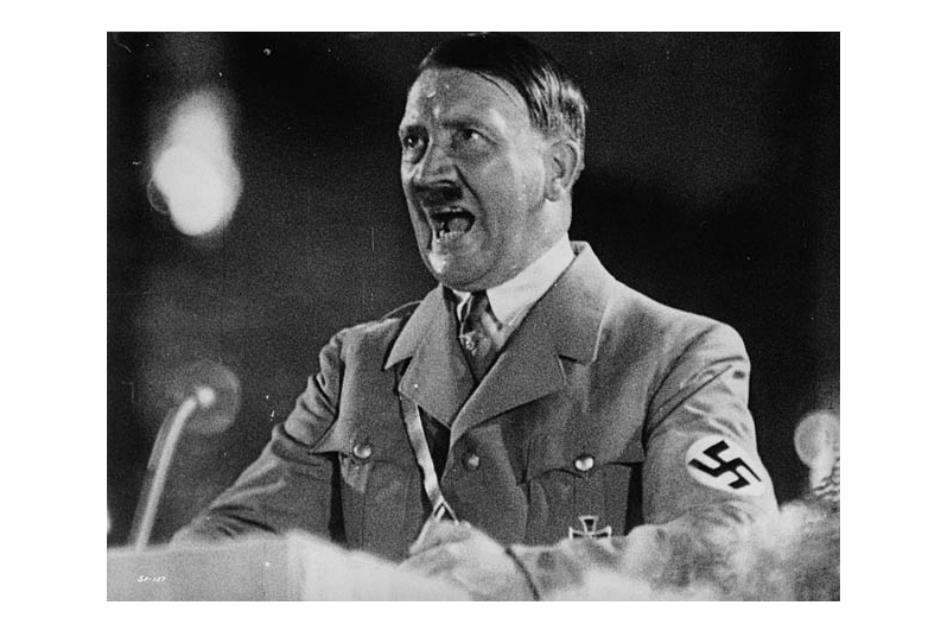
A different Wodehouse character warned, “Never put anything on paper … and never trust a man with a small black moustache.” Indeed, anyone “whose moustache rose and fell like seaweed on an ebb-tide” was best avoided. Plum could have been referring to Mosley or Hitler. The former, as leader of Britain’s real-life black shirts, was an unashamed admirer of the latter, and he interned in Holloway prison during the war. Afterwards, as an advocate of what we today would call Holocaust denial, he moved to Paris where he died in 1980. His political journey was interesting. Mosley started as a Conservative, drifted leftwards into the Labour Party, then further left into his own independent party, which evolved into the right-wing British Union of Fascists.

Modelled on the Italian and German fascist movements, Mosley and his supporters came to believe that “Jewish interests commanded commerce, the Press, the cinema, dominated the City of London, and killed British industry with their sweatshops”. Fascism lurking in the upper classes troubled Plum Wodehouse so greatly that Spode and his Black Shorts appeared in five of his works between 1938–74.

Peter Caddick-Adams, “Coups and coronets”, The Critic, 2022-12-13.

March 27, 2023

Why Russia Lost the Polish-Soviet War

Filed under: Europe, History, Military, Russia — Tags: , , , , , , , — Nicholas @ 04:00

The Great War
Published 24 Mar 2023
The Polish-Soviet War was one of the most important conflicts in the aftermath of the First World War when Eastern Europe was in flux. Both the Polish and the Bolshevik Army had the advantage numerous times and at the Battle of Warsaw is looked like the Bolsheviks would carry the revolution into Western Europe.
(more…)

February 26, 2023

Ortgies Automatic Pistols: Not as Boring as You Think!

Filed under: Business, Germany, History, Weapons — Tags: , , , , — Nicholas @ 02:00

Forgotten Weapons
Published 16 Jun 2016

The Ortgies is a pistol whose interesting aspects are often overlooked on the assumption that it is just another identical .32 ACP blowback pistol. Well, it is that — but it is also more.

Mechanically, the Ortgies has a rather unusual grip safety mechanism that is quite different from what we expect to see today. It is also interesting in that the .32 and .380 versions differ only in the easily-interchanged barrel — even the magazines are marked for both calibers.

However, the most interesting part of the Ortgies story (in my opinion) is its production. In less than 5 full years (1919-1923), close to a half million of these guns were made, primarily by an industrial subsidiary of the German government. The guns were in large part a work program, creating export goods which could bring desperately needed hard currency into Germany to counteract the economic devastation of the Versailles treaty.

Have a look at the video and you may come away with a newfound appreciation for the humble Ortgies, like I did!
(more…)

February 25, 2023

Rise of Franco – The Spanish Rif War 1921-1926

Filed under: Africa, Europe, France, History, Military — Tags: , , , , , — Nicholas @ 04:00

The Great War
Published 24 Feb 2023

The Rif War between Spain and the Rif Republic gave rise to a young Spanish officer named Francisco Franco — who later would become Spanish dictator. After Spain had almost lost the war against the Rifi people, they got help from France and WW1 hero Philippe Pétain.
(more…)

February 20, 2023

Garate Anitua y Cia “El Tigre” – Winchester 1892 Copy

Filed under: Europe, History, USA, Weapons — Tags: , , , , — Nicholas @ 02:00

Forgotten Weapons
Published 5 Jun 2016

Spain was historically a major center of patent infringement in firearms manufacture because its patent law left open a big loophole: patents were only enforceable if the patent holder actually manufactured their guns in Spain. The major European and American firearms manufacturers were not interested in setting up plants in Spain, and so their patents were not enforced there, leaving Spanish shops and factories legally free to copy them.

One of the more successful copies was the “El Tigre“, a clone of the Winchester 1892 lever action rifle made by Garate Anitua y Cia. Ironically, Garate actually registered their own patent on the design since Winchester hadn’t bothered to, and that patent was enforced, since Garate did make the guns in Spain. Their copy was chambered for the .44-40 Winchester cartridge, known in Spain as the .44 Largo. This made it compatible with many of the revolvers in the country of American, Spanish, and Belgian origin, and thus quite popular with a wide variety of groups. Rural citizen militias and the Guardia Civil both used significant numbers of El Tigre carbines. They were also fairly popular in the United States, as the cost was substantially lower than a true Winchester. Many Hollywood films and shows used them as less expensive prop guns, especially for scenes where guns would be handled roughly.

Despite their competitive cost, the El Tigres were actually quite good guns, and served their owners well.

(more…)

February 7, 2023

The Soviet Union Adopts an SMG: Degtyarev’s PPD-34/38

Forgotten Weapons
Published 21 Oct 2022

The Soviet Union adopted its first submachine gun in 1935 after trials of some 14 different design in 1932/33. The winner of the trials was Vasily Degtyarev, once of the Soviet Union’s most prolific firearms designers. His model 1934 was a simple blowback gun reminiscent of the MP-28,II albeit with different trigger and magazine systems. The PPD34 used a 25-round box magazine, chambered for 7.62x25mm Tokarev. It was put into slow production, with just 3,300 or so produced by the end of 1938. During that time, Degtyarev made a number of small improvements to the gun, smoothing out the teething problems that are always found in new production systems. This improved version was designated the PPD34-38.

During the time, the submachine gun was not considered a priority by the Red Army. The leading generals did not see the value in the class of arms, and actually pulled all the PPDs from service in 1939 and had them put into storage. Only a few months later, the Red Army would be given a grim demonstration of SMG effectiveness when they closed the border into Finland and encountered determined Finnish resistance with kp/31 Suomi SMGs.

Some Suomis were captured by Soviet troops, and were very well liked — for obvious reasons. The inevitable inquiry into why the Red Army did not have such a weapon led to a frantic re-issuing of PPDs and production of as many as possible. At Stalin’s direction, the Suomi drum magazine was copied and adapted to the PPD34-38 as well. This required the addition of a short feed tower to fit the magazine well initially deigned for a standard box magazine. While PPD34-38 production continued, the PPD40 was quickly designed and put into production alongside the older model. Eventually, both were replaced in service by the PPSh-41, which was truly designed for mass industrial production.
(more…)

February 3, 2023

Tank Chats #166 | SOMUA S35 | The Tank Museum

Filed under: France, History, Military, Weapons, WW2 — Tags: , , , , , — Nicholas @ 02:00

The Tank Museum
Published 14 Oct 2022

Join David Willey in this week’s Tank Chat as he details the history of the SOMUA S35, a French cavalry tank of the Second World War.
(more…)

January 18, 2023

Ask Ian: Why No German WW2 50-Cal Machine Guns? (feat. Nick Moran)

Forgotten Weapons
Published 20 Sep 2022

From Nathaniel on Patreon:
“Why didn’t Germany or Axis powers have a machine gun similar to the American M2?”

Basically, because everyone faced the choice of a .50 caliber machine gun or 20mm (or larger) cannons for anti-aircraft use, and most people chose the cannons — including Germany. There were some .50 caliber machine guns adopted by Axis powers, most notably the Hotchkiss 1930, a magazine-fed 13.2mm gun that was used by both Italy and Japan (among others). However, the use of the .50 caliber M2 by the US was really a logistical holdover form the interwar period. The M2 remained in production because it was adopted by US Coastal Artillery as a water-cooled anti-aircraft gun, and commercial sales by Colt were slim but sufficient to keep the gun in development through the 20s and 30s. It was used as a main armament in early American armor, but obsolete in this role when the war broke out.

However, with the gun in production and no obvious domestic 20mm design, the US chose to simply make an astounding number of M2s and just dump them everywhere, from Jeeps to trucks to halftracks to tanks to self-propelled guns. And that’s not considering the 75% of production that went to coaxial and aircraft versions …

Anyway, back to the question. The German choice for antiaircraft use was the 20mm and 37mm Flak systems, and not a .50 MG on every tank turret. And so, there was really no motive to develop such a gun. The Soviets did choose to go the US route, though, and developed the DShK-38 for the same role as the US M2 — although it was made in only a tiny fraction of the quantity of the M2.
(more…)

January 11, 2023

Repurposing Obsolete Rifles: The Lebel R35 Carbine

Filed under: France, History, Military, Weapons — Tags: , , , , — Nicholas @ 02:00

Forgotten Weapons
Published 19 Dec 2017

The French military had investigated the possibility of a Lebel carbine in the 1880s, but by the 1930s a different set of priorities was in place. In an effort to make some use of the vast stockpiles of obsolete Lebel rifles France had, a plan was put in place to shorten then into carbines for auxiliary troops like artillery crews and engineers. These men needed some sort of rifle or carbine, but they did not need the best and newest weapons. By giving them shortened Lebel carbines, it would free up more modern rifles like the M34 Berthiers in 7.5mm and the new MAS-36 rifles to go to the front line infantry who needed them most.

The R35 conversion was developed by the Tulle arsenal and adopted in January of 1936. The French government ordered 100,000 to be made, and deliveries began in April of 1937. Production would accelerate and continue right up to the spring of 1940, with a total of about 45,000 being actually delivered before the armistice with Germany. The conversions were all assembled at Tulle, but four other factories manufactured barrels for them: Chatellerault (MAC), St Etienne (MAS), Société Alsacienne de Constructions Mécaniques (SACM), and Manufacture d’Armes de Paris (MAP). These barrels were 450mm long (17.7 inches), and with the similarly shortened magazine tube, the R35 carbines held just 3 rounds. Production would not continue after the liberation of France in 1944.
(more…)

January 7, 2023

Converting the Lebel to 7.5mm: The M27 Lebel

Filed under: France, History, Military, Weapons — Tags: , , — Nicholas @ 02:00

Forgotten Weapons
Published 12 Dec 2017

In the aftermath of World War One, the French military instituted a plan to introduce a completely new roster of small arms. This would begin with the development of a modern rimless rifle cartridge, which was adopted in 1924. With the new cartridge in hand, programs were begun to develop a light machine gun, bolt action rifle, and semiautomatic rifle using it. To supplement these new arms — especially during their development and production — plans were also made to convert existing 8mm rifles to the new cartridge.

The two rifles in large supply, of course, were the Lebel and the Berthier. The St Etienne arsenal was tasked with developing a Berthier conversion (this would become the M34 Berthier), and the Tulle arsenal was assigned to do the same with the Lebel. The first prototype was ready for testing in 1927. That first example was not satisfactory, and iterative development would continue into the early 1930s. Ultimately, the Lebel conversion was simply not as well liked by troops or as effective as the M34 Berthier, and so the Berthier was chosen for mass production. A total of about 1500 Lebel M27 conversions would be made by 1940, in a wide variety of configurations including different barrel lengths, rifling patterns, and optics mounting setups. While this did not result in a successful production rifle, it would inform the development of the MAS-36, and not go to waste. In addition, a number of M27 rifles would be converted into pressure testing guns to assist in ammunition development.
(more…)

December 18, 2022

Belgian GP-35: Pre-War Browning High Power Complete Rig

Forgotten Weapons
Published 17 Aug 2022

The Browning High Power (“Grande Puissance“, aka GP-35) was developed by Fabrique National in Belgium, designed primarily by John Browning’s apprentice Dieudonné Saive. It began in the very early 1920s as a pistol designed for a new French Army requirement, but eventually split into two separate development tracks. By the early 1930s the French procurement process was still ongoing, but FN felt that the current iteration of their pistol (the Grand Rendement) was sufficiently mature to be a viable military sidearm. They began offering it for sale, and the Belgian Army quickly took an interest. One thousand were purchased for Belgian field trials in 1933, and with a few minor changes it was adopted by Belgium as the GP-35 in 1935.

The first guns are delivered in May of 1935, and the first troops to receive them were troops like machine gun crews, tank crews, messengers and other men who needed a weapon, but not a full-length rifle. By 1938 enough have been delivered that the specialty troops and NCOs have been fully equipped, and guns begin to go to officers, replacing things like the FN Model 1900. By the time of the German invasion in May 1940, some 30,000 — 35,000 High Powers had been delivered to the Belgian Army. In addition to this, several other military contracts were made by FN, selling the pistol to Estonia, Lithuania, Paraguay, China, and Finland. However, the Belgian orders account for the significant majority of all pre-war made High Powers.

Note that in the US, original pre-war High Powers with original stocks, 500-meter tangent sights, and serial numbers below 47,000 (no prefix) are exempted from the NFA, and are not legally considered short-barreled rifles.
(more…)

December 12, 2022

Before the High Power was the FN Grand Rendement

Forgotten Weapons
Published 8 Aug 2022

The Browning High Power story begins with a French 1921 request for a new military pistol. FN engineer Dieudonné Saive developed a double stack, single feed magazine and John Browning adapted a Browning 1903 pistol to use it, and this was sent to France for consideration. This pistol worked well enough, but the French trials board requested changes … and they would continue requesting changes and more trials for the next decade.

By 1931, FN felt that the current iteration of the pistol — while still not meeting all the French requirements — was good enough to stand on its own as a service pistol for the Belgian Army and other clients. They named it the “Grand Rendement” (High Efficiency) and began marketing it. The Belgian Army showed a definite interest, and bought 1,000 pistols for field trials, based on the prototype example we have in today’s video. These would become the Grande Puissance, aka the High Power.

For more details on this and other FN Browning pistols, I highly recommend Anthony Vanderlinden’s FN Browning Pistols, soon to be released in its third edition:

https://www.fnbrowning.com/book-fn-br…
(more…)

« Newer PostsOlder Posts »

Powered by WordPress