
Forgotten Weapons
Published 30 Aug 2023Brno’s ZB-26 was one of the best light machine guns of the 1920s, and it was widely adopted by countries that did not have domestic arms design and production capacity (and it would eventually become the British Bren gun as well). It was designed for the 8mm Mauser cartridge, and had a simple fixed gas system that ran very well — until countries began following the German lead in moving to standard use of s.S. (schweres Spitzgeschoß; heavy ball) ammunition. This put undue strain on the ZB-26 mechanism, and so an improvement was made to include an adjustable gas system that could be set to accommodate a variety of loadings. This experimental model was the ZB-27, and it was tested by Romania in the late 1920s.
Romania liked the design, and adopted it in 1930, purchasing guns from Brno and also buying a license to produce them at the Cugir factory complex in Romania. Today we are taking a look at two examples of Romanian ZB-30s, one Czech-made and one Romanian-made. They both incorporate a number of improvements over the ZB-26 (improved barrel latch security, rear monopod socket, bipod locking lever, etc) but also have a few minor differences from each other.
Thanks to the Southern Iceland Shooting Association for helping me film these and other cool guns in Iceland!
(more…)
December 9, 2023
Romanian ZB-30 LMG: Improving the Already-Excellent ZB-26
December 4, 2023
Jeeves and Wooster, in a nutshell …
Barcode
Published 11 Oct 2021A summary of the entire Jeeves & Wooster series in roughly 6 minutes.
P.G. Wodehouse’s Jeeves (played by Stephen Fry) and Bertie Wooster (Hugh Laurie) have been lauded as one of the greatest comic double acts of all time. Set in the late 1920s-1930s, Jeeves and Wooster (1990-1993) follows the hilarious misadventures of Bertram Wilberforce Wooster — a young, affable English gentleman of the idle rich — and Jeeves — Bertie’s omniscient and resourceful valet. Jeeves discreetly takes control of his “mentally negligible” employer’s life, while Bertie Wooster finds himself pushed and reeled into countless imbroglios, fiascoes, and romantic entanglements led by his hapless friends and imperious aunts. But each disaster is drawn to its own satisfactory conclusion through a concatenation of intriguing coincidences … or so they would seem. Until, that is, the silent force behind every “coincidence” is revealed to be none other than the brilliant and inimitable Jeeves.
(more…)
November 28, 2023
Light Tank Mk IV | Tank Chats #173 | The Tank Museum
The Tank Museum
Published 18 Aug 2023Weighing in at five tons, machine gun armed and with a two-man crew, the Tank, Light, Mk IV was one of a series produced for the British Army by Vickers before World War II, seeing service on the NW Frontier of India. Recently restored, the Mk IV is the oldest running tank in our collection.
(more…)
November 24, 2023
The Man Who Started the Cold War
World War Two
Published 23 Nov 2023What if I told you that a new conflict will sweep the globe in less than a year? It will open not with gunshots but with silent, shadowy espionage. The man who will kick off the Cold War is a quiet Canadian pilot, millionaire, and spymaster. A trusted aide to Churchill and FDR. I bet you haven’t heard this name before: William Stephenson.
(more…)
November 9, 2023
Remembering Weimar
In The Critic, Darren O’Byrne reviews some recent books on German society between the Armistice of 1918 and the rise of Hitler, including Frank McDonough’s The Weimar Years: Rise and Fall 1918–1933.
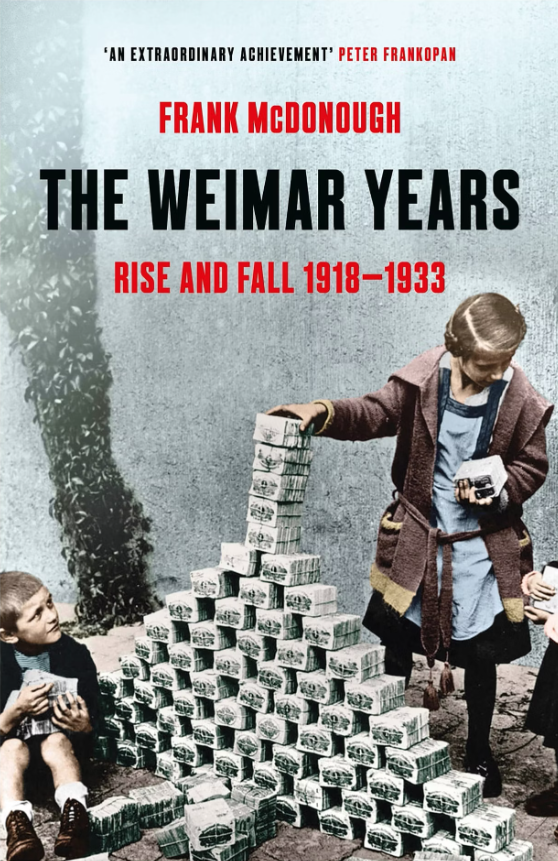
One of the latest additions to the canon is Frank McDonough’s The Weimar Years (1918–33). A prequel to his two-volume narrative history of the Third Reich, The Hitler Years, it sets out to explain the Nazis’ rise to power by examining the reasons why democracy failed in Germany. Like the earliest histories of the period, the Republic is not examined on its own terms but rather as a kind of backstory to what followed, the numerous crises that befell it being used to explain the ultimate catastrophe.
Structured chronologically, the book provides a devastating, play-by-play account of why, for McDonough, democracy stood little chance in Germany. Defeat in World War I, the Kaiser’s abdication and the humiliating terms of the Versailles treaties challenged the legitimacy of the Republic from the start, as did its failure to contain political violence. Crippling inflation and mounting government debt, exacerbated by the obligation to pay reparations to the Allies, hampered German economic recovery from the start and threatened to wipe out the middle classes.
A degree of economic stability did return in the mid-1920s, but the country experienced its second “once-in-a-lifetime” economic crisis in the early 1930s, causing further instability and ultimately paving the way for Hitler. It’s a well-known story, skilfully retold for a contemporary audience by one of the foremost authorities on modern German history.
Does McDonough tell us anything we didn’t already know? The answer, in short, is no. In comparison to other recent histories of the period, more attention is paid here to high politics than Weimar’s cultural achievements, which are mentioned, but this tends to disrupt the flow of what is otherwise a high-paced, edge-of-the-seat political history of Germany’s first democracy. Despite being nearly 600 pages in length, the book’s focus is quite narrow, with little attention paid to what was happening below the national level in the federal states.
This may seem like an inane criticism. Who, after all, would demand to read more about Buckinghamshire in a political history of interwar Britain? However, the Weimar Republic, like Germany today, was a federation. Understanding what was happening in states like Prussia, which contained three-fifths of Germany’s population, is crucial to understanding the country as a whole.
Indeed, McDonough places some of the blame for Weimar’s collapse on the Social Democrats, who he argues should have participated in more national governments. Prussia was governed by an SPD-led coalition for most of the Weimar years, though, yet the Republic still fell. McDonough sees another reason for this fall in the failure to purge the military and civil service of hostile elements.
Again, Prussia replaced a considerable number of these officials with others loyal to the new democratic order, yet the Republic still fell. The book’s rigid focus on high politics, in short, obscures an understanding of the more structural reasons why democracy failed.
Unlike most history books, however, The Weimar Years is a genuine page-turner, full of lessons for those who want to learn something about the present from the past. It’s also a beautiful book to hold, full of period photos that help bring the story alive. This all makes the book worth reading, even if there’s not much in it that can’t be found in other histories of the period.
October 31, 2023
In the 1920 presidential election, Americans voted overwhelmingly for a return to “normalcy”
Warren G. Harding’s term in office has been treated like a punchline by progressive writers and commentators for a century, but Lawrence W. Reed refutes this easy mockery and points out that the winner of the 1920 election deserves much better:
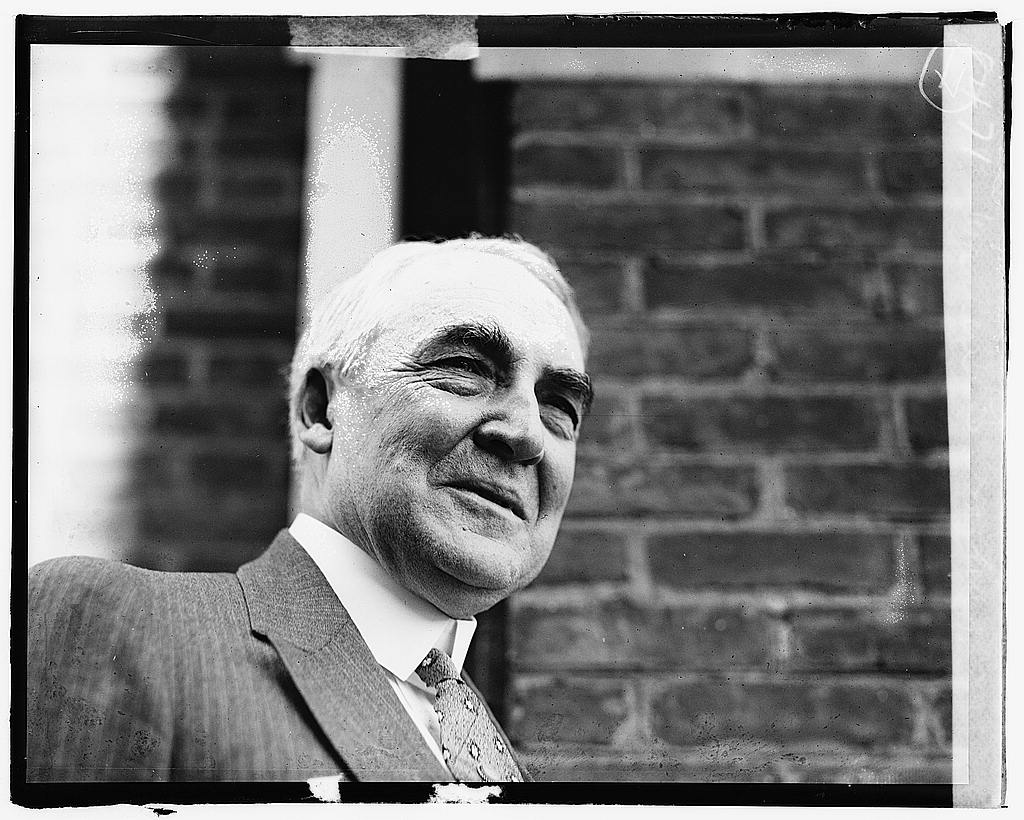
Warren G. Harding, 14 June 1920.
Library of Congress control number 2016828156
Routinely dismissed as a bad chief executive, Harding’s reputation is undergoing a long overdue renovation. The latest contribution in that regard is a new, must-read biography by Ryan S. Walters titled, The Jazz Age President. Read it, and you’ll forever be skeptical of the lazy, biased, conventional historians who worship power and those who wield it.
Warren Harding didn’t just tell audiences what they wanted to hear. He sometimes told them what they did not want to hear. He went to Birmingham, Alabama to condemn racism and Jim Crow laws, for example — a fact I’ve previously pointed out.
Conventional historians praise Presidents for the bills they signed into law but often it requires more courage and conviction to veto them. On that score too, Harding can be judged favorably. He vetoed six bills in the 2-1/2 years he served in the White House. None of the six was overridden. That may not sound like a lot but remember, his party controlled both houses by big majorities; Congress didn’t send him much it thought he wouldn’t sign.
Four bills Harding vetoed concerned minor issues and generated little attention, but one concerned a bonus for veterans of World War I. It stirred up quite a fuss. As the bill worked its way through the House and Senate, Harding gave ample warning that he wouldn’t even consider a bonus that wasn’t paid for. Congress ignored him and sent the bill to his desk. He rejected it, noting as follows:
In legislating for what is called adjusted compensation, Congress fails to provide the revenue from which the bestowal is to be paid. We have been driving in every direction to curtail our expenditures and establish economies without impairing the essentials of governmental activities. It has been a difficult and unpopular task. It is vastly more applauded to expend than to deny.
After the Civil War, Congress paid pensions to veterans of the conflict and their dependents. Sixty years later, in 1923, it sent a bill to Harding to grant pensions to women who married aging Civil War veterans long after the war. It even authorized higher payments to them than what recent widows of veterans in the war with Germany were getting. His veto message included this unassailable objection:
The compensation paid to the widows of World War veterans, those who shared the shock and sorrows of the conflict, amounts to $24 per month. It would be indefensible to insist on that limitation upon actual war widows if we are to pay $50 per month to widows who marry veterans 60 years after the Civil War.
Congress should have known better than to expect Harding to sign such bills. This was the same man who declared at his modest, unembellished inauguration that “Our most dangerous tendency is to expect too much of government”. He had expressed a desire to put “our public household in order”. He said he wanted “sanity” in economic policy, combined with “individual prudence and thrift, which are so essential to this trying hour and reassuring for the future”.
If somebody told me all that, I wouldn’t even think of asking him to approve a check for an able-bodied 30-year-old simply because she married an 80-year-old veteran.
This was the same Warren Harding, remember, who gave the country perhaps the best Treasury Secretary in its history, Andrew Mellon. According to historian Burton Folsom, Mellon slashed government expenses and eliminated an average of one Treasury staffer per day for every single day he held the office. Harding, Mellon and Calvin Coolidge (Harding’s successor), together with a friendly Congress, reduced the federal budget and cut the national debt by more than one-third.
October 29, 2023
QotD: Leni Riefenstahl’s Triumph of the Will
Eighty-five years ago today, the National Socialist Party was midway through its hugely successful rally at Nuremberg — the Reichsparteitag des Willens, or Rally of the Will. Unlike previous get-togethers, the 1934 rally would produce a hit movie, one that cinéastes still watch with appalled fascination to this day. Its creator was a brilliant cinematographer and editor who could compose and edit anything — except, in the end, her own life. If only she’d been able to snip one problematic decade out of her 101 years, we’d know Leni Riefenstahl as a game old gal who in her sixties went off to live with an African tribe, in her seventies learned to scuba dive, and at the age of 98 survived a plane crash in the Sudan. There was a documentary made about her a few years back in which she’s seen getting off the boat at the end of a day’s diving. The captain and her friend Horst walk up the pier ahead of her, lost in conversation. She follows behind, carrying her scuba gear and oxygen tank. She’s 92, and it never occurs to either man to give her a hand. They don’t think of her as a woman or as a nonagenarian.
Ah, if only it weren’t for that awkward patch …
In the 1930s, Fräulein Riefenstahl put her formidable film-making talents to the cause of the Third Reich, and, after attending the Reichsparteitag des Willens in 1934, produced one of the most remarkable films ever made: Triumph Of The Will.
Go back to that scuba-diving disembarkation scene in Ray Müller’s The Wonderful Horrible Life Of Leni Riefenstahl. In theory, it could all be a setup, and the participants chewed over how best to do it beforehand and did fifteen takes: anyone who’s worked in documentaries knows how phony the whole business is. But the point is it seems careless — as if it happened, and the camera happened to be there to record it.
There’s no sense of that in any frame of Triumph Of The Will. Granted that audiences were a lot less media savvy in 1934, and granted that a people dumb enough to fall for National Socialism will fall for anything, it’s still hard to believe that even in its day anyone accepted what remained Fräulein Riefenstahl’s official explanation to the end — that this was just a “documentary record” of the 1934 annual party convention. Early on, we see the Führer‘s motorcade driving through Nuremberg, with what seems like the entire citizenry jammed on to the streets to greet him. Riefenstahl’s camera shoots Hitler (if you’ll forgive the expression) from directly behind him, a sequence which for some reason always reminds me of Gore Vidal’s boast that only very famous people such as himself know what the back of their heads look like. There’s a fabulous moment when the great man — Adolf, not Gore — is responding to the Hitler salutes offered up by the crowds with his campy little elbow-bend and wrist-flip and, as his Mercedes moves forward, the sun catches his fingers and fills the palm, first bathing it in glory and then making it appear as if the Führer‘s hand is the very source of the sunlight itself. Did the director just get lucky? Did the sun just happen to hit? Seconds later, we cut to a long shot of Hitler in the Mercedes continuing down the street. There’s no camera in the car, although the scene we’ve just witnessed could only have been filmed by someone in the back seat. Another minute goes by, and we’re back to the close-up of the Führer‘s neck.
Did she stop the car, get out and film the long shot, and then get back in? Did Leni get Adolf to do re-takes? Or maybe she made the entire population of Nuremberg re-take the scene; maybe they staged the procession twice. If Hitler was unusually agreeable about taking direction, it was because this was never a filmed record of an event so much as an event created for the film. Whatever Triumph Of The Will is, it’s not a documentary. Its language is that of feature films — not Warner Brothers gangster movies or John Ford westerns, but rather the supersized genres, the epics and musicals where huge columns of the great unwieldy messy mass of humanity get tidied and organized — and, if that isn’t the essence of totalitarianism, what is? Riefenstahl has the same superb command of the crowd as Busby Berkeley, the same flair for human geometry (though Berkeley would have drawn the line at giving the gentlemen of the chorus as swishy a parade step as Hitler’s personal SS bodyguard do).
Mark Steyn, “Triumph of the Will”, SteynOnline, 2019-09-07.
October 20, 2023
Orwell on “Boys’ Weeklies” (aka “penny dreadfuls”)
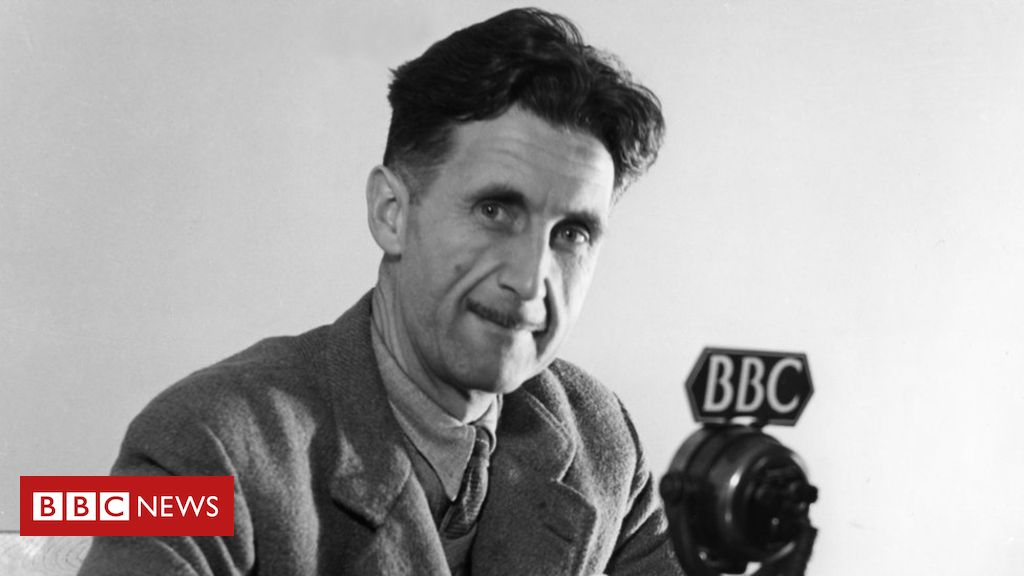
David Friedman is enjoying re-reading some of George Orwell’s collected essays and has some comments on one that I’m quite fond of as well — Orwell’s survey of “Boy’s weeklies” first published in Horizon March of 1940:
The Weeklies, of which Orwell identifies ten, produced by two different publishers and including two older series somewhat different from the others, were very popular reading, targeted at boys up to about fourteen or fifteen. All of the stories in the two older ones and many in the others were set in British public schools; Orwell suggests, plausibly enough, that much of the inspiration for the setting was Kipling’s Stalky and Company.
Orwell focuses mostly on the two older ones, each of which had a stock cast of characters and a setting that showed no sign of changing for the thirty years over which they had been coming out and recognizably stylized plots and dialog. He comments that although each claims to be written by a single named author — “Frank Richards” for one series and “Martin Clifford” for the other — it is obvious that a single author could not have done thirty years of weekly stories and that the stylized writing is in part a way of maintaining the illusion of a single author.
The essay is interesting both for the detailed, and to some extent sympathetic, description of the weeklies
In the Gem and Magnet there is a model for very nearly everybody. There is the normal athletic, high-spirited boy (Tom Merry, Jack Blake, Frank Nugent), a slightly rowdier version of this type (Bob Cherry), a more aristocratic version (Talbot, Manners), a quieter, more serious version (Harry Wharton), and a stolid, “bulldog” version (Johnny Bull). Then there is the reckless, dare-devil type of boy (Vernon-Smith), the definitely “clever”, studious boy (Mark Linley, Dick Penfold), and the eccentric boy who is not good at games but possesses some special talent (Skinner Wibley). And there is the scholarship-boy (Tom Redwing), an important figure in this class of story because he makes it possible for boys from very poor homes to project themselves into the public-school atmosphere. In addition there are Australian, Irish, Welsh, Manx, Yorkshire and Lancashire boys to play upon local patriotism. But the subtlety of characterization goes deeper than this. If one studies the correspondence columns one sees that there is probably no character in the Gem and Magnet whom some or other reader does not identify with, except the out-and-out comics, Coker, Billy Bunter, Fisher T. Fish (the money-grabbing American boy) and, of course, the masters.
and for Orwell’s analysis of their political implications. He thinks they are designed, probably deliberately by the owners of the firms that publish them, to indoctrinate boys with conservative views — respectful towards the upper classes, ignorantly patriotic, contemptuous of foreigners, blind to the real problems of British society.
Here is the stuff that is read somewhere between the ages of twelve and eighteen by a very large proportion, perhaps an actual majority, of English boys, including many who will never read anything else except newspapers; and along with it they are absorbing a set of beliefs which would be regarded as hopelessly out of date in the Central Office of the Conservative Party. All the better because it is done indirectly, there is being pumped into them the conviction that the major problems of our time do not exist, that there is nothing wrong with laissez-faire capitalism, that foreigners are un-important comics and that the British Empire is a sort of charity-concern which will last for ever. Considering who owns these papers, it is difficult to believe that this is un-intentional. Of the twelve papers I have been discussing (i.e. twelve including the Thriller and Detective Weekly) seven are the property of the Amalgamated Press, which is one of the biggest press-combines in the world and controls more than a hundred different papers. The Gem and Magnet, therefore, are closely linked up with the Daily Telegraph and the Financial Times. This in itself would be enough to rouse certain suspicions, even if it were not obvious that the stories in the boys’ weeklies are politically vetted. So it appears that if you feel the need of a fantasy-life in which you travel to Mars and fight lions bare-handed (and what boy doesn’t?), you can only have it by delivering yourself over, mentally, to people like Lord Camrose.
The essay ends with a somewhat tentative suggestion that someone ought to produce a left-wing equivalent and a discussion of some problems in doing so.
It is an interesting essay on its own merits. Still more interesting is the response, an article by Frank Richards rebutting Orwell and defending his own work. It turns out that, contrary to Orwell’s confident claim, most of thirty years of weekly stories by “Frank Richards” were produced by the same person, with occasional stories by other authors when he was for some reason not available. Further, as Orwell comments in a later footnote to his essay, Frank Richards was also Martin Clifford, so the same person produced, for thirty years, most of the contents of two different weekly magazines for boys.
His response shows him to be an intelligent and articulate writer. His views are conservative in a general sense; he makes it clear that the setting of the stories is an unchanging 1910 England because he does not think much of the changes since. But he also makes it clear that the reason his stories do not include strikes, unemployment, labor unions, and a variety of other features of the real world is that he believes that providing boys an imaginative foundation in a secure world helps equip them to face future difficulties in a world much less secure.
Of strikes, slumps, unemployment, etc., complains Mr Orwell, there is no mention. But are these really subjects for young people to meditate upon ? It is true that we live in an insecure world: but why should not youth feel as secure as possible? It is true that burglars break into houses: but what parent in his senses would tell a child that a masked face may look in at the nursery window ! A boy of fifteen or sixteen is on the threshold of life: and life is a tough proposition; but will he be better prepared for it by telling him how tough it may possibly be? I am sure that the reverse is the case. Gray — another obsolete poet, Mr Orwell! — tells us that sorrows never come too late, and happiness too swiftly flies. Let youth be happy, or as happy as possible. Happiness is the best preparation for misery, if misery must come. At least, the poor kid will have had something! He may, at twenty, be hunting for a job and not finding it — why should his fifteenth year be clouded by worrying about that in advance? He may, at thirty, get the sack — why tell him so at twelve? He may, at forty, be a wreck on Labour’s scrap-heap — but how will it benefit him to know that at fourteen? Even if making miserable children would make happy adults, it would not be justifiable. But the truth is that the adult will be all the more miserable if he was miserable as a child. Every day of happiness, illusory or otherwise — and most happiness is illusory — is so much to the good. It will help to give the boy confidence and hope. Frank Richards tells him that there are some splendid fellows in a world that is, after all, a decent sort of place. He likes to think himself like one of these fellows, and is happy in his daydreams. Mr Orwell would have him told that he is a shabby little blighter, his father an ill-used serf, his world a dirty, muddled, rotten sort of show. I don’t think it would be fair play to take his twopence for telling him that!
As a child in England in the early 1960s, I didn’t encounter any of the stories by Frank Richards (at least, I strongly doubt it), but many of the storylines and tropes of his work were still echoed by later authors, especially in the British comics (Lion, Tiger, Valiant, Rover, and The Hotspur among the many offerings). Alongside the heroic adventure stories, the war stories, science fiction, and the (omnipresent) football stories, there were still some that might well have been comic versions of Mr. Richards’ originals.
I missed them after we emigrated, but I was delighted find that the W.H. Smith bookshop at Sherway Gardens carried a few of them (at a significant mark-up, of course) so I was still getting my occasional comic fix until about 1974.
October 11, 2023
Art Deco in 9 Minutes: Why Is It The Most Popular Architectural Style? 🗽
Curious Muse
Published 3 Sept 2021What comes to your mind when you think of the 1920s? For most people, the 1920s conjures up images of jazz, flappers, Old Hollywood, the Great Gatsby, and the Chrysler Building in New York City. It was a time of prosperity, exorbitant spending, and entertainment that gave rise to one of the most popular decorative arts and architecture movements — known as Art Deco.
Characterized by exquisite craftsmanship, lavish decoration, and rich materials, the style has become synonymous with the Roaring Twenties. So, what was the Art Deco movement all about and what differentiates it from other major movements? Finally, despite its popularity today, what makes Art Deco so closely associated with the 1920s?
In this week’s video, we’ll dive into the history of the era and learn about Art Déco, the style that continues to inspire designers and architects around the world!
(more…)
September 27, 2023
The British army between 1918 and 1940
Richard Dannatt and Robert Lyman recently published Victory to Defeat, which chronicles the decline of the British army’s fighting capabilities in the interwar years. Robert Lyman posted a longer version of Gordon Corrigan’s review for Aspects of History (with permission):
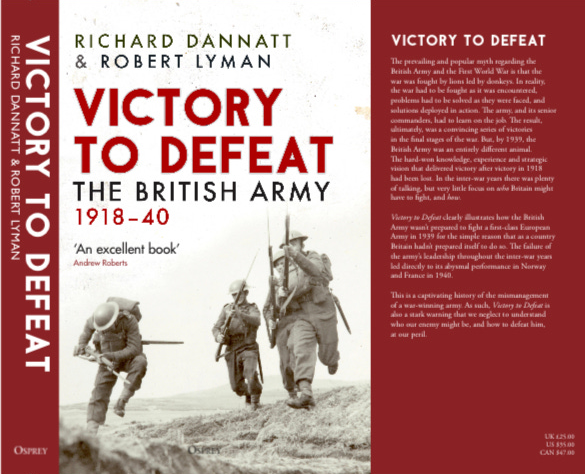
The British Army ended the First World War well trained, well led, well equipped and capable of engaging in all arms intensive warfare. Of all the players, on both sides, this army was unquestionably the most capable of deployment against a first class enemy anywhere in the world. Twenty years later it found itself with very much the same equipment, but with very much less of it, and devoid of either the ability or the means to fight a war in Europe against an enemy which had absorbed the lessons of 1918 but which the British had forgotten. It was the British Army that had invented blitzkrieg (although of course they did not call it that, a term coined by the French press very much later) and used it during the Battle of Amiens and on into the “Hundred Days” that saw the defeat of the German Army on the battlefield, and whatever German myth later averred, it was the British Army that forced that victory on the Western Front, not the French and not the Americans. And yet, in 1939 and 1940 the British were roundly defeated in France and Belgium, in Greece, in Crete and in North Africa. In this important – and to this reviewer almost heart rending – book the authors describe how and why the victors of 1918 were allowed to become incapable of fighting intensive warfare a mere two decades later.
In the first part of the book the authors describe the build up to the First War, and their explanation of the so called “Curragh Mutiny” is much more accurate than many accounts by others (although the officers did not threaten to disobey orders, only to resign, and while Carson’s Ulster Volunteers were indeed incorporated into the British Army as the 36th Ulster Division, so were Redmond’s National Volunteers, into the 16th Irish Division). The authors then go on to show how the British government had, albeit reluctantly, accepted a continental commitment in 1914 and had despatched an expeditionary force to Belgium, described then and later as the finest body of troops ever to leave these shores. Fine they certainly were, well trained, well led and well equipped, but the British Expeditionary Force (BEF) of professional regular soldiers was pitifully small, and with experience of imperial policing and not of war against a first class enemy. With the need to expand enormously and rapidly, this army had to adapt to a theatre where massed artillery, machine guns and barbed wire made any attempt to manoeuvre almost impossible. The book shows how by trial and error, by analysis of operations and by a gradually developing doctrine the British learned to use a combination of all arms to break through German defences and eventually to defeat them. With the infantry, the artillery, the armour, the engineers and increasingly the air all working together to get inside the enemy’s decision making circle, to get him on the back foot and keep him there, these were the elements of blitzkrieg, but it was the defeated Germans who were to absorb those principles and perfect them until twenty years after their defeat they were the most competent army in Europe.
After an excellent account of the British journey from an imperial gendarmerie to a practitioner of intensive war, the next part of the book shows how and why by the time the Second World War came along the British were incapable, not only of deterring war, but of fighting it. The “ten year rule”; the reluctance of governments to spend on defence; the political refusal to contemplate another war in Europe and the reluctance of the public to contemplate another bloodletting like that of the First War; the inability to experiment or to develop tanks and armoured vehicles; the seeming impossibility of reconciling the twin requirements of imperial policing and any commitment to land operations in Europe with the assets available; the myth of the “bomber will always get through” and the absence of any consistent war fighting doctrine, all are lucidly explained. Much of the fault is shown to lie with politicians, and surely the most disgraceful example of political interference was the sacking of the Chief of the Imperial General Staff (CIGS), the professional head of the army, by the leaving of a note on his desk by the very dubious Secretary of State for War, Hore-Belisha. The generals are not spared, however. Despite restrictions on funding and refusal by governments to accept that another war was looming generals could have spoken out, although it does have to be recognised that in a democracy the civil power is paramount.
September 18, 2023
Learning lessons from the plight of the British army in 1940
Lessons from history are only occasionally learned easily … they’re more likely brought to our attention by the Gods of the Copybook Headings after we’ve suffered some awful setback. As the latin tag would have it, Si vis pacem, para bellum: if you want peace, be prepared for war. Most western democracies refuse to believe this is true, and one of the easiest things for peacetime democratic governments to do is to short-fund the military and use the “savings” for more politically popular things that will help them get re-elected. The Canadian government has been a shining example of this since the late 1960s, with no end in sight.
A recent book on the British army, tracing its decline from the end of the First World War to the defeat in the Battle of France in 1940 shows just how quickly a world-beating army can be reduced to second-best in its next conflict. Richard Dannatt & Robert Lyman, the authors of Victory: the British Army 1918-1940 to Defeat, had an article in the Sunday Mail, illustrating the parallels between the army in their book and the British army today:
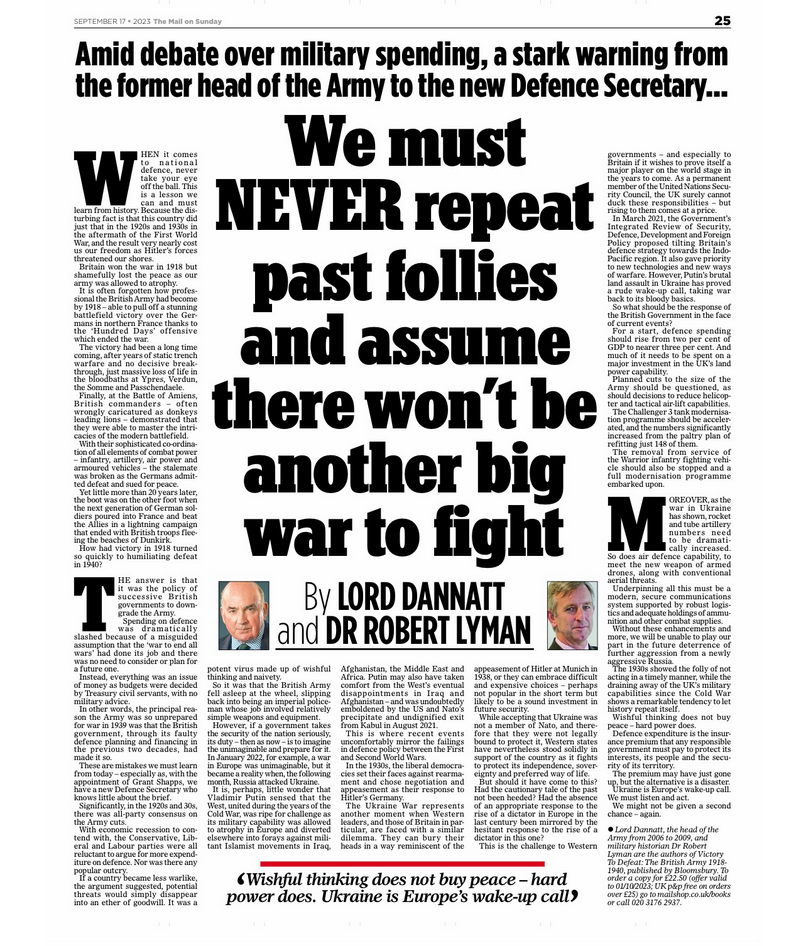
WHEN IT comes to national defence, never take your eye off the ball. That is a lesson we can and must learn from history. Because the disturbing fact is that this country did just that in the 1920s and 1930s in the aftermath of the First World War and the result very nearly cost us our freedom as Hitler’s forces threatened our shores.
Britain won the war in 1918 but then shamefully lost the peace as our army was allowed to atrophy.
It is often forgotten how professional the British Army had become by 1918, to pull off a stunning battlefield victory over the Germans in northern France in the final Hundred Days of the war.
It had been a long time coming after years of static trench warfare and no decisive breakthrough, just massive loss of life in the blood baths at Ypres, Verdun, the Somme and Passchendaele.
But finally, at the Battle of Amiens, British commanders — often wrongly caricatured as dunderheads and “donkeys” leading lions – demonstrated that they were able to understand and master the intricacies of the modern battlefield. With their sophisticated co-ordination of all elements of combat power — infantry, artillery, air power, armour — the stalemate was broken.
Modern war-fighting skills, technology and methods — learned at great cost in lives over the previous three-and-a-half years — secured victory for the British Army and its allies in 1918 as the Germans admitted defeat and sued for peace.
And yet little more than 20 years later, the boot was on the other foot as the next generation of German soldiers poured into France and defeated the Allies in a lightning campaign that ended with British troops fleeing from the beaches of Dunkirk.
How had victory in 1918 turned so quickly to defeat and humiliation in 1940?
The answer is that it had become the deliberate policy of successive British governments to downgrade the Army — a lesson we must learn today, with a new Defence Secretary who knows little about the brief.
Spending on defence was dramatically slashed amid an ill-thought-through assumption that there would not be another major war within ten years and so.
So far as the then government was concerned, the “war to end all wars” (as the Great War was dubbed) had done its job. There was no need to consider or plan for a future one, whether in policy, financial or practical terms. Everything was an issue of money as budgets were decided by Treasury civil servants with no military advice.
The principal reason why the Army was so unprepared for war in 1939 was that the British government, through faulty defence planning and financing in the previous two decades, made it so.
September 13, 2023
Why Do People In Old Movies Talk Weird?
BrainStuff – HowStuffWorks
Published 25 Nov 2014It’s not quite British, and it’s not quite American – so what gives? Why do all those actors of yesteryear have such a distinct and strange accent?
If you’ve ever heard old movies or newsreels from the thirties or forties, then you’ve probably heard that weird old-timey voice.
It sounds a little like a blend between American English and a form of British English. So what is this cadence, exactly?
This type of pronunciation is called the Transatlantic, or Mid-Atlantic, accent. And it isn’t like most other accents – instead of naturally evolving, the Transatlantic accent was acquired. This means that people in the United States were taught to speak in this voice. Historically Transatlantic speech was the hallmark of aristocratic America and theatre. In upper-class boarding schools across New England, students learned the Transatlantic accent as an international norm for communication, similar to the way posh British society used Received Pronunciation – essentially, the way the Queen and aristocrats are taught to speak.
It has several quasi-British elements, such a lack of rhoticity. This means that Mid-Atlantic speakers dropped their “r’s” at the end of words like “winner” or “clear”. They’ll also use softer, British vowels – “dahnce” instead of “dance”, for instance. Another thing that stands out is the emphasis on clipped, sharp t’s. In American English we often pronounce the “t” in words like “writer” and “water” as d’s. Transatlantic speakers will hit that T like it stole something. “Writer”. “Water”.
But, again, this speech pattern isn’t completely British, nor completely American. Instead, it’s a form of English that’s hard to place … and that’s part of why Hollywood loved it.
There’s also a theory that technological constraints helped Mid-Atlantic’s popularity. According to Professor Jay O’Berski, this nasally, clipped pronunciation is a vestige from the early days of radio. Receivers had very little bass technology at the time, and it was very difficult – if not impossible – to hear bass tones on your home device. Now we live in an age where bass technology booms from the trunks of cars across America.
So what happened to this accent? Linguist William Labov notes that Mid-Atlantic speech fell out of favor after World War II, as fewer teachers continued teaching the pronunciation to their students. That’s one of the reasons this speech sounds so “old-timey” to us today: when people learn it, they’re usually learning it for acting purposes, rather than for everyday use. However, we can still hear the effects of Mid-Atlantic speech in recordings of everyone from Katherine Hepburn to Franklin D. Roosevelt and, of course, countless films, newsreels and radio shows from the 30s and 40s.
(more…)
August 17, 2023
QotD: The decline of the British aristocracy
In the years between 1920 and 1940 it was happening with the speed of a chemical reaction. Yet at the moment of writing it is still possible to speak of a ruling class. Like the knife which has had two new blades and three new handles, the upper fringe of English society is still almost what it was in the mid-nineteenth century. After 1832 the old landowning aristocracy steadily lost power, but instead of disappearing or becoming a fossil they simply intermarried with the merchants, manufacturers and financiers who had replaced them, and soon turned them into accurate copies of themselves. The wealthy ship-owner or cotton-miller set up for himself an alibi as a country gentleman, while his sons learned the right mannerisms at public schools which had been designed for just that purpose. England was ruled by an aristocracy constantly recruited from parvenus. And considering what energy the self-made men possessed, and considering that they were buying their way into a class which at any rate had a tradition of public service, one might have expected that able rulers could be produced in some such way.
And yet somehow the ruling class decayed, lost its ability, its daring, finally even its ruthlessness, until a time came when stuffed shirts like Eden or Halifax could stand out as men of exceptional talent. As for Baldwin, one could not even dignify him with the name of stuffed shirt. He was simply a hole in the air. The mishandling of England’s domestic problems during the nineteen-twenties had been bad enough, but British foreign policy between 1931 and 1939 is one of the wonders of the world. Why? What had happened? What was it that at every decisive moment made every British statesman do the wrong thing with so unerring an instinct?
The underlying fact was that the whole position of the monied class had long ceased to be justifiable. There they sat, at the centre of a vast empire and a world-wide financial network, drawing interest and profits and spending them – on what? It was fair to say that life within the British Empire was in many ways better than life outside it. Still, the Empire was underdeveloped, India slept in the Middle Ages, the Dominions lay empty, with foreigners jealously barred out, and even England was full of slums and unemployment. Only half a million people, the people in the country houses, definitely benefited from the existing system. Moreover, the tendency of small businesses to merge together into large ones robbed more and more of the monied class of their function and turned them into mere owners, their work being done for them by salaried managers and technicians. For long past there had been in England an entirely functionless class, living on money that was invested they hardly knew where, the “idle rich”, the people whose photographs you can look at in the Tatler and the Bystander, always supposing that you want to. The existence of these people was by any standard unjustifiable. They were simply parasites, less useful to society than his fleas are to a dog.
George Orwell, “The Lion And The Unicorn: Socialism and the English Genius”, 1941-02-19.
August 8, 2023
How the Battle of Amiens Influenced the “Stab in the Back” Myth
OTD Military History
Published 7 Aug 2023The Battle of Amiens started on August 8 1918. It started the process that caused the final defeat of the German Army on the battlefield during World War 1. Many people falsely claimed that the German Army was not defeated on the battlefield but at home by groups that wished to see German fall. One person who helped to create this myth was German General Erich Ludendorff. He called August 8 “the black day of the German Army”.
See how this statement connects to the stab in the back myth connects to Amiens and the National Socialists in Germany.
(more…)
July 24, 2023
QotD: The Duke and Duchess of Windsor after the abdication
We are reminded that the king’s much-rehearsed coronation speech was a success. “Millions of his subjects sat at home listening to the broadcast, willing him to succeed whilst knowing of his stammer and the difficulties that even speaking a few short sentences publicly had caused him … Yet fortunately for the coronation ceremony, the king’s nerves seemed to vanish on the day, aided by his sincere religious faith: another characteristic absent from his brother’s life.”
[…]
One trait that runs through this important book is the personal weakness of the Duke and the compelling strength of his bride. Larman makes it plain that both Baldwin and Chamberlain were aware that it was Wallis who was passing state secrets to German intelligence, although her husband also expressed sympathies for Hitler’s regime. Cecil Beaton, photographer of the David-Wallis wedding in France, noted in his diary that the Duchess “not only has individuality and personality, but [she] is a strong force”. Even as he praised her intelligence and admiration for the Duke, Beaton offered the judgement that she “is determined to love him, though I feel she is not in love with him” — an interesting reflection on the woman for whom her husband had abandoned his throne. In 2015, Andrew Morton dwelt in great detail on Wallis’s treachery in 17 Carnations: The Windsors, The Nazis and The Cover-Up.
Throughout Larman’s compelling read, we are offered evidence of how tone-deaf the Duke was to international protocol, the interests of Britain and the sufferings of others. Anthony Eden, as Foreign Secretary, observed how the pair felt they should be “treated abroad by ambassadors and dignitaries, rather as they would a member of the royal family on a holiday”. This came to a head when friends of the Duke organised a visit to Germany over 11–23 October 1937. They met several leading Nazis, including Hess, Goebbels (who called the Duke “a tender seedling of reason”) and Göring, as well as renewing their acquaintance with Ribbentrop, still then ambassador to Britain. It was Ribbentrop, according to Morton’s book, who had sent Wallis 17 carnations daily “each one representing a night they had spent together”.
On the penultimate day, the Windsors met Hitler at Berchtesgaden. Larman reasons that the visit was as much to show that the Duke and his bride were still relevant in the wider world, as to form a bond with the Führer to avoid future war. As with many public figures of the era, David feared communism far more than fascism, for which he saw the best antidote in an alliance with Germany. We are left wondering whether the Duke observed in Hitler’s authoritarian state all that he admired and wished for Britain, but was now denied.
A subtext to The Windsors at War is just how much anxiety David caused the King, his younger brother, during the run up to war and during it. For most of the period, the Duke badgered for money, confirmation of his status and a royal title for Wallis. Whilst the first was forthcoming, amounting to a financial settlement of £25,000 a year (generous by any standards, considering the Windsors spent their days sofa-surfing and sponging off their rich friends), neither of the latter were. Chamberlain was forced to write that “in addition to letters of protest he had as Prime Minister … all classes stood against him. In addition to the British not wanting him to return, residents of Canada, New Zealand and America wished him to remain in exile”.
Yet, writes Larman, the Duke would not simply “languish in exile and be denied the opportunity to contribute his thoughts on the international situation. This arrogance made him both unpredictable and, with the outbreak of war drawing closer, dangerous. At a time when it was crucial that the loyalties of prominent public figures were transparent, his inclinations remained opaque”.
Peter Caddick-Adams, “The other one”, The Critic, 2023-04-18.


