“When I come into a house with buyers, I start picking it apart,” says San Diego’s Jim Klinge, known on the internet as ‘Jim the Realtor,’ a wise-cracking real estate agent who posts his honest, painful, and sometimes hilarious assessment of bank-owned properties on his Youtube channel: youtube.com/jimtherealtor.
While both the Bush and Obama administration have advocated programs aimed at keeping people in their homes, Klinge argues that this is the exact wrong approach and is only prolonging the agony in the housing market.
March 22, 2012
Reason.tv: Jim the Realtor
March 21, 2012
This is why Paul Ryan’s budget proposals will go nowhere
It’s because he’s not only requiring the middle classes to take a hit for the team, but he’s also trying to get rid of all the custom-crafted deductions, loopholes, shelters, and special favours in the tax code. Middle class voters have been sending their elected representatives to Washington to add to the special tax “tweaks” that disproportionally benefit the middle class. That’s how politicians ensure their re-election chances.
Unveiling his new budget proposal, Paul Ryan once again reminds us that he is one of the few men in Washington with guts and brains operating in harmony. His budget asks the big question in American politics: What is the middle class willing to give up in order to save the country?
I am afraid that the answer will be: Not very much.
[. . .]
The reaction to Ryan’s tax plan will be the truly telling thing. He proposes to create two relatively low tax brackets but to do so in a way that achieves revenue neutrality by eliminating most deductions and exclusions. Almost certainly this will mean reducing or eliminating the mortgage-interest deduction, deductions for state and local taxes, and deductions for charitable giving. (Ramesh’s beloved child tax credit probably will survive, unfortunately.) The Committee to Reinflate the Bubble will fight tooth and talon to defend the mortgage-interest deduction, and they’ll have a great many middle-class homeowners behind them.
H/T to Kathy Shaidle for the link.
Update: Nick Gillespie thinks that the Ryan budget proposal is merely an echo of Obama’s plan, not a serious attempt to get the government’s finances in order:
In brief, the Ryan plan is not as bad as [President Obama’s] budget, which wants to spend $3.8 trillion in FY2013 and envisions spending $5.8 trillion in FY2022. Over the next 10 years, Obama assumes that federal spending would amount to 22.5 percent of GDP while revenues would average just 19.2 percent of GDP. That ain’t no way to run a country.
In this sense, Ryan’s plan is slightly better but still doesn’t pass the laugh test. He would spend $3.5 trillion in 2013 and $4.9 trillion in 2022 (all figures in the post are in current dollars unless otherwise noted). Spending as an average of GDP would average 20 percent of GDP and revenue would amount to just 18.3 percent.
[. . .]
Yet Ryan’s plan is weak tea. Here we are, years into a governmental deficit situation that shows no sign of ending. How is it that Ryan and the Republican leadership cannot even dream of balancing a budget over 10 years’ time? All of the discussion of reforming entitlements and the tax code and everything else is really great and necessary — I mean that sincerely — but when you cannot envision a way of reducing government spending after a decade-plus of an unrestrained spending binge, then you are not serious about cutting government. If Milton Friedman was right that spending is the proper measure of the government’s size and scope in everybody’s life, then the establishment GOP is signaling what we knew all along: They are simply an echo of the Democratic Party.
February 19, 2012
Tim Worstall on the dilemma facing the social housing authorities
I don’t know what the actual situation is in Britain, but here in Ontario the responsibility for public housing is a regional or municipal responsibility. There’s no automatic mechanism for planners in one area to anticipate the need for additional housing, so apartments, townhouses and other subsidized accommodations are informally “swapped” between city, town, and regional governments. Would-be tenants are able to refuse being moved from one municipality to another (if you’re in Oakville, but the offered housing is in Pickering, for example).
I suspect, based on Tim Worstall’s thought experiment here, that the British system does not work quite the same way:
What’s the first thing that rational planner is going to do? Note that there’s a number of people living in London without the means to afford housing in London. And no particular economic reason for living in London either. She’s also going to note that’s there’s great swathes of housing up North which is indeed affordable. And given that there’s no particular economic reason for those in London to be in London why shouldn’t they be on benefits up North in the much cheaper housing?
This will be, after all, greatly to the benefit of society even if a bit tough on the personal liberty side. But then that’s what planning of all these things is about, doing what is best for society, yes?
So you can see the amusement: the Statists, the planners, those who insist that society is more important than the desires of any mere individual, are in something of a bind. The current reforms to the housing market are producing exactly what a rational planner would produce. The poor are sent off to be poor in cheap housing, individual desires be damned.
February 3, 2012
New economic ideas on employment and stimulus
Arnold Kling, writing in the Wall Street Journal, explains why (if his new theories are validated) governments have been doing exactly the wrong things to help the economy recover:
… I believe that the process of creating employment is explained not by the theories of Keynes, but rather by the theories of Adam Smith and David Ricardo. Smith famously described the advantages of specialization and division of labor. Ricardo pointed out the gains from trade that come from consuming goods that others produce more efficiently. From the perspective of Smith and Ricardo, real jobs emerge in the context of patterns of sustainable specialization and trade.
Unfortunately, the patterns of specialization and trade that had emerged five years ago were not sustainable. Many jobs in home construction, durable-goods manufacturing and distribution, and mortgage finance were dependent on housing markets with ever-rising prices. In the U.S. and the U.K. in particular, the finance industry expanded well beyond its true economic value. Once the property bubbles burst, these jobs were exposed as not viable. Meanwhile, ongoing creative destruction brought about by the Internet and globalization have continued to allow substitution of capital and emerging-market labor for industrialized countries’ labor in many sectors. Together, these phenomena have caused widespread dislocation.
More government spending will not bring back the days when supposedly triple-A-rated mortgage securities could be fashioned out of dodgy loans to unqualified borrowers. Doing so would not halt the ongoing improvements in productivity in manufacturing and retail trade. It would not facilitate the adjustments that are needed in the mix of skills in the labor force. The necessary adjustments can only be made by the decentralized efforts of entrepreneurs.
[. . .]
The word “sustainable” in “patterns of sustainable specialization and trade” refers to profitability. Patterns that are profitable can be sustained. Patterns that are not profitable must eventually be shut down. That is the problem with patterns of trade created by government borrowing and spending: They are not sustainable, as has been illustrated in the U.S. by the failure of many of the “green energy” companies supported by President Obama’s stimulus package. Moreover, as European policy makers have discovered, there are limits to how much governments can borrow to fund their experimentations in specialization and trade.
December 29, 2011
Alternatives to ordinary houses: former missile silos
A former US Air Force missile silo (with a house and other buildings on the land above) was put on the market earlier this month at a low-low price of only $750,000:
Boing Boing has come across a cozy little place that any future super-villain would be happy to call home on Sotheby’s International Realty website. Situated in the scenic Adirondack Mountains of New York, this silo and air park were operational for a short time in 1961. Hundreds of these Atlas F missile silos were built across the U.S. in the 1960’s in anticipation of attacks on the country.
As if the promise of moving into your very own missile silo isn’t tempting enough, Sotheby’s has recently dropped the price from $4.6 million USD to a mere $750,000. Not a bad deal if you’re looking to save money on your lair so you can splurge on that death ray you’ve always wanted.
In addition to the house perched atop the missile, you may also be interested in the adjoining air craft hanger, seven buildings spread out over neighbouring acres of land and an additional log cabin with runway access. To get the whole package, it’ll cost you $1.76 million USD.
The article also linked to this related video:
December 28, 2011
Going beyond merely precut lumber for homebuilding
Precut – Modern Japanese Timber Construction from BAKOKO on Vimeo.
H/T to Popular Woodworking for the link.
December 8, 2011
The Law of Misguided Subsidies
T.J. Rogers explains the latest corollary to the well-known Law of Unintended Consequences (for examples of that law in operation, see your local, regional, or national government):
Wall Street understands how to make money, up-market or down. “Margin Call” may fuel Occupy movement ire, but in creating mortgage-backed securities, Wall Street did nothing other than facilitate home-financing access to the next tier of less-qualified home buyers, as demanded by every president since Bill Clinton. After that, the bankers did exactly what their shareholders wanted: bundle those risky loans into securities, sell them to lock in the profits, and dump the risk right back onto the federal government — where it belonged.
My purpose is not to debate the morality of mortgage-backed securities but to update the Law of Unintended Consequences with the corollary Law of Misguided Subsidies: Whenever Washington disrupts a market by dumping subsidies into it, Wall Street will find a way to pocket a majority of the money while the intended subsidy beneficiaries are harmed by the resulting market turmoil.
Rogers also explains why so many “special Limited Liability Corporations (LLCs)” are getting into the solar power business — not the manufacturing side, but the retail side. The profit margins are obscene. If the government hadn’t set up the market to work this way with their subsidies, the profit margins would be much lower.
October 12, 2011
So, if it wasn’t Wall Street, then who inflated the US housing bubble anyway?
Peter Wallison has the answer:
Beginning in 1992, the government required Fannie Mae and Freddie Mac to direct a substantial portion of their mortgage financing to borrowers who were at or below the median income in their communities. The original legislative quota was 30%. But the Department of Housing and Urban Development was given authority to adjust it, and through the Bill Clinton and George W. Bush administrations HUD raised the quota to 50% by 2000 and 55% by 2007.
It is certainly possible to find prime borrowers among people with incomes below the median. But when more than half of the mortgages Fannie and Freddie were required to buy were required to have that characteristic, these two government-sponsored enterprises had to significantly reduce their underwriting standards.
Fannie and Freddie were not the only government-backed or government-controlled organizations that were enlisted in this process. The Federal Housing Administration was competing with Fannie and Freddie for the same mortgages. And thanks to rules adopted in 1995 under the Community Reinvestment Act, regulated banks as well as savings and loan associations had to make a certain number of loans to borrowers who were at or below 80% of the median income in the areas they served.
June 22, 2011
What is a balance-sheet recession?
Stephen Gordon has some really nasty looking diagrams explaining just what a balance sheet recession looks like:
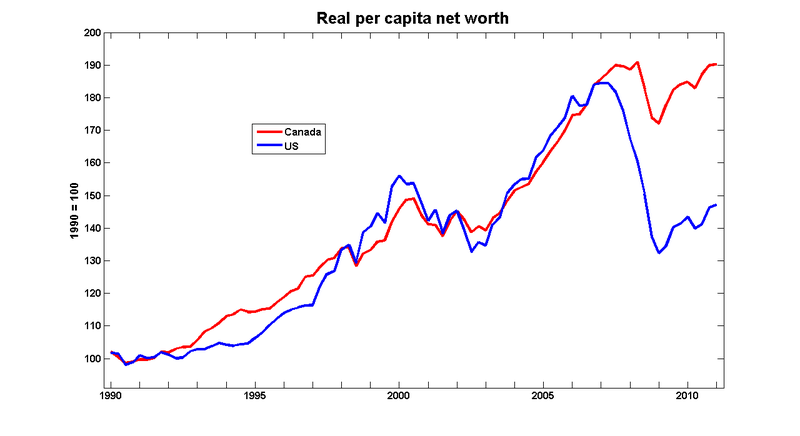
I had never heard the expression “balance-sheet recession” before this recent episode, and it’s time I got around to a comparison of the household balance sheets of the US and Canada. Of all my “Canada is not the US” posts, this is the one that makes me most grateful.
The quarterly data goes back to 1990, and it’s good to put the last few years in context. I’ve scaled all the series by price (the consumption spending deflator) and population. Here is the net worth series:
There’s been talk of a Japan-like ‘lost decade’ in the US; that seems optimistic. US real per capita net worth is back to what it was back in 1999.
More (and somewhat scarier) diagrams at the original post. It doesn’t even finish on a high note:
The US data go back to 1952, so I was able to check the last time the real, per capita value of US housing equity was at its current level. Even after looking at all of these graphs, the answer astonished me: 1978. Nineteen seventy-freaking-eight.
May 27, 2011
Colby Cosh: It wasn’t a market failure that caused the sub-prime fiasco
He’s quite right, not that the powers-that-be will take away the correct lesson from the experience:
What I see when I look at the origins of the financial pandemic is the story “government-sponsored enterprises that subsidize crazy lending practices and puppetize legislators fail.” Mortgage-writing institutions did things throughout the late 1990s and early oh-ohs that weren’t just likely to turn out badly; they made enormous amounts of loans that were practically certain to go bust in the short-to-medium term, loans that your mother could have told you would go sour. It wasn’t a “free” market that relaxed mortgage underwriting standards to the point of annihilation; it wasn’t a “free” market that put unskilled workers in million-dollar homes in the Sand States, or that spent too long ignoring the rising default rates that resulted.
We know this, in part, because we know how slightly freer mortgage markets traditionally behaved; they “redlined” the living heck out of low-income neighbourhoods. Because redlining resulted in racial discrimination — critics would just say it is racial discrimination — there has been a concerted attempt among economists to absolve the major U.S. anti-redlining statute, the Community Reinvestment Act of 1977, from any role in creating the housing bubble. Obviously it won’t do to pin the crisis on a 1977 law, but there is such a thing as the straw that broke the camel’s back; the CRA was followed by an even more intense fusillade of statutory and regulatory measures consciously designed to increase home ownership in America without making homes less expensive and valuable per se.
May 26, 2011
Charles Stross on Buckminster Fuller’s “Dymaxion House”
I remember something about Fuller’s potentially revolutionary design for housing from a few mentions in Robert Heinlein’s work, but I’d never followed up those hints. Charles Stross did:
. . . the Dymaxion House was probably the most fascinating of his failures, because it was nothing short of an attempt to revolutionize how we live.
Modernist architects of the 20th century generally designed two types of house: those for rich architects and other members of the upper classes to enjoy, and grimly regimented concrete cookie-cutter apartment blocks for factory workers. Fuller’s approach to housing was cookie-cutter-esque, insofar as he planned to mass-produce Dymaxion Houses on converted B-29 Superfortress production lines after the second world war, and ship them to their owners in freight containers, but as far as I know it was radically different in conception, purpose, and design from any of the other modular homes of the period. For one thing, he was interested in portability and nomadism; while a concrete foundation with utility connections was necessary, Fuller’s idea of moving house was that you could pack your house down into a container that would fit on a truck, drive it to your new neighbourhood, and deploy it again — the design influences of the traditional Mongolian yurt should be obvious. The Dymaxion House used aluminium sheeting for floors and structures, suspended by wires from a central steel structural shaft: saving weight was a priority. As he famously asked an architect on one occasion, “why are your houses so heavy?”
For another thing, he took an early interest in minimizing the human impact on the environment. The Dymaxion House had passive air temperature control and a pressure-triggered roof vent to survive near-misses from tornados (by releasing over-pressure inside the building so that it didn’t rupture). It had a then-unique mist-spray shower and a grey-water system to reduce water usage; Fuller was also interested in non-flush toilets.
Finally, it was intended to be mass produced for $6,500 per house in 1946 money — the cost of a high-end automobile — with a design life of 30-50 years. Early development was funded by the Pentagon, for reasons that should be obvious: WWII generated unprecedented demand for accommodation on bases overseas and, later, demand for housing in war-ravaged regions.
The story of why we aren’t all living in Dymaxion houses today is a convoluted epic of business failure (for one thing, starting up a production line for houses using cutting-edge aerospace technology was something that had never been done before; for another, Bucky’s business sense was not, sadly, as good as his design sense) that has been recounted in numerous biographies. What interests me about it is that it’s a far more humane approach to the problem of providing housing for the masses than his Brutalist contemporaries, whose designs tended to be fixed, immovable, made cheaply out of low-end materials, and built with high density mass housing in mind rather than low impact customizability. It was also way ahead of the field in terms of awareness of environmental constraints; while we could design better today, we’d be making incremental tweaks, whereas Bucky came up with the original idea of modular, lightweight, mobile low-impact housing ab initio.
Image detail from Tim O’Reilly’s Flikr photostream.
More, including a few photos at Wikipedia. And Rivet-head has a picture of the house while it was in use.
May 12, 2011
“It should have been called The Cell”
That’s Rob Lyons and he’s talking about an eco-residence called The Cube:
I think estate agents would refer to it as ‘compact and bijou’. It’s The Cube, the eco-home that’s showing just what sustainable living is all about. It should have been called The Cell.
The tiny house, which was on show at April’s Edinburgh Science Festival and is the brainchild of Dr Mike Page of the University of Hertfordshire, has an internal footprint of just three metres by three metres, yet has all the modern conveniences. There’s a tiny lounge with a flat-panel TV. If you want to dine with a friend, you need to swap half the sofa round with the sliding table. On the next level — reachable by a staircase so tiny that there’s only enough room for one foot at a time — you’ll find the composting toilet, the walk-in shower and the kitchen. (Is that even legal?) From there, you can clamber into the narrow bed, which could only accommodate two people if they both happen to be skinny vegans who don’t suffer from claustrophobia.
Everything is extremely well-insulated, including triple-glazed windows. Heat is provided by a heat-pump attached to the outside wall while electricity is generated through solar panels on the roof. Of course, they won’t work during the night, but you’ll have made so much money flogging electricity to the grid during the day — thanks to the insane prices at which electricity companies are obliged to buy micro-generated power — that you could actually earn £1000 per year.
All this could be yours for £50,000, assuming you’ve got some land to stick it on and you’re prepared to live in such cramped conditions. Considering you could buy a far larger luxury caravan with better facilities for less money (though not so well insulated), you may wonder why you would bother. But Page isn’t really interested in building eco-homes; in fact, he’s a psychologist. What he’s really interested in is why there is no demand for such eco-living, given that we now have lots of technology available to reduce our ‘impact’ — our ‘ecological footprint’.
April 28, 2011
Want a secure home? Even want it zombie-proof? Here you go
The first house to be certified as Zombie-proof:
“The most essential item for our clients was acquiring the feeling of maximum security,” begins the designers’ website in the summary of the structure. Who wouldn’t feel safe in a concrete rectangle that folds in upon itself to become completely sealed? Even the windows are covered with a slab of concrete when the structure is on nap time.
The house, with its movable walls, has only one entrance, which is located on the second floor after crossing a drawbridge. Seems like the perfect opportunity to use a flamethrower and defend the life of your family, while stylishly nesting in a piece of architectural elitism.
Lots of pictures at the original post. Here’s your drawbridge:

Here are the upper-story “shutters” swinging shut and the roll-down partially deployed:

And finally, your nice, safe, snug zombie-proof home all tucked in for the assault:

H/T to Markus Baur for the link.
April 17, 2011
March 15, 2011
Shang-Jin Wei on the Chinese sex imbalance and its economic impact
China’s one-child policy not only intruded into the personal lives of Chinese couples, but it may also have been a key contributor to the economic bubble:
Could a reproductive policy have caused the financial crisis? Could it still be wreaking havoc with the world economy? During a lively discussion at the Council on Foreign Relations yesterday, Columbia professor Shang-Jin Wei said this could be the case. He claimed that the skewed Chinese sex ratio (there are more men than women) can explain much of global trade imbalances. Mr Wei reckons the Chinese sex ratio can explain the high Chinese saving rate, and this is what’s behind China’s current-account surplus.
China adopted the one child law in the early 1980s. It resulted in a skewed sex ratio because many couples preferred a male baby and aborted female fetuses. In 1980, 106 boys were born were born for every 100 girls. By 1997, it was 122 boys for every 100 girls. This means that today one in nine Chinese men will probably never marry and the situation is expected to get worse as time goes on. It’s been suggested that the large pool of single men with no marriage prospects can lead to social unrest. What that will mean for China’s political future is uncertain and potentially troubling. But the world may already be experiencing the economic impact of this policy. Trade imbalances, specifically the Chinese current account surplus and America’s current account deficit, are often cited as a cause of the financial crisis. They provided a glut of cheap, easy capital which fed the housing bubble.
[. . .]
The lack of a social safety net is often blamed for the high Chinese saving rate. Without welfare and government pensions the Chinese must save to self-insure themselves. But Mr Wei pointed out that even as the government has extended more social welfare programmes, the saving rate has continued to rise. He believes the uneven sex ratio can explain half of the increase in private saving between 1990 and 2005. He explained that the marriage market is becoming very competitive with so few girls. Chinese parents want to accumulate as much wealth as possible to ensure that their son can attract a wife. It is also important to provide sons with the best education possible. A competitive marriage market means that members of the disadvantaged gender must raise their game, which in China means greater wealth and education.
Mr Wei also reckons the sex ratio can explain capital accumulation in the corporate sector. The desire to accumulate wealth means that boys and their parents are more likely to become entrepreneurs, work more hours and take more unpleasant jobs. He found higher rates of entrepreneurship in areas with more skewed sex ratios.
This, of course, is the optimistic view of things. The pessimistic view involves those tens of millions of men who can never find wives and projects that into social unrest, civil disorder, and military adventurism. Let’s hope the optimistic view is closer to being correct.