
Forgotten Weapons
Published 3 Dec 2025Walther began developing a modern stamped sheet metal SMG in the late 1950s, and it entered production in 1963. It was an open-bolt, simple blowback gun available in a short (MPK; 6.75″ barrel) and long (MPL; 10.25″ barrel) version. It was cheap and simple, but well thought out with a number of quite good features.
The standard design was just safe/full, but a semiautomatic selector position was available if desired by the client. An excellent safety sear prevented the bolt from bouncing open and firing, and the charging handle was both non-reciprocating and capable of also serving as a forward assist if needed. The sights were a bit too clever for Walther’s own good, with a 75m notch and a 150m aperture, both of which were not really great.
Faced with competition from contemporaries like the Uzi and MP5, the Walther never really became massively popular. It did get enough small and medium sized contracts (German police, South African police, Mexican Navy, Portuguese Navy, US Delta Force, etc) to remain in production until 1985 though. Overall a solid and reliable gun even if it failed to really stand out from the other options on the market.
(more…)
April 22, 2026
Walther’s Forgotten SMG: The MPK (and MPL)
April 18, 2026
The First M60 Prototype: FG42 + MG42 = T44
Forgotten Weapons
Published 1 Dec 2025The FG-42 caught the attention of a lot of countries at the end of World War Two. The British and Swiss both used it as the starting point for some developments. The US went one step simpler, and simply cut up a captured FG-42 to make into the T44, the first prototype of what would become the M60 machine gun.
This project was done in 1946 by the Bridge Tool & Die Company, who spent about six months reinforcing an FG42 and adding an MG42 feed system to it to create an unholy hybrid kludge of a gun. It was, however, successful enough to justify continuing the project. Only this one example was made before moving on to much more practical models built from the ground up instead of hacking up captured German guns.
(more…)
April 15, 2026
Origins of the Legendary CZ-75: Short Rail and Pre-B Models
Forgotten Weapons
Published 28 Nov 2025The CZ-75 began development in the late 1960s as a commercial project. It was not intended for Czechoslovak military use, but instead for export sales to bring foreign currency into Czechoslovakia. It was designed by František Koucký with some elements from other pistols (like frame rails and camming lug from the SIG P210 and a magazine based on the Browning High Power) and a healthy dose of original creativity (including the trigger mechanism). The design was finalized in 1973, approved for production in 1976, and the first production models were ready in June 1977.
The first model of the pistol is quite distinctive, with frame rails much shorter than what we see on examples today. This is called the Short Rail or Slab Side model, and it comprised just the first 16,000 guns produced, with the last ones made very early in 1980. This frame design proved prone to cracking, and in 1980 a longer frame replaced it. A half-cock notch was also added to the hammer in 1980. A few additional points in the production timeline include:
1984: Heavy black enamel paint replaces bluing as the standard finish
1986: Slightly enlarged trigger guard, grip panel design changes
1987: Magazines cease being marked with serial numbers
1988: Serial numbering changes to from 6 digits to 1 letter and 4 digits
1989: Ring hammer replaces spot
1993: CZ-75B introduced with a firing pin block in the slideIn 1992 the communist government in Czechoslovakia fell, and the country split into Slovakia and the Czech Republic. CZ became a privately owned company, and a slew of new options on the CZ-75 were rapidly introduced — so we will leave those for a separate video.
(more…)
April 12, 2026
TKIV-85: Finland’s Ultimate Mosin Nagant Sniper Rifle
Forgotten Weapons
Published 24 Nov 2025Finland’s final iteration of Mosin Nagant sniper was adopted in the 1980s to replace a mix-and-match assortment of m/39-43, m/27-66, and m/28-76 rifles. The two options were a Mosin system using a new bedding block (developed by Border Guard officer E. Toro) or a purpose-made new rifle made by Valmet (the Model 86). The Valmet was clearly the better rifle, but the Mosin option was acceptably good and much cheaper — so that’s what was adopted. The parts for the conversions were made by Valmet and assembled at Asevarikko 1.
Two different models were made. One was a military specific type, and the other was a dual-use rifle for competition shooting as well as potential military use. The competition rifles had a lighter barrel profile to meet the international competition weight limit and were fitted with competition aperture sights in addition to mounts for scopes.
Thanks to Frozen Trigger in Finland for giving me access to these examples to film for you!
(more…)
April 9, 2026
Aly & Kaufman AKB-23: Better Than the SA80 / L85
Forgotten Weapons
Published 19 Nov 2025The Aly & Kaufman AKB-23 is a set of parts that allows one to use a Brownells BRN-180 upper to create an SA80 / L85 lookalike. It’s a very clever adaptation, based on the fact that the original British L85A1 was essentially copied from the AR-180 design. By creating a new bullpup lower for Brownells’ modernized AR-180 (the BRN-180), the basic mechanics of the SA80 are used, but in a form that is well tested and reliable.
The parts include, of course, the new lower (which is legally a firearm, and requires FFL transfer). The lower is milled aluminum, and uses standard AR fire control parts. It also includes iron sights that mount onto the BRN-180 picatinny rail and a high quality 3D-printed cheek rest and front handguard.
This is a really fun rifle, and a very clever way to create an L85 analog that is affordable and accessible.
(more…)
April 6, 2026
T20 Family: Springfield Makes the Garand a Grenade Launching Sniper Machine Gun
Forgotten Weapons
Published 17 Nov 2025Late in 1944 the Ordnance Committee recommended adoption of a magazine-fed, select-fire version of the M1 Garand as a new standard US infantry rifle. Both Springfield and Remington developed rifles to meet the requirement, with Springfield’s being the T20 and Remington’s the T22.
The Springfield design went through several iterations from the original T20 to the T20E1 and T20E2, with the capability to launch rifle grenades, mount optical sights, and fire in either semiautomatic or full auto. The first examples of the final T20E2 design were ready in June 1945, but the program lost momentum in August when Japan surrendered. It did continue slowly until 1949, providing some of the basis for the eventual M14 rifle.
(more…)
April 2, 2026
m/27PH aka m/37: Finland’s First Standard Sniper Rifle (and it’s really bad)
Forgotten Weapons
Published 14 Nov 2025The m27PH, aka the m/37, was the first standardized Finnish sniper rifle. It was developed as part of the plan to make a whole family of m/27 rifles for the Finnish Army, including cavalry, trainer, and sniper models. The sniper model was delayed because of the structural problems with the m/27 base rifle, and it was not formally adopted until 1937. The rifle used a 2.2x prismatic scope made by Finnish company Physica Oy. The scope was heavy, fragile, and had a very short eye relief.
When first adopted, the rifles had short, slightly bent bolt handled and standard stocks. Once they began to see use in the Winter War (for which they were Finland’s only standardized sniper rifle), experience showed these features to be problems. The bolt handles were largely replaced with much longer Soviet-style sniper bolts, and wooden cheek rests were added to the stocks.
During the Continuation War, m/27PH rifles were still in service, but as they were damaged their scopes were generally used to build new m/39PH sniper rifles instead. Today they are extremely rare rifles.
(more…)
March 29, 2026
Adventures in Surplus! Finnish M28 “Ski Trooper”
Forgotten Weapons
Published 10 Nov 2025Today we are going to take a look at just how much historical [information can] be read from the features and markings of an individual rifle. This is an early production Finnish M28 “ski trooper” Mosin Nagant that can be traced from Russian manufacture to WW1 Russian use, Austro-Hungarian capture, rechambering to 8x50mm Mannlicher, concession to Italy as war reparations, sale to Finland, rebuilding as a Civil Guard M28, use in the Winter War and Continuation War, transfer to the Finnish Army, and finally importation into the United States.
(more…)
March 28, 2026
AK50: How Hard Could it Be? Brandon Herrera’s 10-Year Project
Forgotten Weapons
Published 5 Nov 2025Scaling the AK up to .50 BMG … how hard could it be? Today we find out, with a detailed look at all three iterations of Brandon Herrera’s AK-50 project.
(more…)
March 27, 2026
Protecting modern warships from new threats
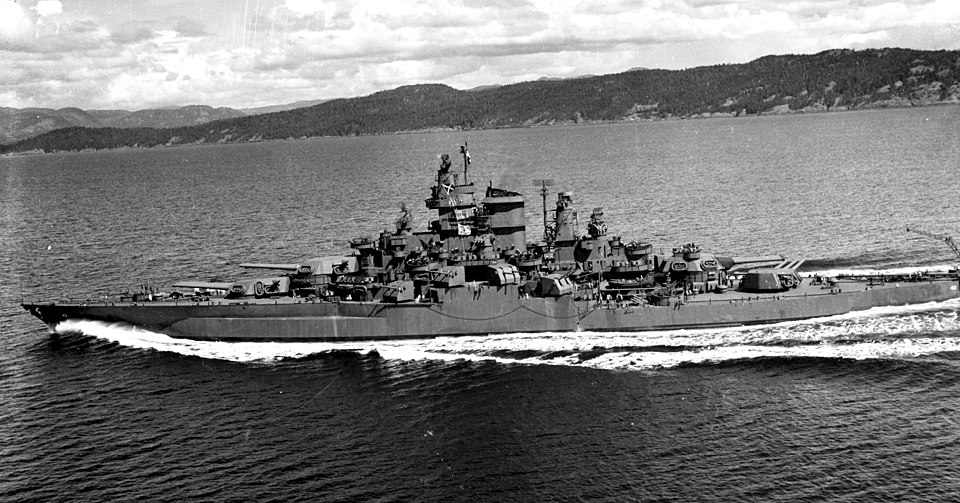
CDR Salamander considers how the US Navy up-gunned their fleet after the shock of the Pearl Harbour attacks with an eye to the current day, where it appears that modern warships suddenly need far more defensive firepower than they have:
USS Tennessee (BB 43) underway in Puget Sound, Washington, on 12 May 1943, after modernization.
Photograph from the Bureau of Ships Collection in the U.S. National Archives via Wikimedia Commons.One of the many lessons of the modern air threat against surface ships in the last few years is simple: we need more of everything.
It isn’t really a new lesson. It is an old lesson that our peacetime accountants convinced us to pretend we didn’t know.
Since the first war in which the threat from the air targeted the surface fleet, what was a common thread after D+0 from WWII to the Falklands War?
After cursing those responsible for preparing the fleet for the next war, those tasked to fight the war in front of them would, at the first chance, put every possible weapon possible on their warships.
My favorite example is what the U.S. Navy did with its old battleships the first chance after Pearl Harbor.
The picture at the top of the post is the battleship USS Tennessee (BB 43) after the completion of her rebuild, May 12th, 1943.
- The older single 5-inch/25 cal guns were replaced by eight twin 5-inch/38 caliber dual-purpose gun mounts (totaling 16 guns).
- Ten quadruple 40 mm Bofors mounts and 43 single 20 mm Oerlikon guns replaced 1.1-inch and .50 cal machine guns.
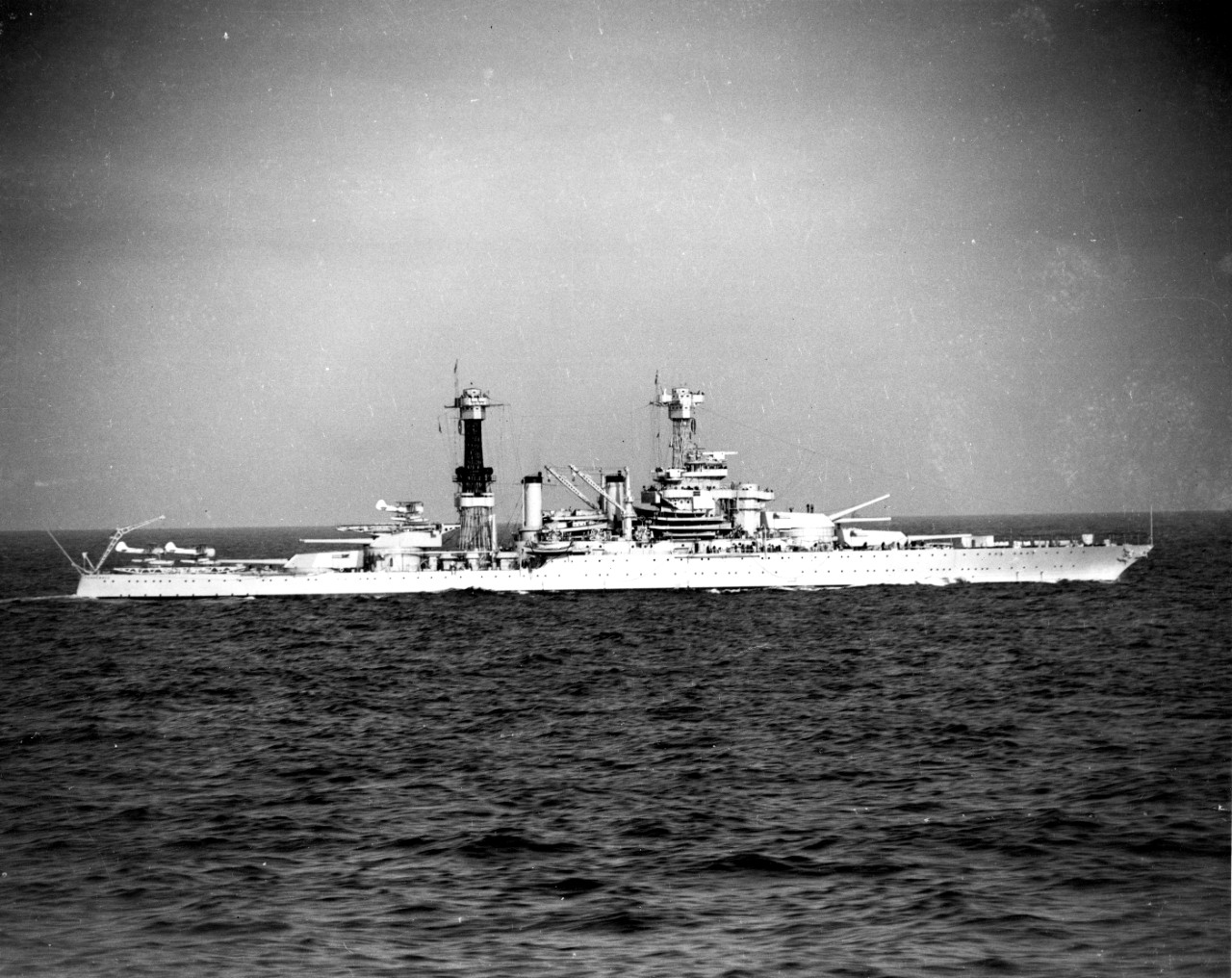
Here she was with her “cleaner” deck from the 1930s.
USS Tennessee in the mid-1930s.
The Royal Navy reached the point in the Falklands War that they resorted to lining the decks with Seamen firing whatever weapons they could find from rifles to crew-served weapons … as they simply did not have the time to up-arm their ships properly.
Like the sudden realization that they did not quite understand the true nature of the threat from the air in the 1930s, here in the mid-2020s we are suddenly realizing that we don’t fully understand — or more likely were comfortable ignoring those warning of the problem — the high/low threat to warships from the air.
The tan, rested, ready, if the not quite battle-tested People’s Liberation Army Navy (PLAN) is comfortably unbothered, moisturized, happy, and staying in their lane as we have been emptying out magazines and wearing out sailors and ships, They continue to be focused on how to defeat the U.S. Navy should it venture west of the International Date Line in response to a future contingency — the very mission the PLAN was built to execute as the world’s largest navy.
I am quite confident, because, especially in the ballistic missile area, they were ahead of everyone, that the PLAN has a whole mix of threats they are ready to throw at our fleet should it be required.
The Houthi who have been providing us unscheduled range time in the Red Sea for over two years, and Iran from Turkey to UAE over the last year. The Houthi are a fourth-rate threat, and the Iranians are on a good day, a second-rate threat. They are throwing everything from slow drones to anti-ship ballistic missiles (ASBM) at ships.
The People’s Republic of China (PRC) is a first-rate threat … and then some. She will do the same, but better and in higher volume. We need to be ready to face that, and we are not.
Taking advantage of the temporarily insane market price for tungsten
Tim Worstall has a business idea to capitalize on a current price fluctuation in the tungsten market … and you wouldn’t need to build a massive mine or a large smelter for the purpose:
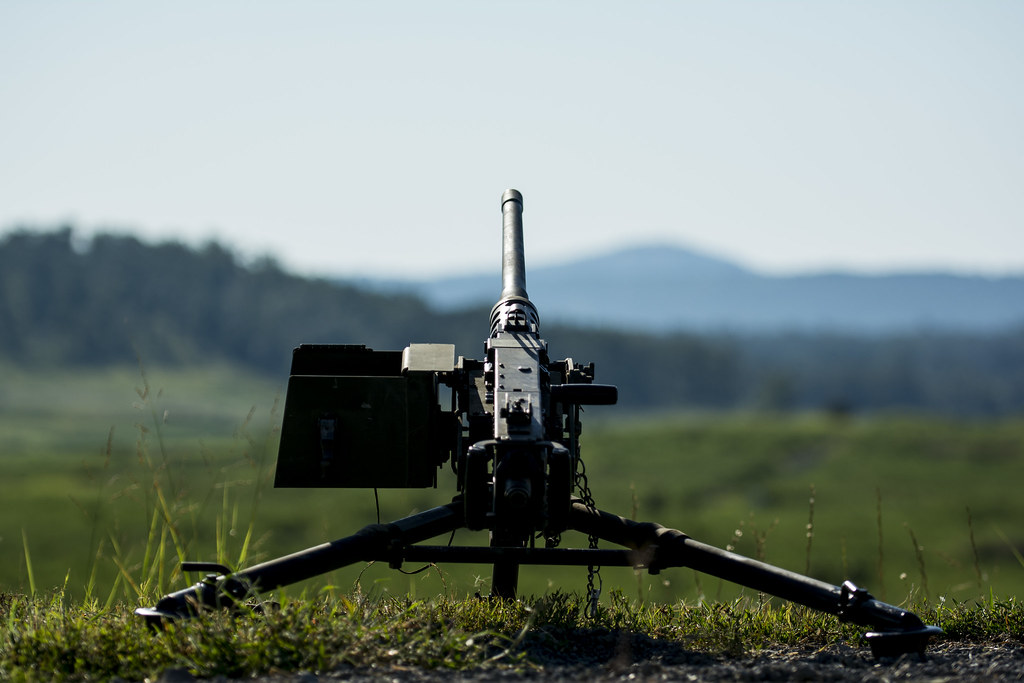
“Making friends with the 50-cal” by 416thTEC is marked with Public Domain Mark 1.0  .
.
There are times when the prices of weird metals just get wholly out of hand. Like, absurdly, nonsensically, out of hand. This is of great comfort to the usual morons as they can then point out that markets are not rational. They’re morons because no one has ever used — other than morons — “rational markets” to mean always correct markets.
The actual defence of markets is that they produce less absurd prices less often than allowing morons to determine them.
But, OK, odd prices.
Those of a certain age might recall back around the millennium tantalum prices went ballistic. They had been $200 a kg and they went to $2,000 a kg. This was because a little bit of Ta is essential to make the capacitors that make a mobile phone work. Mobile phones were proving to be pretty hot shit and so demand rose, demand rose faster than new mines could be opened and so the price went ballistic.
[…]
So, tungsten. A fair old use (and while everyone’s screaming about this and China it’s a minority use, by a long way. The major use is actually in the teeth of digging machines as tungsten carbide. If you’ve a scrap yard of those drop me a line!) is in armour piercing bullets and shells. Which, when in use are dispersed on the battlefield and no, it’s not worth going out and collecting those. The brass shell casings, especially of artillery, those are but let the specialists do that — too many dud rounds that can still go bang for amateurs to do that.
Tungsten prices are weird. The price is quoted at metric tonne unit in WO3 concentrate. Which is, now, perhaps $2,400 (which is insane, but there we are). An mtu, well, WTF? To get to the tungsten price divide by 8 (OK, OK, 7.92). So, $300 kg tungsten metal. The scrap price will be less than that, obviously and etc.
And, well, something that some do do. Firing ranges.
Lead has a value, most bullets are made of lead, a lot of bullets are fired at the range. There’s a big bank of earth behind the targets at the range to ensure we don’t hurt no kangaroo etc with bullets flying over the horizon. It does actually pay, every so often, to go dig out that bank of earth for the bullets embedded in it. Lead scrap has a price.
Can you see where this is going? Find the ranges they test their armour-piercing ordinance on and offer to dig out their bank behind the targets. Collect the tungsten scrap — and the lead, but separate them — and make bank on the vast, stupid, insane price of tungsten. Shovel, wheelbarrow, sieve, sweat, this works.
If we can find the shooting ranges they try their tungsten bullets out upon. Each bullet is going to be in the 3 to 7 grammes range, that sort of thing. So we’ll need 200 bullets to get a kg at $300 (less scrap discount!) which sounds like a lot. But if we find the ranges where they teach firing the .50 cal armour piercing machine gun rounds then … well, if they’ve not dug through that bank for a few years $$!!
March 25, 2026
Apache Arms Carbine: A Saga of Compliance and Crappy Manufacture
Forgotten Weapons
Published 3 Nov 2025The Apache Arms carbine was a Thompson SMG lookalike that was made in small numbers in the late 1960s. It was the successor to the Spitfire carbine made by the same people, after the Spitfire was deemed a machine gun by the IRS. The Apache used M3 Grease Gun magazines and was chambered for .45 ACP. It uses a square receiver tube and many of the same cast parts as the Spitfire. It is a very interesting look at how the design was adapted to be legally considered semiautomatic.
(more…)
March 23, 2026
Canada’s NEW Rifle – the CMAR
The Armourer’s Bench
Published 22 Mar 2026The Canadian Armed Forces are set to adopt variants of Colt Canada’s MRR as the Canadian Modular Assault Rifle (CMAR). The announcement stated that more than 65,000 rifles will be procured over the next 5 years to replace the Colt Canada C7 rifles and C8 carbines currently in Canadian service.
Be sure to check out our accompanying article for this video here – https://armourersbench.com/2026/03/22/canada-adopts-new-rifle/
March 22, 2026
The Original AR-15: Serial Number 6 in Original Configuration
Forgotten Weapons
Published 1 Nov 2025The very first AR15 rifles submitted to US government trials were extremely lightweight, with an assortment of interesting features that did not last long. They had top-mounted charging handles, one-piece hand guards, very thin barrels with plain muzzles, and a different safety selector configuration than became normal later one. Updates and modifications were made to virtually all of the original rifles, but today we have a chance to look at serial number 6 in the Springfield Armory collection — which is still in completely original configuration.
Thanks to the Springfield Armory National Historic Site for giving me access to this truly unique specimen from their reference collection to film for you! Don’t miss the chance to visit the museum there if you have a day free in Springfield, Massachusetts: https://www.nps.gov/spar/index.htm
(more…)
March 21, 2026
Colt LE-901 Modular Multi-Caliber AR: A Well-Designed Failure
Forgotten Weapons
Published 29 Oct 2025Colt originally developed the 901 as part of the US Army SCAR program, with the intention being to create a 7.62x51mm rifle that could also use unmodified 5.56x45mm upper assemblies. This would allow special operations units to customize a single weapon to a variety of different configurations for different mission profiles. Mechanically, the system Colt devised to do this was quite clever, and very effective. However, the rifle ultimately failed to win a military contract.
Moved to civilian sales, the system was unsuccessful fundamentally because the modular concept is just not very desirable. A single modular rifle like this inevitably sacrifices some capability in every specific configuration in exchange for the modular capability and most people would rather have two dedicated rifles in different configurations than one swappable one. It sounds appealing on paper, but almost always fails economically in practice.
(more…)


