World War Two
Published 4 Jul 2026Spring 1938: Hitler has taken Austria. Now he turns toward Czechoslovakia — and at home, Nazi Germany’s terror against Jews and other targeted minorities accelerates.
In this episode of Death of Democracy, Spartacus Olsson reports from Berlin at the end of Q2 1938, as the Nazi regime fuses foreign-policy intimidation with domestic repression.
After the Anschluss, Hitler pressures Czechoslovakia over the Sudetenland, but the May Crisis exposes that Germany may not yet be ready for war. Humiliated, Hitler secretly issues a revised Case Green directive: Czechoslovakia is to be smashed by military action.
At the same time, persecution inside the Reich escalates. Jews are forced to register assets. The Nuremberg Laws are extended to annexed Austria. The Great Synagogue in Munich is demolished. Berlin sees orchestrated anti-Jewish street violence. And during “Operation Work-Shy Reich“, thousands of so-called “asocials” are sent to concentration camps — including the first mass arrest of Jews since Hitler’s seizure of power.
This is the quarter when the road from Anschluss to Munich becomes clearer: diplomatic extortion abroad, racial terror at home, and a world still hoping that concessions might preserve peace.
In this episode:
– The April 1938 Anschluss plebiscite
– Jewish asset registration and Aryanization
– The extension of the Nuremberg Laws to Austria
– The Sudeten May Crisis
– Hitler’s Case Green directive against Czechoslovakia
– The demolition of Munich’s Great Synagogue
– Anti-Jewish violence in Berlin
– Operation Work-Shy Reich
– Flossenbürg and the expansion of concentration-camp labor
– The world’s hesitant response to Nazi escalation
July 5, 2026
How Hitler Targeted Czechoslovakia – Death of Democracy 22 – Q2 1938
June 28, 2026
How to Steal a Country Without a European War – Death of Democracy 21 – Q1 1938
World War Two and Spartacus Olsson
Published 27 Jun 2026In early 1938, Adolf Hitler turned a military scandal into personal control over the Wehrmacht — and within weeks used that power to pressure, invade, and annex Austria in the Anschluss. This episode follows the Blomberg-Fritsch crisis, Hitler’s February 4 command takeover, the Berchtesgaden ultimatum, Schuschnigg’s failed plebiscite gamble, the German invasion of March 12, and the terror that followed in Vienna.
This was not just a border crisis. It was the moment Nazi Germany moved from internal dictatorship to open territorial expansion. Britain and France did not intervene, Austria was erased as a sovereign state, and Hitler’s next target — Czechoslovakia — was already coming into view.
This historical documentary examines Nazi Germany, the Anschluss of Austria, the Wehrmacht, appeasement, antisemitic terror, propaganda, and the collapse of the post-1919 European order.
Educational documentary. Nazi symbols and imagery are shown only in a historical, critical, and anti-fascist context.
June 26, 2026
Magda Goebbels: The Nazi Mother Who Murdered Her Children
World War Two
Published 25 Jun 2026Magda Goebbels was one of the most infamous women in Hitler’s inner circle. Known as the wife of Nazi Propaganda Minister Joseph Goebbels and often treated as an unofficial “First Lady” of the Third Reich, she helped project an image of family, elegance, and loyalty while standing beside one of history’s most murderous regimes. But her story ends in one of the darkest acts of the Second World War.
As Berlin collapsed in 1945, Magda Goebbels took her six children into Hitler’s Führerbunker. Offered chances to escape, she refused. One day after Hitler’s suicide, she helped murder her own children with cyanide, claiming that a world without National Socialism was not worth living in.
In this episode of our new format, Baddies and Battleaxes, Anna Deinhard returns to tell the story of Magda Goebbels: socialite, Nazi fanatic, mother, accomplice, and child murderer. Her life reveals how women in the Third Reich were not always passive bystanders. Some, like Magda, actively embraced Nazi ideology, helped legitimize the regime, and chose loyalty to Hitler over humanity itself.
This is the story of the Nazi “First Lady” who followed fascism all the way into the bunker.
Who should Anna cover next in Baddies and Battleaxes? Tell us which heroines and villainesses of WW2 you want to see in a future episode.
June 25, 2026
Coenders’ Bolt-Less Last Ditch Bolt Action Rifle
Forgotten Weapons
Published 4 Feb 2026When the German Army tested last-ditch Volkssturm rifles late in World War Two, one of the particularly obscure submissions was August Coenders’ Coenders-Rochling Volkssturmkarabiner. This was a bolt-action rifle chambered for 8mm Mauser with a 5-round magazine. However, instead of using a traditional bolt action system it had a fixed breechblock and the handle was attached to the barrel. Cycling the action meant unlocking the barrel and sliding it forward, while the breechblock held the fired case in place. When the barrel was fully forward, the next round in the magazine would kick out the empty case, and pull the barrel rearward seated the next cartridge, ready to fire. In testing, the rifle was, frankly, terrible.
Thanks to the Springfield Armory National Historic Site for giving me access to this unique specimen from their reference collection to film for you! Don’t miss the chance to visit the museum there if you have a day free in Springfield, Massachusetts: https://www.nps.gov/spar/index.htm
(more…)
June 21, 2026
How To Make War Inevitable – Death of Democracy 20 – Q4 1937
World War Two and Spartacus Olsson
Published 20 Jun 2026By late 1937, Nazi Germany’s rearmament economy had trapped itself. Autarky was failing. Hjalmar Schacht was pushed aside. Göring’s Four-Year Plan dominated economic policy. And at the secret Hossbach meeting of November 5, Hitler turned economic impossibility into an argument for territorial conquest.
This episode covers Q4 1937: the Hossbach Memorandum, Schacht’s resignation, the Anti-Comintern alignment, Lord Halifax’s visit, Himmler’s police-state consolidation, the December “Preventive Crime Fighting” decree, and the antisemitic propaganda exhibition Der Ewige Jude.
The argument is not that war was metaphysically inevitable. It is that the Nazi regime built an ideological, economic, and police-state machine that made war look increasingly necessary to its own leadership. This is a historical analysis of Nazi dictatorship, antisemitic propaganda, and war planning. It condemns Nazism and uses extremist material only for educational and documentary context.
Chapters:
0:00 Q4 1937 Intro
0:53 The world at the end of 1937
1:36 Germany’s quarter of acceleration
3:30 Himmler Tightens Police Power
6:26 Der Ewige Jude and dehumanization
8:30 Hossbach: autarky fails
11:16 Halifax and diplomatic confidence
13:03 Mood inside Germany
15:09 Mein Kampf has become policy
17:16 Conclusion: the politics of beasts
June 14, 2026
How to Make Dissent Disappear – Death of Democracy 19 – Q3 1937
World War Two and Spartacus Olsson
Published 13 Jun 2026In 1937, Nazi Germany moved from controlling politics to controlling thought itself. Churches, artists, workers, and dissenters all came under attack.
Berlin, September 1937. From the outside, Germany can seem strangely quiet while the rest of the world slides deeper into war, civil conflict, and authoritarianism. But inside the Reich, the Nazi state is tightening its grip on the last spaces where dissent can still exist.
This quarter, the Gestapo arrests Pastor Martin Niemöller and intensifies the attack on the Confessing Church. The regime opens the House of German Art in Munich, then stages the infamous “Degenerate Art” exhibition to mock, vilify, and destroy modernist culture. The SS establishes Buchenwald near Weimar, forcing prisoners to build their own prison. Meanwhile, Göring’s new state industrial empire and the Nuremberg “Rally of Work” reveal a society being reorganized for war.
This is Step 19 in the death of democracy: when the authoritarian state stops merely silencing opposition and begins fighting the inner freedom to believe, imagine, worship, create, and think.
June 7, 2026
How Hitler Tested His Next War in Spain – Death of Democracy 18 – Q2 1937
World War Two and Spartacus Olsson
Published 6 Jun 2026Berlin, June 30, 1937. Hitler has not staged a major diplomatic shock this quarter — but beneath the surface, Nazi Germany is preparing for war.
In Spain, the Condor Legion helps Franco’s Nationalists and the bombing of Guernica gives the world a terrifying preview of modern aerial terror. At home, the regime escalates its assault on the Catholic Church, begins the purge of “degenerate art”, tightens the link between courts and concentration camps, and hides rearmament behind spectacles of economic success.
This episode of Death of Democracy looks at Q2 1937: the quarter when Nazi Germany normalized aggression abroad while deepening tyranny at home.
00:00 Berlin, June 30, 1937
00:05 No Hitler Surprise — But War Preparations Continue
00:51 The Hindenburg and the Shadow of Modern War
01:50 The “Give Me Four Years” Exhibition
02:25 Guernica and the Condor Legion
02:55 The Bombardment of Almería
03:11 Case Green and Case Otto
03:54 Degenerate Art and Cultural Cleansing
04:22 The Judiciary and the Concentration Camps
05:13 The Nazi Assault on the Catholic Church
06:07 Goebbels, Propaganda, and the Morality Trials
07:45 Autarky, Rearmament, and Hidden Austerity
08:52 Mood Inside the Nazi Leadership
09:48 Ordinary Germans and Apathy
12:15 Analysis: War Abroad, Tyranny at Home
14:19 Conclusion: Nazi Double-Talk
June 4, 2026
Sci-Fi and the WWII Mythos Part II : The Political Element
Feral Historian
Published 16 Jan 2026Last time I was focused on cultural aspects, but what about the direct political manifestations today? Is there a resurgence of neo-nazi attitudes or is just an artifact of the ubiquity of digital media preserving everything? Why might those ideas resonate with the young, and how does it fit with my argument that the old myths are breaking down?
00:00 Intro
01:42 Right, Left, and Gen-Z
02:56 Patterns of Force
04:25 Rambling about Economics
05:48 Efficient? No.
06:39 Bifurcation
08:00 Loss of PerspectiveThis one is a direct result of a conversation on the Talking History program on KSMU (I’ll link the episode when goes up) and covers something that came up but wasn’t really addressed well.
(more…)
May 31, 2026
How the Nazis Got Rich Preparing Germany for War – Death of Democracy 17 – Q1 1937
World War Two
Published 30 May 2026By March 1937, Nazi Germany had renewed dictatorship, buried Versailles, and turned rearmament into a corruption machine.
Berlin, March 31, 1937. Adolf Hitler’s regime appears stronger than ever. The Enabling Act is extended for another four years, the civil service is bound more tightly to Hitler personally, and Germany formally rescinds its signature from the war-guilt clause of the Versailles Treaty.
But behind the speeches about honor, work, and national revival, another transformation is underway.
In the first quarter of 1937, Nazi Germany moves deeper into an economy built around rearmament, Party patronage, racial exclusion, corporate privilege, and theft. The new German Corporation Law weakens ordinary shareholder control and strengthens management boards. Industrial giants profit from military preparation. Jewish property becomes a field of extortion and enrichment. Hitler himself grows wealthy through book royalties, image rights, hidden payments, and political slush funds.At the same time, the regime tightens control over public life. Civil servants are required to serve the Nazi state without reservation. Journalists, professors, doctors, artists, and Jewish Germans are pushed out of public and professional life. Concentration camp roundups expand beyond political opponents. And on Palm Sunday, Pope Pius XI’s Mit brennender Sorge is read from Catholic pulpits across Germany, openly challenging Nazi ideology.
This episode looks at Germany in the first quarter of 1937: a moment when dictatorship no longer needs to look revolutionary. It looks administrative, profitable, respectable — and permanent. This is the story of how power, profit, propaganda, and fear helped turn a modern state into a robber regime preparing for war.
0:00 Berlin, March 31, 1937
0:47 A World in Crisis
01:10 Germany Extends the Legal Shell of Dictatorship
01:23 Civil Servants Bound to Hitler
01:51 Hitler Rejects the Versailles War-Guilt Clause
02:21 The Enabling Act Is Renewed
02:48 Göring in Rome, Reassurances in Warsaw
03:44 The New Corporation Law
04:00 The Catholic Church Challenges Nazi Ideology
05:08 Police Roundups and Expanding Concentration Camps
05:46 Press, Education, Medicine, and Culture Under Control
08:20 The Nazi Economy: Private Profit, State Power
09:41 Aryanization and Organized Theft
10:20 Rearmament, Industry, and Oligarch Profits
12:21 How Hitler Personally Got Rich
14:55 The Party Mood: Confidence at the Top
15:22 German Public Sentiment and Victor Klemperer
16:20 Analysis: How Results Become Consent
17:06 Conclusion: The Quiet Theft of Democracy
18:27 Never Forget / Support TimeGhost
May 24, 2026
How to Indoctrinate a Generation – Death of Democracy 16 – Q4 1936
World War Two and Spartacus Olsson
Published 23 May 2026How did Nazi Germany seize control of its youth by the end of 1936? In this episode, Spartacus traces the Hitler Youth Law, the Four-Year Plan, Winterhilfswerk, the Anti-Comintern Pact, Goebbels’ attack on criticism, and the tightening exclusion of German Jews.
Berlin, December 31, 1936. The Nazi regime did not need another single dramatic coup. It connected the household, the factory, the school, the street collection, the newspaper, and the foreign threat into one system of mobilization.
This episode covers how the Law on the Hitler Youth declared all German youth organized within the Hitler Youth; how the Four-Year Plan redirected recovery toward rearmament and autarky; how charity became mandated patriotic ritual through Winterhilfswerk; how anti-Bolshevik propaganda linked Spain, Japan, Italy, and Germany; and how Jewish Germans were pushed further into isolation through administrative humiliation and police control.
This is an educational historical documentary condemning Nazism, antisemitism, dictatorship, racial exclusion, and political indoctrination.
May 17, 2026
Why Didn’t Germans Resist Hitler? – Death of Democracy
World War Two and Spartacus Olsson
Published 16 May 2026Why didn’t Germans resist Hitler? Were they all Nazis, or were they terrorized into silence by the Gestapo?
The truth is more unsettling. The Nazi regime ruled through a combination of targeted terror, social atomization, propaganda, popular support, opportunism, and broad accommodation. This episode examines why mass resistance never emerged — and why millions of ordinary Germans accepted, enabled, or benefited from the Third Reich.
00:00 Why didn’t Germans resist Hitler?
00:33 The myth of the all-powerful Gestapo
01:36 Targeted terror and selective repression
02:39 The Nazi seizure of power
03:09 Gleichschaltung and the destruction of civil society
03:38 Inner emigration and private conformity
04:16 Why early Nazi successes mattered
04:33 Unemployment, rearmament, and national pride
05:39 Versailles, trauma, and German victimhood
06:22 Identity, propaganda, and belonging
07:25 Volksgemeinschaft and the “Hitler Myth”
08:54 Kristallnacht and the failure of collective action
10:40 What the numbers suggest
11:47 Postwar surveys and lingering Nazi support
13:31 Terror, consent, and accommodation
15:07 Did this absolve ordinary Germans?
16:16 Democracy, responsibility, and Never Forget
May 11, 2026
Were the Nazis socialists?
If you’re ever bored and want to kick off an argument online, you can take either side of this statement and watch the signal-to-noise ratio drop precipitously. The NSDAP, the Nazis, began as one of the many, many groups of angry young Germans in the days after the end of the First World War. The full name of the party — the National Socialist German Worker’s Party — indicates who the original party founders thought would be the engine of their political rise. They were explicitly anti-communist, as the spectre of the Russian Revolution terrified many Germans, but German socialism was still within the Overton Window of political debate.
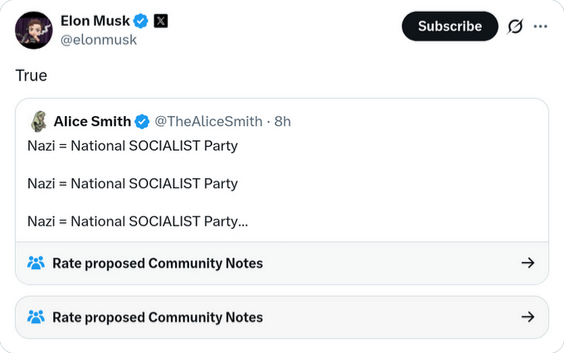
Lots of arguments about this one.
Many people assume Nazis could not have been socialists, despite all the time and energy they devoted to jumping up and down screaming “We are socialists!”, because they were “right-wing” and socialism is supposed to be “left-wing”.
Except “right-wing” and “left-wing” don’t have rigid definitions outside the context of the French revolution. In any other context, they’re just a metaphor.
So why did the NATIONAL Socialist German Workers’ Party and the INTERNATIONAL Marxist-Leninist Socialist Workers’ Movement hate each other so much?
It’s pretty obvious when you look at the names.
National.
International.
To Nazis, the race and culture of a people are everything. They are what the state is supposed to represent. Ein Volk, as they would say. The purpose of Nazi socialism is to control capital assets, subordinating them to the will and welfare of the ethnostate.
But Marxist-Leninists seek to abolish all ethnostates. They are a globalist movement, seeking to place all capital assets under the control of a universal proletariat in theory, which is in practice represented by one world government.
Thus, Nazis sought to use socialist policies for the welfare of the German people and Marxist-Leninists seek to abolish “German” as a meaningful distinction, along with all other cultures.
The antipathy between Nazis and communists was a sectarian struggle within socialism. Same methods, but different sacred groups.
Since the defeat of National Socialism by International Socialism in WW2, all modern socialism is pretty much of the international variety.
This does, however, suggest that there is a contrast between National Capitalism and International Capitalism as well.
Which is the source of the current sectarian struggle between elements of the American right wing.
Update, 12 May: Welcome, Instapundit readers! Have a look around at some of my other posts you may find of interest. I send out a daily summary of posts here through my Substack – https://substack.com/@nicholasrusson that you can subscribe to if you’d like to be informed of new posts in the future.
May 10, 2026
How to Make Nazi Germany Look Normal – Death of Democracy 15 – Q4 1936
World War Two and Spartacus Olsson
Published 9 May 2026How did Hitler use the 1936 Berlin Olympics to make Nazi Germany look peaceful — while preparing the country for war?
Berlin, September 30, 1936. Under the Olympic flame, Nazi Germany staged one of the most successful propaganda spectacles of the twentieth century. Foreign visitors saw order, ceremony, technology, pageantry, and athletic triumph. But behind the facade, the regime hid antisemitic persecution, rounded up Sinti and Roma, intensified police repression, intervened in the Spanish Civil War, and moved toward a massive new war economy.
In this episode, Spartacus Olsson looks back at the third quarter of 1936: the Berlin Olympics, Jesse Owens’ victories, Hitler’s secret war memorandum, the Four-Year Plan, Nazi propaganda, Germany’s growing involvement in Spain, and the dictatorship’s attempt to sell peace to the world while preparing for conquest.
The Olympics gave Hitler international validation. The Four-Year Plan revealed what he truly intended.
In this episode:
– How Nazi Germany sanitized Berlin before the Olympic Games
– How the regime temporarily hid antisemitic violence from foreign visitors
– How Sinti and Roma were forced out of sight before the Games
– How Jesse Owens challenged Nazi racial mythology on the track
– How Hitler moved Germany toward a war economy
– How the Four-Year Plan tied German recovery to rearmament
– How Germany’s intervention in Spain marked a new stage of escalation
– How propaganda, spectacle, and controlled media helped normalize dictatorshipThis is not just a story about the 1936 Olympics. It is a story about how authoritarian regimes use spectacle, national pride, media control, and international complacency to hide what they are becoming.
Never Forget.
May 3, 2026
How to Declare a Live Person Legally Dead – Death of Democracy 14 – Q2 1936
World War Two and Spartacus Olsson
Published 2 May 2026In Q2 1936, Adolf Hitler consolidated power after the Rhineland gamble, tightening the machinery of dictatorship while projecting strength abroad. As Hermann Göring took control of Germany’s economic lifelines and Heinrich Himmler centralized the police, the regime accelerated its transformation into a fully integrated police state.
Behind Olympic pageantry and propaganda triumphs like Max Schmeling’s victory, the Nazi system deepened repression. Courts enforced the Nuremberg Laws with chilling logic, reducing Jewish citizens to a state of “civil death”, while Joseph Goebbels expanded total control over media and public discourse.
At the same time, Germany’s economy bent further toward war, with dwindling foreign reserves and rising dependence on autarky. Yet domestically, resistance remained minimal as propaganda, fear, and perceived stability drove growing public support.
Globally, the quarter exposed the weakness of the League of Nations during Italy’s conquest of Abyssinia, saw Léon Blum’s rise in France, and witnessed the outbreak of the Arab Revolt in Palestine — signs of a world drifting toward instability.
This episode examines how dictatorship consolidates not just through terror, but through law, economics, and consent — and why, by mid-1936, meaningful resistance inside Germany had largely vanished.
April 26, 2026
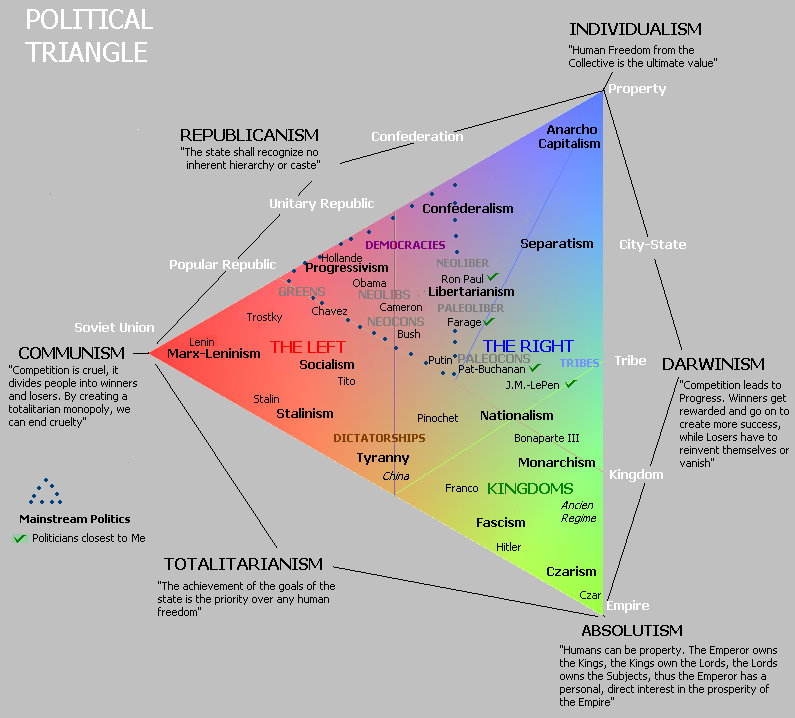
Rightists think leftists are stupid and leftists think rightists are evil
Lorenzo Warby discusses political categories and explains why they aren’t the same as moral categories:
A lot of people who class themselves as being on the Left clearly feel that there is some automatic moral kudos from being on the Left. As a direct implication of this sense of moral kudos, they also clearly think that there is some moral deficiency from being on the Right.
Yes, there are difficulties in defining Left and Right. Nevertheless, even without that difficulty, any such claim of moral kudos is ridiculous. The Left includes Lenin, Stalin, Mao, Kim il-Sung, Pol Pot, Mengistu … Indeed, by far the most important historical impact of Left politics on world history is precisely the actions of this succession of mass-murdering tyrants and their regimes.
If you think that somehow the Left does not include said mass-murdering tyrants, you are simply wrong. It is very revealing that there are clearly many folk on the Left who somehow edit out this history. They are not looking at the Left as it is in history, but as some set of noble aspirations that morally ennoble themselves.
Folk not of the Left absolutely associate the Left with those mass-murdering tyrants. Moreover, if you edit out that history, you are editing out how the political tradition you identify with can go horribly wrong. That is not a reassuring pattern. On the contrary, it is a deeply worrying pattern.
Of course, if you are happy to be associated with some or all of those mass-murdering tyrants, that is even more of a worry.
Clearly, Left is not a moral category. It is a political category, not a moral one.
The same point applies, of course, about the Right. After all, the Right includes Hitler.
Thus, neither Left nor Right are moral categories. They are political categories, and political categories that people can get very tribal about. But they are not moral categories.
This point applies to other political categories: Socialist, for example. Hitler was a socialist. He called himself a socialist, he did socialist things, intended to do more socialist things after the war. In his writings, he argued in socialist ways.
The aforementioned mass-murdering tyrants were all socialists. They were implementing socialism on the way to communism, except for Hitler, who was using socialism as a tool to forge an Aryan super race worthy and able to dominate others. So, Socialist is not a moral category.
If you stop regarding broad political categories as also being moral categories, a lot of silly arguments go away. Such as, for example, whether Hitler was a socialist. Or, whether Hitler was of the Right. Yes, Hitler was a both a socialist and of the Right—which points to how diverse a range of political traditions Right applies to.
Even when there are grounds to attaching moral valence to political categories, that is something to be done carefully and sparingly, otherwise it can seriously get in the way of understanding.
Thus, using Fascist as a boo! word but Communist as a neutral, or even hurrah! word, is ridiculous. It is even more so when Fascist is used to obscure Nazis being National Socialists.